Somehow, we got here. There’s the old phrase that as one door closes, another one opens.
A year ago, on a bus journey home from work, after certain issues were raised, and reasons I still can’t go fully into, I decided to close down How Did We Lose In Adelaide. It was never meant to be a permanent closure of cricket blogging on my behalf, but the preceding year had been, to be truthful, absolutely knackering, both physically and mentally. I thought of that bus journey today and thought, we’re probably in a much better place now. I know I am.
The year we’ve had here has been incredible. Those who were with me on HDWLIA largely came over and joined in the discussions. It picked up from HDLWIA and in my mind improved out of all recognition for the addition of The Leg Glance, who is not only a bloody talented writer, a master of argument and a teller of stories, is also a cracking good bloke and a top friend. Without him, no way do we get here. He stepped in at the right time, when I was struggling with a change of role and pressured stuff in the real world, and written great pieces throughout the year. He’s probably embarrassed about me writing this stuff, but I’d place on record my huge thanks. This is not my blog, it’s our blog.
There’s been ups and downs. I was close to jacking it in after the Ashes. I had, frankly, had enough. But then I realised that I do enjoy doing this and despite some nonsense from people who think nothing of denigrating the sheer effort that goes into this with their 140 character sniping, the fact we still drum up the amount of comments we do is astounding and certainly keeps me going. It’s not an echo chamber, no matter how much people think it is. It’s two cricket lovers talking with loads of other cricket lovers and that’s how it will stay.
As I say on numerous occasions, I never take your support for granted, I still get a buzz when a post hits the spot, and we’ll keep on until we stop. Judging by our recent hit and visitor rates, there’s no sign of a decrease in interest. We had over 22000 comments this year. I’m not sure there’s another cricket blog in England pulling that amount in.
So one year in, and more (hopefully) to come. It has been a year.
Please continue to comment on today’s ODI in the post below.
The first thing about this game is why couldn’t they make it a day-nighter, the bounders? I’m off work and don’t want to be getting up at 8am to watch this stuff. Very inconsiderate!
There is one thing we can say about this ODI team. There’s a buzz about them. The attitude change is absolutely magnificent, giving them a greater chance with the bat to protect the weaknesses with the ball. 300 is not a bad score, but it’s not a guarantee of success any more. 350 is now where you feel pretty comfortable, though not always so. I was watching the highlights of the Manuka Oval game between Australia and India, and the 349 target looked totally within reach when Kohli and Dhawan were going at it. But 400 and you can cover a multitude of bowling sins. That England are getting up over 350 is so bloody refreshing it’s like actually realising that this game exists…
I’ve said a number of times on this blog, most notably before last year’s World Cup, that the most difficult task this team has is to make England fans care about ODIs. For too long the travails and failures have been shrouded in the defeatist notion that we simply aren’t any good at this format. It’s nonsense. Now these guys are proving it. I think I’m correct in saying that this ODI team’s batting line-up all made their debuts before the World Cup (except Sam Billings). This unleashing of a new mindset, which, as we all know will have its ups and downs, should mean that when we bat well, we win. That has not always been the case – we’ve settled for 300-320 (and less).
Tomorrow’s match at St. George’s Park is, according to some of the previews I’ve read, going to pose a much different challenge to Bloemfontein. Kepler Wessels, in his column in the Cricket Paper, believes that it might be the surface that helps the bowlers the most – it’s a slow pitch (I’ve seen many critics of the test wickets there). This will be an interesting test of our mettle if this is the case. The upcoming World T20 is going to be played on slow wickets, and adaptability is the key. They showed in UAE that they could tailor their approach to the conditions and still be explosive. It could be a fascinating match. One thing Kepler said in his piece that is clear; these are two batting sides, not bowling sides (although D’Arthez might have more to say on the home team’s selection policy).
It is going to be a keen weekend of cricket. As an appetiser we get the second match between New Zealand and Australia, with the World Champions (minus some key bowlers) given an absolute thumping in the first game. We have the IPL auction, and while I’d imagine most of the limelight will be on how much the great unwanted goes for, it will be interesting as well to see if Jos Buttler is selected (and if any other Englishman are picked up). If he isn’t then I’m really not sure what is going on. We also have the U19 World Cup with England taking on Sri Lanka in the Quarter-Finals. Bangladesh beat Nepal today in the quarters, and when the associate team had Bangladesh at 98-4 chasing 212, might have sniffed a real live chance. Namibia get to play India tomorrow, and reading Tim Wigmore’s piece in The Cricket Paper, the scale of this achievement for the associate team is not to be underestimated. I’m sure the Associates will be firmly backing Giles Clarke in his pursuit of the ICC leadership!!!
I know this preview is a completely different in style to The Leg Glance, who is hob-nobbing it this evening (to be very clear, I mean having a cup of cocoa and bicuits) while I’ve been on the lime and soda elsewhere, but it’s what makes this blog tick. It was the same first Friday in February last year that something quite major happened to this blog, but more of that later…. let the gift keep on giving!
Comments on the game below. Of course. And have a super weekend.
I make no apology for commemorating this date. Even after a wonderful, fluent, thrilling, exciting ODI batting performance, the point remains.
February 4th. It is now two years since Kevin Pietersen was sacked as an England international cricketer.
Note to some of you who are reading this. In case there is a problem understanding this, the book “KP” was released in October 2014. By my maths, 8 months after his sacking. Therefore, it did not cause his dismissal.
I know. A number of you are rolling your eyes right now. “The book showed why he shouldn’t be playing”. Hang about, what did that have to do with the attitude shown by our cricketing authorities towards the cricket supporters when the dismissal took place? Sweet eff all, is the answer. I know, a number of yo are rolling your eyes “we’ve moved on, we’ve an exciting team, we’ve won the Ashes, we’ve won at the World #1 team”.
It’s what the sacking meant, it’s what it means now. It’s what, as one of my twitter friends says, the cause (I’d say more a very effective catalyst, but let’s not split atoms….) of the schism now. It still has a profound effect on the team, the support, the media and for this blogger.
In those two years we’ve watched people contort themselves in many twisted arguments not to go back to Pietersen. We’ve seen the funnies – the lack of form argument always tickled me, as did the “he is on the decline” right through to “no vacancies in the middle order” – and those who think he still texted the South Africans telling them how to get Andrew Strauss out. There’s those of pure blind hatred, who I sort of respect more, because they use the “I hate him” line. They used it before England sacked him. That’s daft, but it’s honest.
My line has been consistent. Pick your team on merit. All along. Not deviated. If KP is one of the best four middle order players, then play him. The only thing that would prevent that is gross insubordination, and even then, I’d want the causes of why that happened to be investigated too. That has never been suggested, as far as I know, by anyone in authority. If they did, they’d be on firm grounds legally and that would be that.
The anniversary is to note. We won’t pick him for the T20 World Cup. We certainly won’t for tests or ODIs. Strauss hates his guts. To climb down on this would be remarkable. That doesn’t mean we shouldn’t recall the day he was sacked. It was the first of a number of “up yours” to the supporters, and the more important one is commemorated in five days time.
Roll your eyes all you want, those who visit here to get riled up. We ain’t going away.
Remind me – did you cheer this?
Thanks to all the commenters for the last two years. The significance of this decision brought most of you here. Five days later we were to have our tag……
Oh. And in case you think I’m obsessed, there’s nothing like the Daily Mail…
This blog is absolutely no fan of Giles Clarke. His appearance in Death of a Gentleman was perfect pantomime villain, except he was deadly serious. He wasn’t playing for laughs or entertainment, he was self-justification personified. I’ve talked to a number of journalists, cricket writers and bloggers on line and it seems that he is the one subject that unifies all of them. I’ve hardly heard anything good about him.
The carving up of the ICC into the Big Three was something that got us all going. We aren’t alone, but one thing running through this blog and with our commenters is the love of much overseas cricket. Blackwash evokes the memories of the great West Indian teams. New Zealand are, in recent times, a thrill to watch. Pakistan evoke great passions in the commenters, Sri Lanka as well, especially with Sanga and Mahela. There is nothing but huge praise for Dale Steyn, and anger that we play a great team so infrequently. There’s unanimity on the need for a larger World Cup.
The justification Clarke raised was that when the ICC was being carved up, it was he who got India into the tent and not left outside to effectively go it alone. For this the ICC tournaments were handed exclusively to the Big Three for the next decade. Clarke got on the side of Srinivasan, despite his travails at home with the betting crisis involving his son-in-law at Chennai Super Kings. Srini became ICC Head Honcho, and Clarke got to be his replacement in 2016. It was neat, it was tidy.
Then Srini fell, and the game changed. I remember asking a source what the impact of the new broom in Indian cricket would have on the ICC. At the time he was non-commital but had some views…
He thought the grounds had shifted but had no idea if Manohar was going to be pro- or anti-Clarke.
We believe that the election was a fudge, to prevent a bloodbath at the ECB. That’s an accepted view.
He stated that if the BCCI professed to not knowing everything about international cricket, Clarke would be in the room as a loud voice telling them. But he was certainly of the view that Clarke’s position looked less solid.
I might bring some more, but need to speak to the individual first.
It appears as though Manohar has indicated he’s not sold on Clarke’s charms (backing the wrong horse I would imagine, Giles) and now we see the intimations that the vote will be open, there will be freedom to choose (I wonder if there will be an Indian candidate) and that some of the Big Three grab will be returned. These sound like good stories.
The Telegraph is all over it. Nick Hoult is doing great work. The Independent is silent. Andrew Miller has run this prominently on Cricinfo, the Mail is silent. And The Guardian. The Guardian is silent too. The Guardian is not interested. The Guardian does not mention it. The Guardian doesn’t really do ICC business unless it’s internet rights for the Beeb and something that tried to paint Giles in a good light. I think their coverage is shameful on the future of the sport.
Now the ECB has a dilemma. They created a post which would allow Clarke to go to the ICC and do his thing. Now, on initial assessments, he looks as popular with India, Australia and South Africa as a rat sandwich, and now we are faced with a man in a position where he’s a liability and not an asset, and there is no clear path on what to do with him. The ECB’s next move is going to be extremely interesting….he doesn’t look the sort to go quietly.
It was said by Clarke that no-one should be interested in sports administration. Look over there, that implied. People aren’t “looking over there” but the Guardian, for one, is. I don’t have time to dedicate to this post now, but hope it gives the flavour and welcome insights and views (and please add related links when you come across them – who knows, there might be a Guardian one there one day).
Come hither, Al, and look at my soul….er, I mean this is all David Collier’s idea!
I’d like to thank Sean B, aka The Great Bucko, for his excellent post and all of you who contributed to the discussion. Sean even got some old faces back! Really pleased it went down so well. I’m not sure a post coming up linking events of yesterday together is going to work, but that’s the joy of this. More importantly, anyone noticing the new photos on the Header?
I write this blog, in conjunction with my co-editor and guest posters, as a personal record of both my attitudes to the sport and also to the developments within the game. It is also here to reflect a little on what is going on with me (other writers can feel free to do the same) and events related to the blog that I experience.
Yesterday there came news that Giles Clarke would have to resign his role at the ECB in order to complete the end game of his master plan for world domination. I was reading an old edition of The Wisden Cricketer which contained the news of Clarke’s appointment. It was not without rancour. He went up against Surrey’s Michael Soper and the initial election finished 9 votes each. When it was re-run, Soper was bitter that three people who said they would vote for him turned and voted for Clarke. I wonder if those three would want those votes back right now! Of course, within a year of this election we’d be going through Sanford and all that and Teflon Giles was born.
Reading yesterday’s news was interesting. India are clearly changing the rules of the game just as the prize is at hand. The machinations that came about from the so-called stepping down from the head of the ECB last year look to be in jeopardy. A view from a source I speak to said that Clarke knew he would lose, Graves knew he would win, but both knew it would be a bloodbath to get to that spot. The messy compromise was that Graves knew next to nothing about the international organisational foibles, and that if he stepped down he would take that part of the job on – unpaid of course – while Graves could be the new man at the helm. This was, of course, very true. Clarke knew the then head honcho of Indian cricket extremely well. He was there to be Srini’s partner, and a new man might not have the chops to take the situation as it was. We should be grateful for the man’s foresight and equanimity.
Of course, this means some interesting organisation watching coming up. Clarke is going to gauge if he is going to win. If he thinks it is hopeless, then he’ll not put himself forward and keep his nice position at the ECB. If he does think he’ll win, he’ll resign (but probably as late in the piece as he can) but one thinks he needs India on side first and foremost and I don’t think many people know which way things are going. There are promising noises about ending the big three stitch up, but I’ll believe that when I see it. The U19 World Cup is proving, in a small way, the nonsense of the World Cup carve up.
The fact is though, with poor ticket sales on first viewing, for this year’s test cricket in England, the need for the big three revenue (we include South Africa who have been a big attraction over here) remains. In their own annual report they talk of the four year cycle. That revenue from tests is almost taken for granted by our authorities. The support of the England paying public will provide the revenue for the national game, and our prominence world wide should be rewarded on the global stage.
Sean’s piece on Friday night, and as I mentioned in Schism last weekend, emphasises that despite our despair at the ECB we still love the sport. But is that love taken for granted and would people walk away from the game if it became too much. Maybe yesterday for me proved that you can. DeNiro’s character in Heat comes up with that line about never getting involved in something/someone you couldn’t leave in 30 seconds. It’s not quite like that, but when the split is made, it’s hard to get back.
I was a football fan. Absolutely besotted by it for over three decades of my life. As soon as I got on a payroll, it was used to watch football. I went home and away. I’ve been to most grounds in the country, many of them no longer with us, including my team’s old home ground in 1993. I had the same seat in the new stadium from its opening until 2013. There were great highs – seeing my team run out against the great Liverpool team of the mid-to-late 80s and take the lead at Anfield would be one – and awful lows (Stern John, riot) but it was a story of life. We produced top talent and it was sold on, as the laws of economics dictate. But it was fun. It was really brilliant. It didn’t matter if we were on the up, or on the way down, I went. During that time I could never envisage packing it in.
I packed in my season ticket for a number of reasons. The traffic getting to the game was a nightmare. My brother, who went with me, had four kids and it took a fair bit of cash out of his pocket (and although he wouldn’t want me to use that as an excuse, it was a part of the decision). It wasn’t expensive but what we weren’t getting was entertainment at all. It was defensive, boring crap, played with a large coterie of transient footballers getting an end of career payday or loanees, and without that one thing any club needs. Hope. We were defeatists. Not for us Bournemouth… we didn’t have the nous for that. And no, I don’t quit on clubs not playing well, I quit because it was becoming an ordeal. I didn’t enjoy it.
I went to my team’s home game yesterday. Since I gave up my season ticket in 2013, I’ve returned to the ground once. My mate had a ticket for £5 and so, for reasons I still can’t quite fathom, I went (well, good to see some old mates was the best one). I found it sad. It’s the same old sport. Same old team walk-out of the tunnel. Same ground. Same turgid football, but I found it bereft of hope. 90 minutes dragged. I’d lost the connection to the team and it was never going to return. I still follow all their results, but it’s not got my emotional investment any more. I don’t think it ever could. Ironically, as I’m writing this Cristiano Ronaldo has just scored an amazing goal for Real Madrid, and they are hammering one of the cannon fodder in that league. It’s fine if you like these teams, the top ones, but the rest exist just to provide the entertainment for the show. If the understudies get too good, the big ones just nick their top players. There is no connection with clubs.
So could that happen to me with cricket? Well, I’ve taken an initial step and stopped getting test tickets for England matches at the Oval. We’ve been down that road before. The county game is still great fun if you get the right day. I can’t be arsed with T20s. But there’s the international game, and this blog, that keep me going. I have a Sky subscription for the cricket and NFL – I can take or leave the football – and now they have all the Majors, the golf. BTSport cover my baseball and basketball fandom. I can take or leave tennis, and darts and pretty much all else. International football perhaps would be an influence if it wasn’t on terrestrial.
But let’s face it. There’s no Brian Laras out there. Not really. While there is a lot of pomp and circumstance over the Big 4 batting titans (Kohli, Smith, Williamson and Root), there’s massive appreciation but for many reasons, not that certain something that gets you out of your seat. Well, my seat. Like it or not, KP had it. AB has it when he’s on form. I was checking some old photos yesterday and came across loads of a Hashim Amla masterclass against Middlesex on a rampant bunsen, and that resonates. It may be the blog, it may be the ECB, it is probably me. That connection, while still strong, isn’t unbreakable.
I’ve tried to steer away from the debates we’ve had this week on here, and reflect what yesterday meant to me – that’s what blogs are for, and I don’t pretend that I represent anyone other than me. But I do believe that an all consuming passion can burn out if care is not taken to preserve what creates that passion. There are still great things I love about this game, and just how much I do will be tested to the utmost in the not too distant future. Cricket is at the crossroads internationally and utmost care needs to be taken. We may see one of the main sores cured if Clarke doesn’t get to his dream job and the ECB is free from his influence. I don’t think it will happen. For the world game, and the future of many us who support cricketers from everywhere, this might be the best thing. It might.
The thing with a cricket blog, and certainly one like this one, is that we can get all wrapped up in our little worlds as authors / editors / masters of all we survey. I’m as guilty as any of that.
Earlier this week I wrote a post called “Schism”. It reflected how I felt the last two years had gone, and where we are now. Now, separately, without any prompting, our fellow writer, Sean B, had been thinking along similar lines, but with a different approach. As a long-time commenter on the blog, he’s certainly of our parish, but when he put the piece to me, I thought it would be good to have another set of eyes cast over this landscape. It might seem to be more of the same, but it isn’t. I believe this issue is simply to big to ignore. English cricket cannot afford to toss fans away.
As usual, my huge thanks for Sean’s efforts and contributions, and as always, if you want to write something, you only have to ask….
TAKE IT AWAY SEAN B……
I’ve been somewhat of an interested bystander this week (not to be to confused with Innocent Bystander from Twitter) around the continued arguments between what I will refer to as the “Cook enthusiasts” and the “Cook sceptics” on both the blogs and on social media. After all, this all stems from the wretched remnants of the 2014 Ashes tour, which saw England sink to new depths both on and off the field. I read with interest Dmitri Old’s piece – https://beingoutsidecricket.com/2016/01/25/schism/, in which he highlighted how time hasn’t healed the divides, in fact it is has made them more entrenched than ever before. You only have to read the BTL comments of the national newspapers (or those that haven’t been edited suitably by Mike Selvey and his Guardian chums), that the mudslinging and rancor is greater than it have ever been, which is another reason why I stopped reading BTL comments apart from those on a couple of blogs. How and why is it the case that even after 2 years, we have no sign of peace from both warring parties? Is it really just the sacking of Kevin Pietersen or is it something that goes way beyond this?
After the Ashes humiliation 2014, the ECB knew something needed to change to take the heat off them. Andy Flower, a favourite son of the ECB, was no longer in a tenable position to lead the England team; however such was the humiliation of events Down Under, they were also aware that this would not satisfy the fans. They realistically knew that one of the senior team members would have to be sacrificed (Cook, Bell, Anderson or Kevin Pietersen), so they could herald a new start and claim that lessons had been learnt. I genuinely believe that they had identified their main target after Perth, as we all knew which way the series was going by then, which was more than enough time for a new Managing Director to be briefed about the ECB’s wishes. Enter Paul Downton, a creature so hideous and incompetent that I genuinely don’t know which bog the ECB dredged him up from, to do their dirty work. Kevin Pietersen, they decided, was the man to go, as he was the easy fall guy, a man that had completely polarized England fans across the world. KP would be the sacrificial lamb and Paul Downton the bumbling hitman. The ECB probably thought the fallout would last a few months, in which time their pals in the National Media could do a character assassination of him to alienate him from the English public. Except it didn’t quite work out that way, many people were rightly angered and saw past the hacks, and here we are in 2016 with the KP issue still being violently discussed.
Now, I don’t want this to be a KP piece, there has been so much written on it, that quite frankly I’m done with it. He’s not going to come back, and as much as I am still angry about and as much as I would like Strauss to do a U-turn for the World T20’s, it’s not going to happen. You may well be thinking, that if this isn’t a KP piece, then why have I spent the last 2 paragraphs talking about him? Well I needed to put the piece into some context. I believe that the rabbit hole goes far deeper than this. As I alluded to in my paragraph, there are a group of people out there, who think Alastair Cook has had a terrible rep from some of the online blogs and on social media and can’t understand why people in the “Cook sceptic” group would want him to do badly. I will do my best to explain why not all of us hail Alastair Cook, coming from the more sceptical group myself, though I don’t agree with all of the reasons set out below, this is more to try and provide those that think we’re not “England fan’s” with some sort of context.
I’m no great fan of Alastair Cook; however neither am I his biggest critic either. I genuinely hope Cook has a great summer with the bat, England desperately need him to fire owing to the porous nature of our current batting line up for us to be successful in the upcoming series. I think when he has retired, history will look upon Alastair Cook as a good quality international batsman but an average international Captain. He will soon reach the landmark of 10,000 runs, which will be a great achievement personally for him and I will be happy to congratulate him on this; however the stark reality is that the majority of his runs were scored pre-summer 2011 and at that time only could he be rightly hailed as world class. Since the Summer of 2013, Cook has scored runs only sporadically and rarely when we have needed them most. Using the winter as an example, Cook had an average of around 48, which is very acceptable in itself; however if you take away the 250 against Pakistan on the flattest of pitches, his contribution was quite meagre. In South Africa, Cook didn’t manage to score any meaningful runs at all, yet Nick Compton’s match winning knock of 86 in the first innings has been totally forgotten and both he and Hales have been singled out as the fall guys. Aside from his international statistics, I strongly believe it’s not Cook the batsman or even the captain, that has caused any real ill feeling amongst the Cook sceptics, it’s the Cook aura that has led to most murmurings.
After the winter of discontent, when “he who must not be mentioned” (Kevin Pietersen – Ed.) was given his marching orders, it was decided the Captain Cook was the man that the ECB would lay all its eggs in. He was well spoken, talked about the team a lot and most importantly came from what the ECB would deem as “the right type of family”. As a result, any criticism of the Captain meant that you were automatically deemed as “outside cricket”. It was deemed a hangable offence from anyone inside the MSM to criticize Cook after all, the ECB knows how important it is to relay the right message to the masses – “Think of the press as a great keyboard on which the government can play”. This is actually a quote from Joseph Goebbels, that well-known member of those “lovable rogues” the Nazi’s; however if you replace “government” with the “ECB” then you have a fair idea of the ECB’s views on their approach to our national press. The deification of Alastair Cook that the MSM and Sky have been portraying since the Summer of 2014 has made many of us wary about this continued praise, I would hasten to add that this is not in any way Alastair Cook’s fault, but it is certainly a circumstance of the ridiculous eulogies emanating from our own broadcasters and national press.
This, however, is not the main reason why there are individuals out there, who not only dislike Alastair Cook, but actually want him to fail, of which I am not one for the record, despite being highly critical of him at times over the past 2 years. Alastair Cook, whether he likes it or not, is the public face of the ECB. Alastair Cook was both consulted and in the room, when KP was sacked in the full knowledge that this was an opportunity to both get rid of the person who had criticized his captaincy in Sydney in 2014 whilst also ensuring that his failings during that series alongside his captaincy were quietly forgotten about. Cook displayed a ruthless trait by quietly cozying up to the ECB, to ensure his position as “head boy” was unchanged, never mind who else got thrown under the bus. Would I have done the same, possibly, possibly not. This isn’t a one off either, you just have to examine Cook’s words at the end of the South African series to realize that self preservation is of pressing concern to our Captain:
“It’s been tough batting conditions and it’s not been easy, but there are still a lot of unanswered questions in our top seven batting,” he said.
“I think at the end of the day results matter and your end column of runs is absolutely vital. So to say they’ve totally convinced me would be wrong, but there have been flashes.
“There’s certainly places up for grabs. Myself and Trevor (Bayliss, head coach) and the selectors will have to sit down and discuss that because the output we’ve had in this series hasn’t been good enough if we’re trying to get to number one in the world – which is the ultimate aim.”
This is from a Captain, who averaged 23 with the bat, but one who was more than happy to pile the pressure of Hales, Compton and Taylor, who are all trying to make their way in the international game, whilst trying to take the heat of himself at his own poor series (also unless I’m mistaken and the Captain is now a national selector, then why would Cook be talking to Bayliss about this). It’s hardly from the Mike Brearley coaching manual of great captaincy. This is another major reason why there are some people out there that both dislike Cook and some that want him to actively fail; however again, it is not just what Cook says or does that garners a distaste for him, which I must again stress is not his actual fault, it ultimately what he represents as the face of his employers, the ECB.
The ECB, it would be fair to say, hasn’t covered itself in the greatest of glories over the past few years, unless you mean financial glories, with over £70million sitting in their account at the end of last year (I don’t think Giles will struggle to dine well this year). At a glance, some of the ECB’s highlights (or most probably low lights) over the past few years have been:
Sacking our best batsman, with a so called dossier of misdemeanors given as the reason; however, much to the embarrassment of the ECB, this dossier has since gone missing (though you would suspect they could call Newman, Brenkley and Selvey to throw some more mud)
Hiring Paul Downton, a man so inept, breweries and piss up doesn’t even seem to cover half of it.
Telling many English fans that we were “outside cricket” and treating the rest with such a level of disdain, that you wonder why we were ever even allowed to set foot onto a cricket ground to watch our national team in the first place.
Requiring Test Grounds, many of whom had been promised international cricket if they invested in their facilities’, to bid so high for Test matches, that they have to raise prices to an unsustainable level to try and break even, which are beyond the means of many.
Sticking with a completely antiquated and unsustainable domestic format, with the games and formats being constantly interchanged to try and plunder the most money possible from the T20 competition. I’d genuinely not be surprised if the players turning up to a ground, knew which format they’re going to be play that day.
Cozying up with Allan Stanford, a criminal convicted of one of the largest ever Ponzi schemes ever, as the answer to the competition from the IPL.
And the coup de grace, selling their souls to the BCCI to ensure that they didn’t miss out on their cut of the riches in international cricket. Never mind those outside of the Big 3, who will see international cricket slowly die in their countries. Giles Clarke is on record saying his priorities are “to put his board first”, stuff the rest of international cricket.
This is the ultimate reason, why many individuals do not see Alastair Cook as the shining beacon of hope that he has been portrayed as in the national press. In fact, if anything, it has nothing to do with Alastair Cook himself, more the ruthless, greedy and disdainful organisation that he represents every time he appears in the paper or speaks on television. This is why there are those out there, who have been England supporters all their lives, that are so disillusioned with the sport, that they are thinking of walking away for good; in their eyes, it has become impossible for them to distinguish between the team that goes onto the field with the deceitful organisation in the background. Am I one of these people, no, as much as I despise the ECB, I still want every member of the England team to do well (Cook included) and to win every series possible, but I can understand where these individuals are coming from (much as I do understand, those who choose to think that everything is rosy in the garden of English cricket). This is why I do struggle to both abide and understand the constant mud throwing from both camps, which shows no sign of abating. There shouldn’t be an “us and them”, we are all England cricket fans after all but there is and it is wider than ever before, yet we hear nothing from the ECB to try and unite English cricket under one positive banner like the Ashes in 2005. Perhaps though, it is really not in their interest to unite the English public, as whilst we’re still arguing about what a divisive individual KP is and how he should be nowhere near the England cricket team, the ECB has got in to bed with India and sold international cricket down the river, with a hardly a murmur from the masses. After all, we’re all still shouting at each other about Kevin Pietersen.
If I may use an analogy (with the caveat that I’m desperately not trying to sound like Ed Smith): At the battle of Pharasalus in 48BC, Caesar dragged his war-torn armies into one last battle with his former ally and member of the triumvirate, Pompey. After a vicious battle with many casualties, Caesar eventually won and the dead Pompey was brought to him. On receiving the dead body of his former ally, he shook his head and uttered the immortal words “hoc voluerunt” – “They wanted this”. It would be quite easy to interchange 48BC with 2016, and “the Senate” with “The ECB”. I have the very same fear that in a few years time, when we finally look up from our arguments about KP, that we too maybe uttering these words when looking at the barren and parched landscape of international cricket. No-one wins in a pyrrhic victory, except perhaps the ECB and Giles Clarke, and the one thing that we can all agree on is that this would be the worst case scenario for all parties.
“Deprived of the batsman who had been far the most impressive in application, technique and temperament, and accorded inadequate practice facilities on a tour of increasingly murmuring hostility from politicians and demonstrators, England entered the first Test Match with unease. The victories over India and Australia seemed far distant, and the Indian medium pacers and the Australian bowlers of average county standard were recalled with the nostalgia of blue remembered hills. Certainly the present reality of Patterson, Marshall, Garner and Holding offered darker mountains and threatening storm.” B&H Cricket Year – 5th Edition – First Test Match – Jamaica
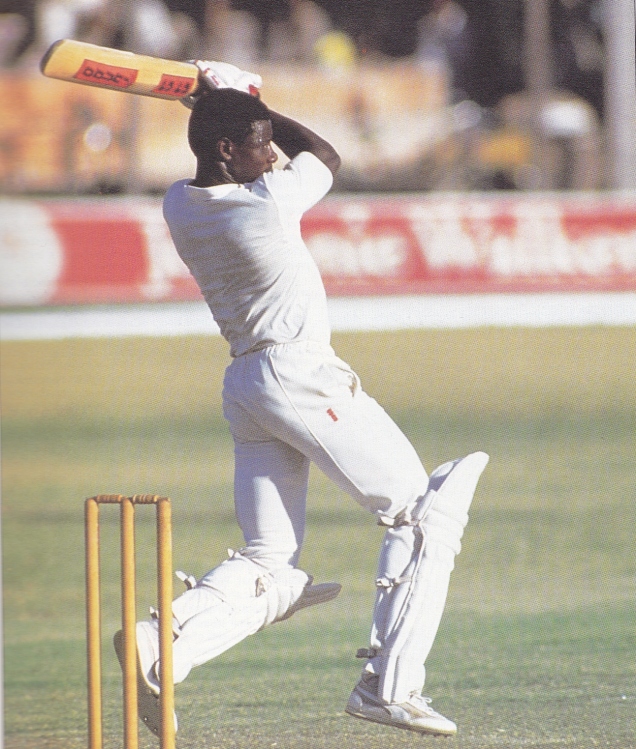
Sabina Park. Even as a kid it sounded like a proper test venue, in much the same way that the WACA does, and Eden Gardens doesn’t (it sounds like a bloody flower show venue). Once the televising of overseas tests became the norm, then seeing what Sabina Park actually had to offer was a reaffirmation of those thoughts. Especially when you saw the pitch, rolled so much that it actually looked, at the start of a test, like a gymnasium floor, all polished and smooth. And bloody quick. Now, of course, it’s like all the rest. A bloody pudding.
Sabina Park – West Indies v England – 1986
But Jamaica would be where the test series started, and for some reason the Sabina/Caribbean tour experience seemed new to me. I don’t believe the 1980-1 series was on the radio, and I might be wrong, but I don’t really recall it and in any case, first year of secondary school was a bit of a mare that I try to erase. This test serues I do recall a bit more. It started on a school night, and as we were driving home we stopped at the shops. Mum left the keys in the car so we could listen to the radio as Gooch and Robinson got us off to an unexpectedly solid start. England had won the toss and batted.
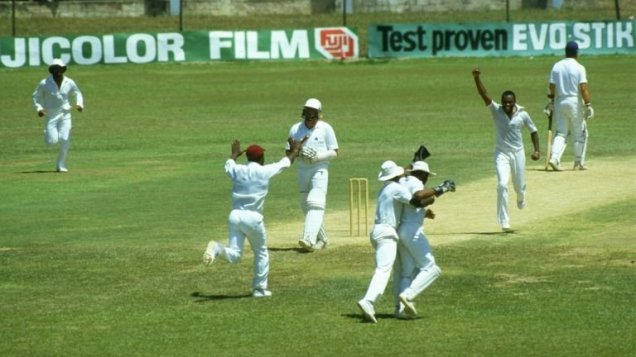
There then followed what we’d all become used to. A procession of wickets. Robinson went for 6 and it was 32 for 1. Gower played a bit more fluently but went for 16. David Smith, making his test debut, went for 1. Two of the three falling to the new tyro, the man with pace truly like fire, Patrick Patterson. Doing homework, eating dinner, watching TV, I dipped in and out. Gooch and Lamb appeared to effect a recovery, but it was small in scale and Gooch went for 51. The innings fell away. Lamb made 49, no-one else made a thing. 159 all out. Patterson 4 for 30, Marshall 2 for 30. Garner was relatively expensive, with 2 for 58 in 14.3. Big Bird at 4 an over? Standards had slipped.
Three players made half-centuries for the hosts, Greenidge top-scoring with 58, Gomes with 56 and Dujon 54. Greg Thomas took the first scalp of the innings on his debut, taking Haynes. But his appearance miffed the B&H yearbook writer, who believed the omission of Neil Foster was “as cruel as it was incomprehensible”. The Essex Mafia were as strong then as they are now! Carlisle Best, making his debut too, began his test career hooking Ian Botham for 6. It would be a turbulent tour for Beefy. The star of the show had been Richard Ellison, fresh off his amazing end to the 1985 summer. He took 5 for 78, four of them LBW, and including Richards and Greenidge. However, with the WIndies, from my standpoint then, unless GG or IVA were spanking the runs (and RR to follow) I wasn’t that interested. Their bowling made them, their batting fed off them. The lead of 148 was imposing – in truth, in modern cricket that lead would look like 400 with that attack, on that pitch, and with that skill.
England made 152.
Alas Smith and Gower. Or The Despatch of the Two Daves.
The Yearbook mentions a lead of “manageable proportions”. Looking back at that now, even with the gift of hindsight, that looks very optimistic. Marshall, Garner and Patterson took three each. Robinson and Smith added ducks to their paltry first innings totals. Peter Willey made 71, in some part justifying his place, in others showing the hopelessness of it all. Promoted up to number 4, he showed why he was picked. But it was never going to be enough.
“Four of the best fast bowlers that the game has seen bowled at the top of their pace on a wicket which gave them assistance, and they were unfettered by any consideration for Law 42. Nothing should detract from the West Indian superiority, nor from their greatness of their fast bowlers, but this was cricket without subtlety and if one had only little sympathy for English batsmen of uncertain technique, one had great concern for the future of the game at international level.” B&H Yearbook
I’m not sure if this Bill Woodfull-esque or a reverse make them grovel. Bloody hell, it seemed pious and not a little unsporting. We were getting humped by a much better side in their own backyard. An all-time great team. And they knew it, both that team and the writers of the time. It was bellyaching.
Only while Gooch and Robinson batted without undue difficulty in the first hour of the match did England promise to give West Indies a harder fight than in 1984. Of the five West Indian victories in that series in England, two were achieved on the fourth day: at Sabina Park, after two England collapses, they had almost an hour to spare on the third when Haynes and Richardson completed the formality of scoring the 5 runs needed in West Indies’ second innings.
Once again the cause of England’s defeat was their inability to play exceptional fast bowling, much of it short-pitched. Their problems were accentuated by a fast, uneven surface and the presence in the West Indies ranks of Patterson, a 24-year-old Jamaican who, after failing to make much impact in a handful of games for Lancashire in 1985, forced his way into the West Indies team by his performances in the Shell Shield. Described before the Test as the fastest bowler in the Caribbean after Marshall, Patterson left no doubt in the England batsmen’s minds that the order should have been reversed. A heavyweight of 6ft 2in, with a sprinting run and powerful delivery, in England’s second innings he bowled at a pace comparable to that of Jeff Thomson of Australia in his prime. Deprived of the new ball by the prior claims of Marshall and Garner, he none the less took seven for 74 in his first Test and won the match award.
And yes…we were bad losers then…
England went into the game weakened by Gatting’s injury in the one-day international. (He returned home for further treatment after two days’ play.) Lamb was the only other batsman in true form following four games on sub-standard pitches, and the England batsmen were further incommoded by an inadequate sightscreen at the Southern end, which was too low to frame the hands of bowlers more than six feet tall. The Jamaica Cricket Association had been unable to grant England’s request to have it raised, lodged after their problems facing Walsh and Holding in the Jamaica match, because to do so would have obscured the view of an estimated 200 spectators to whom tickets had been sold. All Patterson’s wickets were taken from that end.
The English team licked the wounds of their 10 wicket beating and moved on to the Queen’s Park Oval for a tour match, an ODI and a test.
The writer of the piece in the Yearbook, and I’m assuming it was David Lemmon, must have been pleased to see Neil Foster take 6 for 54 in that match as in reply to a score of 229 made by England, Trinidad and Tobago were skittled for 109. In trying to set up a game due to bad weather early in the fixture, England didn’t pull off a win, but were reminded of the phenomenal depth in the home side’s fast bowling resources. Tony Gray, who played with some merit for Surrey, took 5 for 50 and if he were around in any other era might have picked up a regular berth. In the WIndies he was just another pace bowler.
The second ODI was a slightly different affair. Played on the 4th of March, West Indies were without Jeff Dujon who was replaced by Thelston Payne. For some reason, and I do not know why as I never saw him play, I always liked the thought of Thelston Payne playing for the West Indies. The surname…..the surname. The match was reduced by rain to just 37 overs a side, and the Windies struggled in the on-off conditions. After 28 overs they had 106 for 2. Now in the modern era 117 off 9 overs is still quite a lot – in that era it was almost unprecedented, and you know who, the King himself was the destroyer.
“Botham was brought back to bowl when Richards came in and the West Indian captain greeted his friend with a 4 through mid-wicket. This was a mere prelude,”
82 not out. 39 balls. Botham’s last over going for 23. Game Over.
In West Indies’ innings, Richards was in the form that makes him impossible to bowl to. The length of the ball, and especially its line, were immaterial as he scored his runs out of 117 in nine overs, overtaking Richardson who had a start of 38. The biggest of his 6s was a straight drive off Botham out of the ground, a hit of more than 100 yards.
Now, if there were TV coverage of the England innings existing, I guarantee it would be played in one of those dewey eyed montage talking head way for generations to come. England started by thinking outside the box. They needed over 6 an over, and so sent out Botham. It didn’t work (although Botham would open in ODIs soon enough), and Wilf Slack, out as a replacement for Gatting, came in at three. Together with Gooch he added 89 at over 5 an over, so for once, we were in the game. After one failure (and a glorious Ashes summer) this was enough to threaten Robinson’s place already. Despite Gooch going well, England needed 50 off the last 5 overs and only Smith as a recognised batsman (Downton was outside batting) remaining in with him. Gooch went for it. Smith played the odd shot to keep it going.
Now with an over or so to go comes my bizarre memory of this match. In those days big boxing match ups were rarely shown live on TV. They were held on midweek nights, and the fight shown the day after on Sportsnight. This game took place on a Tuesday, if memory serves, and Frank Bruno, the up and coming, glass-jawed hero of British heavyweight boxing (I’m being unfair, but most of us loved Frank) had a poster match-up as a final eliminator for the World title. Never mind Bonecrusher had knocked his lights out the year before, Frank got reinvented… That night he was due to fight Gerrie Coetzee at Wembley Arena. The thing was, the fight was due to start on Radio Two at the same time that Gooch was doing his thing in Trinidad. No red-button or digital channels in those days. The ODI was not on Radio 3 and it was a reporter (it might have been Pat Murphy, yes even that long ago, but I’m not sure) doing the commentary from Port of Spain. Nine was needed from the last over. Gooch had passed 100. This is what we’d really missed in his three years away.
First ball, single. Second ball, single. Third ball, four. Gooch pulls one through mid-wicket. 3 to win from three. Fourth ball, single. Fifth ball, Smith on strike, he swings, he missed. It’s a bye as they ran through to the Payne Man. One off the last ball. Patterson bowling. Gooch swings, the ball squirts off his pad, they run, the throw….
MISSES.
England win….the result is announced to the fervent boxing crowd at Wembley Arena. There’s a cheer. We feel good. C’mon Frank. Coetzee was knocked out in the first and many thousands of people bought tickets to watch Bruno get larruped by Tim Witherspoon later that Summer in the early hours of a July morning – or was it June? It seemed to sum up England actually. A brief feel-good, and years of futility.
The Second Test was played a few days later and Wilf Slack made his debut in place of Robinson who was injured. Smith, according to the Yearbook, had struggled with sunstroke in the first test and so Emburey played in his stead. This looked off, given he played in the ODI and the tour match against T&T. Still no Foster.
One of my memories of the pre-series build up was John Emburey saying he was looking forward to playing at Port of Spain because he reckoned the wickets would take spin. I raised my eyebrows at that one. Doubt there’d be much prep to that end for this tour, Ernie? But he wasn’t miles off the mark. He took 5 for 78 in the first innings – West Indies reply to another outstanding team effort of 176 in 44 overs – and two in the second innings as well. Peter Willey never got a bowl. Looks odd in hindsight.
Richie Richardson – 1986 Style…
England were asked to bat, which probably sounds like being asked to slice your own arm off, but the Yearbook suggests there was little about the pitch that influenced the decision, just our state of mind. Gooch got smacked by the second ball of the match, scampered two off the third and sent on his way with the 4th. Slack soon followed, also the Maco, and Willey hung around for a bit, before he went with the score on 30. Gower and Lamb then rebuilt the innings.
It’s something that always gets me when people think about David Gower and the West Indies, and I know that crap show with Lee Hurst, Nick Hancock and Rory McGrath had something to do with it, but if you actually look it up, Gower had a pretty decent record in the Caribbean. He wasn’t the waft outside off and casual nick off of repute. That’s just home televised laziness. In nine test, with us usually being thumped, he scored 746 runs at an average of 43.88 in the West Indies. That’s the equivalent, I kid you not, of averaging 60 now. These were wickets with pace, seam movement, in alien conditions against top bloody notch bowling. Sneer at his more lame home record against them, but never over there. Never.
Gower and Lamb (who played 79 tests and barely averaged 36, which isn’t a knock on him, but showed how damn tough it was back then – and averaged bang on his career mark in the Caribbean over 9 tests too) effected a more than decent recovery posting a century stand and taking England to 136 for 3. Now the mantra goes these days that you add two wickets to the score to get the true position of the match. With the West Indies, you added 2 runs per wicket remaining to get the true scope. OK, I exaggerate. 4. Four hours after the innings commenced Gower (67) and Lamb (62) were the only players to reach double figures and we were dismissed for 176. Marshall 4, Garner 3, Patterson a very expensive 2 and Walsh, in for Holding, 1. And what a one. Paul Downton. Walsh was outside medium pace bowling. If you are keeping tabs, Downton currently had test scores of 2,3 and 8 and had been picked for his batting. Yeah, I know…
West Indies then did their usual. Solid opening start. Greenidge first to go for 37. Haynes took them past 100, and then 200 with the mighty Richie Richardson (fast on the way to becoming one of my favourite ever players – god, I wanted to play like in. Played more like Robert Robinson). Richie made it to a century and then got out to spin, and he was followed by Haynes. Downton missed a straightforward stumping according to the yearbook, and so proved he was outside glovework, but it didn’t really matter. The West Indies didn’t collapse, Malcolm Marshall made one of those all too frequent lower order 50s the so and sos used to make when you thought you had them, and they almost got to 400. At this point Downton might have been asked what his ambitions for the tour might have been. He could have said “oh, 100 runs, 20 catches and making a little stumping here or there” to which we might have replied “I was hoping you’d say getting a drawn test.”
So, a deficit of over 200 against this lot. But there was to be a little bit of resistance. Slack made a duck to have us 2 for 1, but Gooch and Gower played well, putting on 80. Both were dismissed in their 40s, and both got out by the supposed weak link of the attack. When that weak link is Courtney Walsh, you sort of know you might be in a bit of bother. At 109 for 3, England remained 116 behind with seven wickets in hand, but the surrender wasn’t forthcoming. Another stand of 81 was built between Willey and Lamb, and this little brain was hoping this might be the start of something. Maybe a lead of 150? A chance to put some pressure on. Then logical brain told me to stop being an idiot. The stand went over a fair old time. Bad light ended play on day 3. Rain delayed Day 4. But crash, Lamb went LBW to Walsh for 40, Bang, Willey was bowled by Marshall, and then Wallop, Botham was caught by Thelston Payne, that man again, for 1 off Walsh and the hope died. As if it ever lived. 190 for 3 became 214 for 8. Downton showing he remained outside double figures with 5. Edmonds and Ellison took England past the humiliation of an innings defeat, and Greg Thomas joined the Kent man at the crease.
Things started to happen. Suddenly the bowlers seemed less threatening. The 9 and 11 were becoming entrenched. They could not be moved. The scoreboard wasn’t screaming round, but they weren’t getting out. I remember setting off to the Den to see my lot play Wimbledon and they were still batting. I had a portable radio, yes kids, a portable radio not the effing internet that ruined things, and kept on listening as the partnership passed 50. England reached 300, which wasn’t frequent against the great team. Extras brought up a stunning half century, with no balls and byes making up 47 well made, compact runs, for which Mr Aplomb must have dreamed. The fun had to end, but not before Les on the tannoy at the Old Den gave us updates. Sadly, like England, our night was to end in disappointment as Wimbledon won 1-0 through a Carlton Fairweather goal on their way to the top flight, taking with them one of our best players. No more Fash the Bash. No more Ellison and Thomas.
“….and proceeded to play with a resource and determination that must have shamed some of their colleagues. They added 72 runs, full of fight and energy, and West Indies were left to make 93 to win. It was an easy task but at least England had made the match last into the fifth day.”
The West Indies lost three wickets in reaching their goal, including Gomes for 0. But it was 2-0. There was no getting away from that. All the little bits of fight were just that. Little. Inconsequential. Nothing to worry our pretty little heads about. Take some consolation, but we were being battered. Absolutely battered.
The game was played against a background of demonstrations from a small group of anti-apartheid protesters, but there was no trouble inside the ground and, without being large, the gates were satisfactory. Marshall, who completed 200 wickets in his 42nd Test when he dismissed Downton, won the match award.
With three tests still to come, it didn’t, shall we say, look good. And nor was the off the field stuff….
The poignancy in writing this is overwhelming. In 1986 England travelled to the West Indies for a tour where, surprisingly, England were being built up to give the hosts a run for their money. Now, three decades on the common themes I encountered when researching this seem painful. The mention of the never-ending production line of rapid West Indian quicks. The verve and power of the batting, under the power of Viv Richards, the human tour de force. The packed crowds, jamming every corner of every ground, climbing trees to watch at homely stadia across the region. It’s almost cliche to look back like this now. But it’s painful. They were, really, that good. Put them on their own wickets, with conditions in their favour, they were invincible when at their best.
The anniversary of that tour clicks to number 30 this weekend, and I thought I’d do a little, or long, recap on thoughts of the time, and in hindsight. I’ve read up on the tour using the relevant B&H Yearbook (the 5th edition) and Wisden. The first part deals with the run-up to the series, the second starts at the first test and I hope to complete over the weekend. So, after that intro, Part 1…..
On 1 February 1986 England started their ill-fated tour of the Caribbean with a warm-up match on the island of St.Vincent. What was to ensue over the next few weeks was the cricketing equivalent of a mismatch. Unlike, for example, David Haye’s recent victim, England had to keep getting up after being knocked out, ready to take another pummelling from a far superior foe. The captain’s ship wasn’t just sinking, it was being ripped apart at the seams. We shall never see the like from those shores of the Caribbean ever again. So I thought I’d just write a few personal memories of the test series that confirmed that lightning really could strike twice. I was a schoolkid, keen as mustard on the sport, and hoping for the best, but fearing the worst.
Let’s put this into the context of the times. I’m guessing most of my readership are more than aware of how we got to where we did, but it does no harm to look back. Mid-80s English cricket had major heroes like Gower and Botham, but were looking down the barrel. Rebel tours took out some good players. The production line wasn’t exactly rolling top players into the team. We started losing to foes we never used to, such as New Zealand and Pakistan. Then, in a painful series, England were hammered 5-0 at home by a rampant West Indian force in 1984. The Blackwash series. They slaughtered us by an innings at Edgbaston, chased down 340 odd in just over two sessions at Lord’s, handed out a one-handed beating at Headingley, had Greenidge, Dujon and Davis take us apart at Old Trafford, before applying a routine coup de grace at The Oval. If England managed to get through the top order, the lower order helped bail the West Indies out. Even if they did, no-one thought we’d match their scores anyway. Defeatism reigned. Once Larry Gomes punched that ball to the boundary at Lord’s to chase down that 340 odd for the loss of 1, we really did put the dead into dead rubber. Hell, we got excited at Headingley because Paul Allott bowled well.
But there was a significant but. England were without their Apartheid Tour players and the bans were soon to be lifted. This meant the automatic reinstatement of Graham Gooch, probably the insertion of John Emburey, and maybe Peter Willey as well. The England selectors of the time certainly didn’t hold this betrayal against the various participants, as the 1985 Ashes series saw Gooch, Emburey and Willey in the team, and with Sidebottom and Les Taylor also given a shot. It always brings a smile to my face when you see some of the outlandish stuff now about “team culture”. Our keeper at the time was Paul Downton…..he didn’t rebel tour. Just thought I’d throw that in.
There was a definite whiff of optimism in the air going into 1985 and the “strengthening” of our team because a redoubtable band of men, without Ian Botham, went out to India and won 2-1. Tim Robinson, one of my favourite bats at the time, making a magnificent 160 in Delhi to set up a levelling win, and then Fowler and Gatting making double hundreds in Madras, as it then was, to back up Neil Foster’s excellent bowling to put us 2-1 up. Fowler made 201 there, and was dropped, never to play for England again, after the next test. He could probably feel a bit more peeved than most at the forgiveness shown to rebel tourists.
We won the Ashes 3-1 against a pretty feeble Australian team, kept afloat by Allan Border and Craig McDermott. It was a great summer of batting, England winning the last two test matches by an innings, including 300+ partnerships in both matches. Tim Robinson made two hundreds, so did Gatting, Gooch got a 196 at The Oval and captain Gower made three tons, all over 150, including a 215. As a kid watching that partnership at Edgbaston between Gower and Robinson, I was transfixed. My old favourite with my new.
So we were hopeful going into the next tour, the hardest tour. I was in the A Level years at school, so I was no callow youth, but I do recall reading all the previews and the suggestion was prevalent, if I’m correct. “Although no-one underestimates the strength of the opposition, one thing is certain. It won’t be another blackwash.” The old logical gene was going off the charts – they are at home, the wickets are fast, their bowling is miles better than ours, and their batting isn’t exactly crap, especially now Richie Richardson is established and looking good. But then hope over-rides that (and why that first test win in Jamaica in 1990 was so special) and you think about those writing these things “well, they must know what they are talking about…..”
These were the days before live TV coverage of cricket overseas. BBC would dabble with a little live play from Australia if it got interesting on an ad hoc basis, and we’d get the Channel 9 highlights (and those from New Zealand too with Peter Williams, I think, about as unbiased an anchor man you could ever have) for those tours. But there was nothing from the West Indies other than what the news would show you for five or ten seconds each night. On some occasions there wasn’t, I recall, total radio coverage because BBC with just a few stations weren’t prepared to have key slots taken up with the cricket. It is why one of my recollections of the first test was tuning into LBC (a London radio station where Jeff Stelling cut his teeth on football score coverage) every half hour to hear the Sunday score.
In these days of wall-to-wall coverage of pretty much all international cricket, you’d think the situation back then would be hell, but it really wasn’t. Sam Collins (yes, a name drop) said to a number of people talking to him after the DOAG screening I went to earlier this week, that it was like Stockholm Syndrome. We were grateful, extremely grateful, for whatever we got. There were no campaigns to get this live on the TV, because we had four channels. The technology did not exist. It was radio or nothing. When that coverage included the tones of Tony Cozier, it seemed absolutely dreamy. Exotic. Brilliant.
The tour, commencing on 1 February at the Arnos Vale (not Grove, you muppet. That’s on the Piccadilly Line) ground did not start auspiciously. The weakest team in the West Indian domestic competition bowled England out for 186, yet England fought back and bowled themselves to a small lead. This was not to prove vital. England barely scraped into three figures on their second dig, and the home team knocked the runs off for the loss of 3. This did not augur well. The one half century in the match was a 77 made by Mike Gatting, who at least had shown he was up for the challenge. The top score in the second innings? 18 by David Smith and Phil Edmonds. Desmond Collymore, the chief destroyer in the first innings with a career best 5-34, averaged 38 with the ball in the Shell Shield that year. We weren’t talking Marshall or Garner.
On to the Leeward Islands and another sketchy performance, but decidedly better in the first innings. The hosts made 236 with the wickets being shared around, and although no England player made three figures, they scored over 400 and set up the match. Leewards got to parity with 4 wickets down but Ralston Otto, a cousin of Curtly Ambrose, made 92 not out and set England 116 to win. The Leewards used two bowlers for the 34 overs that it would take to get these runs. At one end was Leicstershire man Winston Benjamin, and at the other, bowling superstar Richie Richardson! The latter actually took five wickets as England collapsed in a heap and finished grateful for a draw with 8 wickets down and 94 on the board. Tim Robinson, with 32, was the only one to hold his head up high. It wasn’t good.
The third prep game was against Jamaica, and England sealed a victory against one of the stronger sides in the West Indies. Gatting and Lamb made runs in the first innings, Lamb again in the second but still no hundreds, while the Jamaican wickets were well spread, with Les Taylor taking a lot of the top order scalps. England registered a 158 run win.
Of course back then England’s test and ODI teams were picked from the same squad and the fixtures were inter-mingled. The opening match against the full national side would be an ODI fixture at Sabina Park. A match that will live in infamy for the introduction of Balfour Patrick Patterson to an England team, and a projectile from Maco into Mike Gatting’s septum.
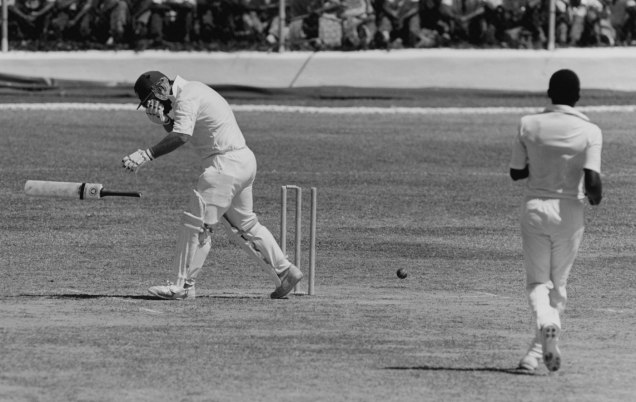
“A bad injury to Gatting, whose nose was broken when he missed an attempted hook off Marshall from a ball which cannoned off his face into the stumps, did far more damage to England than West Indies’ easy victory. They won with thirteen balls to spare in a match reduced by eight overs by their own slow over-rate, four fast bowlers and off-spinner Harper managing only 46 overs in the allowed 200 minutes. After England had been sent in, Patterson made immediate inroads by dismissing Robinson and Gower with his fourth and eighth balls in international cricket. Marshall prevented a full recovery by bowling Gatting and Gooch, and though Lamb and Willey added 62 off sixteen overs, England could not put West Indies under pressure. But for careless strokes by Gomes and Richardson with 7 runs needed, the margin would have been eight wickets.”
The ODI had been a disaster. All the fragilities we feared were exposed. The batting could hardly score at a pace to make us competitive, 145 off 46 overs. Marshall, Patterson, Garner and a young Courtney Walsh (Holding had been injured in the Jamaica match) gave us nothing. Then the West Indies scored patiently to win with a couple of overs to spare. The tests were just around the corner. The foreboding, immense. One thing was certain, 5-0 was a possibility all right.
Schism – def. is a division between people, usually belonging to an organization, movement, or religious denomination.
Around 15 months ago, after the acrimony of Summer 2014, I mentioned on HDWLIA that the divide between the supporters of the Cook side of the argument and the KP side of the argument, if we can simplify matters here, had shown no signs of being bridged. At that time the former were firmly of the view, exhorted by a compliant press, that the moves by Downton and co to rid themselves of the turbulent KP were absolutely correct and that the team, and therefore, by extension those running it, needed our support. On the other side, those of us sick to death of hearsay, rumour, gossip and leak, having our most exciting player removed from the scene with nothing to say why (those cursed lawyers) also had the Big Three Stitch Up to get our teeth into.
I may not be a totally unbiased member of the jury, but I think the latter bunch absolutely slaughtered the other in the debate. We’ve been down the road about what we got right many times – most notably Downton and Moores – but there’s no doubting we got people talking in our own way, and got some terminology out there to guide us. You know, that “outside cricket” thing that won’t go away.
I thought, at the beginning of 2015, there was hope. A new head of the ECB, a disastrous World Cup that used up any goodwill anyone should have had, some moves towards a settlement of divisions with KP. It looked hopeful that the divide, which was becoming a chasm, could be bridged. But could it really? Because, as we know, the strength of feeling out there against KP, and that’s what it is only about to those on the other side of the debate (what else is there, that we are a grumpy bunch? That I offend the misuse of the Question Mark Society?) is immense. Absolutely immense. Not in quantity, as the unscientific polls show, but in sheer venom. By the end of 2015’s summer, and the Ashes win, the divide was becoming wider, not narrower.
Now this blog has been accused, on a number of occasions, of being spiteful and nasty. It’s been accused of being full of guesswork. Tonight it has even been accused of being a “bunch of oddballs” and not “real cricket fans”. You know, that might be what you think, but I doubt it. We give a toss. I didn’t spare criticism of Alastair Cook during those times for in my view, he deserved to be criticised. I fail to see how any sentient cricket fan could watch a series losing storm of nonsense like Day 4 at Headingley and not be moved to paroxysms of rage. It was woeful. Whether it was entirely him, his bowlers or Moores, it was extraordinary. There was anger at performance as well as anger at his appearance as being, in part, responsible for the exclusion of KP.
Bloody hell, I’m not saying I’m without sin here, without going overboard maybe, or said everything in the way I wanted to. But here’s what I do. I understand the frustration some have with us, keep harking on about bringing KP back, keep mentioning when he’s making the basis on which all selection decisions, with extremely few exceptions should be made, look a joke (the other side of the debate taught me many ways to discount an innings of 355* in first class cricket), keep saying what we’re saying. I understand people telling us we should move on, that this is a fight that’s over, that he’s never coming back so “get behind this new exciting team”.
I make one request tonight of those on the other side of the debate. Why do you think we’ve not totally embraced this new future? Do you seriously think it is man-love for one player? Because if you do, you are not the intelligent people I give you credit for.
The schism remains, and will continue to do so. I feel cut adrift from England cricket, I feel betrayed by the authority that runs the game, both in terms of domestic teams and on the international administrative stage, and it shows no signs of abating. It’s both sides to “blame”, whether you like it or not. Where there’s no signs of meeting in the middle, we’ll continue being torn apart.
Have a think, next time you question our support for the game. Have a think. Because I’ve never questioned yours. Just your judgement. As you, on the other side, no doubt do with ours.
As The Leg Glance battles enthusiasm problems I share with this test match – if England and their apologists, I mean the media, play and say like this doesn’t matter, then why should we care – I thought I’d pick up on a few points that the whirlpool that is Social Media and background research have thrown up.
Due to some circumstances I may delve into a lot later, I might be in the market to go to the Oval test this year. I think Pakistan might be a decent opponent, Younis Khan, Azhar Ali, Asad Shafiq, Sarfraz Ahmed and the venerable Misbah-ul-Haq are good players, even great, and different from the stuff we’ve seen recently. So I went on to the Surrey site to see the state of ticket sales.
Day 3, Saturday, is almost sold out. There’s odds and sods about. Same, but with a few more, for the Friday. But Day 1 is not well sold, and Day 4 would be an utter embarrassment if that’s the final tally. The prices aren’t overly attractive for the first three days. The cheap seats in the OCS Block 1-3 are £50. Where I usually sit, which was always priced the same is now £60. This is, we are told, an attractive, attacking England team. A team we should be getting behind, with great, exciting young players. Doesn’t seem that message is getting across.
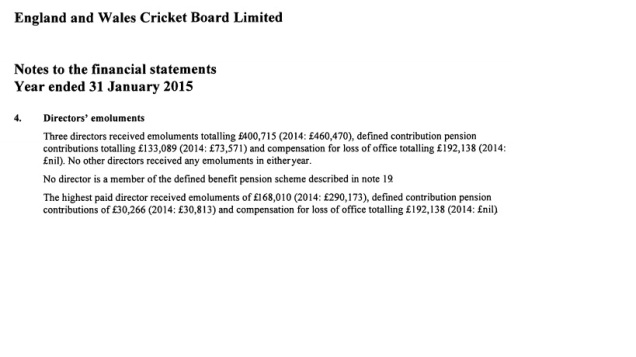
In something tangential I wanted to look at the last set of accounts put out by the ECB. They are from January 2015, covering the previous 12 months. Apart from seeing that a director was given £190k to sling their hook – two directors left that year, and the clear implication is that this could be Collier – there was also the notable £24m added to the reserve pot.
The ECB say they budget on a four year cycle and that two out of the four make a loss. I looked at the ticket situation for Day 1 at Durham against Sri Lanka (a Friday) and it looks hopeless.
This was just a spot check. Innocent Bystander tells me that Lord’s tickets for both test matches at Lord’s are going on general sale for most days. We sit back and say test cricket is in rude health in England, but is it outside of the Ashes? Really? The prices at the Oval do not match demand, and there’s a bit of a nod with the lower prices for Day 4, but cricket has to face up and wonder what it can do – stuck between the Sky money vice, and the clear lack of visibility this team with its exciting young talent has.
Which then leads me on to the panacea that is a T20 competition like that which has just finished in Australia. The Big Bash has, for a couple of years now, had envious glances cast from here at the slick running nature, the big crowds, the buzz and excitement and yes, glamour of it. We know the arguments and we’ve been over them countless times. I hear people say the competition lacks quality – it doesn’t; I hear people say it is the free to air TV that makes it – that may have a point; the size of the grounds and the climate lend to the spectacle – they do; but to me the key is that it runs for a month, has a clear Final and a limited number of teams (8). Many more than this and it would go too far and dilute the quality. There is no answer that meets the demands of the English summer. But in a year when we’re not selling test matches out, the very thing we are supposed to be shit scared of protecting, that line of defence doesn’t look strong. Nor does our argument about diversity of opposition because, as we see, it’s Australia for the crowds and India for the TV and the rest are loss-makers.
The Big Bash saw a notable performance in both the semi and the Final by Kevin Pietersen. It doesn’t really prove anything we didn’t know. He’s not done, but he’s also not coming back. That doesn’t make it a closed matter not to talk about how we got here, and it doesn’t make it OK for the ridiculous abuse any tweet on him gets, which Maxie encapsulated superbly in a Tweet today:
Reaction to @NHoultCricket 's @KP24 Tweet underlines the tragic degree to which the ECB's lies have poisoned English cricket.






 Being Outside Cricket