Again, another photo montage of two rain affected days in the crucial test in 2005. I will go into Day 1 more in the future, but here’s a taster of some of the pictures I took from those two days.
Australia
The Gathering Storm
Less than a week to go before the Ashes begin, and the news today that Ryan Harris has announced his retirement is an unwelcome development for Australia. Harris probably wouldn’t have been in the side for Cardiff, mostly because his fitness was questionable anyway – and clearly rightly so – but to lose a player of that calibre from the squad is unquestionably a blow. For Harris himself, he’s had perhaps four more years of a Test career than seemed likely when he limped out of the 2010/11 series, seemingly into retirement. That he came back, and proved so effective a bowler, is greatly to his credit. A shortened career at international level perhaps, but 113 Test wickets at 23.52 represents a fine return even so. And there’s little question that a certain England captain will be delighted that there’s no prospect of his technique being picked apart by such a clever bowler.
He has said himself that he’s played 27 more Tests than he thought he would, and it’s probable that is at least partly down to Cricket Australia’s relatively careful management of him, providing space for recuperation. They received a lot of stick for their policy of resting and rotating their pace bowling attack, yet it may well have ensured that in Harris’s case, they truly did get as much out of him as was possible.
Pat Cummins has been called up as his replacement, which is an interesting choice, as he hasn’t played first class cricket in almost two years. His talent isn’t in doubt, but given his own injury record, it has to be questionable whether in the event he needed to play, he’d be able to last five days of a Test. Even if completely injury free, he’s very much out of practice at the longer format.
Australia have had a decent workout in their two warm up matches, and perhaps the one area of concern for them has been that their spinners have come in for a fair degree of stick. A warm up is a warm up, so not too much should be read into it, but it does perhaps detail a line of attack that England could look to adopt when the phoney war is over.
And a phoney war it certainly is. David Warner picked the build up to the Tests to repeat his claims about Joe Root from the tour two years ago which resulted in Warner throwing a punch. This is trivial stuff, but it indicates that the sledging game is well and truly on. Australia themselves are something of a known quantity anyway, much of the series depends on how England play. The one day series raised optimism that England would look to be aggressive, but the Test side and the one day side are two distinct entities. An obvious difference is that the captain is Alastair Cook, not a skipper renowned for going for the throat of the opposition. Indeed Shane Watson specifically referred to that issue recently:
“I’m not sure if that’s exactly in Alastair Cook’s DNA, to be really able to put a game on the line. It’s going to be interesting to see how now that Alastair Cook comes in and takes over the Test team, how they continue to evolve as a team, because it’s very obvious in the one-day series they’ve played how they’ve really started to take on the game.”
Watson hits the nail on the head there. Partly of course it’s a case of trying to undermine England, which is normal enough and fair enough. But the question itself is one that England followers have raised several times. Putting aside the merits of the teams for a moment, the style of play is going to be interesting to watch. It remains extremely hard to imagine England adopting the mentality of the first innings at Edgbaston in 2005. That contradiction has been observed by the incoming coach Trevor Bayliss:
“The way the game has been played over the last five or ten years, you could argue that maybe we haven’t kept up to date maybe as some of the other teams. Whether you like it or not, the T20 format and the one-day format do have a bearing on the way the game is played at Test level. It’s that philosophy of being positive and aggressive.”
And yet Andrew Strauss doesn’t seem to be on the same page.
“As I said at the start of the summer, I think Cook is very much the man to take the England Test team forward
Perhaps there’s an element of having to say that, but the innate conservatism of Strauss is looking somewhat out of kilter with the approach of both the new coach and of the stand in. It was certainly noticeable that Bayliss was very quick to praise Morgan and Farbrace for the way the one day team played the game, as was the much more non-committal remark about Cook:
“I’ve not seen him up close or worked with him before.”
It is of course entirely possible that despite the initial appearance of them being chalk and cheese, they might get on like a house on fire. It wouldn’t be the first time that has happened – perhaps most notably in the instance of the taciturn Duncan Fletcher and the fiery Nasser Hussain, who proved to be an outstanding partnership. But it still has the feel of end of term about Cook’s captaincy, particularly so if England lose, as so many expect.
And will England lose? It was quite amusing to see Glenn McGrath react at the terming of Australia as “Dad’s Army” when it was actually Jason Gillespie who made a point of describing them as such. And yet it is quite clear that this is indeed a fairly old Australian side. One thing that shouldn’t be ignored is that sides never look past it until they actually are. Although more sensible observers noted that England in 2013/14 were a side running out of steam, few anticipated the collapse that followed. A side can look old very quickly.
Where Australia do clearly look to have the edge is in the fast bowling stakes. Starc and Johnson are a potent opening pair, though Johnson does blow hot and cold. If he were to return to the 2009/10/11 vintage, then Australia have a problem. Of course, if he’s more like the one from the last Ashes, England could be in for a fearful hiding. Even then, Starc looks a more obvious – and more consistent – threat in any case.
So where do England have to perform if they are to have a chance? Cook himself is pivotal. His technique was dismantled by Australia’s bowlers in the last two series, and should that happen again, England will do well to compete. Cook bats long, and blunts opposition attacks when all is going well for him. His technical approach is vastly improved over the recent vintage, both in terms of playing much straighter and his judgement of line. The strength in England’s batting is in the middle order, but for that to be a strength they need a platform. Lyth is at the start of his career, it’s asking a lot for him to provide it consistently at this stage. So it hangs on Cook himself. If England are consistently 30-3, then to call it an uphill task is an understatement.
Equally, there are question marks over other players. Ballance’s sophomore difficulties need to be resolved and fast. Ian Bell’s relative drought likewise. There is ability throughout, but as things stand too many of them have dubious recent records.
The England bowling attack is simpler to assess. Broad and Anderson are a fine new ball pairing in English conditions, the doubt is over whether the latter will be ground into the dirt and asked to do too much. Broad might blow hot and cold almost as much as Johnson, but Australia does seem to bring the best out of him. Perhaps the key might be Mark Wood, who has shown serious promise in his brief career to date. That doesn’t mean he’s under pressure to deliver, it means that he’s a wildcard that may just come off.
Bayliss also made an interesting comment that Moeen was the number one spinner “at the moment”, and suggested that he had no problem with selecting two spinners for Cardiff. It seems unlikely, but it’ll give Adil Rashid a degree of hope he might be more than a drinks carrier in future.
One of the fascinating elements of this series will be how Steve Smith performs. He’s had an outstanding couple of years, but his idiosyncratic technique is likely to receive greater examination with the Duke’s ball moving around. He certainly didn’t do that well on the last tour, and while that doesn’t reflect the player he has become since, the same could be said of Joe Root.
And so it comes to the time of actually making a prediction for the series. I don’t think it will be as one sided as some others do, but I do think Australia will have a bit too much for England to beat them. Being optimistic, a 2-2 series result would represent serious progress for England, but the head says Australia will win 3-1.
An Ashes Exchange Of Views – Part 2 – Dennis asks, Dmitri Answers

So you’ve read part one….. Now on to the questions set by Dennis of Dennis Does Cricket to me. These are my honest views, and feel free to take them to pieces if you wish!
1) Australia has the Brutal issue of having to squeeze four world class quicks into three spots. Who are the lucky three and why?
England fans cannot believe you won’t pick Ryan Harris. He appears to have achieved that status reserved for a few Australians, in that I get the sense he’s really liked! I think we all love to see a bowler who suffers for his craft. That said, England have had enough experience of relying on old crocks with injury issues to know you should always go with the younger fitter model (I recall 2002/3 all too well, waiting on Gough and Flintoff) so unless Hazlewood gets monstered in the early tour matches, you should go with what you had in the West Indies. So it’s Johnson, Starc and Hazlewood, and Harris and Siddle up your sleeve. Of dear lordy.
2) Fawad Ahmed and Nathan Lyon lead the Shield wicket taking table last summer. Should the leg spinner be used in tandem with Nathan Lyon at any of the grounds? What about instead of Lyon?
My blog has Nathan Lyon’s number 1 fan (outside Australia) so I’m not ever suggesting he should not play. Nathan Lyon is a bloody good bowler, and the problem is that when you’ve had superstar spinners in your team, you always shoot for the moon (something we should remember now Lovejoy* isn’t in our team). Fawad Ahmed is an interesting wildcard, but none of the venues we are playing at are going to be raging Bunsens because we don’t have Swann any more. I think our allergy to leg-spin is overplayed a bit, but also the other reason for playing them – that they are great at getting tailenders out – is our problem rather than yours. You seem to take great pleasure in a 90mph left armer coming in to the lower order players and smashing them out. I don’t think there will be any “two spinners” wickets and I cannot see you dropping the lead singer in the Under the Southern Cross ensemble.
*Swann is called Lovejoy on here because of his remarkable similarity in personality to a much loved, sorry much loathed, football geezer of the 90s, called Tim Lovejoy. It’s a running joke.
3) How should Australia attempt to reduce the influence of Joe Root?
I put the same question to you! We’re all going a bit mad about Joe Root, and why not? He has this knack of making big hundreds now, so once he’s in, and past the century mark, he’s not satisfied. The drop down to number 5 has been huge, but it also left a major hole we’ve not filled yet at opener. I’m a little disappointed, to be honest, because I’ve always felt 5 is the armchair position in the batting line-up; you’re not likely to be up against the new ball with fresh bowlers, and you get time before the marshalling of the tail (which Root is good at).
I think Root has the same sort of weaknesses as many other player, i.e. good bowlers, bowling well. Also, Australia will play on the mental side of things. He was dropped in the last series. He also, one innings apart, didn’t cut it as an opener in 2013. He has “mental scars”. We’re comparing him a lot to Steve Smith and I see much the same sort of characteristics in the two players. If they get in, watch out.
4) What tactics by Australia will cause the biggest headaches for the captaincy of Alastair Cook?
What was it Ricky Ponting said about the 2005 series? “Win the first test and let the British press do the rest”. That worked. 🙂 It needs something more tangible than that. He had a point at the time, though.
The one thing that 2014 and the fall-out from the whitewash proved is that Cook is, at the moment, unsackable. I’m aware not everyone agrees with me on that, but look how long we held on to him as ODI skipper against all the evidence. Now he’s scoring some runs again, he’s the saviour returned. He’s leading from the front. We can forgive his tactical abominations. The world has changed in 10 years – the press were complicit in the retaining of Cook – and now the British press are more likely to rally around a losing captain than bury him.
Cook’s series depends on him scoring runs. You’d think, by the way ECB-TV goes on, he’s only ever played one Ashes series, because every time he needed bolstering, the 2010/11 series is mentioned. If the Aussies pray on that off stump weakness, don’t feed his outlet shots, and bowl him to a standstill, he’s not going to hurt you. Whether the public will turn on him, I don’t know. The one side effect of this New Zealand ODI series is that without our behemoths, the new team looks like it is enjoying itself and playing like it. How much that attitude seeps through if we lose early will be interesting. If Cook is scoring runs and we are losing, the press over here might blow a gasket.
5) Should Shane Watson’s position at 6 be in question?
Do you have anyone better? I’m a believer that if you don’t perform, you shouldn’t have a divine right to play – see Alastair Cook, 2014, see Ian Bell 2015 – but also that if he’s the best player and isn’t letting the side down, for his role, you can lose a lot of ground trying to find someone better. His last test here saw him make his career best, he’s used to the role, and although we laugh about his LBW review skills, he still appears a formidable presence even if he probably doesn’t back it up with stats. His bowling is also really useful for the team as he does perform an important role for Clarke.
Put it this way – if he’s one of your best players, you’re in trouble. If he’s one of your worst players, we’re in trouble.
6) Will this be Clarke’s final Test series? If so, is Smith ready to fill his shoes?
You’ll know that better than I, but the mood music appears to suggest Clarke’s coming to the end of the road, and it’s another couple of years before we go out to Australia to get smashed again. He’s won the World Cup, he’ll have another Ashes win in all probability so why not go out on top? I’m not sure what drives him these days.
I don’t really have a feel for Smith’s captaincy, and part of me thinks it is a little too soon. You have a tendency to not play retired captains, and he is just 26. If Australia will stick with him for 8 years even if the results turn for the worse then fine. I don’t think the captaincy has such a corrosive effect on Australian captains than it seems to on English ones in terms of batting form.
You can’t fail to be impressed by his attitude, his mental strength and his results. Wind back to our commentary teams (and yes, me) in 2010/11 when we laughed at his selection! Eating humble pie now.
7) The last Ashes series in the UK saw Australia constantly at 5/150 and requiring Haddin to save the day with the bat. Is this likely to happen again?
Our propensity to go spectacularly off the rails when it comes to lower order batsmen is gaining legendary status. I have genuine fear that this will be a major difference in the two teams. We are simply not good at blowing away the tail. We don’t have express pace, not really, and we don’t have a spin bowler on form who can tease them out. If you want Exhibit A of this monumental inability, we refer to Day 4 at Headingley – this year it was at New Zealand tailenders, last year it was Angelo Mathews and Rangana Herath. We were pitiful. Haddin was a key last time, but he also, often got a lower order player to stay with him once the top order man he was with got out. It takes two to make partnerships.
So the ball goes into Brad Haddin’s court. Is he the same player as 18 months ago or are there now too many miles on the clock? Are the manner of his dismissals the sign of the twilight of a career? Was the 2013/14 series just a freak?
Frankly, I don’t think you’ll be 150/5 (this is an England piece, so not putting the numbers the wrong way around) very often. I think we’ll make pitches to make it a batting contest, and not feed your strengths. It’s why I fear what David Warner might do.
8) Haddin is averaging less with the bat that Nathan Lyon over the last 12 Test matches. Should Australia be worried about this, given his keeping is at the top its game?
As long as he’s not keeping a Gilchrist-like figure out of the team, and he’s not a total liability with the bat, then fine. To turn the debate around, we brought Prior back into the test team last summer (with a tear in his achilles that turned out to be career-ending) and held back Jos Buttler. We all thought it was madness at the time, and were proved right. Prior wasn’t the same batsman, and was as mobile as a wheelie-bin behind the stumps. Who is backing up Haddin these days (hastily checks tour squad)? Peter Nevill, it seems, who is 29 and not exactly a young gun, but appears to have been picked on a good batting season for New South Wales.
If Haddin gets blown away early in the series, I’d be interested to see if any pressure is exerted from your press.
9) How should Australia play Anderson? Attack or defence?
You seemed to have little trouble with him last time out. In fact there’s a school of thought that his tour de force at Trent Bridge in 2013 marked the high-water point for James, and it’s been a lot, lot tougher since. If Anderson isn’t taking wickets, we’re in trouble. You were pretty positive against him last time out in Australia, and rather more cautious over here. I don’t think Warner or Smith in particular are going to let him tie you down.
I know Anderson is a source for much of your “bantz” Dennis, but he’s quite a divisive character on the blog. I believe he’s one the diehard, love England regardless section adore, while some of the more cynical, jaded among us believe he got the record because he stayed upright longer than any of our other decent bowlers in the past 20 years.
I think my attitude to him could best be described as “tepid”. I find him remarkably dour and uninteresting, although I can’t ignore 400 test wickets -it’s a fact and he did it. My belief is that if he were around in 2005 bowling like this, I wouldn’t have picked him in our team. There’s a debate over whether he would have replaced Matthew Hoggard, but not for me (as he’d won us the South Africa series with his spell in Jo’burg). The first test will be key in setting the tone. Let Anderson get on top of you, and your batting might struggle to free the shackles. See him off, weather him at Lord’s where he usually performs, and I think you’ll have got the better of him.
10) Is Stokes capable of stealing a game or two off his own bat?
No. And I like Ben Stokes. We see Stokes as a KP figure. He doesn’t appear to march to the disciplinary drum. We had someone like that recently.
The rub on KP, and you knew I’d get him in somewhere, is that individual performances are all well and good, but you need to be a team player, a team man, as if individuality doesn’t count as much in jolly old England. Stokes is almost the ultimate individual. He will play the most idiotic shots to get out, or bowl a load of old nonsense. That is the way he plays. He will get drunk on tour, or he’ll punch a locker, and the old heads and the stuffed shirts will sniff and snort, and want to teach him a lesson. I fear for him. He’s not nice amiable Jos, who won’t say a controversial word. He’s brash. He’ll give it a go.
Stokes had a brilliant Lord’s test against New Zealand, and immediately it’s “Flintoff this” or “Botham that” from our hyperbolic press or ECB-TV. There was great focus on his record paced 100, but it wasn’t even his best innings of the match. It was the 90-odd he made in the first innings, pulling us out of the 30/4 mire we were in. He got the two big beasts of New Zealand batting in the second innings, but his bowling is erratic, and while there is a lot of promise there, he’s still not a key cog in the bowling wheel as the other two mentioned above were. He’s the fourth one used, and there is no doubt that is his place.
That said, he’s exciting, he’s got talent, he has an attitude, he plays with passion and his heart on his sleeve. We’re a nation that loves that, when we’re winning, or when that individual is successful. But once that individual has a dip in form, watch out. As we saw last year when the media piled into him over his locker-punching incident and his inability to provide anything last summer. They’ll take the good times and be over him in the bad. That’s us. I think you call it “tall poppy syndrome”.
11) Which Englishmen are likely to quit mid series this time?
Ah. Damien Martyn syndrome, you mean? Well, if we’re 3-0 down I would imagine Alastair Cook might have to quit as captain, but then again, I thought he’d have gone ages ago. Anderson would be the likeliest, or maybe Broad, but they would be extreme long shots. I think Bell is more likely to be dropped than quit.
That tour was such a disaster it makes you wonder what was really going on. We are still wondering!!!!
12) Swann was the difference last time in the UK. Is Moeen any chance of getting close to having Swanns impact? Why no Rashid?
Ian Bell was the difference in the last series, and Stuart Broad too (as well as a one man show with the ball by Anderson at Trent Bridge) so I don’t agree with the immediate contention. Moeen Ali is, by most people’s definition, a decent county bat and a decent spin bowler, but he’s nowhere near Swann’s level. We did what we usually do as a media in this country – blow too much smoke up his arse when he has a couple of decent performances, and then say we told you so when he struggles. He now bats at 8, which is scandalous for a man with his ability if not results, and his bowling has been disappointing if you compare it to his early days.
Rashid is an unknown quantity to me in the long form of the game. I’m not a Yorkie, my county plays second division cricket, and I don’t like judging spin bowlers on one day form? Why no Rashid? Well, ask the brains trust out in the Caribbean that. He wasn’t played in the first game, supposedly, because he bowled badly in the nets. And boy, were we told he bowled badly in the nets. Again and again and again. That’s the way we roll. After that, Moeen came straight back into the team, and not pulled up any trees. It doesn’t look promising.
My thanks for Dennis’s co-operation, and he has expressed an interest in being on the Ashes panel this summer. It was a lot of fun for me putting the questions and answers together last weekend. Remember, Dennis can be found on his blog – http://dennisdoescricket.com/ – and on Twitter https://twitter.com/DennisCricket_ or @DennisCricket_ – so follow his unsubtle (unfunny, always!) japes at our expense……
An Ashes Exchange Of Views – Part 1 – Dmitri Asks, Dennis Answers
As part of this blog’s build up to the Ashes, I got in touch with perennial doubter of all things English, a pox on our establishment, the itch we cannot scratch, but once I’d finished talking to myself (again) I wrote to Dennis of Dennis Does Cricket (in)fame(y) to exchange some questions in the run-up to the Ashes. In Part 1, I have Dennis’s views on 10 questions I posed, with an open-ended bit at the end.
So, here goes chaps. Dennis speaks. Feel free to comment.
1. Last time we met, it was 5-0. Ask a lot of England fans a few months ago and we’d have predicted the same (with some caveats for the weather). What do Aussies think the score will be?
Before I answer this, let’s address your caveat. Don’t you find it amazing that the English created a sport that is reliant on the weather?
In Australia, we think Hobart is a cold and wet place. The next land you hit going south is Antarctica. 16% of Australia’s rain fall sin Tasmania.
But as it turns out, the UK is closer to the North Pole than Tasmania is to the South Pole.
Anyhow, I digress.
I would suggest that Australians are still rather optimistic about the Ashes result. England couldn’t beat the West Indies. Hell, you even lost a Test to them. How does that happen? You couldn’t win the Test series against New Zealand at home. Last year you lost to Sri Lanka at home. You did beat India, but who doesn’t when they are on the road? I almost forgot that you let Ishant Sharma bounce you out with an old ball at Lord’s.
So, given that and given you have a horrible captain and given your Test side hasn’t had the positive change like the ODI side and given the fact that Australia hasn’t lost a Test for two years and given man for man, England probably don’t win even one spot, Australia will win the Ashes easily.
4-0. Nah, stuff it. 5-0.
2. Are you persuaded by the new vibe coming from England of “positive” cricket? Lots of us were surprised in the New Zealand test series by a change in attitude. You buying it?
In the ODI space, yes.
But let’s look at the Test space. In both the West Indies and New Zealand series, England were 1-0 up. Then this so called ‘positive’ cricket vibe suddenly drained away and they lost the final Test.
That’s two chokes in a row. The South African culture is strong in the ECB.
So no, in the Test space, I don’t buy it. Cook is not a leader who creates positive vibes. Bell is out of form. Ballance has been found out. Broad is struggling. Moeen may not last until the third Test before being dropped.
There is no positive vibe when half the team is scared of losing their place in the side. I know this because I watched Australia pre-Boof.
3. I read that you didn’t think Ryan Harris should make the team? England fans palpitate at the very mention of his name. Is he really not going to play?
My detailed thoughts are documented in this article: http://dennisdoescricket.com/ryan-harris-isnt-in-australias-best-xi/
If you remove the emotive element, I can’t see how Harris plays in the First Test. The other three amigos just bowled Australia to a World Cup win and tore up the West Indies.
You don’t split up a winning formula. Harris hasn’t bowled competitively since the New Year’s Day Test in Sydney.
However, every time I watch this video, I second guess this stance:
https://www.youtube.com/watch?v=mrdNjB9urZE (Available, it seems, only to Australian viewers)
4. In 2013 we were hearing big things about James Pattinson. Now we are hearing big things about Josh Hazlewood. Should we take them seriously?
James was coming along swimmingly until he got injured. Don’t judge him on his brother’s efforts for England.
Unfortunately for James, the list of available fast bowlers in Australia is longer than the English tail.
Johnson, Starc, Hazlewood, Cummins, Pattinson, Harris, Bird, Siddle……and so on.
Hazlewood is the real deal. He is like Peter Siddle from the last series, but just 10 kph faster, gets more bounce and with Glenn McGrath’s lines.
Hazlewood is the reason why I don’t see an easy way for Harris to walk straight back in to the team.
5. Is Steve Smith lucky or great?
You don’t get to the number one ranked Test batsmen in the world by being simply lucky. In fact, his ranking points exceed anything Brian Lara achieved.
However, that doesn’t make him great, but he is well on the way. So is Joe Root and Kane Williamson.
In 2013, I wrote that if Smith gave up the leg spin and focused on his batting, he could become the next Steve Waugh. That won’t happen now as Smith is Australia’s number 3, rather than hiding at 4 or 5 like Waugh did and Root does now.
This Ashes should see Smith as the leading run maker. His form is that good. His technique ensures it is hard to bog him down. He plays spin brilliantly. He has cross bat shots. He can skamper quick singles.
His get out shot at the moment is either the pull shot bottom edged on to middle stump or the run out. England should set plans for both of these possible eventualities.
6. Who is commentating on this series for the Australian viewers. Will James Brayshaw be anywhere near it?
I’m not sure, except to say that Channel Nine are bringing over their own crew, rather than relying on Sky.
I think this is a poor outcome for Australian cricket fans.
The positive is that we get to see every match live on Free To Air television. No need for a Sky subscription in this part of the world. Remember that argument that there is no market for Test cricket on terrestial TV? The ECB are selling you a lemon.
7. Our older core of Broad, Anderson and Cook get a ton of stick from you. Which one of them do you fear might do you the most damage in this series?
None of them.
Anderson will take his 4 wickets a match. 2 or 3 of them will be lower order batsmen. This is not a prediction based on guesswork. It is based on historical fact and statistics. That makes him no better than Peter Siddle. Do England [rate] the banana eater?
Broad has the ability to take a quick 2 or 3 wickets with the new ball because he attacks, but his control is gone. Watching him bowl against New Zealand and the West Indies, he was way too short.
Cook will make a century somewhere, but I’d be surprised if he averages over 35 this series. The bowling attack is just too strong and Australia love to attack the opposing skipper. We will be given no free space to settle.
8. We’re all a bit keen on Joe Root at the moment who is in brilliant form. What’s your view on what you’ve seen?
I love him. Australia love him. He shows grit and attacks the game. He is mouthy in the field. He shows no fear.
The Root v Smith battle will be amazing.
9. Two of your older players are question marks. Shane Watson seems nailed on, am I right? And is Brad Haddin’s lack of form terminal or will he get it back playing against us again?
Both should be under strong scrutiny.
Watson looks much better at number 6 rather than at 1,2 or 3. However, even at number 6, he doesn’t produce like he should. This is especially evident when the contenders for his spot are Mitch Marsh (lost his place due to injury), James Faulkner (the last decent all rounder to play an Ashes Test for Australia in the UK but lost his place due to injury), Moises Henriques (not available due to injury) and Glenn Maxwell (will get another chance at some stage).
The other option is that Australia back their three quicks and Lyon, and then play a proper number 6 batsman. That would mean that Shaun Marsh and Voges both play. Perhaps a batting order or Warner, Rogers, Smith, Marsh, Clarke, Voges, Haddin.
Haddin was the saviour the last time we visited your Britain of Greatness. How pompous is that name?
In the last 12 Test matches, Nathan Lyon has averaged more with the bat than Haddin. That said, Haddin’s keeping is as good as anyone in the world at the moment. That is worth a wicket or two an innings, possibly off-setting any potential batting losses.
The understudy keeper is a guy named Neville. No, that’s his surname. His First Class batting average is 44. He is also much better with the gloves than say Buttler, Bairstow or Billings.
10. Give us a name that might surprise us from the Aussie party – I think I know who it might be – and one you think might give you some grief from England.
Nathan Lyon is the guy. This unassuming ex-Adelaide Oval groundsman will play the role that Graeme Swann played for you last time we met in the Northern Hemisphere.
He has slowed down his pace, allowing for more flight and drift. He creates more chances than even the quicks. He gets bounce. He gets great turn. His arm ball is brilliant. He is the best number 11 in the world.
Lyon will spin Australia to at least two wins on Day 4 or 5.
The person Australia would fear most is probably Rashid, but he won’t play until the ECB drop Moeen Ali. That won’t happen until after the series is lost.
Ben Stokes is probably good for a quick 80 somewhere and a 4 fer
11. Finally – Open House. What’s on your mind DDC with this series?
To be honest, I’m mostly looking forward to re-aquainting myself with the English cricket fans via social media and my site. Most are very knowledgeable about the game and I have made many friends due to being active during the previous few Ashes.
In a cricketing sense, seeing how Mitch Johnson goes this time around will be interesting. Does he still scare the bejesus out of you guys? He should.
I fear Australia’s batting depth may not be as strong as some imagine. I sense Warner is in for a shocker and Clarke is on his last legs. Add Haddin and Watson to that mix, and we have a potential problem. However, I could be completely wrong. Remember what Warner did on his last tour to South Africa? Yes, he got his girlfriend pregnant, but he also stood up when under the most immense pressure.
C’mon Aussie C’mon!!!!
——————————————————————————————————–
My huge thanks to Dennis for participating in this exercise. We cooked it up on Saturday morning, and we threw ourselves into it. He’ll be re-linking this on his site, and my answers to his questions will be going up soon – http://dennisdoescricket.com/ , and no doubt we’ll be discussing the series during the next few weeks. Catch him on Twitter too @DennisCricket_ or his podcast, Can’t Bowl, Can’t Throw – the latest edition of which has Mr Roland Butcher’s Hook himself, Mr David Oram, to listen to.
I’ll just steer him on the Great Britain thing….
The classical writer, Ptolemy, referred to the larger island as great Britain (megale Britannia) and to Ireland as little Britain (mikra Brettania) in his work, Almagest (147–148 AD).[23] In his later work, Geography (c. 150 AD), he gave these islands the names[24] Alwion[sic], Iwernia, and Mona (the Isle of Man), suggesting these may have been native names of the individual islands not known to him at the time of writing Almagest.[25] The name Albion appears to have fallen out of use sometime after the Roman conquest of Great Britain, after which Britain became the more commonplace name for the island called Great Britain.[18]
Book Review – Put To The Test by Geoffrey Boycott

On my very occasional visits to Hay-on-Wye (I’ve been there twice), I head out looking for older cricket books, and often they can be snagged for a pound, maybe two. I have picked up a number of the Boycott books from the late 70s, early 80s, where he wrote a tour diary about his fortunes, and often with blisteringly honest critiques of his team-mates. It’s the sort of book that could never be written now. It’s from a bygone age. But for all that, this Boycott book reads of a man in crisis and it is better for it. It seems real.
This particular book relates to the Ashes series of 1978/9, in the midst of the Packer Revolution, with an Australian team lacking its main stars. It is largely disregarded by the Australian cognoscenti on the grounds we were playing their 2nd XI, and thus the 3-0 hammering we received the following year (in a non-Ashes series) is more of a true reflection of the two sides at the time.
The book is couched within the first chapter when Geoffrey gets his excuses in early. He had been sacked as Yorkshire captain – oh don’t we miss those brutal fraternal wars in that quaint old county – and had the terrible sadness of his much beloved mother passing away. Geoffrey, as one of those highly paid gurus would no doubt have said, was not in a good place. So excuses may be a bit harsh, but I’m not going to call them reasons…
The book takes us through a tour that seems to be played on nothing but rubbish pitches. Look at the scores in the tests. Barely anyone has a good series with the bat. Rodney Hogg stands out with his bowling figures, but the teams are all over the place, and there are no draws. England find themselves in difficult positions in many of the games, but pull themselves out of them with a lot of luck and a lot of help from poor captaincy, dropped catches and bad play. Boycott himself has an awful tour with the bat, but even then Sir G is a front-runner for modern thinking, as the epilogue has a wonderful bit where he takes the positives.
Boycott pulls apart Yallop’s captaincy, while also getting the hump early in the tour that he wasn’t being listened to, but then being fulsome in praise of Brearley for asking him his views once that concern had been raised. Brearley does seem to apply remarkable common sense in most of his dealings, from what I can see. I think Geoff really liked Derek Randall, even though he really wasn’t his kind of player, and his 150 in the Sydney Test, when England had just lost the 3rd in Melbourne to lead 2-1, and had conceded a first innings lead of 142, was the deciding factor in the series. Then Randall’s contributions seemed to fade away.
There’s some interesting stuff throughout. England’s former run scoring record holder, Gooch, is still without a test hundred, and would go another two years before getting one. Brearley seems to get the solid start off to a tee more than Geoffrey, and this book is very noticeable by a lack of comments on that. There’s lots of praise in there for those who surpassed themselves, including Bob Taylor, who made a 97 in the 5th test that pretty much secured the game. But Boycs does show his frustrations with Botham’s batting and bowling, Gower getting out the same way, but he is borderline effusive on Brearley:
“I watched Brearley pretty closely…..and I consider he did a magnificent job on and off the field.”
This is also cricket from a byegone era, and it makes me feel old reading it, because this is the first overseas highlights I ever remember watching (I was 8). There is plenty running through the piece on bouncers, and the almost quaint “no bouncing list” that existed (yes, people were protected from having bouncers bowled at them if they were crap batsmen). It was more understandable given helmets were in their infancy in those days, but reading it makes me feel old.
Boycott has a pop at the umpires “they assumed an air of infallibility which their decisions did not always bear out” and at the Aussie crowds “The Hill at Sydney used to be amusing, sharp and cutting, but not unfriendly; now it is simply foul-mouthed and crude.” He wasn’t pleased with the pitches “The great Don Bradman himself once remarked that nobody expected Joe Davis to play snooker on a bumpy table” and Yallop’s captaincy also came under his microscope, with one exchange with Rodney Hogg an example of how the new captain struggled to assert authority. Boycott also rails against sledging and over-appealing, and the former debate still lingers on.
A really interesting read, and although just over 180 pages of text, none the worse for its relative brevity. Highly recommended if you can lay your hands on it. It is big boy/girl cricket writing. Honest, frank, informative, descriptive and free from cliche, management-speak, taking the positive speak (with one caveat) and dealing in nicknames. It’s a book that covers the debut of Allan Border (which all those who wish to dismiss this series Down Under should contemplate) and the force of nature that was Rodney Hogg. There are also familiar themes – the running between the wickets of Graeme Wood runs through this like a stick of rock – and the ODIs in this book look like the belong in Roman times compared to today’s high octane stuff.
A book like that today would be media managed out of existence. James Anderson once said that the ECB amended about 200 pages in his book (he may have been joking) and yet although I have it on my Kindle rack, I’ve not read (but also not heard anything controversial about it either). If you wonder why I am so nostalgic, books like this are the reason why. Honest accounts, dealt with in an adult manner. It’s actually quite refreshing.
Closing Ranks
It’s been quite striking the last couple of days how those who adore the establishment that is the ECB have adopted a “move on, nothing to see here” approach. As usual, they do not answer the questions or objections that have been levelled by the hoi polloi, but instead repeat the same old lines about it being about the future, and that for undisclosed reasons, this is the right decision, and indeed the only decision.
Strauss should be trusted to do the right thing, Colin Graves is an honourable man and certainly didn’t intend to mislead, and we all know what Kevin Pietersen was guilty of (I can’t tell you though) and therefore deserves everything he got.
It’s nonsense though.
Colin Graves’ self-serving statement did nothing but use the lawyer technique of picking something no-one had accused him of, and denying it strongly. No one ever claimed Pietersen had been guaranteed a place. No one. Not Pietersen himself, nor anyone else. Claiming that private conversations had been talked about in the press deliberately ignored his own public statements which no matter how the apologists try and squirm, were absolutely clear and repeated on more than one occasion. It was in any case more than slightly hypocritical given the BBC announced the outcome of the Pietersen/Strauss/Harrison meeting within minutes of it being over. Since then we’ve had reports that Pietersen went out “in a blaze of glory” shouting expletives at the other two. Since there were only three of them present, that means that if true, the information has come from either Strauss or Harrison – probably via a third party who likes to pass this on. It’s a matter of trust you see.
Ian Bell’s press conference statements appear to have been largely glossed over. But they are important because of who it was saying it, and what he said. One of the constant refrains in the whole affair has been about what the players think about it all. But the players won’t think about it overly because they will be thinking about themselves. For the batsmen, no Pietersen means that they are just a little bit more secure in their position. All players will first and foremost be interested in themselves and their own careers. Bell was telling the absolute truth when he said they didn’t think about it much when they were in the West Indies and nor should they either. Very few people in any walk of life are prepared to put their heads above the parapet for another, they prefer to keep their heads down, focus on themselves and hope it doesn’t happen to them. That’s why the ECB got away with it initially – not because of some overwhelming support in the dressing room, which seems to amount to two or three players, but because the others would not stand up and object when it risked their own position and own careers. It’s not malicious, it’s simply human nature.
Yet what Bell said contradicted so much of the ECB line. He didn’t come out firing, he quietly and firmly had his say and deserves credit for doing so. Much was made of his backing for Strauss in his new role, but again this should come as a surprise to no-one. Players will accept the hierarchy in which they work because they can’t individually change it, and the public comments will always be in favour, no matter what their private feelings. Yet there’s no reason to doubt that Bell absolutely meant it, because the players – especially the senior ones – will want stability. The problem is that the behaviour of the ECB does just the opposite, and that has been the criticism all along. Ignoring the rest of what Bell said, which runs so counter to the official line, simply reinforces the dim view taken of the way the ECB conduct themselves.
As much as the press obsess over Pietersen, they continue to miss the point about the whole matter and simply store up the resentment and indeed the story for later. The termination of Pietersen’s chances does not provide closure on the whole affair; it might do to an extent were England to carry all before them this summer, because as much as it might fester amongst the supporters, it gives the press something different to write about, and the lack of trust amongst the supporters that has been so vocally put forward would reduced to a rumble. That’s still damaging, especially when they don’t buy tickets, but it wouldn’t be front and centre in the media. That is unlikely and there is the distinct possibility the summer could be a complete cricketing calamity. If that were to transpire, every single one of these issues is going to be highly visible once again. The fundamental point the ECB cannot address, no matter how much they try and obfuscate, is that their new policy is not one of selecting the best players on cricketing merit. And that means should England lose Tests, the same questions will be put to them, as to whether England would be a better team if Pietersen were in it. They’ve managed to turn the whole issue of a single player into a fundamental question of how they operate, in which Pietersen is simply the catalyst for questioning that approach. At some point a player will step out of line. They don’t dare drop him without inviting the same opprobrium.
The same applies to the question of who they will appoint as coach. There have been enough indications that at best Gillespie is uncertain whether he would want to take a role where the Director, Cricket (that writing that title is in itself an instance of sarcasm demonstrates their problem) has already decided who can’t be picked and who is captain with no input or apparent authority from that coach means that there is the distinct possibility that the most able candidates will rule themselves out. And if that happens, and we are left with another Peter Moores – presumably whoever gets it is at most the second best coach of his generation – then they have indeed sacrificed the England cricket team’s ability to succeed on the altar of their dislike of Pietersen. This is a critical point, which has not been directly addressed in the discussion around the whole debacle. If the unqualified removal of Pietersen from consideration results directly in being unable to engage a coach of the highest quality, that is not acting in the interests of the England team, and undermines the repeated claims to be acting in the medium to long term.
With the gift for timing that we have come to expect from the ECB, Tom Harrison chose this week of all weeks to effectively kill off the prospects of cricket appearing on free to air television:
“Sky have been a great partner for English cricket, going forward, we need to be very careful about the way in which this argument is understood. Is there a role for terrestrial television post the current deal with Sky. Terrestrial is becoming, frankly, less relevant every single year in the context of how people consume media. I don’t think we solve all our participation concerns by terrestrial television.”
Again, it’s using an argument advanced by absolutely no-one to defend the actions of the ECB. No one has ever claimed putting cricket on free to air solves all problems, but it doesn’t mean for a second that at least some on there wouldn’t help. All comparable sports make the effort to put some of their output on terrestrial TV, even those who took the Sky shilling long ago like rugby league. Most sports try to ensure there is a balance – the money from Sky is undoubtedly important, but so is exposure on as wide a platform as possible.
Everyone is aware that consumption of audio visual output has changed and will continue to change over the years ahead, but failing to take into account how people discover the game is potentially crippling. Cricket tragics will tend to eventually pay up if they can so they can watch. The casual viewer will not, unless they are already interested in other sports and the bundling of content gives them cricket they would not specifically pay for. Yet the ECB consistently tries to ignore the wider issue in favour of re-writing history. Colin Graves – a man of integrity so he claims vociferously said:
“It would be nice to have some cricket on terrestrial television but the problem we have got is terrestrial television does not want cricket. It certainly does not want Test cricket. We have to get best of all worlds, but if terrestrial broadcasters don’t want cricket, then what can you do?”
This misses the point and is completely disingenous. It is hardly surprising terrestrial broadcasters are uninterested when it is abundantly clear that they have no prospect whatever of winning a contract to show it. Why should they invest time and effort in thinking about where they could fit it into their schedules when they know perfectly well they have no chance and that the ECB will go with the highest bidder – which will be Sky unless BT Sport decide to jump in. If the ECB were to state that they wanted Test cricket on terrestrial television and then no broadcaster showed an interest, then they could claim that. Unless that happens it’s simply more mendacity from an organisation that seems to find telling the truth challenging in all circumstances.
The argument has been made that young people consume their media in other ways than television these days. That is true, but whether via X-Box, Playstation, iPad (other tablets are available – they really are) or anything else comparable, you still need that Sky subscription to watch it. Unless you access illegal streams. One would presume the ECB are not advocating that approach.
In any case, it pre-supposes an existing interest. This does not happen by default, in order to develop an interest in a sport initially there must be some kind of exposure to it. That may be from a parent, in which case all is well because that parent may imbue the child with the enthusiasm for the sport, but what if the parent hasn’t the finance or the interest in cricket in the first place? The child will never casually come across cricket if the household does not have Sky Sports, and the idea that media output from the ECB will compensate for that is nonsensical – only those with an established interest will seek it out.
Cricket has become a niche sport, and the focus of the ECB’s response to criticism has been in terms of the England team. But that is not their whole role in cricket, they are responsible for it at all levels. The loss of cricket in schools has to some extent been offset by the clubs who have made astonishing efforts to drive interest; indeed the clubs have been instrumental in taking cricket into schools themselves. As much as the ECB like to congratulate themselves for that, much of the funding comes from Sport England, who have expressed serious concerns about the decline in participation and warned their funding cannot be taken for granted, and most of the effort comes from people down at club and village level, who despair of where the next generation of cricketers will come from unless they do it themselves.
Cricket Australia have taken a fundamentally different approach. The media position there is not radically different to the UK – and the point about youth televisual consumption is identical to here. CA insist on cricket being free to air, and even take out advertisments promoting the game on Australian television. By the ECB insisting their approach is the only one for the UK, they are directly saying that the Australian one is not the way. There might be differences in the structure of TV between the two countries, but they are not so vast a comparison cannot be made.
Whether it be on the continuing fall out from the Pietersen omnishambles, the question of the coach, the matter of Alastair Cook being affirmed as England captain, or the subject of cricket on television, it is possible the ECB are right, and others wrong. And in the last case, I would dearly like to be wrong.
Trouble is, I fear I’m not wrong at all.
UPDATE: Since this post was originally put up, the press have released articles concerning what Stuart Broad said about Pietersen. Essentially it amounts to saying he’d have no objection to Pietersen playing, that the differences between them have been exaggerated, and perhaps most tellingly that he’s not spoken to anyone above him in the ECB about it. Can anyone find anyone else in the England team apart from Cook who has a problem with him? Because it seems to be narrowing the field by the day.
A Matter of Life and Trust
Like so many others, the activities of the last couple of days have left me in despair about cricket in England. That the ECB can invoke a question of trust in their carefully rehearsed PR speak was roundly met with hollow laughs amongst professionals, amateurs and supporters alike. So much of the focus has been on Kevin Pietersen for obvious reasons, yet the ECB will be perversely pleased by that, because it avoids the wider questions and the wider problems.
That Pietersen has been treated dreadfully is a given even amongst those who are not remotely his fans – and let’s nail this particular straw man argument right here, there are a tiny number of people who are proper, out and out Pietersen fans. Most of the others are England fans who may or may not think the side would be better with him in it, but believe a team should be selected from its best players, and who know a stitch up when they see one.
There is no doubt at all that Graves told him it was a clean slate, not just from his public pronouncements, but in two phone calls. Pietersen responded to that by giving up his IPL contract to come and play county cricket. He did what was asked of him. Pietersen might be wealthy, but making someone give up a contract worth hundreds of thousands is not a small matter. There have been some comments that Graves is just one person and that no guarantees were given. This is sophistry of the highest order. That one person is the incoming chairman of the ECB, and Pietersen trusted what he said. More than that, if he has gone out on a limb then there was plenty of opportunity for the likes of Tom Harrison to talk to him and tell him that was not ECB policy. He didn’t do so.
Let’s call this what it is – a lie. They lied to him, an action of both commission and omission. Pietersen might be a controversial figure, but he did not and does not deserve that. At no point yesterday has there been so much as a hint of an apology for that. That is outrageous behaviour. Whataboutery concerning Pietersen is not the issue at hand here – it wasn’t him that kept banging on about trust. The ECB are the organisation comprised of people that promptly leaked the outcome of Pietersen’s meeting with Strauss and Harrison minutes after it happened, the organisation on whose watch the coach Peter Moores found out he was being sacked via the media before they’d bothered to tell him (leaks or otherwise is irrelevant to this – it’s what happened), who backed Alastair Cook vocally two days before sacking him as ODI captain, who allowed a private memo from the England captain in 2009 to leak to the press. What Pietersen has or has not done over the years does not for a single second justify any of this. To talk about trust is a sick joke.
Nasser Hussain tried to make the point that trust has to go both ways, and Strauss’s response that he isn’t blaming anyone for the breakdown of it simply isn’t good enough. He can refuse to talk about where Pietersen is at fault, that’s his prerogative, but he cannot avoid the complicity of the ECB, the organisation he works for. Tom Harrison apologised to Peter Moores for how he found out about his sacking. An apology to Kevin Pietersen for being led up the garden path is the very minimum that is needed.
It’s not going to happen of course. The arrogance of the ECB knows no limits. Over a year later they still haven’t addressed the realities of the “Outside Cricket” jibe and the utter contempt that signified for those who buy tickets and play the game. And here is the fundamental question of trust as it really is, not as the ECB would like it to be. There is none for the ECB. The way Pietersen has been treated – and indeed the way Moores was treated – are indicative of an organisation that considers human beings to be commodities and nothing more. Losing the trust of individuals barely scratches at the surface of the problem, because despite the ECB’s apparent belief, the public are not stupid. They can see how this translates into a wider lack of interest or concern for anyone that doesn’t fit into their narrow field of vision.
The media response has been fairly predictable in the way it has gone down the usual lines. What the ones who loathe Pietersen fail to understand is that it is not about that, it is entirely within their rights to despise him and not want him anywhere near the England team while at the same time recognising that the ECB have behaved poorly. The inability of some of them to see things through anything other than a Pietersen prism is the reason they attract such contempt. If Pietersen is a side show to the wider issue, then deal with the wider issue. Being an apologist for awful ECB conduct is not journalism, it is cheerleading. Let’s put it a different way, if it was someone other than Pietersen who was the central player in the drama, would there be such fawning coverage of the ECB itself? This goes to the crux of the matter, because if not, then it means that they need to ask themselves about the job they are doing – their loathing of Pietersen is blinding them to what are far more important questions.
It is abundantly clear Pietersen is not coming back. So given that, it raises a whole series more questions about where we go from here.
The first thing that Strauss and Harrison talked about was the plan for 2019. In itself, this is hardly surprising – all new arrivals give themselves a nebulous target some time in the distant future, usually when they’re fairly certain the near term is going to be catastrophic and don’t want to be blamed for it. But there are a couple of things about that. By focusing so relentlessly on it, they invite ridicule that it’s tantamount to a Soviet Five Year Plan that was simply replaced by another Five Year Plan when the previous one went wrong. In one day cricket, England cleared the decks for the World Cup, moved the Ashes with spectacular – in one sense anyway – results. Yet now they are telling us not to worry, there’s another new plan coming along, and this one will be a belter.
Ah, but we should trust them we are told. Why? For what reason should we trust these people who have made a monumental mess of everything they have touched. Trust needs to be earned, as Strauss himself banged on about with that terrified look in his eye, but he apparently again didn’t grasp that the horrible masses don’t believe him.
It’s nothing more than a permanent offer of jam tomorrow. That can work for a bit, yet they drew much greater attention to it by self-evidently rejecting a player who might be of value in the here and now. Anyone over the age of about 15 can remember rotten England teams, but it’s been a fair while since having a weakened side was specific policy.
The Ashes this summer are not sold out. It’s not disastrously so, but it’s not brilliant either. Next summer we have Sri Lanka (again – though doubtless they’ll compensate for that by not playing them again until about 2030) and Pakistan. If ticket sales are struggling for this year, what on earth is going to be like next year? The blasé talk about what happens in four years time is surely not a deliberate writing off of the near term, but once again it does give the impression of it, which is exceptionally clumsy, even if not intended. Those who have bought tickets are perfectly entitled to ask what the point of going is if the current team is not the focus. It can’t especially cheer up the players either.
Buried in the detail was the sacking of Ian Bell as vice captain and Stuart Broad as T20 captain. Poor Bell. He seems to be the favoured whipping boy, there’s no question that he has been briefed against – when Cook’s position came under scrutiny for captaincy (not exactly a rare event) there were a slew of articles talking about how badly Bell had done in team building events to make it clear he wasn’t a viable alternative. This is a minor matter in relative terms, but once again a player suffers in certain media quarters when the status quo is under threat. Broad’s removal as T20 captain is less surprising in itself, but replacing him with Eoin Morgan perhaps is, given his recent troubles. Broad might wonder quite how he has been booted while the Test captain is so strongly backed.
As for Cook himself, although at first sight it seems he’s been thoroughly backed, in reality he’s already been given notice on his captaincy. The appointment of Root as his second in command is the first time the ECB have deliberately chosen someone who they feel (the “they” is important here) can take over. The ECB are plainly not optimistic about this summer, and Cook now appears to be in place as a firebreak for when it all goes horribly wrong. Not remotely the first time they’ve used this tactic, and whatever the opinions on Cook, it seems quite likely he is the next sacrificial lamb. What that does suggest though, is that the Ashes themselves are not regarded as the priority. It may also just be dawning on Cook that if he doesn’t win this summer, he’s probably out (it is the ECB of course. So they could decide to grant him life tenure – funny how we don’t trust them…), and therefore if Vaughan is right and Cook said he would resign if Pietersen was recalled, then he’s signed his own death warrant by refusing to include a player who might give them a better chance, and thus him a better chance of keeping the captaincy.
And then we come to the question of the coach. The sacking of Moores was nothing other than a panic response. That he shouldn’t have been appointed in the first place doesn’t alter the truth that Moores had a point when he complained he hadn’t been given enough time. Although you could equally argue he’d had far too much time given the results were pretty dire, if you are going to appoint a coach with a brief to build a new team, and then sack him a year later when the said new team doesn’t do too well then you’ve sold him a pup.
Both Strauss and Harrison responded to questions about Jason Gillespie by saying that he is certainly one of those they will want to talk to. In ECB speak, this is tantamount to openly saying he hasn’t got a prayer, because the front runner never seems to get the job with them.
The Pietersen affair has rightly re-opened the question as to what sort of coach will take on a role where certain players are denied to them through policy. It may well be the case that Gillespie wouldn’t want Pietersen anywhere near the team, but there has to be significant risk that he will feel having that principle enforced at a level above him will be considered an interference in his ability to do his job. There remains the feeling that the lack of high profile coaches applying last time was directly related to interference in team selection. And here’s the rub – if by their actions against Pietersen they have limited their ability to obtain the best coach, that is a far wider impact than a single player, and a direct failure on the part of the ECB to do their job. This has already happened with the choice of Director, Cricket (I wonder how much it cost to have the consultants decide on that format?) where Vaughan hinted, and Stewart openly stated, that they would want to select from all players. Repeating this with the coach is an abrogation of their responsibilities to English cricket to play the best team, with the best support staff, to give them the best chance of winning.
The ECB have tried to pretend the Pietersen omnishambles is a discrete issue. It isn’t, it pervades everything they are doing and everything they have done. The consequences of it are ongoing and extremely deep. If high quality coaches are uninterested in the England job because of how they’ve dealt with Pietersen, that is appalling mismanagement not of a single player, but of the entire England structure.
The question must be posed, what is the ECB actually for? If it is a governing body of cricket domestically, then their lack of interest in the game below the exalted professional level is a savage indictment of them not doing their job in any way. Participation levels have dropped, viewing figures for England on Sky are now lower than they are for darts. There are huge swathes of supporters disaffected and disillusioned. Ed Smith’s ridiculous attempt to claim that all those NOT using social media are silently delighted with the ECB merely reinforces the cosy image of those Inside Cricket, talking amongst themselves. They don’t see the anger, and are taken aback by it, because they don’t understand why. The ECB hierarchy see the world through the prism of their own experiences, while the media have absolutely no idea whatever about the supporters and their world. When did any of the journalists last queue for 90 minutes to get a beer? When did they last find themselves squeezed into a tiny seat with inadequate legroom? When did they discover that lunchtime is a terrible time to try and get some food at a Test?
They have no idea about any of this, because it’s not part of their world. The reaction to the Pietersen debacle is one of puzzlement as much as anything else – the confusion of people for whom the masses might as well be speaking a different language. There is simply no doubt the ECB have succeeded in keeping the bulk of the cricket press onside, while at the same time driving a huge wedge between them and the wider cricketing public. Bloggers, commenters and tweeters might not be representative of the wider public (although they might well be too), but they are extremely important for one reason alone – they tend to be the kind who care sufficiently to consider buying tickets. How many bilious inadequates not attending does it take to become noticeable? One for you to work out Ed.
It’s a matter of trust we are told. There is none. And the worst part of it is, they don’t even realise why it is, or what they’ve done wrong. That’s why there are some English cricket fans actively hoping for Australia to hammer England this summer. Think about that. That’s the ECB legacy. Well done chaps.
@BlueEarthMngmnt
Unmoved
I didn’t watch a ball.
That’s a really poor confession by a cricket blogger who has been going on about how important ODI cricket is to this country and how we can’t take it seriously is holding us back. But I didn’t watch a lot of the 2011 Final (shopping), 2007 (at football) and 1999 (playing cricket). I woke up several times to see this was a pretty one sided final, so I stayed in bed. Well done Australia, but it was a bit like Germany winning the football world cup. You recognise their brilliance, their technical and mental superiority, their will to win and their drive, but you can’t help but hate that it’s your most accursed rivals doing it. It’s a bit like cheering on the dealer at the blackjack table.
What is clear, from the re-run, is that once again Australia were the best at taking wickets. For all the talk about the batting, the sixes, the big bats, small boundaries et al, it was Australia who didn’t look like conceding 300 and facing difficult chases, or taking on water in major chases of their own. Their only loss was the only one away from home, when they walked into a maelstrom in Auckland, and were beaten by New Zealand. I don’t think many seriously believed that result would be repeated last night. We hoped, but at the end, we never got the performance we wanted to see. But they were the stars of the tournament for me – their no fear attitude, their resilience in many games, and their sheer joie de vivre is an example to many nations.
Australia have much of that energy and passion too, and they have the better players (for now) in the crunch. This has been a sobering tournament for many outside the ANZAC region. These two teams had the best bowling line-ups. India took a lot of wickets, and won a particularly impressive victory over South Africa, but once up to one the top two, they were easily beaten. It may be an interesting debate to see if India would have beaten New Zealand in a game of importance, but that’s by the by. This format only really gets interesting when it comes to the knockouts.
Which goes against the grain, I know. While watching Ireland play really, really well, ultimately this competion is about who wins, not who does well early. Colombia and Costa Rica and Chile all played some superb football in the World Cup last year, but they never made the semis. Ireland, sadly, have to face the commercial realities. India, and therefore the ICC, don’t give a shit. We can moan and complain all we want, and I really want to moan and complain, but there’s little point. Sport has been stolen from us by TV companies, sponsors and big businesses. By businessmen who care about the bottom line. It’s of no interest to them that the associates had certainly moved a step forward, even if the results of all but Ireland didn’t reflect that. As a supporter of a lower league football team, I’m still livid about the Premier League. There’s only so much resentment I can have in my heart. Of course it’s wrong what they are doing to the World Cup. I would be stunned if anyone gave a crap about the views of any fans outside of India. If they kicked up, then maybe, just maybe, there might be a change.
I see there is a debate about this being an outstanding tournament. It was pretty good, but not outstanding in my eyes. I’m with those who say there weren’t enough iconic matches, close fought contests to live in the memory. Too many hammerings. So the Irish wins over West Indies, UAE and Zimbabwe are only really joined by the New Zealand v Australia game and the iconic match, and shot, of the tournament – New Zealand v South Africa and Grant Elliott’s six. That was a MOMENT. I have nearly all that game recorded, and I’ll be keeping that, I can tell you.
We’ve got this far without mentioning England. We were a monumental embarrassment. The passage of time has not eased my anger. Not in the slightest. I see invocations that we should “build for 2019” and that this means a certain player should not be picked. Stuff that. I couldn’t trust this lot to build a six inch wall with lego bricks. They were meant to be building towards this, but some rocket scientists couldn’t tell our decent team was getting old, and that of all of that team to back in an ODI format, a beautiful batsman with 3 ODI hundreds up until end 2014, and a captain with all the invention and flexibility of a steel cage, rather than a bloke who may not have smashed it out of the park but seemed to make scores and a maverick with a penchant for being a bit out of line. In my opinion Root, Buttler and possibly Ali are the only three who are certain to be in our 2019 team, injury permitting. The rest requires inventive thinking, patience, skill and a bit of luck. It will need the second of those in abundance. The mob in charge only have patience when they might be proved embarrasingly wrong. That’s the management skill of a dinosaur.
Many times last year we were angry at the way the Ashes had been thrown to the wind, how there was no proper review of the failures, and that history should never forgive those people for this if they didn’t do well in the World Cup. For this was what we had cleared the decks for. To have a proper go at the World Cup. Oh yes, I know the Aussies wanted it moved too, but we were the only country not to play tests in the run up to the World Cup. We had the plans, the opportunity and the schedule that the ECB wanted in the run-up to the most important international tournament. The rest is history. We made it about a captain’s retirement gift, which we decided not to give him anyway. We made it about undermining players like Woakes and Taylor by changing their roles on the first day of the competition. We made it about data. We made ourselves a laughing stock. My Aussie mates are laughing at me for giving a stuff about this lot. They see our lot as a class-ridden, public schoolboy, pampered secluded bunch of people you’d take home to your mum. They see us as an establishment team. A team for the toffs. Good grief. Up until that last Ashes tour, they were beginning to get a bit cheesed off of us beating them. We’ve fallen miles.
So that’s the World Cup in the books. I had a good time, the blog was well populated with excellent comments, and great insight on many occasions. We now move forward to England’s tour of the West Indies, county cricket and more KP. I’m sure there’s still a lot of fuel in the tanks.
As for the competition, I’ll try to do the calculations this week. I know I got the highest team score of the tournament spot on (417) so maybe I should just declare myself winner!
Carry on…..
UPDATE – Lead picture and story on the Mail’s cricket page…. dog whistle anyone?
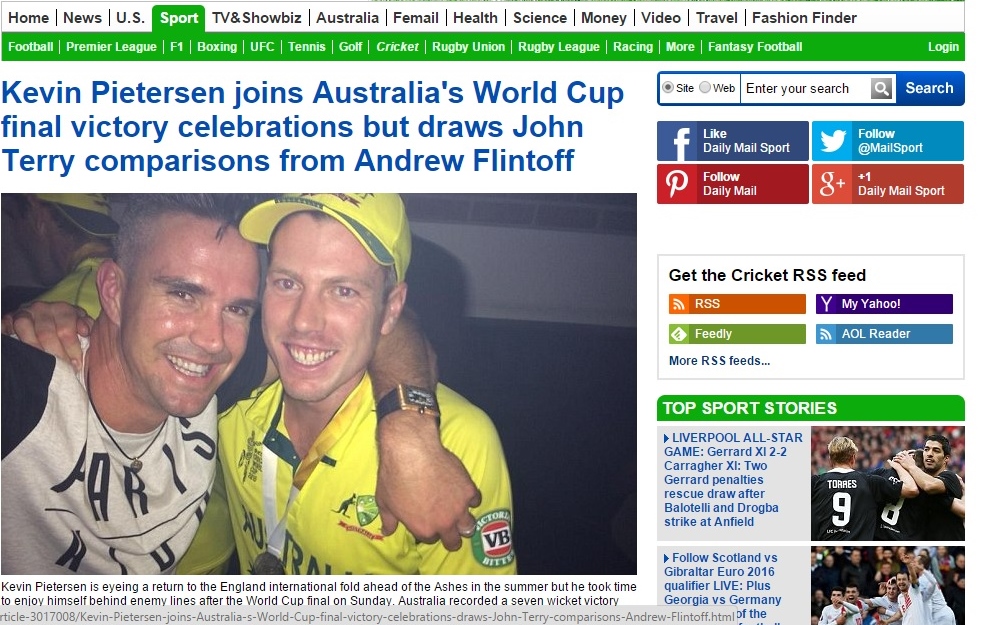
2015 World Cup Final – Australia v New Zealand
Well. The Final.
I’m not one for previews, as I think the hype of these things gets too much. Too many people getting far too carried away, with silly press, silly angles and me being world class Mr Grumpy.
I want New Zealand to win. It’s anti-big three, the Aussies need something like this in their own back yard to go spectacularly wrong (with apologies to my Aussie mates), and well, the Black Caps appear to be nice guys playing above themselves.
But the Aussies are going to win. Just feel it in my bones. They needed to be got shot of before the Final for me, and they never really looked like being defeated in the knockout phase.
Comments as and when. I’ll be on, I’m sure, in the morning. Good luck New Zealand.
2015 World Cup Semi-Final – India v Australia
Can’t they both lose?
Comments below. I’ll be awake a bit earlier tomorrow, so I’ll try to watch some of this on the train if I can get my Sky Go up and running.
We are all Black Caps now (presumably if you aren’t Indian or Australian or desperate to win the contest).
Thanks for all the nice words below. It’s always good to know people like the blog.
 Being Outside Cricket