Schism – def. is a division between people, usually belonging to an organization, movement, or religious denomination.
Around 15 months ago, after the acrimony of Summer 2014, I mentioned on HDWLIA that the divide between the supporters of the Cook side of the argument and the KP side of the argument, if we can simplify matters here, had shown no signs of being bridged. At that time the former were firmly of the view, exhorted by a compliant press, that the moves by Downton and co to rid themselves of the turbulent KP were absolutely correct and that the team, and therefore, by extension those running it, needed our support. On the other side, those of us sick to death of hearsay, rumour, gossip and leak, having our most exciting player removed from the scene with nothing to say why (those cursed lawyers) also had the Big Three Stitch Up to get our teeth into.
I may not be a totally unbiased member of the jury, but I think the latter bunch absolutely slaughtered the other in the debate. We’ve been down the road about what we got right many times – most notably Downton and Moores – but there’s no doubting we got people talking in our own way, and got some terminology out there to guide us. You know, that “outside cricket” thing that won’t go away.
I thought, at the beginning of 2015, there was hope. A new head of the ECB, a disastrous World Cup that used up any goodwill anyone should have had, some moves towards a settlement of divisions with KP. It looked hopeful that the divide, which was becoming a chasm, could be bridged. But could it really? Because, as we know, the strength of feeling out there against KP, and that’s what it is only about to those on the other side of the debate (what else is there, that we are a grumpy bunch? That I offend the misuse of the Question Mark Society?) is immense. Absolutely immense. Not in quantity, as the unscientific polls show, but in sheer venom. By the end of 2015’s summer, and the Ashes win, the divide was becoming wider, not narrower.
Now this blog has been accused, on a number of occasions, of being spiteful and nasty. It’s been accused of being full of guesswork. Tonight it has even been accused of being a “bunch of oddballs” and not “real cricket fans”. You know, that might be what you think, but I doubt it. We give a toss. I didn’t spare criticism of Alastair Cook during those times for in my view, he deserved to be criticised. I fail to see how any sentient cricket fan could watch a series losing storm of nonsense like Day 4 at Headingley and not be moved to paroxysms of rage. It was woeful. Whether it was entirely him, his bowlers or Moores, it was extraordinary. There was anger at performance as well as anger at his appearance as being, in part, responsible for the exclusion of KP.
Bloody hell, I’m not saying I’m without sin here, without going overboard maybe, or said everything in the way I wanted to. But here’s what I do. I understand the frustration some have with us, keep harking on about bringing KP back, keep mentioning when he’s making the basis on which all selection decisions, with extremely few exceptions should be made, look a joke (the other side of the debate taught me many ways to discount an innings of 355* in first class cricket), keep saying what we’re saying. I understand people telling us we should move on, that this is a fight that’s over, that he’s never coming back so “get behind this new exciting team”.
I make one request tonight of those on the other side of the debate. Why do you think we’ve not totally embraced this new future? Do you seriously think it is man-love for one player? Because if you do, you are not the intelligent people I give you credit for.
The schism remains, and will continue to do so. I feel cut adrift from England cricket, I feel betrayed by the authority that runs the game, both in terms of domestic teams and on the international administrative stage, and it shows no signs of abating. It’s both sides to “blame”, whether you like it or not. Where there’s no signs of meeting in the middle, we’ll continue being torn apart.
Have a think, next time you question our support for the game. Have a think. Because I’ve never questioned yours. Just your judgement. As you, on the other side, no doubt do with ours.
Providing the weather holds, South Africa ought to win the final Test of the series some point tomorrow afternoon. For the match has been thoroughly one sided throughout and unless England somehow escape through their own endeavours, which is possible but unlikely, a draw seems most possible only with the help of a thunderstorm or two.
If that were to happen, then perhaps the finger could be pointed firmly at the home team’s captain and coaching staff, for the lack of urgency in building the lead in the second session and after tea was unusual to say the least. It’s not exactly a matter of batting on too long, more that with a more positive mindset they would have been able to declare somewhat earlier. Still, with three early wickets already taken South Africa would be disappointed if they failed to finish England off, so the point will probably be a moot one, but just occasionally, this conservatism comes back to haunt teams, as England found on a number of occasions, most notably in managing to lose a series in the Caribbean they dominated, but where sheer timidity cost them two Tests and one collapse ultimately the series.
Certainly South Africa’s reluctance to take risks was justified early on, for with Anderson taking two wickets in an over early on, there would have been some concern even though at 182 ahead for three wickets down, it was hardly disastrous; given the collapse in the last Test, perhaps it was forgivable. But the lack of acceleration after lunch was less so, as by that point they were 254 runs ahead with four wickets down. England probably weren’t too upset. Between lunch and tea they only scored 102 runs in 30 overs, and after tea 65 runs in 15.2 overs – a small acceleration, but hardly putting their collective foot down.
By that point, and with England going through the motions to an even greater extent than they have in the Test is a whole – bowling wide of the off stump and wide of the leg stump in an effort to restrain the scoring and keep them out there, the Test really wasn’t going anywhere, except for a debate as to whether they were intending to let Bavuma score a century. It was a touch peculiar, and suggested a side seriously lacking confidence, for there was no sign of an imminent declaration.
The rain break forced their hand and with a pretty nominal 382 required in 109 overs, England were left with just a draw to play for. They didn’t exactly start very well. Alex Hales did get one that kept a touch low, but that he hasn’t had a great series is plain. As ever, it needs to be qualified that he’s hardly alone in not having a great series. The radio report from Jonathan Agnew this evening highlighted that he’s averaged 17 across the Tests, and that is indeed not great. Yet it is as striking as it always is that this point was followed with saying that Cook was the next to be dismissed, with no mention of him only averaging 23 in the series.
It is tiresome to have to keep writing this, but it does Cook no favours to be treated as the prodigal son all the time. Yes, he has a very strong record behind him, and yes anyone can have a bad series. But to specifically, repeatedly and consistently overlook when the chosen one doesn’t do well as though it is of no consequence is failing to properly scrutinise matters. That does not mean for a second that Cook is or should be in any kind of danger of his place, for he had a decent 2015 after a disastrous 2013 and 2014 and has the fine career as evidence of his skill and ability. But what it does mean is that he has had a bad series. It happens. It’s worth noting. It’s worth mentioning. It is something that when totally ignored draws attention to the disparity in treatment. Sky have managed to skilfully ignore his poor series but still mention that he’s closing in on 10,000 Test runs. That will be a fine achievement, and worthy of comment as the first England player to reach that mark – though another would probably have done so sooner had his career not been curtailed. It is also true that he’s not had a great tour. It is quite astounding how the media will go out of their way to ever mention these things. Once again, it is not a case of criticising him heavily, querying his position, calling for his removal or any such thing, but it unquestionably is about highlighting how TMS can entirely ignore it, yet tweet a question as to whether Compton has convinced in this series with an average of 30.
For tomorrow, England do have a long batting line up, but assuming a full day’s play of 98 overs, pulling off a draw here would be an outstanding achievement. Indeed, nigh on impossible though the target might be, with a middle order as attacking as England’s is, it would probably be more likely that England win rather than bat out a draw, and that’s very unlikely indeed. And if South Africa do win the Test, then Scyld Berry’s point that it would have set up a fifth Test perfectly is ever more apposite. It was meant to happen, for the ECB promised it would a few years ago. It didn’t. And while the home team have to approve the scheduling, there has been a remarkable silence on the part of the ECB that their desire for five has been flouted. Four Tests is at least an improvement on the dreadful three match series in 2012 that was blamed on the Olympics, but five is the best Test format for big series for very good reason – as previous England – South Africa encounters have demonstrated amply. It’s not being wise after the event, plenty of people who love cricket were disappointed it wasn’t five before the series started. Apparently, only India and Australia are deserving of this. The Big Three who have accrued all the power and money to themselves, allowing five match series between themselves. Try to contain your shock.
England’s repeated defeats in the final Test of a series, dead rubber or otherwise, is beginning to look careless. Curiously, it isn’t so long ago that they suffered from losing the first Test of a tour consistently. The series win is a fine achievement, and whether South Africa are quite the side they were doesn’t change that. But if they do want to be the best side in the world, there’s plenty of work ahead of them yet.
As The Leg Glance battles enthusiasm problems I share with this test match – if England and their apologists, I mean the media, play and say like this doesn’t matter, then why should we care – I thought I’d pick up on a few points that the whirlpool that is Social Media and background research have thrown up.
Due to some circumstances I may delve into a lot later, I might be in the market to go to the Oval test this year. I think Pakistan might be a decent opponent, Younis Khan, Azhar Ali, Asad Shafiq, Sarfraz Ahmed and the venerable Misbah-ul-Haq are good players, even great, and different from the stuff we’ve seen recently. So I went on to the Surrey site to see the state of ticket sales.
Day 3, Saturday, is almost sold out. There’s odds and sods about. Same, but with a few more, for the Friday. But Day 1 is not well sold, and Day 4 would be an utter embarrassment if that’s the final tally. The prices aren’t overly attractive for the first three days. The cheap seats in the OCS Block 1-3 are £50. Where I usually sit, which was always priced the same is now £60. This is, we are told, an attractive, attacking England team. A team we should be getting behind, with great, exciting young players. Doesn’t seem that message is getting across.
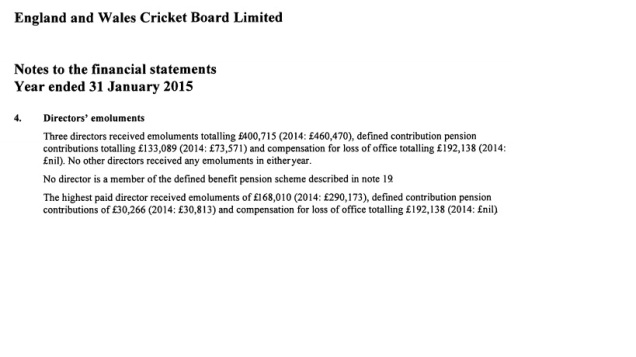
In something tangential I wanted to look at the last set of accounts put out by the ECB. They are from January 2015, covering the previous 12 months. Apart from seeing that a director was given £190k to sling their hook – two directors left that year, and the clear implication is that this could be Collier – there was also the notable £24m added to the reserve pot.
The ECB say they budget on a four year cycle and that two out of the four make a loss. I looked at the ticket situation for Day 1 at Durham against Sri Lanka (a Friday) and it looks hopeless.
This was just a spot check. Innocent Bystander tells me that Lord’s tickets for both test matches at Lord’s are going on general sale for most days. We sit back and say test cricket is in rude health in England, but is it outside of the Ashes? Really? The prices at the Oval do not match demand, and there’s a bit of a nod with the lower prices for Day 4, but cricket has to face up and wonder what it can do – stuck between the Sky money vice, and the clear lack of visibility this team with its exciting young talent has.
Which then leads me on to the panacea that is a T20 competition like that which has just finished in Australia. The Big Bash has, for a couple of years now, had envious glances cast from here at the slick running nature, the big crowds, the buzz and excitement and yes, glamour of it. We know the arguments and we’ve been over them countless times. I hear people say the competition lacks quality – it doesn’t; I hear people say it is the free to air TV that makes it – that may have a point; the size of the grounds and the climate lend to the spectacle – they do; but to me the key is that it runs for a month, has a clear Final and a limited number of teams (8). Many more than this and it would go too far and dilute the quality. There is no answer that meets the demands of the English summer. But in a year when we’re not selling test matches out, the very thing we are supposed to be shit scared of protecting, that line of defence doesn’t look strong. Nor does our argument about diversity of opposition because, as we see, it’s Australia for the crowds and India for the TV and the rest are loss-makers.
The Big Bash saw a notable performance in both the semi and the Final by Kevin Pietersen. It doesn’t really prove anything we didn’t know. He’s not done, but he’s also not coming back. That doesn’t make it a closed matter not to talk about how we got here, and it doesn’t make it OK for the ridiculous abuse any tweet on him gets, which Maxie encapsulated superbly in a Tweet today:
Reaction to @NHoultCricket 's @KP24 Tweet underlines the tragic degree to which the ECB's lies have poisoned English cricket.
One of the common criticisms of England in this match has been that they have looked off the pace, and far less intense now that the series has been won. I’ve alluded to it myself too, and as today’s play proceeded, it occurred to me that I’m just not into this match.
It’s not because South Africa are plainly winning it, but it might be because of the lack of meaning in terms of the series result. Or perhaps it could be that if England aren’t up for it, why should anyone else be either? Whatever the reason, and despite the cricket being more than passable, it’s very much a background interest in the way that the first three Test were not.
Perhaps if there were a fifth Test to be played, as the ECB of the past said they wanted, then the jeopardy of the series would make it more required viewing than it is. Judging by the number of comments in comparison to normal, it could be the sense of it all being underwhelming is shared. Or it could be because these articles are crap.
That’s a pity though, for in Kagiso Rabada, we may be watching the emergence of a rare fast bowling talent. He destroyed the England middle order with some outstanding bowling. He is only 20, and as such there are good days and bad days, but he has pace, and the ability to move the ball. No England player looks entirely comfortable against him.
The difference between the first innings scores was 133, which represented something of a triumph for England after they’d sunk to 211-5 after a decent start. That they got as close as that was mostly down to first Ben Stokes, whose 33 runs had more effect in turning the tide than the runs scored suggests, and particularly Moeen Ali, who marshalled the tail (such as it is) wonderfully. He remains a frustration in that he needs to score more runs than he is, but when he’s in full flow there are few if any players more gorgeous to watch.
With the early loss of Dean Elgar, there was a small chance of putting South Africa under real pressure, but Amla and Cook saw it through to the early finish.
175 ahead with 9 wickets left on a pitch that is noticeably wearing and becoming harder to bat on is a position of complete control. Even another hundred runs would probably be too much, so unless there’s a miracle session for England tomorrow morning, they’re going to probably lose.
The one concern for the home team will be the fitness of Kyle Abbott, off the field with a hamstring injury. Down to two seam bowlers and without even the club medium pace of Van Zyl to call on, they’ll be twitchy if England keep them out for any length of time. Still, you’d back them to ensure it doesn’t matter.
England are developing a habit of going through the motions in the final Test of a series, and this is proving no different. For a side who profess a desire to be the best in the world, it’s less than impressive. The bowling was once again off colour, the fielding laissez-faire. The batting retained that intensity, but for the first day and a half, there was little to suggest it was a team who had come out on top in the series.
De Kock’s reinstatement in the team x been met with universal approval, for his late understudy at Johannesburg had done exceptionally well with the gloves, yet he answered those criticisms in the best way here, with a scintillating innings that turned South Africa’s decent position into one of substantial strength. He didn’t even have much in the way of support, except in terms of the lower order staying with him, it was all his own doing.
Stokes finished with the best of the bowling figures, but in truth no one except Broad on the first day will look back on their performance with great pleasure, and the frustration of the captain was evident.
As always in such circumstances it is then all about how the team batting second respond, and England will be content with their overnight position. Alastair Cook was had a poor series, but here looked somewhere back towards his best, and if he goes on tomorrow then the match could get extremely interesting. The concern will be that the pitch showed signs of unevenness as early as today, with Compton being desperately unlucky to receive one that whistled past his ear off a length, and then a grubber which gave him no chance whatever. If the pitch continues to deteriorate, England are going to have to bat exceptionally well to get close.
Should they do so, and with South African memories of a third innings collapse still fresh in their minds, England will look to strike, but at this stage and with such a big lead, the home team are warm favourites to win the so called dead rubber.
Hales failed to get going, and while he has made pleasant runs this series, he’s failed to get the big score that would get the critics off his back. But England need to make a decision on this, for the revolving door of openers not called Cook whenever there is a mediocre series is becoming rather busy with discarded batsmen. If a player is considered sufficiently talented then a longer stint in situ with a clear brief that the player in question is being backed might be the way to go.
At the start of the series, a player called Cook scoring a century could have been expected to result in endless articles paying glorious tribute, so it’s an undoubted irony that Stephen, on debut, would be the first Cook to reach three figures. In the way of cricket, there will be celebration at the achievement, and an accusing finger pointed at the selectors for waiting until he was 33 before picking him. In the wider scheme of things, it may yet matter little, but the achievement of a Test century cannot be taken away from him, and perhaps he’ll have that late career opportunity that Chris Rogers took so gleefully with both hands.
That South Africa don’t have another Test for six months may cause a problem with that hope, but in becoming the hundredth player to score a hundred on debut, he has made his mark.
It was a curious sort of day, and the kind that Test cricket is so good at, in that one side was utterly dominant for the first two thirds of the day, only for it to move slightly more back in the balance after tea.
England consistently bowled too short, something they are prone to do to immense frustration all round given how dangerous they look when they bowl a fuller length. Broad was once again the pick of the attack but even he failed to make the most of what movement there was, though he did more with the ball than anyone else by a distance.
In the case of Anderson, he was unthreatening and innocuous. It’s not been a great tour for him, and he’s at the age where the whispers start about a player in decline. Given his record that’s unquestionably premature, for he’s far from the only player to have had a quiet time, notably the captain has too.
Woakes looked tidy and decent, but sooner or later he’s going to have to start taking wickets to justify his place. His batting is certainly decent, and so is his bowling. Test quality? Well perhaps, perhaps not, but in his fifth Test he’s on his fourth spell in the side, which is hardly going to help him settle in.
Moeen just has the knack of taking wickets, and that cannot be overstated, while Stokes keeps threatening to break through with his bowling without yet showing consistency. Patience is a key to all watchers.
At 237-1, South Africa were in total command, so finishing on 329-5 will represent something of a disappointment, and so it should. On a flat surface 400 is a minimum, and while they should do that, England will feel they’ve got away with it today.
They were at least honest enough to admit it wasn’t a great day for them, which in itself is welcome given the days in the past where the approach was not dissimilar to Channel 9 commentators when assessing the chances.
Hashim Amla was again dropped early, and again punished England for it. Amla remains one of the most watchable batsmen in world cricket. Yet the malaise of the captains this series has seamlessly transferred to AB De Villiers who collected another duck.
Day one is always a wait and see day, unless one side or the other has a total catastrophe, and so it is here. But both sides have cause to be relieved and both have cause to be dissatisfied.
Bad news for all you “The Leg Glance” fans out there, as the reins for the 4th Test preview have been handed to me. Yes, one of my alter egos that gets the people to moan, is back. The Twitter Idiot Dmitri Old. If you’ve not seen my poem on trains tonight, well, go and look. The Bogfather liked it. That’s enough for me. TLG is unavailable until much later in the week, so I’m writing the preview. Loads of words, a bit of scorecard nonsense, a plea for realism and I think just the one mention of Kevin Pietersen. That’s progress.
We’ve seen the media in full cry this week. I do believe we were world ranked #6 going into this series so inevitably knocking off the world #1 in their own backyard is sound enough evidence that this is the World’s Best on the brink of something special. Now, as you know, I’m not overly swayed by world rankings, and tend to think of who might come out best on neutral grounds in test matches. So, if England were to play Australia in India for example, who would win? India played Australia in the UAE who would win (or maybe the West Indies)? I think it is fair to say that South Africa got to number 1 because they were the most adaptable side in all conditions. They got stuck into pretty much anyone and didn’t lose. Then that tour of India saw them disintegrate and provided England with an opportunity to hit a side very low on confidence.
That they did, and kept the hammer down speaks volumes for this team, and we can all see the promise. But think of the dominant teams and you think of excellent bowling attacks – and England could provide rivals to the vaunted 2005 attack if only they could all bowl together. It’s as if Stuart needs Jimmy to be absent or off his game to be the king. Stokes has a lot more wickets at this stage of his test career than Freddie for instance. It has immense promise. The batting line-up is deep, allowing numbers 6,7 and 8 to flog tired attacks if the top order does its job. But the achilles heel is the batting. Think of world number 1 teams at their ascendancy. Greenidge, Haynes, Richards, Lloyd; Hayden, Langer, Ponting, Martyn, S. Waugh/Hussey/M.Waugh, Gilchrist; Sehwag, Dravid, Tendulkar, Laxman, Dhoni; Smith, Kallis, Amla, DeVilliers. We have Cook and Root. England’s team that got to world #1 had a fading Strauss, but Cook going well, Bell, Trott, KP. When you look at this team, it’s short there.
This needs to be remembered as we see press people get carried away. I’ve not read BTL, or much of the papers (that site needs updating when I have a few hours) as real life has interjected. But some of the hints on Twitter, the over-burdening of praise, over hyping individuals has been noted on social media. This is an exciting team, I really don’t want people to get the idea that I’m arguing the contrary, but act like we’ve not got ADHD? They’ve won three of their last 8 test series, drawn 1 and lost 4. Perspective is not losing sight of the bigger picture. There are many looking at the upcoming home schedule and thinking that it’s there for us. It could be, but let’s win those matches.
I was also amused at the piece today citing that Stuart Broad is in the top five English bowlers ever. All I’d say about that piece is that no-one would have written it before this test. And that’s not to besmirch Stuart Broad, who can point to the wickets and say, “it’s true.” I hate everything about this rush to hyperbole, and contextualising modern day cricket only. It’s the way the Premier League denies anything before 1992, why any young kid who scores for Man Utd is lauded out of scale etc. I’ll bark at the moon all I want on this one. I do get excited, just not carried away. That’s not the modern way.
So on to the 4th Test in Centurion. We have not lost there, if my memory serves me well. The first tour was the first test ever played on the ground, and Hick made a ton before the rains. The infamous leather jacket test was next, so less said the better. 2005 saw us clinch the series having given us mild palpitations after tea on Day 5, and the last time we visited, we drew with nine down. So the positives are that we go to a venue with a decent record. The flip side is that we don’t seem to finish test series well. Losses in Sharjah, at The Oval, Headingley and Bridgetown this past 10 months are fresh in the memory. Only one of those can be put down to being a “dead rubber” like this.
The hosts appear to be a team in disarray. A captain who seems to be giving out all the signs of jacking it in before he even started, flux at the top, Amla seeming to be not as sure as himself as he used to be, bowling raw or not good enough (or a bit of both) and the fielding surprisingly off. But there’s a palpable sense, from here, of a team lacking belief. Belief in itself, in the future, and with the sport itself. I’m used to South Africans being up for it, playing up their strengths, not approaching a game in fear. They looked a beaten side in Joburg long before the coup de grace was executed by Broad.
This is a big test match for Hales, Compton and Taylor. None have stamped their authority on their place, while all have given great hints as to why they are there. I’m not going to have the obligatory dig at Cook because there’s no point. His stats only matter when he scores runs. Bairstow nailing down the batsman/keeper spot is a bonus, Stokes’s game changing abilities are a rare commodity and we should be keen to accentuate the positive – I’m not sure we’ve really come to terms with the 258. I suppose Woakes will be in for the injured Finn to cement his status as “next taxi on the rank”.
OK, I’ve meandered enough. Comments for Day 1 will be in a separate thread, but until then, have a great rest of the week.
The series win was clinched yesterday and it’s one to savour. Since readmission we’ve won one series at home and two away against South Africa, and while we can get the feeling that we are beating a side on the way down, it’s also a salient point to remember that in 2005 we were thinking much the same thing. A number of us on this blog remember that 2004/5 series win as probably one of the greatest away wins England had, and we aren’t wrong. But there were also some similarities as well.
Any victory, in fact any tour result, has an obvious series to compare it to. 2005 Ashes had 1981, the whitewash of 2013-14 had the whitewash of 2006-7, every dominant Aussie side will be compared to the number 1 team of the late 90s, early 2000s. England’s series win here will be compared to 2004/5, so let’s do some of that now. I’m going purely on memory of 2004/5, so any errors, please let me know.
Going into that tour England had had an amazing 2004 – they’d won all but one test match they played, and that was due to playing against Brian Lara on the Antiguan equivalent of Heathrow Airport’s main runway. Some of these wins came from blowing the oppo away, but many came from gritty batting displays chasing down some very itchy totals – I’m thinking New Zealand at Lord’s (the Nasser farewell), New Zealand at Trent Bridge (all hail Thorpe) and West Indies at a very gloomy Old Trafford (a grossly unfairly forgotten knock by Rob Key). During that spell we’d drafted a new opener (Strauss) who had settled in well, and a new keeper (Jones) who made a ton in his third test. The bowling was gelling as a unit, without Simon Jones, but with Hoggard, Harmison, Flintoff and Giles. The batting was solid, Strauss, Tres, Butcher/Key, Vaughan, Thorpe, with Ian Bell waiting in the wings. The focus was on 2005, and the Ashes. This was our chance. But in the way, and as it turned out, how great it was that it was, was a tour to South Africa.
Readers will know that I went to the Cape Town test, and also two days of the Jo’burg match on that tour. You may also know that by pure chance we booked into the Guest House run by the former manager of the South African cricket team who had just recently been reassigned when the Board sacked coach Eric Symons and installed Ray Jennings. This was also the time when the South Africans had a right downer on Mark Boucher. On our first full day in the country the hosts arranged for a friend to take us round the Cape Coast, and it turned out he was a retired sports journalist. We’ll always remember (I went with Sir Peter) his rationale for the exclusion of Boucher (“the board hate him. I hate him. He suffers from “little man syndrome”).
At this stage the home side were 1-0 down and had just narrowly avoided it being 2-0. The first test at Port Elizabeth was a triumph for Andrew Strauss, who made a ton in the first innings and an unbeaten 90-odd to see us home in the second innings. It was a top test match, as the game ebbed and flowed, and it also saw two reasonably decent players make their debuts, AB de Villiers and Dale Steyn. I think it fair to say we were far more impressed by the latter at the time. That team looked unbalanced, with Tsolokile keeping wicket, new players, and confused selection. The coach had come over as some sort of boot camp sergeant (infamously pinging a ball of Smith’s head in catching practice in Joburg) lacking any degree of sophistication.
The second test in Durban was one of those “stake in the ground” matches for England which made you utterly proud of them. The first two days could hardly have gone worse. Put in on a helpful wicket, England were skittled in the first innings for 139 and then felt the brilliance of Kallis who made a brilliant 162 and put the hosts nearly 200 in front. Three days left and the situation looked bleak. England did not wilt. They erased the deficit for no loss, piled on 570 for 7 declared and gave themselves time to bowl South Africa out. The hosts were clinging on (just as Sir Peter and I were venturing out for a beer in Cape Town – we were successful in our pursuit) and arguably were saved by the bad light.
The third test, in Cape Town, was a wake up call. England conceded 400+ in the first innings, fell foul of Charl Langeveldt on debut by collapsing in the reply, with the hosts putting on the required runs in enough time to give them to bowl us out for a second time. The game was sealed mid-way through Day 5, giving us enough time to belt up Table Mountain before our flight out the following day.
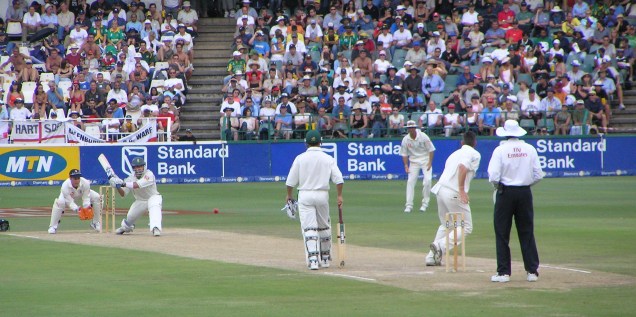
Herschelle Gibbs about to sweep and bring up his century – Joburg 2005 (c) DmitriPics
The Joburg test was one of those seminal moments for that team. A great first day (when we were driving down from Hluhluwe to catch our flight from Durban for Day 2) by England was eagerly taken in on the radio and the airport TV, but as we were in the air Strauss got out for his third hundred of the tour, Key was dismissed for 80 odd, and Thorpe a duck. It wasn’t so great. Nor was the weather in Joburg on Day 2, but there was enough play to see Vaughan regain some nick and he and Harmison put the hosts through the wringer before Bucknor took everyone off for bad light. England had over 400, declared overnight, and a lovely sunny Day 3, spent sitting next to Kevin Whateley while not uttering a word to him, saw Herschelle Gibbs make a century, and South Africa claw their way back into the game. We flew home that night. What followed was possibly Tres’s greatest knock for England, and then possibly Hoggy’s greatest spell of bowling. With time running out England knocked over the hosts and took a 2-1 lead.
Centurion was blighted by weather, saw AB make his first test hundred (having got out in the 90s in the first innings), Kallis make his third of the series in mystifyingly slow circumstances, and England wobbling in a nervy last session. There wasn’t really a doubt, but we’d suffered enough in the past to have it in our minds that it was. But even in that test there was confused thinking from the hosts. DeVilliers opened with Gibbs with Smith batting at 5! Seems odd to think that now, doesn’t it?
So, using this as a tenuous reference point, what are the similarities. Well, there was a feeling that England were on the up, with a team coming together. The batting had largely held up, but we knew Thorpe was nearing the end and the assumption was that Bell would come in. Butcher had played his last test, although we didn’t know that at the time, and I’m not sure Key ever played again, either. We know who came in for that slot, and we were a matter of days from hearing the name that partially dominated the newsline for the next decade. Our bowling was solid as a rock, even allowing for Jones not quite nailing it and Anderson having a bad time at Joburg.Harmison didn’t have a great tour, but then we won without our main bowler having an impact. Broad went into this series as Anderson’s oppo. Now he’s on top of the pile.
Jones was a concern at keeper as he had developed a habit of going for pretty much all that was heading for first slip and not nailing it. Bairstow finds himself a bit more advanced on the batting front but with still major keeping concerns.
We encountered a South Africa unsure of themselves and it permeated the team. Van Jaarsveld had a decent second test, playing a big role in saving the game, and was bunted out straight away and turned into the Surrey-killing Kolpak. Tsolokile was keeper for one test, then it was AB, then Boucher. Openers were changed. Pollock wasn’t long from the end of his career. South Africa had a Nathan Lyon complex over Nicky Boje. But they also had two gun young players in their midst – Steyn and AB and that meant hope sprung eternal. Also in that series we saw Amla. This Hashim Amla was a walking wicket, a man no-one feared. Stick with someone and you never know what you might have might be the mantra.
For AB and Steyn the hosts must be hoping Bavuma and Rabada are somewhere in the same zipcode. Can you rely on that and also, there are othere ageing players in that line-up too. But all the comments I’m seeing on the future for the South Africans are grim. When your not quite made it test players can go back to first class cricket and immediately dominate, it does not look great. A number subscribe to the “cyclical nature” of cricket but that’s not happened for the West Indies, is not looking likely for Sri Lanka, and who is to say Pakistan will continue to churn out talent? The noises around AB, that has inspired huge discomfort from the Saffers I come across on Twitter, have not eased anyone’s soul. There’s a lot of discontent that AB took his first captaincy press conference to pour cold water on the future spoke volumes. It may not be the cause, but the effect is that if you feel your leader’s heart isn’t 100% in it, then nor should your’s – even sub-consciously. South Africa have been under the leadership of two players who don’t really exude commitment to being the main man. The fish rots from the head.
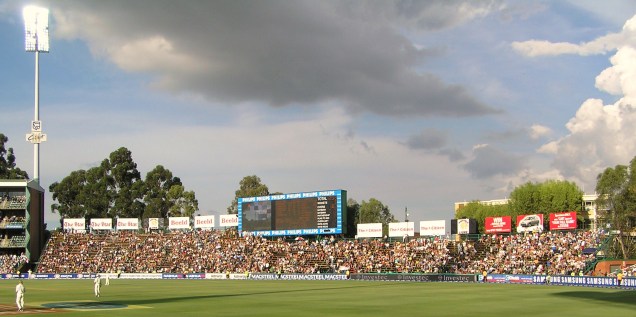
Leaving The Wanderers – 2005
For England this is a great win. Let’s not get churlish about this from the team’s standpoint. Durban was won due to important batting contributions from Compton and Taylor, not our usual old faithfuls. It was won without Anderson. Then there was Stokes and Bairstow at CT, and then two of our old reliables, Broad and Root in Joburg. The batting isn’t world number 1 class, it just isn’t making the runs across the board, the opening slot is a mess, the number 3 in flux, Taylor hasn’t nailed down five (nor is he letting us down) and it’s because the batting has depth down, arguably, to nine, that this is not as crucial. While 2-0 in South Africa is a tremendous result, it doesn’t, for example mean 2-0 in UAE should be ignored, not with the challenges of India this winter on the horizon. This is the World #1 opposition in name only, and a #1 in flux and down in the mouth. We did what we should do. Beat a team in that shape, and make it worse.
Just for laughs, I thought I’d pick a composite team of the two from those winning squads. I bet this will go down well.
Whatever was expected for day three, it wasn’t this. England grabbed the moment, and with it the match and the series. The headlines will be all about Stuart Broad, and so they should be. For he has now taken 5 wickets in a bowling spell seven times in his career, which is remarkable. I was fortunate enough to see the first “Stuart Broad Day” back in 2009 when he ripped through the Australian batting order to effectively win the Ashes back for England, and there’s something about him when he gets going that makes him irresistible, he goes through batsmen like a knife through butter.
Broad is one of those players who seems to attract as much criticism as praise, and he’s not even close to being one of the best loved of England cricketers. His demeanour over the years has sometimes irked people, and his tendency to blow hot and cold has often frustrated – as tends to be the case with explosive players, some remember the bad times rather more than the good. The same applied to Kevin Pietersen of course, where some would choose to deny the match winning performances and point to the failures, as if that meant anything. Those who make the game look easy at times are cursed to be berated for not producing excellence on every occasion. Yet Broad’s overall record as a bowler is now a genuinely fine one. He didn’t have a great start, and his bowling average didn’t dip permanently below 40 until his 21st Test, and only went below 30 after 76 matches. And yet that average continues to fall and is now at 28.54, which is more than respectable.
Nor is this just a golden spell for him, for his bowling average over the last five years is 25.67, and over the last two it is 23.97. This suggests not only a player who is of Test class which has been apparent for years, but one who is now world class. He should now be at his peak, and James Anderson may well be nervously looking over his shoulder as the England record wicket taker, for over the last year or so Broad is just beginning to reel him in.
England have been on the receiving end of games like this often enough, where the team becomes crippled by uncertainty, unable to score, and reduced to resembling startled rabbits, transfixed in the headlights of a rampaging bowler. And yet few of his wickets were batting errors, they were instead outstanding bowling. He won the man of the match award for it, and although some felt Joe Root’s hundred the greater contribution, it was Broad who created the result, and perhaps given the name of the award, that is the right approach to it.
South Africa are unquestionably a team in transition, the loss of their great players to retirement and the absence of Steyn and Philander through injury have reduced them to a shadow of the outfit that reached number one status in Tests, but both age and injury are facts of sporting life, and it’s never been an excuse when England have lost, so nor should it be now. However, there is a strong sense that these are two sides heading in opposite directions. If this is purely a cricketing circumstance, then for the English it would be a reason for celebration; this England side is one that is full of verve and vigour, playing an attacking and incisive style, and responding to adversity by going after the opposition. There is much to like about them.
The trouble is that with Test cricket in the state it is, any pleasure from it has to be tempered with real concern about the future. The ICC stitch up with the resulting loss in relative income means that the potential for South Africa to lose their best players to T20 wealth is high, and if that is so, then building another fine side could prove beyond them. For the point about Test cricket is that to take the maximum pleasure from your own side winning so handsomely, it must be in the knowledge that in future the tables will be turned. That is after all why the English and Australians gleefully tease the other, because they know next time they’ll get it back to the same extent. Success is only special when failure is an option.
England’s win means that South Africa are dethroned as the side at the top of the ICC rankings. India for now take over, with Australia in second place. England may well be currently fifth, but with home series against Sri Lanka and Pakistan to come, are more than likely to move up the table quite quickly. In short order the top three Test sides will almost certainly be India, Australia and England. Quite the coincidence.
With that proviso, it remains an outstanding feat to win the series, for since being accepted back into international cricket, Australia and England are the only sides to have won series there. That is perhaps not so surprising as it might seem, for South African conditions are entirely alien to all other sides bar perhaps New Zealand, who you wouldn’t expect to win there often if at all. Yet those predicting a healthy England win before the series were considered outliers, and understandably so. England have unquestionably exceeded expectations, the younger players have brought verve and joie de vivre, and the side appears a very different one to the nervous, hidebound and risk-averse outfit under late era Flower and Moores.
Which means praise for Trevor Bayliss and Paul Farbrace in particular – and indeed Andrew Strauss for appointing the former and backing the latter. Good decisions should always be acknowledged, in the same way that bad ones should never be brushed under the carpet. The style of Bayliss and Farbrace appears to be to remain in the background, encourage the players to express themselves, ensure the captain runs the side rather than being a cipher for the backroom staff, and to play attacking cricket wherever possible. What sets them apart is that so far they’ve actually done it, for every coach says these things, but they have managed the ultimate coaching trick of getting out of the way. Cricket is not football, and prescriptive management isn’t going to work. Being a support and an adviser is, and early stages though it might be, the signs are excellent.
England aren’t a very good side just yet. But they might become one. From the depths of disaster, largely self-inflicted, that’s considerable progress.
 Being Outside Cricket