Tomorrow an England cricket team will play a major World Semi-Final and it provides us with a chance to move towards a second world title in this format. It will be played out, the drama, the big hits, the slower balls, the yorkers, the running between the wickets behind a pay TV wall. As far as I am aware, there are no plans to share the coverage with those not in possession of a Sky subscription. Oh well. Internet highlights it is.
Has this game registered on the public conscience here? Has anyone outside your normal cricket circle expressed any sort of interest? Not with me it hasn’t and all my colleagues and friends know I’m that blogger.
But there’s not a problem.
New Zealand are unbeaten in the competition, have a game plan, or several plans, and yet if we could choose a team to play at this stage of a competition, we’d probably be grateful to be playing the Black Caps rather than Kohlishire. But again, they are not to be underestimated.
From a misery guts point of view, England are probably playing with house money now for the powers that be. They’ve reached the semi-final so even if they go out here, the ECB have some tangible progress to report. In many ways they have, but this still looks a flaky team to me. It could chase down pretty much anything, but it could also be chasing pretty much anything. It definitely looks more comfortable chasing rather than setting.
Note – Sean has a post below, and I’ve stuck a new one up as well. But I need to set up tomorrow’s game…
An early start for this one, as England seek to solidify their position going into the final round of games. Despite the fantastic win against South Africa, the chasing down of a mammoth total did not do a huge amount for the net run rate, and so it probably means that to qualify we will need to beat Sri Lanka and hope South Africa lose to West Indies or give them a huge beating (assuming South Africa beat Sri Lanka, of course).
There’s the danger. Afghanistan are not to be treated lightly. England can be vulnerable to non test playing nations in these competitions. We can’t assume a team that puts up a spectacular performance like they did with the bat on Friday, can just repeat it. England should win, but it doesn’t mean they will win. The unspoken words are that we don’t need to just win, but win very very well.
Comments below, as per usual. After this game we’ll see where the land lies. We have Sri Lanka to play on Saturday, and then we have to wait for three other games in the group to play out. We’re by no means certain of qualifying even if we win the last two games.
And I’m noticing that I’m still using “we” for England. It’s still there. Somehow. Lord knows the authorities that run our game don’t deserve it.
For reasons which have never been entirely clear, the BBC in their wisdom decide that while Test matches and tournaments are covered on the Radio Four long wave frequency, a T20 like this one isn’t, with them advertising coverage of Sports Extra which is of absolutely bugger all use to most people driving a car at the time as without digital radio there’s no way of listening to it. It’s a curious policy for the BBC to have – one would think that those who listen to TMS usually would probably also listen to a T20 match, but apparently not.
All of which is by way of explanation that this afternoon was spent driving back from a family engagement, tuning in to try and listen to South Africa’s reply, and being unable to. Having watched England perform a collapse that was spectacular even by their exalted standards, the final total was unlikely to ever be enough, but the hammering that followed wasn’t entirely expected.
All of which means that this is going to be a short post due to an inability to reasonably assess the defeat, except to say that the collapse was partly bad luck (the run out of Morgan) and partly self-inflicted (the run out of Hales).
What isn’t surprising is that the response concerned it being an inexperienced side and the various excuses therein. As so often, there may be a grain of truth in it, but at some point those have to stop – with a global tournament next month you couldn’t say England go into it as one of the favourites, no matter how some have tried to big them up.
If we’re honest, then generally speaking the outcome of an international T20 tacked on to the end of a tour would be worthy of limited comment and response, sometimes we don’t even get round to writing anything about them, which may say more about us than anything else. It’s the disposable Christmas present of international cricket, that one you look at, smile politely, toy with for a few minutes then put back in the bag never to be seen again.
With the World T20 approaching though, there’s more interest than normal, not least because of how these matches are to all intents and purposes part of the warm up for the competition. It does have to be said that South African pitches bear no relation whatever to the conditions in India, but as an exercise in seeing how this new, exciting (®ECB) England team perform, then it has merit.
And how did they perform? Well, for a side whose bowling has been decidedly average in the one dayers, this was a marked improvement. To nearly defend 134 on a pitch where all the forecasts (for what they’re worth) had suggested 180 was the target was a pretty good effort. But the reason that pretty good effort was required was down to another batting performance where England lost wickets while trying to be aggressive and stumbled to a modest score. This is a difficult one, because if England are going to play this way, then there will be days when it all goes wrong, and the worst thing that can happen is for them to be criticised accordingly, while celebrating the days it goes right. It’s the old “score at ten an over, but don’t take any risks” exhortation. What can be said is that going hell for leather in all circumstances is not that much of an improvement in terms of consistently winning matches than being overly circumspect in all circumstances. The very best teams adapt to conditions in a way that at this stage England don’t seem able to. Given the choice of two limited tactical approaches, this is by far the better, but it would be nice to know that they had a Plan B from time to time.
As an aside, Kevin Pietersen got runs again, and is in his third T20 final of the winter. There may be no way back, but it doesn’t mean he has to stop embarrassing the ECB.
It does mean that when all goes well they are a thrilling side to watch, and they did at least get some kind of score to defend, thanks to Buttler in particular doing just that kind of adapting. Unfortunately, we’re still not really sure what kind of side England are, or what they’re capable of achieving. Imran Tahir taking 4-21 is not a terribly promising sign for next month though, even if many of the dismissals were remarkably careless in nature.
What England did do rather well was squeeze in both the field and with the ball. Chris Jordan has had a fairly miserable time of it so far on this tour in white ball cricket, but here he was outstanding, taking England to a position where they really should have won the game. That they didn’t, well poor Reece Topley. Having dropped Chris Morris first ball, he then had the over from hell, with balls two and three going for four and six; then missing a straightforward run out that would have tied the game and taken the sides into a super over. The best thing that can be said is that these things do sometimes happen, and better now than in a knockout match in the World Cup.
For South Africa? It’s hard to say. They bowled well but made incredibly hard work of what ought to have been a straightforward target. As ever, it’s a question of whether that was down to England playing well or them badly. But it’s unlikely they’ll have learnt too much from this one.
“Barbadians come not to see if the West Indies win but, rather like the informed spectators around the Madrid bullring, to judge the style and efficiency with which it is done”
Robin Marlar – Sunday Times
I rummaged around the detritus in the spare room to see if I had any back issues of WCM to refer to. I knew I had a lot of late 80s stuff, but not so sure about this season. I found one. And what a cover.
I’m never one to belabour a point! But imagine if the front cover of the prominent cricket magazine pictured your best player in friendly pose with the opposition’s iconic captain were reproduced today. Lord almighty there would be vapours. Especially if that best player was surrounded by acrimony, salacious stories and accusations of a poor attitude.
There are a couple of things about this cover. I think any lip reader out there recognises what the word is that’s just about to come out of Botham’s mouth. Second, good job there weren’t mobiles around and Strauss/Flower weren’t running the show.
Anyway, we left the gallant English team 2-0 down, battered and bruised, but not without some fight after a 7 wicket defeat in Trinidad. Thirty years ago we didn’t have large amounts of rest and recovery. Two days after the test finished, England left Trinidad, flew to Barbados, and commenced a fixture against the island. Not surprisingly, England were knocked over for 171. More symbolically, and man alive we were clutching at straws, was the return of Mike Gatting. He’d come back to the team from the UK, having sorted out his nose, and he took his place in the batting line-up. There was hope…. until he broke his thumb in this game and his tour was over. It was probably a good tour to miss out on! (Only it wasn’t the end).
England kept the game competitive but ended up losing on the final day by three wickets. Ian Botham bowled just three and a half overs in the match, but was to be declared fit for the upcoming test. The island of Barbados would go down in infamy for our all rounder, as the location for the most salacious story of the winter.
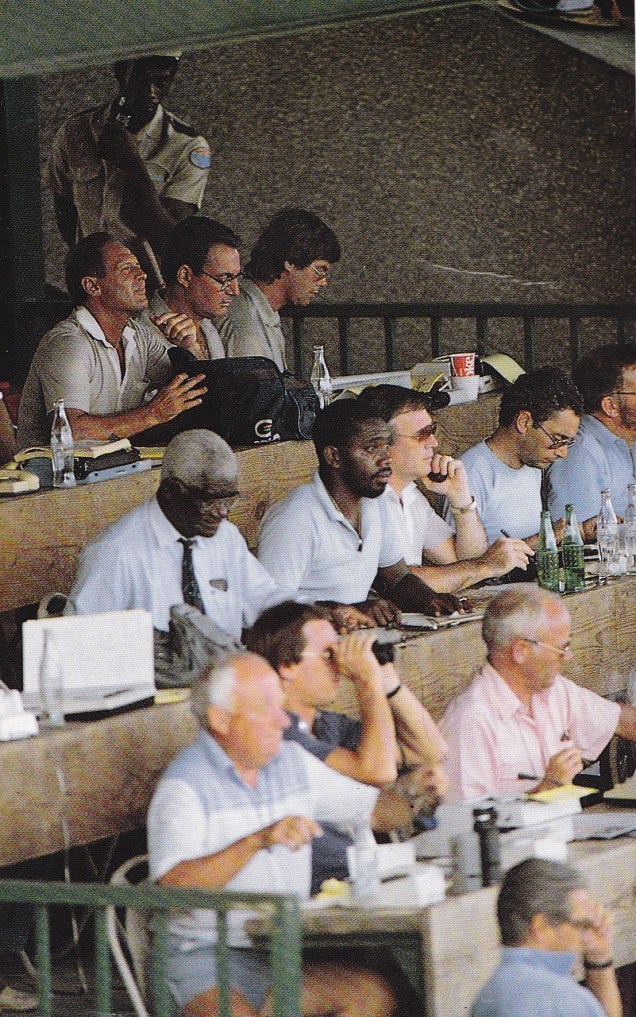
I see Boycott, Cozier and Engel….. The media at Kensington
Before the third test was the third ODI at the Kensington Oval and with the series level at 1-1, an interesting diversion from the test trauma. It was normal order restored – West Indies made 249 on the back of a pair of 62s from Sorcerer (Viv) and Apprentice (Richie), and then England collapsed in a heap from 42 for 1 to 89 for 9, with only a little cameo 10th wicket partnership getting us into three figures. WCM suggests Botham bowled as impressively as he had all series. That wasn’t saying much. Joel Garner’s bowling figures were 6-2-6-1; Malcolm Marshall 6-2-14-3. You don’t get to win with figures like that.
The edition of Wisden Cricket Monthly I managed to locate covered the second and third tests (so apologies it wasn’t included in the last piece), but David Frith’s match report and editorial are worth their weight in gold.
“Like fools, many of us thought England were back in the series after the second day’s play in Bridgetown.”
We’ll come to that in the process of this post.
England won the toss and put the West Indies in. After a solid start, Neil Foster, in the team by popular demand it seemed, struck in his first over to remove Gordon Greenidge (for 21). I’ll let David Frith take up the story:
“…..and Richardson played and missed at his second ball, from Foster. Botham then let him have a ball which in line and length was perfect…for the hook. The Antiguan was on his way. Capless and with hair-parting and slitted eyes of an Everton Weekes [not sure you could write that now], he carved into England’s toilers with the dash that reminded some of the late Collie Smith, driving assuredly and raking his characteristic cut to anything the slightest bit short.”
The day’s play ended with the hosts on 269 for 2. The English fought back very well on Day 2, with the last 8 wickets falling for 132. Richardson made 160, Dessie Haynes a patient 84 and Viv a typically aggressive 51. Greg Thomas took 4/74, Neil Foster 3/76.
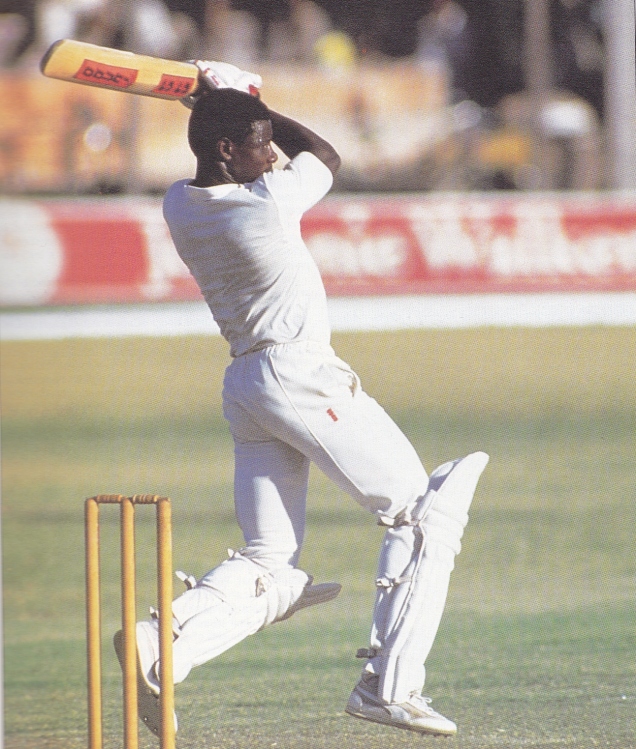
Down, but definitely not out. Richie Richardson makes 160
So with 418 on the board, every pessimist around was looking at 219 as the magic number to at least extend the game. But the clue here is in Frith’s pre-amble… things actually went well, for a while. Sure, Tim Robinson’s desperate tour continued with another cheap dismissal at the hands of Malcolm Marshall, but that would be the Windies’ only success on the second day.
“That blissful evening we went back over the scores. West Indies, an ominous 269 for 2, had crashed to 418 all out, and England were not 66 for 3, as might have been anticipated, but 110 for 1. Gower 51, Gooch 46. Clearly England’s best day of this uncomfortable tour.”
It wasn’t all plain sailing. Got to love 1980’s writing. Can’t see Newman writing this (perhaps Bunkers), but a certain journo may appreciate the commas…. I love it, by the way!
The captain had survived one particularly torrid over from Patterson, flashing a no-ball to the third man boundary and swishing at the next, standing meditatively, guiltily, not, in the time-honoured imagery, like a boy caught stealing jam, but rather like a marksman whose own ear had just blushingly been clipped by a bullet.
I actually remember my feelings of optimism, but then recalled one day’s play in particular. I thought of the Saturday in 1984 at Headingley. England had held the West Indies to a lead of 32, and their main man, Malcolm Marshall had a broken hand. We lost two early wickets but Fowler and Gower took us to 100 for 2 and all seemed great. We were in a car going to Rotterdam for a cricket tour at the time (and not getting in to our first choice camp site) and as we pitched the tents ready for the second party in the minibuses we then heard the wickets fall. 104 for 3, 106 for 4, 107 for 5, 135 for 6. Close of play and our dreams ruined. England would subside further on the Monday, Marshall took 7 wickets. Positions of strength were ephemeral against this team. They were more positions from which England would collapse. It was just a question of degree.
And collapse we did.
“Next morning grim reality returned. In the fifth over, Gower took four off Marshall with that same hook stroke he executed to his first ball in test cricket, nearly eight years ago. But then he felt for the next ball and was caught behind, his stand with Gooch worth 120….”
“Gooch went to a lifter four overs later. Willey to a static response three overs after that, giving Dujon a hat-trick of catches in seven overs.”
126 for 1, 126 for 2, 134 for 3, 141 for 4, 151 for 5, 168 for 6, 172 for 7, 181 for 8, 185 for 9, 189 all out. 63 runs for 9 wickets. You’ll be delighted to know Aplomb got 11. Marshall claimed four top order wickets, Patterson brushed up three lower middle order scalps. It was painfully familiar. All hope had gone. Looking to get on terms at the start of the day, England were batting for the second time after lunch, and six down at stumps. If Day 2 had been the day of miracles, day 3 was the day of misery.
“Lamb edged to second slip.”
“Botham, having staggered from the crease gasping for breath after a crack in the ribs from Holding, skyed an attempted hook off Patterson to give Dujon his fourth pre-lunch catch while becoming England’s fifth casualty of a disastrous session.”
The second innings started promisingly. An opening stand of 48 between Robinson and Gooch gave fleeting hope. But it was always only that. Gooch played on for 11 and Robinson for 43, both off Patterson, but then the resistance, such as it was, disintegrated in what Frith called a range of “one day strokes or reactions”.
“Botham’s kamikaze approach would have been extraordinary in any other batsman. His aim in this hopeless crisis seemed to be to smash a rapid 149 not out and let Thomas or somebody – his desperate self? – follow up with 8 for 43. We all continue to suppose this to be an impossibility. Ironically Botham died feebly with an offside waft after having thumped 21 off 4 balls.”
In researching this post I came across an excerpt from Botham’s autobiography – I have no idea which one as he’s written three to my knowledge – in which he revealed his mental state. There’s the infamous incidents that I might deal with later (or in the next post on this) but he comes into the dressing room after a dismissal and is absolutely livid. He screams out something along the lines of “how the hell are you supposed to play on a wicket like that? It’s dangerous” which would have done wonders for all that followed. According to his book, Gatting, who presumably had stayed on (he did, he played the 5th test) took him to one side (he was the vice-captain) and told him he was bang out of order and should not have done it. One of the commenters on the second part had a recall that Botham had had a poor attitude throughout. In my eyes, at that time, he was our superstar and people were out to get him. There was that feeling, in your logical self, that he was simply not a good enough batsman against extreme pace, but you tried not to think that. This was our hero.
“In the evening session, they had succumbed to their own low morale as anything else. Botham had come to the wicket with 20 minutes remaining, the score 108 for 4, and a rest day beckoning, but he played an innings totally out of context with that situation. It left the impression that the ship was rudderless, a view that was enhanced by the lack of demand on players to practice. ” B&H Yearbook
“The Way I Play” anyone?
It rained on the rest day. Aplomb and Embers batted a while, but it was a hopeless mission. England were finally dismissed for 199 and losing by an innings and 30 runs. It was 3-0. But if people thought the storm was over, it was only just beginning.
In the next part, I’ll deal with aftermath of the defeat, and the next test. I hope people are enjoying it. I think the quote below summed up how we all felt playing the WIndies….
“A gloom several shades deeper than the overcast sky itself descended over the England camp and its several thousand holidaymaking supporters. The pattern of West Indian dominance which had driven British writers and spectators to the edge of despair had reasserted itself, with no realistic prospect of its ever being lifted for more than the odd estatic hour”
In these days of scores approaching 400, there’s something curiously old fashioned about a game where 260 is the target and it goes down to the last few overs. It’s almost a throwback to the 1990s, with Ben Stokes playing the Derek Pringle role by going for six an over and being given out twice, and not out once when he probably should have been for a duck of glorious proportions.
It all meant that after the pyrotechnics of the first match, this seemed relatively low key throughout, where you notice that the Port Elizabeth crowd are not only fond of singing, but offer a rarity at any sporting location of being very much in tune. There’s something rather beautiful about it.
Perhaps South Africa did rather make heavy work of their last ten overs, but at that point a score of around 285 would have been towards the top of their aspirations anyway, so while 262 was disappointing, it is hard to make a case that they lost it just in that short period.
De Villiers’ dismissal to another exceptional catch, this time by Chris Jordan, did come at just the wrong time, but De Villiers was looking to go fully on the attack at that point anyway, with all the risks associated.
Much had been written about the surface being slower and less conducive to hitting, but it still felt at least 30 or 40 short. Of course, the change in mentality couldn’t be better expressed than in the feeling that if the England of a year ago had set that total they’d have walked off to applause from people pointing at their laptops, saying that would win most games historically. South Africa weren’t aiming for a score around that level, it’s simply how it turned out. In any one ODI, this can and does happen.
In truth England seemed in control for most of the run chase. Alex Hales will bat better than that for many fewer runs, and in some ways those are the most satisfying innings. It was cruel on him to be dismissed one short of a hundred he’d have worked so hard for.
When Hales was dismissed England still needed 61 off 52 balls and with half the side out, surely a tight finish was likely. 20 minutes later it was all over, as IPL bound Jos Buttler, aided and abetted by Moeen Ali, finished the match in a flurry of fours and sixes. He’s in some form.
An individual one day international is the equivalent of a McDonalds value meal, it’s appealing in advance, you quite enjoy it at the time, and afterwards you feel a bit empty and wondering why you’d anticipated it all day in the first place. But enjoying it at the time is no bad thing, though a Super Size Me month might leave the equivalent feeling of sickness.
Given England’s approach to the shorter forms of the game recently, it remains consistently fascinating how they could possibly have got it so wrong for so long. The team hierarchy of the time persistently denied that they were ever so fixated on statistics as was portrayed, though the less than entirely trustworthy Graeme Swann did claim that to be exactly what happened. Whatever the absolute truth of it, it is hard to believe that England would have carried on throwing the bat with abandon after their quickfire start in order to reach a total just shy of 400 – more that they would have felt that keeping wickets in hand and a decent score over 300 would have been viewed as satisfactory.
Perhaps that is overly harsh, for received wisdom is a very hard thing to fight against and there’s a tendency to paint failed regimes in the worst possible light, but the reality is that five of England’s seven highest one day international totals ever have come since June last year. Yes, it is true that the game has changed over the last few years, but it is only in this last seven months or so that England appear to have caught the zeitgeist.
Towards the end of the England innings it actually appeared quite possible that England might be bowled out, yet that didn’t stop them, they carried on attacking and considered being bowled out to be merely an occupational hazard. For supporters of other teams around the world, this must seem a statement of the most bleeding obvious there can be, but for those who follow England, seeing them play this way is still a startling thing to witness. There are a few players of recent vintage who would revel in this England approach.
Fifteen sixes were hit across the 50 overs, which is a record for England, and you wouldn’t bet against them breaking that again next time out. Jos Buttler will rightly get the plaudits, for a blistering century that came off 73 balls, and still represents his slowest one yet. That in itself indicates the absurdity of the past, and the delight of the present. For it is bringing the best out of players who when set free can be a joy to watch. For Root’s 52 off 58 balls to be the slowest innings in the top eight is absurd.
Buttler made the big score, but Roy looked more assured at the top of the innings than he has done before, Hales appeared liberated from the inhibited player in the Test series, while Stokes simply terrifies opponents at the moment. His catch to remove De Villiers on the boundary had the preposterousness of so many great all rounders of the past, for whom sometimes nothing is impossible.
South Africa’s run chase was ultimately doomed by the rain that curtailed the match and allowed England to win by the not insubstantial margin of 39 runs under Duckworth-Lewis-Stern (let us hope there are no further modifications to this system, it is taking a while to type) and in truth would probably have won the game had it gone to its natural conclusion But probably is only as far as can be said, for Quinten de Kock certainly had other ideas. He was on the field every ball of the match, and batted superbly well to be unbeaten on 138 when the weather closed in. With another 150 needed, and half the side out, it would have been a big ask, but not entirely impossible.
Thus far only batsmen have been mentioned rather than bowlers. One of many jokes a batsman will lob in the direction of their bowling colleagues is that they are there to serve – and to deal with it. In Test cricket, the bowlers are the most important members of the side, in ODI and T20 cricket, they really are there to serve.
England go 1-0 up, while South African supporters will lament that the shortened game robbed them of what could just possibly have been a great victory. There’s been enough in this match for there to be another queue at McDonald’s on Saturday.
“Deprived of the batsman who had been far the most impressive in application, technique and temperament, and accorded inadequate practice facilities on a tour of increasingly murmuring hostility from politicians and demonstrators, England entered the first Test Match with unease. The victories over India and Australia seemed far distant, and the Indian medium pacers and the Australian bowlers of average county standard were recalled with the nostalgia of blue remembered hills. Certainly the present reality of Patterson, Marshall, Garner and Holding offered darker mountains and threatening storm.” B&H Cricket Year – 5th Edition – First Test Match – Jamaica
Sabina Park. Even as a kid it sounded like a proper test venue, in much the same way that the WACA does, and Eden Gardens doesn’t (it sounds like a bloody flower show venue). Once the televising of overseas tests became the norm, then seeing what Sabina Park actually had to offer was a reaffirmation of those thoughts. Especially when you saw the pitch, rolled so much that it actually looked, at the start of a test, like a gymnasium floor, all polished and smooth. And bloody quick. Now, of course, it’s like all the rest. A bloody pudding.
Sabina Park – West Indies v England – 1986
But Jamaica would be where the test series started, and for some reason the Sabina/Caribbean tour experience seemed new to me. I don’t believe the 1980-1 series was on the radio, and I might be wrong, but I don’t really recall it and in any case, first year of secondary school was a bit of a mare that I try to erase. This test serues I do recall a bit more. It started on a school night, and as we were driving home we stopped at the shops. Mum left the keys in the car so we could listen to the radio as Gooch and Robinson got us off to an unexpectedly solid start. England had won the toss and batted.
There then followed what we’d all become used to. A procession of wickets. Robinson went for 6 and it was 32 for 1. Gower played a bit more fluently but went for 16. David Smith, making his test debut, went for 1. Two of the three falling to the new tyro, the man with pace truly like fire, Patrick Patterson. Doing homework, eating dinner, watching TV, I dipped in and out. Gooch and Lamb appeared to effect a recovery, but it was small in scale and Gooch went for 51. The innings fell away. Lamb made 49, no-one else made a thing. 159 all out. Patterson 4 for 30, Marshall 2 for 30. Garner was relatively expensive, with 2 for 58 in 14.3. Big Bird at 4 an over? Standards had slipped.
Three players made half-centuries for the hosts, Greenidge top-scoring with 58, Gomes with 56 and Dujon 54. Greg Thomas took the first scalp of the innings on his debut, taking Haynes. But his appearance miffed the B&H yearbook writer, who believed the omission of Neil Foster was “as cruel as it was incomprehensible”. The Essex Mafia were as strong then as they are now! Carlisle Best, making his debut too, began his test career hooking Ian Botham for 6. It would be a turbulent tour for Beefy. The star of the show had been Richard Ellison, fresh off his amazing end to the 1985 summer. He took 5 for 78, four of them LBW, and including Richards and Greenidge. However, with the WIndies, from my standpoint then, unless GG or IVA were spanking the runs (and RR to follow) I wasn’t that interested. Their bowling made them, their batting fed off them. The lead of 148 was imposing – in truth, in modern cricket that lead would look like 400 with that attack, on that pitch, and with that skill.
England made 152.
Alas Smith and Gower. Or The Despatch of the Two Daves.
The Yearbook mentions a lead of “manageable proportions”. Looking back at that now, even with the gift of hindsight, that looks very optimistic. Marshall, Garner and Patterson took three each. Robinson and Smith added ducks to their paltry first innings totals. Peter Willey made 71, in some part justifying his place, in others showing the hopelessness of it all. Promoted up to number 4, he showed why he was picked. But it was never going to be enough.
“Four of the best fast bowlers that the game has seen bowled at the top of their pace on a wicket which gave them assistance, and they were unfettered by any consideration for Law 42. Nothing should detract from the West Indian superiority, nor from their greatness of their fast bowlers, but this was cricket without subtlety and if one had only little sympathy for English batsmen of uncertain technique, one had great concern for the future of the game at international level.” B&H Yearbook
I’m not sure if this Bill Woodfull-esque or a reverse make them grovel. Bloody hell, it seemed pious and not a little unsporting. We were getting humped by a much better side in their own backyard. An all-time great team. And they knew it, both that team and the writers of the time. It was bellyaching.
Only while Gooch and Robinson batted without undue difficulty in the first hour of the match did England promise to give West Indies a harder fight than in 1984. Of the five West Indian victories in that series in England, two were achieved on the fourth day: at Sabina Park, after two England collapses, they had almost an hour to spare on the third when Haynes and Richardson completed the formality of scoring the 5 runs needed in West Indies’ second innings.
Once again the cause of England’s defeat was their inability to play exceptional fast bowling, much of it short-pitched. Their problems were accentuated by a fast, uneven surface and the presence in the West Indies ranks of Patterson, a 24-year-old Jamaican who, after failing to make much impact in a handful of games for Lancashire in 1985, forced his way into the West Indies team by his performances in the Shell Shield. Described before the Test as the fastest bowler in the Caribbean after Marshall, Patterson left no doubt in the England batsmen’s minds that the order should have been reversed. A heavyweight of 6ft 2in, with a sprinting run and powerful delivery, in England’s second innings he bowled at a pace comparable to that of Jeff Thomson of Australia in his prime. Deprived of the new ball by the prior claims of Marshall and Garner, he none the less took seven for 74 in his first Test and won the match award.
And yes…we were bad losers then…
England went into the game weakened by Gatting’s injury in the one-day international. (He returned home for further treatment after two days’ play.) Lamb was the only other batsman in true form following four games on sub-standard pitches, and the England batsmen were further incommoded by an inadequate sightscreen at the Southern end, which was too low to frame the hands of bowlers more than six feet tall. The Jamaica Cricket Association had been unable to grant England’s request to have it raised, lodged after their problems facing Walsh and Holding in the Jamaica match, because to do so would have obscured the view of an estimated 200 spectators to whom tickets had been sold. All Patterson’s wickets were taken from that end.
The English team licked the wounds of their 10 wicket beating and moved on to the Queen’s Park Oval for a tour match, an ODI and a test.
The writer of the piece in the Yearbook, and I’m assuming it was David Lemmon, must have been pleased to see Neil Foster take 6 for 54 in that match as in reply to a score of 229 made by England, Trinidad and Tobago were skittled for 109. In trying to set up a game due to bad weather early in the fixture, England didn’t pull off a win, but were reminded of the phenomenal depth in the home side’s fast bowling resources. Tony Gray, who played with some merit for Surrey, took 5 for 50 and if he were around in any other era might have picked up a regular berth. In the WIndies he was just another pace bowler.
The second ODI was a slightly different affair. Played on the 4th of March, West Indies were without Jeff Dujon who was replaced by Thelston Payne. For some reason, and I do not know why as I never saw him play, I always liked the thought of Thelston Payne playing for the West Indies. The surname…..the surname. The match was reduced by rain to just 37 overs a side, and the Windies struggled in the on-off conditions. After 28 overs they had 106 for 2. Now in the modern era 117 off 9 overs is still quite a lot – in that era it was almost unprecedented, and you know who, the King himself was the destroyer.
“Botham was brought back to bowl when Richards came in and the West Indian captain greeted his friend with a 4 through mid-wicket. This was a mere prelude,”
82 not out. 39 balls. Botham’s last over going for 23. Game Over.
In West Indies’ innings, Richards was in the form that makes him impossible to bowl to. The length of the ball, and especially its line, were immaterial as he scored his runs out of 117 in nine overs, overtaking Richardson who had a start of 38. The biggest of his 6s was a straight drive off Botham out of the ground, a hit of more than 100 yards.
Now, if there were TV coverage of the England innings existing, I guarantee it would be played in one of those dewey eyed montage talking head way for generations to come. England started by thinking outside the box. They needed over 6 an over, and so sent out Botham. It didn’t work (although Botham would open in ODIs soon enough), and Wilf Slack, out as a replacement for Gatting, came in at three. Together with Gooch he added 89 at over 5 an over, so for once, we were in the game. After one failure (and a glorious Ashes summer) this was enough to threaten Robinson’s place already. Despite Gooch going well, England needed 50 off the last 5 overs and only Smith as a recognised batsman (Downton was outside batting) remaining in with him. Gooch went for it. Smith played the odd shot to keep it going.
Now with an over or so to go comes my bizarre memory of this match. In those days big boxing match ups were rarely shown live on TV. They were held on midweek nights, and the fight shown the day after on Sportsnight. This game took place on a Tuesday, if memory serves, and Frank Bruno, the up and coming, glass-jawed hero of British heavyweight boxing (I’m being unfair, but most of us loved Frank) had a poster match-up as a final eliminator for the World title. Never mind Bonecrusher had knocked his lights out the year before, Frank got reinvented… That night he was due to fight Gerrie Coetzee at Wembley Arena. The thing was, the fight was due to start on Radio Two at the same time that Gooch was doing his thing in Trinidad. No red-button or digital channels in those days. The ODI was not on Radio 3 and it was a reporter (it might have been Pat Murphy, yes even that long ago, but I’m not sure) doing the commentary from Port of Spain. Nine was needed from the last over. Gooch had passed 100. This is what we’d really missed in his three years away.
First ball, single. Second ball, single. Third ball, four. Gooch pulls one through mid-wicket. 3 to win from three. Fourth ball, single. Fifth ball, Smith on strike, he swings, he missed. It’s a bye as they ran through to the Payne Man. One off the last ball. Patterson bowling. Gooch swings, the ball squirts off his pad, they run, the throw….
MISSES.
England win….the result is announced to the fervent boxing crowd at Wembley Arena. There’s a cheer. We feel good. C’mon Frank. Coetzee was knocked out in the first and many thousands of people bought tickets to watch Bruno get larruped by Tim Witherspoon later that Summer in the early hours of a July morning – or was it June? It seemed to sum up England actually. A brief feel-good, and years of futility.
The Second Test was played a few days later and Wilf Slack made his debut in place of Robinson who was injured. Smith, according to the Yearbook, had struggled with sunstroke in the first test and so Emburey played in his stead. This looked off, given he played in the ODI and the tour match against T&T. Still no Foster.
One of my memories of the pre-series build up was John Emburey saying he was looking forward to playing at Port of Spain because he reckoned the wickets would take spin. I raised my eyebrows at that one. Doubt there’d be much prep to that end for this tour, Ernie? But he wasn’t miles off the mark. He took 5 for 78 in the first innings – West Indies reply to another outstanding team effort of 176 in 44 overs – and two in the second innings as well. Peter Willey never got a bowl. Looks odd in hindsight.
Richie Richardson – 1986 Style…
England were asked to bat, which probably sounds like being asked to slice your own arm off, but the Yearbook suggests there was little about the pitch that influenced the decision, just our state of mind. Gooch got smacked by the second ball of the match, scampered two off the third and sent on his way with the 4th. Slack soon followed, also the Maco, and Willey hung around for a bit, before he went with the score on 30. Gower and Lamb then rebuilt the innings.
It’s something that always gets me when people think about David Gower and the West Indies, and I know that crap show with Lee Hurst, Nick Hancock and Rory McGrath had something to do with it, but if you actually look it up, Gower had a pretty decent record in the Caribbean. He wasn’t the waft outside off and casual nick off of repute. That’s just home televised laziness. In nine test, with us usually being thumped, he scored 746 runs at an average of 43.88 in the West Indies. That’s the equivalent, I kid you not, of averaging 60 now. These were wickets with pace, seam movement, in alien conditions against top bloody notch bowling. Sneer at his more lame home record against them, but never over there. Never.
Gower and Lamb (who played 79 tests and barely averaged 36, which isn’t a knock on him, but showed how damn tough it was back then – and averaged bang on his career mark in the Caribbean over 9 tests too) effected a more than decent recovery posting a century stand and taking England to 136 for 3. Now the mantra goes these days that you add two wickets to the score to get the true position of the match. With the West Indies, you added 2 runs per wicket remaining to get the true scope. OK, I exaggerate. 4. Four hours after the innings commenced Gower (67) and Lamb (62) were the only players to reach double figures and we were dismissed for 176. Marshall 4, Garner 3, Patterson a very expensive 2 and Walsh, in for Holding, 1. And what a one. Paul Downton. Walsh was outside medium pace bowling. If you are keeping tabs, Downton currently had test scores of 2,3 and 8 and had been picked for his batting. Yeah, I know…
West Indies then did their usual. Solid opening start. Greenidge first to go for 37. Haynes took them past 100, and then 200 with the mighty Richie Richardson (fast on the way to becoming one of my favourite ever players – god, I wanted to play like in. Played more like Robert Robinson). Richie made it to a century and then got out to spin, and he was followed by Haynes. Downton missed a straightforward stumping according to the yearbook, and so proved he was outside glovework, but it didn’t really matter. The West Indies didn’t collapse, Malcolm Marshall made one of those all too frequent lower order 50s the so and sos used to make when you thought you had them, and they almost got to 400. At this point Downton might have been asked what his ambitions for the tour might have been. He could have said “oh, 100 runs, 20 catches and making a little stumping here or there” to which we might have replied “I was hoping you’d say getting a drawn test.”
So, a deficit of over 200 against this lot. But there was to be a little bit of resistance. Slack made a duck to have us 2 for 1, but Gooch and Gower played well, putting on 80. Both were dismissed in their 40s, and both got out by the supposed weak link of the attack. When that weak link is Courtney Walsh, you sort of know you might be in a bit of bother. At 109 for 3, England remained 116 behind with seven wickets in hand, but the surrender wasn’t forthcoming. Another stand of 81 was built between Willey and Lamb, and this little brain was hoping this might be the start of something. Maybe a lead of 150? A chance to put some pressure on. Then logical brain told me to stop being an idiot. The stand went over a fair old time. Bad light ended play on day 3. Rain delayed Day 4. But crash, Lamb went LBW to Walsh for 40, Bang, Willey was bowled by Marshall, and then Wallop, Botham was caught by Thelston Payne, that man again, for 1 off Walsh and the hope died. As if it ever lived. 190 for 3 became 214 for 8. Downton showing he remained outside double figures with 5. Edmonds and Ellison took England past the humiliation of an innings defeat, and Greg Thomas joined the Kent man at the crease.
Things started to happen. Suddenly the bowlers seemed less threatening. The 9 and 11 were becoming entrenched. They could not be moved. The scoreboard wasn’t screaming round, but they weren’t getting out. I remember setting off to the Den to see my lot play Wimbledon and they were still batting. I had a portable radio, yes kids, a portable radio not the effing internet that ruined things, and kept on listening as the partnership passed 50. England reached 300, which wasn’t frequent against the great team. Extras brought up a stunning half century, with no balls and byes making up 47 well made, compact runs, for which Mr Aplomb must have dreamed. The fun had to end, but not before Les on the tannoy at the Old Den gave us updates. Sadly, like England, our night was to end in disappointment as Wimbledon won 1-0 through a Carlton Fairweather goal on their way to the top flight, taking with them one of our best players. No more Fash the Bash. No more Ellison and Thomas.
“….and proceeded to play with a resource and determination that must have shamed some of their colleagues. They added 72 runs, full of fight and energy, and West Indies were left to make 93 to win. It was an easy task but at least England had made the match last into the fifth day.”
The West Indies lost three wickets in reaching their goal, including Gomes for 0. But it was 2-0. There was no getting away from that. All the little bits of fight were just that. Little. Inconsequential. Nothing to worry our pretty little heads about. Take some consolation, but we were being battered. Absolutely battered.
The game was played against a background of demonstrations from a small group of anti-apartheid protesters, but there was no trouble inside the ground and, without being large, the gates were satisfactory. Marshall, who completed 200 wickets in his 42nd Test when he dismissed Downton, won the match award.
With three tests still to come, it didn’t, shall we say, look good. And nor was the off the field stuff….
The poignancy in writing this is overwhelming. In 1986 England travelled to the West Indies for a tour where, surprisingly, England were being built up to give the hosts a run for their money. Now, three decades on the common themes I encountered when researching this seem painful. The mention of the never-ending production line of rapid West Indian quicks. The verve and power of the batting, under the power of Viv Richards, the human tour de force. The packed crowds, jamming every corner of every ground, climbing trees to watch at homely stadia across the region. It’s almost cliche to look back like this now. But it’s painful. They were, really, that good. Put them on their own wickets, with conditions in their favour, they were invincible when at their best.
The anniversary of that tour clicks to number 30 this weekend, and I thought I’d do a little, or long, recap on thoughts of the time, and in hindsight. I’ve read up on the tour using the relevant B&H Yearbook (the 5th edition) and Wisden. The first part deals with the run-up to the series, the second starts at the first test and I hope to complete over the weekend. So, after that intro, Part 1…..
On 1 February 1986 England started their ill-fated tour of the Caribbean with a warm-up match on the island of St.Vincent. What was to ensue over the next few weeks was the cricketing equivalent of a mismatch. Unlike, for example, David Haye’s recent victim, England had to keep getting up after being knocked out, ready to take another pummelling from a far superior foe. The captain’s ship wasn’t just sinking, it was being ripped apart at the seams. We shall never see the like from those shores of the Caribbean ever again. So I thought I’d just write a few personal memories of the test series that confirmed that lightning really could strike twice. I was a schoolkid, keen as mustard on the sport, and hoping for the best, but fearing the worst.
Let’s put this into the context of the times. I’m guessing most of my readership are more than aware of how we got to where we did, but it does no harm to look back. Mid-80s English cricket had major heroes like Gower and Botham, but were looking down the barrel. Rebel tours took out some good players. The production line wasn’t exactly rolling top players into the team. We started losing to foes we never used to, such as New Zealand and Pakistan. Then, in a painful series, England were hammered 5-0 at home by a rampant West Indian force in 1984. The Blackwash series. They slaughtered us by an innings at Edgbaston, chased down 340 odd in just over two sessions at Lord’s, handed out a one-handed beating at Headingley, had Greenidge, Dujon and Davis take us apart at Old Trafford, before applying a routine coup de grace at The Oval. If England managed to get through the top order, the lower order helped bail the West Indies out. Even if they did, no-one thought we’d match their scores anyway. Defeatism reigned. Once Larry Gomes punched that ball to the boundary at Lord’s to chase down that 340 odd for the loss of 1, we really did put the dead into dead rubber. Hell, we got excited at Headingley because Paul Allott bowled well.
But there was a significant but. England were without their Apartheid Tour players and the bans were soon to be lifted. This meant the automatic reinstatement of Graham Gooch, probably the insertion of John Emburey, and maybe Peter Willey as well. The England selectors of the time certainly didn’t hold this betrayal against the various participants, as the 1985 Ashes series saw Gooch, Emburey and Willey in the team, and with Sidebottom and Les Taylor also given a shot. It always brings a smile to my face when you see some of the outlandish stuff now about “team culture”. Our keeper at the time was Paul Downton…..he didn’t rebel tour. Just thought I’d throw that in.
There was a definite whiff of optimism in the air going into 1985 and the “strengthening” of our team because a redoubtable band of men, without Ian Botham, went out to India and won 2-1. Tim Robinson, one of my favourite bats at the time, making a magnificent 160 in Delhi to set up a levelling win, and then Fowler and Gatting making double hundreds in Madras, as it then was, to back up Neil Foster’s excellent bowling to put us 2-1 up. Fowler made 201 there, and was dropped, never to play for England again, after the next test. He could probably feel a bit more peeved than most at the forgiveness shown to rebel tourists.
We won the Ashes 3-1 against a pretty feeble Australian team, kept afloat by Allan Border and Craig McDermott. It was a great summer of batting, England winning the last two test matches by an innings, including 300+ partnerships in both matches. Tim Robinson made two hundreds, so did Gatting, Gooch got a 196 at The Oval and captain Gower made three tons, all over 150, including a 215. As a kid watching that partnership at Edgbaston between Gower and Robinson, I was transfixed. My old favourite with my new.
So we were hopeful going into the next tour, the hardest tour. I was in the A Level years at school, so I was no callow youth, but I do recall reading all the previews and the suggestion was prevalent, if I’m correct. “Although no-one underestimates the strength of the opposition, one thing is certain. It won’t be another blackwash.” The old logical gene was going off the charts – they are at home, the wickets are fast, their bowling is miles better than ours, and their batting isn’t exactly crap, especially now Richie Richardson is established and looking good. But then hope over-rides that (and why that first test win in Jamaica in 1990 was so special) and you think about those writing these things “well, they must know what they are talking about…..”
These were the days before live TV coverage of cricket overseas. BBC would dabble with a little live play from Australia if it got interesting on an ad hoc basis, and we’d get the Channel 9 highlights (and those from New Zealand too with Peter Williams, I think, about as unbiased an anchor man you could ever have) for those tours. But there was nothing from the West Indies other than what the news would show you for five or ten seconds each night. On some occasions there wasn’t, I recall, total radio coverage because BBC with just a few stations weren’t prepared to have key slots taken up with the cricket. It is why one of my recollections of the first test was tuning into LBC (a London radio station where Jeff Stelling cut his teeth on football score coverage) every half hour to hear the Sunday score.
In these days of wall-to-wall coverage of pretty much all international cricket, you’d think the situation back then would be hell, but it really wasn’t. Sam Collins (yes, a name drop) said to a number of people talking to him after the DOAG screening I went to earlier this week, that it was like Stockholm Syndrome. We were grateful, extremely grateful, for whatever we got. There were no campaigns to get this live on the TV, because we had four channels. The technology did not exist. It was radio or nothing. When that coverage included the tones of Tony Cozier, it seemed absolutely dreamy. Exotic. Brilliant.
The tour, commencing on 1 February at the Arnos Vale (not Grove, you muppet. That’s on the Piccadilly Line) ground did not start auspiciously. The weakest team in the West Indian domestic competition bowled England out for 186, yet England fought back and bowled themselves to a small lead. This was not to prove vital. England barely scraped into three figures on their second dig, and the home team knocked the runs off for the loss of 3. This did not augur well. The one half century in the match was a 77 made by Mike Gatting, who at least had shown he was up for the challenge. The top score in the second innings? 18 by David Smith and Phil Edmonds. Desmond Collymore, the chief destroyer in the first innings with a career best 5-34, averaged 38 with the ball in the Shell Shield that year. We weren’t talking Marshall or Garner.
On to the Leeward Islands and another sketchy performance, but decidedly better in the first innings. The hosts made 236 with the wickets being shared around, and although no England player made three figures, they scored over 400 and set up the match. Leewards got to parity with 4 wickets down but Ralston Otto, a cousin of Curtly Ambrose, made 92 not out and set England 116 to win. The Leewards used two bowlers for the 34 overs that it would take to get these runs. At one end was Leicstershire man Winston Benjamin, and at the other, bowling superstar Richie Richardson! The latter actually took five wickets as England collapsed in a heap and finished grateful for a draw with 8 wickets down and 94 on the board. Tim Robinson, with 32, was the only one to hold his head up high. It wasn’t good.
The third prep game was against Jamaica, and England sealed a victory against one of the stronger sides in the West Indies. Gatting and Lamb made runs in the first innings, Lamb again in the second but still no hundreds, while the Jamaican wickets were well spread, with Les Taylor taking a lot of the top order scalps. England registered a 158 run win.
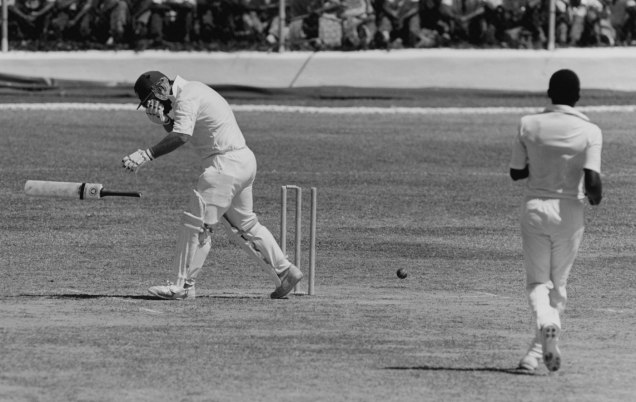
Of course back then England’s test and ODI teams were picked from the same squad and the fixtures were inter-mingled. The opening match against the full national side would be an ODI fixture at Sabina Park. A match that will live in infamy for the introduction of Balfour Patrick Patterson to an England team, and a projectile from Maco into Mike Gatting’s septum.
“A bad injury to Gatting, whose nose was broken when he missed an attempted hook off Marshall from a ball which cannoned off his face into the stumps, did far more damage to England than West Indies’ easy victory. They won with thirteen balls to spare in a match reduced by eight overs by their own slow over-rate, four fast bowlers and off-spinner Harper managing only 46 overs in the allowed 200 minutes. After England had been sent in, Patterson made immediate inroads by dismissing Robinson and Gower with his fourth and eighth balls in international cricket. Marshall prevented a full recovery by bowling Gatting and Gooch, and though Lamb and Willey added 62 off sixteen overs, England could not put West Indies under pressure. But for careless strokes by Gomes and Richardson with 7 runs needed, the margin would have been eight wickets.”
The ODI had been a disaster. All the fragilities we feared were exposed. The batting could hardly score at a pace to make us competitive, 145 off 46 overs. Marshall, Patterson, Garner and a young Courtney Walsh (Holding had been injured in the Jamaica match) gave us nothing. Then the West Indies scored patiently to win with a couple of overs to spare. The tests were just around the corner. The foreboding, immense. One thing was certain, 5-0 was a possibility all right.
Providing the weather holds, South Africa ought to win the final Test of the series some point tomorrow afternoon. For the match has been thoroughly one sided throughout and unless England somehow escape through their own endeavours, which is possible but unlikely, a draw seems most possible only with the help of a thunderstorm or two.
If that were to happen, then perhaps the finger could be pointed firmly at the home team’s captain and coaching staff, for the lack of urgency in building the lead in the second session and after tea was unusual to say the least. It’s not exactly a matter of batting on too long, more that with a more positive mindset they would have been able to declare somewhat earlier. Still, with three early wickets already taken South Africa would be disappointed if they failed to finish England off, so the point will probably be a moot one, but just occasionally, this conservatism comes back to haunt teams, as England found on a number of occasions, most notably in managing to lose a series in the Caribbean they dominated, but where sheer timidity cost them two Tests and one collapse ultimately the series.
Certainly South Africa’s reluctance to take risks was justified early on, for with Anderson taking two wickets in an over early on, there would have been some concern even though at 182 ahead for three wickets down, it was hardly disastrous; given the collapse in the last Test, perhaps it was forgivable. But the lack of acceleration after lunch was less so, as by that point they were 254 runs ahead with four wickets down. England probably weren’t too upset. Between lunch and tea they only scored 102 runs in 30 overs, and after tea 65 runs in 15.2 overs – a small acceleration, but hardly putting their collective foot down.
By that point, and with England going through the motions to an even greater extent than they have in the Test is a whole – bowling wide of the off stump and wide of the leg stump in an effort to restrain the scoring and keep them out there, the Test really wasn’t going anywhere, except for a debate as to whether they were intending to let Bavuma score a century. It was a touch peculiar, and suggested a side seriously lacking confidence, for there was no sign of an imminent declaration.
The rain break forced their hand and with a pretty nominal 382 required in 109 overs, England were left with just a draw to play for. They didn’t exactly start very well. Alex Hales did get one that kept a touch low, but that he hasn’t had a great series is plain. As ever, it needs to be qualified that he’s hardly alone in not having a great series. The radio report from Jonathan Agnew this evening highlighted that he’s averaged 17 across the Tests, and that is indeed not great. Yet it is as striking as it always is that this point was followed with saying that Cook was the next to be dismissed, with no mention of him only averaging 23 in the series.
It is tiresome to have to keep writing this, but it does Cook no favours to be treated as the prodigal son all the time. Yes, he has a very strong record behind him, and yes anyone can have a bad series. But to specifically, repeatedly and consistently overlook when the chosen one doesn’t do well as though it is of no consequence is failing to properly scrutinise matters. That does not mean for a second that Cook is or should be in any kind of danger of his place, for he had a decent 2015 after a disastrous 2013 and 2014 and has the fine career as evidence of his skill and ability. But what it does mean is that he has had a bad series. It happens. It’s worth noting. It’s worth mentioning. It is something that when totally ignored draws attention to the disparity in treatment. Sky have managed to skilfully ignore his poor series but still mention that he’s closing in on 10,000 Test runs. That will be a fine achievement, and worthy of comment as the first England player to reach that mark – though another would probably have done so sooner had his career not been curtailed. It is also true that he’s not had a great tour. It is quite astounding how the media will go out of their way to ever mention these things. Once again, it is not a case of criticising him heavily, querying his position, calling for his removal or any such thing, but it unquestionably is about highlighting how TMS can entirely ignore it, yet tweet a question as to whether Compton has convinced in this series with an average of 30.
For tomorrow, England do have a long batting line up, but assuming a full day’s play of 98 overs, pulling off a draw here would be an outstanding achievement. Indeed, nigh on impossible though the target might be, with a middle order as attacking as England’s is, it would probably be more likely that England win rather than bat out a draw, and that’s very unlikely indeed. And if South Africa do win the Test, then Scyld Berry’s point that it would have set up a fifth Test perfectly is ever more apposite. It was meant to happen, for the ECB promised it would a few years ago. It didn’t. And while the home team have to approve the scheduling, there has been a remarkable silence on the part of the ECB that their desire for five has been flouted. Four Tests is at least an improvement on the dreadful three match series in 2012 that was blamed on the Olympics, but five is the best Test format for big series for very good reason – as previous England – South Africa encounters have demonstrated amply. It’s not being wise after the event, plenty of people who love cricket were disappointed it wasn’t five before the series started. Apparently, only India and Australia are deserving of this. The Big Three who have accrued all the power and money to themselves, allowing five match series between themselves. Try to contain your shock.
England’s repeated defeats in the final Test of a series, dead rubber or otherwise, is beginning to look careless. Curiously, it isn’t so long ago that they suffered from losing the first Test of a tour consistently. The series win is a fine achievement, and whether South Africa are quite the side they were doesn’t change that. But if they do want to be the best side in the world, there’s plenty of work ahead of them yet.




 Being Outside Cricket