Integrity In English Cricket, And Other Myths

Yesterday, former Somerset chairman Andy Nash resigned his role on the ECB management board as a non-executive director representing the interests of the counties. In his resignation letter, Nash said that:

“The standards of Corporate Governance at the ECB are falling well short of acceptable and in all conscience I can’t allow myself to be associated with it.

Those are pretty damning words about the ECB, which should make him something of a hero here at Being Outside Cricket. Certainly, his core argument that the ECB is full of biases and that it is poorly run is one that most of us would agree with. The question I have regarding Nash is whether someone who has been on the ECB’s management board for almost five years, and a county chairman before that for another nine years, has any right to distance themselves from the decisions that the ECB has made in that time.

Certainly I question whether the specific issue which appears to have triggered his resignation is worth such a gesture. In the letter he sent to Colin Graves, Nash wrote:

The current fiasco over the actual / alleged / planned payments to TMGs [Test Match Grounds] is an exemplar. Whether intentional or not it clearly signals to many a move to promote 8 counties as the first among equals. As an ardent supporter of the 18 FCCs [first-class counties] this is not a direction I can live with.

To put this into context, it leaked this week (quelle surprise) that the ECB planned to give counties with Test match grounds an extra £500,000 in every year which they didn’t host a Test match. Now I’m certainly not suggesting that there is absolutely nothing dodgy about this arrangement. It could well have been a backroom deal to reward the larger counties for supporting the ECB’s new T20 competition, when a similar payment actually tied to hosting one of the new teams would have almost certainly been blocked by the other ten counties.

But equally, I believe that these payments are a necessary evil. The ECB’s policy of forcing counties to ‘bid’ in order to host England games since 2007, guaranteeing to pay the ECB a minimum amount even if the revenue the county receives from the game isn’t enough to cover the payment, has meant that being a Test match ground has been a financial struggle for many counties. The ECB have also considered factors like the capacity of grounds and the quality of the facilities when assigning games, which has meant that grounds have had to invest (at great expense) in updating and enlarging their stands simply in order to maintain their allocation of international games.

Last year, the ECB decided to reduce the number of home Test matches per year from seven to six. With Lord’s hosting two games annually, this means that at least three of the eight counties with Test grounds will miss out on Tests every year. This could cause significant financial problems and end up with more counties getting the same treatment as Durham, which no one wants. Well except perhaps for Durham fans, who might be glad to know that they weren’t singled out for punishment before the ECB decided to address the underlying problems in their own systems.

However, even though I might agree with the principle of ensuring that England’s international grounds have a guaranteed income, there have to be questions about how the policy has been arranged. It appears to be the case that the ECB’s management board did not approve of the decision for the ECB to hand out £1.5m annually, nor were they even informed. This suggests a worrying (and yet entirely unsurprising) lack of oversight for the people in charge, and perhaps a worthy justification for a person of principle to resign as a member of the ECB’s board.

Which brings us to Andy Nash’s principles. In an interview with BBC Somerset today, he said:

“It suggests we’re moving towards favouring an elite band of eight teams rather than treating 18 fairly, and that is not something I could reconcile my conscience to.”

Which of course is wonderful. Most readers here seem to support there being eighteen teams in English cricket. Bravo to such a man of conscience, willing to resign rather than even considering any move towards a future where English cricket is divided between the haves and have-nots. A future where eight counties stand alone above the rest.

Except, of course, that this is a relatively new position for him. As Somerset’s chairman, Nash voted in favour of the ECB’s new T20 competition which only has eight teams. Why? Apparently he was in possession of a signed letter from the ECB’s chairman, Colin Graves, stating that Somerset were well placed to host one of the new sides. He was also on the ECB management board at the time, representing (in theory) all 18 major counties, where he voted for the ECB’s proposition.

I would argue that Andy Nash was perfectly willing to live with a two-tier county system when he thought that Somerset might be in the top tier. Now that this is clearly not going to happen, it seems a little late to cast himself as an ardent defender of the smaller county teams.

So, to summarise: I agree with the ECB’s payments to Test grounds, but not the way it’s been managed. I agree with Andy Nash’s purported sentiments about maintaining 18 teams in English cricket and his assertion that the ECB’s level of governance is extremely poor, but consider him wholly complicit in the ECB’s actions during his time in significant positions of influence.

But I certainly agree with this quote from Nash’s interview on BBC Somerset:

“If, as directors, you’re learning about such things through the media then there’s something very wrong.”

As always, comments are welcomed below.

There Is Power In A Union

According to the singer Billy Bragg, trade unions are powerful and virtuous entities which support the workers against the abuses of their employers. They ensure fair pay, equitable treatment and protection from abuse. For professional cricketers and England and Wales, that role is filled by the Professional Cricketers’ Association.

The PCA helps support professional players in several ways. They help negotiate central contracts for England internationals, teach rookie players important lessons about what it means to be a modern sportsman, and support players after they leave the game. What they don’t do, in virtually any circumstances, is protect their members in any public way from the actions of the ECB. After several incidents in the past few years, I have been left wondering where the reaction from the player’s union was.

This post was prompted by a story posted today on the Daily Mail website. To summarise: Because of the large pay disparity between players who are and aren’t on central contracts, non-contracted players who played in 4 Tests, 10 limited overs games, or a combination of the two, would receive a £50,000 bonus. In the current England team, that would mean Stoneman, Vince, Malan, Curran and Roland-Jones are all due a large payout.

Except, of course, for the fact that the ECB are unmitigated arseholes and so have chosen to instead return to the old system of incremental contracts made solely at the discretion of the team’s director, Andrew Strauss. Of the five players who would have qualified for the bonus only Toby Roland-Jones has been offered an incremental contract, leaving the other four £50,000 out-of-pocket.

Now it may well be that the ECB were fully within their legal rights to get rid of these bonuses. I am not a lawyer, I haven’t seen the players’ contracts, I have no expertise in these areas. It certainly seems unethical to me though, withdrawing a bonus without informing the players involved. I would hope, if I were in that position and was a member of a players’ union, that they would intercede on my behalf. Instead, the PCA has remained silent on the issue.

But It All Amounts To Nothing If Together We Don’t Stand

Of course, sometimes silence is preferable to the alternative. As the saying goes, “Better to remain silent and be thought a fool than to speak and to remove all doubt.” In past years, the two things the PCA has most been associated with in the press have been when they have come out on entirely the wrong side of events.

In 2014, England played against India at Edgbaston in a T20I. During that game, the last of England’s summer that year, Moeen Ali was booed by a significant number of Indian fans. The reason? Because he’s a Muslim of Pakistani heritage. It was bigotry, pure and simple. It was certainly against the terms and conditions for people who bought their tickets. It was quite possibly illegal (again I reiterate, I am not a lawyer). But it was also something the ECB would wish to minimise, both in order not to antagonise the powerful BCCI and to present the appearance that there is little to no racism within cricket.

To that end, the PCA’s chairman Angus Porter said in an interview soon after that:

“There is an element of taking it as a compliment. You are more likely to boo someone when you think they are someone to be feared. Take it as a positive, you’d rather be booed than ignored.”

Personally, I think cricketers would take it as a positive if they weren’t ever subjected to racist abuse, and if that did happen then at least their union should support them rather than telling them to “take the positives”. After a swift and decisive backlash Porter did apologise for his words, but the fact he said them at all was pretty damning.

The second example of the PCA’s folly, and the one more apposite to this blog, is the infamous press release that the PCA and ECB jointly wrote about Kevin Pietersen. Of course the headline quote was about allegations “from people outside cricket”, which indirectly gave this blog its name, but there are some other gems in there as well. This paragraph, for example, has not aged well after England’s 4-0 thrashing in Australia:

“The England team needs to rebuild after the whitewash in Australia. To do that, we must invest in our captain, Alastair Cook, supporting him in creating a culture in which he will have the full support of all players, with everyone pulling in the same direction and able to trust each other.”

But the quote which really angers me regarding the PCA’s continued silence is this:

Clearly, what happens in the dressing room or team meetings should remain in that environment and not be shared with people not connected with the team.”

This is so hypocritical, it is bordering on comedy. I can think of few players in the history of English cricket that have been leaked against more than KP. If anything unflattering to Pietersen occurred within the private confines of the England camp, you could be assured that it would be in the paper the next day. I can’t recall the PCA ever standing up for him (I presume he’s a member) and demanding that the leakers be punished.

But Who’ll Defend The Workers Who Cannot Organise?

It is fairly easy to pick out several England cricketers in recent years who have been the subject of repeated ‘anonymous’ leaks questioning their character, ability or fitness. Joe Root, Adil Rashid, Gary Ballance and Jonny Bairstow, just to name the Yorkshire contingent. These largely baseless allegations from “sources inside the England camp” (or however it’s phrased) could have real negative consequences for these players’ careers. Clubs could be less likely to sign them, or lower the amount they are prepared to pay for them. I want the players’ union to stand up to the ECB and demand either the leaks stop or the leakers (and let’s face it, we know who most of them are) should be sacked.

Likewise, the ECB’s punishments are often arbitrary and unwarranted. If we just take the recent tour of Australia as an example, following the first Test and the revelations of Jonny Bairstow’s odd meeting with Cameron Bancroft there was a curfew placed on the whole England team. Because of the actions of one player, the whole team was punished.

A few weeks later, Ben Duckett dumped a drink over Jimmy Anderson and was severely punished with suspension from the Lions team. It emerged soon after that other players had done similar things during the night, but only Duckett was punished at all.

And throughout the whole tour, Ben Stokes was named in the squad but unofficially suspended. Really, anything with the word “unofficial” is going to be a bit dodgy. Now, it’s possible that visa issues would have prevented Stokes entering the country, but it seems equally likely that the ECB failed to follow any kind of due process with someone who is presumably a PCA member.

Being a fan of cricket, I have more affection for the players than anyone else in the game. I certainly like them more than the sport’s administrators, the coaches, the journalists, the commentators, and even the other fans. I want them to be well paid, well prepared for life as a professional sportsman, and also well prepared for life after cricket. The PCA appears to achieve these things, and I am grateful.

But I also want the players to be defended when attacked, or abused, or treated unfairly, and it is here that I find the PCA lacking. The players deserve better, and I hope their union faces up to that challenge.

As always, we welcome your comments below.

All Stars Cricket II: The Quickening

Last May, I wrote a post on a tiny blog I had started to rail against problems in English cricket. This post was about the ECB’s latest initiative, All Stars Cricket, and how I believed it to be a colossal failure. Virtually no one read it though, because I’m a nobody with barely any Twitter followers and I never played professional cricket (which appears to be a prerequisite for cricket journalism nowadays). One of the handful of people who did read it was thelegglance, and he liked it enough to repost it here on BOC. That one post got me in the door here, and I’ve since been lucky enough since to be invited to the inside of Being Outside Cricket.

This week marks the opening of the sign up period for kids to join this year’s edition of All Stars Cricket. Assuming your local club has filled in the necessary forms online, you will be able to register your kids for it very soon. For £40 your 5-8 year old kid can have their own personalised cricket kit delivered right to your door, plus 8 sessions at your local cricket club. This might come as a surprise to you, because there hasn’t been much publicity about it so far. If I wasn’t researching this article, I’m honestly not sure that I would have known.

So it would appear that the ECB have not learnt their lesson from last year, when they failed to market the scheme effectively despite some grand promises made during the launch event last March. So what has changed from last year? The answer, unsurprisingly, is not much.

If your kid still has last year’s kits and you were wondering if they could just use that and save yourself £35, the answer is no. There is a new shirt design, and perhaps more crucially a set of stumps included in the kit bag. There are a few minor alterations to the kits the club can get too, the standout part of which for me was that they are now offering “female specific clothing” for ‘Activators’, the ECB’s buzzword for coaches and volunteers.

As I said at the start of this post, I’ve been lucky enough to be here for almost a year now. In that time, I don’t think I’ve ever sworn on the site. I have only ever gone as far as saying ‘shit’ a few times on my Twitter (and admittedly a few gifs of people extending their middle finger). I am not a person who likes to swear. But the ECB apparently launched this scheme with the assumption that women wouldn’t be a part of their  “major grassroots initiative” to increase participation in cricket. In 2017? Seriously? Fuck these guys.

The Australian Blueprint

As you may know, the ECB’s All Stars Cricket scheme is more or less a direct copy of Cricket Australia’s in2CRICKET program. The ECB even hired Matt Dwyer, the man who had run the scheme for four years in Australia. It costs pretty much the same, it gives the kids pretty much the same equipment, and the activities are probably virtually the same too. It even has roughly the same number of kids as All Stars Cricket, with 35,731 kids taking part in Australia compared to around 37,000 in England and Wales.

Except, of course, that Australia has a much smaller population than England and Wales. Less than half, in fact. In2CRICKET’s participation figures are actually the equivalent of just over 83,000 if you take that into account, far beyond the figures for All Stars Cricket.

So what lessons can the ECB learn from Cricket Australia’s example? There are so many things that I almost don’t know where to start. Obviously the elephant in the room is that the sport is freely available in Australia, with live cricket appearing on free to air television. Kids see the game, like it, and want to play it. They not only like the game, they like the players. Most English players could walk down any High Street in the country with a fair chance of not being recognised. Obviously nothing is going to change about this situation for the next few years, but it needed to be said.

One thing I do wish the ECB might learn is consistency. In2CRICKET launched in 1996 as Have-A-Go Cricket and is now 21 years old. I’d honestly be amazed if All Stars Cricket managed to last 5 years. The ECB seem to have a predilection for launching new initiatives and scrapping old ones with barely a thought. No sooner has a club got themselves familiar with the status quo than the ECB will throw in a new scheme, often with more training and paperwork for the volunteers running the club. I would wager that constantly having to jump through hoops of the ECB’s devising is a major reason for people involved in clubs behind the scenes leaving the sport.

There is also a feeling with Cricket Australia’s youth development that everything is joined together and part of a larger plan. Whilst getting cricket into schools in England and Wales is largely done by the independent (and currently underfunded) Chance To Shine charity, in Australia it is done by Cricket Australia’s in2CRICKET Skills program. Whilst Chance To Shine claims to reach around 250,000 children per year in the UK, the Australian scheme reaches 500,000 every year. If we again consider the differences in population between the two countries, that is the equivalent of 1.16m children in England and Wales every year.

And what happens when the kids turn nine? Cricket Australia has a similar program for them too: the somewhat confusingly named Milo T20 Blast. Although it shares its name with our domestic T20 competition, it is in fact a more grown up version of All Stars Cricket aimed at 9-12 year olds.

All of which inexorably leads me to the conclusion that the ECB have failed to understand why youth participation in cricket is significantly higher in Australia than in England, and why Cricket Australia’s schemes are successful whilst theirs aren’t. Simply copying a single part of what is clearly an effective development framework is no more likely to work than teaching British kids how to speak Portuguese in the hope that it will make them play football like Ronaldo.

The ECB would contend that they do have a master plan for improving English cricket: Cricket Unleashed. All I can say is that if you can pick out a single substantive thing the ECB are going to do to increase participation on their website then you clearly understand business jargon a lot better than I, because the whole thing reads like vague nonsense to me.

Which leads us back to this year’s All Stars Cricket. By all accounts it is fun, and kids seem to love the personalised kit, so if your 5-8 year old kid is interested in cricket and you can spare £40 then there are probably worse ways to spend the money. But let’s not kid ourselves, All Stars Cricket is still not going to do what the ECB want it to do.

As always, comments welcome below.

Guest Post: What Chance Have You Got Against A Tie And A Crest?

Whilst that annoying little thing called work has got in the way of writing this week, one of our resident commenters, Topshelf, has kindly written a piece around the lack of appeal and meritocracy that is so ingrained in English cricket.

As always, we are extremely grateful for people putting the time and effort in to write for us, especially on a subject the other editors don’t have personal experience of. As with all of our guest posts, please bear in mind that for many of our guest writers, publishing on the blog is a new experience for them, so please afford a bit more respect than some of our usual rants.

Over to you Topshelf…..

On the 5th of January, David Hopps commented on Twitter:

“There are 8 private schoolboys in this England XI, some from overseas, even including Yorkshire who like to feel they spread the net wide. Well, well done the private sector for backing cricket. But the net is narrow. That’s all you need to know.”

Lizzie Ammon replied :

“Don’t get me started on county age cricket. The least meritocratic system on earth.”

On the 7th of January, on the way home from the first borough training session of the year, my county age-group son said: “Dad, I reckon I’m the only state-school boy at training now.”

Given that pretty much every conversation I’d just had with other parents had begun “So where’s X going to school?” it seemed he was probably right. (One of my simple pleasures in life is enjoying the moment of blinking panic as other parents try to work out why they haven’t heard of my son’s minor public school, before I put them out of their misery – “It’s just a state school, it’s 5 minutes from my house.”)

Of course, on the 8th of January, England’s 8 private schoolboys finally succumbed 4-0 to Australia.  The predictable blame-game began, and the usual suspects took aim at the county system, bemoaning the lack of true quick bowlers, the emphasis on white-ball cricket, the scheduling of championship cricket, all of which no doubt have a detrimental effect. George Dobell aimed wider, saying:

“The talent pool on which the game relies has grown shallow and is absurdly over-reliant upon the private schools, Asian and ex-pat communities.”

As if to rub it in, we’ve just seen another 10 public schoolboys in England kit capitulate dismally against Australia and a very good leg-spinner, Lloyd Pope’s extraordinary 8-35 sending them spiralling out of the U19 World Cup.

So, putting on my best Peter Moores hat, I thought I’d have a look at the data.

Firstly, a quick comparison. The last time England won the U19 World Cup – in 1998 – only 3 squad members attended fee-paying schools, compared to the 11 Daryl Cullinans this time. England’s best Ashes team of recent times, the 2005 squad, contained just 4 “posh nobs”, while even the 2011 3-1 team only had 6 by the final test. Of course, as is the way with data-mining, things soon expanded. I’ve now looked at every Test debutant since 1990, and every currently contracted county player. I know far more than I ever expected to about the sports scholarship system, and will probably be getting ads for private schools on my laptop until the end of time.

It will surprise no-one that cricket is a sport that favours the public schoolboy. Of 141 players to make their debuts since 1990, 48 (34%) attended at least a private 6th form. For context, 18% of pupils in England do the same, so a recent Test cricketer is almost twice as likely to be privately educated. As you would expect, given the number of state playing fields sold off by successive governments since 1979, the trend is definitely upwards. The 90’s saw 14 private school debuts of 59 (24%), the 00’s 14 of 44 (32%), while this decade has seen 20 out of 38 (53%) so far.

So far, so predictable. Cricket is an expensive sport that requires open spaces to play, and a big sacrifice of parental time. It is hidden behind a paywall, and rarely played in state schools. Much like rugby union – where, amazingly, around 60% of English Premiership players are ex public schoolboys – its appeal to the “working class” is diminishing. It’s little wonder that it risks becoming a niche sport for the privileged few. That is borne out by the fact that of 313 currently contracted and English qualified county players, 138 were privately educated, which is 42%, well over twice what demographics would predict. (Worth noting also that there are another 86 players who are out of the England picture, which is nearly 22% of the total. But that’s another story.)  Many of these schools are more sporting academy than traditional educational establishment, although no doubt they would stress their academic credentials as well. The school that provides the most cricketers, Millfield (with 10), not only has great cricket facilities, it has a golf course and equestrian centre. The school claimed in 2015 to have around 50 former pupils playing international sport every year. Like many others, it has an extensive sports scholarship system in place, and is able to hoover up a great deal of promising talent.

The first thing you notice when looking at recent England test players is a truism. Batsmen go to public school. Bowlers, especially quick bowlers, don’t. It’s the modern-day equivalent of Gentlemen and Players. Of the 46 batsmen to make debuts since the 1990, 26 (57%) were educated privately. Conversely, of the 62 fast bowlers and fast-bowling all-rounders, only 13 (21%) went to private schools. This makes a sort of sense; more and more public schools are recruiting cricketers using sports scholarships, which aren’t cheap, for school or pupil. Often counties are involved in referring promising players, and it’s a lot easier to pick a batsman, whose numbers are usually pretty clear. For a start, they’re allowed to bat long enough to get big scores, while young bowlers are ham-strung by ECB guidelines restricting the overs they can bowl. Bowlers also mature later, and are prone to injury. Very few schools (and counties, who are known to contribute as well) are going to commit tens of thousands of pounds to a promising bowler who might stop growing or develop stress fractures. And I’ve heard plenty of horror stories about how counties treat the attrition rate of their young fast bowlers anyway – one county reportedly considers it a success if 1 in 6 of their late teen quicks makes it to adulthood unscathed.

It also becomes clear that going to a private school gets you a longer Test career as a batsman. Of those 46 batsmen, the private school players get on average 37.3 Tests, with half playing over 15, while the state school boys get only 27.6, with half playing under 7. At this point it would be easy to cry foul, and assume that the likes of Downton (Sevenoaks), Whitaker (Uppingham) and Strauss (Radley) favour their own. However, the truth is probably simpler. A public school batsman has very likely already been selected for his ability – for example Joe Root and his Yorkshire-arranged scholarship to Worksop College – at an early age. He will have had access to years of high-class coaching, bowling machines, and, most importantly, many many more matches than his state counterpart. It’s no surprise that they perform better overall. And having had a good look, I can’t find anything that suggests worse players get more of a go if they come from the right sort of family. Albeit a bowler, the final word on obvious bias should be Mark Wood, alumnus of Ashington High School, who is apparently still in the Test reckoning after 26 wickets in 10 tests at an average of 40.65.

At this point it would be easy to shrug – how could any state school compete? –  and hope that the holy grail of the City T20 being intermittently on free-to-air will miraculously enthuse a new generation of kids. Who’ll still have nowhere to play, and lack the money for kit and coaching. The lucky few will still get a cheap ride through a private 6th form, assuming they start, or, more importantly, keep playing in the first place. Perhaps they can consult The Cricketer’s helpful Top 100 Schools Guide – state schools up to 9 this year…

But state-school participation matters, massively, not only for the obvious social and participation reasons, but also for the future success of the England team. Put simply, if state-school cricketers don’t make it to the top, England’s Test team will be a team of batsmen only.

In county cricket, public school batsmen make up 53% of their total, while quicks are only 30%, the smallest proportion. Nowhere is this disparity clearest than at Middlesex, which has 5 of 7 privately educated batsmen, but only 1 bowler of 8 who’s familiar with an apple-pie bed. Nor is stacking your team with posh boys any predictor of success. Essex won the Championship with only 3 players from the private sector (none bowlers, shock, and the fewest in the division) and a core of locally educated boys. Middlesex were relegated with 13 of 24 posh boys, while Sussex languish in Division 2 with a staggering 15 of 17 privately educated English players. God only knows what Tymal Mills must make of that dressing room.

The England U19 squad’s stand-out bowler has been Dillon Pennington (Wrekin College and Worcestershire), who lets it go at about 83mph. He looks a very decent cricketer, but compared to the Indian opening pair, who both touched 90mph, is a bit pedestrian. No doubt he has been very well coached, but one wonders how much progression he has left in him. If I were a county coach I’d much rather see a raw state-school bowler who has not had his opportunities, and probably has a much greater upside. But therein lies the problem. If state-school cricket continues to decline, and counties continue to outsource the training of their top youth cricketers to the private schools, how will a promising quick bowler ever make it far enough to be spotted? And how will England’s batsmen ever face high class bowling growing up if they all head off to private school to play each other? Does it really matter to the counties if long-form bowling standards drop as long as they drop uniformly? After all, the likes of Tom Curran, with plenty of T20 “skills”, are much more useful in white-ball cricket, where he doesn’t need the raw pace he’ll never have. And we all know that T20 is where the money and the future lies. The men’s Test team clearly struggled against real pace, while the U19s seemed never to have seen high-class leg-spin before. Which, to be fair, they probably never had. I know that Mason Crane exists as a product of the private system; he is an outlier though, lucky enough to be coached at Lancing College by Rajesh Maru, a proper spinner in his day.

So is there hope? The charity Chance to Shine has shown cricket to over a million primary school kids, and Sukhjit Singh, a left-arm spinner at Warwickshire, is the first boy to have been discovered by the programme to make it to a professional contract. The ECB’s All Stars programme is trying to attract the young primary pupil. And in researching this, I discovered the existence of The MCC Foundation Hubs, another charity which aims to provide free coaching to promising state secondary children not yet in the county system. There are already 54 of them, and they have ambitious plans to roll out all over the country. Sadly, I’d never heard of them, and nor had my club, which is something of a worry. And their promotional video has a representative of Eastbourne College proudly talking about the children they have picked up from the scheme as sports scholars!

I occasionally play cricket in a local park early on a Sunday morning. When we arrive the pitch is usually being used by local Afghan families playing a break-neck version of T20 they’ve started at dawn. Everybody from 14 to 50 bowls as fast as they can, spins it as hard as they can, and hits it as far as they can. Maybe if we can get these kids into club cricket through the likes of the MCC Hubs we’ll be able to tap a fabulous resource, and we’ll get our own Rashid Khan, or at least Shapoor Zadran, one day. If we don’t make the effort soon, I really fear for the future of test bowling in this country.

As for my son, well, he’s a bowling all-rounder, with plenty of growth left in him. No private school is going to be coming for him yet. So we’ll continue with club cricket, probably playing more adult matches, hope to keep his place in the county system, and carry on saving up for 6th form…

Once again, many thanks to Topshelf for putting this piece together for what is our 900th post in just under 3 years. As always, if you fancy writing a guest post, please send it to any or all of us. Our email addresses are listed in the ‘contact us’ section.
Sleepwalking into the Slaughterhouse

If you’ve read any of the cricketing press or numerous posts on Twitter recently, you may have mistakenly believed that England are the best run and most innovative cricket side in the world. No mention of the 4-0 Test defeat, just praise of England’s white ball cricket hero’s in destroying the Australian white ball team. Everything is now rosy again. Operation sweep ‘the Test side and everything that is wrong with English cricket’ under the carpet is in full swing. I’m sure that Messer’s Graves and Harrison couldn’t be happier after all it was the white ball focus that led England to hire Bayliss as Coach and prioritize ahead of all other forms! All is going to plan for our glorious ascent to World Cup winners in 2019. Deck the halls with boughs of holly! Cricket’s coming home!

You won’t be surprised to hear that I’m not feeling as full of the joys of spring as some of the above people. Sure it has been a great performance by our white ball team, but it’s all ‘after the Lord Mayor’s show’ for me, a tepid rice pudding after a main course of old manure that we had served to us during the Test series. Now of course, I’m not aiming to denigrate the skill of our white ball team as England have finally produced a team of extremely talented players. The likes of Roy, Buttler, Stokes, Woakes and Bairstow could probably walk into any ODI team now and will likely be in line for deserved financial rewards in the IPL, which is great for them and for those that are a fan of ODI cricket. Except that I’m not. There is nothing the white ball team can do to erase the pain and embarrassment of watching England implode again away from home in Test Cricket. The ODI team could hit 400 each innings and then bowl Australia out for 10 and yet it would still only raise the smallest of smiles knowing that all it does is to provide our greedy administrators with a mandate that they know best and that cricket has never been in better health under their watch. Call me cynical, call me outdated, call me wrong, but I’m only describing how I feel about English cricket at the moment. England winning the One Day Series is like putting a plaster on a severed leg as far as I’m concerned; indeed this analogy also seems to work in terms of what our friends at the ECB are currently doing.

Oh and on another note, you may well have noticed who’s back, back again. Downton’s back, tell a friend. As much as I would enjoy writing another article based on the absolute incompetence of Paul Downton, I’m not sure I could add too much that hasn’t been said before. An individual so ingrained with the ECB’s modus operandi that he had decided the fate of a certain South African born batsmen before he had even got on the plane, failed to produce the so-called dossier of misdemeanors that said player has been sacked for and then went on to blame this individual’s book, which had been written a number of months later as the core reason that Mr. Pietersen had to be sacked. Downton then went on to lay all his eggs in the Peter Moore’s camp, a genuine man but one who was never cut out for International Cricket, but also a man who would never pick Pietersen nor question the ECB’s stance. We then had all of the gaffes, the disastrous defeat to Sri Lanka (which was some of the worst Test Cricket I’ve ever seen) and the culmination of a pathetic and embarrassing World Cup performance in 2015. Simon Hughes might defend his mate to the hills and who knows, he might be a decent man in real life, but purely looking at his CV from a cricketing point of view, then there should be no way that this guy ever runs a cricketing side again. Except no-one told this to Kent.

Equally, we can look at the hire of Rob Andrew at Sussex, a man who hardly covered himself in glory in his reign as leader of the RFU, yet finds himself in another CEO position. Andrew was the establishment’s master of survival: changing titles, moving sideways, losing influence, but still there on the sidelines grimly holding on to power. Indeed, Andrew mentioned in his book:

“The game I played in the closing decade of the amateur era was completely different from the one we watch and marvel at today,” Yet despite that, we continue to demand more of the players; more rugby at ever-higher velocity, at ever greater risk to life and limb.”

“The reason? No-one wants to cut back on the number of matches because matches mean money. Where rugby finds itself now is in the early stages of a conflict over the nature of the compromise – a scrap for viability.”

There are many individuals out there who know more than me about the game of rugby; however the mantra has always seemed to focus on delivering short term profit, irrespective of the quality of the game, nor the health of the players or focusing on a long term increase in demand. I wonder if anyone else finds this strangely familiar to the position that cricket in the UK finds itself in.

It would be fair to ask, why I have waffled on about these two in particular, but for me these 2 individuals symbolize the malaise of English cricket, the very essence of ‘jobs for the boys’. It doesn’t matter if you have failed miserably in the past, as long as you spout the right buzzwords and can tap into your friends at the ECB, then come on down and make yourself comfortable, perhaps take a six figure salary at the same time. Yet in my own opinion, counties such as Kent and Sussex (and there are plenty more out there) have simply signed their own death warrant. They’ve not noticed the wolves at the door, the wolves that are most keen in furthering their own career rather than doing what’s best for their counties or players and are very happy to cozy up to their mates at the ECB to ensure that they are rewarded. It doesn’t take a genius to work out that the ECB views the counties as cannon fodder for when the red ball game goes badly, a nice diversionary scapegoat. It is also clear that the ECB and Tom Harrison in particular really doesn’t give much of a hoot about the red-ball game at all. It’s there to scrape in television money whilst it still can, whilst Harrison tries to find the next big thing – T20, T10, Franchise Cricket, Underwater Cricket or whatever else he can think of that might make a quick buck or two. So let’s guess how Harrison feels about county championship cricket without its’ so called big crowds, interest from Sky and razzmatazz? Well of course, it’s been relegated to the very margins of the English season, there to appease the traditionalists, whilst he tramples all over them by trying to shoe-horn what he feels is the savior of English Cricket – the city based T20.

Yet, what can we expect from this beast that the counties are only belatedly seeing as a real threat to their existence? Whilst Harrison might have made a pretty penny out of Sky, is this really going to be savior of English cricket? In my opinion, this is an emphatic no. We don’t just need to look at our own competition, which is heavily reliant and weighted to those who want to go and throw 10 pints of ridiculously expensive Fosters down their throat on a Friday night; we can look at other ‘franchise’ competitions that are hardly setting the world alight. 5 of the 6 teams in the PSL are struggling to make their sponsorship targets and are looking for financial bail outs, the Big Bash league attendances are down by over 150,000 year on year and the South African franchise cricket never even got off the ground, when the television companies rightly thought they were massively overvaluing it. It would also be fair to mention that the above countries haven’t hidden their cricket away on pay-per-view for the past 12 years either and yet they are still struggling, so why on earth does the ECB think that this is the goose that lays the golden egg? That this new competition is suddenly going to turn around years of disinterest from an audience who hasn’t been able to access to live cricket on TV without owning Sky? That the huge costs in implementing this and paying off the counties is actually going generate long term interest and revenue? This seems to be a huge white elephant which is growing by the day, yet Harrison and Graves are willing to bet the future of English cricket on a hunch and a whim. Even worse, the counties through a mixture of self-interest and incompetent hires such as Downton and Andrew have been complicit in their demise from Day 1.

There it is, whilst Graves, Harrison and Downton ride off into the sunset on the gravy train, the rest of English cricket will look back with regret on the day they unwittingly slumbered into the slaughterhouse. Even worse, they’ll reflect that they could and should have done something about it, but hey, that’s just not cricket is it?

County Cricket: Is It To Blame?

In light of England’s performances this winter, a particularly Difficult Winter some might say, it will surprise no one that people are looking for someone to blame. Whilst alcohol and team discipline have been strong contenders, it looks like county cricket will ultimately be the designated scapegoat to cover the ECB’s embarrassment.

The argument is this: County cricket is not creating world-class batsmen, fast bowlers or spin bowlers. The selectors are choosing the best players available, the coaches are doing the best they can with what they’ve been given, and therefore it isn’t the England team’s fault that they are losing.

Is It The Responsibility Of County Cricket To Develop Test Cricketers?

I don’t believe that developing players for England is a priority for county teams, nor should it be. The main focus of every county is to win their next game and ultimately to win the competition. The County Championship is a competition which has run for 127 years and winning it means a lot to the players, staff and fans.

The emergence of Test-ready players has always been a side product of the counties finding promising young cricketers to improve their own team, and then the players reaching close to their potential through training and playing in competitive domestic games. It has never been the counties’ goal.

Is It In The Counties’ Interest To Develop Test Cricketers?

There’s two aspects to this question: Does it help them win games, and does it make a profit.

It could be argued that developing Test-quality players isn’t advantageous for county teams. The current county champions are Essex, who haven’t developed a Test-quality player since Alastair Cook over a decade ago. Yorkshire have produced two world-class batsmen in Root and Bairstow and are essentially punished by having both only play in two games each this season.

So a county which develops a batsman for England gets perhaps 2 years of above-average returns from their player before their England call up, at which point they’re forced to rely on a second-string player to fill the gap. It would arguably be better for them to grow or sign a player who is marginally better than most county batsmen but not so good as to be in contention for an England spot. At least that way they are virtually guaranteed to be able to pick their first choice XI.

There’s little financial incentive to work on development either. There have been three genuinely world-class players to debut for England in the last 10 years: Joe Root, Jonny Bairstow and Ben Stokes. Durham have in recent years provided a world-class allrounder to the England team, as well as their current opener and perhaps their two best fast bowlers. Rather than getting a generous stipend from the ECB for Stokes, who is possibly the lynchpin of the whole England team, they have had their Test status revoked and massive points penalties after having to accept a bailout. Yorkshire have developed two world-class players and yet they probably have the most debt of any county. Including their planned ground redevelopment, they now owe something like £40m.

Neither county is benefitting financially in any significant way from these players. It probably costs a lot of money to find talented youngsters and train them from junior cricket through to the cusp of the England team. It almost certainly makes more sense financially to simply hire journeyman cricketers from other teams, or indeed other countries like Australia and South Africa, than to grow your own.

What’s The Solution?

Firstly, I’m not entirely convinced that debutants coming into the side are necessarily of a significantly lower quality than players in the past. It is the nature of sport that players are rarely playing at their full potential when they are first picked for the national team. Instead, they typically improve by playing against a higher calibre of opposition and by being fine-tuned by the team’s coaches. The players who are on central contracts have very little to do with their respective counties once they enter the national side, and so how can domestic cricket be to blame for them not performing or becoming better cricketers? If players aren’t improving (or even regressing) whilst in the England setup, that has to be an issue of selection and coaching.

The ECB also takes a huge role in attempting to develop the most promising young players in English cricket. Through the England under-19s, Loughborough and the England Lions teams, they get their hands on most of the promising young players long before they’re in contention for the national team. Therefore, one obvious solution would be for the ECB to fix what appears to be a broken system. Andy Flower became the Technical Director Of Elite Development at the ECB in 2014 after he was fired as coach of the England Men’s team, which means that he is ultimately responsible for both the England Lions and the ECB academy at Loughborough. If he has failed to produce one “elite” player in his four years working there, surely questions have to be asked about his effectiveness.

Even if you accept the premise that county cricket needs to do more to create world-class players, it’s not immediately clear what could be changed to make that happen. I would guess that the ECB’s plan of replacing the county youth academies with their own regional youth academies will resurface, having been shelved to placate the counties before they voted in favour of the new T20 competition. This may be the dumbest idea known to man. The national academy at Loughborough has not only failed to develop an elite player in recent years (or ever, as far as I’m aware), I’ve honestly never even heard it being credited for improving a single player. Not one. And they want to take over the county academies, at least some of which do actually work.

There are some suggestions about dramatically changing the structure of county cricket which will quite simply never happen. Some people suggest that the quality of the Championship would be improved if the number of teams was reduced to eight or ten. Whilst this may be true (I personally doubt it), this would require half of the counties to essentially vote themselves out of existence so I can’t see it happening. Likewise, the competitiveness of Division 2 might be improved if it was possible to be relegated to the Minor Counties. There are some clubs which perennially sit at the bottom of the league whilst still cashing their cheques from the ECB, but again for this to occur some teams would have to vote against their own interests. They’re dumb, but I don’t think they’re quite that dumb.

There are always murmurings about the large number of foreign players in county cricket. Commenter StephenFH did some research last year which suggested that 111 players in county squads weren’t qualified to play for England, 26% of the total number. Some people say that if you got rid of these players then there would be more opportunities for English players to be selected and develop. This might be true, but if the foreign players are better than the homegrown players they are keeping out of the team then getting rid of them would also lower the overall standard of the competition. Isn’t it a good thing that English players have to earn their place in the first XI, and have to compete against the best players available when they get there?

All of which leaves the usual tinkering around the edges that happens in county cricket. Moving more games to the middle of the season, cutting the number of games, changing the points system, redistributing teams between the two divisions, minor changes to the playing conditions and so on. Basically what happens every year or two anyway. It seems unlikely that such small changes would reap big rewards for the ECB, but it will at least allow them to reassure themselves that they are doing something.

Not that it really matters. After all, we all know it’s really KP’s fault…

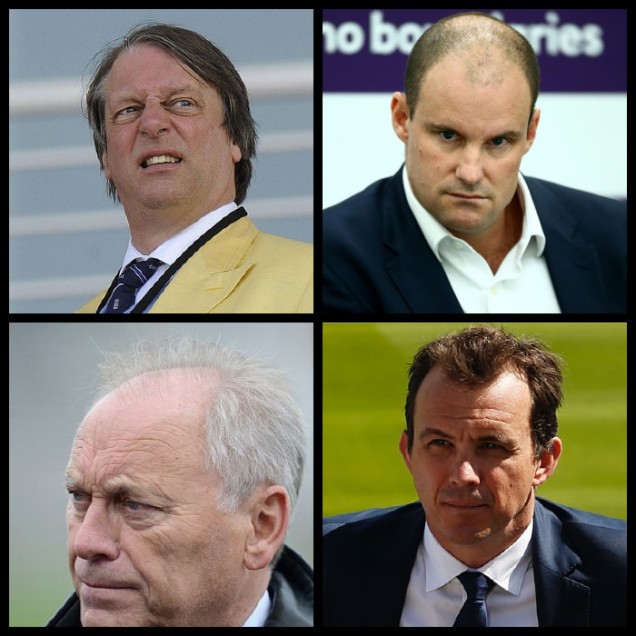
The Four Horsemen of the Apocalypse

“In Affectionate Remembrance of ENGLISH CRICKET, which was mortally wounded at the SCG on 5th January 2014 and then through the greed of its administrators, was finally killed off on the 8th January 2018. Deeply lamented by an ever-smaller circle of sorrowing friends and acquaintances. R.I.P.

N.B.—The body will be cremated and the ashes taken to The ECB’s headquarters and buried in its vault of gold”

image1

It may just be me, but I remember certain promises of a New England team after the humiliation of 2013/2014 Ashes. The difficult and unpopular South African batsman who had batted at number 4 was removed due to an overwhelming dossier of (soon to be published) evidence. We were promised a new start under the welcome leadership of the darling of English cricket. We were promised that there would be a review and something like that would never happen again. There was a promise of a fresh start with a new, young and exciting team that could unite the nation; plus administrators who acknowledged the pain that the English supporters felt and would take steps to ensure that our voice would be heard and that they would right past wrongs.

At least, that’s what the ECB and many of their complicit associates thought they were saying. Instead, they managed to split a cricketing nation down the middle, insult the fans by saying anyone who didn’t agree with them was from “outside cricket”; who then alienated those fans by hiking up the costs and by refusing to put the interests of the true fans ahead of their own financial lust. Every time they told us they knew what they were doing and to have faith in them, they immediately plummeted to new depths. They first marginalised and then penalised county cricket and many of the counties themselves were soon staring down the barrel of bankruptcy and at the mercy of handouts from their increasingly iron-fisted administrators. Durham were docked 48 points and relegated for having the misfortune of producing a number of young English players whilst having to build an international stadium that the local economy didn’t need or warrant. They’ve seen participation in the sport disappear to an all time low thanks to hiding it away on pay for TV and investing the princely sum of £2.5 million for grass-roots cricket. They’ve turned a significant number of loyal England fans against the team and away from cricket who in all likelihood will never return to the sport.

The ECB did all this and for what? A mediocre white ball team and a Test team that has once again been humiliated in Australia, after being humiliated in India, with a team lacking in basic talent and a future pipeline that resembles a dry well . Well done to the ECB, you’ve achieved so much in the last 4 years that many others who were deliberately trying to destabilise the sport wouldn’t be able to do in 10 years. I hope you’re proud.

So after this embarrassment of a series, those few fans that remain are waiting for what comes next, yet we all know what comes next – nothing. Nothing at all. I’ve seen many of the media say that we shouldn’t ‘sweep this under the carpet’ after this series’ calamity yet that’s exactly what will happen again. Boycott had some good questions at the end of the series but took out his frustrations out on the wrong person in the absence of any management. Instead, if lucky we may get the odd staged interview where Tom Harrison dictates to us why English cricket is in a such a good state of health. We may get the odd dissenting question from the likes of Jonathan Agnew (whose last interview was more Graham Norton than Jeremy Paxman), yet I’m sure Harrison will be allowed once again to gloss over these things and nothing will be said or done, after all it’s not particularly in the interest of the media to shoot the golden goose.

Yes there have been exceptions, George Dobell has posted some fine and cutting articles about administrators both in this series and before, but what about the rest of them? The fact that some of the ‘establishments of the media’ are talking about a need for change only now just makes me laugh. Literally where have you been for the past 4 years? It’s been staring you in the face all that time and you have only just woken up and smelled the coffee? If that’s your idea of hard hitting journalism, then perhaps you should consider a career at the Cricket Paper?

Naturally, there will those that blame the team, the coaches, the selectors and probably  the boogie and yes, all of these need to share in some of the responsibility (well perhaps not the boogie, but it has often proved to be an efficient scapegoat in the past). The best thing that could be said about the team is that they kept trying their best to the end, though the worst that could also be levelled at them is that they are a talentless bunch of egotists who can’t handle their alcohol. The coaches have hardly covered themselves in glory either, Trevor Bayliss couldn’t find most of the counties if you gave him a Sat Nav, let alone identify most of their players. Farbrace seems to appear when things are going well, has a large chuckle with the media and hides when they’re not. Ramprakash has been given a contract extension when half the team don’t seem to know which side of the bat to hold and I’m not even sure who our bowling coach is these days! As for the selectors, well let’s just say you could fill a bag with the name of every cricketer in county cricket and pick the team at random and they’d probably be more successful than most of England’s selection in the past 4 years. It’s a mess and whilst the above should all cop their side of the blame, it’s our four protagonists who deserve the most attention and the most recrimination. It’s these four in particular that have taken our once beloved sport and brought it to its knees.

I’m not going to focus on Strauss too heavily as rightly his focus has to be the health of his wife at the moment. Cancer is an awful illness and looking after her and the whole family must take priority over everything else. Another reason that I’m not focusing too much on Strauss is that he is simply the Company Man, employed by those above him to do what they say and to do it in the correct manner. There was talk before his appointment about the role being one where he would have the opportunity to make changes to the structure of the English game to ensure success in all formats and if that was indeed his mantra, then he has failed spectacularly.  My own personal view at the time was that Strauss was the hired hand: get rid of KP for good and be the face of the regime so that no-one looks too closely at what’s going on behind the scenes.  Not a lot has changed my opinion in that regard.

Sure I dislike Director Comma immensely especially by the way that he is able to embrace leaving his faculties at the door so that he can have a fairly cushy job of giving ‘short buzzword-loaded statements’ that the media will lap up in exchange for being part of the Establishment. In truth though, Strauss was part of the establishment long before he retired. He was from the right type of family, had the right look and was willing to adapt to situations that suited him at the time and then to dump those no longer useful. Sure, the ECB would’ve liked Strauss to have a team performing on the pitch to remove any investigation about what was going on behind the scenes but that never was a mandate. The mandate all along was keep the media happy and get the punters paying whilst saying the ‘the right thing’. It is impossible to tell whether Strauss would have copped much heat after this disastrous series if his personal circumstances were different, but I certainly have my doubts, after all why would the ECB want to remove their head boy?

It can also be rightly pointed out that all of this started way before 2014, under the stewardship of a certain Giles Clarke. Clarke is without the doubt the bogeyman of English cricket, a man who has always been so singular in his own quest for power and the riches that come with it that he isn’t worried about destroying anything in his way. I know a few of the hacks had pieces on Clarke that never made their way to print, such has been the fear of offending him and his lawyers. One can quite easily recall his reaction to Lawrence Booth after a mildly critical piece appeared in the Wisden Almanack alongside his haranguing of former ICC President Ehsan Mani at the same gala dinner. Whilst no-one in the press had the cojones to actually quote what Clarke said to either Booth or Mani (I’m guessing it wasn’t that he was a ‘‘man of great judgment’ unlike Paul Downton); however Mani acerbically commented afterwards that:

‘I’m very used to Giles being utterly irrational. He always thinks it’s just about him when there’s a far bigger picture of three countries sharing 52 per cent of income between them.’

Giles, we know – much like some of those who have followed him into power – was always about the commercials and pretty much stuff everything else. He got into bed with a soon to be convicted criminal – Alan Stanford, strengthened ties with Sky and took more pleasure in boasting that he had increased the ECB’s revenues up to £140 million than he did speaking about on the field success. Clarke created the revenue model whereby counties had to bid for Test Matches rather than the ECB distributing them as this lowered the ECB’s risk and accountability for a poor attendance or rain ruined Test. Indeed it was reported in the Telegraph some time ago:

“Giles’s agenda was all about financial imperatives, keeping the counties alive,” says one former county chief executive, who preferred not to be named. “He was very clever at making sure that he kept at least 10 of the 18 onside, and he was re-elected twice on that platform. Plus, some people became too scared to vote against him. If they did so and didn’t win, he found out, and he was a great one for punishing you.”

“Some people feared he wouldn’t give them a winter cash-flow loan [which many of the counties use to keep the creditors off their backs] or an international match.”

Ah yes, the fear factor the Clarke actively cultivated is well and clearly shown by the above. Back me or I take the money away and give it to someone else who will. It was Clarke’s obsession with money and power that laid the groundwork for the carve up of cricket and the absolutely despicable  “Big Three” revenue agreement, though it seems that Clarke had very little intention of sharing this money with the wider English Cricket community, this was the ECB’s money after all.  Clarke failed to get his hands on the most powerful job of all in world cricket, yet he’s still there, hovering around the halls of the ICC and ECB and no doubt leaning on those in the front line to carry out his mandate. I could write many more words about Clarke, but many of these have been written before and there are some new boys in town ready to take up the mantle.

Then we come on to Colin Graves, either a bumbling fool who has got in far too deep than he thought or some kind of evil genius that the world has never seen before. I’m genuinely torn between the two statements personally because he has shown both sides of this at times, sometimes even in the same press conference. We all know that Colin’s favourite word is mediocre (though surprisingly not when talking about the England Test team), West Indies cricket is mediocre, our current T20 competition is mediocre, I would probably guess that he describes lunch in the long room at Lords mediocre. Surprisingly enough, the reaction to this wasn’t what he had anticipated (i.e. pissing people off and motivating the opposition). However we have also seen a more cut-throat side from Graves, marginalising many of the counties that helped him come to power and survive through his initial appointment when Clarke still had a say on English cricket. He then went completely postal on Durham, a county that had unfortunately no rich benefactor and who were at the mercy of the ECB.  One only has to remember that this certain Colin Graves had helped Yorkshire out of a massive financial hole with a number of loans in the past as County Chairman – conflict of interest, what conflict of interest sir? This is the man, who has single handedly led the charge for a franchise based T20 when there was no support from the fans or the counties and looks to be around 5 years too late to make a major difference. This is the man who has decided to relegate red ball cricket to the very margins of the county season and then wonder why our Test team continues to fall apart when not faced with green seaming pitches. Still Graves is always good for the odd catch-all statement:

‘Everyone is very disappointed. Everyone gave their all, but we have to do things better going forward. There is no specific review.’

‘We have Andrew Strauss as MD of the England team and [ECB chief executive] Tom Harrison in charge, and I trust them completely to make the right decisions. There will be no witch hunt. We have to look at it and see how we can improve, so in four years’ time we are better placed to win [in Australia] than we were this time.’

Ah yes, no witch hunt this time, after all we’ve only been thrashed 4-0 this time with only a dead dog of a pitch in Melbourne saving us from a whitewash and since there’s no Kevin Pietersen to ‘sort out,’ then we can rightly sweep it under the carpet. And Colin, whilst you’re there, I’ve got news for you: if you truly believe that Director Comma and the Empty Suit that is Harrison (more on him later) are deserving of trust to make the right decisions for English Cricket, then you are even more deluded than I even thought. Colin Graves: unfortunate idiot or world class baddie?  I guess the answer will be left to the cricket historians…

Finally this brings us on to the Empty Suit, Tom Harrison – the bean counter, the money man and the dangerous one. Let me just make this abundantly clear, Tom Harrison would organise a game of cricket on the moon, with a basketball and flippers if it made him some extra money. Tom Harrison does not care one jot about the game of cricket, the development of youngsters, grass roots cricket, how the Test team performs and what the future of English cricket will look like. As far as he is concerned, cricket and those who love it are just an unfortunate annoyance that sometimes gets in the way of him making money.  Nothing and I mean nothing else matters. NOT ONE SINGLE BIT. Whereas Downton was both incompetent and stupid, Harrison is unfortunately highly competent in his singular goal of making cash and will ruthlessly destroy those who dare get in his way. I have published this a couple of times in the last week or so, but let’s just look at this statement one more time:

The health of the game is more than just Ashes series overseas.  We’ve had a successful entry into the broadcast rights market out of which we have secured the financial future of the game until 2024.

“We are in a process of delivering cricket across three formats. They’re making huge strides across the white-ball game, up to a place where we’re winning 70% or so of our white-ball matches – the ODI side in particular – and the T20 side is making good progress.”

In other words, yes we’re crap but look at the money, just look at it!  Look how much money I made out of Sky and everybody else! Yes, Harrison deserves some credit for selling a pretty crap product to Sky and others for £1.1 billion from 2020 to the end of 2024, but equally it would have been pretty embarrassing if he hadn’t managed to get a significant cost increase bearing in mind his background in selling TV rights.  Still even with the ECB breathing a huge sigh of belief, having postponed the inevitable financial precipice until 2024, Harrison once again let slip his key motivations:

‘You’re not thinking about the deal that you’re doing, you’re always thinking about the next deal.’

Stop me if I’m wrong, but it appears that the future of English cricket has been solely handed over to a greedy, ruthless, ex-car salesman type who has masqueraded as the answer to all of the ECB’s prayers. The snake oil salesman, who has rocked up from nowhere with supposedly all of the answers and none of the nasty drawbacks, does it remind anybody of someone else??

1057288

And there we have it folks, we don’t matter, because once the next generation has finally discovered the note with ‘there’s no money left’ our four protagonists will be long gone with their riches and so will be what’s left of the money.  The game will be up, every single decision that the ECB has made during the last four years has ensured that English cricket in the future will be nothing but a rotting carcass, mourned by the few but largely forgotten by the majority and we have Clarke, Strauss, Graves and Harrison to thank for this.

I thought after 2014 the ECB had reached the nadir, covering up a truly despicable performance, sacking our best player, labelling anyone not employed by the ECB as outside cricket and showing almost no regard for the fans  Unfortunately I was wrong, this was just the start. The ECB have done all of this and more over the past years, and whilst we were furious four years ago, this time there is simply no-one around that cares enough anymore. And this is their most damning failure of them all.

Fifth Ashes Test: Day Five – Humiliation

Defeat came as expected, and the scale of it was every bit as huge as anticipated, as England collapsed to lose by the small matter of an innings and 123 runs.  In some ways it offered the perfect conclusion to the series, for despite England being well beaten, indeed thrashed, there was also the smallest morsel for some to point to as the latest excuse – in this case the loss to illness of the captain, Joe Root, who at least deserves credit for trying to bat when clearly and visibly extremely poorly.  No doubt if he had been fully fit, England would have saved the Test and started the year on the same kind of high as they finished 2017…

Analysing the final day of the series is pointless, it went as expected, and with little fight beyond Root.  The series as a whole is a different matter, and as the dust settles somewhat, then the questions that won’t go away will come to the fore.  To some extent, Paul Farbrace was rowing against the tide when asking the kinds of questions that ought to be obvious, but which seemingly are buried beneath a wave of ever more desperate explanations.  It is striking that it was the first time anyone associated with the England set up even dared to say anything of the kind, and offered a marked contrast to Tom Harrison’s ridiculous collection of platitudes insisting that all was well.  How Farbrace’s call for “brutal honesty” goes down among his superiors remains to be seen, but the signs aren’t good.

The press certainly aren’t going out of their way to answer them, or even properly consider them.  Two elements immediately spring to mind, firstly that Alastair Cook is consistently highlighted as being one of the more successful elements of the series.  One genuinely superb innings in Melbourne on an officially poor pitch cannot be used to mask the remainder of the series where he scored just 132 runs in 8 attempts.  By all means salute that one knock, but rarely has a series average of 47 proved so misleading or irrelevant.  It isn’t dismissing him or belittling him to acknowledge that, and he’s openly expressed his frustration – why others make excuses that he doesn’t is exactly why some cricket journalists attract such contempt.

Secondly, the response to Mason Crane’s performance has been nothing short of extraordinary.  He’s a 20 year old kid, playing in his first Test, and to that extent expectations were entirely minimal, and his match figures of 1-193 aren’t terribly relevant.  First Test, dead rubber, let’s see what he can do, and he bowled nicely at times.  But it certainly can’t be considered a success, and to highlight him as being so is downright peculiar. No seam bowler would receive such plaudits for that kind of debut, and certainly no off spinner, no matter how young.  It isn’t about hammering him for not having a good match, it’s about being realistic about what it was, and acknowledging him for what he is – a young player learning his game, who may or may not go on to have a good career.  Adil Rashid must wonder just what it is about him that deserved such an entirely different set of headlines throughout his seemingly finished Test career.  On that point, what England would have given in Australia for a spinner who could bat and was capable of taking 23 wickets in India.

The parallel universe of cricket reporting and administration continues to amaze.  A 4-0 defeat is hailed as being better than the last attempt four years ago on the grounds that England managed to draw one on the flattest pitch ever seen in Australia.  Nominally, that’s true, but denial of the horror of this tour against an Australian side that hasn’t been particularly outstanding over the last couple of years is a remarkable exercise in putting heads as deep in the sand as possible.  One draw and four heavy defeats as progress isn’t the highest of bars at which to aim.  At that rate of improvement, a  flippant observer might think England could just possibly look forward to a very dull drawn series round 2034.

Any cricket supporter can acknowledge and accept being outplayed by a better team, but they also have the right to ask why that is, especially when it keeps happening.  This series defeat is worse than any of those in the 1990s, when Australia did have an exceptional side and England a poor one, yet at no point during that era was there such insouciance in the press and within the ECB about it.  Even the 2006 thrashing, while shocking, had some mitigation in being at the hands of a magnificent side bent on revenge.  2014 might well have been a disaster, but at the end of it the sole response was to kick out one player and insist that it wouldn’t happen again.  Well, it has done.  What the bloody hell have the ECB been doing for the last four years and why will so few in the media hold them to account for it?

The truth is that they don’t care.  The money is rolling in from TV deals and T20 cricket in particular, though they’d be wise to realise that catastrophic performances (and it’s only a year since the same thing happened in India) tend to kill interest quicker than anything else.  Cricket is in deep trouble in England, not because of one series defeat, but because of the policies adopted that have led to it.  Viewing figures are down, participation is down.  Sponsors tend not to align themselves with invisible sports that are failing, and kids most definitely don’t take up sports they don’t see and don’t have any heroes in.  Yet because finances look good at present, there is much backslapping at Lords, and those responsible will be long gone by the time the reality of the disaster they’ve overseen in the game manifests itself.

There are so many elements to this, and barely any of them are ever even acknowledged, let alone addressed.  The ECB have already stated that there won’t be major action taken over it, so just like last time around, the structure will remain the same – only this time there’s no obvious scapegoat to blame for everything.  The county championship will remain marginalised at each end of the season, limiting opportunities for fast bowlers and spinners, and continuing to ensure that medium pacers who do a bit off the seam can thrive – and be entirely unsuitable for higher levels.  Darren Stevens’ success last season was a beautiful thing, but the fact it could happen at all is not.

The fast bowling academy at Loughborough, which has been spectacularly unsuccessful will carry on as though nothing of import has taken place. The bowling attack will continue to be carried by two veterans who have done sterling service over the years, but who have so little behind them to challenge their positions.  The batsmen will carry on being drawn from the ranks of those averaging in the thirties in first class cricket, who may or may not be capable of making the jump to the top level.  The administrators will remain in position with no accountability whatever for what has transpired on the field.  The players will be developed from the tiny pool of the public schools which demonstrates a genuinely impressive level of wastage amongst the 93% who do not.  The people who care for the game will continue to be dismissed as “obsessives” in favour of those who wander along to a T20 match.

The worst part is that none of this is going to change.  None of it.  This is how it has been set up, in fact this disintegration of English Test cricket (it isn’t going to get better as things stand) is the exact outcome from the policies set in place over the last decade.  Removing all cricket from free to air television in favour of a financial drug fix was a disastrous decision.  It doesn’t mean that had they not done that all would be well, but it does mean that it set the game on a path of dwindling relevance and interest that the ECB then compounded with their other decisions.  To that extent, this is what they’ve achieved, and it was pointed out at the time.

The ECB consistently talked about the four year cycles, and did so after the last drubbing.  What have they achieved in that time?  The refocusing on short form cricket has delivered precisely zero titles, and the current team is mired in the middle rankings of the ICC tables, just as they were four years ago.  They approach it rather better than they did, and they’re certainly more exciting, but it’s hardly been an obvious road to success.  The Test team in that four year period has been “rebuilt” to the point where the only players secure in their places are the ones who have been there since then, and in most cases, years before.  Jonny Bairstow is the single exception to have come through and he was on the fringes then anyway.  England don’t even have the excuse of being  young side.  They arrived in Australia with doubts over three of the top five batting positions, the spinner in Australian conditions (and who openly regards himself primarily as a batsman anyway) and the entire seam bowling attack apart from two who have been around for a decade and more.

The biggest crisis the Test team face right now is the sheer poverty of what is behind the veterans, with very little sign of anything truly exciting coming through.  That this will get worse, not better.  When people say England will miss Cook, Anderson and Broad when they’re gone, they don’t realise just how right they are.  Home series against Pakistan and India may well paper over the cracks somewhat – though should England lose, as well they might, perhaps the alarm bells might finally penetrate the heads of the assorted establishment figures – but not to anyone paying close attention.

England have lost 9 of their last 12 away Tests – two thrashings in India and Australia, and a drawn series in Bangladesh that frankly, they got away with.  But it’s ok, Tom Harrison says all is well.

A small housekeeping note:  Sharp eyed visitors will have noted a new link at the top of the home page where you can contact any of us, to have a rant if you feel the need.  We will do a final Ashes panel over the next few days, so if you’re interested in being part of it, drop an email to tlg@beingoutsidecricket.com


5th Ashes Test, Day Two

Australia in a strong position – check

Steve Smith in and looking ominous – check

England’s bowling looking toothless – check

Here we go again.  Despite Tom Harrison’s proclamation that all is well and the only reason England are marginally losing this series is because they haven’t taken their opportunities, two days of cricket at the SCG have once again emphasised the gulf between the teams.  And this after England did fairly well with the bat in the morning too.  In a better balanced series, Australia finishing on 193-2 would mean that with a deficit of 150 still to be made up, the game was in the balance, and if England bowled well in the morning then they would be in a decent position.  The problem is that repeating this in the face of all previous evidence is the kind of thing only the empty suits at the ECB do, to try and ensure that wherever the blame goes, it doesn’t go to them.

Sure, it’s possible that by the time the third day is complete, this post will look ridiculous, as England skittle Australia and start building on their sizeable lead, but the exceptionalist nature of such an outcome, and the way that you, dear reader, have almost certainly scoffed at that possibility is exactly the point.  England have now reached the point where the feeling of inevitability about the outcome has taken hold, a pattern in every Test, apart from the one where the pitch was officially rated as “poor” and allowed England to escape with a triumphant draw – one that sealed the Ashes into eternity according to the response to it in the media.

There can be surprises, certainly.  The weak looking England tail did rather well, aided by some extraordinarily brainless bowling at Stuart Broad, and some impressively inept catching.  Maybe the Australians weren’t quite feeling the intensity with the series well and truly won, not that anyone is allowed to mention that of course.  Still, Tom Curran and Broad rode their luck and made decent contributions, as did the out of sorts Moeen Ali.  Yet while 346 represented a much better total than it could have been, it still looks lightweight in context.

England gained a quick success in dismissing Bancroft, a fairly routine delivery from Broad breaching his defences, which merely goes to highlight that the idea that England are up against a great team remains as absurd as ever – the controversy over their lack of batting depth seems a long time ago.  Perhaps it is the case that Australia do indeed have a very fine bowling attack, but given England’s inability to cope with many others around the world, it’s hard to tell for sure.  Even allowing that, it doesn’t provide an excuse: either England are totally outclassed, in which case why is that; or they are, just unable to grab the moment (Harrison), in which case why are they being battered repeatedly?

After the early success, there were few alarms; Warner compiled a well made fifty, Khawaja closed in on a century, and Steve Smith seems to have been at the crease for the entire series.  And there’s the problem, James Anderson has done fairly well this tour, but while he has received some criticism for being defensive and containing, the question needs to be asked as to what else should be expected of him?  He’s 35 years old, is unquestionably one of the cleverest bowlers around, but surely at this stage of his career he ought to be a support bowler of extreme skill rather than the one carrying the entire attack.  Broad at the other end has had a mixed tour by his own admission, and that’s fine, because it happens.  Last time around he was exceptional even as the side disintegrated around him.

George Dobell is one of the few journalists pointing out the reality of England’s position, the abysmal failure of the ECB to produce fast bowlers, and the seemingly counterproductive fast bowling programme allied to the sidelining of first class cricket.  England’s current pace bowling attack has the feel of the West Indies in the late careers of Courtney Walsh and Curtley Ambrose.  Those who respond to criticism of Anderson and Broad by saying England will miss them when they are gone are exactly right – for when they do go there is so little behind them except a collection of medium pacers without their level of exceptional ability, or crocks.  Cyclical problems can afflict any country, but the utterly blasé response of Harrison’s insistence that all is well highlights Dobell’s point about the complete lack of accountability.  When it is said that this is a golden era having Anderson and Broad, the sad truth is that they are almost certainly right.  A 35 year old and a 31 year old should not be leading the attack with no rivals for their position in a healthy structure.  Don’t blame them, blame the administrators who have created the position where they are not only the best we’ve had in the last 20 years, they are also the best we will have for the next few years as well.  Ambrose and Walsh indeed.

The same can be said to apply to the spinning role.  Moeen Ali has had a miserable tour of it, and once again failed to impress here.  Yet earlier in the series he was apparently being played as a batsman only (only to then bowl) because his finger was so badly damaged, and was also suffering from a side strain.  In the rush to beat him up for this series, this no longer seems to be mentioned at all, in which case it either wasn’t a problem in the first place, or he’s being slated for playing badly when he’s not fit – it has to be one or the other.

Like clockwork, now there are calls for him to be replaced.  Fine.  No player should have a sinecure when they are out of form, or if they ultimately aren’t good enough to stay in the team, but here it still smacks of thrashing around in the death throes.  Drop Moeen Ali by all means, but be sure that the replacement is going to be better.  This doesn’t mean you don’t try things of course, otherwise no one would ever be selected, but in the last 15 months England have used Moeen, Rashid, Ansari, Dawson, Batty and now Crane.  Six spinners in just over a year, discarded one by one as not being good enough, with the last a left-field punt that doesn’t offer huge confidence for a long term selection, which is absolutely not his fault.

As Dobell points out, Adam Riley, meant to be the answer to England’s spinning woes, didn’t play a county championship match last season, and even Crane only appeared in some of them.  They can give Ollie Rayner a go, presumably based on his average of just under 40 last season that just screams “pick me”, but it isn’t going to magically change things.  Moeen might well have been very poor away from home (again, let’s emphasise he was meant to be injured for this one, because this seems to be constantly ignored) but he has been good at home, both with bat and ball.  Is that remotely ideal or acceptable?  Absolutely not.  Is it probably as good as is likely whoever they pick?  Yes.  It might even be better.  This is not a defence of Moeen Ali or a call for him to be retained, but it is pointing out that the idea that things will magically change for the better when a player is dumped is wishful thinking.  England do not have ready made replacements to slot in and improve the team, nor do they have a production line of young talent.

The same applies to Cook.  In his poor spells, it can’t possibly be said that he came under true pressure for his place, not in this case because of the media, although that is true, but because with a lack of a successful opening partner, how could he possibly have his own place questioned?  Cook horribly out of form was still England’s best opener.

Irrespective of how this match unfolds, the true horror of England’s position is that this really is their best team, and most of their best players are in the later stages of their career.  Perhaps some will magically seize their opportunities, but it’s not something you’d put the house on.

This is where the ECB have led the English game to.  Invisible, unimportant, hidden away, wealthy (for now), not very good, and likely to get worse in future.  Well done chaps, drinks all round.

Day Three Comments Below


How To Make A Crisis In Four Easy Steps

In the past few weeks, all of the cricket media in England and Australia have been talking about England’s behaviour off the field. Two incredibly minor events, coincidentally in the same Perth nightclub, have overshadowed coverage of the actual Ashes.

I would argue that this whole situation has been caused by the ECB’s chronic failures in PR and management. Time and time again, they act in a way which actively hurts the team’s perception with fans and the media. It’s incredibly predictable, unfortunately, and here’s how they do it:

Step 1: Wait until the reporting hits fever pitch before releasing the full story

This allows the journalists to build up speculation through the day, ideally whilst England are playing cricket. Some people might suggest that this would distract the English players from performing at their best, but the management still want to perform a thorough investigation of any incident before they release it to the press.

So if we look at how the Bairstow incident was revealed, the Aussies were sledging England over the incident through the game and after hearing about it through the stump mics the Aussie media published the story on their back pages on Sunday. Speculation continued running through Monday, the fifth day of the Test, with a vague statement from Strauss confusing matters even more. Apparently it was “playfulness, no malice, blown out of all proportion.”

It wasn’t until after the game had finished that the full story came out, and then only because the Australian opener Cameron Bancroft explained it in great and amusing detail whilst Steve Smith was laughing his ass off beside him.

With Ben Duckett, the news came just before the toss in England’s two-day warmup game in Perth that he had been replaced by Joe Clarke. There was nothing else released, which led the assembled journalists to investigate the matter and about halfway through the day’s play the ECB finally released a statement. Even then, it only described the situation as an “alcohol related incident” with no details included. It was only through “good journalism” that the full facts of the matter came out later.

Step 2: After “investigating” the matter, declare the players involved as both simultaneously innocent and guilty

As we know on this blog, the ECB are not unfamiliar with the concept of confusing statements. The name “Being Outside Cricket” comes from a joint ECB/PCA press release (still available on the PCA’s website) surrounding KP’s expulsion from the England team in 2014, where they appeared to suggest that no one outside of the ECB had any right to question their decisions.

So in Brisbane, Trevor Bayliss described the Bairstow ‘headbutt’ as “blown out of all proportion” but also said that the players have “got to be smarter” away from the pitch. The Director Comma England Cricket also came out of hiding to talk about it, declaring that “It’s a minor issue but it highlights the fact that minor issues can become major issues.” I think that certainly is the case when the ECB are in charge.

Trevor Bayliss’s statement on Ben Duckett is a thing of beauty, if you find contradiction and incompetence beautiful that is.

“To be quite honest it’s fairly trivial but in the current climate it’s not acceptable. Everyone’s been warned about [how] even small things can be blown out of all proportion. The ECB has also been quite strict to the boys with their message, and it’s quite simply unacceptable.”

So let’s break that down. Duckett’s actions were simultaneously both “trivial” and “not acceptable”, to the point where his possible England future is being written off. Again, this seems fairly familiar to fans of the blog, with its regular references to staring out of windows and whistling being sacking offences. How would this affect a team’s morale, when they know that their team’s management will actively attack them over incredibly minor issues.

Step 3: Severely punish the innocent players

What would be the absolute worst thing to do after a team’s management categorically denied their players had issues related to drinking after the Brisbane Test? How could they utterly undermine themselves and put all of the team under huge pressure? If there was one surefire way to suggest that England are a team of violent drunken thugs who can’t be trusted, it was forcing a curfew and other restrictions on the players. So that’s what their management did.

Certainly I enjoyed the irony when Bayliss said that “even small things can be blown out of all proportion” about Ben Duckett, since the whole media circus was created by the ECB overreacting to a “trivial” incident and dropping the batsmen for the tour match and possibly the rest of the Lions series. As far as I’m aware no journalists had heard about Jimmy Anderson’s unscheduled shower before the warmup game, and so there’s no reason to suspect that it would have come out. Even if it did, without the ECB promising a full investigation from Andy Flower it would be a fairly minor and amusing story rather than another alcohol-fuelled crisis.

Step 4: Repeat

If there’s one thing you might admire about the ECB, they certainly have the courage of their convictions. Despite screwing up in the same ways over and over again, they never change. They never admit they were wrong. They never apologise. So it keeps happening, as regular as an England batting collapse and just as much fun for the fans.

No doubt this won’t be the last of this sorry saga. At this point, anything could become a full-blown international incident and many England players should contemplate not leaving their hotel rooms for the rest of the tour lest they risk their careers in some way. There are already reports that Bayliss wants to get rid of the people he considers troublemakers from the squad to face New Zealand, which certainly offers some interesting parallels to Andy Flower’s actions four years ago.

And… that’s it. Hopefully England can make it through to Wednesday night without another self-inflicted wound, but I wouldn’t bet on it. As always, feel free to share your views below.