Death of a Gentleman

We’re hardly the first to have our say about this most important of films, but given that importance, it remains essential that the message it conveys continues to be discussed and promoted.

It’s striking that the media reporting of this film has been extremely muted; some might say that a cricket documentary is hardly mainstream, but Fire in Babylon received far more attention. Amongst the written press, the ones who have talked about, or reviewed it, are those one would expect to see do so.  Yet of the major newspapers, the relative silence has been striking.  Even at the time of the Big Three’s effective takeover of the world game, the press was largely silent.  In this country, Scyld Berry and Lawrence Booth more than had their say, while in Australia Gideon Haigh was voluble in his criticism.  That’s not an exclusive list, but that so few “journalists” put their heads above the parapet says an awful lot.  Failing to hold the ECB to account over the way they manage the England cricket team is one thing, failing to hold the ICC and constituent boards to account for actions massively detrimental to the whole game is another entirely.  They could even hold a contrary view and express why they think it is a good idea – that at least would be something.  Silence is not.  It is an absolute disgrace, and the cricket press as a body should hang their heads in shame over it.

The broadcast media too has barely even mentioned it, with Test Match Special tiptoeing around the issues raised, and Sky not so much as acknowledging its existence.  Giles Clarke would have you believe it’s because administration isn’t of interest to anyone, only teams and players are, but the film details how when the ICC discovered the story being told, Jarrod Kimber’s press accreditation mysteriously went missing, while potential interviewees were warned off.  That it is a tale the various boards don’t want told is obvious.  The lengths they go to in order to prevent that is a different matter, and the silence from so much of the cricket press about a film that is central to the future of the game more than suspicious.

There are some telling asides away from the main narrative, such as Andrew Strauss bemoaning the rise in the number of short Test series, presumably an opinion given long before there was any possibility of him beingwithin the same ECB who were party to it.  Maybe someone will ask him.

The invention of T20 cricket in 2003 (by which we mean the professional invention, that club cricketers have known the game for years doesn’t count), and the subsequent creation of the IPL is often blamed for the threat to Test cricket, but it didn’t need to be.  As Haigh points out, for T20 to have an attraction, it has to be shorter than something.  There is absolutely no inherent reason why they couldn’t co-exist.  Indeed, the potential was and is there for T20 to support Test cricket while taking the game to brand new places and countries.  It was an opportunity to grow cricket, to nurture it and also to make money for the game.

The powerful argument Messrs Kimber and Collins build instead is of a venal, self-interested group who care little for the game except as a means of building power and making money.  Lots of money.  The IPL is central to this, as businessmen spied the opportunity to make a fortune.  Yet it would be too easy to simply blame India for everything, and there is a danger that the film will be dismissed there as nothing but an attack on an India that has been on the receiving end of a patronising attitude from the English and Australians through cricket history.  In that they certainly have a point, yet a second wrong doesn’t right the first one, and in any case blaming India solely would be to miss the point being made.

The IPL itself has undoubtedly become a monster, but one which is extremely popular, and on its own merits that should be a good thing for the game.  The trouble, as is apparent throughout the film is that it is run by those who don’t care about the wider game of cricket.  It is a means of enrichment, and when those in charge of the sport don’t have that innate love for it in its own right as a game, the dangers are clear.  That is why sporting governing bodies are meant to be neutral – or at least relatively neutral – in such matters, their role is to be the custodians of the wider sport, ensuring that naked commercial interests don’t damage the integrity of the sport itself.

For that is the fundamental central point.  The ICC is not a governing body in the true sense and never has been.  One of the striking things while watching the film is that it is so reminiscent of the goings on at FIFA.  And yet even FIFA have managed to expand football and have distributed serious wealth around the world, no matter how dubious the morality behind it.  The ICC in contrast, have a woeful record of furthering the game.  The example illustrated on screen was of the pathetic £30,000 funding given to China, a nation of such size and potential growth that it would be thought a country ripe for development and support.  Perhaps it is one degree of cynicism too far to think that cricket in China would be entirely against the interests of the current establishment, for whom a new market of over a billion people represents nothing but a potential threat to their power base.  Perhaps not too cynical after all.

The film makers did at least manage to get interviews with many of the major players in the drama – though Cricket Australia manage to come out of it rather better through the simple method of refusing all co-operation.  N. Srinivasan is consistently smooth, while failing to answer a single question, and Giles Clarke manages the impossible, by coming across as even more repulsive than normal.  If he’d been born Australian, he’d be called Sir Les Patterson.

Indeed, while Srinivasan stonewalls thoughout, it is Clarke who is the undoubted star of the drama, though not in the way he probably imagines himself to be.  Lord Woolf’s report into governance at the ICC – which was rejected by the ICC itself – is dismissed by Clarke in contemptuous and self-reverential terms.  Woolf had been scathing about the lack of accountability within the organisation in his own report, stating that the ICC behaved like a “members club” for whom the development of the game was secondary, and whose boards acted in their own self-interest rather than the overall good of the game.  Giles Clarke in the film actually inadvertently proved this by stating “I have every right to put my board’s interests first” – a comment that is notable for putting the interests of his board ahead of the interests of English cricket, let alone cricket more generally.

Woolf’s criticisms were  aimed at the old ICC, yet it was known at the time that India in particular were strongly opposed to his recommendations, which amounted to a democratisation of the organisation and the prevention of conflicts of interest.  A summary of those recommendations can be found on this link:

http://www.espncricinfo.com/ci-icc/content/story/551836.html

Far from approving the report that they had themselves commissioned, the three richest boards decided to go in the opposite direction.  India, England and Australia in great secrecy put together a plan whereby they would take effective control of the whole of the ICC.  The middle portion of the film covers the meeting held in Dubai, in secret and without being minuted, to put this plan together.  Kimber and Collins are rightly appalled at this, the behaviour of an autocracy with plenty to hide, not those supposedly appointed to be the custodians of the game.

“There is a paragraph which says: It is proposed that the ICC executive board forms a new committee of the ICC called the executive committee, which under new terms of reference will act as – and I emphasise this word – the SOLE recommendation committee on all constitutional, personnel, integrity, ethics, developments and nomination matters, as well as all matters regarding distributions from the ICC.

“I have never seen anything of that sort in a body of this nature.” – Lord Woolf

When the details of the carve up actually became apparent, it was worse than anyone could have imagined.  Over half the revenues of world cricket were to go directly into the back pockets of the three biggest boards, with India taking the largest share.  That could be argued to be reasonable enough in principle, given that India generate the largest amount.  Of far more concern and fully detailed, was the fait accompli presented to every other cricket nation to accept it, with each other Test nation to receive a mere 5% of the pot.  Former ICC President Ehsan Mani calculated that $300 million over 10 years would be cut from the ICC Development Programme, to be redirected to the coffers of the already wealthy.

At the same time, the plan to reduce the size of the World Cup to 10 teams makes the ICC the only sporting body to actively try to shrink their game globally – a truly astounding policy.

And here is where the initial concept behind the film – the fears for Test cricket – are beautifully brought into focus.  For the other Test playing nations were neither consulted, nor given any real opportunity to object.  One of those happens to be the side who are currently the best in the world in the form of South Africa, but it applies whether or not they are good on the field.  The flexing of muscles extended to making it abundantly clear that any opposition and those countries could forget about getting lucrative tours from India.  Bullying is rarely an edifying sight, and had already been seen in India’s response to Haroon Lorgat becoming the Chief Executive of Cricket South Africa.  Earlier than that, Tim May had been ousted from the ICC Cricket Committee, with it being reported in the Australian press – and repeated by Tim May – the BCCI had put pressure on Test captains to vote for Laxman Sivaramakrishnan instead.  Sivaramakrishnan is an employee of India Cements, whose Managing Director is one Narayanaswami Srinivasan.

Test cricket outside of the big three nations was thus put on life support, with other nations unable to make it pay, except through the largesse and exceptional and well known kindness of India, England and Australia.

“The intention to entrench a privileged position for ‘The Big Three’ appears to be an abuse of entrusted power for private gain, giving them disproportionate, unaccountable and unchallengeable authority” – Transparency International

N. Srinivasan was duly made the Chairman of the ICC, the proposal was passed, and what Scyld Berry called “the worst thing that has ever happened in our sport” was made real.

If India’s dominance wasn’t leading to a good outcome, the acquiescence, nay roaring approval, of England and Australia was worse.  Instead of looking at the wider interests of the game, they instead decided to grab as big a piece of the pie themselves and stuff the rest of the world.  England’s own conduct is entirely reflective of that – the much vaunted return of five Test series for iconic opponents quickly and silently excluded South Africa from the list, for reasons that have not been disclosed.  England decided to focus almost entirely on matches against India and Australia instead.  Bangladesh, a nation new to Test cricket will likely go a decade between tours of England, and while they may not be currently the greatest of draws, the reality is that they never will be under this global regime.  In discussions on these boards, D’Arthez did the mathematics on England’s recent schedule, and as such deserves to be quoted in full:

Since the start of 2011, there have been 47 matches between Australia and England across formats. A few of those were in World Cups / Champions Trophies T20 World Cups, but still. Compare that to the number of England / South Africa games which stands at 14. An eye-watering three of those were Tests. Pakistan stands at 10 (mostly all from the UAE tour of 2012). Bangladesh stands at 2 games in the World Cup, both games won by Bangladesh.

Australia has played 47 games against England in that period. They have played 6 against New Zealand. 4 against Bangladesh, and 3 against Zimbabwe.

India have played 42 games against England. 31 against Australia, and also (surprisingly) 31 against West Indies. 12 games against Pakistan, 11 games against Zimbabwe and 10 games against New Zealand.

Now I am aware that this snapshot may not be fair, but scheduling is not rational: we have had 3 Ashes series since the last time Australia played Tests against New Zealand for instance, or England played against Pakistan. So it is impossible to take a “fair” snapshot courtesy of the ICC.

Schedules are simply becoming increasingly dominated by teams of financially similar standings to make more money. Yay for the scrapping of the FTP. So you get a group of India, Australia, England, who dominate the fixtures between each other. England plays close to 50% of its ODIs against Australia and India for instance.

It is only going to get worse.  The other nations seeking the scraps as they are dropped from the top table, and playing more lucrative ODIs or T20s against each other when they have no one else to play against, rather than Tests.  Furthermore, what is the point of a nation like Ireland seeking Test status when this is environment in which they will be operating.  They have already been kicked in the teeth over the reduction in size of the World Cup – reduction in number of teams that is, the number of games will be barely affected, and now the Tests they hope to play will be thoroughly devalued, if not scrapped entirely, except when the Big Three deign to notice them.

Clarke attempted to make the claim that he was acting for the good of cricket, and in a nauseatingly self-justifying section pointed to his being unpaid in his role.  Curiously enough, this writer is on an industry board, also unpaid, and does so partially because of the professional advantage it gives him.  It’s best left there.

Clarke also refused to answer any kinds of questions about the Stanford affair, an example of sacrificing the values of cricket and the integrity of the England team on the altar of naked commercialism.  That it was arranged with a criminal is actually the least of the sins involved, for a national team is meant to be representative of that country, not a play thing for filthy lucre.  He not only survived that episode, but went on to create his own position of President (sarcastically referenced in the end credits) responsible for ECB dealings with the ICC which both indicates an awareness of where the real power lies, and a complete lack of any kind of integrity or conscience.  Clarke also managed to demonstrate his familiar sense of timing and old-fashioned courtesy so evident at the Wisden dinner (a note here: Lawrence Booth’s rebuff towards Clarke was sufficiently stylish and acute that it will doubtless be noted down for future retaliation by the great man) by not realising he was on the ICC’s own cameras when noting about Collins “that idiot Sam is outside”.

When the viewer is watching so aghast at the naked greed on display that even Lalit Modi appears to be something of a good guy in arguing against what is happening, the trouble the game in is clear.  It is more than right to be deeply sceptical of his motives in suddenly discovering the soul of cricket, but the news today that he intends to set up a rival governing body to the ICC ironically represents the kind of challenge that is not appearing from any other quarter – our film making heroes notwithstanding.

An interesting comment made is that his intention is that it be affiliated to the Olympic movement, and another strand of investigation in Death of a Gentleman is the refusal of the Big Three to countenance the idea of cricket being an Olympic sport.  Clarke tries to defend this on the utterly preposterous grounds that it would disrupt the English season.  And so it would.  Every four years.  When it would disrupt the season in the same way that Tests and One Day Internationals do.  What he really means is that it wouldn’t earn the ECB any money.

T20 would be perfect as an Olympic sport; it would massively raise the profile of the game, it would allow countries all over the world to appear at a major sporting event on a level playing field.  There is no downside for cricket whatsoever, there is only a downside for those who would not be able to control it as it would be organised by the IOC, and it would not make any money for those who care about little else.  Quite simply, they cannot make any kind of rational argument against it, so resort to bluster.

And in all of this, what of the cricket fan?  What of the supporter, who pays his hard earned money to watch the greats of the game?  One of the most pointed comments in the film is that the fans are there to be monetised, and that the broadcasters and boards are the only ones who matter.  The objections to the conduct of the ECB need to be seen in the context of this, for in all the documentation and comment about the changes to the ICC, there is no mention whatever of the interests of the spectator.  Not one word.  Nor is there any reference to the amateur game – which shouldn’t be any kind of surprise when the associates and the affiliates are so roundly ignored and disparaged.

Jarrod Kimber and Sam Collins have made a film that every single person with an interest in cricket needs to watch.  This is all being done in our name, by an organisation that is meant to have the interests of the game we love at heart, by constituent cricket boards who are meant to look after the game in their home countries.  It is nothing other than the complete theft of an entire sport by a self-appointed oligarchy bent on advancing their own interests.   When the English cricket fan watches this international summer, he or she basks in the enjoyment of beating the Australians but laments that only two Tests were scheduled against New Zealand.  It is all part of the whole rotten edifice.  The ECB claimed that the Ashes needed to be rescheduled because of the World Cup in order to prevent players being burned out for the premier one day competition.  It would then revert to a four year cycle.  Oh really.  Is that except for the plans in the 2020s when it doesn’t?

From the village green to the barest patch of ground to packed out stadiums, the subject of this wonderful film affects every single person with a passion for the game.  It is polemical, it asks the right questions, and that it doesn’t get all the answers is not down to any shortcomings on the part of the makers, but entirely due to the reluctance of those in and below the ICC to have their dealings exposed to public scrutiny.

You need to see it.  And you need to digest it.  And tell your friends.  The makers have set up http://www.changecricket.com/ to campaign to get our game back.  It’s up to us all to support them in that, because while we may not succeed, if we don’t try then we have no chance.  And we will deserve all we get.

TLG

Dmitri View – I too have watched the film. I did so last week, but wanted TLG to cast his eye over it too. I’m sure you’ll agree, he’s done an amazing, thorough review. I know Arron is also watching it tonight, and I’d seriously recommend the film to all of you.

This is not about this blogger, or those of you on here, switching horses to another narrative, because the ECB and the way it interacts with us and other bodies in our name is part of the discourse on this blog nearly every day. Jarrod and Sam undertook this venture to discuss test cricket and instead saw the writing on the wall when they started delving deeper. Cricket is another sport being milked for cash, with corporate parasites getting their millions of pounds of flesh in an orgy of self-interest, short-termism and blatant profiteering. Sport shouldn’t be about supply and demand, it should be about equal access. Sport engenders great things in people, makes them strive, better themselves, set themselves targets they may never reach. It encourages camaraderie, spending hours with people, making lifelong mates. In the world we live in that is abused. That love of playing is there, as Gideon Haigh speaks so eruditely, to be monetised.

I can bark at the moon all I like, but cricket is just like all the rest. While the heart-strings are pulled a little by the Ed Cowan portions of the film, the rest did not shock me. Not in the slightest. I sat there getting more and more angry at a world governing body that runs the sport firmly behind closed doors. At an ECB that plays its full part in keeping it that way. It may be in our players short-term interests to trouser more money for playing for England, but who are they going to play against? Australia and India ad infinitum? I remember the 2003 series v South Africa, and the one in 2004-5 too. Five test series, absolutely brilliant cricket, entertaining and thrilling. We’ve not played them in a five test series since, but in the past three years have had mind-numbing, one-sided (results) series. This isn’t growing the game in this country, it’s putting on endless repeats.

I can’t add much more to TLG’s piece, except to finish up with Giles Clarke. I refuse to believe this man still does not hold the wheels of power in English cricket. You barely hear a peep out of Colin Graves, but Clarke still bestrides world cricket like a colossal oaf. Only oafs can be innocent. He isn’t. In no way. The contempt, the disdain, the arrogance, the sheer affront that these two “journalists” should have the gall to question this Ozymandias? How very dare they! England, we are told, are not in his grip any more. The ECB isn’t his. I don’t believe them. Because the same attitudes persist. I’ve not seen a change from them. Not really. Still sticking to the Big Three, still no apology for “outside cricket”, still no recognition of the fans. Clarke sums it up with his advice, which I’ve heard before, that no-one is interested in cricket administration. Jarrod and Sam bring this dripping condescension through. Loud and clear.

It’s a terrific film, has its rough edges, but you can’t deny that the message is clear, despite the critics saying there is no smoking gun, no silver bullet (how ridiculous is that in the context of something else we all remember). It shows the ICC and the three organisations that now dominate to be unaccountable, have no transparent governance, and they’d wish questioners away without a care.

I ain’t going nowhere, sunshine, and nor are Jarrod and Sam. #ChangeCricket could do a lot worse than #AGilesClarkeFreeECB.

@DmitriOld    

@BlueEarthMngmnt

Together, The Leg Glance and Dmitri Old/LordCanisLupus are “Being Outside Cricket”

@OutsideCricket

See more information on Death of a Gentleman at the website – http://deathofagentlemanfilm.com/ – as well as following their Twitter page – https://twitter.com/doagfilm.

ChangeCricket is their new portal, so check that out – http://www.changecricket.com/ while Jarrod Kimber and Sam Collins are both on Twitter at @sampsoncollins and

You can watch the trailer for Death of a Gentleman here:

State of Play

The gap between Tests reduces to some extent the frenetic nature of the media as far as cricket goes, and allows a little time for reflection about where we are more generally, and how we got here.

Although it’s fairly rare to offer up any praise for the ECB (for the simple reasons that they tend to both incompetence and duplicitousness, which is rarely a good combination), it is worth noting that Women’s Ashes matches have been scheduled for between the men’s Tests.  For once they have it right, as it’s far more likely to gain attention that way.  It says a fair bit about the ECB that the overriding reaction to seeing such a piece of consummate common sense is surprise.  Generating that interest creates a feedback loop, as shown by Sussex announcing that the T20 at Hove is nearly sold out.

The rise of women’s cricket in England is a fascinating development.  It’s one that the ECB pat themselves on the back for an awful lot, and it has to be said they have played a significant part in that, although women’s participation in what were traditionally male sports has shown a significant rise across the board, from the success of the football team to the way the women’s Six Nations is now covered on television and gets decent crowds.  In rugby, the RFU have gone as far as to schedule some matches directly after the men at Twickenham, something the ECB have also done beforehand with some England games, and with the same kind of success.  As a means of allowing the more casual supporter to watch, it’s obviously highly successful.  But what it also means is that cricket is not a discrete entity in this; women’s sport is gaining an attention that would have seemed highly unlikely a generation ago.  Quite why that might be is a little hard to pin down, much of it being for sociological reasons as to the acceptability of women playing such sports – good to know we’re in the 21st century at last.  The ECB are entitled to be pleased, but when seen in the context that the number of women playing football is shortly to overtake the number of men playing cricket, it raises as many questions as it answers about their role as governors of the English game.

Nevertheless, whatever provided the catalyst, and whatever the context of cricket more generally, the ECB have certainly played their part in helping growth in women’s cricket.  Free kit has been distributed to clubs, and free coaching and umpires courses provided for women who wish to make use of them.  That does represent something of a contrast in how it is for men wishing to do the same, and the costs involved tend to be significantly higher (and with less given back) than the football equivalents.  Many clubs offset that cost themselves, in order to encourage their members to gain their qualifications, but it is still a lot of money.

What doesn’t get mentioned much (and here the ECB aren’t alone by any means, it is taken for granted across both sport and other walks of life) is that any success requires people on the ground to volunteer and give up huge amounts of time to help encourage people to play the game.  The decline of schools cricket is often cited as being disastrous in this, yet in comparing what was available 25 years ago to what is available now, the clubs have more than filled that gap.  As someone who attended a cricket playing state school, the coaching was non-existent (and the county paid little attention to the state schools there anyway – in that little has changed) while only one local club had a thriving youth section – indeed only one local club even tried to create a thriving youth section.  Moving forward to the present day, it is truly astonishing to see medium sized clubs having colts evenings comprising up to a hundred youngsters of an evening, and a plethora of qualified coaches to help them.  It is, of course, enlightened self-interest from the clubs; shorn of a supply of schoolboy cricketers, they are producing their own.  It is hard to avoid the conclusion that for a child who has shown an interest in cricket (therein lies a different debate), the opportunities for playing are now markedly more plentiful than they were in the 1980s.  So far so good, with the obvious concomitant opportunities for cricket more widely.

With both boys and girls cricket, those volunteers are the heroes and heroines.  Many clubs simply decided they wished to create a women’s and girls’ section, and worked ridiculously hard to try and make it work.  Many male players will be familiar with making up the numbers in the initial stages until sufficient players of the correct sex were available.  It is there where the ECB provided some support, a little of it directly, more of it via the counties.  Let there be no mistake, that support was and is critical, but it is still the uncredited hard workers that form the backbone of every cricket club who have made it happen, almost always unappreciated higher up in the game.  The ECB and the counties have been facilitators of an existing desire, not the creators of it.  Given the sheer number of clubs it couldn’t be any other way, but that’s where the balance lies, not in initiatives from the ECB.  Like any organisation, self-justification is part of the marketing, but agreeing that they deserve some credit is not the same as allowing them to take it all.

There is another side issue that affects both male and female youth cricket, and that’s the way funding and support is channelled through the counties.  Girls cricket provides a fascinating insight into the methods of boys cricket as well, given that it was essentially a tabula rasa upon the foundation of the structures.  Some of the counties are excellent, and it’s striking how many cricketers at the top level they are producing, notably Durham.  Others are not.  There is sufficient anecdotal evidence that some counties wish to work with a very small number of clubs in their Premier League alone, and ignore the rest.  That manifests itself in pushing even 12 year olds of promise, boy or girl, to the big clubs in the county, where they can be watched by the county structure.  The frustration for the majority is that there is little point in focusing on producing the best players they can, if the first time they come into contact with the county, that county tells them to leave and go somewhere else.  It becomes a parasitical relationship rather than one of mutual support.  Now of course, as that youngster develops, there comes a point where they need to be exposed to the highest level of club cricket possible, if they are to make it to the professional ranks, and every club is – or should be – fully aware of that.  But that isn’t what is occurring in at least some of the counties, they are attempting to hoover up every single promising player and divert them from their home club at the earliest possible age to a bigger one.  If this was happening to a tiny village club with one eleven, you could almost understand it, but it isn’t, it applies to clubs who are playing in the county league cricket structure and by any measure are good, strong cricket clubs.

The Sky Millions question is: how widespread is this?  It is dangerous to extrapolate anecdotal experiences with reality, but it is a complaint heard sufficiently to cause deep concern.  The trouble is that few people have direct experience of multiple county structures, so one that doesn’t behave in this way would be seen as doing things extremely well by those living in a “good” county without being aware of the circumstances elsewhere – and vice versa.  In at least some of the counties, and perhaps more, the club game is treated as something of a hindrance, except as a means of extracting the best players out of it and into the arms of the county.

That attitude towards the clubs at the ECB and the counties is evidenced by the complete lack of representation of the amateur game within its own governing body.  It is striking that the much maligned FA has much greater representation outside the professional game than the ECB does.  A cricket club needs to be affiliated to the ECB but has no power of influence over it.  There is a single representative from the recreational game on the board, and that one person wasn’t elected by any clubs, but is an appointee.  Equally, there is little or no oversight for how a county fulfils its obligations to the clubs in its area, which means it is reliant on them doing so in the wider interest rather than their own.  The clear decline in participation can be for any number of reasons on an individual level, but when there’s a pattern more widely, questions need to be asked why.  It would be easy to point to the loss of terrestrial TV coverage, and undoubtedly that will have played a part, but it is much more complex than that.

Where this has relevance as we move up through the levels of cricket is in terms of affecting the quality of the player base from which the counties and then England can select.  As has been pointed out on a number of occasions, up to seven of the England eleven are public schoolboys.  In some instances they are scholarship boys, quite possibly because of their cricket prowess in the first place.  This isn’t a class based point, or a political one, but the reality is that with 93% of children going to state schools, there is clearly an enormous wastage of basic talent.  That has to be balanced with the reality that with excellent facilities, the public schoolboy has likely far better access to cricket as a matter of course.  It’s not an either/or and it’s not a straightforward criticism.  What it is though, is extremely careless to have failed to make the most of the vast majority, in a way that football tends to avoid.  And that’s without taking into account the worrying lack of Asian talent making it to the top level given the proportion of club cricket that comprises.  The clubs are developing young cricketers in greater numbers than they ever have before, athought there is inevitably wastage as they grow up, and inevitably some parents will regard it as a useful form of free babysitting.  The volunteers and the clubs themselves are more than aware of that, but do it anyway because of the small percentage who will stay with the club into adulthood.  If the clubs themselves are providing the basic numbers, then at some point as the standard increases, they are falling by the wayside as a proportion of the whole.

With the Edgbaston Test approaching, the dropping of Gary Ballance for Jonny Bairstow has been accompanied by a sideline that there aren’t too many alternatives to choose from.  There is obviously the pachyderm hovering which must not be mentioned, but even in that instance, the point of origin for that player is South Africa.  Since he arrived as a 19 year old off-spinner, a strong case can be made that he learned to become the player he was in England rather than anywhere else, yet the formative years weren’t here.  Indeed the same applies to Ballance himself who learned his cricket in Zimbabwe.  The county system itself looks in both directions, both up to England level and down to club level.  If done well, that link can be invaluable, if done badly, it’s a matter of self-interest rather than the greater good.  England are always going to have some input from places like South Africa for obvious historical reasons, the number of overseas British passport holders is enormous, and the county game offers the potential for a good living.  Some object to the importation of such players who then turn out for England, but given the rules, which are stricter in England than they need to be internationally, there is nothing wrong with England choosing them, and in any case someone who moves across the world to make their career as a teenager is clearly a driven individual.

No, this isn’t about the use of such players per se, but why it is that without them England would be so markedly weaker, why we aren’t producing enough players of the requisite standard ourselves, and why we don’t produce the exceptional players that other countries seem to.

A little over a year ago, an article appeared in Cricinfo from a father talking about the experience of his son, who hadn’t been part of the age group sides, but had developed later on his county trial.  For those who missed it, it is well worth reading again in its entirety:

http://www.espncricinfo.com/thestands/content/story/717821.html

On its own, a single article like that means little, but the trouble was that it very clearly chimed with a great many others.  It was a small article, somewhat hidden away, and within the depressingly small confines of those interested in cricket, received a lot of attention.

Even if they can still think for themselves, they won’t be allowed to if they want to progress. Their whole lives will be structured by a battalion of experts for every eventuality, and should they speak up against it, they will be labelled “a divisive influence”, “a rebellious individual”, or most worryingly of all, “not a team player”.

The relentless focus on fitting in with what those above wished, the intolerance of individuality, and the requirement for a player to be coached to meet the narrow definitions of the approved cricketing path, rather than trying to get the most out of them is a complaint heard all too often, even in the national set up.  This is the other side of the coin from the counties themselves trying to drive the direction of youth cricketers from a very young age.  A child whose parent resists the push to move to a bigger club at an early age is already risking being marked out as part of the awkward squad, with all that entails.

Recently, he trialled with a first-class county, and after a single session lasting less than three hours, he was left injured and demoralised for more than a week afterwards. The injuries were because the session seemed to be less about cricket and far more about physical punishment. If a bowler failed to hit the cone, hurdle or pole that was acting as a target in the drill in question, he faced punishment. If a batsman failed to hit the bowling machine ball back between the cones provided, he would face punishment. If a fielder failed to complete the drill faultlessly, he would go back to the queue, because for the second half of the session, fielding drills were the punishment.

Allowances in that particular article need to be made for someone being a father to his son; the trouble was the lack of outrage from other counties, and the lack of anyone coming forward to say that it was an entirely isolated incident.  Indeed, just the opposite, with even some coaches lamenting that their own experiences in the centres of excellence mirrored it exactly.  Few allowances are made for players developing at different rates in the first place, if anything it was something of a surprise that an older player who hadn’t been through the county process got as far as getting a trial in the first place.

There’s a degree of irony in this.  When England talk about “executing their skills” ad nauseam, what is clear that those skills form a smaller part of the development of young players than might be thought.  English cricket – and the clubs are no more immune to this criticism than those above – has a terrible tendency to focus on what someone cannot do rather than what they can.  It is indicative that it is somewhat hard to imagine a Steve Smith, with a highly unconventional technique, making it to the top level without someone trying to force him to do what everyone else does, and probably failing.  A wise man once said that the skill of coaching was to ensure a player became the best he could be, and that doesn’t mean making that player fit in to preconceived ideas and micro-managing every aspect of their lives beyond the nets.

The danger for women’s cricket is that this template is being duplicated at every level.  From a low base, this probably doesn’t matter in the immediate term, but it seems too much to hope that lessons are being learned.

None of this should be seen as a criticism of the selection of Bairstow, his record this season merits consideration, and he is clearly steeped in cricket from birth, both directly and indirectly.  It is a matter of closing the circle from the lowest levels on the village green to the Test arena, whereby England are able to select from the widest and deepest talent pool available.  Whether it is the bowling attack, or the batting line up, the cry that often goes up is that is all too samey.  Yet this is hardly surprising given all the above.  Talented players are pushed the same way, to the same circumstances, and the same end result.  And ultimately we end up with an England team where the batsmen tend to be very similar, and so do the bowlers.  It is perhaps unsurprising in that context, that the county who are often seen as creating a template for producing players who exist on their own merits – Durham – are also the one who create players who reach England level that have quirky personalities and techniques that have been largely left alone.  It is furthermore disappointing to see that someone instrumental in that, Graeme Fowler, felt the need to stand down in protest at the direction the university cricket centre was going in.

In recent times one of the more striking things about the England team has been the peculiar joylessness in their play.  If the likes of the article above are true about how the various development centres are run, it is unsurprising that this would be the case, players pushed in a certain direction from a very young age, forced to operate with narrow parameters lest they be considered unable to toe the line or form part of the group, and prevented from expressing themselves in their play.  Of course, the New Zealand series showed that this doesn’t need to be so, yet the last Test showed worrying signs of a reversion to the mean, although a single match shouldn’t in itself be viewed as any kind of trend.  The challenge for Trevor Bayliss and Paul Farbrace would then be far more extensive than simply to allow England players to express themselves, it would be to undo half a lifetime of being trammeled and restricted.

This doesn’t mean for a moment that those players in the England set up are therefore unhappy, but it does take a particular type of person to operate in the kind of environment cricket in England works in.  The problem is not those players who have made it, but those who have not.  How many talented players are lost at every stage due to it?  Falling by the wayside is inevitable, not making the most of what you have is criminal.   Whether at 12 years old or 25 years old, a one size fits all approach cannot work, it simply produces those who are pre-disposed to fit the prevailing culture.  And that’s all very well, but you end up with an England side who are the products of that, with all the limitations therein.  One of the most striking things about l’affaire Pietersen is that he so plainly didn’t fit into the box into which the ECB wanted to put him.  When that same perspective pervades the entire game, then suspicions start to arise that the ECB itself is a major part of the problem.

It is highly unlikely that the ECB are doing anything except that which they feel to be the best overall.  But the tail wags the dog, with the counties having the overriding power.  Where this ties in as at both ends of the game’s spectrum.  The wider club game is often viewed as a chore within the counties, hence the desire to compact it to as few clubs as possible, while the England team is not the focus except inasmuch as it benefits those counties, especially financially.  That being the case, from youth to senior professional, the counties play their role well, producing significant numbers of county level professionals, of whom England select the best at playing county cricket.  The trouble is, that is not the same as producing the best possible players.  And this is completely inevitable, because although some would doubtless protest at the way they are being painted here, any organisation will gear itself to the promotion of its primary aim, irrespective of what they might say that aim is.   How that translates in terms of the financial distribution of the money brought into will be the subject of a future blog.

Women’s cricket is in an expansion phase where there is optimism about the direction in which it is moving.  But by doing it the same way as they are with the men, the potential for the same shortcomings is clearly there.  The men’s team will play the best available team (with arguably one exception) who will do the best that they can.  But why they are the best we have is a subject that reaches right the way down to the park and the village green, and ultimately, England get what they have worked for since the players were children.  The problem is, that isn’t necessarily a good thing.

@BlueEarthMngmnt

Closing Ranks

It’s been quite striking the last couple of days how those who adore the establishment that is the ECB have adopted a “move on, nothing to see here” approach.  As usual, they do not answer the questions or objections that have been levelled by the hoi polloi, but instead repeat the same old lines about it being about the future, and that for undisclosed reasons, this is the right decision, and indeed the only decision.

Strauss should be trusted to do the right thing, Colin Graves is an honourable man and certainly didn’t intend to mislead, and we all know what Kevin Pietersen was guilty of (I can’t tell you though) and therefore deserves everything he got.

It’s nonsense though.

Colin Graves’ self-serving statement did nothing but use the lawyer technique of picking something no-one had accused him of, and denying it strongly.  No one ever claimed Pietersen had been guaranteed a place.  No one.  Not Pietersen himself, nor anyone else.  Claiming that private conversations had been talked about in the press deliberately ignored his own public statements which no matter how the apologists try and squirm, were absolutely clear and repeated on more than one occasion.  It was in any case more than slightly hypocritical given the BBC announced the outcome of the Pietersen/Strauss/Harrison meeting within minutes of it being over.  Since then we’ve had reports that Pietersen went out “in a blaze of glory” shouting expletives at the other two.  Since there were only three of them present, that means that if true, the information has come from either Strauss or Harrison – probably via a third party who likes to pass this on.  It’s a matter of trust you see.

Ian Bell’s press conference statements appear to have been largely glossed over.  But they are important because of who it was saying it, and what he said.  One of the constant refrains in the whole affair has been about what the players think about it all.  But the players won’t think about it overly because they will be thinking about themselves.  For the batsmen, no Pietersen means that they are just a little bit more secure in their position.  All players will first and foremost be interested in themselves and their own careers.  Bell was telling the absolute truth when he said they didn’t think about it much when they were in the West Indies and nor should they either.  Very few people in any walk of life are prepared to put their heads above the parapet for another, they prefer to keep their heads down, focus on themselves and hope it doesn’t happen to them.  That’s why the ECB got away with it initially – not because of some overwhelming support in the dressing room, which seems to amount to two or three players, but because the others would not stand up and object when it risked their own position and own careers.  It’s not malicious, it’s simply human nature.

Yet what Bell said contradicted so much of the ECB line.  He didn’t come out firing, he quietly and firmly had his say and deserves credit for doing so.  Much was made of his backing for Strauss in his new role, but again this should come as a surprise to no-one.  Players will accept the hierarchy in which they work because they can’t individually change it, and the public comments will always be in favour, no matter what their private feelings.  Yet there’s no reason to doubt that Bell absolutely meant it, because the players – especially the senior ones – will want stability.  The problem is that the behaviour of the ECB does just the opposite, and that has been the criticism all along.  Ignoring the rest of what Bell said, which runs so counter to the official line, simply reinforces the dim view taken of the way the ECB conduct themselves.

As much as the press obsess over Pietersen, they continue to miss the point about the whole matter and simply store up the resentment and indeed the story for later.  The termination of Pietersen’s chances does not provide closure on the whole affair; it might do to an extent were England to carry all before them this summer, because as much as it might fester amongst the supporters, it gives the press something different to write about, and the lack of trust amongst the supporters that has been so vocally put forward would reduced to a rumble.  That’s still damaging, especially when they don’t buy tickets, but it wouldn’t be front and centre in the media.  That is unlikely and there is the distinct possibility the summer could be a complete cricketing calamity.  If that were to transpire, every single one of these issues is going to be highly visible once again.  The fundamental point the ECB cannot address, no matter how much they try and obfuscate, is that their new policy is not one of selecting the best players on cricketing merit.  And that means should England lose Tests, the same questions will be put to them, as to whether England would be a better team if Pietersen were in it.  They’ve managed to turn the whole issue of a single player into a fundamental question of how they operate, in which Pietersen is simply the catalyst for questioning that approach.  At some point a player will step out of line.  They don’t dare drop him without inviting the same opprobrium.

The same applies to the question of who they will appoint as coach.  There have been enough indications that at best Gillespie is uncertain whether he would want to take a role where the Director, Cricket (that writing that title is in itself an instance of sarcasm demonstrates their problem) has already decided who can’t be picked and who is captain with no input or apparent authority from that coach means that there is the distinct possibility that the most able candidates will rule themselves out.  And if that happens, and we are left with another Peter Moores – presumably whoever gets it is at most the second best coach of his generation – then they have indeed sacrificed the England cricket team’s ability to succeed on the altar of their dislike of Pietersen.  This is a critical point, which has not been directly addressed in the discussion around the whole debacle.  If the unqualified removal of Pietersen from consideration results directly in being unable to engage a coach of the highest quality, that is not acting in the interests of the England team, and undermines the repeated claims to be acting in the medium to long term.

With the gift for timing that we have come to expect from the ECB, Tom Harrison chose this week of all weeks to effectively kill off the prospects of cricket appearing on free to air television:

“Sky have been a great partner for English cricket, going forward, we need to be very careful about the way in which this argument is understood. Is there a role for terrestrial television post the current deal with Sky. Terrestrial is becoming, frankly, less relevant every single year in the context of how people consume media. I don’t think we solve all our participation concerns by terrestrial television.”

Again, it’s using an argument advanced by absolutely no-one to defend the actions of the ECB.  No one has ever claimed putting cricket on free to air solves all problems, but it doesn’t mean for a second that at least some on there wouldn’t help.  All comparable sports make the effort to put some of their output on terrestrial TV, even those who took the Sky shilling long ago like rugby league.  Most sports try to ensure there is a balance – the money from Sky is undoubtedly important, but so is exposure on as wide a platform as possible.

Everyone is aware that consumption of audio visual output has changed and will continue to change over the years ahead, but failing to take into account how people discover the game is potentially crippling.  Cricket tragics will tend to eventually pay up if they can so they can watch.  The casual viewer will not, unless they are already interested in other sports and the bundling of content gives them cricket they would not specifically pay for.  Yet the ECB consistently tries to ignore the wider issue in favour of re-writing history.  Colin Graves – a man of integrity so he claims vociferously said:

“It would be nice to have some cricket on terrestrial television but the problem we have got is terrestrial television does not want cricket.  It certainly does not want Test cricket. We have to get best of all worlds, but if terrestrial broadcasters don’t want cricket, then what can you do?”

This misses the point and is completely disingenous.  It is hardly surprising terrestrial broadcasters are uninterested when it is abundantly clear that they have no prospect whatever of winning a contract to show it.  Why should they invest time and effort in thinking about where they could fit it into their schedules when they know perfectly well they have no chance and that the ECB will go with the highest bidder – which will be Sky unless BT Sport decide to jump in.  If the ECB were to state that they wanted Test cricket on terrestrial television and then no broadcaster showed an interest, then they could claim that.  Unless that happens it’s simply more mendacity from an organisation that seems to find telling the truth challenging in all circumstances.

The argument has been made that young people consume their media in  other ways than television these days.  That is true, but whether via X-Box, Playstation, iPad (other tablets are available – they really are) or anything else comparable, you still need that Sky subscription to watch it.  Unless you access illegal streams.  One would presume the ECB are not advocating that approach.

In any case, it pre-supposes an existing interest.  This does not happen by default, in order to develop an interest in a sport initially there must be some kind of exposure to it.  That may be from a parent, in which case all is well because that parent may imbue the child with the enthusiasm for the sport, but what if the parent hasn’t the finance or the interest in cricket in the first place?  The child will never casually come across cricket if the household does not have Sky Sports, and the idea that media output from the ECB will compensate for that is nonsensical – only those with an established interest will seek it out.

Cricket has become a niche sport, and the focus of the ECB’s response to criticism has been in terms of the England team.  But that is not their whole role in cricket, they are responsible for it at all levels.  The loss of cricket in schools has to some extent been offset by the clubs who have made astonishing efforts to drive interest; indeed the clubs have been instrumental in taking cricket into schools themselves.  As much as the ECB like to congratulate themselves for that, much of the funding comes from Sport England, who have expressed serious concerns about the decline in participation and warned their funding cannot be taken for granted, and most of the effort comes from people down at club and village level, who despair of where the next generation of cricketers will come from unless they do it themselves.

Cricket Australia have taken a fundamentally different approach.  The media position there is not radically different to the UK – and the point about youth televisual consumption is identical to here.  CA insist on cricket being free to air, and even take out advertisments promoting the game on Australian television.  By the ECB insisting their approach is the only one for the UK, they are directly saying that the Australian one is not the way.  There might be differences in the structure of TV between the two countries, but they are not so vast a comparison cannot be made.

Whether it be on the continuing fall out from the Pietersen omnishambles, the question of the coach, the matter of Alastair Cook being affirmed as England captain, or the subject of cricket on television, it is possible the ECB are right, and others wrong.  And in the last case, I would dearly like to be wrong.

Trouble is, I fear I’m not wrong at all.

UPDATE: Since this post was originally put up, the press have released articles concerning what Stuart Broad said about Pietersen.  Essentially it amounts to saying he’d have no objection to Pietersen playing, that the differences between them have been exaggerated, and perhaps most tellingly that he’s not spoken to anyone above him in the ECB about it.  Can anyone find anyone else in the England team apart from Cook who has a problem with him?  Because it seems to be narrowing the field by the day.

@BlueEarthMngmnt

Trust – 2

First of all, I have some bad news.

It is time to have an honest conversation about thelegglance. After Wednesday morning, with his blogging equivalent of a 355 not out under his belt with his post A Matter of Life And Trust, it was decided, unanimously, by the blog board, that he would no longer be retained by Being Outside Cricket. I cannot trust him not to overshadow me again, and he’s also upset my support staff, Armand the Rubber Duck, and my border collie (although I’ve not asked him yet, being in a different country and all that) and have decided that in the short term, Being Outside Cricket will move forward with a fresh and exciting skipper at the helm (me). HE IS NOT BANNED. DEFINITELY NOT. We’ll see, if he agrees to be utter crap in future, whether we can get that trust back. Until then, he can get on a plane to Dubai and write for The Full Toss for all I care. I just want the best for Being Outside Cricket, as long as they aren’t more talented than me.

Seriously, my thanks to Vian for the post. It meant I didn’t have to write much the same thing, but in a much less focused manner, and it was one of the best posts I’ve read anywhere. I’m biased, but as he knows, when we had that legendary Krusovice evening that I’d wanted him to come on board, and knew what an asset he’d be. He just better not do it too often!!!!

I thought I’d do a little bit on some of the side issues. I listened to the two podcasts on Tuesday night. The Switch Hit was interesting principally for David Hopps nailing the Alastair Cook issue. I hear many times that “no-one dislikes Cook” when there is a growing element that do. Hatred is too strong a word for me. When he said that the continued, repeated backing made Cook sound entitled, you could have heard the cheer from my mother-in-law’s kitchen. He got it. He actually got it. The rest of the podcast was a bit nondescript to me, missing a Butcher or a Dobell, and Jarrod went a bit OTT. But it got a damn sight nearer to the points we are making than most.

Then came the TMS podcast, weighing in at a brutal one hour and 45 minutes. At the end of it I felt thoroughly crushed. What the hell has happened to Phil Tufnell? He’s about as rebellious as Marks & Spencer. Is it too simple to ascribe his views to becoming a paid-up member of the Middlesex Mafia? “When I did wrong, at least I said sorry” he said. Phil Tufnell was a rebel who on his day, and I was there for one of them, was a brilliant bowler. He was a maverick. He didn’t seem to do well with authority. What possesses him to side against someone you would think was in his sort of field? I was surprised how willing he was to side with the authorities.

Jonathan Agnew was blaming it all on Graves. At the time Colin Graves reached out to KP, England were performing appallingly in the World Cup. Downton was a dead man walking. There, presumably, was no fixed thoughts on the way forward and who would be the new personnel. Moores was also probably a dead man walking, because I’m not 100% convinced this was a Strauss decision in its entirety, much as the KP one wasn’t either, in my view. He may have been too hasty, but lord, he thought he was dealing with adults, not children. Now he’s in a hell of a spot, probably, again as a mere “guess” because I don’t believe Giles Clarke is going to be a silent partner, but a very influential back seat driver (I must find where he was referenced in the decision making process) who has made sure, before he left that KP wasn’t getting back. (It wasn’t the book, I think, on that, but when KP listed who needed to go before he got back – Downton, Moores and Clarke). Agnew did admit that KP is entitled to feel let down, but that it was Graves’s promise, not Strauss’ nonsense that was the problem.

The other point that Jonathan made was one that’s really itching at me. He said that he speaks to other players in the team who feel that the support isn’t there for them from the fans. Instead of really focusing why, Jonathan seemed to be exhorting us to get behind the lads. I’ve heard the same from George Dobell, put in a slightly different way. The fact is that this is down, fairly and squarely to the ECB. I understand those people I see on Twitter who say the team matters more than any individual, and certainly more than any organisation. I understand, but I do not agree. I’m at an age where I’ve been taken the mickey out of enough by authorities to know they don’t care about me. If I disagree with them, I will tell them, and I will fight and get angry if needs be. The ECB couldn’t give a stuff whether I support them or not. They’ve shown that by their attitude to those of us “outside cricket”. Those who don’t care about that, fair enough. I think you are wrong not to.

The ECB sacked one of their best players in February 2014. They did not tell us why. They clearly believed over a short period of time we’d die down. They were wrong. They thought that a decent test series win against India would calm it down. They were wrong. They thought that the silent treatment of the book would mean the England community would turn against KP, but they were wrong. They thought that he might be permanently finished as a player on the basis of a poor T20 Blast season and a disappointing IPL. They were wrong. They have one hope left. That time will calm us down. 16 months on, and with the events of Tuesday, there’s absolutely no sign of that.

The Cook issue is for another post, but Jonathan ought to realise how much many of the angry brigade don’t like the way he’s been reinforced at every turn, and now, it seems, having a veto on selection. It’s hard to pull for a team, even with really exciting players like Buttler and Root, and really promising talent like Ballance, Stokes, Jordan and Moeen, when their positive results keep Cook in his position. I can’t betray my feelings, Jonathan. I really can’t.

Trust – 1

What else could I call this post? While my good friend and colleague on here, Vian, aka thelegglance, held the fort so spectacularly this morning, I sat in my room, here in New Jersey, at 6 in the morning wondering what the hell was going on. I couldn’t shout or swear at the screen because didn’t want to wake the beloved or mother-in-law up. I was interested in seeing how the new dawn of Harrison and Strauss looked, and what new ideas they had going forward. I also wondered how prepared and how briefed they were for the KP onslaught.

I sort of owe Stephen Brenkley an apology. Compared to this, Paul Downton and Peter Moores handled their questioning with aplomb last year. I’ve just seen George tweet “Bring Back Downton” and I’m inclined to believe it might not be worse. Downton could have been told to wind his neck in, eat humble pie and go with a selection policy based on merit. If he didn’t like it, he knew where the door was. The ECB needed a scapegoat after the World Cup, Downton inserted mouth and put his foot in it, and eh voila, we had our token sacrifice. But by doing this early enough, one man would still have a vital say in the replacement.

Someone said today, I think it was Harrison, it may have been Strauss, that the decision to axe KP, although he’s not banned (they think they are so effing clever, don’t they) was unanimous at board level, with the names mentioned being Strauss, Harrison, Graves and Giles Clarke. There you have it. That man Clarke. There was absolutely no way he’d countenance a return to the fold for Pietersen, an uppity man who dared challenge his monstrous ego. No way would Clarke allow this. Whether he should have been mentioned is a point for debate. After all. wasn’t he being shunted overseas, out of the way, not to get involved and let Graves run the show. Or is he the ultimate back seat driver? Instead we’ve got into this position. Downton’s early termination by ECB standards may have been part of the plan. They needed a scapegoat and no-one was going to bemoan his departure. By doing so swiftly enough the current Chairman was going to get involved in the selection process. There have been whispers in the press that there was no way he would go quietly. So, how better to construct a false competition, with the illusion of rivals for the post, and then, when one dropped out and one was ignored, we arrived at Strauss. A man with well known views on Kevin Pietersen, made clear in a book (funny how that worked, eh) and on air. Hey, that’s all right, he took time away from the game to do all that. Every man and his dog knew he was biding time before getting back into cricket admin. I think I’ve spent 500 words saying I don’t believe Giles Clarke is going to let go at all. We’ll see.

So to today, and Andrew Strauss. Having woken up appallingly early, I managed to get a Sky Sports News feed, and given no-one else was using much internet at 6am, I got an unbuffered stream. My first surprise was that we weren’t shown the press conference, a la Downton, but that there would be interviews first. OK. I didn’t hold out much hope. Tim Abraham comes off as a good guy, but he’s not Pat Murphy. Now, I’ll have to trust to memory and Vian’s recall here, but the first words out were something along the lines of “we need to have an honest, open discussion about Kevin Pietersen.” I sighed. I couldn’t swear. I sighed. By implication this means you have not been honest in the past about it, and that you’ve not been open at all. You’ve had all night to prepare for this question and you come out with startingly obvious platitudes that those of us who have followed this for 16 months now will see straight through. Andrew, old bean, you threw a fit over text messages and you called him a c—. You are not some impartial, detached honest broker. Don’t hold yourself up to be one.

To his credit, this early gambit didn’t hold, and he didn’t even try. What followed was bilge. Some believe it is those dastardly lawyers, clamming everything up again. That pesky employment law, eh? But what we had was the key element of trust, and Strauss couldn’t make up his mind if the key factor was at corporate level (a unanimous view of the board) or his own (we’ve had serious trust issues and I don’t trust him). There’s the first error, a massive one. He put his own personal beef above English cricket and he never went into detail why. Not that I heard. When even Paul Newman says we needed to read between the lines, you know this was not working. Only a couple of usual pillocks – Selfey, Lovejoy Jr – went hurrah! Here’s his excerpt from the book: Driving Ambition 1So a grudge, eh? Yet again, when it comes to the crunch, Strauss never went into this with an open mind. But we knew this from what he had said before. But many came to the same conclusion – what the hell is he on about? This bloke (KP) was just completing his 355 not out – a special score – and Strauss is still going on about a beef three years ago? What was he talking about? What the hell did it matter? How many runs did “trust” score? Oh, I’ve seen those who liken sports teams to corporations say that you can’t do what he did and return. Pietersen would be the one with the problem, not them. It would be Pietersen ostracised in a dressing room, not them. If KP could go in there and take it, then so should they.

No. I came to a pretty swift thought. This is about Alastair Cook. Again. Cook doesn’t want him back, he never goes into detail why this should be the case, and Cook rules this roost. Once again, another senior management figure gives this man carte blanche. Denials do nothing to convince me otherwise.

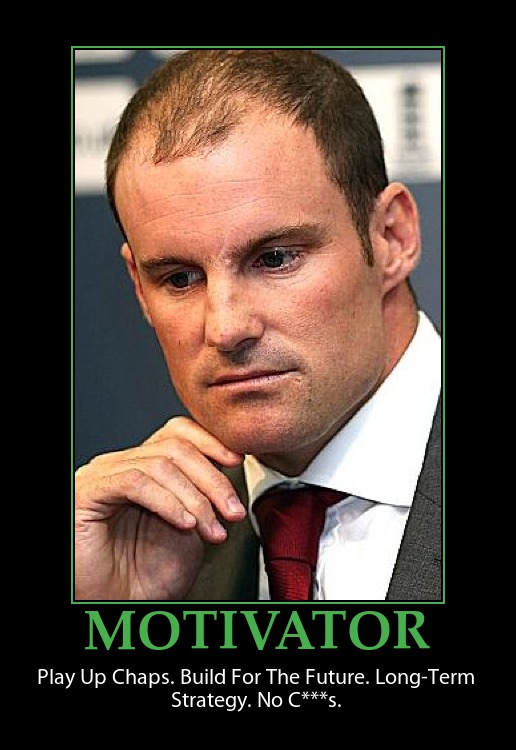
Strauss gave it the big one over sacking Moores. Bravo. He wasn’t tactically adept enough at the international level. Well, that’s nice. I suppose all those press boys who fell over themselves last year have recanted their sins on both Moores and the man who appointed him (sound of crickets). There then came all the stuff that Andrew Miller, in his excellent Cricinfo piece, called the “white noise of corporate bullshit”. If you’ve read Driving Ambition, and I have, the bit I most recall was Strauss’ devotion to managment text books, team bonding exercises and military disciplines. People here will know how much I absolutely adore all of that. We try to escape this sort of claptrap in watching sports. I’ll bet Lionel Messi has never read a management text book in his life. I’ll bet Ronaldo doesn’t do team bonding. It’s drivel. We are playing sports, not planning a mission to invade Afghanistan, or to deliver a leveraged buy out. But here they were all trotted out, the most vacuous of them all being the “long-term strategy”.

We had the shock that he was keeping Eoin Morgan as captain of the ODI team – hey, while we’ve just sacked the coach, let’s kick him even harder by saying the World Cup was ALL his fault by keeping the captain (who just happens to be a Middlesex player, but I wouldn’t be that cheap to draw a conclusion based on that). Then there was the promotion of Joe Root to vice-captain, which, who knows, may have been based on the legendary leaked performance on some leadership exercise by Ian Bell to demote him back to the ranks. Then there was the woolly philosophy of separate ODI and Test teams, but under one coach. There would be more of a distinction but we’ll flog a head coach to death to do it. Well, good luck with that.

And that was pretty much it. A trust issue where there was no-one to blame, and I didn’t go into the semantics of the following old shite where he said KP had no future, but he absolutely wasn’t banned. Some contrition for the manner of Moores dismissal, but a dismissal of Moores himself (and how that contrasts with his book which when KP and Moores were having their spat, Strauss almost indicated that “it was nothing to do with me guv”. Driving Ambition 2He certainly worked with him there, didn’t he? (Driving Ambiton, by Andrew Strauss is available from normal sources if you wish to read the full book). Tom Harrison came on and did a speak-your-Downton regime. First of all, his credibility is shot because he looks like Tim Westwood. Secondly, when challenged on the KP front, he then did what all good charlatans do when caught on a weak issue for them, and said, I don’t want to talk about the past, it’s about the future, and then went on about excitement and long-term strategies. I lost the will. He’s dead to me. No more than a Downton in a sharp suit, but with more of an attitude.

Of course, since then, the main copy has been provided by the Pietersen sacking (for that’s what it is, don’t bullshit us) and what KP had or had not been told.

Like last night, I’ll divide the post in to two, and have a real pop in the second part. Because I want my dinner, and I’ve topped 1500 words. I’ll hand it over to thelegglance to take things up.

Also, read The Full Toss (James and Maxie), and Andrew Miller on cricinfo (which also has a link to Switch Hit).

UPDATE – Not really been at it today, even though I seem to have devoted a full day of my holiday for this nonsense. I’m likely going to take a couple of days away from the blog (don’t hold me to it) and I know Vian has something up his sleeve for tomorrow. I feel a bit of my spirit is broken, to be honest. I’ve felt this way before. I get over it, and get on with it. It wasn’t helped by listening to Tuffers and Vaughan, to be honest. If we showed one tenth of the bile for Cook or Strauss that is doled out to Pietersen, we’d be annihilated. We don’t come anywhere near close.

326 Not Out – Part 2

COOKY

Read Part 1 below – a bit of a diary of the day up to the TMS tweet. Now I’ll really get stuck into this nonsense.

Let’s take ourselves back to the end of the day’s play. The reaction to the 326 that I saw was mostly of the “wow” kind. A few churls who wouldn’t have cared if it was Marshall and Holding in their pomp at each end had a pop, but they looked rather stupid. One moron of the month, who Clive rightly called a troll said “one innings in four years” which not only questioned his recognition of how relatively rare 300s are, but also his numeric ability given KP’s knocks since 2011 – you know, the golden trio even his worst critics can’t help bu admire. I’m used to this utter nonsense now. It’s tedious, it’s dull, a bit like this blog to non-believers.

So to the TMS Tweet.

Seems pretty unequivocal. Of course it’s a leak, or whatever you want to call it, because a leak isn’t a leak if it isn’t a leak or something. Some people got rather uppity about all that over the weekend (no, not you LB), as if we were doubting their journalistic abilities. But this looked like a leak to me, this one… if it looks like a leak, smell lies a leak, it probably is one. So the reaction was one of fury.

I absolutely one hundred percent stick behind this one. I’m deadly serious. I’m not over-reacting. This blog is built on these foundations. Call it as you see it on DAY ONE. I called for Downton’s dismissal the day after he said something utterly stupid and now I call this.

I am seriously not impressed by Tom Harrison. Oh, I know, he wouldn’t give a toss if he read it, and why should he? He’s a highly paid executive and I’m just a mere bilious inadequate with a small platform and loyal support. But this was another one we were told was made of the right stuff. A former county pro, who went into media rights management and is now in charge of something or other at the ECB.

This is him.

HarrisonSo far, he’s sacked Downton, which was a fair move but bloody hell, he took his time over it as he presided over a costs and structure review – and boy does Harrison like a structure. Then he presided over the absolute clusterf*ck that was the dismissal of Moores. In the interim he employed head-hunters to come up with Andrew Strauss for a new post called Director, (and that comma says so much) England Cricket (or whatever – I cannot be bothered with this muppetry) and now, that is coming home to roost. They had it all planned. Andrew Strauss would be unveiled, they’d say a teary farewell to Peter Moores, and then new Management Structure England would move forward to the New Zealand series and the Ashes.

But, as we know, the information on Moores leaked. How it leaked we do not know, because, well we’ve done that already above. So a decent bloke (I think I’ve been consistent in that) was humiliated in public by this organisation. You’d think they’d feel a little chastened, a little wounded, maybe a touch humble. But I’m not sensing humility from Harrison. I’m sensing someone who is a little too cock-sure and seems to think he’s wielding a big stick. Just a hunch, and we’ll see how it plays out. Not been too wrong on them so far.

So, with plans completely blown out of the water, a contingent strategy took place, and the announcements were made on Saturday. Vian’s post below captures my thoughts brilliantly. My thanks for such a really good post on the matter. After this nonsense we were advised there would be a press conference today (Monday) or tomorrow (Tuesday). No-one was quite sure. There seemed to be utter confusion, while at the same time trying to exude some sort of decisive authority. This smacked of Captain Mainwaring shouting “I’m In Charge” as his bunch of old timers rambled off here and there.

Now, they knew the press conference, on Tuesday, was always going to throw up the KP question. At this stage (Sunday) it was an easy case to answer. Let him make some runs, he’s not in our plans at the moment, and it’s difficult to see him in our plans going forward. But he has to make runs. Even this has not, it appeared, satisfied our captain. I’ve been told a ton of times how nice a guy Cook is, but he doesn’t seem to act like it it. Either he’s being horribly misinterpreted here, or there’s something I’m missing, but every time someone seems to broach a rapprochement with KP, there’s a column saying Cook’s angry at someone for it, being Aggers (reportedly) over his TMS stint at the World Cup, or Graves for that message during the World Cup that got KP to sign for Surrey and play county cricket. It seems that Team England is run for the benefit of Team Cook. We’ve been down this road on this blog before. It really appears to me a him or me situation, a back me or sack me. In Downton, Cook had an implacable supporter. In Flower, behind the scenes wielding whatever power, he had someone in his camp if it means keeping KP at bay. And in Strauss, he has a man who KP fell out with, who didn’t want him to return to the team after Textgate, and who called him a c*** live on TV. I think, as they say in the legal world, these lot have “previous”.

I’ve been saying all along they’ve been leading him up the garden path. This is not an organisation steeped in an ability to admit mistakes. It refuses to believe it can ever be wrong on any matter, or admit it’s core policies are misguided or prone to scrutiny. This is a body that went into a major deal with a subsequently committed felon, and you’d gather from our governing bodies attitude to its culpability in the terms of “ooops, shucks, well, ok, never mind.” Collier, the architect supposedly of this kept his job for a mere six years after that. Clarke has had to be prised out of office with the promise of a lovely old international jolly. Hugh Morris presided over the Moore/Pietersen nonsense with all the authority of Captain Peacock in Are You Being Served, while throughout this period we had leaks/good journalism all over the shop. That an organisation is supposed to be anal about leaks lets so much information out, such as KP’s report, the dodgy dossier and the sacking of Moores II, is preposterous. They are a sick joke, with the emphasis on sick. It’s bloody ironic that the new chairman is called Graves. This is a place where common sense goes to die. Where good chaps preside over the serfs, and don’t you dare question authority.

Above all, this is an organisation that employed Paul Downton in a position of responsibility. You remember him. All aplomb and good impressions. He may have been a lovely guy, aren’t they all, but he was out of his depth from day one. He hid. When he spoke, we knew why he hid. But we are told that things will be different now. While Downton was removed from the game for a couple of decades, the new Director, England Cricket, will be more in touch. More in tune with the modern game.

The list of those who would be in for the job underwhelmed. While Michael Vaughan was an inspirational captain, he’s a twit online. Alec Stewart had experience of being a Team Director, but that didn’t count a jot, and really, were we enthused by his candidacy. Then there was Andrew Strauss. The last week has seen people falling over each other to tell us how tough he is, how single minded, how focused he was. How he’d do the best for English cricket. He is the ideal man to take us forward, a great captain, a great leader of men. The evidence? He got rid of Moores (or did he. I’ve heard from some that he was gone well before the announcement of Strauss….and I’m talking a couple of weeks). But if Strauss sacking Moores adds to the narrative, well, what’s the harm in that? Of course, we’d heard from Michael Vaughan that Moores wasn’t going to be sacked, and that he’d been told that the ECB were not going to take KP back. Then Strauss is their man, and Moores goes. It’s laughable. So Strauss has a big decision under his belt, so it seems.

And it is abundantly clear, if I’m guessing, that the plan was to talk to KP before the presser to sort that out. They know that the question is going to come up, and I said how I thought they might answer it in part 1. But it’s easy to speak to KP with a forthright view if he’s not made runs. Now he has. 326 un-ignorable runs. 326 stabs into the heart of the ECB with their high-fallutin’ principles and beliefs. 326 jabs at their pompous approach, their holier than thou, high and mighty, we are in charge balloon of infallibility. 326 reasons why they are wrong to adopt a policy of selection that excludes someone because someone inferior doesn’t get on with him. 326 reasons why this country is a bag of shite when it comes to creating and maintaining great English sporting teams. It’s too much about getting along, and not enough about getting runs.

So when faced with the utter shit-storm the initial twitter post from TMS unleashed, with people going absolutely puce with rage (me included), there was a very quick back-track via Nick Hoult in the Telegraph. Lawrence Booth has reported much the same thing. But this is them trying to be clever and the ECB-watching public out there are not going to be fooled one iota. Their policy, if not explicit, but as close as you can get to it, will be KP over their dead bodies. Even now these control freak, superiority complex muppets will be concocting something that is designed to fool the public tomorrow. You won’t. Without the simple mantra that the team will be selected on merit, as it should be, anything else is claptrap. We won’t get fooled for building for 2019, because we built for this World Cup and blew it up in a tantrum last year. Setting long-distant dates, talking about long-term strategies is management bullshit. You going to give all the punters who paid all that cash for the Ashes some money back as you ain’t giving it your all? Like hell. It’s talking down to us. Some, in their bilious hatred for KP will accept this bag of nonsense. More shame them.

So, on the off chance that Strauss will surprise us, which I doubt, I’ll hold all my fire. But here’s the Dmitri Declaration. If I hear anything other than the England cricket team will be selected on merit, and no player is excluded, and if he is playing well and is deemed to be the best available at that time, regardless of age, then that player will be selected. But as this is a team that selected Tredwell over Rashid, Trott over Lyth and is busy flogging Anderson and Broad to a standstill, it’s all a smokescreen.

To the final insult, the last in a long line. The Graves comment that KP’s not available for selection as he’s not playing county cricket and not scoring runs. There have been denials that a deal has ever been struck, that this was a mere innocent comment and nothing had changed. KP is many things, not all good, but he’s not stupid. He returned because he felt there was a genuine chance of a rapprochement. He felt Graves would take none of the previous regimes nonsense and set them straight. To that end he negotiated an exit to his IPL contract, and gave up a decent, not huge, sum of money, and does not take a salary from Surrey. If there were “no chance” of a recall, then they should have said so, there and then. They didn’t. They hoped he would fail, would not score sufficient runs. That he would wither and die, and sod off to the CPL later in the summer. KP’s not that gullible that he wouldn’t keep that in his back pocket.

Now he makes 326, now we see them close ranks. Now we see them all but shut it off in perpetuity. That’s reprehensible, and let’s see them get their way out of this. A good number of cricket lovers are enraged at this apparant duplicity. That this isn’t just getting shot of a trouble-maker but exacting a bitter, cruel revenge. I am a KP fan. This man gave me some of the greatest thrills of my cricketing life. I would have loved to have been there today. I’m desperately hoping he’ll be there at Beckenham in a fortnight’s time, but that looks unlikely. I’m not saying he’s an angel, but he’s among the best we have. But we don’t play the game that way.

From the outside this is an organisation not representing its core supporters. This is an organisation that leaks. This is an organisation that thinks it is too clever by half. This is an organisation that is rotten to the core, steeped in some misty-eyed half-baked concoction of superiority complex elitism and management philosophy claptrap, that only they can judge and only they can decide. This is an organisation that couldn’t organise a piss up in brewery, a sacking on the Apprentice, or honest broking in a room full of spivs. It is diseased, it is malevolent and it has to go. Yes. We need a new organisation running the game, free of all this rubbish, these agenda, this structure. There’s another structure for you, Tom.

Sure, I’m outside cricket. I’ve never felt more outside than I do now. Judging by the reactions of many today, so do they. It’s an incredibly sad day when our own organisation rushes to dampen down the enthusiasm felt by many when a player who gave great service to England, who played many amazing innings, who had us glued to our screens, buying our tickets, makes a thrilling riposte and does what he thought he need to do, only to be told within a matter of hours, it seems, to foxtrot oscar. Someone put cricket on the back pages today, and instead of welcoming it, our beloved guardian authority hated it. They’ve got it all right, ain’t they….

Let’s be pleasantly surprised tomorrow, eh? Anyone betting on it?

kp FO

326 Not Out – Part 1

Not Wanted

For some context, and a piece that sums up my views on KP, try this.

Where on earth do you start on a day like this? Let’s set the scene a little. As some of you know, I’m on holiday (vacation out here) in a place called Cape May, New Jersey. It isn’t the Jersey of Springsteen, with the New York overspill or the refineries and factories. It isn’t the Jersey Shore of TV infamy, nor is it Atlantic City, where I’ve been today, but a quiet, sleepy seaside town, with one side on the Atlantic Ocean and the other on the Delaware Bay. I’m 200 yards from the sea. It’s lovely.

So you’ll understand that I wasn’t up with the lark this morning, and rather enjoying a lie-in. I awoke, at around 2pm I think, UK time to be greeted with a number of comments on the blog remarking that KP had made a century. “What a lovely start to the day” I thought, and then chuckled to myself that those haters would be tripping over themselves to diminish it. Also, taking the game situation into context, Surrey really needed those runs, and needed more. What did I do though? I tweeted

Lawrence Booth got back to me (he didn’t know how the day would end up)

I responded…

I calmed down a little, and had a little walk, and came back to see the Pietersen machine rolling along, allied to a tail that didn’t give it away. 150 was up…. and I was busy working out what he needed to make to get the average over 100 if he got out (188). When he passed that, the next target was 200, and so that was passed. By now the joy was let forth. I never believed he would get back to smashing any attack around for these sort of scores. A century or two would be ignored, because, well, anyone gets them. But a double is not easily ignored – as Sky Sports pundits and hosts kept saying “if KP churns out a double hundred or two, then what…” As I left the house with a spring in my step and a little joy in my heart, I got on my international sim phone and followed the score up the Garden State Parkway. 220, 240, 255 (past his best score), 270, 290 and then….300.

Now, I don’t care what standard you play, but 300 is nothing to be trifled with. It is not to be ignored. If this were a player who had shown no aptitude for test cricket, had tried and failed, or was a promising youngster, maybe there’s an excuse. That isn’t what we are talking about here. We are talking about a test cricketer of proven ability, who not that long ago was making very decent centuries (anyone forget his Old Trafford hundred less than two years ago?) and had answered his critics by coming back to first class county cricket, a format that he doesn’t particularly cherish, and he’s smashed it everywhere. 326 not out. Ignore that.

I was so happy, I should have popped into the Golden Nugget and put money on 24.

So, I’m wandering around the shops and left the international phone in the car. Treated myself to a couple of things, and then went back to the car. As we’re crossing Little Egg Harbour, I saw the TMS Tweet.

And I went ballistic. Absolutely fucking ballistic.

You may have seen my twitter outpourings, but if not, just go on there and look for @DmitriOld . The ECB had chosen this moment to announce that they were not picking KP for England again. Ever. This would not happen. Not in a blue moon. No chance. Cut off without a prayer. Brought hope forward by intimating he had a chance, and when he stuffed it back at them, they said “no, sorry”.

Make no mistake, for all the weasel words we’ve heard since, where there has been some suppsoed back-tracking, we’ll get a restatement of Andrew Strauss’s position tomorrow (the one we read about weeks ago, and why we so opposed his appointment now) which will be all about building teams for 2019 blah blah blah and that KP will be 39 by then. If you fall for that old pony, you’ll fall for anything. They are blocking his way, no matter what. There will always be a reason not to pick him. If he followed this 300+ up with another monster score in his next outing, it won’t matter to these idiots, for idiots are what they are that they would rule out a monster talent returning to monster form. It IS one innings, and it IS just part of the road back. But this lot want to block it for what? Personal reasons? If he’s the best batsman, in form, in the country, you play him. It really isn’t that complicated. Let me effing well repeat that. IT REALLY ISN’T THAT COMPLICATED.

This is the ECB in a nutshell. Cricket is meant to be exciting, it is meant to be fun to watch, it is meant to thrill as well as enthrall, to appreciate graft and genius in all its forms. It’s not a bloody game won by management consultants, self-help books on army drills and team-building nonsense. It’s won by talent, it’s won by attitude, it’s won by seizing the moment, not ticking some Belbin Analysis or a team leader assignment on a marines assault course. This team we have now can be as together as it likes, but it collapsed like wet cardboard at Headingley last summer after an abject display by its captain. It hooked its way to a loss after another abject bowling display at Lord’s v India, and despite a turnaround which has been praised as if we’d turned into the Invincibles, we went to the West Indies and collapsed in a heap in Barbados. They are so together, they collapse in a heap in synch. I’m not saying KP makes you immune to that, but it also doesn’t mean that these batsmen are set in stone, no matter how much they say they are. If I could have a pound for all the times someone says to me “who would you drop?” then it would have paid for my shopping today. That’s not the way to look at it. It is “who are the best batsmen in the country?” If the answer is KP, then Ian Bell, Gary Ballance or Joe Root will just have to get over it.

Which is all I want. Pick our best team. Pick our best players.

Watching some of the jealous muppets on Twitter is sickening. Honestly, they act like the Katie Hopkins of the sporting world. Muppet Pringle, a man who got the sack for not reading the runes it appears, had this absolute gem, which in its brevity sums up why English team sports are absolutely Donald Ducked.

Principles over PR? What is he on about? Principles…. oh yes, they’ve worked so far. We backed a captain who took two years to make a ton, and has little or no tactical acumen over and above chuck it to Anderson and Broad and hope it works. We’ve had principles that Cook is sacrosanct in the test arena, and for a while in the ODI arena, and will work to the detriment of English cricket and hamper preparation for major events by backing him until it’s too late. Yeah, principles. Teams with principles are usually rigid, inflexible, and bound to them. Principles means authority rules, so shut the hell up.

Meanwhile, making 326 not out in a county game, I suppose, is PR. Jesus wept. Oh, and there’s a dig about tweeters too. Genius.

But it seems that our ECB would rather follow this “play the game chaps” approach, rather than countenance that they might have made an error. In part 2, which I’ll write later, I’ll go on to all that. And the unprecedented reaction I saw on Twitter after that TMS tweet. This is a fire that just will not go out. The ECB, instead of dampening it down, seem to want to put petrol on it.

The Moores things change

So I picked a good few days at the end of last week to be snowed under…

Dmitri has highlighted a few things about the peculiarities of the ECB actions, and as the days go by it seems they have learned absolutely nothing.

Firstly the sacking of Moores has handled with a complete lack of respect.  Whether he should have been appointed for a second stint as England coach is one thing, but he was.  Dumping him after a year is an open admission they got it completely wrong, just as they did with Downton, though with fewer excuses given Moores had done the job before.  Naturally, there’s been no admission from the ECB of that, and naturally they managed to make a mess of it.

On Friday Moores took the England side to play Ireland in Dublin, and the morning papers were full of articles about his impending sacking.  The television coverage consisted of commentators openly talking about it while the camera focused on him.  Moores retained his dignity after his first period in office, refusing to criticise the ECB or complain about his treatment, indeed his conduct would have been part of the reason that they considered his return.  He deserved far better than the public humiliation of leading the team to Ireland and having his removal an item of discussion while the camera focused in on him, just as he deserved far better than being the subject of numerous press articles that morning.

Moores may not have been the right person to be England coach, but that doesn’t make it remotely acceptable for someone in the ECB to have briefed the press about it all before the official announcement.  The journalists are doing their jobs, there’s no criticism of them.  There is criticism of the ECB for failing to treat an employee with the respect due to them. One must hope that Moores had already been advised of what was to happen before then, because anything else goes off the scale of dreadful treatment.  It is to Moores’ immense credit if so that he still did his job that day.

The point here is that you don’t have to approve of Moores’ appointment or the job he was doing to be be aghast at his treatment.  This is a decent man doing his best for the England team.  Whether or not his best was good enough is entirely beside the point.  Treating people like commodities to be discarded without recourse to their feelings has been a pattern of behaviour within the ECB for quite some time, and it seems clear that nothing has changed.  Doubtless they will wonder what all the fuss is about; after all, the bilious inadequates weren’t happy about Moores’ appointment in the first place, so surely they got what they wanted and should pipe down and move on.  No.  Moores deserves an apology, and a public one.  It is unacceptable in the extreme to treat him with such contempt.

Of course, the appointment of Strauss has led to numerous articles about what this means for Kevin Pietersen.  Like others, it is intensely amusing to read the usual suspects who lament that Pietersen dares to be an issue write extensively about him while demanding that everyone else move on.   Like a dog returns to his vomit so fools repeat their folly.  But there is an important point here – if Pietersen is once again going to be told that he won’t be selected for England, then the ECB have told him lies.  He came back into county cricket because he was led to believe there was an outside chance of him winning back his place in the England side.  He gave up his IPL contract, and he donated his salary with Surrey to charity.  He would not have done so if told he could forget any possibility of selection.   Leave aside the practical matter of whether it is remotely sustainable should England have a poor summer, a restatement of his banishment is at odds with the indications they have given him.

Pietersen has a limited number of years left in the game.  Leading him up the garden path and messing around with the remainder of his career would be a spiteful, vindictive thing to do.

And this is where the treatment of Moores and the treatment of Pietersen coincide.  Not for the first time, the ECB have behaved with nothing but contempt for others.  The defenders of them try to argue that the dreadful disaffected people are the problem, and that nothing the ECB could ever do would satisfy them.  They can’t even treat their own employees or players with respect, it is hardly surprising that they don’t care about anyone else.

Let’s be abundantly clear.  The treatment of Moores was loathsome.  If they do what has been trailed in the press to Pietersen, that is repugnant.  There are no justifications, no weasel words that make it more palatable.  Simply an organisation that cannot even abide by standards of common decency towards other human beings.

@BlueEarthMngmnt

Esperanto

Bilious Inadequates

Which one makes more sense to you?

The last year has been a period of transition and rebuilding in which Peter has nurtured new talent, developed new players and laid the foundations for the new coaching structure to build on.
“This decision has been made as we focus on the future and our need to build the right approach and deliver success over the next five years within a new performance structure.”

or this…

La lasta jaro estis periodo de transiro kaj rekonstruo en kiu Peter nutriĝas nova talento , evoluigis novajn ludantojn kaj fondis por la nova trejnisto strukturo por konstrui sur .
‘ Tiu decido estis farita kiel ni enfokusigi sur la estonteco kaj nia bezono por konstrui la dekstra alproksimiĝo kaj savos sukceson dum la venontaj kvin jaroj ene de nova agado strukturo .

Because it doesn’t make any sense to me. I weep when I see this sort of thing. The implication is that Moores has done a good job developing talent that they needed after the loss of the Ashes and the key players who walked, were injured/ill or just chucked out for reasons not explained, but now it needs to be left to the big boys, like Andrew, who knows best. The only way this could get better is if they re-appoint Andy Flower as coach.

More on all this later. It’s a lovely sunny day by the Shore and we have visitors coming so probably won’t be around much more today.

UPDATE – Vaughan’s piece in the Telegraph, if true, is astonishing – http://www.telegraph.co.uk/sport/cricket/international/england/11594878/ECBs-handling-of-Peter-Moores-sacking-was-disgraceful.html

I had talks with the ECB about the director of cricket job the day after the Grenada Test when the team had won and there was a vibe about England’s Test cricket. It was clear to me that they would not be removing Peter from his job and I felt I could not be the boss of someone I did not rate.

It would have created too much pressure around the team and too much focus would have been on that relationship leading into a huge Ashes series.

There was also the Kevin Pietersen situation. That was always going to be hard to manage. I personally wouldn’t want to rule him out of playing for England again if he scores runs for Surrey and a vacancy opens up in the middle order. If his game is good enough why would you not want to take someone like that to a World Twenty20 next March? But the ECB still seem to be a little bit reluctant to bring him back and I feel that the Pietersen issue is still going to be a talking point through the summer. So it was not the right time for me and I was never offered it anyway.

But then the situation changed. England lost in Barbados and Peter’s job was on the line again. It is a warning of how quickly things can move on in sport.

Where do you start with that? I have not mentioned KP that much recently but this indicates there is still no desire AT ALL for KP, meaning he has been led up the garden path as I thought.  How one match (Barbados) changed everything with a body that talks about “long-term” strategy and building structures. How Moores was staying, then going. In a blink of an eye.

I mean, it’s enough to inspire zealotry in anyone, isn’t it?

Dis-Appointment

Strauss Motivator

So it has been confirmed by the usual type of press release where those doing the appointing try to persuade us that this has been an exhuastive and thorough process, where after enormous efforts, they’ve got the right man.

Like this one:

“Paul’s experience of a World Cup final, Ashes success, six County Championship wins and 58 international appearances for England provides a wealth of cricket experience.

“His background in law when coupled with his experience in the City provides the unique set of skills which is required to lead and manage the England Cricket Department’s £100m budget over the next four years.”

Still make me chuckle. The “outstanding candidate indeed”.

Today it has been announced, not with the hoopla of a press conference that you’d associate a major announcement like this to have given the high profile nature of the job (Downton’s post wasn’t making news like this one is), but via a press release, that Andrew Strauss is now the Director of Cricket. Let’s take the release in full first.

“Andrew Strauss has been appointed Director, England Cricket. In this new high-performance role for the England & WalesCricket Board [ECB] he will be responsible for the long-term strategy of the England men’s cricket team and for developing the right coaching and management structure to support it.

“The appointment follows a month-long formal recruitment process led by ECB chief executive Tom Harrison. Strauss, who led England to two Ashes wins and took his team to the top of the ICC world Test rankings, reports to the chief executive.

“Commenting on the appointment, Harrison said: ‘Andrew’s breadth of ideas, his passion for England cricket and his proven leadership skills shone out. He was an exceptional England captain, is an authoritative voice on the modern game and has a wealth of experience building successful teams.

“‘Andrew’s also widely respected across the sporting landscape. We’re delighted he’s joining us at the ECB as we set out to create a new strategy for the game.’

“In this new role Strauss will oversee the England’s senior men’s team including their performance and development programmes and the selection process and player pathway. The England Head Coach will report directly to him.”

There’s more wooliness than a sheep farm, more platitudes than a showbiz awards show, and more guff than listening to the reporters on the TMS slot (sorry chaps! needed something). First up we have “long-term strategy”.

This is the refuge of people who have no idea how to make a success. Long-term strategy and development of the right structures of management etc. A little bit of me died. What does this mean? What is long-term, and what structures are we on about when for the England cricket team, it seems to be in place now (or are we talking about Andrew cutting down/increasing support staff). How is Strauss going to get star players out of the ether if none exist?

The second paragraph mentions a month long formal process to reach the decision. The job plan wasn’t made public, the interviews seem to consist of Michael Vaughan having a chat and saying that the job wasn’t for him, and Andrew Strauss saying it was. Perhaps the ECB might enlighten us poor plebs as to what this process was, who else might have been approached, and what they might think of the role? Did they speak to Alec Stewart for instance, or did they approach Martyn Moxon? Instead, it seems to this bilious inadequate that we’ve designed a job in the England team called “Being Andrew Strauss”.

Now, I’m not impressed at all by Tom Harrison so far. I’m sure he doesn’t even have the likes of us on his radar. The next few comments he makes are straight out of the management appointment bullshit lexicon that drives me up the wall. The “he’s really great and we’re so lucky to have him” bollocks that sets my antennae off, and makes me immediately suspicious.

Andrew’s breadth of ideas, his passion for England cricket and his proven leadership skills shone out. He was an exceptional England captain, is an authoritative voice on the modern game and has a wealth of experience building successful teams.

Seriously, what are these ideas? He reads management and armed forces guides and implements some of their ideas. This worked well because one of his best batsmen wandered a mile off the reservation under him, and while it’s too easy to say it was all that man’s fault, you had to be blind not to see the cliques emerging, especially the Swann Anderson nexus which got to include Broad. So count me sceptical about his record on that. He captained England very well when we got on top and scored big runs.

As for the last bit, please spare me. An authoritative voice? Really. What’s the most memorable thing he has said since he left the England set-up? If that’s authoritative, we’re in for a fun time. I’m also not sure that the last bit was bang-on, but the players mostly seemed to like him. But once the team came off the rails, it did so with a bang, so he had experience of seeing one fall apart too.

“‘Andrew’s also widely respected across the sporting landscape. We’re delighted he’s joining us at the ECB as we set out to create a new strategy for the game.’

Pure management-speak bollocks. Set out to create a new strategy for the game. Seriously, what does that mean? When I have a work objective set it has to be SMART. My eyes roll at that. Time specific? Measurable? Specific? No, woolly management guff you can kick down the road because extraneous factors will always get in the way. Oh yes, and the first bit. I’m sure he’s widely respected across the sporting landscape, but funny how the bilious inadequates think he’s the “safe” choice, the “company” man, the assured diplomat and just the sort of family they’d like to see a DOC come from.

“In this new role Strauss will oversee the England’s senior men’s team including their performance and development programmes and the selection process and player pathway. The England Head Coach will report directly to him.”

Does this mean he becomes a selector, or replaces Whitaker? This is the interesting part because it was this role that Downton seemed to take that alarmed us all. Also, how do you oversee the performance if you’re not the coach, and how is he supposed to influence it?

I genuinely don’t think they know what they want Andrew Strauss to do except be Andrew Strauss. We all have our views on him, and mine are on the slightly unfavourable but not downright hostile. I see him as a reasonably set in his ways, typical establishment manager, with adherence to major principles and too keen a take on text book management tomes. If he’s allowed to kick the can down the road, he is going to, because he’s already known as “bob the Builder” on here for his insistence on taking long-term approaches and building for the future, when the team he led was as conservative and for the time as you could get. It wasn’t exactly known for developing talent. It also was a team that had its way of winning. The infamous “bowling dry” which worked if you made masses of runs, which we did.

Of course, there are major elephants in the room. KP will always loom. Calling him a you know what will always be remembered, and the biggest of them all, his attitude to Cook and probably more importantly Flower loom. I think he sees kindred spirits in those two, and if that’s the case, I can’t be positive. We need to be released from the shackles of the past, not be beholden to it.

These will be outstanding times indeed.