Ashes: 4th Test. Day Three comments

Here it is, the big day. All in here…

Dmitri Comment – Congratulations to the England cricket team for reclaiming the Ashes from Australia. They have taken their opportunities with ruthlessness and vigour. The bowling has been very very good, and the batting has been mostly solid where the opposition’s has been rickety.

We can discuss everything that surrounds this series in due course. The fact is that we’ve hammered Australia in two successive matches to put Lord’s behind us. Only subsequently will we find out if this is the start of something special, or a false dawn. I have no problem at all with people celebrating. I’m sorry I can’t feel the unbridled joy of 2005 or 2009 (when I was there when they were won).

Feel great for most of those players today. They did England proud.

Ashes 4th Test, Day two review

And that is pretty much that. Still 90 runs adrift, only three wickets left, short of a cricketing miracle for Australia, or the arrival of a freak hurricane, England will go 3-1 up sometime tomorrow, probably in the morning and regain the Ashes.  After the carnage of day one, to all intents and purposes the game was already up.

Being bowled out for 60 more or less guarantees defeat anyway, so today was in some ways a fairly normal panning out of the situation as expected from the end of day one.  Australia did bowl a little bit better, though that’s not especially unusual when a day has been as bad as that, it would be hard to imagine Australia could do any worse. Yet such was the total dominance of England’s position, they could happily play their shots safe in the knowledge that it mattered little.

Mitchell Starc got just rewards for a bowling performance that was a cut above those of his colleagues, but with the game already pretty much gone, it will hardly be a successful set of figures he will look back on with too much pleasure. Once again, Moeen and Broad showed they like batting together. Moeen is simply gorgeous to watch when in full flow, reminiscent of David Gower, to the point you want him to succeed simply because of that. His batting this series has been a major plus point, the debate over him will certainly continue, but his performances at key times with the willow have been the least of the issues.

As for Broad, some time ago it started to look as though he was just beginning to get his batting back. It’s not entirely there yet, but he is staying in line, and looking to play shots, rather than desperately slogging. A Broad who plays like that is a serious asset in the lower order.

Australia couldn’t possibly have batted as badly as they did in the first innings, and the opening stand from Warner and Rogers restored both a little respect and a fair degree of sanity to proceedings. Yet the problems were still there, Rogers never looked entirely comfortable, while Warner was consistently squared up.  England have clearly identified that his strength to the short ball is also his weakness when he’s cramped for room, hence coming around the wicket. His arms don’t extend and the ball can only go up. Other teams will be watching.

From a promising start, Australia collapsed horribly yet again. In each case it was a grim shot, even allowing for the two lives provided when England bowlers overstepped; Smith looks completely at sea at present, which is remarkable when only four innings ago he looked imperious at Lords. His idiosyncratic technique was always going to be examined in conditions where the ball moves in the air and off the pitch. He’s more than good enough to work that out, but it’s far too late for this series, and not alone in having serious difficulty against the moving ball. Clarke too was hopelessly out of touch, while Marsh’s dreadful shot did little to change the minds of those who simply don’t think he’s good enough for Test cricket.

As previously mentioned, it is never quite evident that a team has lost it until it actually happens, any more than anyone expected England’s hammering last time out. The signs were there after the first Test of a team showing signs of distress, and only a pitch that couldn’t have been better prepared to entirely nullify England’s bowlers got Australia back into it. Yet the abject, spineless capitulation of Australia’s batting in the last two Tests has been every bit as shambolic as anything England produced in 2013/14.

Well as England have bowled, time and again players have been dismissed playing attacking shots that are exceptionally high risk, with no evidence of a willingness to graft in less than perfect batting conditions. These are not bad players, to be getting out in this way repeatedly betrays minds that are completely shot, a team that has no idea how to arrest the slide. There is always a temptation when England win to limit the praise to them by pointing out the faults of the opposition. Yet in just the same way as the most recent 5-0 said more about England’s abysmal surrender than it did a great Australian side, so this almost certain series victory is less about England being outstanding than Australia being dire.

That doesn’t mean that there aren’t plenty of things to praise England for, the catching has been excellent, the on field direction has simply been far better than anyone could possibly have expected from the captain given his performance to date, while Joe Root in particular is starting to look the real deal, and Ben Stokes might still be inconsistent but is a major talent in the making with both bat and ball. Yet when Australia keep being bowled out to self inflicted calamity rather than England brilliance, that praise does need to be tempered by a recognition that England haven’t suddenly become a great side.

Future opponents will not be anything like so meek. That isn’t meant to be grudging, more a reflection on an astounding collapse in morale and stomach for the fight from Australia. England can certainly take pleasure from the way they have pressurised Australia – unforced errors are rarely entirely unforced when it afflicts the whole team – but there can have been few tours where Australia have been so appallingly inept on such a regular basis.

This has been a truly bizarre series, no match has even had the resemblance of a close contest, and this fourth match has been even more one sided than the three previous.  Australia are shot to pieces.   Quite why that is, will be a debate for the future. For now, they deserve every bit of the kicking they are getting from their own media who at least seem to recognise a team shambles when they see one.

@BlueEarthMngmnt

Ashes: 4th Test Preview

A bit busy this week and travelling the country, so the posts will be much briefer than normal.  I’ll try and get reflections on the play up as and when I can at the end of each day, but it might not be so detailed, or indeed so argumentative!  Thursday is the day that will represent the biggest challenge, so bear with me.

As for this forthcoming Test, I’ve got to confess, I haven’t got a clue.  This series has been thoroughly ridiculous and making predictions is guaranteed to leave egg on faces.  You would think that England have the upper hand, and you would think that Australia are showing signs of distress.  But given the Lords hammering they dished out, that’s a dangerous belief to hold.

Of the items of side interest, Michael Clarke’s form is a concern for Australia, but it so often tends to be the case that the moment the media notice is just about the time a huge century is about to be delivered.  He’s clearly more than got the class to do it.

For England, it’s about how they cope with the absence of Anderson.  Broad looks more than capable of stepping up, the expectation is that if fit Wood will return, and he has made a decent enough start to his career, while Finn will be looking to show his performance in Birmingham wasn’t a one off.  The assumption is that the Trent Bridge pitch will offer something to the seamers, but previous pitches there have been dreadfully slow and low, not just two years ago.  For the sake of the game, let’s hope it’s not that.

The batting line ups of both teams looks as brittle as ever, so we arrive into the match having no real idea what is going to happen.  And actually, that’s a very good thing, because sport is always at its best when there is uncertainty, even if that uncertainty here is based on the flawed teams rather than excellence in both parties.

So having gone through all that, and having thought deeply….we’re no closer to having any idea what will happen.  Probably a tie.

@blueearthmngmnt

UPDATE FROM LCL – Do go over to The Full Toss and listen to James Morgan’s interview with Jarrod Kimber if you haven’t already done so, and not just because our humble little blog gets a mention (oh well, just because it gets a mention). Seriously, very interesting stuff, and well done to James for getting Jarrod to speak to you on all things blogging and film making.

Ashes: 3rd Test review

When the intellects of Sartre, Russell and Machiavelli considered potential locations in which to contemplate life and the unfairness of being, it is safe to say that somewhere around the Banbury junction of the M40 probably didn’t figure too highly in their considerations.  Yet it was here that a revelation was to be found, a dawning horror, and a mind forced to express a desire never yet felt by an English cricket fan.

The miles were eaten up, the air conditioning was keeping the cabin cool and pleasant, yet a painful thought kept surfacing as the TMS team chirped away in the background.  The previous day’s work had prevented watching more than the first morning of the Test, although it had been closely followed in mounting amazement.  Australia had won the toss, and though it was felt not to be a bad toss to lose, no one expected the carnage that would follow.  The pitch had offered a bit to the bowlers, but with the exception of Rogers, the lack of discipline in Australia’s batting was the principal cause of a side skittled out for 136.  Certainly England took advantage of what help there was, but a succession of dire shots had led to the pre-series favourites being bundled out in just over 36 overs.  Anderson might have been the chief destroyer, but while he might be nowhere near the best bowler in the world (he is very good – the Henman rule applies*), he is one of the cleverest.  A little bit of swing, a little bit of seam, and an Australian batting order that has long been vulnerable to both allied to an apparent inability to graft in such conditions all led to a total that looked woefully inadequate at the time, and proved to be so as the game unfolded.  Yet although Anderson rightly took the plaudits, the England bowler who caught the eye was Steven Finn, not because of how many wickets he took, but how he looked.

Finn has been in the highly promising category for many years, and perhaps more than anyone else still available to play has been the subject of ire directed at the management and coaching staff.  Finn is a wicket taker, first and foremost, and back in 2010/11 he was dropped from the England team because he was too expensive, despite being the leading wicket taker in the series to that point.  The frustration that the England set up preferred economy to wicket taking prowess was strongly felt at the time, and only became ever more magnified in the years following.

Finn has a Test strike rate of 46.2; he is in 16th place in all of Test history (minimum of 2000 balls) with that, and that takes into account a lost four year period when his run up was messed with, panic set in about his habit of occasionally striking the stumps with his knee – and the ludicrous rule change resulting – and a general focus on what he can’t do, not what he can.  Finn will go for runs sometimes, deal with it.  Two of the best fast n’ nasty bowlers of the last decade, Shane Bond and Dale Steyn, both have poor economy rates.  Better than Finn for sure, but neither of those have been comprehensively mangled by well meaning coaching staff.  That Finn goes for runs is of little relevance if he takes wickets.  The age old choice of whether 5-100 off 20 is better than 2-60 off the same shouldn’t even be a debate.  Yet for the England of the last few years it clearly was, and if the current approach is just to let him bloody bowl, that in itself is to be celebrated.  Strike bowlers are so rare, so valuable it is of incalculable frustration that England have spent years trying to wreck their one bona fide example of it in years.

How a bowler of such talent could have ever reached the point of being “unselectable” was disgraceful.  It’s also entirely unfair how Ashley Giles is now being criticised for saying so, when he was clearly right at the time, and his comments were rather obviously borne of annoyance it had reached that point rather than a dig at Finn himself.

As Warwick approached on the right, and an eye glanced down at the fuel gauge that visibly dropped with every passing mile (note to self – rotary engines and fuel economy don’t go well together), that mind considered England’s reply.  Having been so panic stricken at Lords, England instead did exactly what they said they would in the build up to the game, and went on the attack.  Lyth may be having a bad time of it at present, but nicks to wide half volleys are not evidence of a flawed technique but one of a simple mistake or a mind that feels under pressure.  Like with so many of the Australian team, it was poor batting, but not in itself an inherent fault in his game.  He is starting to run out of time to make an impact, even if it is entirely right to stick with him for the rest of the series.

Cook had been simply unlucky, but he hasn’t had a great series so far. There’s an irony here, he’s never captained better in his whole time as England’s leader, yet the runs have dried up.  His game still looks far sounder than it did, so it shouldn’t be a concern in and of itself, but it’s there in the background.  What is somewhat startling is that almost everyone, me included, thought that for England to have a chance in this series, Cook would have to be the one who led the batting.  It’s not turned out that way so far, but there are two Tests to go to make an impact.

Bell and Root responded by decisively going on the attack.  For all the ups and downs of England’s performance, it is pleasing to see that the intent is still there, and they set about turning an initially strong position into one where England could ram the advantage home.  Much has been said of Bell being promoted to number three, and after the match he himself referenced that it felt good to have been backed.  There’s been a school of thought that Bell is somehow a reluctant number three, but this re-writing of history does him a disservice, not for the first time.  When Trott’s troubles first appeared, Bell was the one who said he would be happy to do the job, and was roundly ignored.  Pretending that it didn’t happen and using it as yet another stick with which to beat him is sheer mendacity.  He clearly needs to feel valued, and it is no good brushing that off and saying he should be able to handle it; different people have different needs – good management is in accounting for that.

Bell’s dismissal at the end of the day was simply him going a touch far and picking the wrong ball to hit.  It is the same for him as it is for anyone else, if you want a positive approach, this is what is going to happen sometimes.   A Bell who counter-attacks is an outstanding asset.

On the morning of day two, as I headed for the car, tickets for day three safely secured, a horrible nagging thought surfaced.  With Australia dismissed in less than half a day, this could be a short match.  That nagging thought became loudly ringing alarm bells as Johnson produced two terrific short balls in the second over to account for Bairstow and Stokes.  Bairstow may or may not be good enough ultimately to hold down a Test place, yet the reaction to a ball that had “out” written all over it was excessive to say the least.  A player 80 not out might ride the bounce, one at the start of his innings, and also at the start of the day, might not.  It was a very good ball, as was the one Stokes got.  It doesn’t say a thing about the batsman except that he was unlucky to receive it.

Yet while England were ahead, they were losing wickets.  Before even reaching the motorway, Root had gone, and so had Buttler, in the latter case needlessly given a review would have saved him.  Buttler has thoroughly gone into his shell with the bat, though it must be said, he is keeping extremely well, and seems subdued by the problems he is having outside off stump.  It may just be one of those things, but such a destructive player prodding and poking isn’t going to do him any good.  It is to be hoped he is encouraged to go out and play his shots, and then be backed on those occasions it goes wrong.

As the variable speed limits on the M25 showed first 60, then 50, then 40, indicating that the never ending joys of a traffic queue were ahead, England were only 50 runs ahead, with Moeen and Broad at the crease.  Two thoughts sprung to mind, one strategic, and one utterly selfish.  In the first instance, England were throwing away their advantage with abandon, and on the second, the weather was good, and I needed England to get a grip and bat for as long as possible.  With the two of them going after the bowling, the latter seemed ever more unlikely, but the former was a possibility.  Broad’s batting woes over the last three years have been well documented, even if in far too many cases it’s simply been dated back to when he was hit rather than the way it had tailed off long before then, but there have been signs of improvement recently, even if the runs haven’t always reflected that.  He’s less legside of the ball, doesn’t flinch as he did, and is looking to play shots, not simply slog.

As for Moeen, he is peculiarly unappreciated.  To date in this series he has 9 wickets at 45.  Not great figures, for sure, yet perfectly comparable to those Swann got against Australia, and Swann was without question the best England spinner since the 1970s.  Simply put, he’s doing a job with the ball against a team who don’t tend to struggle against English finger spinners, and doing it well.  Australia clearly want to attack him, yet when they do, they get out.  I remain unsure what people expect of him.

Of course, a big difference between him and Swann is that Moeen can bat.  There is an innate desire to see him succeed anyway, because he’s so gorgeous to watch.  His batting is highly reminiscent of David Gower – if not quite in quality – and when batting at number eight, provides a source of quick runs, stylishly scored.  It appears also that he relishes batting with the tail, and it is in that his value can be found.  A less attacking batsman would be left high and dry all too often as the bowlers were dismissed, but a curiously counter-intuitive point is that Moeen is usually dismissed when attacking as the wickets fall around him, which is both unselfish and oddly maximising his contribution.

As Oxford Services hove into view, England had extended their lead to one that might prove decisive.  A pause for coffee ended with England having been dismissed 145 ahead, and Australia were back in.

At this point, rebellious, naughty thoughts were surfacing.  Surely Australia couldn’t bat so badly a second time?  Yet that wasn’t the worst of it.  For the first time, the need for Australia to bat well was apparent.  As England came out to field, a sudden rooting for Rogers and Warner could be felt.  A sudden wish for Anderson to lose his radar, preferably with wide balls outside off stump that were left alone but were no threat to anyone.  As the key was turned in the ignition, I reached for my cork hat, bedecked the cabin with green and gold and launched into a chorus of “Come on Aussie, C’mon”.

Over the last couple of years England – and more specifically the ECB – have enraged me, infuriated me, and led me to chuckle as the latest self-induced disaster unfolded.  Yet never before had England led me to actively become an Australian.  As Rogers played back, and Jim Maxwell announced with that gentle sorrow he does so well that the opener was on his way back to the pavilion, a loud expletive filled noise could be heard by anyone with half a mile of the silver car pulling onto the motorway slip road.  Even at England’s lowest moments, the incompetence and duplicitousness of the ECB included, never did I imagine myself actively cheering on Australia.  Australia for God’s sake!  As Finn roared in, his pace up, causing the top order no end of problems, a nagging feeling that now would be a good time for his hand to brush the stumps requiring him to go off and have it repaired for half an hour kept popping up at the back of my head.

There was hope.  David Warner seemed to be playing a different game to anyone else, but with the first day curtailed by rain, play could be extended until 7pm, meaning there was still four hours of play to go.  Finn beat Smith all ends up, and in came the captain.  Surely, despite all his problems, now would be the moment Clarke regained his mojo and made a game of it.

Not even the most ardent of Aussie fanatics let out as heartfelt a moan, as passionate an “oh no”, as angry an “Oh FFS” as I did when instead, that utter bastard Finn instead took out Clarke and Voges in consecutive balls.  Looking ahead, there were no signs of the violent thunderstorms now wished on Birmingham, all was sunny and pleasant.   That’s the trouble with tornadoes, they don’t happen when you need them to.

By the time Warner decided to play what I now considered the most irresponsible shot in the entire history of cricket and Mitchell Marsh had regarded the defence of his stumps to be an optional extra, the five stages of grief had rattled past the bargaining stage and had settled thoroughly on depression, occasionally leaping back to denial concerning the implausibility that buying a day three ticket could possibly be a risky enterprise.

By this stage, I’d also thoroughly blamed my friend Graham for suggesting we go to the Test in the first place.  Edgbaston is not exactly on my doorstep, so wincing at the £70 handed over to my best mates at Shell to get up there was looking the worst investment since Mr Enron had rung up offering a sure thing.

Having picked him up from his office, we headed to the hotel, just in time to see Mitchell Johnson conclusively prove he hates the English by hitting the ball aerially 180 degrees away from his intended destination.  23 runs ahead at the close of play, three wickets left.

What to do?

Well, we were there, so we might as well go and watch the conclusion.  Over a curry (what else?  It’s Birmingham after all) the decision was made to check out of the hotel in the morning, head over to Edgbaston and watch the last knockings of the game, before driving home.  The principal debate was whether it would be 100% refund for fewer than 10 overs, or just the 50% for fewer than 25.  Plus a disagreement as to whether the two overs lost for the change of innings would count or not.

Having consumed the world’s biggest breakfast (Graham’s colleague Dave Tait finished his before I’d even started – honestly, I’ve never seen anyone demolish a plate that fast) that comprehensively removed any desire for a £10 soggy burger at any point, we headed for the ground, idly wondering how many would be there.  It was packed.  Clearly, everyone had bought tickets in advance, but not everyone is local to the ground.  Still, England were going to win, and there were few empty seats.

And so it came to pass that Mitchell Starc became the hero of the day, along with Peter Nevill.  Australia certainly fought hard, and nearly got to a point where they had a chance of a highly unlikely victory.  Nevill himself was the subject of a fair bit of barracking for refusing to walk when he edged one down the legside, and then instantly reviewed one he’d middled.  None of this was serious, but made the endlessly repeatable point about the ludicrous hypocrisy of the Australian attacks on Broad for not walking in the 2013 Ashes.  Sauce for the goose.

It certainly didn’t feel a tense ground as England embarked on the short run chase, perhaps because those present were simply delighted to have seen so much play in the first place.  Cook and Lyth’s dismissals continued the match pattern of batsmen getting out to poor shots – the ball that bowled Cook was decent enough, but had more to do with playing back when he should have been forward than anything else, while Lyth simply played across the line.

It was Bell who removed any question of the chase being a nervy one by going out and playing his shots.  With a small target, teams get into trouble when they become fearful; each boundary knocks a significant percentage off the target, and Bell knew that and took the calculated risk of ensuring that the runs came sufficiently quickly to prevent that fear setting in.

And so instead of it being a short and sweet visit to see an England win, it became two full sessions to see England win.  The track had certainly flattened out, as evidenced by the relatively little difficulty Australia had in the morning.  The sun was out – the fourth of our cohort Paul Godfrey finished the day with an exceptional case of panda eyes due to leaving his sunglasses on all day, to much amusement – and the crowd was thoroughly involved in barracking Mitchell Johnson.

It’s actually an important point too.  When the crowd got on  his back, even given the match situation of England being about to win, his bowling fell apart, and the lengthy delay to his run up to make the crowd wait, plus running through the crease, were indications that he was listening to the crowd rather than concentrating on his bowling.  A note for the Trent Bridge crowd to pay attention to.

Two and a half days of play, and an England win.  A crazy, ridiculous match, which bore little resemblance to the norms of Test cricket, but a 2-1 scoreline after three in England’s favour.  Where next?

After the first Test, there were signs that there were cracks in the Australian side.  The hammering they dealt out to England at Lords didn’t change that, but it did show that they are no toothless tigers either.  After all the attempted cleverness about conditions that might suit England but not Australia, what this Test showed was that in English conditions, England can do well.  Who would have thought such a thing?  Of course, those conditions do also bring Australia’s bowlers into play too, but if you don’t back your own players to perform, what is the point in even competing?

The injury to James Anderson is unquestionably a blow, but Trent Bridge hasn’t swung quite as much as it used to, possibly because of the new stand built there – though the vagaries of swing make assuming correlation to equal causation as being even more unwise than normal.  England do have a chance to put the series and the Ashes to bed though, at a ground where they tend to perform well.  Certainly Australia are the side that have questions to ask of themselves after this one.  Mitchell Starc bowled poorly throughout which may be just one of those things, and the middle order in particular looks downright flaky.  Yet England are setting new international records with their habit of winning a game and losing a game, with the sequence now at seven matches.   It would be no surprise whatever if England were to repeat the dose by losing in Nottingham.

There is some talent in this England side, and like a lot of unformed talent, it is inconsistent.  If they want to become a good side, finding that consistency is going to be the difference.  But the momentum is all with England……and that makes as little difference as it ever has, though it won’t stop some saying that it does, or being wise after the event should England win.

It is almost impossible to draw conclusions from such a ridiculous Test match, except to say the series is being played by two flawed teams, and anything could happen.

Hopefully one thing that won’t is having to cheer on Australia, because that felt dirty.  And wrong.  So very, very wrong.

*Reaching fourth best in the world is not failure

@BlueEarthMngmnt
Ashes 3rd Test: Preview

Perhaps to begin with, a few words about the sad death of Clive Rice.  Like so many of his generation, he didn’t get to play Test cricket due to South Africa’s banishment from the international game.  With a first class average above forty and nearly a thousand wickets at a bowling average in the low twenties, had he been able to perform at the highest level, he would have been a great addition in the era of the great all rounders that bestrode world cricket in the 1980s. Indeed, such was his ability, he could have been viewed as the best of them all.

An entire generation will remember seeing him play for Nottinghamshire over many years, and the Sunday League matches were required watching on Grandstand for a child rapidly falling in love with the game in the early eighties.  And while that shortened form of the game may not have quite shown him at his peak, he was plainly one of the main men in the sport.  Nor should it be forgotten that Rice brought an unknown 19 year old offspinner over to England, and was instrumental in Kevin Pietersen’s development.  14,000 international runs later, English cricket can be grateful for that too.

His early passing is a deep blow for the game, and it is to be hoped that a suitable tribute to a genuinely great cricketer can be arranged for the fourth Test, so those where he played and coached for so many years can pay tribute.

Turning attention to tomorrow, England have at least one change with Bairstow coming in for Ballance.  The news today is that there could also be disruption to the bowling attack, with Mark Wood’s fitness in question.  Should he not make it, then Steven Finn will be the replacement.  It was notable that in talking about that, Cook said Finn had been “bowling well in one day cricket”, an oblique reminder that the English summer now limits the first class opportunities to excel when the main Test series is on.

The pitch is of course part of the debate, and Australia have lost few opportunities to play mind games, with Mitchell Starc the latest to lob a grenade at England saying they didn’t know what they wanted or what they were doing.  There’s little doubt from the words flying from the Australian camp that they feel on top of England at the moment, it’s been a remarkable turnaround from the uncertainty afflicting them after the defeat at Cardiff.  The Lords pitch unquestionably offered up a lifeline to Australia, a team that were showing signs of fragility after the first Test defeat.  That Australia grabbed it with both hands and then demolished England entirely merely demonstrates that giving a good team a break like that is as daft as it always is.

The recent rain has hampered preparations in Birmingham to the extent that heaters have been used on both pitch and outfield to assist in drying the surface.  What that means is that even if England had wanted it (unlikely) the wicket could not have been prepared with pace in mind.  What is far more obvious is that after the Lords debacle, it will offer something to the seamers, something the Lords track unquestionably didn’t.  However, what this debate around wickets does show is that for all the noble words upon the appointment of Strauss about it being all about the future, the same short term thinking applies.  English wickets have been extremely slow for a few years now, the idea the Australians have that they are specifically slowed down for them is simply wrong.  But it is still true that they are slow, and looked at over a longer period than the last five years, that isn’t typical of English grounds.  That’s largely because of the recent desire to ensure matches go the full five days to ensure a maximisation of earnings, but it’s hardly likely to benefit England’s development in that longer term to keep doing this.

In times past, the pitches offered a much greater level of variety, one that simply isn’t there any more with a uniform turgidness about them.  That Strauss, according to Nick Hoult at the Telegraph, sent an email requesting that the pitches be slower rather than faster as a general rule makes it abundantly clear it’s about the here and now.  The contradictions between what England say and what they do never seem to stop.

England will certainly have to play much better than they did at Lords to even compete, because any kind of similar performance is going to result in another hammering.  Yet there’s no reason they shouldn’t do.  Cricket teams do sometimes have matches where everything seems to go wrong for no apparent reason.  England are not as bad a side as they looked at Lords, and Australia are not as good either.  One of the recent trends in Ashes matches has been for them to be one sided, whoever wins.  Even the narrow Trent Bridge win of two years ago owed more to a freak performance narrowing a gulf between the side than anything else.

What England do have to do is come up with a method to combat the left armers, and that means showing a degree of aggression.  This is the test for England’s brave words about the way they want to play the game, because no side reacts well to being successfully attacked.  An England who try to sit in will play into Australia’s hands, as they rotate the bowlers knowing that wicket will follow.

That said, Australia have to be seen as favourites, and if they get their noses in front in the series, it is hard to see England coming back, especially after two consecutive defeats.  This Test is likely to prove pivotal in the series, how England handle the challenge this time will tell us much about where they are going as a team.

@BlueEarthMngmnt

State of Play

The gap between Tests reduces to some extent the frenetic nature of the media as far as cricket goes, and allows a little time for reflection about where we are more generally, and how we got here.

Although it’s fairly rare to offer up any praise for the ECB (for the simple reasons that they tend to both incompetence and duplicitousness, which is rarely a good combination), it is worth noting that Women’s Ashes matches have been scheduled for between the men’s Tests.  For once they have it right, as it’s far more likely to gain attention that way.  It says a fair bit about the ECB that the overriding reaction to seeing such a piece of consummate common sense is surprise.  Generating that interest creates a feedback loop, as shown by Sussex announcing that the T20 at Hove is nearly sold out.

The rise of women’s cricket in England is a fascinating development.  It’s one that the ECB pat themselves on the back for an awful lot, and it has to be said they have played a significant part in that, although women’s participation in what were traditionally male sports has shown a significant rise across the board, from the success of the football team to the way the women’s Six Nations is now covered on television and gets decent crowds.  In rugby, the RFU have gone as far as to schedule some matches directly after the men at Twickenham, something the ECB have also done beforehand with some England games, and with the same kind of success.  As a means of allowing the more casual supporter to watch, it’s obviously highly successful.  But what it also means is that cricket is not a discrete entity in this; women’s sport is gaining an attention that would have seemed highly unlikely a generation ago.  Quite why that might be is a little hard to pin down, much of it being for sociological reasons as to the acceptability of women playing such sports – good to know we’re in the 21st century at last.  The ECB are entitled to be pleased, but when seen in the context that the number of women playing football is shortly to overtake the number of men playing cricket, it raises as many questions as it answers about their role as governors of the English game.

Nevertheless, whatever provided the catalyst, and whatever the context of cricket more generally, the ECB have certainly played their part in helping growth in women’s cricket.  Free kit has been distributed to clubs, and free coaching and umpires courses provided for women who wish to make use of them.  That does represent something of a contrast in how it is for men wishing to do the same, and the costs involved tend to be significantly higher (and with less given back) than the football equivalents.  Many clubs offset that cost themselves, in order to encourage their members to gain their qualifications, but it is still a lot of money.

What doesn’t get mentioned much (and here the ECB aren’t alone by any means, it is taken for granted across both sport and other walks of life) is that any success requires people on the ground to volunteer and give up huge amounts of time to help encourage people to play the game.  The decline of schools cricket is often cited as being disastrous in this, yet in comparing what was available 25 years ago to what is available now, the clubs have more than filled that gap.  As someone who attended a cricket playing state school, the coaching was non-existent (and the county paid little attention to the state schools there anyway – in that little has changed) while only one local club had a thriving youth section – indeed only one local club even tried to create a thriving youth section.  Moving forward to the present day, it is truly astonishing to see medium sized clubs having colts evenings comprising up to a hundred youngsters of an evening, and a plethora of qualified coaches to help them.  It is, of course, enlightened self-interest from the clubs; shorn of a supply of schoolboy cricketers, they are producing their own.  It is hard to avoid the conclusion that for a child who has shown an interest in cricket (therein lies a different debate), the opportunities for playing are now markedly more plentiful than they were in the 1980s.  So far so good, with the obvious concomitant opportunities for cricket more widely.

With both boys and girls cricket, those volunteers are the heroes and heroines.  Many clubs simply decided they wished to create a women’s and girls’ section, and worked ridiculously hard to try and make it work.  Many male players will be familiar with making up the numbers in the initial stages until sufficient players of the correct sex were available.  It is there where the ECB provided some support, a little of it directly, more of it via the counties.  Let there be no mistake, that support was and is critical, but it is still the uncredited hard workers that form the backbone of every cricket club who have made it happen, almost always unappreciated higher up in the game.  The ECB and the counties have been facilitators of an existing desire, not the creators of it.  Given the sheer number of clubs it couldn’t be any other way, but that’s where the balance lies, not in initiatives from the ECB.  Like any organisation, self-justification is part of the marketing, but agreeing that they deserve some credit is not the same as allowing them to take it all.

There is another side issue that affects both male and female youth cricket, and that’s the way funding and support is channelled through the counties.  Girls cricket provides a fascinating insight into the methods of boys cricket as well, given that it was essentially a tabula rasa upon the foundation of the structures.  Some of the counties are excellent, and it’s striking how many cricketers at the top level they are producing, notably Durham.  Others are not.  There is sufficient anecdotal evidence that some counties wish to work with a very small number of clubs in their Premier League alone, and ignore the rest.  That manifests itself in pushing even 12 year olds of promise, boy or girl, to the big clubs in the county, where they can be watched by the county structure.  The frustration for the majority is that there is little point in focusing on producing the best players they can, if the first time they come into contact with the county, that county tells them to leave and go somewhere else.  It becomes a parasitical relationship rather than one of mutual support.  Now of course, as that youngster develops, there comes a point where they need to be exposed to the highest level of club cricket possible, if they are to make it to the professional ranks, and every club is – or should be – fully aware of that.  But that isn’t what is occurring in at least some of the counties, they are attempting to hoover up every single promising player and divert them from their home club at the earliest possible age to a bigger one.  If this was happening to a tiny village club with one eleven, you could almost understand it, but it isn’t, it applies to clubs who are playing in the county league cricket structure and by any measure are good, strong cricket clubs.

The Sky Millions question is: how widespread is this?  It is dangerous to extrapolate anecdotal experiences with reality, but it is a complaint heard sufficiently to cause deep concern.  The trouble is that few people have direct experience of multiple county structures, so one that doesn’t behave in this way would be seen as doing things extremely well by those living in a “good” county without being aware of the circumstances elsewhere – and vice versa.  In at least some of the counties, and perhaps more, the club game is treated as something of a hindrance, except as a means of extracting the best players out of it and into the arms of the county.

That attitude towards the clubs at the ECB and the counties is evidenced by the complete lack of representation of the amateur game within its own governing body.  It is striking that the much maligned FA has much greater representation outside the professional game than the ECB does.  A cricket club needs to be affiliated to the ECB but has no power of influence over it.  There is a single representative from the recreational game on the board, and that one person wasn’t elected by any clubs, but is an appointee.  Equally, there is little or no oversight for how a county fulfils its obligations to the clubs in its area, which means it is reliant on them doing so in the wider interest rather than their own.  The clear decline in participation can be for any number of reasons on an individual level, but when there’s a pattern more widely, questions need to be asked why.  It would be easy to point to the loss of terrestrial TV coverage, and undoubtedly that will have played a part, but it is much more complex than that.

Where this has relevance as we move up through the levels of cricket is in terms of affecting the quality of the player base from which the counties and then England can select.  As has been pointed out on a number of occasions, up to seven of the England eleven are public schoolboys.  In some instances they are scholarship boys, quite possibly because of their cricket prowess in the first place.  This isn’t a class based point, or a political one, but the reality is that with 93% of children going to state schools, there is clearly an enormous wastage of basic talent.  That has to be balanced with the reality that with excellent facilities, the public schoolboy has likely far better access to cricket as a matter of course.  It’s not an either/or and it’s not a straightforward criticism.  What it is though, is extremely careless to have failed to make the most of the vast majority, in a way that football tends to avoid.  And that’s without taking into account the worrying lack of Asian talent making it to the top level given the proportion of club cricket that comprises.  The clubs are developing young cricketers in greater numbers than they ever have before, athought there is inevitably wastage as they grow up, and inevitably some parents will regard it as a useful form of free babysitting.  The volunteers and the clubs themselves are more than aware of that, but do it anyway because of the small percentage who will stay with the club into adulthood.  If the clubs themselves are providing the basic numbers, then at some point as the standard increases, they are falling by the wayside as a proportion of the whole.

With the Edgbaston Test approaching, the dropping of Gary Ballance for Jonny Bairstow has been accompanied by a sideline that there aren’t too many alternatives to choose from.  There is obviously the pachyderm hovering which must not be mentioned, but even in that instance, the point of origin for that player is South Africa.  Since he arrived as a 19 year old off-spinner, a strong case can be made that he learned to become the player he was in England rather than anywhere else, yet the formative years weren’t here.  Indeed the same applies to Ballance himself who learned his cricket in Zimbabwe.  The county system itself looks in both directions, both up to England level and down to club level.  If done well, that link can be invaluable, if done badly, it’s a matter of self-interest rather than the greater good.  England are always going to have some input from places like South Africa for obvious historical reasons, the number of overseas British passport holders is enormous, and the county game offers the potential for a good living.  Some object to the importation of such players who then turn out for England, but given the rules, which are stricter in England than they need to be internationally, there is nothing wrong with England choosing them, and in any case someone who moves across the world to make their career as a teenager is clearly a driven individual.

No, this isn’t about the use of such players per se, but why it is that without them England would be so markedly weaker, why we aren’t producing enough players of the requisite standard ourselves, and why we don’t produce the exceptional players that other countries seem to.

A little over a year ago, an article appeared in Cricinfo from a father talking about the experience of his son, who hadn’t been part of the age group sides, but had developed later on his county trial.  For those who missed it, it is well worth reading again in its entirety:

http://www.espncricinfo.com/thestands/content/story/717821.html

On its own, a single article like that means little, but the trouble was that it very clearly chimed with a great many others.  It was a small article, somewhat hidden away, and within the depressingly small confines of those interested in cricket, received a lot of attention.

Even if they can still think for themselves, they won’t be allowed to if they want to progress. Their whole lives will be structured by a battalion of experts for every eventuality, and should they speak up against it, they will be labelled “a divisive influence”, “a rebellious individual”, or most worryingly of all, “not a team player”.

The relentless focus on fitting in with what those above wished, the intolerance of individuality, and the requirement for a player to be coached to meet the narrow definitions of the approved cricketing path, rather than trying to get the most out of them is a complaint heard all too often, even in the national set up.  This is the other side of the coin from the counties themselves trying to drive the direction of youth cricketers from a very young age.  A child whose parent resists the push to move to a bigger club at an early age is already risking being marked out as part of the awkward squad, with all that entails.

Recently, he trialled with a first-class county, and after a single session lasting less than three hours, he was left injured and demoralised for more than a week afterwards. The injuries were because the session seemed to be less about cricket and far more about physical punishment. If a bowler failed to hit the cone, hurdle or pole that was acting as a target in the drill in question, he faced punishment. If a batsman failed to hit the bowling machine ball back between the cones provided, he would face punishment. If a fielder failed to complete the drill faultlessly, he would go back to the queue, because for the second half of the session, fielding drills were the punishment.

Allowances in that particular article need to be made for someone being a father to his son; the trouble was the lack of outrage from other counties, and the lack of anyone coming forward to say that it was an entirely isolated incident.  Indeed, just the opposite, with even some coaches lamenting that their own experiences in the centres of excellence mirrored it exactly.  Few allowances are made for players developing at different rates in the first place, if anything it was something of a surprise that an older player who hadn’t been through the county process got as far as getting a trial in the first place.

There’s a degree of irony in this.  When England talk about “executing their skills” ad nauseam, what is clear that those skills form a smaller part of the development of young players than might be thought.  English cricket – and the clubs are no more immune to this criticism than those above – has a terrible tendency to focus on what someone cannot do rather than what they can.  It is indicative that it is somewhat hard to imagine a Steve Smith, with a highly unconventional technique, making it to the top level without someone trying to force him to do what everyone else does, and probably failing.  A wise man once said that the skill of coaching was to ensure a player became the best he could be, and that doesn’t mean making that player fit in to preconceived ideas and micro-managing every aspect of their lives beyond the nets.

The danger for women’s cricket is that this template is being duplicated at every level.  From a low base, this probably doesn’t matter in the immediate term, but it seems too much to hope that lessons are being learned.

None of this should be seen as a criticism of the selection of Bairstow, his record this season merits consideration, and he is clearly steeped in cricket from birth, both directly and indirectly.  It is a matter of closing the circle from the lowest levels on the village green to the Test arena, whereby England are able to select from the widest and deepest talent pool available.  Whether it is the bowling attack, or the batting line up, the cry that often goes up is that is all too samey.  Yet this is hardly surprising given all the above.  Talented players are pushed the same way, to the same circumstances, and the same end result.  And ultimately we end up with an England team where the batsmen tend to be very similar, and so do the bowlers.  It is perhaps unsurprising in that context, that the county who are often seen as creating a template for producing players who exist on their own merits – Durham – are also the one who create players who reach England level that have quirky personalities and techniques that have been largely left alone.  It is furthermore disappointing to see that someone instrumental in that, Graeme Fowler, felt the need to stand down in protest at the direction the university cricket centre was going in.

In recent times one of the more striking things about the England team has been the peculiar joylessness in their play.  If the likes of the article above are true about how the various development centres are run, it is unsurprising that this would be the case, players pushed in a certain direction from a very young age, forced to operate with narrow parameters lest they be considered unable to toe the line or form part of the group, and prevented from expressing themselves in their play.  Of course, the New Zealand series showed that this doesn’t need to be so, yet the last Test showed worrying signs of a reversion to the mean, although a single match shouldn’t in itself be viewed as any kind of trend.  The challenge for Trevor Bayliss and Paul Farbrace would then be far more extensive than simply to allow England players to express themselves, it would be to undo half a lifetime of being trammeled and restricted.

This doesn’t mean for a moment that those players in the England set up are therefore unhappy, but it does take a particular type of person to operate in the kind of environment cricket in England works in.  The problem is not those players who have made it, but those who have not.  How many talented players are lost at every stage due to it?  Falling by the wayside is inevitable, not making the most of what you have is criminal.   Whether at 12 years old or 25 years old, a one size fits all approach cannot work, it simply produces those who are pre-disposed to fit the prevailing culture.  And that’s all very well, but you end up with an England side who are the products of that, with all the limitations therein.  One of the most striking things about l’affaire Pietersen is that he so plainly didn’t fit into the box into which the ECB wanted to put him.  When that same perspective pervades the entire game, then suspicions start to arise that the ECB itself is a major part of the problem.

It is highly unlikely that the ECB are doing anything except that which they feel to be the best overall.  But the tail wags the dog, with the counties having the overriding power.  Where this ties in as at both ends of the game’s spectrum.  The wider club game is often viewed as a chore within the counties, hence the desire to compact it to as few clubs as possible, while the England team is not the focus except inasmuch as it benefits those counties, especially financially.  That being the case, from youth to senior professional, the counties play their role well, producing significant numbers of county level professionals, of whom England select the best at playing county cricket.  The trouble is, that is not the same as producing the best possible players.  And this is completely inevitable, because although some would doubtless protest at the way they are being painted here, any organisation will gear itself to the promotion of its primary aim, irrespective of what they might say that aim is.   How that translates in terms of the financial distribution of the money brought into will be the subject of a future blog.

Women’s cricket is in an expansion phase where there is optimism about the direction in which it is moving.  But by doing it the same way as they are with the men, the potential for the same shortcomings is clearly there.  The men’s team will play the best available team (with arguably one exception) who will do the best that they can.  But why they are the best we have is a subject that reaches right the way down to the park and the village green, and ultimately, England get what they have worked for since the players were children.  The problem is, that isn’t necessarily a good thing.

@BlueEarthMngmnt

2nd Ashes Test: Day Four review

It’s one thing to lose, it’s entirely another to offer no resistance whatever, on a docile pitch, in good conditions.

This was as bad as anything on the Ashes from Hell tour, because this pitch offered absolutely nothing for the bowlers even on day four.  England at the start of play were clearly likely to lose the match, but few would have expected any side – not even Bangladesh – to surrender meekly in 37 overs.  This was abject, pathetic and spineless.  Sure, collapses happen, but with England they happen a lot, and they happen against Australia all the time – indeed even ignoring the three for not very many at Cardiff, it’s happened in 6 of the last 7 Tests against them.

That England went through the motions with the ball this morning is almost forgivable, given the match position.  Australia were so far in front even skittling them wouldn’t have made much difference.  But it did betray a side who knew their fate and didn’t rage against it.  The declaration when it came didn’t change the reality of what England needed to do, and what England knew they needed to do right from the start of play.

Instead, once again they flopped horribly.  Two of the first three wickets at least came from decent balls, though Lyth and Ballance both betrayed flawed techniques in how they got out.  What was extraordinary was how the Sky commentary team focused on these two dismissals and actually claimed Cook’s was a good ball at the time (Hussain in contrast did at least call it a “lazy little waft”).  It wasn’t, it was a dreadful shot, a short wide one that he went after and edged.  Getting out to a bad shot happens, it’s an occupational hazard of batting, but to seek to excuse it by crediting the bowler beggared belief, and merely fuelled the suspicion that Cook cannot be criticised on Sky.  Let’s get something clear here, players make mistakes.  They are human beings, and flawed intrinsically.  Pointing out a bad shot doesn’t lessen the person, it’s called being honest.  Stop making excuses.

England had lost their first three wickets for fewer than 52 for the 8th time in their last 12 innings.  It’s been repeatedly pointed out that the middle order will not always bail them out, and the horrible muddle England have got into over the last couple of years is still the same, even with different personnel.  Of the top four, the only one who is in any kind of form is Cook – and Cook the batsman is doing fine – indeed Cook the captain still didn’t have a bad match in the field, England certainly didn’t flop horribly because of his actions. Once again, the problem is not with what Cook does as a batsman, it is the way it is treated as though he’s Bradman reincarnated whenever he gets a few, while saying his dismissal was down to him being “desperately tired” as Mike Selvey put it – a tiredness that didn’t seem to afflict Rogers or Smith who scored far more runs.   And in mentioning Rogers, all cricket fans will have seen his dizzy spell with some concern.  Let us hope it was unrelated to the blow on the head he took at the start of day two.

And so once under way, the procession continued.  Bell again got out cheaply, and again in unconvincing fashion, managing to edge a ball that didn’t spin to short leg.  Stokes had the kind of dismissal that will haunt him for days to come, failing to ground his bat for an easy single.  Whether that was a simple matter of brain-fade or evidence of the kind of scrambled minds in the England team probably depends on how one wishes to think of them.

Buttler once again edged behind hanging his bat out to dry, and Moeen did absolutely nothing to prevent the addition of another piece of evidence that he can’t play the short ball very well.

By this point, not only were Australia rampant, but England were skulking around like a little boy who knew he’d been caught stealing.  Broad at least decided to go down fighting, throwing the bat.  That was another reminder of the dire displays in 2013/14, Broad reacting by trying to hit fours and sixes in a game long since gone.

Root’s dismissal as ninth man out was neither here nor there and entirely irrelevant to anything, while there was something apposite about the way Anderson’s stumps were shattered to end the torture.

The various Mitches had blown England away, and all credit must be given to them.  They will only get better having scented blood.

The only way of reacting to this omnishambles is that with the final wicket, Australia had gone into a 1-1 lead in the series.  It is scarcely credible that England had managed to fall apart so abjectly on such a placid wicket.  Yet they’d managed to, and shown no bottle whatsoever for the fight.  It is therefore ironic that the pattern of England wins and losses recently can be seen to be one of them being metaphorically flat track bullies, able to put sides away with aplomb when in front in the game, but collapsing in on themselves when challenged.  That is, except on non-metaphorical flat tracks where they aren’t just bullied, they are whipped, chained and thrashed.

The inquest will of course begin now, but there’s not much that isn’t already known and has been known for some time.

Bell is in awful form, and has been struggling for a couple of years.  Yet England set the precedent of standing by Cook when he had his drought, and they can rightly point to his form this year as being a justification for that.  So they’ve made a rod for their own back where Bell can legitimately say he deserves the same patience.  Whether he will get it or not is another matter, as is whether he should.  But missing straight balls as he has been isn’t terribly reassuring.

Lyth is perhaps one of two players under most pressure, but dropping him now would betray the same kind of muddled thinking that the ECB under Strauss have absolutely promised is a thing of the past in this brave new world.  Having not picked him in the West Indies when they should have, he then scored his maiden century only two Tests ago.  Lyth may not ultimately prove to be good enough, but that there is such a chorus for his replacement after two quiet Tests, and only four in total would be a return to the chopping and changing of the nineties.  And that worked so very well.

Ballance on the other hand has – at least for the time being – been found out.  He is clearly a highly talented player, and also young enough to improve, but his sophomore season is proving to be a nightmare for him.  The problem is that his place in the side is the critical number three position, and so the question of moving players around comes up.

Here is the rub though, moving Root up to number three is obviously an option, but Root didn’t perform particularly well as an opener two years ago, and there’s no pressing reason why he should do better now so high up the order.  Yes, he’s batting extremely well, but treating the symptom rather than the cause has never been much of a medical solution to anything.  Putting Root there would be to risk getting less out of England’s best batsman, not because of a certainty he would do better there, but solely because those above him currently are doing so badly.  That isn’t a justication, it’s negative selection.

Nor does it in any way address the problems Lyth and Bell are having, so while rearranging of deckchairs would give the selectors something to do, it doesn’t address the bloody great hole in the hull.

Naturally, as this was discussed, the elephant in the Sky studio hovered.  At one point Hussain talked about England needing a “Kevin Pietersen type” player in the top four, without a shred of irony.  At another, Ricky Ponting came dangerously close to saying the name of He Who Must Not Be Mentioned, and Gower flapped in utter horror (“don’t say it, don’t say it”).  This was extraordinary behaviour, but not necessarily for the reasons that might initially be thought.  There’s no reason to assume Pietersen would have made any difference in this Test, and no reason to assume he would be a panacea for England’s batting woes.  That’s not the point.  The ECB have made their decision and that is that.  But.  It is not for Sky to endorse that decision by refusing to even acknowledge the point, it is not honest to pretend it isn’t there.  An honest response is to point out the obvious that one player England could select is in the cold and then move on to the alternatives.  Each and every time this sort of thing happens, the recognition of what has been done is critical to the debate even if that decision is agreed with.  Pretending it isn’t there is ludicrous, no matter which side of the debate someone might be.

Once again, the fundamental point is that Sky’s editorial line is not meant to be at the behest of the ECB’s internal policies.  It’s a basic journalistic tenet, and one they have failed time and again.  It shouldn’t need stating, that’s the point.

More realistically in terms of England’s options, apart from moving those players around, Johnny Bairstow is the likely candidate to come in.  Should they do so then that certainly means changing the order as well, with Bell and Root at three and four.  A second spinner is also an option, if they also drop Lyth and move Root up to open.  That would be a lot of changes.

England were plainly unhappy with the pitch at Lords, which was more than obviously a chairman’s one, intended to last the full five days – so Australia (and England in a funny way) denying them the revenue from day five serves them right.  That’s somewhat ironic, because in one sense England were right to be.  Australia’s faster bowling attack is always going to be better on a very flat and slow surface where England’s fast medium offering is going to be akin to cannon fodder.  Yet this very flat, very slow surface was one on which England were shot out for 415 across two innings.  That’s woeful even on a green seamer, which if Cook has his way based on his post match interview is what we will get at Edgbaston.  The problem for him is that the Chief Executive of Warwickshire probably thinks otherwise.

Yet Cook was correct that for England to have a chance, their own bowlers need to have a chance in the game.  Over the last few years Test pitches in England have followed the same pattern, slow surfaces intended to stretch the game out to the full extent.  It is this tendency that Colin Graves was quietly referring to when he raised the idea of four day Tests – another example of treating the symptom incidentally.  That this has had the result of spectacularly biting England on the arse is exactly what they deserve, for it has been a long time since England produced the kind of quick pitches that might actually prepare them a little for facing the two Australian fast ‘n nasties, and even allow England to develop one or two of their own.

This match was nothing but total humiliation.  It is striking that in the Tests between these two sides, there are very few close ones, one side absolutely batters the other albeit Australia batter England rather more than the other way around.  To that extent England will feel that there is no reason they can’t win the next one, and they are of course right.  If anything has been demonstrated in previous Ashes series, momentum is a rather overrated thing.

Yet England did have a real chance to put Australia under huge pressure in this match.  After Cardiff there were definitely cracks in the side.  Not large ones, and as has been seen in this game, not critical ones.  But had they produced the kind of English pitch we used to get before they started trying to be clever and extract even more money from the poor spectator, it likely would have worked to England’s advantage.  Not so much to guarantee a win of course, but at least to give them a chance.  The Test against New Zealand at Lords was of course a fantastic one, yet that was so unusual compared to the ones we’ve seen in recent years that one can’t help but feel it was some kind of happy error. Certainly the two prepared in 2014 were every bit as lifeless as this one, and note that England could not bowl Sri Lanka out in one, and lost badly to India in the other.

Once England had lost the toss here, their chances of winning were very low.  The difference is that there was no reason why they should lose the Test.  And no reason whatever that they should lose the Test by the margin of 820-10 to 415-20.  Or to put it another way, based on this, England would have had to bat a whole additional Test to reach Australia’s match total.

And finally we come to the media in general.  At the risk of repeating a common theme on this blog, they went completely overboard once again after the win at Cardiff.  It was a terrific win there’s no doubt about that, but the “fickle” people in such places as here and at the Full Toss, repeatedly cautioned that England had a habit of losing their next match badly after a win, and that triumphalism was both premature and more than a bit ridiculous.  It didn’t stop them.  From writing a homage to Andrew Strauss as the architect of England’s success to saying Ian Bell was back, to long paeans of how the new England under Cook would go on to terrify all and sundry, this thrashing is matters coming home to roost.  Again.  Doubtless they will now swing the other way, demand wholesale changes and assume England will be blown away in the remainder of the series.  And that is indeed a possibility, and unquestionably a fear given this implosion.  It’s just not guaranteed.

England may well recover from here, it doesn’t mean they can’t win from here.  It does mean there is concern about how they will react to it – that is up to them, to decide whether there really are scars from 2013/14 or not.

2nd Ashes Test: Day Three Review

It’s indicative of the mess England have got themselves in that this was probably the best day of the game so far for them. And they still well and truly lost it. In isolation, a total of 312 having been 30-4 isn’t that bad, but it represents a major fall off from 266-6 which had represented a decent recovery, albeit while still miles behind in the game.

The trouble is that having got off to such an awful, and frankly careless, start, each wicket was a huge blow further deteriorating the team position. The pressure on the batsmen in such circumstances is immense, knowing a single error cannot be made, while conversely the Australians simply have to be patient, waiting for that mistake.

Cook and Stokes both batted very well, but such was the disastrous state of the game, each needed another hundred on top of what they got to become significant. Doubtless Cook will receive his usual media adoration for his innings, because that’s just how it is, but it wasn’t anything exceptional. He batted well, as did Stokes, and both were deeply frustrated by their dismissals, but in neither case was it close to being enough, and simply that means it has no material effect on the game. It’s not being churlish about this, but the focus on Cook to the exclusion of all else is so tiresome, it becomes vexing when he scores runs to know that it’s coming. In today’s instance, there is absolutely no reason whatever the focus should be on Cook rather than Stokes. None whatever.  Both batted well, but it isn’t the story of the day.

Australia didn’t surprise anyone by refusing to enforce the follow on, and batted freely thereafter. That’s also not much of a surprise. But what this awful performance has done is to play a whole host of Australians into form. After Cardiff, the pressure was certainly on, Warner going so far as to publicly talk about the difficulties he was having. No longer, especially after he was given a life on 0 second time around.

As far as this particular game is concerned it is likely to matter little, as far as the series goes it could yet prove fatal. England had their foot in Australia’s throat after the first Test, to say they have released the pressure is an understatement, England have been every bit as awful at Lords as Australia were at Cardiff, Cook and Stokes the batsmen excepted.

Quite why this is is hard to pinpoint, but it’s not exactly hidden from view. Assuming England do go on to lose this game, it will the third time in a row that they have lost immediately after winning. And the third time in a row they’ve played poorly immediately after winning. Of course x the opposition in each case deserve the credit, but it isn’t coincidence that England don’t match up to their winning display, indeed don’t even begin to get close to matching their winning display.

Not that you’d know that from the media coverage, whi h on each occasion has got extremely giddy and made the customary ludicrous assertions that England are becoming a fine side, only to then brush that under the carpet with the subsequent collapse.

The game is now in one of those phoney war periods while we wait for the real action to begin. Australia will spend tomorrow winding up their attack on the England bowlers, and England will be forced into the position of simply trying to restrict the scoring to keep Australia batting as long as possible.  Clarke is in the enviable position of knowing that the lead is already far beyond what England can achieve, and so can simply tire out the England bowlers and turn an overwhelming position into a completely impregnable one.

Midway through the day, Australia will be over 500 ahead, and leave England around 130 overs to survive.   It’s not impossible that they do it either, this remains a very flat pitch, and is if anything dying for the bowlers rather than showing signs of wear. It’s that that is the risk for England, as the repeated drag ons today showed – the classic sign of a pitch that is getting even slower.

If Cook does an Atherton and bats through the last say and a half, that will indeed be worthy of note, for its hard to see too many others doing it.

In reality, England look a beaten side, it won’t cause paroxysms of shock if when they do come to bat they lose wickets early again.

@BlueEarthMngmnt

UPDATE – I hope TLG doesn’t mind me tapping on to the end of his post, but we are setting up a site to take on Century Watch and most of the photos, as well as things like book reviews etc. This is especially for the busy times so we don’t flood the main site with material.

The link is www.collythorpeii.wordpress.com – and I’ve just put up a couple of pics of batsmen walking off to start it up.

Ashes 2nd Test: Day 2 review

P1060682
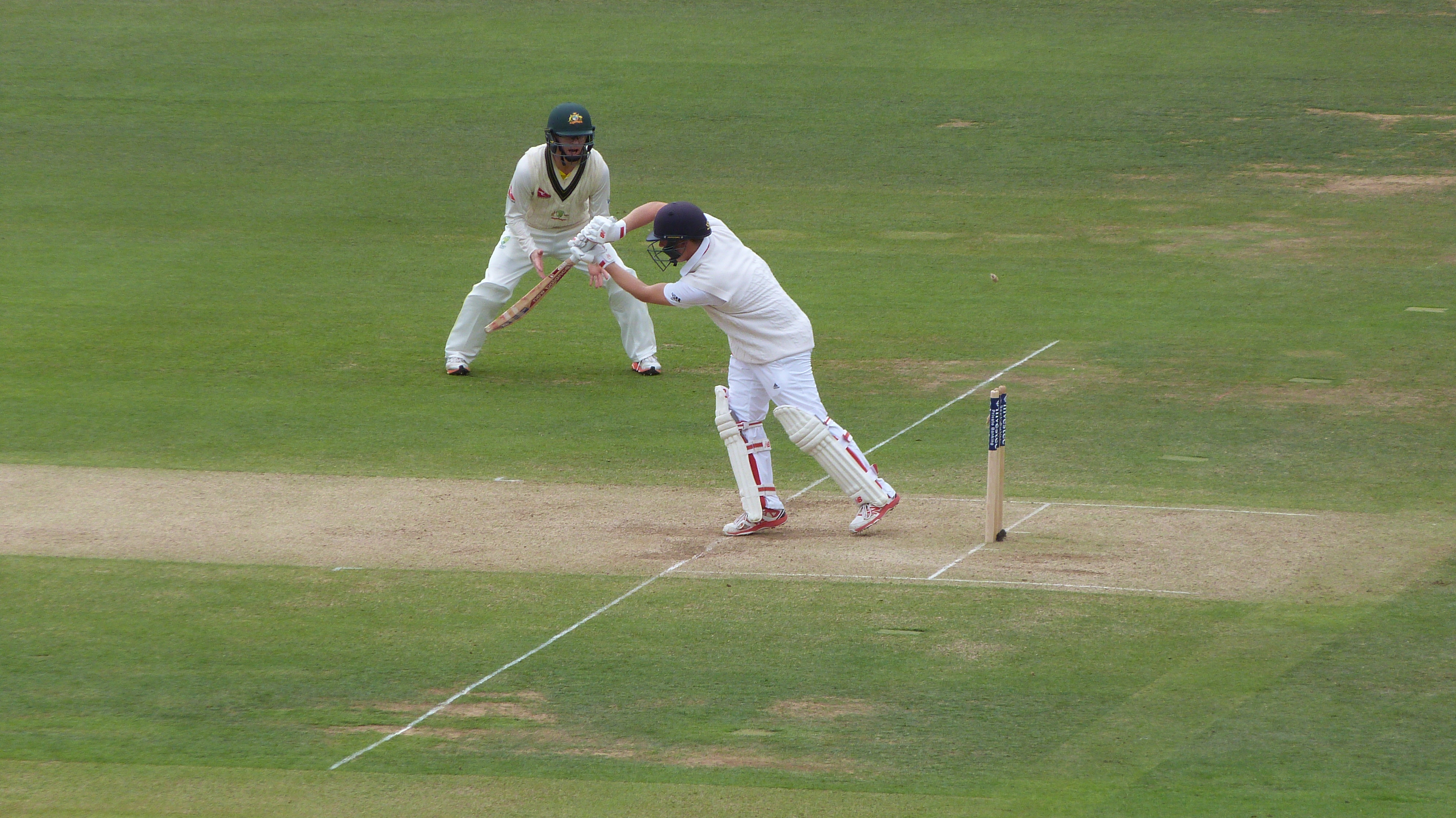
Ballance is bowled by Johnson – look closely and you will see a bail in mid-air….

Now what was I saying about all those who piled in to complain about the pitch after one day?  In the Australian press it was all about England doctoring the surface, which apparently means creating one that Australia rack up a huge score on, and then rip through the England top order.  Indeed, it was wryly amusing to hear Stuart Broad imply that the surface very much aided Australia and not England.  Spin on both sides.

Meantime, the English press went big on the idea that it was a nailed on draw, that the groundsman should be shot and that it was impossible to get wickets on.  The old adage that you shouldn’t judge a pitch until both teams have batted on it is as true as it ever was.  Australia have bowled superbly on it, and have put themselves in prime position to square the series.

There did seem to be a little bit more in it today, but it remains excellent for batting, as Australia demonstrated all too well in their innings. Steve Smith led the way with 215, and as fabulous as that innings was, it was curiously less assertive than normal, and slightly more sketchy than at his best.  Which if anything should cause serious alarm in the England dressing room.  For Chris Rogers, it’s quite possible that his 173 is his last innings at a ground where he has served Middlesex so well.  If so, it’s quite a way to finish.

From there, the scorecard looks like Australia fell away somewhat, which is a good example of a scorecard not conveying a match situation.  Australia were pushing on and trying to score quickly.  Slow surfaces are often quite hard to score rapidly on, and the wickets fell at regular intervals.

England’s reply was a shambles.  As has been pointed out England keep finding themselves three down for very little, and sooner or later Joe Root wasn’t going to bail them out.  Adam Lyth’s poke at a wide ball was fairly typical of what often happens when a team has been in the field for the best part of two days, but it doesn’t make it any better a shot.  Ballance was again undone by a full ball, and while it is good to keep faith with a player, it’s at the point now where he’s not going to get anything else, so transparent are his difficulties.  He needs to work this out and fast.

Bell too was undone by a full ball, and once again this has become a notable weakness in his game.  Any player can be beaten by a full swinging ball, but not time and again. As for Root, he failed today.  It’s going to happen sometimes. From there, Cook and Stokes batted extremely well.  Broad again made a rather telling slip in the post play interview saying that it looked much better when England batted in a more disciplined way.  The implication of that was fairly clear.

There’s no reason whatever England can’t continue to bat that way, this remains a very easy paced, very flat surface. The trouble is that having lost four cheap wickets, they are 481 runs behind.  It is a huge ask for them to even reach the follow on point, no matter how flat the pitch might be. About the only positive they have is that they have frontline batsmen down to number eight in the form of Moeen Ali.  But to even get to within 200 runs, more than one player has to score a century.  All hopes really rest on Cook going very big and batting through.  It’s a big ask, but it’s what’s necessary.

England have got themselves in a horrible hole, and have been completely outplayed in the first two days.  The reality of their plight is that they can’t afford to lose so much as a single session if they want to get out of this one.  1-1 seems almost inevitable given the time left. @BlueEarthMngmnt