Community Service

In this part of the world, and for a certain category of person, April is a special time.  The arrival of spring in itself can warm the soul as well the skin; the profusion of life, the sound of birdsong and the explosion of colour signifies new beginnings.  Yet for some, a small collective, it suggests something rather more.

Across the world, the dates may change, and the climate may be very different, but the principle is identical, and the approach of the cricket season brings out the same mentality and activity wherever it may be.  For those who care start to get ready.  That might include players, who went to indoor nets in January and February, but it also includes all those who do the legwork, who prepare the fixture lists, who seed the grass on the ground, who put up the outdoor nets, who re-wire the pavilion or remove the mildew from the showers.  Those who spend the first part of the month repainting the picket fence outside the pavilion, or who have silently spent the winter ensure the square is ready – year in, year out.  Who go on courses to learn how to do it better, who wince every time the ball bounces badly.

When April itself arrives the same group of people then plan the coaching evenings for the kids, in full awareness that many parents regard this as free babysitting, and they do so on the off chance that one in twenty of the children who turn up may fall in love with the game and therefore could go on to be a playing member for the next thirty years.  They do this even though if that player becomes exceptionally good, they will leave and go somewhere else to play a higher standard.  Possibly and potentially, that might include the county programmes, meaning that all their hard work goes not to their club, but to the wider game.  They will joke that what they really want is a good young player who isn’t very bright, who won’t go to university and who will stay in the area.  But they know they will, and they know they will lose them.  But they pay it forward, in the hope their club will benefit from the hard work someone else put in somewhere else.  The circle of mutual support is a wide one.

And then there are those who have had their cricketing career, who captain the Sunday 2nd XI, batting at number nine and standing at slip, not enjoying their lack of contribution, frustrated at their waning powers, but deeply aware it was done for them in their youth.  They get little thanks for it, and may well be dead before the 40 year old they introduced to the sport thirty years earlier fully realises what he did for them, who then laments that they never told him quite how important to their life he was.  It was a he, mostly, but in decades to come it will be many a she too.   It already is.

Or there are those who despite their full awareness of the affectionate contempt in which the players hold them still volunteer to do the scoring, a thankless, dull task at the best of times, hated by most, loved by a very few.  They may have no cricketing ability at all, but choose to be involved and choose to help out.  Perhaps instead they go on an umpiring course, to give up their weekends to annoy players by being human and getting a decision wrong.  Come September those same people will compile the annual reports, with statistics, averages and club records.

A further subset go and watch a county match, aware of their small band of fellow travellers with whom they are often on first name terms, despite little in common but a shared passion for a game that passes most of the public by.  They go when the weather is cold and grey, and they go – and are joined by a few others – when it is warm and sunny and the appeal of a cold pint with appropriate on field background entertainment is available – the crack of ball on bat, the cries of fielders as they appeal for a decision to another who has given up a substantial proportion of their life to give back to the game they were brought up with, and who are able to make a modest living from doing so.

For five and a bit months across the country, this pattern prevails.  Some make the teas, traditionally they are tea ladies, more recently not so much.  Many will have little interest or concern, but will drive past a village green filled with cricketers and know that a traditional element of their national character is being played out in front of them.  Like Morris Dancing, they may not wish to be part of it themselves, they may even sneer at those who do it, but it is a precious part of national consciousness.  John Major was laughed at for his references to it, but as definitions of a desired national character go, there are many worse that could be chosen.

Each week the same group, always a small number of people in any club, go through the same process.  They prepare, they work, they give up their time for no other reason than a deep seated love for a sport.  Even within their own organisation there aren’t enough of them, they do several jobs not just one.  Sometimes they may get frustrated at the lack of respect they get for the contribution they make, but they do so not for fame or fortune and not for recognition, but because it needs to be done and if they don’t do it, then who will?

The rarefied atmosphere of the highest level of any sport is a world away from the day to day that makes up virtually all of the game.  Yet professional sport relies on the amateur to a far greater extent than the other way around, even though they both need the other for it to flourish.  But take away professional cricket, and the game would survive.  Take away amateur cricket and there is simply no game at all, which is why the dismissive behaviour towards it remains one of the more despicable attitudes pervading the corridors of power.  They deny it, but all involved know it is there – the ECB won’t even give the “recreational game” as they put it, elected representation to their organisation.  That is the reason this band of brothers and sisters quietly get on with things, with little help, and less interest from above.

These people do it all.  They are the backbone without whom nothing, nothing at all, would exist.  They are a minority within a minority, they provide everything and in return get little except perhaps personal satisfaction for making a contribution to society.  They are denied the right to even see their chosen sport at the top level without paying again for the privilege,  they are belittled and even laughed at.  Decisions are taken that make their lives just that little bit harder, and their response is to give even more time, and make even greater efforts, for no reason other than they feel it is the right thing to do, and that it matters.

Cricket is a sport first and foremost.  It isn’t a business, and it isn’t the opportunity to make vast amounts of money.  That may be a by product for a chosen few, but it is not the driver, it is not the raison d’etre, and those who behave as though it is should be ashamed.  Those who allow it to happen should be even more ashamed, for they could speak up yet do not do so. They betray the work done across the country, across the world, to provide a background for all those who care little for their efforts to exploit.

These are the obsessives.  The fanatics who move heaven and earth to ensure there is something for successive generations to complain about.  They do it in many different ways, from the park in the city centre to the village Common.  They support, morally and financially, all rungs of the game, and they provide the base interest that in turn creates the next level, be it County Championship, T20 or 50 over.

Yes, Mr Harrison, they are obsessives.  Every single one of them.  And you should get down on your knees and thank them for their very existence.  And so should we all.
Back to the West Indies

When you have low key series like this one, there’s a temptation to re-use an old post title, asking whether a tree does fall in a forest if no one is there to witness it, but there is an unquestionable appeal to cricket in the West Indies in its own right, not least to the thousands of British tourists who use the opportunity of a cricket tour to get some much needed sunshine at the end of winter.  For the journalists too, it’s still a plum posting to get following the England team about, irrespective of the cricket on offer.  That’s not to criticise them for that, we all have elements of our employment that are rather better than others, and it’s understandable enough to want to go.

Although England are talking a good game about this tour being an integral part of the warm up for the Champions Trophy (which is something of a stretch) there is some importance for the West Indies given the psychological – but not cricketing – shock of failing to qualify for the tournament.  Moreover, there’s no certainty whether they’ll make the next World Cup given the determination to restrict it to as few teams as possible.  As an aside, it would thoroughly serve the ICC right to lose the West Indies if they didn’t make it just to highlight the stupidity of making the premier one day tournament such a restricted affair.  That being said, it would diminish the tournament if they were not there.

Therefore there is something riding on the series, at least for the home team who have only a further five matches to cement their place in the competition before the September cutoff.  Cricket fans around the world have watched in distress as the administrators and players collided repeatedly and often idiotically over the years.  The former powerhouse of world cricket had enough structural problems to deal with without constantly making things even worse.  The blame game got to the point that for many outsiders, they know longer understood what each spat was about, and more damningly they no longer cared.  Across the Caribbean positions were naturally more entrenched, but at the end of it the despair over the collapse of the international team never seemed to concentrated minds sufficiently to the point where all involved actually felt they needed to do something about it.

Given the conduct of the ECB over the last couple of years it’s easy to be cynical about all attempts of governing bodies – who tend to be anything but – to profess a new dawn in how they will run the game, but at some point the civil war in West Indies cricket will have to end.  It might be too much to hope that they will go from their current mess to back challenging all and sundry in the foreseeable future, but any signs of progress have to be welcomed.  If the ICC’s Big Three takeover is properly reversed, there might even  be an opportunity to make the most of doing so, but it will require an alignment of the all the planets to happen.  In England, Andrew Strauss’s title of “Director, Cricket” has been much mocked, yet his role unquestionably has value if done properly.  For the West Indies, the slightly less marketing department inspired Director of Cricket position has been taken up by Jimmy Adams, who is at least a figure who ought to generate widespread respect for his achievements.

George Dobell interviewed him for Cricinfo, and while words in themselves mean little, his desire to have the best players available – no qualification, no hedging – as a straightforward statement of intent, and that all sides need to give ground is perhaps one of the more promising signs for some time.  Whether it ultimately means anything at all, or whether he becomes another in a long line of people to leave in frustration at the Kafkaesque machinations of all sides is still to be seen, but any and all cricket fans around the world will hoping against hope that perhaps he is the one to really push the vested interests into looking after the wider game in the region.

In terms of the on field action most attention has been directed at the reunion of Ben Stokes and Carlos Brathwaite, following the spectacular end to the last World T20 final.  Brathwaite has spoken about his struggles to live up to that day, and it’s perhaps unfair to have expected him to.  There’s every chance it will be the highlight of his career when he comes to look back on it.  If so, there are worse memories to have.

Stokes himself might be worth keeping an eye on, if for no other reason than it’s either in the Caribbean or with Caribbean players that seems to define so many of his actions, from punching a locker to the repeated clashes with Marlon Samuels – which Samuels, it must be said, won.

As far as conditions in Antigua for the first match are concerned, the pitch appears grassy in places and bare in others, but with a 57 metre boundary at one end, the bowlers are going to have their work cut out to stop it being carnage.  As is so often the case with one day or T20 cricket, much discussion is had about bats, fielding restrictions and so on, whereas actually giving the bowlers a chance in the first place tends to be ignored.

England were pretty well beaten in India – in all formats – and perhaps their desire to put right some of those frustrations will make for a watchable series.  But let’s not pretend it’s essential, because it isn’t.

Viewing Figures – A Ramble Through Facts

We’ve another guest post from Andy Oliver, this time about the viewing figures for cricket over the last few years.  It’s a subject that isn’t easy to find hard facts on given the reticence of Sky to tell anyone how many people watch of course.  As ever with a guest post, our sincere thanks to Andy for writing it, and he’ll be around to answer any questions – or of course you can track him down on Twitter – @oshodisa

Don’t forget we’ve also got Man In a Barrel’s piece about county finances – that you can find here: https://beingoutsidecricket.com/2017/02/17/guest-post-a-look-at-county-finances/


A topic of discussion that comes around occasionally is that due to Sky’s lockout of coverage, there is nowhere near as many viewers of cricket as there was 10 years ago.

How true is this?  Has anyone seen any facts, figures or discussion?  I bow to any MSM who have covered this but I cannot recall coming across that many actual facts or discussion (queue the first reply being a list of 4 articles covering the same ground!).  We often hear that 8m people watched at one point of 2005 Ashes, but no one ever says how many people watched ‘Cooks Redemption’ (TM Nasser 2015) Ashes victory.

A Census Taker Once Tried To Test Me…

I’ve gathered this information from barb.co.uk, so cannot vouch for its accuracy, but they appear to be an industry body and say all the right things.  It’s been interesting seeing what info can be found on their website.  To generate their stats they have something like 5000 homes who provide a representative selection of the population.  These homes have automatic program trackers fitted to keep a log of what is watched.  They are then multiplied up to give a number of viewers and Bob’s your uncle.

The data publically available is not particularly user friendly for this type of research (There is a lot of data that I’ve had to plough through one weekly graph at a time).  I think that each individual result is an average for the duration of the program, rather than peak viewers at any given moment.  For example, the 4th(?) Ashes test in 2005 peaked at 8 million viewers but the program averaged 4 million viewers.  Please bear this in mind as I write below – I may play a little loose with terminology, but unless I explicitly state anything different, I mean the average number of viewers in any given broadcast as reported by BARB (so the 4 million, not the 8 million).  I’ve had to make a few educated guesses where info is not available or a particular programme is off the bottom of the week’s viewing figures.


Only the Facts Ma’am…

Since 2012 we have the following showing the maximum number of viewers any single day of a Test match play received.

2016 2015 2014 2013 2012
Most viewers 497,000 647,000 429,000 805,000 427,000


So it’s a bit up and down, but arguably viewing figures are sitting at an even level with intermittent peaks, but what do they represent?  Well, 2015 and 2013 were Ashes years.  It appears that Australia have a large impact on how many people watch cricket on Sky.

Non-Ashes years appear ‘stable’ between 400,000 – 500,000, but our Australian friends give us a significant boost.

So a bit of judicious reviewing of Australia’s last four visits (including you know when) gives us;


Test vs Australia
2015 2013 2009 2005
Most viewers 647,000 805,000 1,109,000 4,630,000

So, the most viewed single day’s play attracted over 4.6 million viewers (average remember, not peak) in 2005, and this has declined to less than 650,000 viewers in 2015.  Sky have lost up to 4 million people who showed an interest in cricket back when it was free to air on Channel 4.

Where have all these fans gone?

And remember that these are the most watched days of play.  The average viewers for the series shows us;


2015 2013 2009 2005
Average viewers across series 360,444 470,434 668,190 2,760,000


Again, this is a significant decline from on average 2.7 million people watching a series to just over 360,000 people.

So, talking broadly, about half the peak viewers for any given broadcast stay on to watch more of a series than just one day.  This number will be swung by rain days / early finishes – but I would not have thought it would be that significant to massively affect the above.

Why are people not watching as much cricket?  Is it the time it takes (this is an assessment of Test matches remember), or is it the quality of the matches?  Obviously the opposition matters, but why has the number of viewers even for Australia decreased?

Are the ECB aware of these numbers?  Do they even care given that Sky are currently happy to fill their schedules with easy to produce programming and pay the ECB handsomely for it?  Do Sky care given that cricket costs peanuts compared to how much they pay for football?  I wonder how much Sky makes on subscriptions and advertising for their £65 million yearly investment with the ECB.

Let’s take a quick look at the top three viewed broadcasts for the last 4 Ashes.

2015 2013 2009 2005
Top three viewed broadcasts 647,000 805,000 1,109,000 4,630,000
476,000 701,000 1,033,000 4,030,000
471,000 668,000 951,000 3,370,000


This gives an idea of how sustainable the top viewing figures are.  As we can see, 2005 quickly loses over a million viewers, but equally it is just one day’s play that kept the peak of 2015 above the half million mark (no prizes if you guessed that was Broads 8-fer-peanuts at Trent Bridge (I think)).  Both have lost about a quarter of their viewers between the peak and the third place broadcasts.

I presume that this is a normal pattern as there will be peaks and troughs – especially over the course of a test summer, but the raw reach of cricket appears to be significantly diminishing.

 You can’t handle the Truth!

No matter how it is spun, Test cricket attracts fewer TV viewers year on year.  Is this because test cricket it boring (dominated by home series advantage), or because it does not have the visibility of (until recently) the IPL.  At least the IPL was available on ITV 4.  That may be another one to look at – viewers between IPL on ITV and Sky.

In fact;

2016 2015 2014 2013 2012
IPL finals 116,000* 100,000* 536,000 398,000 469,000
77,000 59,000


The IPL changed from ITV to Sky from 2015… hmmm, there is a pattern here!

A note about the Sky numbers – The final match was not on the ten most watched list on BARB (Or I could not find it), so I put the highest match actually watched in that week.  Not perfect, but it’s something to go on.  The 2nd numbers in Sky’s stewardship are the 10th most watch programme in the week the final took place (on the channel they were showing the IPL on).  Suggesting that the IPL final got fewer viewers than 59,000 and 77,000 for 2015 and 2016 respectively.

If that is correct… Wow…   Wow…

For all the good that Sky have brought to cricket; the technology, the quality, the analysis (back when they did that well – but I remember first encountering Hughes as the Analyst on Channel 4, when he did actual analysis properly), etc, they seem to have form for slashing the viewing numbers a sport used to get on Free to Air, and for reducing its availability and visibility.

But, a quick look at the last World T20: when England got Brathwaited in the final.  This tournament was in India so time zones come into play for a start, but Sky got over a million viewers for the final.  In fact England’s lowest number of viewers was 323,000 against Afghanistan on a Wednesday, which is basically as much as the peak number of viewers Sri Lanka got in the May tests which followed soon after.

So maybe there is hope there, that there are people who are interested.

If you build it, they will come…

Maybe we have seen in all the above that the broadcasters/ECB should be using T20 and ODIs as a gateway into Test cricket, not as an alternative.  Not everyone will make the transition, especially when Test cricket is sometimes dry, boring and predictable.

Thinking about that – any guesses for how many people watch the Blast Final (or whatever it was called before that).  I might have come across these at the same time as looking for the above.

2016 2015 2014 2013 2012
Blast 262,000 229,000 384,000 245,000 433,000
Leic 0 v Ars 0 Tot 0 v Eve 0 Eve 2 v Ars 2 SWA 1 v ManU 4 not on tv
BT sports Sky Sky Sky
608,000 691,000 946,000 1,833,000


At least the Blast appears to get more viewers than the IPL!

The Blast final is on a Saturday afternoon/evening so I’ve found the equivalent Premier League game on TV at approximately the same time.

As you can see there is a big decrease from the Premier league viewers to those watching the Blast final, but maybe not as much as I might have expected.  I would have thought more games on a Saturday evening would have got over 1 million viewers, but evidently not.

The football is just a diversion from the above table though.  In reality the Blast figures should be compared with other cricket.  Now making a comparison against Test matches is like comparing apples and oranges, but at least they are still fruit.

As we can see from the above information in 2016 more than twice as many watched Tests as they did  the Blast. That must be a scary stat for the ECB, and it’s no wonder they want to re-tool the Blast into a different competition.

Houston, We Have A Problem…

On a personal note (and one that may be echoed by those who read this), I have seen club cricket slowly wither as people participate less and less.  There are a number of reasons for this (my own personal reason is that I have a toddler now who takes up a lot of my time so I cannot justify spending 15 Saturdays over summer out and about like I used to).

But the number of teams that struggle to get a side out, or fold half way through the season seems to be increasing (purely anecdotal, but it does feel that way).

My village pushed forward on the back of 2005.  That was a watershed ‘rebirth’ of the aging side.  We (the royal we, I wasn’t around then!) had a massive influx of juniors who saw the Ashes and wanted some of it.  They are still playing now and are vital young 20 somethings.  We don’t see that now though.  Most of the Sunday juniors are there because it’s free child-minding for the parents (again anecdotal, but from a senior member of the club who does the training).  Often the kids don’t seem that interested.

Why are fewer people playing cricket?  Why are fewer people watching cricket?  Does it take too much time, do people not like the characters associated with the game (either watching it, playing it or dare I say reporting it)?  Are there no heroes to worship (Mine was Atherton growing up…. No, I don’t know why….).  Nowadays people want to bat like Pietersen, Gayle, Kohli, Butler etc.  This is great – but these talents need to be put on display so that more people see them and want to emulate them.

I’m serious… and don’t call me Shirley

What’s the solution for getting cricket back into the public consciousness?  I’m sure greater people than me are actively working on the problem (or at least I hope to God they are).  I know it’s been discussed on and off here on BOC.

I’m not sure getting Test cricket on FTA TV would work.  Not in the short term at least, however there must be a way to get the Blast or some international ODIs/T20s on there.

I don’t watch Premiership rugby, but usually enjoy sitting down to the World Cup or Six Nations.  I’m probably the definition of a fair weather fan where rugby is concerned.

I would watch rugby because it is available.  If it had been available for me to play when I was younger/fitter I might have gone in that direction.  I don’t hunt down rugby on Sky/BT now.  I don’t have the time nor the inclination, but I do watch rugby free to air; I know about the sport and in the future I might start going to matches & watching more.

Where is the draw for the fans in cricket?

It may not be the answer, but it surely must be the starting point.  Everyone agrees that there are more ‘distractions’ available for kids growing up.  They may not sit down in front of TV and be glued for a day (like I was way back when).  But they are certainly not going to sit down in front of Sky and watch it.

It’s all well and good catering to the hardcore fans (is that us?), who go to games, despite the cost, who pay for Sky, despite the cost.  Just to actually see some action.  But where is the next generation going to come from?  Launching a Twitter channel is not engaging new fans.  They won’t go looking for it without hearing/seeing some cricket.

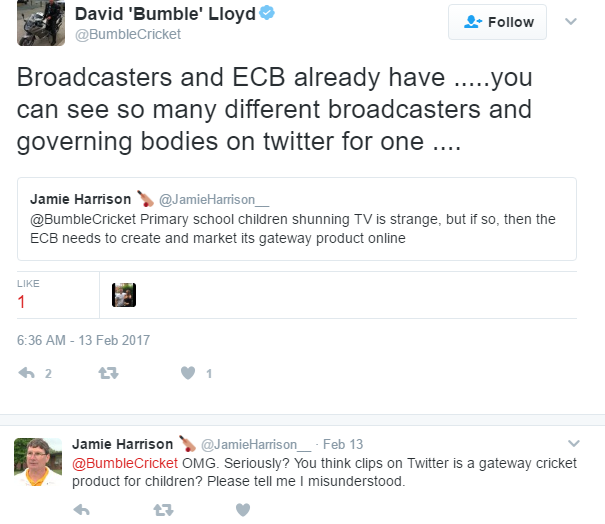
This is a Twitter exchange I happened to see from dear old Bumble.  Don’t know what started it, or the exact details, but it highlights the mindset.  If you put it there, people will come, which isn’t true, you need to make people come.  The only people who check Sky/ECB Twitter are people who are already fans.  This is not enough;

tweet


The ECB need to decide what they want from their cricket.  Do they want Sky’s (or BT Sport’s which is another topic) pounds, or do they want to get more people watching it (live and on TV), more people talking about it and ultimately more people playing it.

You be the jury…

This has been a WWAAAYYYYY longer article than I ever intended, so well done if you have stayed with me to the end.  Please tell me what you think?  I could have gone into early summer versus prime summer, what happened on those ‘most watched’ days, what day of the week got the most viewers, ODIs & T20Is, World Cups (more than I did) and who knows what else.   It’s probably a good job I stopped here!

And my topic headers will be no challenge to anyone who has done the Crossword!

Meet the New Boss

One of the more striking features of the ECB in recent years has been their ability to leak when it suits them, remain tight lipped when it doesn’t, and insist that they don’t leak at all at all times.  So while Cook’s resignation was kept under wraps right up to the point it was announced, there can be little surprise at the heavily trailed news over the weekend – confirmed today –  that Joe Root will be appointed England captain.  By all accounts this was agreed on Saturday or Sunday in a phone call with Andrew Strauss, who presumably was using the bugged phone the ECB provide when they want news to get out.  A day is a little slower than normal for it to reach the media – few will forget the way the supposedly private meeting between Strauss, Harrison and Pietersen ended up being reported in detail on Radio Five Live mere minutes after finishing for example.  Sharpen up fellers.

Still, while the ECB deserve all the cynicism that comes their way for their repeatedly duplicitous behaviour (OK, this one is hardly a crime – but they shouldn’t have it go past without comment), it didn’t take a cricketing sage to work out that Root was more or less the only name in the frame once Cook had finally decided to go.  Indeed, it is remarkable how the simple matter of the on-field captain has now been built up to become A Very Important Thing in a way that it never used to be.  Sure, resignations and appointments to the role have always been big news, that’s no different – what is, is how long is taken over the process, as though the Nobel Committee were ruminating on a choice between Einstein and Newton.  It’s natural to want to get it right of course, but it’s hard to get away from the feeling that pomposity and procedure is felt to directly correlate to importance – perhaps it is a direct response to the declining news footprint cricket now has in the British media.  It is a disease afflicting a lot of sports these days – but news management has now eaten itself by becoming more important than the news itself.

Appointing Root was the blindingly obvious decision, and the possibility it wouldn’t be him only arose because the ECB, Strauss and Cook have taken so damn long over the matter in the first place.  When Cook resigned the papers dutifully followed the line that he’d been thinking about it since the start – the start note – of the India leg of the winter tour.  When the handover of the England captaincy takes longer than that of the US Presidency, something is a little peculiar.  To be fair to Cook, if they’re going to allow him to take an age, then why should he rush, but it still reaches levels of absurdity to place the role on that kind of pedestal, with the fundamental difference that the England cricket captain, who hasn’t been especially successful in the role by any measure, was allowed to do all that for himself seemingly with no outside reference on whether he should be permitted that freedom.

What will prove interesting in future years will be whether Root himself is elevated to that level of God-like status, or whether Cook is an exception.  For there are some similarities to Cook in the way that he has been groomed as most favoured son for some time now. It almost felt as though the only reason for a reluctance to move on more quickly was some lingering feeling that being a damn nice chap prevents any action in favour of the next damn nice chap.

Much has been made of Root’s inexperience in captaincy – a situation that is entirely inevitable in the modern game where playing county cricket is the exception rather than the rule for those who reach international level.  It isn’t remotely relevant for the simple reason that unless things change radically in future, this is likely to be the case with every England captain forever more.  Whether he succeeds or fails, it won’t be because of a lack of experience, it will be whether he is any good at it.  For the fundamental point is this:  There is no reason from the outside to assume any one player is a more natural captain than any other.  Root might well be the ideal choice for captain, but then so might Ben Stokes, or so might Mark Wood.  There is simply no reason to think one way or the other amongst those of us outside cricket beyond a certain kind of prejudice that we all carry within us.  Root being a clean cut generally good egg from the right background certainly makes him suitable for the ECB marketing department, but it doesn’t mean for a moment he is the best on-field captain.

Lest this be thought to be making a case for Stokes or anyone else, it isn’t, but it is to highlight that the choice of captain always tends to be from a rather narrow set of parameters.  As the years go on, the choice of Michael Vaughan stands out as being highly unusual from the usual mix of those whose nice background marked them out as being of the right stuff for the ECB. Again, it isn’t anything against Root himself, but it has been long made clear he was the heir apparent and no other candidates were ever put forward.  To put it another way, Moeen Ali has some captaincy experience at both England U-19 level and for Worcestershire as a stand in – not much, but no less than Root, yet there was never any prospect of him being the one, and given he isn’t certain of his place in the side, that could easily be argued as to why not.  This is where it gets into difficult territory, because there is no accusation whatever of discrimination on race grounds (Nasser Hussain belies that anyway), but more that it is simply rather hard to imagine the current ECB going with someone with such a normal personal history.  Not impossible, for it does happen (Vaughan), and nor is it advocating that someone like Moeen should – it’s merely the case that the ECB is constituted by a certain type of person from a certain type of background, and they by default look for a similar kind of person in their captain.  It’s probably unconscious, and echoed by a cricket media that is largely from the same kind of environment who have a tendency to approve of that line of thinking.  They’ll hate that and deny it, but we all do the same thing in our lives, we instinctively support those similar.  Let’s put it this way: how likely is it that the ECB would be keen to appoint a working class kid from the wrong side of the tracks as captain?  It’s a little hard to credit.

For Root himself, there is the fear that his being chosen as captain will automatically impact on his batting, yet there is no reason to believe so.  Cook himself didn’t suffer notably from being captain, his record before and during is fairly comparable; his batting problems when they occur are more a matter of him being a player at constant war with his technique than anything else.  Likewise, to take England’s Australian counterparts, the three most recent incumbents have all performed superbly with the bat as captain. The fear that he will lose form is nothing but seeing the glass as being half empty – why shouldn’t he do a Graham Gooch for example?

Then there’s the question of what kind of captain Root will be.  With so little experience it’s hard to know for sure, but the glimpses of him substituting for Cook tend to imply he’ll be rather more creative and attacking than was Cook, at least initially.  The truth is that we don’t know for sure and won’t find out until later this summer.  Having Cook to lean on should be an advantage, for whatever the merits or otherwise of his tenure, he will know what Root is going through better than anyone else.  Nasser Hussain managed the transition back to player better than most; if Cook can do the same it will be unquestionably an asset to the side and to Root personally.  It’s not an easy thing for Cook to do, and it’ll be hugely to his credit if he does it well.  Likewise, Cook the batsman should – all things being equal – be of far more importance to the England Test side than Cook the captain.  Being able to focus on that rather than the whole team may well liberate him to contribute heavily in the area that he is most valuable.  This too is a matter of uncertainty, precisely for the same reasons that his batting didn’t unduly suffer by being the skipper, but if those who believe Root will lose form from being captain are right, then it follows that Cook should significantly increase his contributions too – it can’t be had both ways.

Perhaps one of the more notable parts of the announcement is by omission – that Root has been appointed the Test captain.  As has been pointed out before, the England schedule over the next 2 years is bordering on the vicious, so it is at least good to see that he hasn’t been burdened with all the captaincy roles.  There are enough fears for the longevity of those players who play all formats already, without making one of them captain and thus unable to easily miss some of the tours – or at least parts of some of the tours.

The instinctive reaction is that Root is a good choice for the job.  There are never any guarantees, but he appears to possess the right blend of brains and mischievousness to make a go of it.  Cook wasn’t a great captain, and to that end he does have a relatively low bar to get over; whether he will get quite the hagiographical coverage that Cook did in the cricket press is a different question.  And in many ways, a deeply interesting one.  If he’s only ever “hung out to dry” to the same extent, he’ll do well enough.


India vs England: 3rd T20

Let’s do the live blog on it we’ve threatened! If you want over by over, go to the Guardian. If you want ball by ball go to Cricinfo.

But if you want general rambles and a chat below, we might just be the place.

12:47 – 45 minutes to go. There’s team news before too long. Go and check the other places if you want to know what they are.

13:09 – so England win the toss again and will field.  Oh and umpire Shamshuddin has stood down from the field and will be third umpire.  OK, some of the decisions he made were pretty poor, but the moment you start using umpiring decisions as an excuse, then you just sound Australian.  Like Denis (one n) basically.  Mistakes happen, and sometimes teams get the rough end of it.  I can’t abide the whining.

13:27 – is there anyone, anyone at all, that thinks national anthems before a cricket match is a good idea?

13:36 – Running because you’ve got a big lbw appeal against you.  I’ve done that.  Difference being at this level they actually hit the stumps.

13:56 – One of the joys of T20 is how the commentators have gone on about how well England have bowled.  So they have.  But it’s still 8 an over India are going at after 5.

14:05 – not being any kind of bowler whatsoever, I’ve always wondered what they’re thinking when they see the ball go out of the ground like that.  “Try it again then mate”, or “Ohgodohgodohgod”.

14:13 – Just three off that Stokes over.  He’s got his career economy rate down to 9 with that.

14:16 – Just three of that Moeen over too.  That’s the trouble with T20, these quiet middle overs…

14:26 – Ooh Adil Rashid’s getting a bowl!

14:35 – 120-3 off 13.3, it’s going to be a big score.  Stokes’ wicket of Rahul turned out to be an unseen no-ball.  It’ll be interesting to see if England mention that afterwards.  Somehow you’d think not.

14:48 – It could be me, or it could be that it’s midweek, or it could be that it’s T20, or it could be a combination of all three.  But it’s very quiet out there.

15:03 – Every chance of getting over 200, and every chance England can get them.  Well that’s what people like to see, six after six after six.  Bowlers are reduced to being there merely to serve the ball.

15:13 – 202-6.  It’s a big score, but it’s also one that with the pitch is gettable.  Whether they will or not…but I think they might do it.

15:36 – So I go for a quick shower between innings (I’ve been to the gym, I’ve not just got out of bed) and I find that I miss Sam Billings’ innings.  He’s useless on Cricket Captain 2016 too by the way.

15:46 – I should clarify that on the rare occasions any captain was stupid/mad/drunk/mischievous enough to let me bowl, most balls did disappear out of the ground.  In fact there’s one player I know of who hit the only sixes in his life off me.  Three of them.  He mentions it often.  Tosser.

15:51 – I appear to be more optimistic than some.  England are on track here, 55-1 from the first six overs.  Jason Roy is going well, and so is Joe Root.  Strike rate of 142 at the moment

15:51.2 – Roy out.  Shut up TLG.

15:56 – Mind you it was a really hideous shot.  He makes a habit of getting in and getting out.

15:57 – Most important question of the day is whether this will be finished in time for Pointless.

16:01 – Required run rate now over 11.50 an over.  Which is of course preposterous to anyone who grew up watching games where the moment the rate went over 6, it was trouble.

16:04 – I’m not sure I want to field at slip when someone reverse sweeps it.  Or keeper when they ramp/scoop it.

16:11 – The half way point and England are 86-2.  Decent start, but they are probably at the “need a big over” stage.

16:16 – This whole idea works best if you read it in a Big Brother Geordie accent.

16:22 – Huge over, Morgan smacking three sixes off Raina.  Joe Root scored two singles.

16:25 – Root is all over the place.  Dropped, playing and missing, and seemingly unable to keep up with the required rate.  It’s a good over all right, but it’s so rare to see him out of his comfort zone – usually he’s too comfortable and gets himself out.  Here, Root – Joe Root! – appears to be an impediment to England winning the game, rather than an asset.

16:32 – Morgan and Root out in successive balls, and needing 14 an over, that’s a bit much most likely.

16:42 – This is an impressive collapse even by England standards.

15:45 – Seven wickets in 17 balls.  That’s actually really hard to do.  Oh it’s eight in 19 balls.  Honestly, even if you’re trying to get out, that’s tough.  Genuinely impressed.

Summary:

As abject a collapse as you could wish to see just about summed up an Indian tour that amounted to England winning just two games out of eleven, and being beaten in the T20 series, the ODI series and battered in the Test series.  While England were certainly under pressure with the run rate climbing, it was still a quite astounding slump from a position where they had a chance to all out.

They’ll be looking forward to getting on the plane home, and quite frankly a lot of people will be relieved it’s all over.  Let’s look forward to the completely pointless West Indies ODI tour.

India vs England: 1st T20

Perhaps total indifference is an unreasonable response to England finally winning a game on the tour of India, but with the BBC deciding not to broadcast the game on Radio 4 LW, and the pressing matter of a flat tyre to sort out before heading to a meeting, this one couldn’t have passed me by more completely if it had been played on the moon.

Apparently England bowled well.  Apparently they batted well too.  But like the tree in the forest, if it’s not been witnessed who knows if it really happened.  It’s not being dismissive of the game itself or the efforts involved, but cricket is so low key with England these days that I didn’t even remember the game was on until it was referenced in the news as I was driving along.  That’s not meant to be a boast, for the implied virtue signalling of pretending ignorance of something only lesser types pay attention to is far too prevalent these days.  In fact it’s just the opposite, it’s rather troubling that I didn’t realise.

It’s been said often enough that T20 is something of a McDonalds Value Meal, enjoyable at the time, but not something to live long in the memory, and that’s part of its very appeal in some respects.  The World T20 is exactly what a cricket tournament should be, short, sharp, entertaining and with hazard throughout for all the teams.  The Big Bash too has been good to watch, and even at the end the Australian coach’s delightfully crass comments made the whole thing grab attention.

But like that Big Mac Meal (free vouchers for the mention from McDonalds UK are welcome) you aren’t worried at all if you’ve gone without (Ah, there go the vouchers), and the same applies to today.  Tymal Mills bowled very fast it seems, and Moeen Ali and Ben Stokes bowled very well.  Eoin Morgan once again made a few journalists push back their calls for his execution for another day, and England cruised home.

Well played all.  What a pity I can’t think of much else to say.  No, truly it is.  Some will say that’s my problem and no one else’s, and you know what, they are probably right.

And now for something completely different

8:00 – The cricket has started.  It’s cold.  I don’t want to get up, but I need to.  I’ve got work to do most importantly.

8:15 – No really, I need to get up.

8:23 – Coffee is on, cricket is on, I’m up.  I seem to have missed Virat Kohli, it’s 21-3.  This is one of those situations where if it was England with that score you’d be absolutely certain it was game over, at least for England of most of the time I’ve been watching them.  But India?  There’s the nagging feeling that after 25 overs they’re going to be 150-3.  Basic rule of this one today is I’m not going to to go back and amend anything that makes me look stupid later on.  Some may say that’s a given anyway.

8:43 – Yep, it’s started.  Yuvraj Singh has spent his career making England miserable by pulling the fat out of the fire, and he’s just pinged Jake Ball for three fours in an over.  Thus it begins.  Watching England involves absolutely certainty that no matter how good the situation, they can find a way to make a mess of it.

8:44 – Djokovic out of the Australian Open.  The reminder that for all the corruption, cheating and theft of sport as a concept in favour of filthy lucre, there’s a reason people love it – the unexpected.

8:49 – Yuvraj and Dhoni, it’s so 2010.

8:50 – Woakes off.  Given he’s taken 3-14 off five it seems a trifle harsh not to have mentioned him.  But I didn’t actually see much.  But well bowled anyway.

8:55 – Yuvraj Singh is a lovely player to watch.

8:56 – Work.  We don’t get paid for cricket.  Although I was once.  I was a professional cricketer. It’s true, it really is.  I was a pro for one day, when my boss for my summer job was due to play for the our club, but had to work, so he got me to do it that day and paid me anyway.

9:02 – Is it just me who really hates the way every other advert on TV is for a betting company?  I don’t object to gambling, but the number of commercials for it pisses me off no end.

9:10 – Nasser Hussain mentions that the England players have black armbands on as a mark of respect for Rachael Heyhoe-Flint.  Quite right too, she put the women’s game on the map in a way that no-one had done before.  There are a lot of female cricketers up and down the country, and across the world, who owe her a nod of thanks for her refusal to accept being patronised.

9:28 – at 88-3 India have fought back well.  England are still on top but it’s a lot more even.  They don’t remotely look like taking a wicket, and it’s something that England have been guilty of for quite a number of years, failing to press home and early advantage and then reverting to run saving and hoping a wicket falls.  Perhaps it’s a mentality thing as much as anything else, but it’s extremely rare to see England determined to take wickets in the middle overs.

9:55 – 135-3 off 26.  It’s a decent recovery alright, you’d think all things being equal 300 was distinctly possible.  Part of the reason for doing today’s report this way was to see how wise after the event I tend to be.  The OBO boys tend to describe the action, and I don’t really blame them – it’s a hostage to fortune to talk about expectations.  So I’m going to do it anyway.  There’ll be acceleration and right now I’ll call India’s final total to be 340.  Which may not be enough.

9:58 – The problem with ODIs is that these overs are just pretty dull.  Yet when at the ground, at least in England, that’s part of it, it’s the time when you wander out to get the beers in or something to eat (after pleading with your bank manager for a loan, especially at Lords).  Yet it’s hard to maintain attention to the television, and perhaps that’s not a bad thing.  In my case, I’m working anyway, so I have plenty to do.  No I really am.  It’s true, I’ve done a fair bit so far.  You don’t believe me I know.

10:10 – Just a comment on England sitting in and not trying to take wickets, there have been three edges through where first slip would be.  The temptation to be Ian Botham and imagine there are 15 fielders on the ground is always there, but that’s how you take wickets, by giving the bowlers a chance.  It’s something England are always prone to do, and then wonder why they end up facing a big total after taking them early on.  It’s not especially a criticism of this one per se, more of an approach issue.

10:15 – The general rule is to double the score at 30 overs, though apparently it’s nearer 31 according to the stattos.  172-3 after 31, so my 340 is looking a decent shout at the moment.

10:25 – Hundred up for Yuvraj.  He seems to have been around forever.  And seems to save his best for England.  No matter, he’s a joy to watch, and given his health problems there’s always a strong sense of goodwill towards him.  Maybe his Test career didn’t fulfil him completely, but as an ODI performer, he’s quite something.  Maybe he’s not quite the player he was, but that’s true of most players as they get towards the end.

10:55 – This is getting messy.  Plenty of chat about what England need to be better, and while it’s true Mark Wood is a loss, the temptation to believe those not in the team would be better by virtue of them not being here is always strong.  Some are saying recall Stuart Broad, but he’s never been that great at ODIs, there’s no reason to assume he’ll suddenly become the best thing since sliced bread.

11:20 – One batsman not out 150, the other not out 100.  As Richie would have said “Problems there”

11:21 – Oh nice, I get an email from an aviation magazine asking if I’ll write them 1,500 words on cultural differences in Asia.  Wonder how I can get out of that.

11:26 – Er.  When did England get Yuvraj out?

11:54 – 340 has been and gone.  The problem when you don’t take wickets is that the slog can be completely unrestricted.  Much doom and gloom, but the boundaries are very small and England aren’t out of it by any means.  A big chase, yes, but not an impossible one.

On that point, some mishits are going for six, which always gets people talking about the bats.  But small boundaries are the bigger issue – and it’s a deliberate choice.  If it’s only said when England are on the receiving end (and it’s glorious batting when they do it) then that’s just lashing out and whining that it’s not fair.

11:57 – Dhoni was brilliant today.  He and Yuvraj, both over 35, both outstanding.  Let’s just remember that in England players get written off in their early thirties all too often purely on the grounds of age.

12:01 – 382 to win then.

12:44 – England under way.  Unless they lose wickets early, there’s never much to say at this stage.

13:08 – 51-1 off the first 8 overs.  Decent start and the complaints about England’s bowlers have quietened for a bit.

13:52 – Root goes, but it’s 127-2 off 19.5.  So England are handily placed.  Still not much to say though, and this is the trouble with the ODIs, they purr along in the background while you wait for the business end of the game.  Maybe it’s just me, as plenty seem to love them.  And I don’t dislike them at all, it’s just that there’s so much setting up time.  The irony is that this is the period that actually dictates the result to a fair extent – England have made a good start, and they bat deep.  The next 10 overs will give a strong idea which way this match is going.

1449 – work does get in the way. Now on my way to an event in London, so having to do the cricket following via Cricinfo. This could make detailed exposition on the good and bad a mite tricky. Oh Buttler is out. Oh dear. At this point India are obviously rather strong favourites, so let’s do the prediction thing again. I’m going for England to be all out for 320 or so. They do bat very deep of course. But 10 an over with half the side out is a big ask. Over to Captain Morgan to make the hacks spit their tea out. 

 1457 – Ashwin and Jadeja look like being the difference. Cue wailing and gnashing of teeth that India have better spinners than England. 

1512 -Biggest shock news of the day, Southern Rail are on time. I feel faint. 

1513 – I’m not the world’s biggest Eoin Morgan fan, but then neither do I dislike or have a problem with him. But I’d really love him to ram the words of those who slag him off back down their throats. 

1531 –  Morgan and Moeen have done extremely well, but this would be the highest number of runs off the last ten over by a side batting second ever. Well, records are there to be broken, and you can usually find one if you look hard enough. 

1538 – Just as I was thinking my 320 was looking pessimistic, bang go two wickets. Big ask now. 

1552 – a game of cricket just isn’t complete until you’ve had a third umpire shambles. 

1601 – Morgan appears to have gone into ‘batting like God’ mode. 

1604 – God’s had a word then

1606 – 22 off an over. Those of a certain age will be thinking about Allan Lamb right now. Younger ones, Carlos Brathwaite

1612 – all over, but close. Morgan almost got England there so it’ll be interesting to see how some manage to blame him for it. At best it’ll be ‘he owed them that’ or similar. 

Curious, I was hoping reading this back to have been miles out, but the format is sufficiently formulaic to follow a script.

I’ve made no changes except to grammar. An interesting experiment for me, and maybe we try it again as an over by over. If it interests anyone. 

India vs England again. Preview

So England are back, for the money element of the tour.  Players have cut short their Big Bash contracts and flown over, and the cricketing world sighs and tries to muster up the slightest interest in affairs.  It is always the case that if the ODIs are placed after the Tests they feel like an afterthought in terms of the itinerary, yet for England it’s all there is for the next six months in the run up to the Champions Trophy. Much of the domestic comment has centred around the return of Eoin Morgan as  captain having elected not to go to Bangladesh, with the usual barbs aimed at him for that decision by those can often pick and choose their tours as journalists without anyone noticing or offering comment.  More than one senior cricket correspondent has sent someone else to cover a series they didn’t fancy in the past.

Hales too returns to the side, with none of the criticism that Morgan received, but with the same degree of media pressure to perform having taken the same decision.

The ECB created and agreed an itinerary over the next 18 months that only a sadist could take satisfaction in, so it’s rather startling to see two warm up matches before the relatively short three ODI series (plus 3 T20s).  Given the lack of anything approaching a warm up before the Test series – unless the Bangladesh Tests were considered so – it goes from the sublime to the ridiculous.

Of course, at the same time there is the matter of Alastair Cook’s captaincy to be resolved.  Nick Hoult at the Telegraph has a good record of calling things correctly in recent times and seems of the opinion that Cook will go.  Equally, all the indications are that it is Cook’s decision, which remains a peculiar state of affairs for someone for whom captaincy has been anything but a natural skill.  When the decision finally comes, it seems almost certain that the press coverage will be vaguely equivalent to that for a deceased monarch, and nothing else quite sums up the total disconnect between the ECB media corps and reality, to that created by talking about a captain in awed tones who has done nothing to warrant it.  Some may love him, some may hate him, but by no objective measure can his tenure be called any kind of unqualified success.  The adoration remains what it always has been – deeply strange.  The difference in media approach to Cook and Morgan is all the more striking given that of the two captains, the latter has had much the better record over the last two years.

For the ODI series itself there are few surprises, the squad currently more or less picks itself, and the interest will be in seeing whether they cope with Indian conditions any better than their Test playing colleagues.  In their own conditions India must be favourites, but England remain a threat to anyone in one day cricket.  The question is whether anyone here will even notice.  The Big Bash coverage has been mostly on BT Sports but with some matches on Channel 5.  To date no viewing figures have been announced, but it has to be likely those numbers will be higher than anything the England team get locked away on subscription TV.  In one sense, it is to be hoped they are, for it would at least demonstrate there’s an interest in the sport.  If not, cricket really is doomed in Britain.

English cricket is in something of a holding pattern this week.  Whatever happens, there’ll be a lot more to write about soon enough.


Herd the Golden Geese

England players got a break over Christmas. For the Test only players, that break is a substantial one, for there won’t be another until July. Whatever the outcome of Alastair Cook’s discussions with the Director, Cricket (funny how the absurdity of that title never wanes) he and the others who aren’t in the short form teams will welcome the chance to rest and recharge over the coming months. Yet there are plenty of players who turn out for England in every variety of the game, and although there has been little comment beyond Cook’s ‘I don’t choose the schedule’ at the end of the Indian Test series , the next 15 months is quite simply barking mad. 

On Sunday begins a series of 3 ODIs in India, followed by 3 T20 internationals. That is actually reasonably sensible, as opposed to the usual five 50 over matches, but from there it starts to head downhill. 

After finishing that tour there is a one month break before heading to the West Indies for 3 more ODIs in little more than a week, then it’s back to England for the build up to the English season. 

Any thoughts of playing four day cricket are pointless, for the first half of the summer is given over entirely to 50 over international matches. There are two very welcome games against Ireland, the first time England have hosted them, and then three more at the end of May against South Africa, presumably as warm ups for the Champions Trophy. 

Should England reach the final – not as unlikely a possibility as in some previous years – they will finish on the 18th June. Three days later they start a series of 3 T20s against South Africa (again – the ODIs pre-tourament clearly aren’t enough).

The kind, thoughtful people at the ECB have allowed 10 days between that and the start of the 1st Test, when the specialists are located from their secret base and those in every side turn their heads round the right way and try and focus on batting for more than ten overs. 

There are then four Tests in just over a month, and then a lengthy break of, oh 9 days before three more Tests against the West Indies at the same breakneck pace. 

Any thoughts that this will conclude the season are misplaced, for then there will be a T20 and five, yes five, ODIs to finish the English international summer in, er autumn. Proper autumn too, on the 29th September. There are clubs up and down the country who will finish their seasons earlier than that. 

With the first Ashes Test taking place on the 23rd November, England will probably arrive at the beginning of the month. Players, note down October in your diaries and mark it ‘time to actually live’. 

The Ashes schedule is fairly similar to those of previous tours – given the Melbourne and Sydney Tests being fixed in the calendar not even the ECB and CA could squeeze in any more – and so they wait until the Tests are concluded before gleefully ensuring extra cash can be generated. 

Since five ODIs aren’t enough, they then arranged a Tri-Series of T20s so there’ll be travelling to New Zealand too. That’s fortunate because when the Tri-Series finishes in late February, England are already there for the tour of New Zealand due to start that month and comprising two Tests, five ODIs and a T20. It’s due to finish in April, which is of course absolutely perfect as they’ll be able to fly home just in time for the scheduled series against Pakistan in May before the vitally important five ODIs against Australia before India arrive. 

Players are lucky to be in the position of being paid for playing the game they love. And plenty will say that they should just get on with it. To a point that’s right, for few will be sympathetic to them in terms of their absolute workload compared to the archetypal man down the pit. Yet that’s not the point. Overloading players means they cannot possibly perform at their best, particularly against opposition not compelled to follow such ludicrously packed itineraries over the entire year – or in this case two years. Furthermore, the potential for injuries is clearly going to go up dramatically, as is burnout. 

For the likes of Stokes, Root, Woakes, Bairstow, Moeen and potentially others, there’s simply no way they can do this. They’ll break. The alternative is to ensure they have time off built in, and that’s possible. But they’ll need more than just a few days and if England aren’t going out with their best teams because the players are on their knees needing a rest, then it devalues the whole idea of international cricket anyway. 

2016 was held up as an example of a ridiculously compressed schedule with too much cricket. Clearly the ECB didn’t see this as a criticism, more as a challenge. 

They’ve certainly met it head on. 

A Christmas Carol (of sorts)

Kevin Marley was dead, to begin with. There is no doubt whatever about that. The register of his burial was signed by the Director (Cricket), the Chairman, the Chief Executive, and the chief Guardian Cricket Correspondent. Ebenezer “Scrooge” Cook signed it. And Scrooge’s name was good upon ‘Change for anything he chose to put his hand to’. Old Kevin was as dead as a doornail.

It was a cold and bleak winter in Essex – has been for years – and the lambs were bleating nearby.  Ebenezer Cook was in his rooms, counting up his runs, when there was a knock at the door.  “Bah” he exclaimed, “I’d just got to to 8,142 as well.  Jimmy!” he called to his faithful servant, Jimmy Cratchit, “Go and see who is at the door”.  Jimmy, puppy dog eyes as ever, returned a moment later.  “There are two men at the door, sir, it’s about Christmas”.

Scrooge got up and went to the door, to be met by Mr Bumble and Mr Beefy, carrying champagne.  “Merry Christmas!” they cried, and explained they were there to collect money for the peasants of Isleworth.  “Humbug” said Scrooge, attempting to close the door.  “But sir, this is for the poor folk of Sky, they need this desperately.  How else will they be able to sell the company for vast profit to Mr Rupert?”

“Bah” said Scrooge again, as he shooed them away only to find his nephew Adil waiting behind them.  “Hello Uncle, come and join us for Christmas!  It’s a wonderful time of the year”.  Cook frowned, “Hang on, you don’t celebrate Christmas”.  “Er.  Ah yes, good point, but it’s too good a character to ignore, so let’s celebrate” said Adil.  “Quite frankly young man, this is another example of you having a weak personality.  I’m going to have nothing more to do with you, and to prove it I’m going to have you running in until your fingers are falling off  and you’re the most successful worker we have.  I don’t think there’ll be any doubt at all about your weakmindedness after that”.

Slamming the door, Scrooge turned to find Jimmy Cratchit in front of him.  “As it is Christmas sir, and I’ve been bowling non-stop for three years now, I was wondering if I could have Christmas Day off?”.  “Don’t be absurd,” Scrooge replied “You’ve had a couple of months off with that shoulder problem of yours, you must be fully rested.  And as far as I can work out, you’ve not done anything on the India work at all.  Oh very well,  but just one day”.

“Christmas, Christmas, Christmas. What a load of nonsense.  It’s been only good for one thing, and that’s the historic birth of a noble creature, one who has changed the world.  One who is known for being the greatest and most important of all, especially in the eyes of the Miller.  Presents?  Celebration?  Humbug!  Runs is all it is good for, lots of runs”.

That night, Ebenezer Cook got ready for bed.  To the side were tomes of articles, praising Cooky for his steel, for his gimlet-eyed approach to the accumulation of runs.  All was well, he read the latest adoring billet doux, sent in the Mail, and he gazed into the mirror to see if the bit about doe eyes was true; they became heavy, and he drifted into sleep.

A noise made him sit bolt upright, and reach for the light.  In front of him was a figure, chained by the hands and feet, carrying a bat and hidden in shadow.  “Who are you?” Scrooge asked.  “Better to ask who I was”, the apparition replied.  “Who were you then?  You’re very particular, for a middle order player”.

“In life I was your batting partner, Kevin Marley.  Most notably against India you might recall. I have been cursed to wander the world, picking up only T20 contracts, banished from my life irritating the hell out of that old telegraph operator, Pringle.  I am here to warn you that you must change your ways, lest you too find the future filled with despair – although admittedly you won’t get the T20 contracts and your Twitter account will be a lot duller.  Should you fail to do so, I fear you too will be forced to spend your days pretending Piers Morgan is your friend”.

“You were always a good friend to me”, Scrooge lied, “tell me how I can avoid your dreadful fate”.  Marley paused, and looked at Scrooge, knowing his old habits were still present.  “You will be visited by three captains.  The first tomorrow night will be the captain of Christmas Past, then it will be the captain of Christmas present, and finally the captain of Christmas to come.  Beware Ebenezer, you will not like what they say”.

The vision of Kevin Marley began to fade, and Scrooge returned to bed.  “Humbug” he exclaimed, and went back to sleep.  By morning, he was convinced it had all been a terrible dream, frightening, but no more real than the time some fool put the city clerk Downton in charge of the livestock.

The following night, convinced it was all his imagination, Scrooge went to sleep, content that he had spent his day wisely, making Jimmy Cratchitt say nice things about their best customers, something he knew he hated.  In the early hours, his repose was interrupted by a presence in the room, a gentle figure, who spoke to him, quietly, calmly and with all the assurance of someone who had a degree in people.

“Who are you?” asked Scrooge.

“I am the captain of Christmas Past.  I am here to show you things”.  “What things?” cried Scrooge.  “Come with me” came the reply.  The bedroom disappeared, and a field came into view.  “What is this dreadful place?  I can’t bear it”.  “It is Leeds”.  “No, no, no don’t make me live through it again” begged Scrooge.

As tears rolled down his cheeks, he watched Angelo Mathews hitting balls to all parts, he saw himself stood at slip, unable to change anything.  He saw people in the distance, appalled at the sight in front of them.  “Can I change it?  Let me change it, what can I do?  Don’t make me wait to talk to Mr Moores again, I can’t cope with it”.

Puzzled, the ghost of the captain turned to him: “I have done nothing, this is who you are and what you did.  Nothing can be changed, nothing can be altered.  It is you, it is what you became”.

The scene dissolved, and Scrooge peered through the mist as it cleared, wondering what punishment would be next.  A face appeared, one who had been precious to him, but who he had not seen for a long time.  Scrooge’s heart leapt, and he called out “Bell! oh my precious Bell, we have spent so much time together, so many wonderful years”.  “He can’t hear you” observed the ghost, “watch closely”.

As Ebenezer observed, he could see Bell was happy, and his heart was filled with joy, and some puzzlement.  For the last time he had seen him, he was not, he was anything but.  As the scene expanded, he saw Bell laughing with other people, full of the joy of life.  Scrooge turned to the ghost and said “but what is this?”.  “It is the happiness of being with friends, it is how he now is, since he moved on from you”.  “This is down to me?” cried Scrooge, “but I thought he was my friend”.  “So he was” came the answer, “until you turned your back on him”.

Before he could reply, Ebenezer Cook found himself back in his bed, but not bathed in sweat for it was well known he didn’t sweat at all.  As he thought about his dreadful experience, he shuddered.  “At least that’s the worst part out of the way” he thought, and eventually he drifted off to sleep.

He spent the following day distracted, his paperwork untidy, finding that the slips were numerous and his pen often simply went down the wrong line.  Increasingly apprehensive, he readied himself for bed, and eventually, sleep overcame him.

Mere moments later, he sat upright.  Another vision was at the end of the bed, one vaguely familiar, yet with an undercurrent of threat that made Scrooge recoil.  The dark face was in shadow, but the beard was visible, as was the shining reflection of the earring, and the sound of thousands of people cheering could be heard softly in the background.  As the hood was pulled back, he gasped, for although the eyes were kind, he did not dare to meet them.

“I am the captain of Christmas present.  Look upon me”.  Scrooge reverently did so, the feeling that this was a presence he had been close to seemingly for weeks strongly in his thoughts.  Nagging at the back of his mind was that he somehow knew there was no way he could get him out, even if he wanted to.

“Touch my robe” commanded the dark, coaly vision.  Scrooge dutifully did so, and found himself in the Cratchits front room.  Christmas was being celebrated, Jimmy Cratchit pouring the drinks.  “A toast to Mr Ebenezer Cook” cried Jimmy.  “I shall do no such thing” answered his wife Broady Cratchit.  “For we all know he is simply obsessed with counting his runs, and gives you nothing.  Here we are at Christmas, you’ve worked all year for nothing, and here am I, preparing everything and getting no credit for it whatever.  No, I shan’t toast him.  And what about the boy?  What has he ever done for him?”

Jimmy’s eyes moved to the corner of the room, where the broken child sat with his crutches.  His eyes were bright, but the pain in them was clear.  “Bless you Markwood Cratchit, it will all be well.  We’ll get you the treatment you need, don’t you worry.  Mr Ebenezer knows all the right people and he’ll see you right”.  “He will not Jimmy and you know it perfectly well.” said Mrs Cratchit.  “Look at how the Prior was treated.  All he needed was a rest, and he wouldn’t have it, even though it was obvious to everyone.  ‘It’s up to him’ he said, and before we knew it that was the end of him”.

Scrooge watched on, knowing in his heart that Markwood would get no help from him.  “What will happen to him?” he asked the ghost.  “I see a vacant seat, at the Finchale End, and a crutch without an owner, carefully preserved”.  “No, no” cried Scrooge, “say he will be spared”.  The ghost turned to him “If these shadows are unaltered by the future, there is nothing that can be done”.

With a flash of light, Scrooge was back in his bed, and he gazed down at his palms, amazed at the first sight of flecks of sweat on them.  Unsettled, he thought about all he had seen, and resolved to change his ways.  Probably.  When he got round to it.  He went to sleep.

That following night, he resolved to stay awake, to ensure no more visitors.  But try as he might, he could not do so, and moments after he dropped off, a third figure appeared.  “And you are?” said Scrooge.  “I am the captain of Christmas future” squeaked a voice.  “You’re very young” said Scrooge.  “I’m not you know, everyone just thinks so – look at this whisker on my chin.  I’m a proper adult, and I can do a really good Bob Willis impression to prove it.  I am here to show you your future”.

Scrooge peered once again into the gloom, and an office appeared.  The ghost led him through the door, marked ‘Dobell and Son’ into the space beyond.  A group of people sat there, quietly talking among themselves.  He moved in closer, wanting to hear what they were saying:

“Do we have to write about this?  No one cares any more”

“We’d better be getting paid.  I hope these drinks are included”

“He just went on too long. It all went wrong in the end.  Apart from us, everyone is celebrating”

“The only one actually crying is that new man, and no one pays attention to him anyway”

“Good riddance I say”

Scrooge turned to the apparition, “who are they talking about?  This person sounds terrible. Awful.”  The ghost turned his baby face, beckoned, and led him over to a corner, an open booth, with half consumed cans of bitter and a nasty letter from his clerk pinned to the wall.  There on the table was a headline “Cooked!  At last”.  Scrooge fell back, shocked.  “It’s me!  They’re talking about me”.  He began to sob, and looked up at the ghost.  “I will change.  I will be a different person.  I will make sure that everyone remembers me for the right reasons.”  The captain of Christmas future smiled.

The following morning, Christmas Day and his birthday, Scrooge leapt out of bed.  “Merry Christmas” he cried.  He went out to buy a duck, and visited the Cratchits.  “Jimmy my friend, allow me to give you this gift for today!  Young Markwood, I have a gift for you – a small horse for you to ride so you will no longer be confined to those crutches.  Mrs Cratchit, there is nothing more that you could want except to be given the credit for carrying us all even when it all goes wrong.  And the password to a secret Twitter account.  Merry Christmas one and all!”

And so it went on, from house to house.  Scrooge had told everyone he would no longer spend all his time counting runs, that he would help everyone and ensure press conferences were the place to praise others and not himself.  And the spirit of Christmas moved through the whole area, as all gaped at the change in Ebenezer.  The joy he felt was shared by one and all, and he skipped like a newborn lamb through the neighbourhood.

In the churchyard was the grave of Kevin Marley.  Scrooge paused in his celebrations, looked across at it and deliberately turned his back.  For not even a fairy tale can create the impossible…


Deep and sincere apologies to the ghost of Charles Dickens, and I will spend Christmas in the hope I receive no visitations from his angry spirit for butchering his work of genius, or from the various characters (apologies to them too!) who have been shamelessly libelled for the sake of a smile or two.  Maybe.

From Dmitri, Sean and myself – have a wonderful Christmas and best wishes to all our readers, commenters and detractors, may it be a time of celebration for you all.