Just more of the same old problems really. A static opening batsman, an over-reliance on what the data says, a determination to reach an adequate score that proved totally inadequate. Square pegs in round holes, a complete unwillingness to try players who have been successful in the short form of the game in domestic cricket, and an approach that looks frankly terrified throughout. Hang on, that’s not what happened at all is it? England won the series 3-2 of course, but even if they’d fallen short in the final match, it wouldn’t have mattered in terms of them demonstrating progress. That they did mattered greatly to the players of course, and the joy and delight on their faces was apparent to all. But what it did highlight was the astonishing change in approach for this series and this series alone. And it raised lots of questions about how England had played before, how they’d been set up to play before, and the management who were responsible for that. As recently as March, Alastair Cook was berating all and sundry for dropping him as captain for the World Cup, stating that the side needed his leadership and criticising Eoin Morgan for how he had led the side. This is history of course, so why bring it up again? Well the trouble is that the most striking thing about the change of approach from England is that it has plainly never occurred to the old guard to do it. When Cook was whining about his omission, he at no time stated his dissatisfaction with the style of England’s play, merely that they didn’t play very well, and that it would all have been so different had he been there. A penny for those thoughts seeing England play in such a manner Alastair. As for Morgan himself, there are enough indications now coming out that he was deeply unhappy as captain in the World Cup, specifically because of the strait-jacket in which the team was placed. Whilst he probably won’t win any awards at the Funky Captaincy Annual Dinner, he is clearly a major influence on the way in which England are now approaching the format. One of the most amazing sights about this England team is that they are so obviously and plainly enjoying themselves thoroughly. The England teams have looked utterly miserable for a long time, and the most basic pleasure of playing sport seemed to have gone completely. For this team at least, it is well and truly back. What isn’t known is whether that will spill over into the Test side as well. Of course, it is an entirely different game, but those players who will return do seem to prefer scowling to smiling, berating team mates to jumping on them. There’s some sympathy to be held here, grumpy, crotchety older players are hardly especially unusual, and particularly so when there’s frustration and unhappiness. Yet the contrast between Broad and Anderson on the one hand, and Mark Wood on the other, couldn’t be more obvious. In the last match, Wood playfully pretended to Mankad one of the New Zealand batsman. He laughed, the batsman smiled, and so did the umpire. And yet….Wood had rather made the point there hadn’t he? Don’t push it with the backing up. All with humour. Likewise with his sudden sneaky running in before the batsman was ready. It kept them on their toes, and was all done with a smile, from a player who looks like a kid at Christmas. What will be fascinating to see is if Wood’s patent enjoyment rubs off on the others. Because there’s no doubt at all, a team having fun will play better than if they’re not. Wood’s economy rate of 5.23 across the three matches he played was bettered only by Trent Boult on either side, and in a series which was such a run fest, it proved critical to the outcome. That Boult was injured dealt a huge blow to New Zealand, without question. But that’s the game, and few series have gone by without injuries to key players. Where it does become relevant as far as England are concerned is that when Wood first played in the Tests, there were concerns about whether his action made him an accident waiting to happen. England then played him in the one day series. This is a difficult one. England’s bowling coaches mangled James Anderson thoroughly trying to fix a potential injury crisis before it happened, and since he returned to his natural action, he’s remained more or less constantly fit. It’s probably best to leave Wood alone, and deal with any issues if and when they arise rather than worrying potentially unnecessarily. But managing his workload is still sensible. One of the overriding criticisms of England is that they are extremely poor at doing so. Grinding Wood into the dirt won’t be easily forgiven if they do it. In terms of the selection for this series, it seems that incoming coach Trevor Bayliss requested a young side and the selectors obliged. That in itself raises questions about how it was done previously. On tour it’s said that although the selectors choose the squad, captain and coach select the team. That means that Adil Rashid’s clear success in this series vindicated the selectors who chose him for the West Indies, but rather hang out to dry then coach Peter Moores and captain Alastair Cook for not picking him. With the ODI series over and eyes turning towards the beginning of the Ashes, quite why Rashid wasn’t tried – and the justification that he’d not bowled well in the nets – looks more and more an aberration, especially given Mooen Ali’s clear and obvious lack of fitness. Better late than never perhaps, but it doesn’t mean excusing it. A similar circumstance applies to Alex Hales, albeit concerning his absence from the World Cup until it was too late. Hales didn’t go on to make the big score he would have craved, but he undoubtedly set the tone with his batting, and others carried it on. That he was ignored for so long because of a supposed weakness to the ball coming in looks ever more bizarre. And yet it’s exactly how it is with English sport all too often, a focus on what someone supposedly can’t do rather than promote what they can. Hales was instrumental to England firing from the very top. Not everything England tried came off. Jason Roy did ok without every looking like he was going to take the world by storm. Steven Finn took wickets yet still didn’t look the bowler he was. And of course the final match yesterday had England 50-5. And yet none of the shots were especially reckless, they just found fielders through slightly awry execution for the most part. That’s not something to worry about, it can happen and on this occasion it did happen. It will also happen again. The recovery led by Bairstow was outstanding, and they still played in the same manner. On so many occasions England have said they are learning, yet right now with this side, they really are learning. Some patience with them when they get it wrong is deserved. It’s only when they use that as a shield to close down discussion and criticism that it’s a problem, I don’t get the feeling with this side that it is. And so New Zealand come to the close of their tour of England, with just a T20 match to come. They have been brilliant tourists, and that people have been heard to say we should have them every year says everything about how they have played the game. As well as playing attacking, exciting cricket as a policy, they have some genuinely fine cricketers. Kane Williamson looks special, Ross Taylor is a terrific batsman, and the seam attack even beyond Boult and Southee looks potent. Above all else, they have played it in a wonderful spirit, demonstrating beyond all question that playing the game hard doesn’t have to mean sledging, abusing or provoking opponents. It’s something England could learn from, as could several teams. Not shouting at an opponent isn’t giving them an easy ride, and never has been. England go to New Zealand in 2018 as currently scheduled. There are again only two Tests to be played. It is possible they will look to amend that, but not very likely. The last tour down there was praised for being beautifully balanced, with three T20s, three ODIs and three Tests. So of course they are not going to repeat that. It would be too much to think that the boards could see a good thing and capitalise on it. Although some things can change on the field, off it very little does. And while this post has concentrated on the cricket, it doesn’t mean that the ECB are now forgotten for what they have done, not for a single second. It might be what they hope for, but the news overnight about telling Sky which commentators they can have remains as symptomatic of their ability to make a bad situation even worse as ever. It’s just that the cricket itself sometimes reminds you why we care. @BlueEarthMngmnt
Day: Jun 21, 2015
Violence Through Silence
I think it shows how weary I’ve become that when I saw the article (quite early in the evening) on KP and the commentary stint I thought I’d leave it be. Nothing surprises me with these clowns any more. That is should go through the conduit of the Daily Mail or Mail on Sunday is little surprise. That Patrick Collins thinks it’s great is little surprise. I’ve no doubt the likes of Pam, who was probably jumping the moon after her little Andy came in and we’ve had this massive turnaround (drawn series at home to New Zealand), and is calling us all KP fanboys, is happy too.
There’s a super piece by Maxie over at TFT if you want to comment. I have and so have other familiar traitors posters (I jest). But I’ve just re-read the Mail article and two bits in particular make my blood boil.
The ECB were outmanoeuvred by Pietersen and his advisors, led by Piers Morgan, during a sustained public relations campaign on his behalf after he was sacked following England’s 5-0 Ashes drubbing in Australia last year.
and
Pietersen has previously impressed as a television pundit, but pressure from the ECB to keep him at arm’s length this summer indicates that they remain extremely wary of his capacity to polarise public opinion and potentially alienate England supporters with his outspoken views. (my emphasis).
Listen here, journos. I don’t think we had everything to do with it, but it wasn’t you keeping “outside cricket” going, and it wasn’t KP either. There was no sustained PR campaign throughout last year when KP kept largely silent on the matters of his dismissal, as he was bound to do. They had a strategy. Stand back and let the morons at the ECB, aided and abetted by the compliant media to do the rest. Just wait, and thou shall deliver.
The ECB did itself in by appointing Paul Downton, and all the campaign had to do was keep quiet, let some of your lot throw themselves in front of the mighty Paul, and call him Lord Aplomb, and then allow him to open his mouth. I miss Downton because he was useless. He had all the suitability to the job as I have of being a court jester. There’s nothing sustained about the PR Campaign. He wrote a book and you lot took out the bits that mattered to you, and ignored some pretty salient points. And you can’t go f–king anywhere without Piers Morgan’s name coming up. Grow up you morons and admit it. Some of his fans, and many who hated the way he was scapegoated, didn’t buy what you fools were selling. Now some of you have buyer’s remorse on Downton in particular, and Moores as well, you want us to say sorry? Do one.
Which leads to the second point. His commentary may alienate some of the cricketing public. I’ve seen it all now. What do you think his sacking did? Do you think I’ve been writing this blog because I love it and accept it? Do you think I care enough to spend all the hours that I have on this and HDWLIA because I’ve not been alientated by this. And you care about those who have done nothing but insult us all the way because of it? Because we were right over Downton, over Moores, over Cook’s position in the ODI, and yes, over his leadership of the test team. You worry about alienating the people who have stuck their heads in the sand?
It would be hilarious if these chumps weren’t serious. Well done Sam. Paul would be very proud.
2015 Test Century Watch – # 28 – Adam Voges

Adam Voges – 130 not out v West Indies at Roseau, Dominica
A debut century always gets the stattos on their uppers, and this one was one of the better ones. With due respect to Graham Thorpe and Alastair Cook, it was a first innings ton. With due respect to Andrew Strauss and Matt Prior, it came when his team were really up against it. With due respect to pretty much everyone, this bloke is a cricketing OAP.
The obvious starting point is that at 35 years and and 243 days he is not only the oldest man to make a test century on debut, he combined this with really pissing off Ian Chappell. The previous holder of this record was Dave Houghton of Zimbabwe, who was 125 days younger when he scored a hundred against India in Harare in 1992. I make it Voges is the 99th player to make a century on debut – there have been 101 debut centuries and Lawrence Rowe and Yasir Hameed made a hundred in each innings – and the fourth Australian this century to do so, following Michael Clarke, Marcus North and Shaun Marsh. Kirk Edwards was the last man to score a hundred on debut in the West Indies (at Roseau too), while Scott Styris was the last visitor to score a debut hundred in the Caribbean (he made his at St. George’s, Grenada). No Australian before Voges made a hundred in their debut test in the Caribbean. Other Aussies to make debut centuries are – Charles Bannerman, Reggie Duff, Roger Hartigan, our main man Herbie Collins, Bill Ponsford, Archie Jackson, Jim Burke, Doug Walters, Greg Chappell, Gary Cosier, Dirk Wellham, Kepler (pure dinkum) Wessels, Wayne Phillips, Mark Waugh and Greg Blewett.
This was the 36th highest score made by a batsman on debut, and the 9th highest by an Australian. The leader in that field is the longest standing record in the game. Charles Bannerman’s 165* still leads the way, with Archie Jackson (164), Wayne Phillips (159), Kepler Wessels (162) and Doug Walters (155) all within 10 runs of that record. Others above Voges include Mark Waugh (138), Shaun Marsh (141) and Michael Clarke (151). It is the 8th highest unbeaten hundred on debut, with that lead being held by Jacques Rudolph who made 222* on debut against Bangladesh. The highest debut hundred remains Tip Foster’s 287 in Sydney for England in 1903.
This was the 109th test century by an Australian against West Indies. At the time it moved into 41st= in the overall scores list, level with another maker of 130*, Kim Hughes. It was the 55th scored in the Caribbean, and at the time, it placed him just in the top 20. The best is by Bill Lawry, who made 210 in Bridgetown in May 1965. It is the 4th highes by someone batting 5 for Australia in the West Indies (Steve Waugh holds the top two slots with 200 and 199), and is one of just two unbeaten tons from number 5 in the West Indies by an Aussie – the other being Adam Gilchrist. All pretty decent names.
Voges was the second Australian to make a century at Windsor Park. Matthew Wade made 106 on the Aussies previous visit in 2012. He became the fifth man to make a hundred there, and the scorer of the 6th overall – Chanderpaul (2), Edwards, Wade and Gayle the others. 130* is the test record for this venue.
Have you seen a 130, Dmitri? Given the two scores of 130 made in London were before I was born, this makes it unlikely, and that’s the case. The last England man to make 130 was Alastair Cook, at Leeds in 2013 – you remember the one. That hundred made before his drought. Other 130s of note include Eoin Morgan’s very forgotten century against Pakistan on a difficult pitch at Trent Bridge. The last 130 before this was made by Imrul Kayes in November last year. The last one by an Aussie was by Michael Clarke against India in Chennai in 2013. Jacques Kallis has ben not out 130 on two occasions. Brian Lara has been dismissed on 130 on two occasions.
The first 130 in tests was made on 17 July 1899 by Tom Hayward. Coming in at 47-4 at Old Trafford, Tom Hayward eased the England score up into the 300s with his knock. Wisden waxed lyrical…
On the first day England stayed in until just after six o’clock their total reaching 372. Nothing in the early cricket gave promise of such a score, the start being so disastrous as to threaten a repetition of the failure at Lord’s. Despite fine weather in the morning the ground kicked a good deal during the first hour, and at the end of fifty minutes’ play four wickets were down for 47. Things changed a little when Hayward joined Jackson these two batsman staying together for an hour and twenty minutes and in that time putting on 60 runs. Jackson was caught at slip off a bumping ball at 107, and though Brockwell played a very bright innings he only remained in while 47 runs were added when he left England’s position was a very bad one, the only dependable batsman left to help Hayward being Lilley. These two had saved the situation at Leeds and again they did brilliant work together, putting on 113 runs in something over an hour an a half.
When Lilley was lbw at 267 a speedy end to the innings was expected, but the Australian bowling had now lost its keen edge and some rare hitting followed. Hayward and Young took the score to 324, and after the ninth wicket had fallen Young and Bradley added 35 runs in as many minutes. Sadly disappointed at the turn the game had taken the Australians became a little demoralised. Hayward’s innings of 130 was in every way magnificent. Rarely or never in the whole series of England and Australia matches in this country has a more remarkable display of batting been given. Up to lunch time he took an hour and a half to make 20 runs, but so completely did the character of his cricket change when things were going better for his side that after the interval he added 110 runs in rather less than two hours and three-quarters.
This was on Hayward’s three centuries for England. Another great Surrey man….
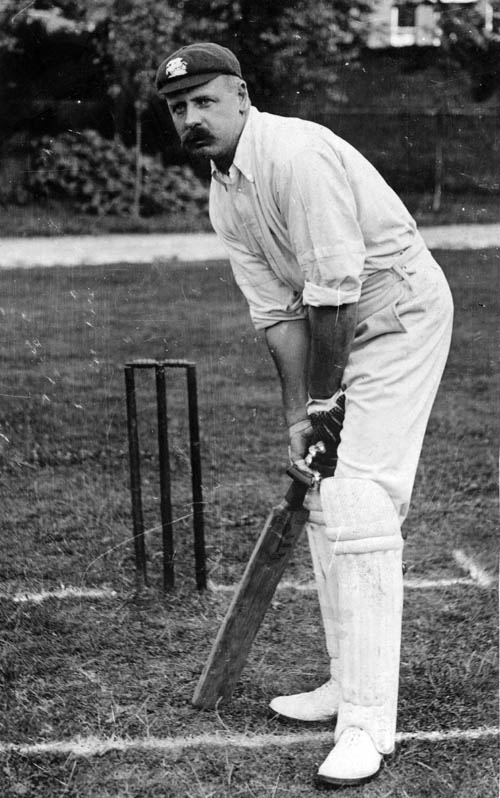
Two Adams scoring test tons within the space of a few days. How coincidental.
Adam Voges century came up in 187 balls and contained 9 x 4 and 1 x 6
 Being Outside Cricket