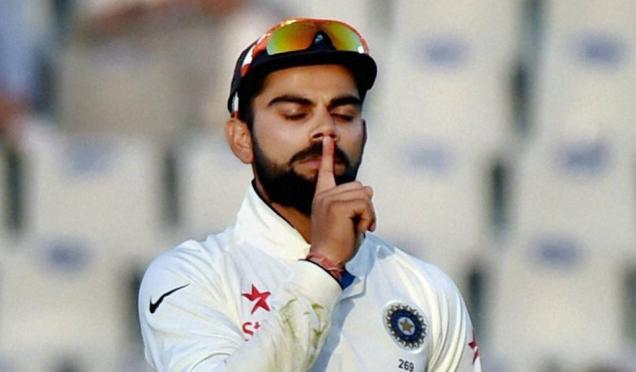
Dmitri #6 – Virat Kohli

kohli

First up, let me tell you about some biases I have. When I played cricket I was a batsman. I didn’t have a lot of time for the bowling art. They always gave me the hump. So naturally I am going to be biased in favour of batsmen. The two previous winners of a Dmitri for international cricket were Brendon McCullum and Steve Smith. This year, due to a bit of late season / late year bias I have decided that the player that had the most effect on me, and on the cricket landscape from my perspective wasn’t his colleague Ravi Ashwin, but the skipper himself, Virat Kohli. If it were test cricket alone Kohli would be near to the player of the year, if not the winner, but because he scored all those runs, allied to his phenomenal record in ODIs, his more than decent T20 record (yes, a record, by far, in the IPL for runs in a season) and it actually seems ludicrous if he isn’t your player of the year.

I’ll also admit another bias. If you piss off our bleeding hearts, both among the twitterati and the print media, and our precious little players, then yes, you have a little plus point in my eyes. You have to be a total Shane Warne for me to get angry with you. Yes Kohli can be a little punk on the field of play, but when that’s a Ben Stokes or James Anderson we laud their competitiveness and fire. When it’s in the opposition they are an arsehole. Have a think about that for once. I’d love to have Virat on my team.

Virat Kohli had an almost impossible act to follow. The next gun middle order batsman after Sachin Tendulkar had to be something else to even get the praise that the Little Master seemed to attract without, later in his career, any need to actually produce much. Kohli was one of those fighting around to take the mantle over, and yet it took him a bit of time to make his way in test cricket, scoring his first ton in his 8th match. He is 28 and has played around 80 fewer test matches than Alastair Cook, who is four years older by way of comparison. Kohli still has just 4209 test runs, almost 7000 adrift of Cook. Kohli has only just, after a massively phenomenal year, got his test average above 50. In many ways looking at his career test stats, he’s a late bloomer, and yet already he has a tremendous aura about him. Of course, he still has to do it in England, they say. I’ll be interested to see what 2018 brings.

Much of that aura is to do, I think, with the way he contemptuously dismisses everyone in ODI cricket. He averages nearly 53 in the limited over form of the game over his career, and as stated, in 2016 he has been phenomenal. He has 26 hundreds. His record in chases is spellbinding. Creating an aura is a pre-requisite to sustained great performance, because psychologically you fear what a man can do. You fear what Kohli might do to you in the ODI game, and then when the test performances follow, you might start fearing him in his all-round batting game. This year he put it all together.

In 2016 he scored 1215 runs at over 70 with four scores over 100. Three of those were double tons. All of those came in the second half of the year. India did not play a test before July. In 10 ODIs this year, Kohli scored 734 runs at an average of 92.37 with three centuries. In 2016 Virat played 15 T20 internationals, averaging a rather impressive 106.83 (helped by a ton of not outs) and with a top score of 90* in his 641 total runs. That’s not bad, don’t you think?

Then comes that aura. The captaincy of India in the test form has been something to behold. Tactically there might always be some issues, but what leadership has done has appeared to galvanise his resolve as a test bat. We saw it in the five match series, with a potentially test saving innings at Rajkot, an exhibition of vivacious batting in Vizag, a useful half century at Mohali and then the masterclass of Mumbai, a double century that took the breath away. Of course, it would never happened if Adil Rashid……..

He was all over the England team in the field, an aggressive presence, indulging in some back and forth which seemed to upset the cognoscenti. “He is not the most popular player among the England team” was used more than once than my upcoming Dmitri winner, as if this actually matters.  I’m sure Kohli couldn’t give a flying one what the opposition think about him. He’s a winner, and he wants to win and attack at nearly any opportunity. Having great wickets at home surely helps, but I can’t forget his performances last time in Australia too, where he looked magnificent. His energetic captaincy is in contrast to MS Dhoni’s test efforts. Where MS seemed not to give a FF about tests and captaincy, especially later in his career, Kohli takes every setback like a personal affront. If Virat Kohli were English, would you not want him as your captain, or would you worry that it might affect his game?

Kohli is the nearest I’ve come to watching Brian Lara. I might actually make a point of stopping everything I reasonably can to watch him bat. He’s that good. Both in terms of ability and fun to watch. Like the other members of the core four – Smith, Williamson and Root – he appears to wield a very long bat. It’s not technical, it’s not any great analysis, but the bat just appears longer in their hands than many others (AB seems to have a short bat to me – it’s nonsense I know, but I hope you get the sort of idea I’m on about). They all seem to be able to wield the willow with a lovely backlift and follow through (Smith, maybe not. He has a technique only his mother could love). Kohli’s bat also seems lightspeed fast. There’s wrist work, but it’s Lara-like, not traditional Indian style. It’s the crack and the pace of the bat that seems special. It’s all pretty woolly I know, but there’s a perception of pure pace when Kohli hits it. He can find gaps, he can manoeuvre fields and shots with the best of them, and he is, when not batting against you, a joy to watch.

He’s also massively, massively important for the game. Virat Kohli evidently loves test matches. He looks as though he relishes his own performances in the elite form of the game and that of his proteges. He wants India to dominate test cricket. He wants to dominate test cricket. It is great he’s a brilliant white ball player, but in a world where test cricket is constantly seen as under threat, it is vital that THE icon in THE largest cricket playing nation does not treat test cricket as a chore. Kohli can fill test grounds. In India. That is massively important for the game. Arguably, from our test-loving perspective, he is more important than Tendulkar and Dhoni. He’s a player we need now, and we need him to be this Virat for a number of years yet.

In retrospect, Virat was a slam dunk for this, wasn’t he? Bias or no bias.

India vs England: Fourth Test, Day Five

With defeat can come a time for reflection, for honesty and the opportunity to examine where a side is going wrong, why games are being lost, and what can be done about it.  It can even be a period where one accepts that the team is being outplayed and there’s little that can be done to change that in the short term, beyond redoubling efforts.  Either way, it requires a degree of self-awareness and the willingness to see that decisions may be wrong, that approaches need to change and that personnel might not be doing all they are capable of doing.

And then there’s the second element, in that the honesty required is internal, and talking to the media doesn’t mean sharing all that with everyone else.  The kind of deep discussion required should not, and usually does not, make it beyond the confines of the dressing room, and that is exactly as it should be.  That makes the fronting up to the media rather difficult, as those who have paid to watch the team play deserve answers, but for the sake of the team there are limits to how detailed and how extensive those answers should be.

Those competing imperatives can cause some frustration amongst supporters.  When a side has been woeful, hearing a manager come out and defend them and claim they actually played well drives many to distraction, as any fan of the England football team for the last forty years or so will tell you.  Yet it’s to some extent a necessary fiction, and in private the manager could well be climbing the walls at the inability of his charges to do what they were meant to do.

As a result, the post match interviews should always be seen through the prism of limited information, both for team dynamics and because the opposition are listening in.  Reading too much into them is a dangerous game, though what people do want to hear is a degree of honesty, and a restriction on the volume of platitudes offered up.  Of course, in many sports, football in particular, that’s because the media themselves are waiting to pounce on any expression of weakness, whereby the plea for honesty is nothing but hypocrisy given how such honesty is then treated.  As a result, wagons are circled and a siege mentality is often the best one to adopt.  All sports teams live in a bubble anyway, and despite occasional protestations to the contrary, the supporters, even though they ultimately pay all the salaries, are removed from consideration.  It’s understandable to an extent, though you can get the situation where an England player assumes the ticket prices to be a quarter of what they actually are – that much ignorance is unacceptable.

The trouble is that there’s a contradiction here.  By no measure could England be said to have a hostile press, indeed supine is nearer the mark given their inability to offer up any kind of examination of their flaws in structure or execution – whataboutery, especially if Kevin Pietersen can be brought into it, is the more likely response.  Defensiveness is understandable in itself after a defeat, the problem is that when it occurs even when the criticism is highly limited in the first place that suggests that the mindset is one of being closed off to the reality of the situation.

The match was completed this morning in short order, England collapsing from their already desperate position to give India the expected series win and revenge for the defeat four years ago.  The response to it was therefore one of interest, to see whether England were fully appreciative of what had gone wrong and why.  Again, an instant response from all involved needs to take into account that words can be poorly chosen, or that with a game still to go baring one’s soul may not be the best, most appropriate response.  Yet the captain’s words are interesting in themselves for demonstrating a particular mindset:

“I thought 400 was a pretty good score on that wicket. Keaton played really well, at 230 for 2 maybe should have got 450. Historically, 400 is a good score on this ground.

“In the second innings we had our chances. We aren’t taking those chances at the moment. Virat played an extraordinary innings but we had a chance on 60-odd to get him. Those are things that the game changes on. We are in it for three days but not good enough to stay in it. We haven’t been good enough to match India.

“We wanted to see what four seamers would look like because on the tour they have given us control and our two best spinners have been Mo and Rash. When you batted first you didn’t need that extra seamer, so that was a mistake. We had a chance to restrict the lead. We would have been in the game. But that isn’t really good enough. To me, we batted better in this game than the previous two.

I go back to the chances we missed, we could have bowled India out for 400. Virat is in incredible form, having one of the series you dream of. Clearly one of the great batsmen of our generation.”

Cook is quite right to laud Kohli’s performance.  He has proved to be the difference between the sides throughout the series, and his extraordinary innings here turned India’s position from middling to utterly dominant.  Yet his comments about the game turning on a missed chance is both unfair and could be said about pretty much every Test match ever played.  Catches will always be dropped, but the bigger and more pertinent question is why it was that this was the only chance created, for that aside, England didn’t remotely look like taking a wicket.  It wasn’t exactly a dolly, and nor was Kohli the only centurion to be dropped in that innings.  Using that as a crutch to explain why the game was lost is throwing a team mate under the bus and effectively blaming him for defeat.  Now, everyone can say things they shouldn’t, and reflect later that it might not have been appropriate, but it’s still not a good thing to do to a member of the side, and nor is it the first time Cook has done it.  Even great teams drop catches, but those great teams create another chance.  If you make only one in an innings of that length, that is the far greater problem.  India have dropped plenty of catches both in this match and across the series – it hasn’t just been England, and while Kohli may have been magnificent, Jayant Yadav also scored a century, and it wasn’t luck that allowed him to do it.   He can bat, and showed it, but England couldn’t get him out.  That isn’t down to Rashid dropping a chance.

Likewise, the section concerning the seam attack is simply rather peculiar.  If taken in isolation, any team can get it wrong and pick the wrong side, but this is the second match in succession that they’re saying this – indeed the implication is that they have got the right teams but the wrong way around: too many spinners last time, too many seamers this.  The reference to the toss is simply odd, since when has the team depended on whether you win it or lose it?  How can it be a mistake if England won the toss, but not if they didn’t?

In any case, India’s seam bowlers have outperformed England’s.  James Anderson went wicketless in this Test, as in the last one, and while he might indeed be offering control, he isn’t taking wickets, or even looking like taking wickets given his insistence on bowling outside the stumps allowing the Indian batsman to watch it harmlessly pass by.  Furthermore, the seam attack isn’t going to be important if you don’t take the second new ball for 40 overs after it’s become due.  It suggests that there’s no faith in them getting any wickets at all.

Ruthlessly analysing every spoken word for an error is not fair on anyone, but Cook’s answer is still jarring, and invites concern that England are too frazzled to understand what they are trying to achieve, whether in selection or execution.  When a side is struggling, errors are magnified by the opposition.  As said yesterday, there’s no disgrace in losing this series to a team who are very good at home, but what is harder to grasp is what England are attempting to achieve here.

Cook did also go on to talk about the captaincy, which in itself suggests that he’s thinking about the end of his reign and there has to be a degree of human sympathy for him here, because leading a team who is getting badly beaten – and England now are being badly beaten – is emotionally difficult.  He is highly fortunate in the coverage he is getting, for it is impossible to imagine any previous England captain ever getting such a comfortable ride – even if there are some words of gentle criticism now being offered.  Still the idea that he can choose his own departure date on the back of more Test defeats in a calendar year than any previous incumbent plus a second proper hammering in an away series under his leadership beggars belief.  To say so would mean that he is more important than the team.

Nobody wants to see a captain (or anyone else please note) made the scapegoat for the failings of a team, but it remains utterly extraordinary how favourable the coverage of Cook as captain is.  Nobody is under the impression that he’s a superb captain, not even the biggest cheerleaders for him would ever make that claim.  Thus the idea that him not doing it would represent some kind of disaster is impossible to believe or justify.  Equally, he’s not had a record as captain that’s good enough to justify the adoration, being no better than that of Nasser Hussain who had far weaker personnel to work with.  He did lead England to two Ashes victories at home, but also in the away disaster in 2013/14.  The away win in India is an undoubted highlight, but balancing that is the home defeat to Sri Lanka and the drawn series in Bangladesh.

His tenure certainly hasn’t been a disaster, but nor has it been especially good, and the suspicion that England aren’t getting as much out of the team as they could does come down to leadership, whether of the captain or the coaching and administration.  His on field captaincy has been – to put it kindly – limited, the administration of the ECB inept.  Quite how he gets such approval, such reverence, is impossible to understand, for the likes of Paul Newman write as though he was a clone of Mike Brearley.  It is notable that far greater criticism of Kohli’s captaincy has been present in the English media than that of Cook’s, and while Kohli may not be a great captain, he’s the recipient of the kind of comment that has been notably absent about Cook for much of his reign.  The problem here is that it is counterproductive.  It is treating the public as idiots – so obviously biased in Cook’s favour that it merely enrages those who would otherwise accept a limited captain doing the best he can.  Pretending that black is white merely destroys the credibility of the cricket media.

The game ended with an on field spat between Ravi Ashwin and James Anderson, which is not altogether surprising given Anderson’s comments about Virat Kohli the night before.  Perhaps the frustration at England’s performances seeped through, but the comments were not especially wise and lacked grace.  It would be equally easy for them to talk about Anderson in the same vein, and Anderson surely knows that.

India are a good team, one who thoroughly deserve to have won the series, yet they are not a great one, at least not yet; suggesting they are is curiously making excuses for England – that they simply could not and never would be able to beat India no matter how well they played.  There is being realistic about things, and there is burying a head under the duvet and hoping it will all end soon and there’s nothing that could have been done.  India are very likely to almost always have better spinners than England, but this series they’ve had better seamers too.  Indian batsmen are always going to be better players of spin than English ones, but it doesn’t explain the lack of patience or irresponsible dismissals of England batsmen when set.  Perhaps it is indeed the case that Kohli isn’t a great captain, but when you have a superior side, that can be disguised – as England have demonstrated under Cook before – and when losing the weakness in that discipline is highlighted more.

Perhaps behind the scenes England are well aware of all these things and are discussing and debating them.  But the media have long abrogated their responsibility to hold England to account, and the signs are that the ECB structure doesn’t see it.  Andrew Strauss, highly visible when England do well, has been entirely absent this winter.

There is one match remaining.  It is a struggle to see anything other than a comprehensive India win, for the margins of victory are getting wider.  Cook’s line that he will sit down with the Director, Cricket at the end of the year is not an unreasonable one, for the conclusion of the series is the time to make decisions not during it. That discussion will decide what the England team are ultimately about and where they go, for there is talent there and there are good players coming though.

For now, India should celebrate their thoroughly deserved win.  England have a lot of thinking to do.


India vs England: Fourth Test, day four

One of the tricks of politics – spin as we call it – is to predict complete catastrophe and then talk up the subsequent normal disaster as being a positive result, better than expected, and evidence that the cause is making progress. A succession of party spin doctors are wheeled out to say the leader is having the desired effect, because they never expected to win anyway, and thus they are very satisfied.

Of course, this is invariably in complete contradiction of everything visible, and the interviewer usually points that out, but it’s a game, a routine to be followed, and at least normally they’ve been clever enough to have set out the predicted calamity in advance. The one group of people thoroughly ignored are all those watching, who roll their eyes at such a transparent fabrication but then they aren’t important anyway, it’s merely a routine to be followed and wilful defiance of the bleeding obvious and living in a fantasy world is considered an entirely normal response in that bizarre world.

Naturally, any statements to the contrary previously are ignored in the hope that anyone watching is so stupid they won’t even realise. This tends not to work.

Now, all of this plays out with the media being the ones making it clear on behalf of the public that this is pure nonsense, but just imagine for a moment that instead, they were to raise the very point of expected flop to the lying bastard…sorry politician offering them a free get out and a nice excuse for failure. And then doing it again. And again. Each time it happens.

England were not expected to win this series, in fact not even the most ardent cheerleaders who usually come up with preposterous predictions of certain victory suggested that. But there’s the realism about what England could have been expected to achieve, and then there’s Agnew claiming England have done well not to lose this winter 7-0. This includes the tour of Bangladesh remember, the team who have never before beaten anyone other than Zimbabwe and the West Indies fourth team.

Now that first series was great, and credit to Bangladesh for how they played. But to attempt to paint the 1-1 draw as being an England triumph is spin doctoring of a level that the West Wing writers would have rejected as unrealistic. Likewise, as this series unfolded England apparently only lost the second Test because they lost the toss, and with a little luck they would bat first in the third and all would be well. And then they did. And got hammered.  Oh and the fourth. And they’re getting hammered.

But then after three matches India really weren’t all that good and England were quite capable of winning and getting back in the series. Which with a fair wind was just about possible, and a reasonable supposition. Except that now it was never possible in the first place and who could ever have suggested such a thing?

Let’s get something clear here, India is a very difficult place to tour, and they’ve not lost at home since England beat them four years ago. So losing this tour is not in itself the problem, for most observers would have thought that was the most likely outcome all along.

But would the England side of four years ago have done better? Almost certainly. They had better spinners, and they had better batsmen. That’s not a lament to a lost side, for time moves on, but it is a recognition that those who said India are good but not unbeatable were right. But to win England would have to play exceptionally well, be led exceptionally well and had their key players perform superbly.

That hasn’t happened.

C’est la vie, for this too is the nature of sport. There’s little point getting too down on an England side who have been outplayed at the key moments in all the matches bar the first one. But it has been remarkable to see an entirely new replacement for the Kubler-Ross model involving some of the fifth estate blaming absolutely everyone possible for wrong reasons at the wrong time. Except one.

Again, to simply point the finger at the captain would be equally wrong, for this is a complex set of circumstances and he has been having a progressively more difficult time of it on the field. But, and this is the constant frustration with his coverage, the endless attempts to excuse the golden boy while lashing out at others is shameful. The cricket press have been supine and by turns spiteful over the last four years. It’s by no means all of them, and of those that do, they seem to be as on the long goodbye as much as Cook now is.  But it remains a grotesque sight, and one that must cause frustration for the more rational objective journalists. They end up guilty by association.

The nub of it is that cricket tragics are well aware that this is a tough tour, they are equally aware that India have better spin bowlers, for the only time they didn’t in recent years was four years ago. Anyone with a passing knowledge of the game also knows that Virat Kohli is a damn fine player, and that he’s anything but alone in that team.

Furthermore, in all team sports the wheels can come off, and on a long tour small margins can become gaping chasms. England really haven’t been completely adrift in this series, they have competed and they have had moments where the opportunity to do something was there. But ultimately the margins of defeat have been large, and they are getting larger. The prospects for the fifth Test are, well let’s just say unpropitious.

But the blame game has another angle to it, the notable whispers about Cook departing as captain. There is an irony that he is now victim of a whispering campaign in the press, for those who objected in the past to the ECB methodology also object now; he may have been a beneficiary in the past, what goes around may come around, but it’s still leaking, and it’s still underhand, and it’s still wrong. Which means that while Cook doesn’t directly get blamed for anything – for that would be to undermine the previous line that he is an outstanding leader who cuddles little lambs – there is an almost pitying theme running through the narrative that he now doesn’t know where to turn when things go wrong.

As if this has only just been noticed.

This morning was an omnishambles, seam bowlers utterly innocuous – and the silence about the way India’s seamers have utterly outbowled England’s is another notable refusal to face the truth – a captain bereft of ideas, catches dropped and a sense of resignation right across the field. Naturally, this is turned into a complaint that the spinners (who suffered from dropped catches, idiotic reviews that subsequently cost wickets and the usual unhelpful field settings) aren’t doing their jobs. As if them not being as good as their counterparts is a major shock.

Adil Rashid in particular continues to be criticised, despite being far and away England’s most successful bowler on the tour. One of a limited number of positive points. It’s not that he can’t do better, it’s that the desire to bully a player in print exceeds the obligation to be objective. It is not the first time it’s happened, and it isn’t going to be the last. The only shock is that it hasn’t happened to Ben Stokes yet.

With such a huge deficit, this match was only going to go one way, and as it turned out England batted reasonably well second time around. When one side is being ground into the dust, it invariably appears the sides are playing on different pitches. And there’s no doubt at all this is now a difficult surface on which to bat, no matter how easy India made it look against a beaten England team. Taken in isolation the approach was a good one, to take some risks, to score some runs and to be positive with footwork and in defence. Root batted well but yet again failed to go on to a really big score, while Bairstow once more did his impression of Horatio on the bridge.

None of it matters. England are gone in this series, and while raging against the dying of the light is meritorious in itself, it doesn’t change anything except to indicate that there are players in this team with the degree of relish for the fight that will serve them well in future years.

A realistic assessment of where they are doesn’t mean focusing on fripperies like Bruce Oxenford making a couple of errors, nor suggesting a game is lost because the current whipping boy dropped a catch and thus the match. It’s an excuse and a pathetic one at that, an attempt to avoid considering the bigger picture, lest the sight of tusks and a trunk be spotted by all and sundry.

Barring the kind of miracle that would genuinely be rather special, India will win the series tomorrow. And they deserve it, for they are a good team, and a very good one at home. There’s no shame in losing to them, there’s not even shame in not playing well. But there is in doing everything possible to avoid facing the facts. The irony is that it may not be the England team on this tour who should be feeling it.

Day Five Comments below