It’s now three days since England came so close to winning a second World T20 title, and the press have had their say and moved on. Ben Stokes has received a lot of scrutiny over that final over, most of it sympathetic, some of it much less so, particularly in the immediate aftermatch, to the point where the concerns about him being the latest journalistic punchbag post Pietersen have resurfaced, specifically a Daily Express headline writer who decided to go with “Choker” as the headline, doubtless to the fury of the journalistic staff.
Over the last couple of years the Daily Telegraph has largely supplanted the Guardian as the broadsheet newspaper which delivers some of the most thoughtful comment. That’s not to say the old Telegraph of blazers and public schoolboys (although to be fair, there’s a lot of that in the Guardian too, they just tend not to revel in it) has disappeared, for Simon Heffer wrote in the aftermath of the tournament a protest against the way it is supplanting both championship and Test cricket. His article actually makes a number of very good points, though the opening line of “Along with thousands of other MCC members” is always going to raise a smile. Still, it’s rare enough that someone in the media references Death of a Gentleman to be worth checking out, and while some of the issues, such as the question of T20 franchise cricket are not open and shut, Heffer argues his case with passion, which is welcome.
Almost all the Telegraph coverage focuses on the players and the match itself. Paul Hayward is one who retains sympathy for Stokes in print. Hayward doesn’t tend to get universal praise for his writing, but his opening line is a potent one:
“If you think Ben Stokes’s bowling was to blame, try hitting four consecutive sixes in front of a global television audience, in the final over, to win a world title when all seems lost.”
By focusing on the brilliance of Brathwaite instead of the pain of Stokes, he followed the line that the Telegraph has maintained since the game finished. Jonathan Liew’s initial match report had remained sympathetic throughout, merely hoping that Stokes would be able to forgive himself, while Michael Vaughan follows pretty much the same line. Vaughan does go on to say that it was the best tournament he had seen, and gave it 10 out of 10, which is a curiously shallow view of it. For certain, many of the matches were exciting, and one semi-final and the final itself were thrilling, but 10 out of 10 when the ticketing was a shambles? When the Associates were more or less ignored at the start? From the perspective of looking only at the TV spectacle, yes you could see why that might be a view, but surely there are wider issues to look at.
In contrast, the Guardian decided to go big on Andrew Strauss, Vic Marks in the build up writing an homage to Strauss’s achievements. It is always curious how the players themselves seem to be secondary in some eyes to those above, for while Strauss does deserve some note for his decisions, retaining Eoin Morgan as captain was unquestionably slightly surprising, to then focus only on all good things as being the work of the Director, Cricket is nonsensical. As for the media being “hoodwinked” over the choice of Bayliss as coach, when all expected it to go to Jason Gillespie, well maybe they were, but this blog queried the likelihood of him getting it at the time, specifically because of how much the media were going on about it, and the ECB’s talent for not telling them the truth. Choosing Bayliss was a good call, but praising Strauss for everything, while quietly ignoring some of the less glorious episodes, and indeed the players is bizarre. Even when Nasser Hussain invoked Strauss, he did make the point of saying the players deserve it most of all. It’s a very English thing though, the suits are the ones who get the praise, but so rarely the criticism as we’ve been all too aware of over the last couple of years.
Marks did focus on the players, or more specifically Stokes himself, when writing after the final, following suit with most others about how he will deal with what happened, but Mike Selvey manages to go through all sorts of hoops when writing about the dysfunctional relationship with Caribbean cricket to avoid even referring to the wider issues about the world game. It’s quite impressive in a way, for while the relations between the players and the board in the West Indies are indeed shambolic, at least part of the problem is down to the West Indies very much being in the bracket of the have-nots of the international game, something that Selvey has studiously avoided ever considering. If he’d ever bothered to watch Death of a Gentleman, he might grasp some of the problems that afflict countries outside the Big Three, but presumably even daring to do so would bring down the wrath of his friends in high places amongst English cricket’s hierarchy.
Over in the Mail, Paul Newman got a bit carried away, writing a tear stained love letter to Stokes of the kind that he used to do for his one time ghost-writing subject Kevin Pietersen. It’s all rather lovely, but we have seen how he can turn. He also decided to take the opportunity to talk about Strauss, going so far as to describe the Champions Trophy as one that Strauss “will be desperate to win” which is just odd.
When reading through the various articles about this, it’s quite striking how little comment there is. The Times might well have plenty, but since it’s hidden behind a paywall it’s going to get ignored. The press did give coverage to the match reports, which is useful given most of the public didn’t see the final, but subsequently? Not so much. It’s a bit thin, and although there are the specialist sites such as Cricinfo, which are so frequently excellent with Jarrod Kimber excelling himself, and Ed Smith being, well Ed Smith. But for general newspapers, the days of in depth analysis seem to be largely behind us. A shame.
“This is not what you wanted, not what you had in mind.” – Moderat (Bad Kingdom)
The last 26 months have made a huge difference to me. I remember how angry I was when we coughed up the Champions Trophy on that dull Sunday June afternoon in 2013, as all our mental failings were laid bare in front of us. I cared, passionately, about how our team got on. I remember 2004, when Browne and Bradshaw won a low scoring encounter in the early Autumn gloom to win the Champions Trophy for the West Indies in 2004 at The Oval. I was gobsmacked. Unexpected, our team that had won all its tests looked nailed on once they’d taken care of the World Champions in the Semis.
We have a way of losing. We have a way about us when we lose. In football competitions there’s usually a hard luck story. Cricket – I still remember Adelaide, of course. But that might be the best/worst yet. A freak ending, and I should feel crushed. But the thing is, when you’ve been so angry at the people running the sport here and in the world game (especially the former), you’ve only so much to give. Despite the constant exhortations that these are a “great bunch of lads” and that people can’t understand why we can’t give this team our all, the sheer fact that newspaper columnists and the useful idiots were lining up to polish Andrew Strauss’s clock (that’s clock), shows what the real power wants. It’s all about the management baby. The palpable sense of articles being re-written and the eulogies put on hold was prevalent. Everyone with a vested interest in pumping up their tyres were ready to give it “all that”. And we know what would have been included in “all that”. We all know.
That management today nearly had it all. It nearly won a major ICC tournament overseas. It nearly had a trophy to ram down the KP fanboys’ throats. It nearly had a load of endorsement opportunities, a boost to their T20 Blast, a load of heroes to parade before an adoring public, and it nearly had their total justification after an Ashes win and a success in South Africa. A T20 win in India? Beyond comprehension. Think of the plaudits, think of the bragging. See you lot on BOC – what do you know?
Let’s be honest. Don’t buy the inexperienced team stuff. There’s a lot of experience in that team, but it is on the young side. It’s fit, it’s enthusiastic and it has room to improve. Saying we are inexperienced is getting your excuses in first.
This England T20 team showed signs of progress before Bayliss. Many of us do not forget the care-free, ambitious, gleeful win of Eoin Morgan’s England against India in the match at Edgbaston in 2014. This had come in stunning contrast to the often staid, dull approach of Alastair Cook’s 50 over side. It really didn’t take rocket scientist levels of deduction to draw the conclusion from a World Cup of nearly all out aggression, that sitting in and making nice handy totals wasn’t the way forward. We’re not exactly talking out of the box thinking. But there they were, giving it all up to Strauss. We are a funny nation.
A major England defeat in many major sports comes with some ready-made controversy or “bad thing” to hang our hats on. Last night it was the classless WIndies. But wait a minute. I know, for one, that I have a go at Australia a lot for their conduct on the field, but that’s what we do. We’re aggressive, and we’re not backward in letting people know we want to “mentally disintegrate” them. While England have, in some ways, “re-connected” with the public who wanted to “re-connect” by a more open approach to fans they previously treated with a little contempt, their conduct on the field hasn’t been without blemish. So let us stop pretending that it is. Ben Stokes, who, as I’ve said, isn’t my favourite player in the team, had been gobbing off to all and sundry this summer, including, it seems to his own coach (according to Cook, half-jokingly, he says Stokes and Bayliss communicate by swearing at each other). I don’t know about you, but if you dish it out, you should expect to take it when the you know what hits the fan. While I will defend Ben to the hilt over his bowling the last over – that Ben Chokes headline is an utter disgrace – he isn’t, outside these shores, a sympathetic character. But those berating him for his final over yesterday have quickly forgotten that Stokes’s final over against Sri Lanka, when defending less, was absolutely magnificent.
We cannot, simply cannot, have a go at the West Indies for their celebrations. My least favourite player in the England team, David Willey, is not someone who I’d employ in the diplomatic service. Stokes we know. Root’s a chippy little sod. There have been outlandish celebrations throughout, and no doubt we’ve been giving players little send-offs throughout. But for the likes of Newman to turn all maiden aunt on us about the West Indies’ celebrations, and therefore lack of class, as if that matters, is laughable. Watch when we clinch the match against Sri Lanka. The game was over before the last ball, yet when it was concluded, all but one player rushed to engulf Stokes in the huddle. Jos Buttler, to his great credit, went over and shook Angelo Mathews hand. I saw it. I doubt Newman did. It reflected well on Jos, and increased my affection for this terrific talent, and less so on his team-mates. West Indies, their players largely hated by their board, not, by any means, without fault or iffy personalities, had clinched a world title. You might not like their celebrations, but STFU about them when your team do pretty much the same.
Also, imagine an England player who would stand up to his board as Sammy did, deliver that speech, excoriating the suits surviving one minute as an international player in his future career. Imagine how the media in this country would react, the sides they’d take, the understanding they’d show. Yeah. Picture it.
I understand people having issues with Gayle, Bravo and Samuels. But don’t imagine our players are universally loved overseas.
Then there is the ICC. They got a tournament they did not deserve. I’m not having a pop at India’s cricket fans for anything. The ICC and the host board, increasingly, in financial terms, one and the same, treated all fans like crap. You have the new jewel in your crown, and you treated it like a pre-season tournament at times. Crap ticketing, arguments over hosting grounds, switching locations (remember India v England got switched in 2011), an awful format. Despite the ICC they got a Final they did not deserve. They got a semi-final in Mumbai they did not deserve. Those who split the cricket from the governing body, claiming that all sports are poorly run, are being wilfully negligent. FIFA may be inherently corrupt, but the World Cup is treated like the sporting treasure it is when it comes to earning revenue and growing the game (because growing the game earns more revenue). Host stadia are known ages in advance, the draw takes place six months before the event and you know where every game is being played. It draws massive audiences around the globe regardless who is playing. The ICC, as this blog, and the commenters point out constantly, treat the major events as if they are personal fiefdoms, treat fans with contempt, constrain the playing field, ensure major teams get at least four matches, and yet no-one outside of what is rapidly appearing to be labelled as an “evangelical sect” seems to care. Those England folk raging against the ICC don’t share the entire portion of the Venn Diagram with the “KP fanboys”, but there’s a decent correlation. Chris, in his piece later this week on the press and the WT20, may reflect further. Watch those “evangelicals” get marginalised further. As one journo once said, and as I was reminded today “I report on men in boots, not men in suits”. Or something like that.
England made remarkable progress, are clearly on the right lines, need a little think on their strategy perhaps (I’m still really keen to see Jos in at four, or three if the openers have lasted until the 6th or 7th over), but are a team on the rise if they don’t let this heartbreaking loss get to them. They can leave India with the knowledge that they’ve made our limited overs cricket respectable, they’ve developed a number of players in the white heat of international competition and that they have done a lot to rehabilitate “Team England” in some people’s eyes.
Spare a thought this evening for Ben Stokes, a player for whom most things have gone right the last 18 months or so. With England needing to restrict the West Indies to fewer than 18 runs off the final over, and with Marlon Samuels marooned at the non-strikers end, confidence must have been high. Four consecutive sixes to win the match with two balls to spare probably wasn’t figuring in many worst nightmares for the England team, and yet that’s exactly what happened.
And you’ve got to laugh. Not because the England players remotely deserve the pain they are going through in any way whatsoever – but because sport can be magnificent sometimes, no matter how much administrators try to ruin it. And make no mistake, that was magnificent. West Indies were if not quite dead and buried then certainly on life support, England on the verge of victory. And yet, there’s always the slight possibility in any sporting encounter for the extraordinary to happen. It doesn’t very often, for if it did the exceptional would become the mundane, but when it does it is enough to make any viewer apart from the most partisan and one eyed stand and applaud. The essence of joy in sport is to chuckle delightedly at special achievements.
The incredible finish doesn’t alter the truth that England could and should have posted a much better score than they did; some dismissals were unfortunate, some a little careless, albeit within the confines of a format where a high risk approach is a necessity and often highly rewarded. It is difficult and unreasonable to criticise players for doing the same thing that gains them success when on occasion it leads to failure, unless that failure is evidence of failing to learn. Equally, safety first is never a profitable means of playing 20 over cricket, but a fair few England players will look on their final with regret. England’s disastrous start in reaching 23-3 was one they never entirely recovered from, although Joe Root once again did his best, and David Willey in the closing overs got England up to some kind of score.
One of the key arts of captaincy is for decisions and gambles to come off, and in attempting to defend a moderate total, opening the bowling from one end with Joe Root was definitely a gamble, but one that did indeed come off, removing both Gayle and Charles in his opening over. From there the West Indies were struggling to catch up, and the required rate began to rise. Marlon Samuels received a life when initially given out caught behind only to be reprieved by the TV umpire. This is as unsatisfactory as it always is. It’s been demonstrated on so many occasions that foreshortening makes the ball look like it touched the ground when it didn’t, to the point where the late Tony Greig showed a ball several inches off the ground appearing to be grassed. Did it carry? Who knows. Television is a poor means of examination precisely because it is fundamentally misleading. Those saying it touched the ground are doing so on the same flawed evidence in the first place – it is simply impossible to know. The umpires need to take control here and make decisions, and onlookers need to accept their judgement as being based on better evidence than the television can provide, that of seeing the action in three dimensions.
Willey was the pick of the bowlers, alongside Adil Rashid, as their ability to restrict the batsmen first tilted the game towards England, and then seemingly had it won.
The fall out from the tournament will undoubtedly continue over the next few days. Darren Sammy had plenty to say at the presentation, not holding back in his criticism of the WICB and stating his uncertainty about whether the team would play together again. There’s no doubt at all that cricket in the Caribbean is in serious trouble; where the primary responsibility lies is open to debate, but if this victory concentrates minds in a region where cricket remains a passion, then perhaps it will be worthwhile. The problem is that we’ve been here before, and it made little difference. There are no signs it will this time either, for a disconnect between administrators and players and supporters are hardly the sole prerogative of the English.
If there’s one thing to act as a saving grace in England’s defeat, it’s that it has stopped some of the more predictable sources from gloating about how the ECB have handled things perfectly over the last couple of years and how a win would have justified it all. It clearly doesn’t, in the same way that defeat doesn’t make those criticisms correct either. But the desire from some to cheerlead the actions of a board that’s demonstrably untrustworthy remains as downright peculiar as it ever was. With 19 required off the final over, the suspicion that “Who needs Kevin Pietersen?” tweets and articles were about to be sent out is a strong one. And here’s the point, that argument is valid win or lose, it’s just that it tends not to appear when England lose. For those it will not present a problem, for they will doubtless pop up again next time the players on the pitch perform well, the obsession is peculiar from those who profess not to care.
And the England team? They’ve performed well in this tournament, probably significantly above expectations. Eoin Morgan has not had the best time with the bat, but has led the team well. The bowlers improved by the game, while the batsmen were explosive, and reasonably consistent, notably the outstanding Root. Those players will be crushed by the loss, and particularly the way it happened, and exhortations to be proud of themselves will fall on deaf ears. That’s the nature of elite sportsmen and women – second is nowhere. But England do have a collection of highly talented cricketers, and despite the ructions above have been a credit to themselves and the shirt they wear.
The tournament itself is a testament to the belief that less is more, for by going straight to semi-finals rather than quarters, each group match became critical. The main competition was short and sharp, entertaining and often nail biting. The continuing disdain for the Associate nations and the way they were kept out of sight before the entry of the Test playing countries remains as contemptible as it appeared a month ago. In 50 over cricket, the ICC have gone for the ultimate – making the tournament long and boring and excluding the outsiders to peering through the gates at the party within. There isn’t so much wrong with cricket that it couldn’t be improved by exiling the sport’s bureaucrats and power hungry businessmen to a remote island somewhere.
As for the media, there will doubtless be much wailing about the outcome here, but the reality of T20 is being wise after the event to explain wins or losses only makes sense where a team is clearly off the pace. England could have won today, but didn’t. It’s just sport – trying to find explanations in a very tight match is merely speculative. There was a huge amount wrong with how England played the game for about a decade, the way they are playing it now is exactly how they should play, and the antithesis of how many in the ECB establishment allowed them to play for a long time. And when that basic concept has been corrected, to the credit of players, captain and coach, it is a bit much for those who stood in the way all that time to try to claim the credit. Some you win, some you lose – but play the right way and the opportunities to win are much greater.
Well done the West Indies, both men and women. The party tonight will be good.
England have played pretty well since that opening game against their final opponents. I’ll bet if you asked the experts which group might produce both finalists, you’d have said it might have been the one with India and Australia in, but it didn’t. Now the question might be are England over the mental scars they might have picked up from the first meeting in Mumbai?
Both teams had shockers in one form or other against Afghanistan. England won their match while the WIndies had little to play for and got caught out. The WIndies saw off the remainder of their opposition in better style than we managed, so on form, it has to be the West Indies, doesn’t it?
England, though, put it all together against our almost perennial ICC tournament nemesis New Zealand, in a complete display. The form of Roy, the clinical bowling, the coolness under pressure all augur well.
You cannot argue. England have taken many strides forward in the limited overs formats, and bat all the way down, with the bowling improving game by game. To argue against that isn’t going to have evidence on your side. This really appears to be Bayliss’s strength, and made the selection of him as coach quite a prescient one (oh dear, another knock on Downton). I think bringing in Strauss as some guru is stretching it a bit – after all, I don’t remember the hosannahs for Hugh Morris when we won the same competition on 2010 – but the philosophy appears the right one. If it is still within your heart to forgive the ECB and all that surrounds it, and cheer on this England team with all your might and heart, things look really rosy. Enjoy the game.
Me? You know where I stand. I wish Jason and Jos, Alex and Joe, Chris and Moeen, good finals. I like these guys. They embody the new England. They seem decent guys. I don’t wish them ill. I just can’t stand their employer. Not quite Teddy playing for Manchester United but not far off it!
Personally, I think England will win. I think they are on a roll, qualifying comfortably through their semi, rather than the fraught, but awesome run chase the WIndies had to pull off. Bit like 2010 – we (relatively) cruised through the knock-out games, the other finalist pulled off an escapology act in the semi – we pulled things together.
As the saying goes, one out of two ain’t bad. Equally, both sexes should be preparing for a final, for this morning the problems in the middle order finally caught up with the women’s team and cost them the match. Throughout the group stages the top order had done most of the job, only for the jitters to kick in, the wickets to begin tumbling and a frantic scramble ensued to win matches that already looked safe. Against Australia the same thing happened, only this time the quality of opposition was superior. A fascinating thing about cricket is the collective panic that can set in to a side, and then happen repeatedly. Everyone in the team is aware of it, everyone about to go in to bat feels they are the ones to arrest the slide – and yet it proves impossible to do. The psychology of team sports is endlessly fascinating. T20 cricket more than perhaps any other form of the game can be about an individual raising their team to higher levels than perhaps they are at as a unit. Edwards, Taylor and Beaumont have been excellent and carried the side to this stage. The inability of those following to capitalise means they will go no further.
From the men however, it was dominant, as they cruised home against New Zealand with nearly three overs to spare – a result that is to all intents and purposes a thrashing. It was also the most complete performance from them in the tournament to date, for every side is more than aware that the firepower of England’s batting is their strong point. Moreover the victory over South Africa in the group stages means that every side will be thoroughly aware that they have the ability to chase down pretty much any target set, but on this occasion they didn’t have to because the bowlers did their bit, and more.
New Zealand will be deeply disappointed to have only made 153, especially after passing 100 after just 12.2 overs. At that point the generally useless score predictor beloved of the TV coverage was suggesting 197, which just goes to show that complex algorithms supplied after hundreds of hours of work are no better than equal to someone with a modicum of common sense and cricket watching experience thinking that they could get 200 here unless England start taking wickets to slow them down. Moeen Ali was the first to apply the brakes to the scoring, despite only bowling the two overs. Stokes and Jordan then increased the pressure to the point wickets began to fall under the strain of trying to raise the run rate. The latter in particular has improved by the game in this competition, while in Stokes England have a genuine death bowler for the late stages. Whoever England play in the final, this is going to be critical, for both potential opponents have explosive players who can ruin any carefully laid plans.
Alex Hales and Jason Roy made a sub-standard total look positively inadequate within 5 overs, rattling along at ten an over and removing any sense of pressure from the equation. Roy in particular was outstanding, demolishing a good attack while never slogging, while Hales, who has plenty of form for doing the same thing showed an excellent sense of game management in playing the supporting role to his partner. By the time Hales was dismissed for 20 runs that were far more valuable than in the numbers, England were over half way to their target with the better part of 12 overs to get the remainder.
It wouldn’t be England without a small wobble, and two wickets in two balls supplied that – Eoin Morgan’s penchant for first ball dismissals coming to the fore once again – but England had this under control and pretty much in the bag even then, despite Scott Styris’ entirely understandable pleas for a couple more wickets. Any prospect of the game going to the wire was removed by Jos Buttler brutally finishing the game off with an unbeaten 32 off 17 balls, yet ironically it was the present of Root, quietly going about his business that lent the sense of certainty to the outcome some time before.
And so a nation rejoices, right? Well not really. As has been observed before, this whole competition has barely registered with the wider public. In some ways that’s down to the perception (in the UK) that T20 is the least important format of cricket, and when England won the thing back in 2010, it can’t be said that open top bus parades were the result. Yet if the muted response to England’s first global tournament victory back then was the benchmark, this time it’s even more low key. Sky’s coverage has been as thorough as it usually is – at least for the men (the protestations that the failure to cover the England women was out of their hands is nonsensical, Sky are a very high value partner for the ICC, one who can and do push their case with them) but the newspaper coverage has been a little scanty and relegated to the inside pages, and while the BBC have certainly promoted the event in their TV reminders (not adverts. Oh no) it is without any sense that it has captured the zeitgeist.
The reality here is that cricket’s media footprint has declined to the point it’s a special interest sport, not a general interest one as it used to be. Here’s a little test for you: when was the last time you heard someone say they hated cricket? It’s so invisible they don’t have to any more, it doesn’t even exist as something to loathe. That’s no reflection on this current team, who are playing T20 how it should be played – indeed how only a couple of England players in the past demanded it be – which means that they are doubly unfortunate to be doing all the right things at a time where people don’t really care any more.
This isn’t carping at the England team, and it’s certainly not berating the print media, who respond to what their readers wish to see. But it is a dreadful missed opportunity that England can reach a world final, and rather than it be a catalyst for increased participation and interest, it merely serves to reinforce the sense of decline in importance for the wider public. The vast majority of people will see this result only in a 60 second round up on the main evening news. The showing of in game highlights has been a welcome development, so it isn’t that things aren’t being tried, with the proviso of refusing to recognise the bigger issue – the fear is that in England at least, it may be too late; not for the game, which will survive, but for cricket as a mainstream sport.
Reaching the final is a credit to this team, and they have every chance of winning the whole thing. What a pity so few will notice. What a shame Jason Roy’s innings today won’t be the thing everyone is talking about work tomorrow.
One of the fundamental problems with working for a living, is that it thoroughly gets in the way of other things – like watching cricket. This is even more the case when that work involves travelling. So it was that the first week of the tournament was spent in Berlin, which didn’t really matter that much given how the ICC were trying to keep those awful associates out of the way as much as possible. The second week was spent back here in the UK, except with a ludicrous schedule whereby the defeat to the West Indies was spent either on the tube or eventually in a car heading to Bristol – which would have been fine but for the presence of a German colleague for whom the delights of a cricket match on the radio probably wouldn’t have been the centre-piece of his trip.
The win over South Africa was spent in Cambridge, a five hour meeting which was productive, but not really the time to be checking Cricinfo to see what was happening.
Afghanistan was missed by dint of what in truth was a fairly pleasant lunch in Mayfair, although my lack of familiarity with such places was evidenced by my (silent) reaction to the presentation of the bill. Free advice to you all: Do not ask someone who works in Mayfair where they fancy going to lunch. They will tell you, and then you’re stuffed.
Sri Lanka – ah yes I watched the Sri Lanka match. I’m pretty sure I was back home by then, and after four overs of their innings texted a friend to say that surely even England couldn’t screw this one up, only to watch them try awfully hard to do just that. Still, they won, and the nature of T20 is that it often gets close simply because of the shortness of the format.
And so England are in a semi-final of a tournament that has largely passed me by. And here’s where Dmitri’s preview hits the nail on the head, because I’m a cricket fan, I watch it routinely and yet by not getting to see it, it’s barely registered as a competition. Worse than that, the women are also in the semi-final and haven’t even had all their matches broadcast on Sky. There have been mealy-mouthed justifications that it’s out of their hands, but that’s a nonsense – if they wanted to show them they would have made a point of ensuring there was coverage. They didn’t.
Tomorrow an England cricket team will play a major World Semi-Final and it provides us with a chance to move towards a second world title in this format. It will be played out, the drama, the big hits, the slower balls, the yorkers, the running between the wickets behind a pay TV wall. As far as I am aware, there are no plans to share the coverage with those not in possession of a Sky subscription. Oh well. Internet highlights it is.
Has this game registered on the public conscience here? Has anyone outside your normal cricket circle expressed any sort of interest? Not with me it hasn’t and all my colleagues and friends know I’m that blogger.
But there’s not a problem.
New Zealand are unbeaten in the competition, have a game plan, or several plans, and yet if we could choose a team to play at this stage of a competition, we’d probably be grateful to be playing the Black Caps rather than Kohlishire. But again, they are not to be underestimated.
From a misery guts point of view, England are probably playing with house money now for the powers that be. They’ve reached the semi-final so even if they go out here, the ECB have some tangible progress to report. In many ways they have, but this still looks a flaky team to me. It could chase down pretty much anything, but it could also be chasing pretty much anything. It definitely looks more comfortable chasing rather than setting.
Captain this ship is sinking Captain these seas are rough, oh yes We gas tank almost empty No electricity, we oil pressure reading low Shall we abandon ship Or shall we stay on it and perish slow We doh know, we doh know Captain you tell we what to do
Gypsy – Sinking Ship
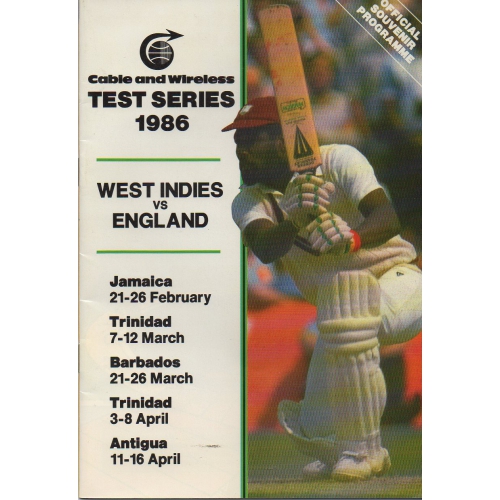
We left the England team a quivering mess. Having been dismissed in Barbados, the series score was 3-0. England faced the fourth test in Trinidad, having lost the second there, and then the finale at St. John’s. The Blackwash was on for a second time. The England team were falling apart at the seams, and morale was at a terrible low. Most of this was centred around the off field relations between Ian Botham and the press. The infamy of this clash is still recalled, because if you play word association with Botham and Barbados, the somewhat less than pristine state of a piece of bedroom furniture generally pops into my mind.
“Optional Nets”?
David Gower, in his column in the May 1986 Wisden Cricket Monthly, commented on the allegations..
“To catalogue the list of allegations against Ian Botham would take too long, and the man certainly has had enough strife on the field out here without having to worry about some of the stuff that has filtered back from home or been thrust under his nose by inquisitive hacks phoning through at five in the morning local time.
This is not the place to try to solve these individual bugbears, nor must I give the impression that all this happens every day as a matter of course. In discussion with colleagues and the gentlemen of the Fourth Estate, the concept is emerging of cricketers now becoming more like pop stars in terms of media treatment. John Jackson of the Daily Mirror, when questioned by BBC Sporstnight, quite happily and honestly admitted that extraneous Press interest was going too far, but. equally honestly suggested it will have to be accepted more and more as time goes on. If this pop-star status is to be officially conferred on us, perhaps the TCCB should be warned that we shall need £1m up front plus a share of all album sales before our next “gig ” at Lord’s.”
This was typical Gower and why he lost the press. He didn’t play their game, but also didn’t appear to take the game that seriously. In trying to laugh off what was a bloody awful time between press and players – and yes, today’s players ought to recognise that (and in the context of Pringle’s piece in TCP too) – he didn’t take umbrage in an overt way as he might have to “protect his players”, nor antagonise those “gentlemen of the Fourth Estate”. His rallying cry at the end of the piece is pure Lubo.
“Lest I be accused of ending on too flippant a note, let me just say that as ever we still have work to do out here, and intend to carry on trying.”
Stephen Thorpe, in the same issue of TCM, starts a piece rather over-dramatically but captures the moment:
“He’s gone on record as saying he doesn’t read newspapers any more. If he’d read them over March he’d be close to suicide now. Those who know hims best say he is affected, but rarely ever shows it.
Botham had been accused of taking hard drugs, bedding local “beauty” queens and hardly tasting sobriety throughout. You had to be there at the time to know how vociferous these attacks were, and how big a personality Botham was in the game. It seems scarcely credible now the game is hidden behind a paywall and there is instant news everywhere.
We can study this a bit more at length in due course, but I think we must sum up the final cricket action of the tour.
England may have still been in the ODI competition, but the fourth game of the series was the end of that hope. Played on a wicket described in the B&H Year Book as a “slow wicket”, Tim Robinson took 40 overs over a score of 55, and in the end racked up a score of 165 for 9 in 47 overs. Haynes made 77, Richards made 50, both unbeaten, and the hosts completed a series win in 38.2 overs.
The fourth test started four days after that, and the wicket I recall John Emburey said he was looking forward to bowling on in the hopes a second go around at Queen’s Park Oval might take spin, was not quite what was expected:
“No blame could be attached to the England side for their batting display in the first innings. They asked to bat first on a coarse, green wicket where survival was precarious and life dangerous. It was disgracefully under-prepared for a Test match although, obviously, highly suited to the West Indian pace attack.”
The Almanack was hardly less vociferous…
The pitch, a hotch-potch of thick grass and bare brown patches, was described as the greenest ever seen in Port-of-Spain. It was two-paced, uneven in bounce throughout, and after two days criss-crossed by cracks. On the third morning when, under the supervision of the umpires, groundstaff shaved off an eighth of an inch of grass, the resultant clippings weighed about two pounds. England’s cricket lacked distinction, and not only with the bat, as Thomas’s analysis makes clear. But what remained of their fighting spirit had undoubtedly been diminished by the seemingly calculated nature of the pitch’s preparation.
I do recall the commentators on the radio mentioning how green the wicket was. But England would hardly have wanted a great batting surface, because there had been a few of them in 1984 and it hadn’t made a difference. Perhaps if we bowled well, it might be a leveller? Ha. Wishful thinking.
England made 200, with Joel Garner the pick of the host bowlers, taking 4-43. Robinson was out early for 0, Gooch out for a stodgy 14 an hour and a quarter later, and Gower had preceded him, caught behind. At 31/3, with Big Bird rampaging through the line-up. disaster awaited. A recovery was put in place, as Lamb and David Smith put on 92 for the 4th wicket, with Smith falling for 47, Lamb for 36. Botham added 38, but the tail provided little value added, with our own Rupe making just 7, and England scraped up to 200.
The West Indies, playing on the same coarse wicket, made their innings count. In their score of 312 there was one half-century, made by VIv (87). England looked to have got a foot back in the game after the WIndies passed 200 with just three wickets down, as they took three wickets for 5 runs and the hosts were 249 for 7. A 50 partnership between Harper and Holding took the game away from England, and the deficit of 112 looked too much. One good response though came from Ian Botham who took 5 for 71. This contrasted to his new ball partner, Greg Thomas, who had 101 runs taken off his 15 overs. Viv’s 87 off 11 balls transcended all other efforts, and it would prove to be too much.
England may have had some hope entering Day 3 – a mere 71 behind at the time – but this was extinguished. The Yearbook spares nothing in their view of our performance:
“England now proceeded to give one of their most miserable batting performances in many years as they showed neither technique nor willingness to cope with high class fast bowling. The misery began third ball when Gooch mis-hooked. Robinson, the gap between bat and pad growing each innings, was bowled. Patterson left Gower stranded with quick movement and Lamb fell to a ball which pitched on middle stump and hit the off.
Holding bowled beautifully and had Smith LBW to an inswinger, the batsman offering no stroke. Willey had looked increasingly vulnerable as the tour progressed and, not surprisingly, fell to Marshall. Botham was taken at cover, and Emburey lost his off stump. Garner accounted for Foster and Thomas.
England were all out in 38 overs….”
Here’s the Almanack summary…
Once Gooch, hooking, top-edged the third ball of the innings straight up in the air, England never looked like overcoming their deficit of 112. Robinson, bat crooked and far away from body, was bowled off the inside edge for his fifth single-figure score in six innings in the series; Gower was adjudged lbw when he turned his back on a short ball, bowled over the wicket, which kept low; Lamb was beaten by a great delivery from Patterson which pitched on middle stump and struck the top of off. Hard enough to play in conditions favouring the bat, as in 1984 in England, the quality of West Indies’ pace quartet made for something less than gripping contests on pitches such as this.
England were bowled out for 150, and the West Indies polished off the 39 required in 5.5 overs to go 4-0 up. Desolation. Beaten inside three days, it just meant we had longer to wait in between times for the final coup de grace. Off to Antigua and to another Blackwash. Surely.
Gower had received a nasty blow in the second innings of the 4th Test and only made himself available on the day of the 5th Test. David Smith, who had top scored in both innings for England in Trinidad, was ruled out with a back injury, and Gatting, back from both injuries, returned.
B&H showed our mindset:
“The England management had rightly complained to the West Indian authorities about the pitches on which they had been asked to play the Test Series for they were invariably wickets on which the bounce was uneven.”
We were a bunch of bloody moaners then too.
Gower won the toss on a belting wicket at St. John’s (plus ca change) and then decided to put the hosts in, believing the only opening you might get would be early moisture. That proved optimistic and our bowling and fielding did not back up that insertion. Botham dropped Haynes off Foster when he was on 2, and dropped again off Emburey when on 38. Dessie went on to make “a sober hundred”. Haynes made 131, but again the West Indies top order didn’t fire fully, with Greenidge (14), Richardson (24), Gomes (24), Richards (26) and Dujon (21) all getting starts and all getting out. West Indies were 281 for 6 when the top order had gone, but this was the start of the malaise in this match.
The lower order launched “a violent attack”, and took the game away. Malcolm Marshall made 76, Roger Harper 60 and Michael Holding made 73. 474 all out after a barrage of shots and a dispirited England looked set to lose by an innings again. After all, who gave us an earthly of making it to 275 to avoid the follow on?
But England did. They started really well, with a century opening stand. Wilf Slack and Graham Gooch both made half centuries as we reached 127 for 0. Both fell in the space of five runs, and it was then left to the Captain of the Sinking Ship to try to avoid the rocks as he made England’s highest individual score of the test series. His 90 took us past the follow-on early on Day 4, and there was, at least, a sigh of relief. Maybe a draw could be established. They passed 275 with seven down, and then eked out another 20 after Gower left the scene to finish on 310, and a deficit of 164. The Yearbook made another point…
“Marshall then subjected Foster to some unwarranted, unnecessary, uncensured and vicious short pitched bowling accompanied by the fast bowler’s glare, as England added 20 for the last week.”
We didn’t half moan.
Obviously not in Antigua. But It’s him…
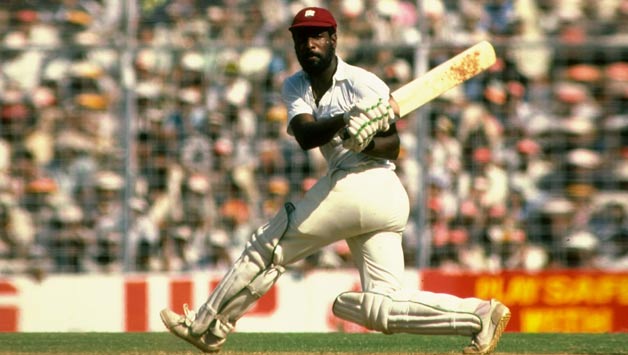
What followed was the stuff of legends. England had one aim in mind, to contain and delay the declaration. The West Indies had one aim in mind, to score, and to score quickly. Greenidge had been injured and so Richardson opened with Haynes. They put on a brisk century partnership, before Richardson fell to Emburey for the sixth time in succession. In hindsight getting out the son of Viv probably wasn’t our wisest idea. For in strolled the Masterblaster. 56 balls faced later, and one of the longest standing records in test cricket had fallen. Jack Gregory had made the previous fastest test century in 67 balls in 1921-22 against South Africa. Viv raised the bar.
“From the second ball he received Richards hit a six.”
“From 35 deliveries he made 50.”
“From the next 21 deliveries he made another 50.”
“The massacre of the England bowlers ended when he declared after reaching 110 from only 41 scoring strokes.”
“…did not play a false stroke in an innings which intoxicated his home crowd and stunned his opponents who could only pay homage in awe at the man’s brilliance.”
Wisden was equally as fulsome:
“Richards’s display, making him the obvious candidate for the match award, would have been staggering at any level of cricket. What made it unforgettable for the 5,000 or so lucky enough to see it was that he scored it without blemish at a time when England’s sole aim was to make run-scoring as difficult as possible to delay a declaration. Botham and Emburey never had fewer than six men on the boundary and sometimes nine, yet whatever length or line they bowled, Richards had a stroke for it. His control and touch were as much features of the innings as the tremendous power of his driving. As can be calculated from the following table, he was within range of his hundred six balls before completing it (with a leg-side 4 off Botham), while from the time he reached 83 off 46 balls there had been no doubt, assuming he stayed in, that he would trim several deliveries off J. M. Gregory’s previous record of 67 for Australia against South Africa at Johannesburg in 1921-22. The full innings went: 36126141 (24 off 10) 211 412 1 (36 off 20) 112 2111 (45 off 30) 1 1624441 (68 off 40) 12 664612 (96 off 50) 21 461 (110 off 58).
Plundered in 83 minutes out of 146 while he was at the wicket, it had to be, by any yardstick, among the most wonderful innings ever played.”
England showed real signs of distress, and in the short period of play that remained that day Wilf Slack was bowled and Robinson run out (ending a wretched tour for one of my favourite players of the day) to leave England 33 for 2.
I remember little of the hundred other than its sheer inevitability. I was at school, it was a Tuesday, and coming home the carnage was starting. I didn’t listen to it. I couldn’t. Richards was a majestic player, and watching him was something else, but listening to him tearing us apart was not something I wanted to subject myself to. Viv was Viv. Nothing else to say.
England commenced Day 5, almost an achievement to savour, with defeat not a total inevitability. Likely, but not inevitable. Gooch was there, our only international centurion of the tour. Richard Ellison was nightwatchman, and he’d shown stickability in the first of the two tests in Trinidad. Gower had made 90 in the first innings. Gatting might be able to get some form back in time to salvage a horrific experience.
And it started really well. Ellison stuck with Gooch until nearly lunch. Ellison fell, having been out there for two hours and faced 76 balls. The pitch had a little bit of low bounce, but no real demons. England might do it. Then Gooch fell shortly after lunch, and the house of cards collapsed thereafter. Gower made 21, but Lamb and Gatting went for one run each. Botham reined himself in, but the game was slipping away. Wickets fell. 84 for 2 subsided to 124 for 6 and the game was up. When Downton, who according to the Yearbook “had been lucky to hold his place throughout the series” (truly a difficult winter), was dismissed, LBW to Marshall (there’s a difference between the Yearbook and Wisden as to who the last man out is – Yearbook seems to suggest it’s Emburey, Wisden says Rupe. Rupe fits the story the best), the second Blackwash was complete.
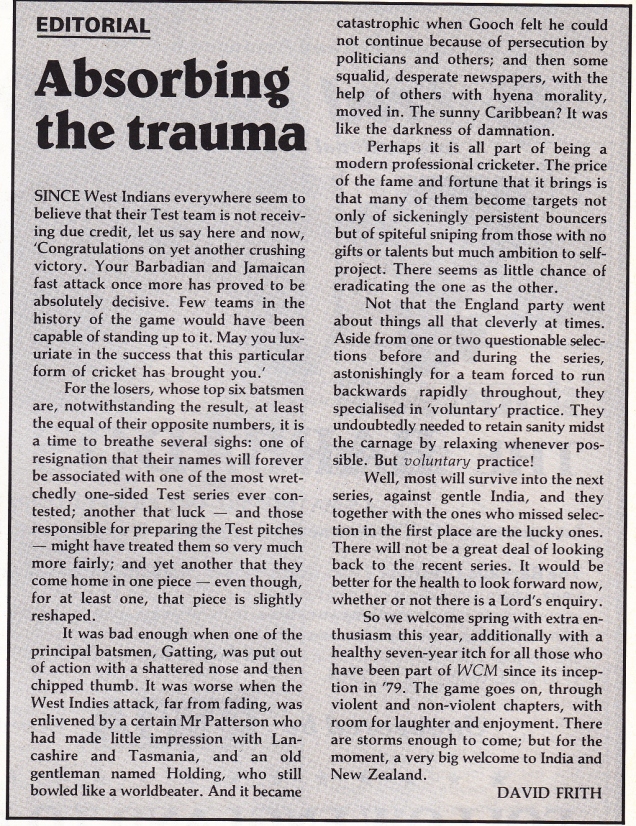
We will finish the story in a wash-up, but let me give you a taste of what is to come. David Frith in WCM wrote this, I think, mid-series. It sums up the age very well.
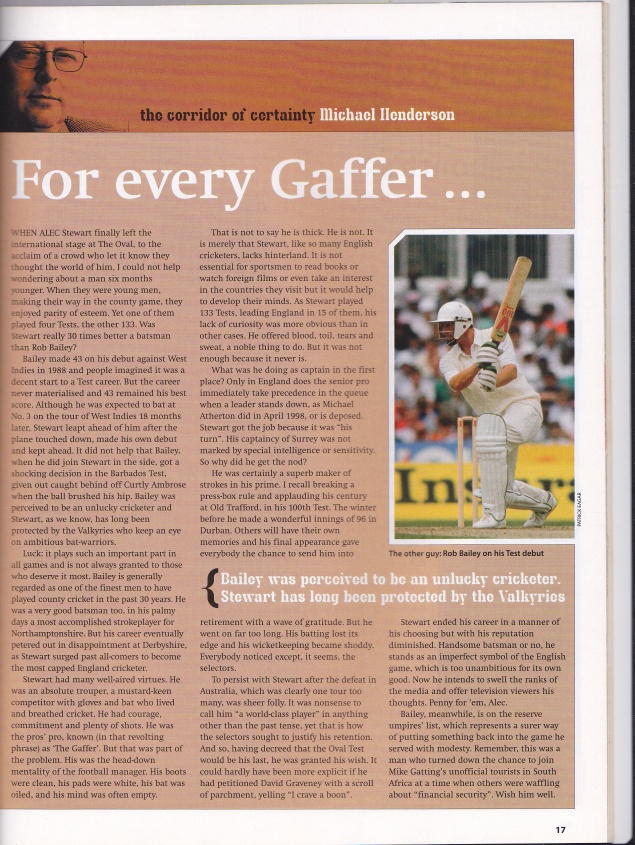
I had a copy of the first TWC out today, released in the late season of 2003. It has a great reminder of one of my favourite test matches – England v South Africa at The Oval – I saw the first three days, including Tres’s 219, Thorpe’s glorious return and the last test innings of FICJAM.
But I thought I’d share with you a wonderful article by Mr Henderson on Alec Stewart. Man-o-man…..
Bloody hell. He didn’t like him, did he?
Mr Conformist, Mr Team Man (Steve Waugh thought he wasn’t though), Mr Straight And Narrow, I reckon he might have ruffled feathers after the 1999 pay schmozzle. Can’t be upsetting the suits now. He ended his career with reputation diminished (really). His choice to try media work is dismissed. His captaincy reign slagged off because he had shown no signs of leadership while in the ranks and in charge of Surrey (oh, the contrasts with Cook).
This man still has a monthly column in The Cricketer. I’m so glad our criticism is labelled as “personal” “mean spirited” and “trolling” but this is fair and above board.
A little late night nostalgia…
Plus, no points for guessing who said this:
“My double-first does nothing for me at the crease, I’m afraid”.
Sadly, Pringle’s article is of the present day. A magnificent piece of work. At no point does he give any evidence of the actual trolling. At no point does he say where it has an effect. At no point is there any tangible evidence that this is “a thing”.
Oh, and well done England. More of that, perhaps, later.
Given the appalling weather forecast for tomorrow, it looks as though I’ll be going to be able to sit down and watch an England game in this tournament. For England the point could not be any clearer. Win and they are through. Lose and they are out (I’m not sure there is any mathematical calculation that keeps us in the competition). England’s performances in this tournament have been patchy. The batting was OK, but the bowling wretched against the West Indies. The bowling went beyond wretched against South Africa, albeit on a batting dreamscape, but the batting got them out of it. Then the converse applied against Afghanistan. So, we will either put it all together tomorrow, or all fall apart! Well, that’s what is due.
This isn’t a Sri Lanka to fear, without three of their key men in the 2014 triumph, and yet we know that underestimating them is not a thing we should be doing. It will be a trial by spin in all likelihood, although we shouldn’t be taking the seamers for granted either. However, they had a bit of a shocker against the West Indies, and there’s always the chance that will happen here. Also, although we can remember some scars over the 50 over format in ICC competitions with Sri Lanka, we were the only team to defeat them in the 2014 World Cup (thanks to Alex Hales once in a lifetime knock – I think!). Hales missed the last game, and may return for this one, but one wonders if the scars inflicted on England at Delhi by Afghanistan might carry over.
Elsewhere, I’d like to thank you all for your comments on the piece called “The Exiled”. This is a blog to talk about cricketing matters, so although I like Mark’s idea about commenting on other sports, I think that would dilute the content here to a degree. However, I’m not discounting that entirely. I do believe there needs to be something to focus on in the next few weeks, as the blog does go a lot quieter during England international breaks. I do like the idea of open threads as well – they work elsewhere. Maybe that will be in the mix. As always, would love ideas as to what to write about.
For example, I’m not going to be in the UK for the first and second tests against Sri Lanka, so I’d love someone to help Chris out in writing up pieces on them, whether you’ve seen the game or not. I know I have Blackwash to finish. I know that I owe Russell Degnan a response to his magnificent comment on Schleswig Holsteinshire. There is also the small matter of getting hold of Pringle’s article in The Cricket Paper (if anyone can get a copy to me, e-mail me on dmitriold@hotmail.co.uk) as I don’t usually find one on a Saturday. That’s the article on trolling, in case you are wondering.
One other point. I know I’ve been a critic of Stephen Brenkley, or Bunkers as he’s known on here. Mr Aplomb was one of those guilty men who drip fed us some crumbs of information but never really told us what went wrong on that Ashes tour. I will remember the salt in the tea analogy as a particular Bunkers piece. Today he took to Twitter to say that he’s written his last piece as The Independent’s Cricket Correspondent, and that’s sad. He also said he has two weeks more to go and he’d write for the I if they wanted him to. I’m not rejoicing. Brenkley’s loss to the media coverage of cricket should be a bloody beacon of woe for the game. I’m not sure who will be taking over at the I, but I’ll bet it won’t be a full time correspondent. Let’s see. It didn’t seem the departure of a retiring man, but one of a paper cutting costs. Maybe things will become clearer.
Finally, other than comments below, I’d like to wish you all a happy Easter weekend. Enjoy the break and hope all close to you do too.


 Being Outside Cricket