The trouble with day one of a Test is that unless one side has had a truly grim day every summary at the end of it revolves around it being too early to say whether the score is a good one, the toss decision is a good one or if the pitch is favouring one side in particular. There are only so many ways to say that it’s in the balance and that after tomorrow we will know more.
Pakistan’s decision to bowl first certainly caused some raised eyebrows, but having bowled England out in a day will have viewed that call as being vindicated. England’s score of 297 is right in the zone of being enough to be in the game but anything but a good score. It could become a good score, if England were to bowl Pakistan out cheaply tomorrow, or it could be a bad score if they go past it – self evident of course, but still how it is. The trouble is, saying as much isn’t about sitting on the fence, there’s nothing but uncertainty around how it will develop from here.
So perhaps the only indication is the relative happiness of the two sides – England trying to convince that it’s not a bad score at all, Pakistan reasonably content with their day’s work. If that is an indicator then Pakistan could be said to have had the better of the day, and instinctively that feels about right, but not so much so that England are at this stage in any kind of trouble. Likewise the strong criticism towards Misbah for electing to bowl had dissipated somewhat by the close, again suggesting that decision had – thus far at least – been vindicated.
Certainly England will be a little disappointed with the total, as much due to how many players got in and then got out again as anything else. Cook started with rare fluency, and while Root’s dismissal was ascribed to overconfidence perhaps the same can be said of the captain. He appeared in outstanding form, and that is so often when the mistakes come. No matter, these things do happen, and all cricketers know the frustration of being back in the pavilion having made an error on a day when they felt they could do as they wished in the middle.
Vince again got in and got out, and again it was his flaw outside off stump that did for him. His 39 was the opportunity to go on and make a meaningful contribution, and he didn’t. He looks good, then he gets out, and while looking good tends to buy a little more patience (unfairly so, of course, but true nonetheless) than for less attractive players, at some point the chances run out. Vince needs a good innings urgently, and he’ll be as aware of that as anyone.
Ballance is the antithesis of the stylish player, yet his 70 was the mainstay of the innings. He scores runs, and while the 142 he’s scored in four knocks he’s since his recall won’t make too many headlines, he looks a far better player than the one dropped last year. What is interesting there is that the technical adjustment appears minimal, and by some accounts he’s proven entirely resistant to attempts by others to tinker with it. Confidence and faith in one’s own game is often far more important. His dismissal was one of those often felt somewhat unlucky, taken down the legside off Yasir Shah by the rather impressive Sarfraz. It was a good catch too, legside catches standing up are always prized by wicketkeepers – more so than stumpings much of the time. The angle did allow that rarity when up to the stumps, time to adjust, but it was a significant deflection, and he will be pleased with that one.
Bairstow pushed too hard at a ball that wasn’t really there to drive off the back foot, and Woakes was probably due a failure. Thus it was Moeen who was principally responsible for getting an unquestionably sub-par 224-6 to a perhaps adequate 297. There may be better batsmen than Moeen around, but there are few as delightful to watch as he is. He has that languid (and frustrating style) that is rather reminiscent of David Gower. One item worthy of note here is that Moeen was today batting at seven. Helped rather substantially by his unbeaten century against Sri Lanka, his average when batting in that position is now over 80. The sample remains far too small to draw conclusions either way, but he wouldn’t be the first player to respond to being in the lower order by batting like a lower order player instead of the batsman that he is.
For Pakistan, the man of the day was quite clearly Sohail Khan – a 32 year old playing only his third Test and his first in nearly five years. His time in the limelight may yet be brief, but there is a special pleasure to be had in seeing an unlikely successful comeback. That he is a right arm bowler may have worked in his favour, after two Tests with solely left arm seamers for England to negotiate. But he bowled well, deserved his success and his evident pleasure (and press ups) leaving the field couldn’t help but raise a smile.
The weather forecast for day two isn’t particularly great, and the England bowlers will hope to make the most of the leaden skies. Yet the England total is not big enough to prove decisive barring something extraordinary. We may well have another good match on our hands.
And finally, the last England wicket fell with five minutes of play remaining, and 86 overs bowled. Once again the required number of overs in the day fell short, even with the additional half hour, and once again nothing will be done about it. Given that, we can assume that the ICC approves of literally shortchanging their paying customers. It remains unacceptable, it remains disgraceful.
Perhaps the most welcome facet of the build up to this third Test is that with the series at one apiece it is both alive and very much uncertain as to the outcome. England may well have well and truly battered Pakistan last time out, but at least much of the press have learnt some lessons from the past and avoided the “momentum” cliché. One sided matches have little effect on the following game, indeed the Ashes last year seemed to provoke the opposite result. Therefore there is no particular reason to assume this match will go the same way.
Indeed, it could be argued that one very special innings from someone who is becoming a very special player ultimately proved the difference. Cricket is what it always has been, an individual game in a team context. A player can have an impact that decides a match, even if the coup de grace occurs a couple of days later.
Pakistan will feel that they had the worst of the conditions at Old Trafford and were beaten by a sublime knock. It happens, and even if it is a crutch on which to lean rather than the whole story, it still means that a fresh start in the next game ensures all possibilities are there.
That said, Edgbaston is a happy hunting ground for England, and a home victory, subject to weather, is probably where the probabilities lie. But a talented Pakistan attack have the capability of ripping through England in any conditions, particularly given the soft middle order. This match is subject to the same vagaries as all the others – two fine bowling attacks, two brittle batting orders.
Where England have had an advantage is in the lower middle order. That is best defined by the lack of comment that replacing the injured Stokes with Finn rather obviously weakens the batting, but only in the sense that it is now simply strong rather than ridiculously so. Moeen at a likely number eight is still a dangerous customer, though he could do with a few runs after his less than impressive dismissals recently. Woakes of course is simply having a golden run with both bat and ball, in the way all rounders seem to do.
Alastair Cook indicated that England would go in with four seamers and a spinner, suggesting that someone has had a word with the groundsman the pitch is not likely to favour Yasir Shah overly, though proverbially leg spinners do have the ability to turn the ball on glass. He remains a substantial threat, particularly given England’s continued vulnerability to it, Old Trafford notwithstanding.
Edgbaston is one of the more raucous, enjoyable Test venues to visit, and Pakistan should have plenty of support too. If the cricket lives up to the crowd, it might just be something special. Not every Test can be an exceptional one, thus far this series we’ve had one excellent match and one that was too one sided to be truly enjoyable, except for partisan reasons. Here’s hoping we are lucky and get a second good one.
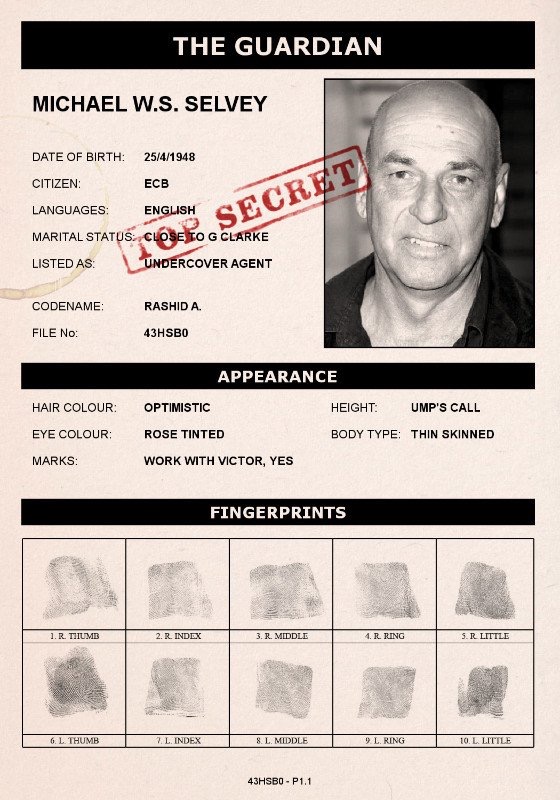
It’s hardly headline news to state that the national newspaper industry is an industry in serious decline, so it should be no surprise that one of the big beasts of cricket journalism should find out that his services (and likely hefty salary) were no longer needed by the Guardian a couple of weeks ago. Whilst I never like to hear of anyone losing their job, any tears will be tempered by the fact that Lord Selvey has no doubt received a decent pay off after 31 years of service and by the fact that he has shown himself through his various barbs on Twitter to be quite an unlikeable gentleman.
So how the situation arrived when newspapers such as the Guardian feel the need to cull their Chief Cricket Correspondent? Well the answer is a little more complicated than the fact fewer people read print anymore and fewer people take an active interest in cricket, although naturally these are actively linked; however this sharpe decline has actually been years in the making and brutally quick in it’s execution. If we go back just over 10 years ago, all this seemed a long way away. The Telegraph had a daily readership of over 900,000 and the Sunday Times had 1.6 million readers, both were making lots and lots of money through advertising (the recruitment advertising arm of the Sunday Times was making £500k a week on it’s own) and hey England had just regained the Ashes from the mighty Australia, so all was looking rosy in everyone’s garden. However if we bounce forward to the situation today, then things are certainly not looking rosy for both the national newspapers and cricket as a whole, so it is worth briefly charting the fortunes of both as without doubt cricket’s health is very dependent on the coverage that it receives the nationals.
What is clear is that the National press has been somewhat arrogant about it’s place at the top table for an awful long time. They felt that they were both the mouthpiece of the nation and the only place (alongside some TV and some Out of Home) where brands should spend their hard earned marketing money to reach their precious audience. The problem is that their arrogance made them spend a lot of their time attacking each other with faux clever marketing campaigns rather than looking at the bigger threats looming on the horizon (sounds vaguely familiar doesn’t it). If we look at things from a purely commercial point of view, all papers are absolutely reliant on advertising as their main revenue source, and from that advertising spend, print advertising is by far the most lucrative (most papers actually make a significant loss on their cover price) and hence any threat to this income makes newspaper owners sleep very poorly at night. This was where the first industry hit took place – the rise of Digital. As the industry changed and how people consumed media changed, the newspaper industry suddenly seemed to be stuck in an archaic rut with print audiences immediately starting to decline rapidly and whilst many owners put out shiny new websites fairly quickly, the money they could charge for digital advertising was a lot less than they could charge for print advertising. This was when the first cull started to happen around 2007. Things did calm down for a while as whilst the revenues they were earning previously were long gone, they still had a stable base of readers (either print or digital) and came up with new, more expensive offerings for the brands who still needed to reach their readers, which at least allowed them to stabilise their bottom lines. This was all fine up until a couple of years ago when the 2nd hit happened, the rise of programmatic advertising, and this is something that the industry has not and probably will not recover from. Automated, or programmatic buying has taken over the industry not only because it makes ad transactions more efficient but because it can make them more effective, as long as the right data is applied. Ad buyers can use programmatic buying to fan ads across the web and then, mid-campaign, evaluate what’s working best, which geographies, times of day, audience segments, publishers to narrow their target accordingly, so they’re paying only for highly effective ads. This has killed the national’s revenue line at a stroke, as all of these companies have the data they need to provide brands with the option to target a particular message to a particular audience at a particular time of day, something the nationals cannot offer and surprise, surprise their revenue has hit the floor and panic has well and truly set in. A serious bloodbath is about to occur.
So you may be wondering why I’m talking in such depth (and thanks for sticking with this) about the decline of the national newspapers on a cricket blog. Well you see all of this has been particularly bad news for our beloved journalists including many cricket journalists and for the sport itself. For many a year, cricket journalism flourished (their words, not mine) in some kind of alternative reality bubble, whereby they could post an article in print, good or bad, and then spend their time giving themselves a big pat on the back at a job well done. This was somewhat tempered when all of the posts started to appear online and various and sometimes quite derogatory BTL comments started to appear; however again many were happy to declare these people as loonies and carry on with business as usual (despite many being not, there were some fantastically knowledgeable contributors to the Guardian BTL back in 2012 before the mods moved in and many moved on). It was the advent of social media and in particular Twitter that really burst their bubble as they were now open to criticism from the masses, many of whom were both knowledgeable about the game and angry at the continued selective reporting, around the content of some of their articles. Some of the new breed were savvy enough to engage in meaningful conversations with those that questioned some of their writings, whereas some of the others, mainly the old school, decided that they would take the opportunity to shoot down any questions in as rude a way as possible. You only need to look at the childish level of language that Paul Newman used towards Tregaskis when the latter quite rightly accused the former of writing a total puff piece about Alastair Cook.
Despite the inconvenience of having to speak directly to the masses, many of our beloved hacks have still spent their time cocooned in their own ivory tower, enjoying the hospitality of the ECB and occasionally getting to do their dirty work too; however whilst they had been cocooned away from the harsh realities of the real world, what they didn’t realize is that the power base they thought they were sitting on has gradually ebbed away. Firstly the amount of cricket correspondents was cut, then coverage of county cricket was cut to almost zero and now we’re in the situation where none of them should be sitting comfortably as even the big beasts are simply not immune to what’s going on in the real world as the sackings (or forced redundancy’s) of Selvey, Bunkers and Pringle et al clearly show. The ECB is fast starting to run out of hatchet men and who knows how safe Newman is these days. The other side of the coin is that there are a number of very good national journalists out there, again mainly from the new breed and it would be a terrible tragedy if the likes of Nick Hoult, Lawrence Booth and Ali Martin found themselves out of their jobs and stuck with writing titbits for the The Cricket Paper with it’s circulation of about 150. The signs I’m afraid though don’t look promising.
So why is this so worrying for the world of cricket? Well again, I suppose we can easily travel back to 2005 and the choices that our friends at the ECB (yes them again) have made since that time. The 2005 Ashes series was a classic and got the whole of the country behind our national team with over 8 million people watching 3rd Test of that series on channel 4. The problem for the ECB was that it didn’t fill their coffers so well, so of course they made the decision to get into bed with Sky and remove any FTA cricket except the odd highlights package from the home test (not that this is a particular criticism of Sky as on the whole their coverage is very good.) This at a stroke cut off access to the masses who had been captivated and excited by the cricket in that 2005 series (it also didn’t help that the national team then got hammered by the Aussies and then had a very lean time under the sorry stewardship of Peter Moores); however there was enough coverage within the national press to keep cricket, if not front of mind, then at least with a share of mind. However as soon as this coverage started to fade from the backs of the nationals with only 1 or 2 cricket correspondents per paper compared to a veritable army of football correspondents, then the impact that our cricketers had soon became invisible to the next generation of potential cricket fans. After all, it has been over 10 years since an England cricketer has been nominated for SPOTY, out of sight, out of mind, one may observe. This lack of coverage of the national game (the county game seems to be fairly obsolete in it’s coverage now, with either only a diehard set of supporters or those who would like to get drunk watching T20’s in certain parts of the country) coupled with the shameful behavior of our boards in the Big 3 takeover has meant that cricket is at it’s lowest ebb around the world. Overall, the decision to take all coverage away from FTA alongside the lack of coverage in the news has meant that cricket is now even more elitist than ever, the preserve of those that can afford to play (i.e. public school boys) or those that are well past their prime, have hung up their bat and are grudgingly willing to pay the exorbitant costs that Sky charge (i.e. me). Growing the game comes a distant second to a quick payday it seems.
Even more worrying is the fact that the ECB doesn’t seem to be able or want to do anything about it. The constant bickering and tinkering with the both the county and domestic T20 competitions is simply like re-arranging the deckchairs on the Titanic, it’s simply not going to get the numbers through the door outside of London or other cricketing hotspots. Their constant leaking of information from the ECB around those that ‘aren’t from the right family’ to it’s favourite attack dog – Paul Newman or the dull and meaningless and often supervised interviews with England’s so called superstars alongside their powder puff reporting on the game’s key issues really isn’t getting anyone excited about the game I love. As for social media, there is a decent hot bed of interest from the cricketing community, yet all we have a monotonous England cricket account and no real highlights from any of the games – way to go guys, ignore the most important channel in reaching out to generation Y, Z and the millennials, that’s a brilliant strategy in attracting new followers to the game! Another tick in the Tom Harrison “achievement” column.
This might not be the most uplifting article you’ve read in terms of the health of cricket as a whole, but the comparisons with the health of their friends in the national press are at best incredibly troublesome and at worst extremely frightening and this is not something that is going to go away like it or not. The ECB (and their friends at the IOC) have a stark choice, do something radical now to get people to the game, such as a better share of revenues to invest in grass roots, showing decent highlights on YouTube or Twitter from both red and white ball cricket and bring back some FTA coverage across the board or risk the total devastation that the national press has witnessed by sticking their heads in the sand and hoping things will go away. Time is running out and I only hope that it’s not too late already, because once the horse has bolted, we’ll all be staring at the empty gate wondering where it all went wrong.
Gordon Greenidge – 1984. Although the post deals with 1976, Gordon needs to be in colour!
One of our loyal commenters has offered up his first main cricketing memory for a piece. SimonH, international governance monitor, statistics maestro, memory man for the game has put together this piece on his first test match memory.
I’ve decided to cut it into two pieces, with the first part the build up to the game and the events of Day 1. The second will finish off the game report, and the aftermath of the match.
As always, I’d love to get pieces from you out there on your cricketing memories, or on anything that catches your eye or you want to talk about. We don’t take anything, as it has to be within the blog’s remit (don’t ask me to define it), but we do certainly like pieces like this.
So, SimonH…. this is your test!
FORTY YEARS ON – ENGLAND V WEST INDIES, 3rd TEST 1976
We all have matches that are particularly dear to us. Some of these are dear to most fans because the game is such an obvious classic – Headingley ’81 or Edgbaston 2005 spring to mind. But others are more personal. Often it’s a first that sticks in the memory. My first ‘live Test was bloody awful. England lost to India at Lord’s under leaden skies.
However the first Test I can remember specific moments from watching on TV has stayed with me and it’s a shock to find it was forty years ago this month that it took place……
SOME CONTEXT
Cricket and me – I had been hooked on cricket the previous year by the first World Cup and my father’s love of the game. It was a love that dare not speak its name at school though (a West Sussex rural comprehensive) where football was king and cricket was seen as dull and posh (if it was noticed at all). This eleven year old was desperate for the game to show it was pretty cool. I’d watched some of the 1975 Ashes but can’t really remember any of it if I’m honest. I don’t remember the first two Tests of this series either (although I do remember watching the ‘Grovel’ interview on ‘South Today’). The Third Test at Old Trafford is the first Test I remember watching – and it turned out to be a game with everything the sport has to offer, except a close finish. It was also one of the most significant games of the modern era, marking the formation of a dynasty that would rule the cricketing world for two decades.
England – England had been the dominant side of the early 70s in world cricket, at times holding all the trophies (TM). What had seemed a settled side inherited by Mike Denness from Ray Illingworth had capitulated in the original ‘difficult winter’ of 74/75 and I got a clear impression from my father that English manhood had somehow been found wanting. Tony Grieg had taken over the captaincy in 1975 and the side recovered some pride as David Steele stood up to Lillee and Thomson. Although Boycott was in self-imposed exile, the team had Edrich’s reassuring presence at the top, SPOTY Steele at No.3, Bob Woolmer fresh off 149 against the Aussies and the new Cowdrey we were told in the middle order, Greig and Knott to halt any collapses at six and seven and plenty of bowling options that seemed to cover all eventualities (pace from Snow and some bloke called Willis if only he’d stay fit, plenty of English type seamers, spin was in the capable hands of Underwood). There was no winter tour 1975/76 so the team was somewhat unproven but there was little sense that this was a team heading for the slaughter.
West Indies – West Indies had been through a rocky patch after 1967 when the great 60s side started to age. From 1967-74 their only great series’ win was in England in 1973 but around that were some poor results. The middle order batting (with Kanhai, Sobers, Lloyd and new bloods Kallicharran and Rowe) and the spin department with Gibbs still looked strong but (ironically, given what was to follow) they had no reliable opener to partner Roy Fredericks and the pace bowling had lacked any real speedster. It all started to come together for West Indies on the 1974 tour of India as new batsmen Greenidge and Richards established themselves and the attack found a new spearhead in Andy Roberts. However that appeared a false dawn as the team went to Australia in 75/76 and were mauled, both on the pitch by Lillee and Thomson (Kallicharran vomited on the pitch after being hit on the head by one bouncer, Bernard Julian had his hand broken by another) and off it by some crowd behaviour that shocked some of the younger players who’d never encountered such blatant racial taunting. West Indies tried to fight fire with fire on that tour and kept losing wickets to hook shots that reinforced the stereotype of ‘calypso cricketers’ who couldn’t knuckle down under pressure. New captain Clive Lloyd, one of the few to sustain his personal performance on that tour and now able to put his stamp on the team with the Sobers-Kanhai-Gibbs generation departing, was determined to change all that.
Cricinfo recently interviewed some of the participants here:
GROVEL – had there been any previous series more famous for what was said to the media more than any of the actual play? And has there been a more infamous line by a Test captain than Greig’s:
Greig’s choice of words, and his delivery in that unmistakable accent, hung over that tour. The fact that there was some reasonable thinking behind it was obliterated by his crassness. West Indies had just lost 5-1 in Australia. England had beaten them on the 73/74 tour by hanging on in a series of draws until West Indies collapsed, apparently under pressure and to Greig’s own bowling, in the final Test. Greig himself had been involved in the controversial run out of Kallicharran and seemed to thrive on confrontation. My memory of it at the time is that it was controversial but more for Greig’s brashness and impoliteness than for its racial sensitivity. That only became clearer (at least to a white schoolboy in rural Sussex) as the summer unfolded.
What few had noticed was that in their last series before coming to England, West Indies had taken on India at home. Some fellow called Richards (mainly up until then famous for his fielding in the 1975 WC Final) had scored a stack of runs at No.3. The last Test seemed to have some odd goings on with half the Indian team marked down as ‘absent hurt’. There were accounts of fearsome pace from new bowlers Holding and Daniel – but then hadn’t India been bowled by England for 42 only a couple of years earlier by Old and Hendrick? Perhaps Holding and Daniel were as quick as those two? India had also chased a then-world record score to win the Test before Kingston – so it looked at worst as if the West Indies were still crazily inconsistent. Nothing too much to worry about……
The West Indies played warm-up matches against all bar one of the counties on that tour. Win after win didn’t set many alarm bells ringing. The few who saw them thrash a strong MCC side at Lord’s (including a century for Richards and seven wickets for Holding plus putting Denis Amiss in hospital) warned this was a formidable team. Still, Yorkshire had come within 19 runs of beating them and Chris Balderstone had nearly scored two centuries off them for Leicestershire.
THE IMMEDIATE CONTEXT
Given what was about to happen, it’s still slightly surprising to realise that the teams went into the Third Test after two draws. Not only that – the matches had been quite even. West Indies had the best of the first game after Viv Richards made 232 (I think I remember him saying that was the best innings of his career) but England held on for the draw relatively easily. Steele and Woolmer made runs which seemed to show their performances against Australia were no one-off. England had the better of Lord’s with Underwood skittling the tourists in the first innings and West Indies had been only four wickets from defeat at the end. The match had ended with Greig resisting Lloyd’s call to call things off early and with England fielders clustered around the bat.
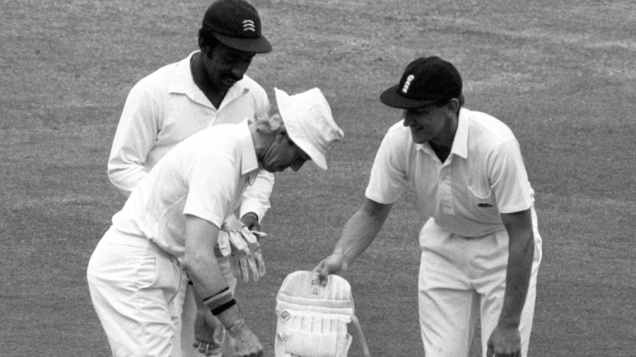
However….. West Indies had not been at full strength for either game. Holding and Daniel had missed the First Test and Richards the Second Test. At Old Trafford, they had everyone fit. England, on the other hand, had problems, especially with the bowling. Snow and Old were injured (possibly others too) so England’s pace attack lacked a cutting edge. However, West Indies had collapsed against spin at Lord’s, had collapsed against spin in 73/74 and OT had a reputation for turning compounded by rumours that, as the hot summer of ’76 took hold, the pitch was dried and cracked. England went in with two English-style seamers in Hendrick and, on debut, Mike Selvey, two support seamers in Woolmer and Greig and two spinners in Underwood and Pocock. There was an issue in the batting too – the openers at Lord’s hadn’t convinced (Mike Brearley had looked out of his depth, Barry Wood had been injured by Roberts) so 45 year old Brian Close (who had top scored at Lord’s) was pushed up to open and local hero Frank Hayes (who had made a debut century against 1973 West Indies) was called up. There were promising young batsmen emerging on the county scene like Gooch, Graham Barlow and Randall but the selectors held off picking them (perhaps remembering Gooch’s tough baptism against Lillee and Thomson the year before). Randall was made 12th man which was one of the few times in his career the selectors did him a big favour.
THE MATCH
DAY ONE– Clive Lloyd won the toss and batted. That was what you did in those days. It was the right decision – and made precious little difference. The start of that day is etched on memory. In his first over, Selvey bounced Roy Fredericks who hooked it straight down Underwood’s throat at long leg. Fredericks falling on his wicket in the WC Final hooking was my first cricket memory and now Fredericks getting out hooking was my first Test memory. I’ve never seen Selvey explain why he bowled that bouncer. In his next over, Viv Richards played his trademark walking on-drive to a big in-swinger, for the only time in his career that I can remember missed it and was bowled. Almost immediately , Kallicharran (who like Lloyd and Rowe was never in any great form on that tour) played on. Lloyd was soon caught at slip off Hendrick and West Indies were 26-4.
What followed was one of those times when you know you’re watching something special. When it’s one of your heroes doing it, it’s something even more. As a young Hampshire fan (although I lived about 800 yards over the border in Sussex I was born in Hampshire, all my family were from Hampshire and there was only one team I was ever going to care about), Richards and Greenidge were my heroes. Greenidge in particular was one of ours. With Greenidge and Roberts playing for West Indies and considerable resentment that Hampshire players (despite the team winning the CC in ’73 and coming second in ’74) were ignored by England, I could feel nothing but enjoyment at what Greenidge was doing. A lifetime of not seeing England as ‘us’ and the opposition as ‘them’ was born. West Indies were more ‘us’ than England to me. I liked him because he hit the ball hard. Very hard. And he had the coolest of cream pads. Later the pleasure would be deepened by discovering Gerenidge had not had an easy upbringing and was a complex and at times difficult man. But mostly he hit the ball hard. When the bowler pitched up, Greenidge waiting on the back foot, would throw his whole weight into the drive in a way that wasn’t textbook, and would get him out sometimes, but was mighty thrilling when it came off. Even better when bowlers pitched short, he took it on. If it was wide, he’d cut – and what a cut! If it was straight, he’d hook – and it very seldom seemed to get him out. No ‘high to low’, no rolling the wrists – he’d try to hook it out of the ground and he usually did. He was everything I wanted to be, but wasn’t. If I couldn’t be it, I could damn well appreciate it in others.
In bald stats, what Greenidge did that day was score 134 out of 211 (193 while he was at the crease). He gave no chances – the nearest he came to dismissal was a top-edged hook that landed between Knott and Underwood. Only Charles Bannerman in the very first Test had scored a higher percentage of his team’s runs at the time (three more have since):
It wasn’t quite Roy Fredericks in Perth – but it would do. Greenidge’s main support came from one of the great unrealised talents in West Indies’ cricket, Collis King, who on debut reined himself in to make a handy 32. King would only play nine Tests but would have his moment in the 1979 WC Final when he eclipsed even Viv Richards for a time. He never seemed forgiven after Packer and ended up a banned SA tour rebel. These days he’d have made a fortune in franchises.
England ended the day on 37-2 with Close and Steele out. Batting had looked tough but the match seemed evenly poised. The next day saw a power-shift in world cricket that would last two decades…..
—————————————————
The second part will be put up in the next day or so. My thanks to Simon for all the effort put into this. I don’t remember this test myself, but do recall Viv’s 232 at Trent Bridge and 291 at The Oval.
You know I love a good anniversary, and you also know I love my nostalgia. So while Sky make a very decent and informative programme about England in the 90s, which, of course, coincided with Sky covering cricket, some of us have some more than poignant memories of the 1980s, when, at times, England were, truly, awful. You might remember I did a series of pieces on the Blackwash in West Indies in 1986, and yes, I never did quite wrap it up but it does stand another view if you’ve not seen it. August signifies a less heralded low point, but a low point nonetheless. In the early part of that month England took on New Zealand at Trent Bridge in the second test of a three match series. The first, at Lord’s had been a bit of a dull bore, livened up only by Bruce French being sconed, and replaced, for a short while, as keeper by Bob Taylor. The test hardly got going.
The second, though, was a different beast entirely. England had been without Ian Botham all summer after his admission to smoking some Moroccan Woodbines (that’s from Only Fools and Horses) and incurring the wrath of Denis Compton who wanted him banned for life. While Botham was a diminishing force anyway, the England team had not recovered from the annihilation in the Caribbean and had been easily defeated at home by India. David Gower was removed from the captaincy in favour of Mike Gatting, but the first test of the Middlesex man’s leadership regime was an annihilation at Leeds. Gatting made a massive ton at Edgbaston, but it looked like it wasn’t going to be enough until the weather ruined the final day of the third test when it looked more likely that India would win than the home team. Rain may have saved us from another clean sweep.
England were in disarray, and yet there was just a blithe assumption that we would beat New Zealand. These were not your pushover Kiwis any more. Richard Hadlee was a brilliant, utterly brilliant bowler – the Jimmy Anderson of his era only, and you might disagree here, much better. Martin Crowe was coming to the fore, not quite the great he would become, but a decent old presence in the middle order. At opener was the sturdy John Wright, doughty, a fighter but bloody good on his day. Ian Smith was the keeper, decent with the gloves, a nuisance with the bat. They had beaten Australia in Australia the previous winter and were simply not to be underestimated, but it felt like we did.
In that first test we gave a debut to Martyn Moxon, a consistent run-scorer at the top of the order for Yorkshire, and a man with a classical technique to match. Moxon had made a decent impression in the Lord’s test, making 74 in his first test innings. One run more than Joe Root made in his first innings in tests! Moxon was opening with Graham Gooch who had made the game safe in the second innings of the test with a score of 183. At three for England was Bill Athey, who at this point had not made an impression in tests, and seemed to be betwixt and between. It wasn’t until the following winter that he got a firm place in the team, and not until the next year he made his only test ton. He seemed made for test cricket, but seemed to be in the team due to a 142 not out he made in the second ODI (which I remember he avoided what looked a plumb LBW when he was near his hundred). At four was David Gower, not in great form, still getting over the captaincy, but still a class player on his day. Shame for England was he wasn’t having many of them.
At five was captain Mike Gatting, He’d made that 180-odd at Edgbaston, but he’d not shown signs of turning the ship around, and with an Ashes winter coming up, panic was beginning to set in. Panic may have been induced by the presence of Derek Pringle at number 6. Now, we’re not fans of Degsy here, but he wasn’t a bad player. I think even Pringle might admit that number six was probably one, and more likely two places too high for him in a batting order. A man who made one test half century shouldn’t be that elevated, and that indicated issues. Number 7 for England was John Emburey, who was a more than useful spinner and handy lower order batsman, and at 8 was his Middlesex spin partner, Phil Edmonds. Both had survived from the previous year’s Ashes series, in their own ways. Note that England had no hesitation in playing two spinners at home in those days. Batting at nine was Glamorgan quickie Greg Thomas, who had an in and out career, which didn’t last too long at the international level. Number 10 was Bruce French, the keeper – and yes kiddywinks, we thought nothing of having a keeper batting at 10! Number 11 was Gladstone Small, the Warwickshire seam bowler, who whenever I saw him play at county level, looked a handy old bowler. But it took him some years to get in the team. He made his debut in this match, joining Thomas, who had made his debut in the Blackwash series, and the military medium of Pringle. Yikes. We had to hope it turned!
The New Zealand team lined up as follows. John Wright opened with Bruce Edgar. That partnership had seemed to be in place for years! Both were doughty players, using that word again, but Wright just had that something extra. In at three was Jeff Crowe, who never seemed to make the scores required of him, but following him at four was his younger brother, the late, great Martin. In the foothills of his career, he’d shown his promise and played some crucial innings. He would become one of their greatest players in the fullness of time. Once the Crowes were out of the way there was Jeremy Coney, the skipper. A redoubtable player, a total annoyance, and a dibbly dobbly bowler of some awkwardness. Coney had a legendary relationship (or lack of) with his gun all rounder, Richard Hadlee, who batted at 7 (compare Hadlee, who made test tons batting 7, and Pringle batting 6 for England). In between Coney and Hadlee was Evan Gray, a spinner/batsman bits and pieces all rounder. Number 8 was John Bracewell, a spin bowler and handy lower order player (not giving much away to the uninitiated here!) and following him at 9 was Ian Smith (let it not be forgotten that in 1984, Smith had made a century against England, and here he was at 9!!!!). The number 10 was Derek Stirling and 11 was Willie Watson, two seam bowlers of honest toil, but limited repute.
Game on.
The B&H Yearbook, for those of you who don’t remember it, was a more pictorial, more acerbic, record of world cricket, than the Almanack of the time, and their introduction to the review of the second test is a belter…
“In the fortnightly search for a fast bowler, England brought in Gladstone Small for his first Test Match and Greg Thomas for his first Test match in England.”
Jeremy Coney won the toss on a wicket that looked a little greener than the previous years strip. The Trent Bridge test in the 1985 Ashes was a festival of runs, as Gower made a huge hundred for England (166?) and Australia replied with a big total of their own thanks to tons by Wood and Ritchie. This strip, according to Wisden, was not that different, but whereas the previous year’s match had been played in glorious weather for much of the contest, the day, according to B&H was mainly cloudy and very windy.
A sub-plot to this test was whether Graham Gooch would make himself available for the upcoming Ashes tour. Botham had missed the 1984/5 India tour, and while many came home from the West Indies the previous winter, missing tours was seen as a pretty drastic thing. Now, I must confess, although I know Gooch wasn’t there for the Ashes, I never really recalled why. Sidesplittin’ in the comments to a previous post said it was because he had had twins (he thought). B&H describes the decision as “hanging over English cricket like the Sword of Damocles”. Anyhow, Gooch began the test with an assault on Hadlee (18 off 18 balls) before the Kiwi, playing on his home county ground, trapped him LBW. Moxon, after his promising debut, was bowled shortly thereafter for 9 and England were 43 for 2. Bill Athey and David Gower took England to lunch, where the total had reached 102 – a really decent clip in any test, but bloody good in that era. It was described as one of England’s “rare shafts of light of the summer” according to B&H.
Athey was dismissed for 55, with the score on 123, LBW to Watson, having played with “pleasing assurance if not total confidence”. Gower marched serenely on, showing the “effortless grace which makes him the most attractive of batsmen” until offering no shot to a ball from Evan Gray that turned sharply from outside off and been given LBW. 170 for 4 became 174 for 5 when Gatting was bowled through the gate by Hadlee, a dismissal B&H thought had “some sense of inevitability”. “The England captain had played an embarrassing shot” it moaned. Arron might have applauded. Did you write it, sir?
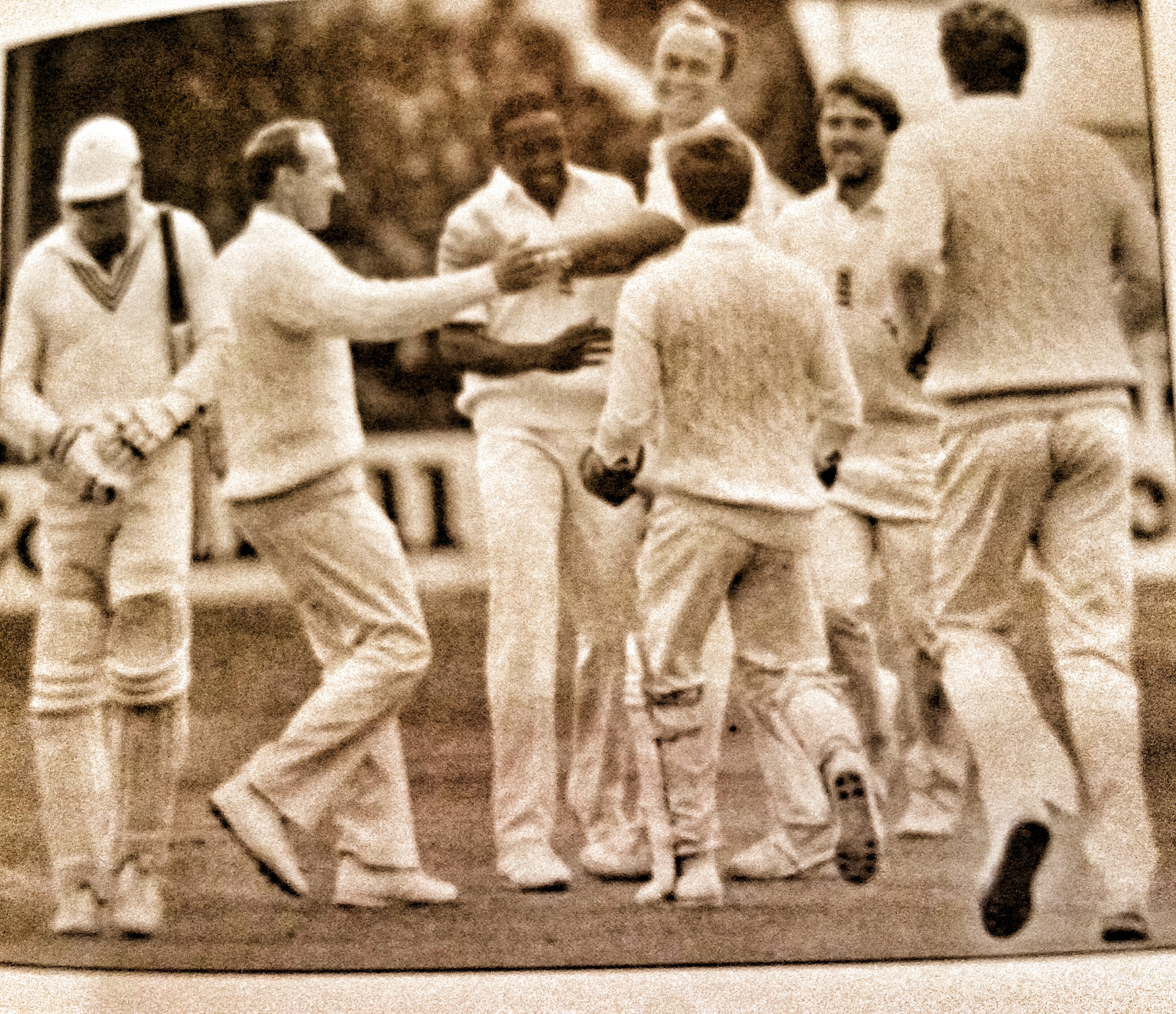
Picture by Adrian Murrell – “enhanced using Snapseed”. I think this is a wonderful snap, just for Richard Hadlee. Evan is giving it the two hands. Smiffy is directing traffic. Wright Jeff Crowe is Saturday Night Fever. Coney looks like he’s in need of the facilities. And then there is Hadlee… Fabulous picture.
After a brief rain delay, Hadlee packed off the Middlesex spinners in one over, both falling to catches that rose sharply and moved away late, and these wickets moved Hadlee into third place in the wicket-takers list behind Lillee and Botham, and completed a 27th five wicket haul, then a record. Pringle, batting at a nose bleeding six, survived a drop before falling to a hook shot. B&H said
“….the failure was more one of confidence than technique. The Essex all-rounder seemed frightened to hit the ball in his old manner.”
As he’s never read the blog, nor is likely to, he won’t comment on that.
England’s innings meandered to the close, finishing 240 for 9. Thomas had played some “spirited shots” before falling to Hadlee. England added another 16 the following morning, with the aid of some dropped catches (B&H lamenting the slip fielding). The previous year 400 played 500, so this instinctively felt short of a decent total.
Thomas opened the bowling and was “fast, but wild” which could have been the summary of his brief career, but he succeeded in making the opening breakthrough, having Bruce Edgar LBW via a fast yorker for 8. Jeff Crowe joined John Wright and solidity was enforced. The pace was dilatory, but it took until the afternoon session to remove John Wiright, who “seemed in total command” and Jeff Crowe, caught behind, both off Gladstone Small to provide the Warwickshire man with the first two of his 55 test victims. Small became a bit of a fan favourite, and I’ll break off this test review to just share a piece of Matthew Engel’s pen picture on Cricinfo…
he was always a whole-hearted tryer, a committed team man and a delightful guy. Australia’s discomfiture was increased by Small’s strange build: seemingly without a neck, he walked around as though he still had a coathanger inside his jacket. He came to England from Barbados just after his 14th birthday, the cut-off date for automatic qualification. However, the combination of his looks and his then-pair of nerdish specs made the Lord’s registration committee think he had no chance of ever playing Test cricket anyway, so they let him through.
Anyway, we interrupt this message to ask, what did he have in common with Derek Randall, Les Taylor, Alastair Cook and Mike Gatting?
Another pic from Adrian Murrell. Small captures his first test wicket, it says being Jeff Crowe, but the piece reckons Wright was his first victim. Quite hard to tell from here. Perhaps one of our New Zealand friends can make the definitive ID?
Back to the test and at 92 for 3 England had got themselves back into the contest. Martin Crowe was joined at the crease by Jeremy Coney, and they set about rebuilding again. Having put on 50 for the 4th wicket, and with both looking untroubled (although Coney had been dropped at slip) “disaster struck in the last over before tea”. Martin Crowe called for what was in the view of B&H an “unwise short single” and Coney hesitated, before perishing. The wicket before tea looked worse when straight after the break Crowe turned Emburey into the hands of Phil Edmonds at backward square leg and New Zealand were 144 for 5, still 112 in arrears. However, the New Zealanders had a more formidable lower order, and it was now their time to shine….
Anyone notice some of the new headers? They mainly come from the Bell / KP partnership in 2011 v India. Look for more new pics in the future…
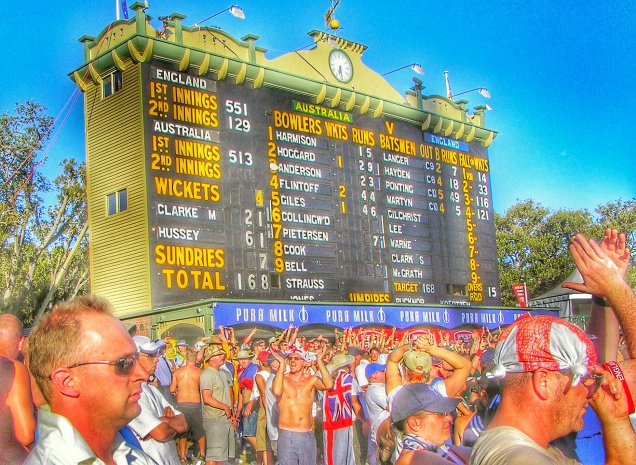
Ian Bell in his career best 235 v India – 2011
The international cricket spotlight is currently on Sri Lanka as the first test against Australia evolves. In the spirit of following the ECB Chief, we aren’t likely to be seeing a 4th day if the weather holds. Simon has pointed out that there are Youtube highlights of the match, so good luck if watching 100 play 200 plays 100 excites you.
James over at the Full Toss has done a piece on the T20 changes that Nick Hoult was signalling in his Telegraph article. I’m genuinely glad James still cares, because, frankly, I don’t any more. It’s the usual response to something perceived as a “shiny toy” and it is appropriate that Vaughan is one of the key proponents of a Big Bash for Britain. The counties are destitute and this may be their only way of making money (if it is for the collective good) but that’s never been the English way. We’re all in it for the cash, and instead of getting a good for all product like the Big Bash, which didn’t make a heap of cash in its first incarnations, we’ll try to replicate the IPL and its bidding for players. But as the game is dead in the mainstream conscience now, it won’t be able to work. So we’ll end up with a dog’s breakfast. When the two biggest counties, Yorkshire and Surrey, the two teams you would presume least threatened by the new system, are worried about it diluting their brand, you have to take notice. But it’s T20. It is fluff. It isn’t for me, but that’s not the point. I’ve got more than enough to worry about other than an arcane structure that is beyond repair. It’s like my boiler. I pray I get another year out of it each year.
I finished reading an old book I found in my cupboard – Andrew Strauss’s tour diary of the Ashes in 2010/11. It also includes a bit about the India series and the World Cup. Interesting that he does nothing but praise KP throughout the book – pointing out he can be a tricky customer, but he was also a great help – and also some of the “culture” stuff. I may do a more full review in the next couple of days.
I have a piece half drafted on a test match 30 years ago. There’s not a lot to read on that time, that English summer, but I was after one piece of assistance from you. Graham Gooch did not tour the following winter – the Ashes series which I intend to do a series of articles on in the same way as I did Blackwash II – and I wasn’t really sure why. Anyone know the reasons?
I visited a cricketing figure today. Put it on Twitter and only pktroll and metatone acknowledged it.
Heathens.
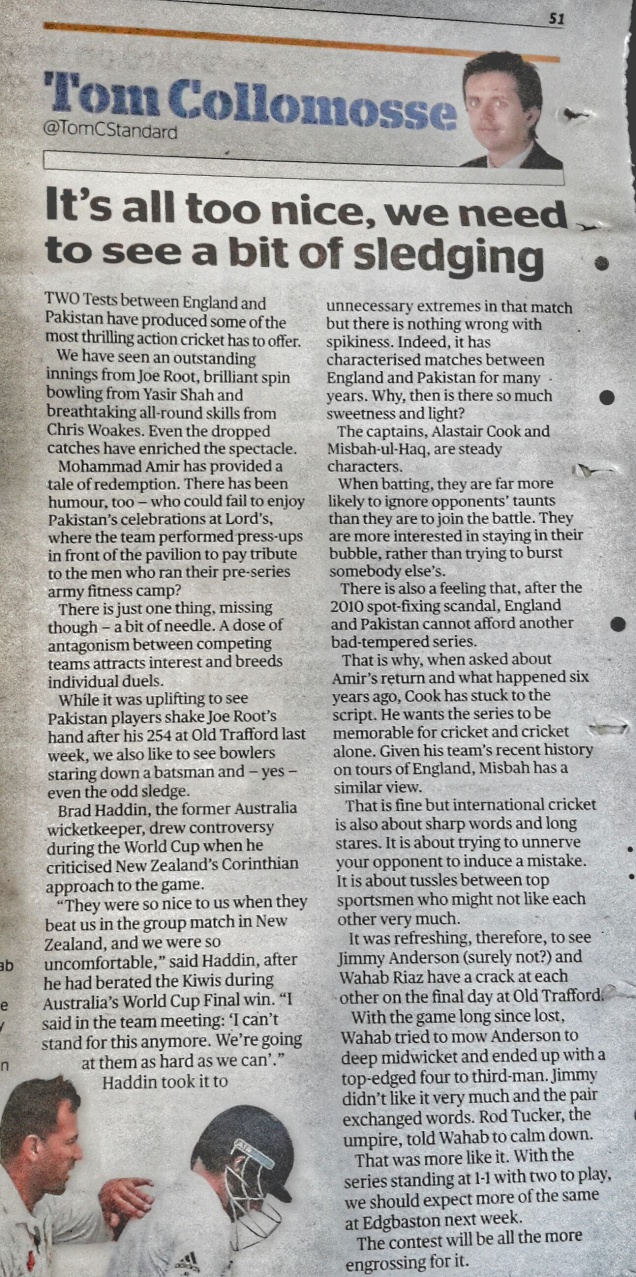
Also, on the way home, I saw this article in the Evening Standard. I quite like Tom Collomosse, but this was every bit as much mailing it in, as this post feels. Do we really need some stupid antics to liven up the series. I think we’d prefer a third and fourth test that has competitive cricket and great matches, rather than a few rows. I don’t know. I think I’m getting old.
The other project in mind is something that will get our fans across the social media sphere in a complete whirl. The old labels will be out. They come here, of course they do, and there will be the usual. But let me think about it. It will be a lot of hard work.
And, remember all. Fill in our Q&A. The responses so far have been great, and a couple of new faces have appeared. It also meant I read back some classic posts of last year, including A TLG special called Publish And Be Damned, and one I wrote called Bruised, where I was told that certain journos “have never read the blog”. Then there was a classic Maxie too, which all derived from a post I wrote about Adelaide to Perth. Dig them out. If I get time tonight, I’ll link them.
The kernel of an idea on writing about this came from a Twitter exchange with Dennis. He called me a journalist, and I disagreed (it was light hearted), but these things get me thinking about ideas to write about it. What am I? What, if any role do we play and what about our relationship, if there is one, with the media? Bloggers and the print media. Are we two sides of the same coin, or implacable enemies?
When I first started blogging, nearly a decade ago now, I was under no illusions. Blogging was not about gaining fame, seeking adulation, attention seeking or even something I was committed to. I liked writing, I’d just lost both my parents, I wasn’t satisfied with commenting on message boards because I felt I couldn’t really control my message and I started to read some pretty decent stuff. So I took to blogging. It was an online record of my thoughts, my views at the time (really, you don’t want to read them) and how they evolved. Everything was going well, I didn’t get any attention from anyone except my mates, who told me they loved it and to keep doing it, until the time I decided to criticise a potential elected appointment at the football team I support. I was threatened, I was abused, and I lost the innocence and the love of just writing my thoughts. Despite presenting a clear case in my defence (and producing it), there was no chance of winning. In choosing to flight or fight, I did the former. That blog is still out there, but I closed it down pretty much that day and is locked behind a password.
One of the accusations that day has stuck with me.
….these things crack me up. its like the sunday broadsheet columnist equivalent of kids playing shop. pretending and imagining that people are fascinated by your article the rise of padraig harrington, and nodding in agreement as they read your article with their cafetiere at their side on a sunday. its the biggest load of self absorbed b*llocks on earth, if they werent so inadvertantly funny it would be tragic.
Ignore the borderline illiteracy in the quote.This person thought I wanted to be a journalist. He might have been the first, but he won’t be the last. I have neither the instinct nor the energy to bother people into talking to me who don’t want to. That makes me pretty much unsuited to that genre of work, that of the journo, the hack. I’m not pushy. I’m not in to having cosy relationships with insiders as those who have met me will attest. If you want to tell me something, then fine, otherwise we can chat about this and that. Sure, I love a little bit of gossip, but you don’t, in the main, find it on here. I’m about as likely to be accused of “good journalism” as I am to win the 100m at the Rio Olympics. What that blog did was to get me to enjoy writing as a bit of fun, and not something to take too seriously. Some say it was really well written, some say my style is an abomination. But it made people laugh (my mates) and it made them see me slightly differently.
Once that blog closed I opened up another, and Seven and Seven Eighths was born. Again, this was a general blog on all matters, but a lot on sport. It followed up the original but my heart was not quite as into it. To put this in to context, this blog (BOC) at its peak got over 2000 hits per day. The record day on Seven and Seven was 350 – for the death of Dan Wheldon. I was perfectly fine with that, but the posts got further and further apart, and my mind wandered on to other potential opportunities. I set up a cricket blog, a football blog, a football memorabilia blog, a photo blog, a cricket photo blog, and yet never seemed settled or focused. I’m all over WordPress. Again, this isn’t to gain attention, but to try to compartmentalise what is written / displayed. At the best, I thought I might get some new friends to speak to who happened to stumble upon my efforts. But mainly it was cathartic, a release valve and enjoyable to do. It stopped me being bored. I love to write, but would never want to be forced to. About as far away from a vocation as you could get.
The How Did We Lose In Adelaide blog, famous or infamous as it was, started in 2010, and ran until I discontinued it in 2015. The final year of its existence was tumultuous. Minding my own business for the first four years, writing away with only my mates looking in occasionally, the trenchant views I took surrounding the collapse of the 2013/14 Ashes team hit a nerve. Suddenly one of my blogs had caught some momentum. This was a genuinely scary moment for me. I did not seek attention, but I wasn’t disappointed to get it. I did not seek to be anyone’s voice, but I seemed to be representing a certain part of the England cricket fraternity/sorority . I had a decision to make – carry on with Seven and Seven, or devote all my energy to something that had caught a wave. I decided to do the latter.
This isn’t a journalist’s journey. It’s a writer’s journey. Ultimately I’m not going to be judged on the stories I break, because I can’t break them. I’m here to comment on what I see, what I think about things, and what I think of those that tell the tale. In many ways the journalism I think should be practiced isn’t anything like a blogger. A journalist delivers the stories, he/she acquires them, and develops them. They report on what they have seen, and pass comment on them. Only the last part applies to a blogger.
Blogging on cricket in the last 30 months has been exhilarating and terrifying in almost equal doses. It has developed my personality, and in a number of ways damaged it. It’s unpaid, and I will always want it that way, despite my wife thinking I’m crackers. It should be a spare time enjoyment, not a vocation. I no more want to be paraded as my real name in search of fame and glory, than I would to have a root canal. I’m not a blogger who thinks he should be anywhere near “Cricket Writers” let alone be on it (as a journalist suggested to me a while back), although I have real issues with some of the “alternative media” that have been on there. You may think the “writer” (and I’ll come to that) protests too much, but then you’ll see my resistance to meeting any of the journalistic corps. I’m not them, I don’t want to be them, I never will be them.
What I find nauseating, and what I try to do different to those who write for the national press, and the broadsheets in particular, is the way many around cricket treat it as some sort of intellectual joust. Exhibit A is Ed Smith, a man who cannot communicate in print at all but still gets gigs because he uses long words and has evidently read a couple of books. That Cricinfo would employ him to write an article, but not a Maxie, or a James, ora Sean or Chris is what’s wrong. Ed Smith got this gig handed to him, has not had to really work at being a communicator, and then gets to preen and pose on articles like the one yesterday on stress. Instead of a piece on a sensible subject, he just had to flaunt his reading material. The Abridged Ed Twitter feed is a wonderful creation because it is so accurate. You can sum up his articles in one or two sentences because that’s all they add up to. The rest is the writing equivalent of looking in the mirror and asking whether you are the cleverest of them all. You see, I can read a Tregaskis, obviously a very clever man, and not be bored by the nuance and cadence of his writing – his piece on the executed West Indian cricketer Leslie Hylton is absolutely magnificent, and an instruction to us all – whereas I’m just waiting for Ed to show off. And that riles me t the extreme. Don’t be ashamed of your education, but don’t patronise with it. Ed Smith patronises.
The other thing I really get annoyed about is the “expert”. This card is played by Selvey the most, but others are prone to lapse into it. We get it, you played the game. That does not mean that we cannot comment upon it, comment upon what you write, and perhaps dig a little deeper. It does not mean you can cast out statements and expect us to take them as fact because you had a county career with a few test caps. The treatment of the avid fan as an idiot, because that is what it is, is patronising, and you wonder why some people rail against it. I don’t claim to be an expert, I never have. I bow to my co-writer’s knowledge of technique, and those of Philip who have written the occasional piece on the subject here. I’m not in some Michael Gove “we are tired of experts” mode either. It’s just not a catch-all that allows you to be an ECB insider and get away with it because you’ve played the game. Without the avid fan, new fans are not created in anywhere near as large a number. The expert may see the blogger as an inexperienced know nothing, a challenge to someone who “knows” but misses the point. That “fan” is mad keen on the sport. Maybe more keen than you are. You have no room to alienate them.
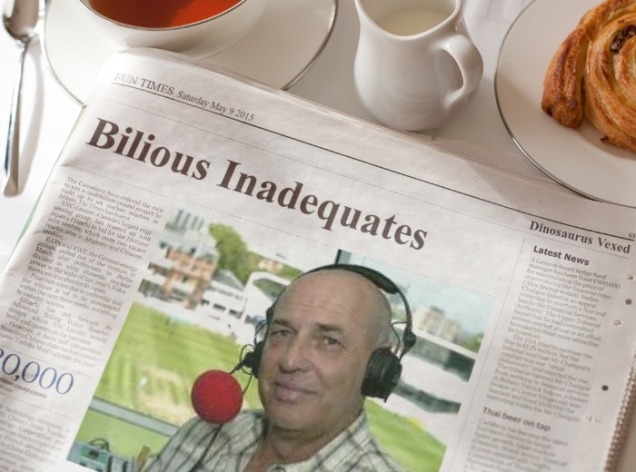
So with those two genres out of the way, the third is the one we focused our aim on in the last couple of years. The journalism by leak, or as it is known on here “good journalism”. I listened to the interview that Agnew had with Parky on that Sunday lunchtime at Lord’s, and Aggers showed that the accusation made (prominently by Tregaskis in The Cricketer) that journos were too cosy with the players and authorities still resonated with him. He made a point of mentioning the dirt in the pocket and the Stuart Broad non-walking incidents. He said that despite them being friends/on friendly terms he had to go with his reporting instincts and calling them out on it. Part of me thought that if that even came into it, thinking how it might hurt friendships, then there’s an issue, but we are all human. I don’t have that gene in me. Indeed, one of the fears I had as a blogger was would people genuinely hate me for what I write. Some do. I’ve seen it, though a lot less lately. Bloggers have that distance, the sort of thing that makes us “cowards” in the eyes of journalist and some of their supporters. We’ll say things on a computer screen we’ll never say to their faces. Well, it was interesting to hear Aggers say that he and Atherton have never talked about the dirt in the pocket. In many ways, that’s the same isn’t it? It is this analysis of the “good journalism” output that I think genuinely spooked some of them. They weren’t used to having their work scrutinised forensically and some made their views clear. Some block me on Twitter. Some call me a bilious inadequate. Some spoke to me on social media. Some called me irrelevant. Chris can speak for himself on this, but it seemed odd that they really thought people should just let it go. Trust them to be our eyes and ears. Instead, we thought they weren’t doing things well enough. Preferring access to aggro. That’s still an issue today. Newman and his selectors piece being the latest in a long line of “I wonder who leaked, I mean helped out, on that piece of “good journalism”. Journos have to get these stories, we don’t.
A blogger has more scope to broaden their approach. They have no editor (I couldn’t deal with that, I really couldn’t) and can go longform at will (as I do). The blogger isn’t particularly time driven, but given there are many competing elements for my spare time, I make a point of drafting once and polishing later, but I can also go a good few days without writing. I choose the topics (or my co-writers do) and our editorial board, such as it is, is on WhatsApp or Twitter DM. Free rein is given, and we write what we feel. Again, Aggers said it on his interview regarding radio, you have to be yourself or you get found out. I think that equally applies to blogging. So I do get emotional. I do get angry, and I do get down. It’s a diary of life and cricket. It isn’t journalism.
I think the term “writer” is pretentious, and one, personally, I don’t want, and I don’t think it applies. I am a blogger. It’s nowhere near journalism, it’s not really seeking to be one’s artistic best as “writers” do. It’s about a view, communicated in my own, and TLG and Sean’s own ways, to people who might be interested. We aren’t here for commercial gains, we are not here to challenge journalists. We’re here because we care, and because we enjoy the platform blogging gives us. It’s what makes us different.
I’ve had a piece of advice from one prominent “nu-school” journo who said of my pieces “why do you write about journalists, when no-one gives a shit about them? You’re a good writer, so do something more with your blog” I’ll take that last part on advisement, but the premise that no-one is interested is more cricket authority facing than the way I face, which is writing to you. That journalist, who in no way is protecting the old school interests, doesn’t realise what pieces on Newman and Selvey in particular do when I write about them. The hit rate is increased.Our commenters bring them to the blog, and then they get more comments back. They drive this place at times.
This blog coasted through the Sri Lanka series (a bit like everyone else) but as soon as Selvey announced his retirement – BOOM. One world cricket writer had reference to us within ten minutes of the announcement, and he wasn’t alone. Newman’s piece on the selection committee, and BOOM again. They aren’t quite the clickbait of Kevin Pietersen times, but there is a noticeable uplift in hit rates when journalists are questioned. The journos will never be allowed to forget 2014, and their part in the abominable process that followed, and this blog will always focus on them. It’s one of our “mission statement” pieces. It’s what got us noticed in the first place.
So, after 2000 words, and potentially a lot more could be written, what is the conclusion? We are not two sides of the same coin, nor are we the feeder fish that cling to the sharks. Bloggers are not a threat to journalists, unless journalists allow us to become a threat because they are not doing their jobs. Bloggers should be encouraged, they should be nurtured, and they need to retain a total independence to be effective. Bloggers are truly judged on the quality of their pieces, and of satisfying their audience, not by giving them what they want, but by retaining their identity and being true. If I became something else, this audience would drop me like a stone. That we’ve kept a core audience even when the supposed keystone to this blog has gone away (the KP back for England) speaks volumes. That others have fallen by the wayside is not surprising. We’re not two sides of the same coin at all, we aren’t even a threat. We’re different, and not to be controlled or briefed, edited or spun, inside or beside. We are outside cricket for a reason – because they don’t want us inside, and we quite like the chill air.
I’d be interested in your views on this. How do you see the “relationship”? Is there one? Are we competing? Let me know in the comments.
Ah. The last refuge of a blogger who has run out of things to say? To get you lot to do some work?
Maybe, but I thought now might be as good a time as any. I’ve not had a panel like last year’s Ashes (maybe do one for the India tour?) but I have, in the past, put a little questionnaire to allow newbies to introduce themselves, those shy ones to say something about themselves, and those old and grumpy members of this parish to tell people the reason for their angst. So here goes. It might work, it probably won’t. Answer in the comments and be polite, people…
1. Name (posting name will do)
2. Favourite England cricketer past (pre-2000) and present (post-2000). If you are too young to remember pre-2000, I’m jealous.
3. Favourite overseas player past and present. List a few if you find it tough.
4. Rank order these batsmen in Test Cricket – Steve Smith, Joe Root, Virat Kohli, Kane Williamson, AB DeVilliers.
5. England’s top six for India, assuming they are all fit?
6. Do you think the loss this year of Brenkley and the imminent demise of Selvey signal the decline of the game in the public eye, or a much needed desire for new writing?
7. Your views on 2 division test cricket? A panacea or a placebo? Or a disaster.
8. What would you like to see more of on this blog? Do you think it is too negative? Do you think it has played it too safe this year?
9. Who should we watch for in international cricket (not England) who may be flying under the radar? If anyone?
10. The biggest villain in English Cricket is….. and Why? (up to 3, but 1 must be put forward. I’ll write a piece on the winner).
VOLUNTARY QUESTION…..
Complete this sentence… When Carlos Brathwaite hit that last six in the World T20, I………..
Thanks for participating, if you do, and thanks for the ongoing support for the blog. I say it many times because I still get immense satisfaction in seeing a decent audience on here most days.
There will be the usual end of season poll too, and the Dmitris, but this is a bit of “fun”. Go on, do something!
Following England cricket for as long as I have should mean that days like these bring unfettered joy. We never used to beat Pakistan like this. Indeed, for a long time, we never really used to beat Pakistan. They had the lightning pace, and swinging bowling that gave domestic batsmen terrors. They would find the resistance of such technically proficient players like Javed, Inzy et al a difficulty too far. Then, if that wasn’t enough, they’d throw a Qadir, a Mushtaq, a Saqlain at you. It was a tough life playing Pakistan.
What has been so noticeable, on English surfaces, is the lack of batting. The last two series have witnessed Pakistan batsmen being all over the place. If I recall, they didn’t make a century in 2010, and just Misbah has made one here, and you wouldn’t put much money on any of them doing it in the remainder of the series. If England bat as well as they did here, and bowl up to standard, it’s going to be tough to see Pakistan putting up much of a fight. Maybe, just maybe, they need to bat first. That might be the key.
It’s 1-1, but it doesn’t feel like a close series to me at this point. Over the last few days I’ve been reading Andrew Strauss’s (aka Comma) book on the 2010-11 Ashes. It must be recalled that on that tour we won three tests by an innings. We demolished them. In the book Strauss says the aim for him was to lead “the greatest England team ever”. That team, as we might recall, carried one batting passenger (Collingwood) while the rest of the team played out of their skins. The point being, that while that team is in the reckoning for the best team we’ve ever put out (2005, IMHO would have battered it) this one isn’t. It’s carrying too many passengers, has won a game thanks to the bowling being superb, and two batsmen making around 500 runs between them, and is prone to some periods where it loses ideas. Yet it has inflicted a 330 run defeat on Pakistan – a team ranked above them in the World list – and it feels as though this isn’t even a surprise. Test cricket is, at this stage, truly baffling. It just feels totally sub-standard. I don’t know if that’s true, but too many teams fold like cardboard under any pressure. I have little hope for the rest of the series being competitive. God, I hope I’m wrong.
So while the main, faintly ludicrous, debate last night focused on whether we should declare or not, I think next week might see calls for one of the two stars of the Lions display today, Duckett and Bell-Drummond, to be included in full squads soon. I wouldn’t be opposed to that. Vince has had five tests, and not done anything to make him indispensable. Ballance has had two back and won’t be ousted yet, but he’s in Compton’s Chair – the selection not endorsed by the media and with no real reason to bring him back – and that’s like the old ducking stool at the moment. But this team prides itself not on short-termism and risk taking, as that has to admit you are wrong, and give off the appearance of not knowing what you are doing. At a time when the selectors have copped some flak, risk aversion might be the order of the day.
I found this game sadly lacking. I’m past the loyal fan boy stage, and now in to wanting to watch contests. It’s like going to watch a top club like Real Madrid play one of those lower Primera Liga sides, and it turns into a 5 or 6 goal romp, with Ronaldo filling his boots. Sure, it’s a pleasure to watch the greats turn it on, but there are only three big clubs, the better competition is few and far between, and it all gets rather dull, unless you support that team. England are winning tests when they get their heads well in front, and when challenged can turn it on (Jo’burg) or flop (Lord’s v Pakistan). I can’t make my mind up about them at all. I think that a team seriously contemplating itself as being World #1 can’t have a top 5 with Hales, Ballance and Vince. That’s indicative of something about test cricket.
Joe Root is a superstar, no doubt, and his average is now over 56. I’m not writing the “greatest ever” stuff just yet (he’d been in the team less than four years) but he is something we have not had for a while. Truly reliable. We’re bound to ruin him.
We have some time between now and Birmingham. Thanks for the comments over the last few days. I’ve enjoyed the writing more than the match! I’m really sorry I can’t be enthused, but those of you who are, good luck. You won’t carry me with you, no matter how much you try. You know that. And you know why.
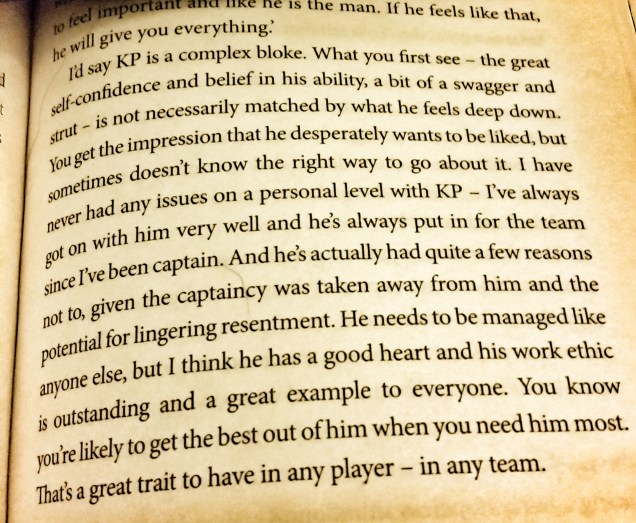
Just for giggles, and as a finale, here’s this. From Comma’s book….
There remains one challenge left in this game. The second test is now a matter of can England take ten Pakistan wickets in the time they allow themselves to level the series. They have a lead of nearly 500, more than enough if they wanted to declare overnight, as it would take one of the greatest miracles of test cricket to see our visitors overhaul that, and it now really rests on whether Cook wants to bunt a few more pretty meaningless runs around, or get this over with as soon as possible so the assembled media can hit the links a day early if they possibly can.
Like watching a Steve Davis or Stephen Hendry snooker final when on their game, there is plenty to admire about how England have gone about this match, but then I just never took to those two players because there was, well, just a lack of charm in the whole thing. And yes, I know it derives from THAT series, and I know three years ago, when we were charmlessly winning the Ashes I wouldn’t have said that, but emotions and instincts change over the years. I’m reading Andrew Strauss’s book on winning the Ashes in 2010/11, and there’s a bit about how lovely Alastair Cook is, and how he is the nicest man around, and he’s such a hard worker and doesn’t go on about it. And I stop, and I think, am I wrong to really not care for him? Is it me making the mistake here, and not those who seem so in hock to his aura? I do think hard over these things. I really do. But I can’t just get past the Ashes thing. I really can’t. This has meant to a dripfeed of animosity, that makes me feel numb when I see England handing out such a thrashing.
Because we can’t have it both ways. We can’t laud the Pakistanis for a magnificent display, while they sit above us in the world rankings, and then as soon as they are getting duffed up we bemoan Big Three cricket. Pakistan’s position in the world test arena is a miracle. We all know they’ll never play a home test against England and Australia ever again. Ever is a long time, but I doubt we’ll go to Pakistan in my lifetime. They are an exiled team, playing cricket in empty stadia, and yet they are where they are. It’s not because of any Big Three that they are suffering. It’s circumstance, and certainly their poor relations with India are driven by national politics, not cricketing issues. So on this one, I think we have to say “well done” to England on being in the position they are in. (There are a myriad of other views with the West Indies, who have been demolished by India in Antigua. Are they mediocre yet? If not, when will they reach that lofty standard?)
What did we learn on Day 3? Not a lot. England cashed in, then decided not to enforce the follow on. I have no problem with that, others do. Farbrace at the end, after he finished his audition for the new Mr Men movie – playing either Mr Happy or Mr Chatterbox – was keen to say it would be better to bat the second time with a good pitch than have to on a bad one. Quite what target a team 400 behind almost on first innings would set England is something I’m not sure about, but I’m sure the first test in the UAE, and the legend of Kolkata are in their minds. That’s not a very positive mindset, but then it does ensure we won’t have even the merest hint of losing the test. Cook has been rattling along, Root has come in and got going, while Hales struggled again. The batting looking very dependent on the two big cheeses at the top of the order these days.
As for the wickets, I have to confess I could only watch one day of the test this weekend, due to family stuff, and that was yesterday. After a shopping trip this afternoon, the TV went on, and my lights went out (sick border collie overnight, woken by motorcycle idiots this morning) and the enthusiasm to watch never returned. There was rain, and I saw bits of the action, but it’s not a contest any more, and this is just accumulation for accumulation’s sake now. The sort of thing Australia did, when Slater or Warner would pick up that bargain bucket second innings ton against defensive fields and worse bowling. Will England regret not bowling in overcast conditions? I don’t know. They wouldn’t tell us if they did.
Day 4 tomorrow, and England will probably bat for another hour or so. If they’ve got to lunch without declaring then I’ll probably hear Sir Ian explode from my London office. So don’t declare until lunch, Alastair. England have played well, but I’m sorry, it’s just not exciting to me. Can’t help the feelings, I’m afraid.
Day 4 comments below. It’s getting a little testy….





 Being Outside Cricket