2015 Test Century Watch – #27 – BJ Watling

BJW

BJ Watling – 120 v England at Headingley

Bradley-John Watling’s second test century of the calendar year was a hugely important one. Playing in this test as a batsman only, he dug in, then expanded and put his team firmly on top. It’s the sort of innings to wax lyrical about, and different to his more legendary “dig-in” knocks to save tests. At the time of this innings he was the third man to make a second test century in 2015 – alongside Kane Williamson and Alastair Cook. With this innings he took his average to over 40, and made his 5th test hundred in just his 53rd innings. To put that in some context, Matt Prior made 7 centuries in 123 innings, and we’ve recently lauded him as a modern powerhouse.

Mind boggling fact #1 – BJ Watling’s hundred is the first made by a New Zealander at Headingley in test cricket. His 120 beat the previous best of 97 by Stephen Fleming in 2004. Luke Ronchi’s 88 was 4th best when he made it. It was the 23rd hundred made by a New Zealander in tests in England, and the second man to make 120 for his country here (Stewie Dempster did it at Lord’s in 1931). 120 is the 8th highest score made in England by a New Zealander. 14 of those 23 hundreds were made at Lord’s.

Have you seen a test 120, Dmitri?  Well, there have been 58 of them since the first test match. The answer is, a little to my surprise, yes. It was a century totally overshadowed by a legendary one later in the innings. It was a hot summer’s day in 2001 at The Oval, and after a lengthy opening partnership between Matthew Hayden and Justin Langer, Mark Waugh strolled to the crease. He did what he did when in nick. He made 120 look easy. Then his twin came in on one leg, made 157 not out, and everyone forgot Waugh (and Langer’s) ton.

The first 120 in test cricket was made by a man who saw one of his long standing records nearly broken a few weeks ago. Bobby Abel, of Surrey and England, made 120 against South Africa in Cape Town in 1889. This is an astonishing score card, because Bobby himself beat the hosts by an innings and 30 runs. England posted 292 and Johnny Briggs then took 7 in South Africa’s first and 8 in the second to bowl the hosts out for 47 and 43. 14 of those wickets were bowled and the other LBW. This is brilliant stuff. Bernard Tancred carried his bat for 26 in the first innings. If he’d played for my school 2nd XI in 1985, he’d have been dropped (30 years on and yes, I’m still bitter!)

I’ll let the almanac describe the state of affairs…

The last match of the tour and a complete triumph for the Englishmen, who outplayed their opponents at every point, and won in an innings with 202 runs to spare. It was the second eleven-a-side fixture, and was more decisively won than any other match during the trip. The South African team, with the exception of Mr. Tancred could do absolutely nothing against Briggs, batsmen who had scored well in earlier matches failing dismally. The Lancashire bowler met with wonderful success, taking in all fifteen wickets for 28 runs – a worthy finish up to his briliant exertions during the trip. Abel, too, wound up in splendid form, making his third hundred during the tour. He went in first and was out seventh, making 120 out of 287.

No frippery or waxing lyrical. Well batted Mr. Tancred. Martin Williamson’s Cricinfo article is brilliant in explaining the circumstances behind this test .and the impact it had on South African cricket. There were three England players in that team that played their only first class games on this tour. But what is even more sobering is the fate of England’s young captain (he was 23):

Bowden, however, was an altogether sadder story. At 23 years 144 days, he was and remains England’s youngest captain, but he never even knew he had represented his country, or even saw his homeland again. In 1891 he headed north with Rhodes where he was incorrectly reported to have been killed. Not long after he was found to be alive, he did die, in a remote a mud hut in Umtali. The final indignity was that his body had to be protected from marauding lions – prior to being interred – in a coffin made from whisky cases.

I may be a bit down on Alastair Cook, but…

Bobby Abel’s famous record is the 357 he made for Surrey in 1899 against Somerset. It is said on Wikipedia that the England selectors were unwilling to choose him after 1896 over concerns about his eyesight. Seems to have more in common with KP than we think!

Other 120s that caught my eye included the previous one made in tests, which has also semi-legendary status. We’re talking about Ben Stokes at Perth. The only century made by an Englishman in the international part of the tour. The one that he needed to be persisted with because of it!

Bob Caterall of South Africa made two scores of 120 in test matches, within a fortnight of each other. In June 1924 he followed up his 120 at Edgbaston with the same score at Lord’s. Fellow countryman Bruce Mitchell also made two 120s against England, but they were separated by 17 months and the distance between The Oval and Newlands. Michael Vaughan has two 120s, with the first being his first test century against Pakistan at Old Trafford, and the other against Bangladesh at Lord’s in the run up to the 2005 Ashes.

Other players to have made 120 twice in tests include West Indian wastrels Viv Richards and Brian Lara and Sri Lankan wicket-keeper Prasanna Jayawardene.

In 1987 fellow Kiwi Jeff Crowe made 120 not out against Sri Lanka. It took him 609 minutes and nearly 400 balls. This was the same test that Brendon Kurrupu batted 777 minutes for 201. If time had not expired, lord knows how long Crowe would have taken to get to that, and the slow century award on this site could be called the Crowe (Jeff) Award! This looks like five days of thrilling cricket!

This was Watling’s third highest score in tests, his highest test score not made at the Basin Reserve, and the fastest of his test tons.

BJ Watling’s hundred came up in 136 balls with 13 x 4 and 1 x 6.

Book Review – Put To The Test by Geoffrey Boycott

boycs book

On my very occasional visits to Hay-on-Wye (I’ve been there twice), I head out looking for older cricket books, and often they can be snagged for a pound, maybe two. I have picked up a number of the Boycott books from the late 70s, early 80s, where he wrote a tour diary about his fortunes, and often with blisteringly honest critiques of his team-mates. It’s the sort of book that could never be written now. It’s from a bygone age. But for all that, this Boycott book reads of a man in crisis and it is better for it. It seems real.

This particular book relates to the Ashes series of 1978/9, in the midst of the Packer Revolution, with an Australian team lacking its main stars. It is largely disregarded by the Australian cognoscenti on the grounds we were playing their 2nd XI, and thus the 3-0 hammering we received the following year (in a non-Ashes series) is more of a true reflection of the two sides at the time.

The book is couched within the first chapter when Geoffrey gets his excuses in early. He had been sacked as Yorkshire captain – oh don’t we miss those brutal fraternal wars in that quaint old county – and had the terrible sadness of his much beloved mother passing away. Geoffrey, as one of those highly paid gurus would no doubt have said, was not in a good place. So excuses may be a bit harsh, but I’m not going to call them reasons…

The book takes us through a tour that seems to be played on nothing but rubbish pitches. Look at the scores in the tests. Barely anyone has a good series with the bat. Rodney Hogg stands out with his bowling figures, but the teams are all over the place, and there are no draws. England find themselves in difficult positions in many of the games, but pull themselves out of them with a lot of luck and a lot of help from poor captaincy, dropped catches and bad play. Boycott himself has an awful tour with the bat, but even then Sir G is a front-runner for modern thinking, as the epilogue has a wonderful bit where he takes the positives.

Boycott pulls apart Yallop’s captaincy, while also getting the hump early in the tour that he wasn’t being listened to, but then being fulsome in praise of Brearley for asking him his views once that concern had been raised. Brearley does seem to apply remarkable common sense in most of his dealings, from what I can see. I think Geoff really liked Derek Randall, even though he really wasn’t his kind of player, and his 150 in the Sydney Test, when England had just lost the 3rd in Melbourne to lead 2-1, and had conceded a first innings lead of 142, was the deciding factor in the series. Then Randall’s contributions seemed to fade away.

There’s some interesting stuff throughout. England’s former run scoring record holder, Gooch, is still without a test hundred, and would go another two years before getting one. Brearley seems to get the solid start off to a tee more than Geoffrey, and this book is very noticeable by a lack of comments on that. There’s lots of praise in there for those who surpassed themselves, including Bob Taylor, who made a 97 in the 5th test that pretty much secured the game. But Boycs does show his frustrations with Botham’s batting and bowling, Gower getting out the same way, but he is borderline effusive on Brearley:

“I watched Brearley pretty closely…..and I consider he did a magnificent job on and off the field.”

This is also cricket from a byegone era, and it makes me feel old reading it, because this is the first overseas highlights I ever remember watching (I was 8). There is plenty running through the piece on bouncers, and the almost quaint “no bouncing list” that existed (yes, people were protected from having bouncers bowled at them if they were crap batsmen). It was more understandable given helmets were in their infancy in those days, but reading it makes me feel old.

Boycott has a pop at the umpires “they assumed an air of infallibility which their decisions did not always bear out” and at the Aussie crowds “The Hill at Sydney used to be amusing, sharp and cutting, but not unfriendly; now it is simply foul-mouthed and crude.” He wasn’t pleased with the pitches “The great Don Bradman himself once remarked that nobody expected Joe Davis to play snooker on a bumpy table” and Yallop’s captaincy also came under his microscope, with one exchange with Rodney Hogg an example of how the new captain struggled to assert authority. Boycott also rails against sledging and over-appealing, and the former debate still lingers on.

A really interesting read, and although just over 180 pages of text, none the worse for its relative brevity. Highly recommended if you can lay your hands on it. It is big boy/girl cricket writing. Honest, frank, informative, descriptive and free from cliche, management-speak, taking the positive speak (with one caveat) and dealing in nicknames. It’s a book that covers the debut of Allan Border (which all those who wish to dismiss this series Down Under should contemplate) and the force of nature that was Rodney Hogg. There are also familiar themes – the running between the wickets of Graeme Wood runs through this like a stick of rock – and the ODIs in this book look like the belong in Roman times compared to today’s high octane stuff.

A book like that today would be media managed out of existence. James Anderson once said that the ECB amended about 200 pages in his book (he may have been joking) and yet although I have it on my Kindle rack, I’ve not read (but also not heard anything controversial about it either). If you wonder why I am so nostalgic, books like this are the reason why. Honest accounts, dealt with in an adult manner. It’s actually quite refreshing.

England v New Zealand – ODI #5 – The Decider At Durham

Well, Chester-le-Street, but you get my drift.

The Greatest One Day Series in the history of mankind (containing one remotely close match in four) comes to an end today up north. There appears to be a little bit of rain about, but probably not enough to impact too much on the game – though you never know – but let’s hope the series is not ended with a DLS, or whatever it is called, schmozzle.

England look to be without Jos Buttler, who has split the webbing on his hand, and there is an emergency call-up for Jonny Bairstow. I’d have thought we’d have allowed the other keeper in the squad, Sam Billings, a chance to carry out the duties, so have England just called Jonny up for another chance to carry the drinks, for which he’s undoubtedly the Don Bradman of in terms of proficiency. With Buttler out, does it mean a place for James Taylor, and if so, will it be at 6 or will he take 5 from Stokes?

As for the bowling, it’s getting to the stage that the quicker bowlers should sling their names in a hat, and the first three are pulled out. This has been a lamentable series for all the bowlers (perhaps I’m being harsh on Wood) and there’s no indication that’s going to stop.

Anyway, I look forward to all your comments as usual. Once this is out of the way, and the T20 game on Tuesday is in the books, this blog will be dominated by the one series that truly matters to all cricket fans in this country. So while the press and ECB TV are waxing lyrical over how great this series is, and what a shame it was just the two tests, all the promos, including that bloody song, and a renamed channel are on the way and filling our screens. We may not be having the “phoney war” as one poking journo (!) called it quite rightly, but it’ll be made up for. Or maybe, just maybe, we are a teeny weeny bit fed up that this is the third Ashes series within 24 months, and that overkill is in play?

Now Alex, when you get in that position again, you know, 60-odd by 10 overs, don’t do that again. There are massive tons in your horizon….

A Prize…

This part of The Plan gasted my considerable flabber.

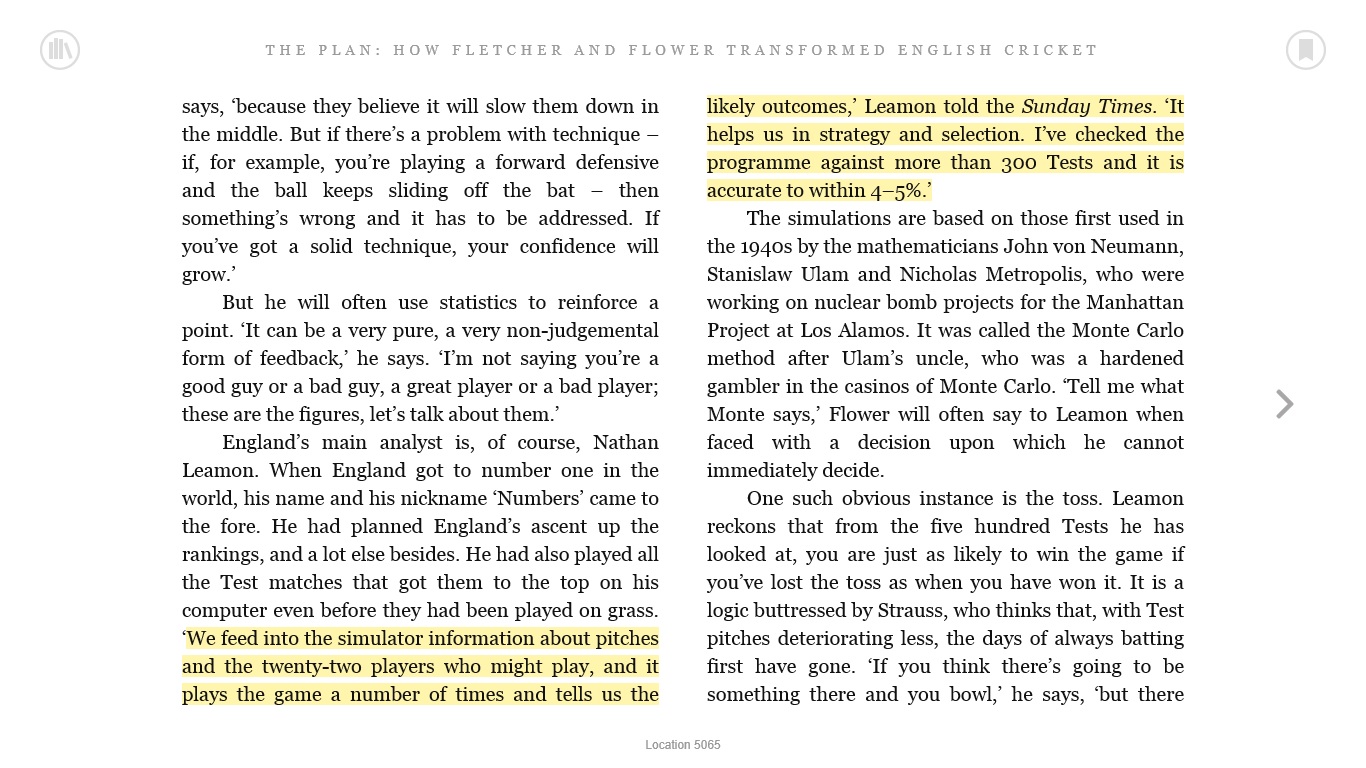
Statistical Hogwash

I mean, really. Someone explain to me how you are accurate to withing 4-5% of whatever it is he’s supposed to be babbling on about. “Oh yes, the computer said Kevin Pietersen would bat like a god at Mumbai, and get out for 188 rather than the 186 he actually managed, and that, yes, the same computer analysis that was 25% out in the selection of the bowling attack at Ahmedabad, was now spot on at Mumbai and Kolkata?” This looks like twaddle.

Someone tell me how this works, because, and I love cricket stats by the way, it is lost on me. “Tell me what Monte” says, said Andy Flower when he couldn’t decide. Maybe whistling out of tune formed part of his statistical analysis.

No wonder we fucked up the World Cup if we had this sort of drivel going on.

A prize to anyone who can decipher that highlighted phrase for me.

Bruised

Evening all.

Personally it has been a tough week for me. Nothing that ends the world, but the sort of week that knocks the confidence, hits the self-belief and makes you question what you think you should do. I did, at one point, think that I might give the blog up for a while, at least until the Ashes, but that was but a fleeting thought. There’s the brilliance of thelegglance to support on here, and there’s also lots more I want to say. So, while bored out of my mind on a training course this week, I jotted down some ideas for future posts and direction. thelegglance and I will get together to discuss some changes to the blog, and perhaps some of the ideas I have and he has. We will let you know what is decided.

The one thing with this blog that amazes me, still, is how from small incidents, major stuff happens, if only at the blogging level. Without the throwaway two press men reviews in the post last week, one of our number would not have tweeted the link to the top five mentioned, and then we would not have had Pringle calling me irrelevant. I’m not one to ever let a snippy comment go unblogged, so off I went, then followed by thelegglance last weekend, and now by Maxie’s opus on The Full Toss, which it goes without saying, I recommend to this house.

From little acorns do these blogging oaks grow, but what’s the relevance? I had a discussion on Twitter DM with a well-known (I think on here) figure in the reporting game who said he wished I dealt more with the actual cricket than journalists who no-one really gives a shit about. Like all constructive comment aimed my way I considered it. A lot. Then came being told I wasn’t strategic enough to build a brand identity and push a plan through cost me a promotion (how I laugh inside at that, not) and I begin to question myself. Am I aiming in the wrong place? Am I just becoming a stuck record? Have we peaked (hits are noticeable on this blog when the news is bad) and could we sustain this blog through “good times”? Is it worth sustaining? How do we do it?

I’m not satisfied. I used to be easily satisfied, but not now. This is too precious to me to give up.

I wandered around for a long time in the wilderness until I got noticed. I then set about keeping the limited audience I had in a flurry of furious posts, each one dripping with anger at the press, the ECB and yes, Alastair Cook. I’m over none of that. Not one bit. Without that anger the well runs dry. I now almost hate the game I love for the fact that nearly every facet of it brings me to rage. The lack of terrestrial coverage, the patronising of New Zealand as if awarding them just two test two years after awarding them just two tests is somehow ordered by some Cricketing authority on high rather than the ECB’s actual choice of oppenents. The victories in the ODIs, and the manner of the defeats, are laudatory, but for the love of all that’s holy, it’s 2-2 and there has been enough dumb nonsense in this series that we now seem to think it is OK to overlook because we are playing positively (and the bowling looks absolutely clueless). There is the very good point thelegglance made about how this rush to gush is now overtaking the inquest that should have taken place about how the team played in the World Cup. Instead we’ll have it all laid on Moores’s door for the failure (Farbrace was in that dressing room, so don’t give me all that) and no doubt the C–tmaster General’s door for the brave decisions. One of our scribes rightly said that we don’t look to the players for the successes, but at the coach, or someone who puts in place strategies. I’ve always said with strategies, that when they are successful they have many parents, but when they fail, they are orphans.

I’ve just read Steve James’s “The Plan”. I might do a review of it when I calm down. It has some interesting nuggets, especially in his willingness to blame anyone but his Zimbabwean colleagues, and some insider stuff that if true, casts an interesting shadow over some of the decisions taken after the book. But it was a throwaway line on Moneyball that got me.

I’m a massive baseball fan, and both the book and the movie of Moneyball omit one incredibly salient fact that is missed about those Oakland A teams. It wasn’t about value for money and all that, but it was about the fact they had a brilliant pitching rotation. They had great pitchers in their midst to start games. The Red Sox this year have, on paper, a really good hitting team. They absolutely stink this season because their starting pitching is atrocious. I go on a blog where they ask you to predict the record of the team for the season. I was the only one who didn’t have them down as having a winning season. It is, in baseball, a lot about getting bang for your buck. It is also about your scouts, your player development, your drafting ability to get good players of your own.

Peter Moores loves this book. According to Steve James, he passed a copy to Flower who also liked it. It’s a good book, tells an interesting story, and pretends that Billy Beane is some sort of out-there genius. It tells the story of running a sporting franchise where the As didn’t have the most money (far from it), didn’t have the best stadium (very far from it) and didn’t play in the best city (I can’t comment on that, but no-one really mentions Oakland in the tourist guides). So he had to look beyond the athleticism and at the numbers to see if he could get value. Beane got older players with a couple of good years left (stop laughing at the back) who may have been looking for one last hurrah. Beane got players who didn’t necessarily have the best physical condition, or who had individual styles that the trainers and physiologists would have kittens over (Samit Patel……any England fast bowler that goes to Loughborough) or develop his own players quickly and get them in the team to trade them for other pieces – which is what a club team does, but not an international one. The thing I believe Moores would probably have taken out of this is the data. The numbers. Not the traditional ones, but the things like WAR or OPS+ that the statsguru’s of baseball love. But that doesn’t really translate to cricket. Take KP, who is berated for having an average of just 47. He has precious few not outs as he’s a risk taker. In my view. How is that translated to the press? “It’s the way he plays….” “A player of great innings not a great player” or the best of all “inconsistent”. I didn’t see anyone try to get behind those numbers too hard.

Moneyball is about running a business, that is why it’s written by a prolific business writer. England are if not the wealthiest team in cricket, than they are second. And they just lost a test in May to a team without a pot to piss in. I hope the new man has nothing to do with such trite twaddle. Sadly, I think Strauss would probably melt into a warm puddle at the very mention of it.

I have rambled off, which is usual, but the point I’m trying to make is that this journalist probably thought Moneyball was some wonderful text because Flower liked it. It needed investigating. I read this stuff. I’ve read virtually every self-congratulatory tome about the Red Sox winning it all in 2004 due to these techniques (of course, buying up one of the best pitchers on the market and having the second highest payroll in the game had sweet FA to do with it). I’m a sports nut who laps this stuff up. But not with an uncritical eye. When someone tells me a book like that helped shape a couple of England coaches’ philosophies, I want to know why.

I’ll never be able to scratch that itch completely. I’ll always be searching for the right point, even if I find out it is wrong. I want to know. The pieces recently by much more precise, beautifully crafting authors like Maxie and TLG than I, hone in on their targets like laser guided missiles, and we are all the better for it. I’m far less accurate, but hope I make up for it in my desire to find out. I’m still not satisfied that I’ve found out what I want.

So it gets to the point, where, yes, I confess, I hope Alastair Cook fails as a batsman, because he’s a wretched leader of men. I get to the point, where, yes, I confess, I see England wins as something to dread for the stupidity of the reaction they garner from people who should know better. I hope Strauss falls on his arse for backing a Giles Clarke line on KP (for that is what I think it is) and he leaves that post with the ridicule his predecessor garnered. I will not forgive those who branded the likes of me as “outside cricket” for turning me off an England cricket team. Even one with players like this.

I’m not falling in love with them. Not one iota. Until that whole top edifice is cleared, Clarke has absolutely nothing to do with the ECB, that there’s an apology to those they insulted, I’ll despise them with every f–king fibre of my being.

When I was a child, I played cricket in the street. I played with 10 other kids on a council estate in Deptford. I watched Botham’s Ashes. I watched the great 1980s West Indies teams. People talked about cricket all the time. Going to my first test match was a thing I will always treasure (1997, Oval, Day 2). I have this game in my soul. I come from an era where it mattered to kids of all social classes. Now?

Yeah. I’ve no right to be angry at all. No I’ll carry on with all of them. And now I don’t have to play the good little foot soldier role in the office, I’m ready to up the ante.

Night.

England v New Zealand: 4th ODI review

At least in the one day series we get the decider that all that has gone before merits.  And given how this sequence of games has gone, who knows what will happen.

England will of course be praised heavily for an astonishing run chase, exceeded in terms of runs only four times in history.  But it was more than that, it was that England plainly could have chased down another 50, 75, or even 100.  They were that in control they had 7 overs and 7 wickets still in hand.

It’s not so long ago that New Zealand setting 350 to win would have made the second half of the game academic, and by not too long ago, we can say about 10 days.   The turnaround has been astounding; not the turnaround in results, it is 2-2 after all, but in attitude and approach.

Amid the delight at seeing England play like this, it cannot be overlooked how much of an indictment this been of various previous managements of the England team.  Peter Moores will certainly be shifting uncomfortably at what he’s seeing (in truth, given that he’s that kind of man, he’ll probably be absolutely delighted because it’s England), but it isn’t and shouldn’t all be laid on his shoulders.  One day cricket has been like this for a number of years, and at no point until this series have England even attempted to play this way.  A whole bunch of them should be looking at themselves in the mirror.  And not just coaches either, the people above them, the selectors, some of the players, all of them carry the responsibility for the wasted years of trying to get just enough and hoping it will do.

Alastair Cook led that side, and led it in a way incompatible with how the game is now played.  It is completely inconceivable that England would be playing in this style under him.  Throughout the build up to the World Cup, those who pointed this out on a regular basis were dismissed as know-nothings, bilious inadequates, fools and knaves – even anti-England.  But they were right.  They were absolutely, incontrovertibly right.  An acknowledgement from the self-appointed great and good of that reality wouldn’t go amiss, and nor would a realisation that maybe, just maybe that even if you don’t agree with them, they have an opinion which has value.

I’m not going to hold my breath it’ll ever happen.

By way of contrast, some credit has to be given to those selectors who insisted on retaining Eoin Morgan, when he was in a dreadful run of form, and many were calling for his head.  They backed him, and to the surprise of many, re-appointed him as one day captain.  You see, when credit is due, it is given.  Another thing for them to learn.

In amongst the pleasure at seeing England play like this, there cannot but be a feeling of anger at the missed opportunity the World Cup represented.  These players are by and large the ones that were called for, to give England a chance of competing.  They haven’t suddenly become a great side, and there will still be ups and downs ahead.  The point is that allowing the team to have a chance was the thing.  They didn’t give England a prayer.  And that is not acceptable on any level.

During the World Cup, some people went as far as hoping England would lose.  Some people?  By the end I suspect it was a lot of people.  They didn’t do so because they liked seeing England get hammered, they did so out of despair that anyone would actually get out of their stubborn, ignorant, antiquated mindset and pay attention to what was going on in the world game.  This change is precisely because the World Cup was such a shambles, that it shocked even the ECB out of their complacency.

It remains to be seen whether Morgan’s clear desire that England continue to play without fear survives the inclination to conservatism that remains.  Today England set about the target with furious, but controlled aggression.  It’s only a few days since England were bowled out for 302 batting first and the conservative sirens were telling them that if only they’d been more restrained, they’d have got 340.  Their attitudes are obselete.

In defeat, New Zealand once again showed themselves to be a class act.  When Morgan was dismissed they were quick to congratulate him, likewise Root at the end of the game.  Perhaps the most thoughtful, kindest and most considerate action was at the conclusion of the match.  It was Steve Davis’ final game as an international umpire, and to remember that and invite him to lead the New Zealand team off the pitch said a lot about how they play the game.

England were magnificent today.  I can’t remember the last time I wrote that.  Long may they give themselves the chance to be magnificent – even if they sometimes fall short.

@BlueEarthMngmnt

Amour (and the preview for ODI #4)

Everyone’s happy. England are playing a really exciting brand of ODI cricket. There’s thrill a minunte stroke play, a new approach, a wonderful fresh positive attitude. It’s New England. Wow. Get it. New England….

So feel free to add your comments below as the 4th ODI takes place at Trent Bridge. I’ll be stuck in a dreary training course, licking my wounds from a horrible day, both personally and professionally, and feeling bitter that people will be enjoying the crash bang wallop of cricket.

At about 12:30 in the latest Switch Hit, George Dobell said something along the lines of “after two years of cynicism about the England team and the ECB, the public are falling back in love with English cricket again, and that’s the most important thing”.

I can’t get angry with George. I really can’t. He’s the only one who could possibly have said that and got away with it. But it got me thinking. Stand by for an even greater load of old nonsense. I’m gonna tell you a story…..

Let’s go down memory lane, and have a bit of catharsis along the way. A good few years ago I went out with a woman who, it is fair to say, I was batting over my average with. I hadn’t a lot of self-esteem, and this brought confidence and a verve to my life. I walked with a swagger, I felt good about myself. It was great. Then I found out I was being used. Used as an emotional crutch, and things turned. Suddenly I found that I was miserable with her, and even more miserable without. Then I was dumped.

Oh, don’t be a tart, I can hear you say, but stick with it. In cricket parlance, the early 2000s were that woman. We had a tremendous team, flawed but exciting, and it was arguably more than we deserved. We knew it couldn’t last, but effing hell, wasn’t it great? Beating South Africa away, seven test wins in a summer and then the Ashes…. the Ashes in 2005. But then things were never the same, and the following few years I followed the team, even away to Oz, but this wasn’t a new era. It was good, but it was also making me miserable as our team floundered.

Anyway, after the first dumping, we got back together. It was nice, for a while, but we knew it wouldn’t last, there were too many fractures, hey, even a lack of trust (ho ho ho).

That period is England 2010-12. Great at times, so much so that you forget the big losses like Pakistan or South Africa. But there were some good times, very good times. But again, you knew a let-down was coming, and some of the rough periods….

Then we split up, permanently. Oh, I didn’t give up, but it was not going to happen. She’d toy with my affection a bit (India 2012….) but then slammed me down with an embarrassing put down (Ashes 2013/14). Then came the waste period, as I had bitter recriminations and couldn’t, as the cricket parlance said, move on….

A few years later, when I first was going out with my lovely wife, I was at work one day when I heard that voice on the phone. “Hello Dmitri, how are you…” I now found myself in a dilemma. Should I seek out the familiar seductive voice on the phone, or move on permanently and ignore it. “I’m down the pub, near your work. Would you like to meet me?”

That, my dear friends, is the current England ODI and test team. Pulling on your heartstrings. You know they haven’t really changed, and that it’s better with the life you live, but you aren’t a silly lovesick puppy any more, in need of a relationship where the other party effects care, but actually doesn’t really need you. But, but, but…….That ex is the ECB. Writ large. Flashing their seductive voice with new eras, and flashy play. But they don’t really care about you. You are there when they want something, and nothing else.

So, George, I’m not going to stop being cynical about the ECB at all. Not at those ticket prices. Not until I hear a mea culpa from them over outside cricket that doesn’t pin it on the bloke they chose to employ. Not with their attitude to the supporters. Not even if England’s players play an exciting, wonderful brand of cricket. I’m not coming back to the fold on the back of the cricketing equivalent of one bloody phone call.

Here endeth the oddest post in Being Outside Cricket. On a day when I was told I didn’t get that promotion, after I’d been told that a client of our’s had passed away at the weekend, it’s been a day. A really bad one.

Lord knows what will happen tomorrow. I only know that it really can’t be worse than today.

Send the men in the white coats. I’m prepared to be laughed at. Because after this day, laughter’s about all I have!

Good night, good people. Keep smiling and ignore that bloody phone call….

England v New Zealand 3rd ODI: Review

Not very many days ago, for England to be 2-1 down after three matches would have been considered something of a triumph, given how low the expectations were. It’s curious how quickly expectations rise, and given the football team have just won their sixth straight qualifying match and finished the season unbeaten, it’s quite likely that the same sort of thing will happen there.

England – the cricket variety, though it’s true of the football team as well – did a fair bit wrong today in all three disciplines of the game, but there’s far more they continued to do right, and a degree of acceptance and understanding is arguably fitting.

From 288-5 to 302 all out is certainly a collapse, yet the disappointment at only getting 300 was remarkable to see.  It’s the first time England have ever scored 300 three matches in succession, and we’re disappointed.  Not just the supporters either, England themselves were plainly extremely unhappy with the way they fell away.  Good.  So they should be.  But it’s anything but a disaster. In the first match England were 202-6, and went for it.  On that occasions it came off, and the score rocketed to over 400; on this occasion it went wrong.  If we’re to praise the buccaneering spirit that allowed them the freedom to attack on that occasion, we do need to accept it can go wrong sometimes.  That doesn’t mean that they can’t learn from it, because there are many things they could have done better.  But what mustn’t happen is that they are criticised for recklessness, because it was no more or less reckless than it was at Edgbaston, it’s just that on that occasion it worked out and this time it went wrong.

It might have horrible echoes of “executing their skills better”, but sometimes it is about the execution and not the mindset.  A gentle reminder to try and hit that particular ball over long on rather than across the line to deep midwicket for example is approving of the intent completely, but trying to better the specific way in which it’s done, and definitely not making anyone scared of trying it or getting out.  For the reality is that teams who are capable of scoring 400 and who are looking to reach that kind of target do sometimes screw up.  To screw up and still score 302 isn’t all that bad – if we go back to the omnishambles of the World Cup, England patted themselves on the back for a total like that.  This time they’re unhappy with it.  Perhaps that’s the most promising thing of all.

There is always a temptation to be wise after the event, and judge on outcome rather than intent.  When a batsman clears long on, just over the head of the fielder stationed there, then the cry of “great shot” goes up.  If he fractionally mistimes it, and it lands in that fielders hands, then often it’s called irresponsible with the fielder there waiting.  Yet if it’s irresponsible then, it’s just as irresponsible when it goes for six – it can’t only be irresponsible based on the outcome.  But few would ever say that when it sailed into the stand.  For many of the late dismissals, if you were to freeze frame it as the shot was played, it’s not necessarily the wrong shot, it’s just not been played that well.  You have to ask, in that freeze frame, if it sails for six who is going to say it was the wrong thing to do?  The answer is no one.  It’s still a bad shot of course, but often the right shot played badly, which isn’t quite the same thing.

Now, none of that means you absolve England of any blame, but it does highlight the very narrow margins that are there when playing a high risk, extremely attacking game.  England are just three matches into this kind of approach, and they are going to get it wrong sometimes at this stage.  So should they have decided to be more conservative when half the side was out?  Had they taken that approach at Edgbaston, they’d have ended up with around 300, and that’s what the old England would have done.

What England do need to do is do exactly what they are doing, but just look to do it better.  The judgement about what a good score is on any given pitch will come, and as they get more used to the way they are playing, so will the shot selection.  If we want them to shoot for the moon, then we need to show a little patience when they don’t quite manage it.  Especially when playing a side like New Zealand, who we must remember are more than a bit useful.

Having said that about the batting, the catching is something that unquestionably will have to improve.  England had their chances in this game and didn’t take them.  It can happen in any game, but there’s been a worrying propensity to shell them in all formats of the game.   As to why that is, it’s one of cricket’s mysteries quite why dropping catches seems to be a communicable disease, but it’s one that self-evidently needs curing rapidly.  Switching confidence on is the only way of doing so – and here is where the coaches earn their pay.

The bowling is a much more uncertain area than the batting.  Mark Wood was the pick of the seam attack, and worries around him are more about a fear of England overbowling him than anything he’s doing on the field.  The rest are having good moments and bad moments.  Some of them won’t be good enough, but we can’t be sure who that is true of just yet.  Having said that, Finn just doesn’t look the bowler he was, and as more time goes by, the fear that he won’t be getting that back grows ever stronger.

For New Zealand, they did what they do in One Day Cricket.  Williamson and Taylor played superbly throughout.  Their stand of 206 set a new record for the Black Caps for the third wicket, and by the time it was broken, the game was largely won.  Sometimes the opposition play extremely well and you have to doff your cap.  The question of how much is inadequate bowling and how much superb batting is always an open one.

The fourth match is Nottingham on Wednesday, and what will happen is anyone’s guess.  But if England play with the same intent, they have a chance.  And a month or more ago, who would have thought that?  So there we have it.  An optimistic, favourable, forgiving view of England’s performance even though they lost.  There must be something in the water to be so controversial.  I do note that Derek Pringle disagrees with me, and Nasser Hussain agrees.  I think I’ll take that.

@BlueEarthMngmnt

England v New Zealand – ODI #3 – The Ageas Bowl

After the day-night nonsense on Friday, there’s a very short turnaround for game 3 of this compelling series. The teams will do battle at the Ageas Bowl and England won’t want to remember the last time we met at that venue….

http://www.espncricinfo.com/england-v-new-zealand-2013/engine/match/566924.html

This game was just before the Champions Trophy, and the score of 359 was an asbolute blockbuster for this country. Now it seems around par. What the hell is going on? I seem to recall Jonathan Trott getting a bit of stick for his century at just over a run a ball, but then again, we sort of blamed him for most things in ODIs when he was a decent performer. But with the euphoria of the last two matches, Jonathan Trott appears to be the Betamax to this team’s VHS. It’s odd how things have turned in two years.

There also was the clue for Guptill’s double ton in the World Cup writ large in that fixture. He went off in the last 10 overs. It was a great batting wicket, he got in, he cashed in. Also, it can’t be helped, but Jade Dernbach posted some mighty fine numbers in that game.

So to the game at the Ageas. England will be forced to make a minimum of two changes. Chris Jordan being ruled out was no surprise as he was shunted down the order, clearly inhibited by his injury, but Liam Plunkett’s absence falls into the “oh damn” category. While his bowling has been no worse than the others, his punchy hitting in the last two games has shown a real liveliness, and he gave England hope when there was little on Friday. Damn. Craig Overton has already been called up, and there’s speculation on the wires over the other, with many wanting Footit to have his day.

As it is, tomorrow might see two of the squad members play, with Mark Wood and David Willey surely in line to play (otherwise, why are they in the squad?) There then remains the question over whether Sam Billings keeps his place. It would appear slightly strange to drop him as his replacement would need to be James Taylor and he’s not a number 7. Or he shouldn’t be. We don’t want Buttler coming in at 7, nor Stokes, so there is a logjam there. I’ll let them call that one.

After a hammering in Game 1, the New Zealanders showed their batting class, and had the real difference maker on the day, Trent Boult, in their line-up. McCullum might be due a big one if he can just cut out the 100% give it a lash approach, but that’s the joy with this team; they can hurt you in so many ways.

Here’s hoping for another belter. Comments below.

It was good to see the people coming out of the ether to discuss thelegglance’s piece with us today. It was an excellent discussion and gave us some food for thought. There’s a key point not to treat the print media as a homogenous unit, but the old guard are certainly in the firing line. One read of Pringle’s article in this month’s Cricketer which speaks again of KP’s propaganda machine and of Strauss calling him a c–t being quite endearing, is just embarrassing. I’ve been advised by more than one source to stop letting this sort of thing wind me up. Well, if I didn’t, you lot wouldn’t be here………

Set your alarm clocks. Bunkers at 8:30 am.

All the best.

@DmitriOld @collythorpe @outsidecricket

Publish and be damned

As has been said before, there’s only one thing worse than being talked about – and that’s not being talked about.  It is of course hardly surprising that Dmitri’s posts didn’t meet with approval, yet the particular nature of said disapproval cannot be ignored.  The content was dismissed without qualification, and without reference to what it said.

John Etheridge then supported his friend:

And further saying:

There are a whole number of issues surrounding this.  The first thing to say is that I have nothing but respect for someone defending their friend.  Irrespective of perceived rights and wrongs, it’s the EM Forster principle, and I wholeheartedly approve.

If I had to choose between betraying my country and betraying my friend, I hope I should have the guts to betray my country.

But there are wider issues here.  Firstly Derek Pringle’s dismissal of the whole piece on the grounds that Dmitri writes under a nom de plume is precisely the kind of playing the man and not the ball that he receives so much criticism for.  Derek Pringle is not unpopular as a person, because as John says, he might be a decent bloke – Mr Etheridge himself is popular amongst his colleagues.  But his writing is, and the criticism that is directed towards it is based on that.  Whether it was his endless, tiresome and extremely personal anti-Pietersen ranting which was exceptionally personal, not based on cricketing merit, or his prediction of England winning 11 out of 17 Tests, his record as a cricket journalist invites the criticism it has received.

And let’s directly address the point about using a pseudonym.  My real name is accessible on here because I work for myself, and thus everything I write I am happy to have attributed to me.  It’s nice and easy because ultimately I’m only responsible to myself, and can do that.  Dmitri cannot because of his work, he is not a journalist and does this for fun, and for free.  He is not anonymous in his employment in just the same way as a journalist is not anonymous in his or hers.  To try and make the comparison when journalists are paid to be known in public for their work is ludicrous.   Their identity is their currency – being anonymous would make their job interviews somewhat problematic.  It’s after all why they are on things like Twitter in the first place, to promote their own work.  And that’s fine.

Nor was it a complaint about journalists having their expenses paid to travel, and seizing on that is a straw man. The issue at hand is the dismissal of the blog as being anonymous and therefore something to ignore – which is not what Mr Etheridge himself said, it must be pointed out.  John Etheridge whether one agrees with him or not has never tried to make that argument and didn’t here either. It’s an argument that is constantly made, whether it is below the line comments or Twitter comments, and avoids the question constantly.  People who take the trouble to write comments in the newspapers or in places like this tend to be cricket tragics, who care enough about the game to want their voice heard.  Those people aren’t paid to do so, they pay to do so, indeed while the question of how comments reflect a wider view is up for debate, newspapers allow it because it directly benefits their bottom line.  These commenters are working for the newspaper, unpaid.  They also buy Sky subscriptions, they buy tickets, and many of them travel abroad following the England team, spending thousands of pounds in the process.  The very idea that such people can be dismissed and ignored as a lesser voice is insulting on the one hand, and downright stupid on the other.  Journalists are not inherently a superior voice to be listened to ahead of those who support, and it’s nothing but arrogance for any of them to believe so.

That doesn’t mean that such criticism is always deserved.  In my own case, I was exceptionally critical of Nick Hoult a few years back, believing his articles to be nothing but rehashes of Derek Pringle’s.  For whatever reason, a flowering of his output, the additional responsibility of becoming the main cricket correspondent, or the development of his own sources, his writing in recent times has been excellent.  When the facts change, my opinion changes with it.  Quite simply, I was wrong about him and for what it’s worth he gets my apology.  The only purpose in so mentioning that is to counter a suggestion that this place is nothing but an attack on cricket journalists, because it isn’t at all.  Good ones get lots of praise.  At the Guardian Ali Martin has been a revelation, and demonstrated the wisdom of that paper giving him the break which he is now repaying in spades.

In my own line of business, I do indeed have travel expenses.  The difference is that I am not contemptuous towards those others on the aircraft on holiday, because they have paid for it themselves, and they, ultimately, pay my wages.  Without them I don’t have a living.  What Derek Pringle did by dismissing the post as being written by a “nom de blog” was to consider someone who ultimately paid his wages as irrelevant, not for what he said, but because of who he is or isn’t.  And make no mistake, cricket supporters do in  the end pay the salaries of cricket journalists, because if they don’t go and don’t watch, then the press won’t publish articles on it, and they won’t have a job.  How many tiddlywinks correspondents are there?

Now that doesn’t mean that any journalist has to agree with what is said by any one of us, but the piece in question detailed Dmitri following England around on tour, with the thousands of pounds spent accordingly.  Pringle might not like what was being written, but an unwarranted attitude of superiority displays a complete lack of awareness and rather inflated sense of self. The same applies to the criticism about the Barmy Army.  They may not be everyone’s cup of tea, but those who actually paid for their tickets and dislike it have the right to object.  Those who are paid to be there do not, when those in the pleb seats have spent thousands of pounds of their own money to be there. The criticism that has been directed at him has been on the basis of what he has written, not who he is – a standard he has singularly failed to apply in his own articles on far too many occasions.  There is more than enough there to be criticised after all, and that has been repeatedly detailed on here and elsewhere.  He can defend himself based on that if he wishes, but the point is he doesn’t.  He doesn’t have to of course, it’s up to him.  But he can’t then complain when people respond on the basis of his writing.

What a good journalist will do is to hold those in power to account, without fear or favour.  It’s precisely this that Derek Pringle gets criticised for, given his output has been nothing but attacks on one player, without ever asking the questions that needed to be asked.   It is possible to be critical of more than one side of the issue; a complete failure to do that is what marks out the propagandist.  The conduct of the ECB has been shambolic for the last two years, yet rather than offer up even the slightest criticism of that, instead it’s been nothing but praise on each occasion.  The style of cricket the ODI team have played in the last two matches should be an indictment of the manner the team was run for many years – yet few have joined the dots and recognised that their own support of the incumbents throughout that time might not have been correct.  The simple reality is that the nasty Dmitri has been a lot more correct in what he has said than most of the mainstream cricket journalists.  I’m sure that does grate, but it remains true.  Has he been right on everything?  Of course not.  But consistently questioning, observing and refusing to be blinded by bullshit is all a person can ask.  It is to the shame of a number that Dmitri’s posts on here have been of a higher critical standard than  many in the cricket press.

The press journalists have a job to do, the problem is that many of them simply haven’t done it.  The ongoing FIFA debacle was partly prompted by a journalist doing his job exceptionally well.  Andrew Jennings spoke about the behaviour of the press corps, and much of what he said was as damning an indictment of the cricket press as it was the football one.  No one is suggesting the ECB are remotely in the same category, but it doesn’t mean they are above reproach or above being questioned.  The failure to do so has been the biggest failing over the last twenty-seven months.  One of the worst parts is the use of Kevin Pietersen as a straw man in this; you don’t have to like him, you don’t even have to disagree with his exclusion.  But what you must do, if you are a journalist, is question everything.  Now, when it comes to this, the response is so often that they have tried and not received answers.  I rather suspect their political correspondent colleagues would find that amusing as a justification – can you imagine any of them faithfully reporting the government line just because the No. 10 spokesman didn’t answer?

“When I looked into the IOC, I discovered the president, Juan Antonio Samaranch, who was universally sucked up to by the sports press, was a Franco fascist. He thought the wrong side won World War II.”

Giles Clarke might not be a Franco fascist, but anyone in such a position who says that “Alastair Cook and his family are very much the sort of people we want the England captain and his family to be” should not remotely receive the deferential treatment he often does.  If that were an isolated example, it wouldn’t be the end of the world.  It isn’t though.  Repeated statements of lofty arrogance fail to be challenged, to the point where the new “Director, Cricket” can say to a cricket correspondent “I don’t need to spell [the issues] out for you Aggers” and not be asked to spell them out for those listening, presumably because they aren’t considered sufficiently important.

“Reporters are moving away from me as if I’ve just let out the biggest smell since bad food. Well, that’s what I wanted. Thank you, idiot reporters. The radar dish on top of my head is spinning around to all these blazers against the wall, saying, ‘Here I am. I’m your boy. I’m not impressed by these tossers. I know what they are. I’ve done it to the IOC, and I’ll do it to them.’”

The very name of this blog is “Being Outside Cricket” and of the journalists only one to my knowledge has even referenced that simple insult which came from the ECB in any of his writings – Jonathan Liew.  The usual response is that it was a dig at Piers Morgan, not anyone else, but it needs repeating that Morgan plays club cricket and goes to watch England.  If he is “outside cricket” then so are all the hundreds of thousands up and down the land who play and watch.  This simple point seems to be beyond the media, who have fundamentally failed to even acknowledge this wasn’t the brightest thing to say, and which still hasn’t even been “clarified”, let alone apologised for.   It’s a minor offence in the conduct of the ECB, but is entirely symptomatic of the embedded nature of the cricket press.  You are meant to be writing for the public, it might be an idea to consider the interests of that public rather than your mate at the ECB.  That doesn’t mean writing hagiographical articles about a new MD handling things “with aplomb” when it’s blatantly obvious it’s been a car crash, and then pretending that it didn’t happen a year later when it all goes horribly wrong.  Perhaps even an acknowledgement that those horrible below the line people might actually have been right in the first place could be a start.  If that sounds as dismissive of the cricket press as they are about the bloggers, it shouldn’t do.  The point is that cricket journalists are needed, but they aren’t doing their jobs.  Why do they imagine that places like these attract attention in the first place?

Of course, if you are paid to cover cricket, you don’t ever get to see the world in which that public live.  Journalists don’t end up missing anything up to a session queueing for a pint, journalists don’t have to shell out for dreadful food at an extortionate price.  Journalists don’t have a terrible seat crammed in which costs anything up to £100 for the privilege of a day’s backache.  Even football journalists write about the lot of the supporter more often than cricket ones.  When was the last article any of them wrote about it?  When you have a former Test cricketer expressing astonishment on air that Test tickets are a lot more than £20, and it being viewed as amusing not scandalous the disconnect is entirely clear.

It goes further.  Only Scyld Berry in the English press made a point of repeatedly attacking the ICC stitch up recently.  It might not be the most glamorous of subjects, and a defence that the newspaper wasn’t interested would be a reasonable one.  But Mike Selvey instead went on air saying he didn’t understand it and wasn’t worried about it.  That’s no excuse, it’s your damned job to understand it and worry about it.  Even if you then write a piece about why it’s a wonderful idea and not to fret about it.

So obviously all I have written is correct and can’t be argued with, right?  No.  And this is the point about engagement.  You can disagree with every single word I’ve written and tell me why I’m wrong if you’ve got as far as reading it all.  My opinion is just that, it’s not an objective truth.   What I won’t do is try and tell you that I know more than you, but I can’t tell you why.

https://twitter.com/alantyers/status/430783842535108609

Everyone knows that a journalist will have sources they can’t disclose.  That’s hardly the point.  No journalist worth his or her salt would try and defend criticism on that basis, it’s simply arrogance.  The thing is also, that the assumption that they know more than those criticising isn’t always true.  That thought appears not to have crossed their minds when talking down to the masses.  I’m not a journalist and have no desire to be one either.  But I know enough about honour to be absolutely certain no blog post of mine will contain a reference to something I know but can’t tell you.  It’s treating anyone who reads like an idiot who can only be spoonfed the information I choose to convey.

It’s an interesting statement.  I wonder if Hughes and Newman have the same view about the masses who bought their books?  I’m one of them in the past, so gentlemen, since I helped provide you with an income, does that still apply?  Ever heard of Gerald Ratner?  When you have such contempt for the masses, don’t be surprised when the masses have the same contempt for you.  Did it even occur that anyone reading that would think twice about buying another book?  How did your publisher feel about rubbishing prospective customers?

One of the defences of such points of view is that as former professionals, they have an insight into the game that the plebs do not.  And yet it’s interesting that this particular line only seems to apply to the preferably passive readership.  I wonder how John Etheridge or Nick Hoult would feel about this particular point if it was applied to them.  Being a cricketer and being a journalist are two separate things.  And then let’s take it further, if it were true on any level, then a Mike Selvey has no right whatever to talk about batting and no right to talk about batsmen on the grounds of lack of knowledge – certainly the drivel that’s routinely written about wicketkeeping by those who palpably know nothing about it is a case in point.  A good club level batsmen would be much much better than he was, and therefore his perspective is far superior, right?  Which is precisely why Selvey calling one of England’s best batsmen of the last forty years “a pest, a fruitfly” is deserving of such contempt.  Whether you like him or not has no relevance, because if you invoke the right to say it on the grounds of having been there and done it, then you deserve having the comparison of playing merits made.

And by the way, that’s why you won’t hear a word of criticism from me about Derek Pringle the player.  He was good enough to play international cricket, which means he was a bloody good player and a lot better than me.  That he wasn’t quite good enough to be a truly successful international player is beside the point.  He was a terrific cricketer by any measure except the very highest.  As was Mike Selvey.  What it doesn’t do is entitle them to pontificate as though their word is law and the “masses” have no value.  Not unless they want to then admit that the view of a Kevin Pietersen (or an Alastair Cook, or an Andy Flower) is inherently superior.  Somehow I doubt that would go down well with them, and nor should it.  Their view has as much merit as anyone else’s, and no more.

John Etheridge made the entirely correct point in his defence of Derek Pringle that were we to meet, we might get on and like each other.  That is of course entirely true, and the corollary of it (which he swiftly acknowledged) is that the obverse is also true, they might even quite like us – although I was mildly amused at the certainty that we’ve never met these people.  It’s not the point. The criticism of them is not of their person, it is of their professional output.  Just because a person might be likable doesn’t for a second provide any kind of justification for what they say.  The criticism over the various blogs and the various comments below the line have been often entirely valid.  I understand why they don’t like it, few people do like being criticised, but it doesn’t make it any less astute or accurate.  There are of course some who will simply throw abuse, and that’s no more acceptable or justifiable when it’s in the article or in the comments.    Using those as a crutch to dismiss all rational questioning is the problem, especially on the grounds of saying that criticism from those they “respect” is ok.  That cuts both ways.

The cricket media as a whole have had a dreadful couple of years, abrogating their responsibility to question, criticise and remain objective.  The ECB is English cricket’s government, and the press have on the whole singularly failed to hold them to account, preferring instead to focus on petty personal dislikes and remaining inside the tent, and thus being the ECB’s useful idiots.  It doesn’t apply to all and the ones who have done well do not need to be listed because they know who they are; deep down all cricket hacks will have a fair idea of whether or not it is true of them.  Defensiveness is often indicative of personal dissatisfaction in all walks of life.

The most infuriating part of it all, is that as a body, we need them.  But we need them to be journalists.  British journalism runs the range between the worst and most scurrilous there is, right up to the very best, most incisive anywhere.  There’s been far too much of the former, and nowhere near enough of the latter.  Everyone wants to be noted in their chosen career and I doubt being held in contempt by many of those they supposedly write for was the aim when they started out, they had visions of being Andrew Jennings.

There’s little worse than a feeling you’ve let yourself down.

@BlueEarthMngmnt