The Blogging Review Of The Year – Part 2 (March)

Thanks for the great response to the first part of the review. On looking back at what has happened this year, the relative peace and quiet of the last couple of months could give the impression it hasn’t been an eventful year. On closer inspection, it’s been a ride all right. On to the next few months and we’ll see where we get….

Uh Oh. Bad news. For some. March had a lot going on. This is going to be in more parts than first feared. Oh well. I’m game if you are….

Continue reading

South Africa v England: 1st Test, Day Four

By no stretch of the imagination could this Test be called a classic, for one thing England have been edging ever further ahead in it over the course of the game, but to go into the final day with all results (just about) possible is indicative of a match that has been fascinating throughout.  The most likely outcome remains that England will go 1-0 up some time tomorrow afternoon, but South Africa showed admirable grit in their second innings; had they done so in the first innings, it could be argued they wouldn’t have been in such trouble.  Yet ironically enough, they finished the day with a near identical score to that they had at the close on day two.  Perception is a funny thing.

England appeared relatively untroubled by the loss of wickets in the morning, a lead already approaching 300 tends to limit any sense of panic after all, and it was Bairstow who was the undoubted star of the show.  On a surface that started slow and is edging towards the turgid as we approach the conclusion, fluent run scoring has proved difficult, yet Bairstow merrily thrashed his way to 79 at better than a run a ball.  England do have an abundance of strokemakers, but they also require the latitude to play that way, both in terms of the match situation and the allowance from the captain and management above.  The signs are positive that coach Trevor Bayliss is keen to allow the players to express themselves, a welcome change from the years of rigid game management, but it still requires the groundwork done by others – Compton’s 85 and 49 are not going to win any awards for entertainment, but a team requires different kinds of batsmen who play in their own way to to bring out the best in the others; he did exceptionally well, and while no judgements can be made going forward on the basis of a single game, it can be said he played the role of the perfect number three here.

England’s long batting order also demonstrated its value, as first Moeen Ali and then Chris Woakes provided competent support, with South Africa merely looking to limit the damage.

Indeed the approach from the hosts was quite instructive.  The new ball was already available when Taylor was dismissed to leave England 224-6, 313 ahead.  It wasn’t taken.  What this betrayed was that South Africa didn’t truly believe they could win the game; for a side that did would surely have wanted to grab the new nut, knock over the tail and set off in pursuit of 330, with a belief it was possible.  Sure, England would have been strong favourites to win still, but it would have by no means been out of the question.  Equally of course, the new ball could have gone around the park, but not to take it was extraordinarily defensive given from there South Africa could still have won.  It is hard to credit that the view of Amla and/or the coaching staff was that their best chance of doing so was to retain the old ball, it seemed purely about being content to stay in the field as long as possible to avoid batting, and that is fair enough if the opposition are already 450 ahead, but not when they are only 300 and a bit on, with six wickets down.   A few things about this South Africa outfit seem rather muddled.

The debate then turned to the timing of any declaration.  Once again though, there was so much time left in the game.  As it happened, England were dismissed before it became an issue, but with a target of 416 and the best part of 150 overs remaining, it was by no means a pressing matter.  Put simply, if South Africa batted the remainder of the match – and no rain was or is forecast – they wouldn’t be too far away from that target.  Therefore England weren’t going to be losing potential overs that might be needed to take a last wicket or two.  Had they gone on much longer, then yes, it would have become a topic of debate, but it didn’t arise.

In the customary manner, South Africa batted much better second time around initially.  Van Zyl in particular started off exceptionally positively, to the point one or two who had been questioning England for not setting about 350 actually queried whether they should have (if they could) gone on longer to make the game safe.  Sometimes there is a desire to have it all ways.  For let’s put it simply, if South Africa were to achieve the second highest run chase in Test history, then you simply doff your caps to them and say they deserve it.  If they instead manage to bat out the game for a draw, then you may wonder why they didn’t get close enough to win in the time available, but you still doff that cap.  The target was exceptionally challenging, the time remaining extensive.  England and Cook did nothing wrong, however it turns out tomorrow.

After that strong start by the Proteas, and with a ball that resolutely refused to swing or seam to any great extent, it was Stokes and then Finn who made the difference.  Firstly, patience is always needed in these situations, for the wickets will usually come, and secondly you need to have a strike bowler who takes those wickets.  Earlier in his career Finn was criticised – and then dropped – for leaking runs, but he takes wickets.  His strike rate is the best of any England bowler with 100 Test victims, at an outstanding 47 balls per wicket.  This is a serious weapon.  Who cares if he goes for a few runs when he can do that?  So does Dale Steyn for that matter, and while his economy rate is a little better than Finn’s, it’s hardly impressive either.  Trying to force the square peg of potent strike bowler into the round hole of line and length operator consistently missed the point about the attacking wealth offered by him.  When he comes on to bowl it’s quite clear he will drop the odd one short and get hit to the boundary.  It’s also equally clear there is a decent prospect of sending one or two opponents back to the shed.  Leave him be, let him do what he’s excellent at – England have other bowlers to tie an end up.

And on that particular matter, Broad is becoming nigh on unhittable in Test cricket these days.  Indeed an economy rate in this innings of 2.27 probably represents something of a disappointment to him.  Add to that that he takes wickets, as his record over this calendar year shows only too well, and it is time that it was more widely acknowledged that he’s a fantastic bowler, one of the best England have had in a long time.  Appreciation of his skills (if not his DRS expertise) is overdue.

Standing in the way of England emerging victorious is one AB De Villiers.   England did have a chance to get him, Moeen Ali’s beautifully flighted delivery turning sharply through the gate with De Villiers out of his ground, only for Bairstow to miss the stumping.  England are choosing wicketkeepers who are primarily batsmen, and the reality is that while they do so, stumpings like this are going to be missed.  The same applies when it’s Jos Buttler doing the job.  In both cases they tend to miss the stumpings when the ball goes between bat and pad.  The eyes follow the bat rather than ball, expecting it to make contact, and by the time the ball has passed the bat, it’s far too late to adjust.  This certainly isn’t to excuse an error that Bairstow himself was in despair over, but it is to explain how it happens and why.  The very best wicketkeepers don’t make that kind of mistake because they always follow the line of the ball instinctively.  It’s a much much harder skill than might be supposed.

With Du Plessis and De Villiers at the crease, memories of their monumental match saving rearguard against Australia were well to the fore, but Finn returned just before the end to produce one that lifted just enough to take the shoulder of Du Plessis’ bat, Cook taking an excellent catch, and England will breathe much easier tonight.

There was still time for two items of note – firstly that Dale Steyn came out to bat as nightwatchman.  There are two ways of looking at that, either surprise at taking such a risk with a key player with the Cape Town Test only days away, or that he’s already ruled out and therefore there is little to be lost.  A slight puzzle though.   Secondly, immediately after Du Plessis was out the ball was changed.  It had been looked at earlier in the over, and the change itself was routine, and nothing need be inferred from the decision.  Just as nothing needed to be inferred from the decision to change the ball when South Africa were bowling.  It is unlikely that those who cast aspersions through innuendo and suggestion in that case will do so here – and that says it all.

A further 280 is required from 90 overs tomorrow.  More realistically, England need six more wickets.  It probably won’t be easy, but it probably will happen.  On the basis of the first four days, England deserve it.


South Africa v England: 1st Test, day two

The trouble with the first couple of days of Test matches is that much of the time every observation is couched in maybes, might bes and possiblys. There are exceptions of course, the slaughter taking place in Melbourne has few uncertainties beyond wondering whether Australia will win by hundreds or an innings and hundreds. 

At Kingsmead in contrast, it’s very much in the balance, as Test matches should be at this stage. In your classic Test story, the first two days are feeling each other out, while day three is moving day, and day four is finding out if the team on the rough end of day three will fight back. Day five of course being the result day. 

So at least thus far this Test is following the perfect script. If the first day was even, it’s hard not to feel the second day deserves exactly the same epithet.   And yet England probably should be the happier; they had the clear worst of the conditions on the first day, yet survived it, and in less bowler friendly conditions on day two removed four top order players. 

Against that it must be said that the way England’s innings fell away from a position of promise will – or should – deeply irritate the team, and it’s hardly the first time it’s happened in recent years anyway. 

Nick Compton held the innings together, his 85 of obdurate defence would have received much greater plaudits from certain quarters had it come from another obdurate player in the England side, which says more about those offering the praise than anything else – Compton was excellent and was the primary reason England made a competitive score. Bairstow’s breezy 41 briefly arrested the decline of the innings, while Broad, who appears to have at least partially rediscovered his batting mojo, provided much needed runs at the end to get England over 300.

In this calendar year, Broad has over 50 Test wickets at an average of 24. And yet he remains in at least some quarters a prophet who is not honoured in his own land. His record over the last few years is excellent, sufficiently so that he was pretty much the only player to come out of the Ashes disaster of 13/14 with any dignity left intact. For some reason he still faces constant criticism. 

Certainly here his wicket in the first over was one that would give opening batsman nightmares – the last thing you want to see is the ball arrowing back into off stump when you don’t want to play, likewise Hashim Amla, out of form or not, could have done little with the one that caused his downfall.

And so to that moving day mentioned earlier. In which direction? Who knows. That’s why when Test cricket is at it best, we watch. 

South Africa v England: First Test, day one

If the toss is crucial in a game, and you lose said flip of the coin, then perhaps if at the end of the first day you can say you are still in the match then that represents a very good day indeed.

Weather conditions were unfriendly throughout, and the surface looked green, seaming just enough early on to be a real danger to the batsman and als0 (more surprisingly – not least for Joe Root) proving conducive to spin from the start.  Yet the forecast for improved weather for the rest of the game made this first day potentially decisive for the Test, and England will be well pleased that they are not just in the game, but in a reasonable position.

The late loss of Taylor was unquestionably a blow, for without that wicket it could have been said to not just be a good battling performance, but one where England had a chance of getting on top.  Even so, from 49-3 and in terrible trouble, to reach 179-4 is a fine recovery.

Losing early wickets probably shouldn’t be too harshly viewed, for it certainly appeared difficult batting conditions, though the nature of those wickets will grate somewhat – Cook won’t need to be told that was a poor shot – and it didn’t appear to ease greatly for the rest of the play.

For both Taylor and Compton, much praise is warranted.  Although Compton scored slowly, which is what he was criticised for first time around, in these circumstances it was exactly what England needed, and in any event at no time did it feel in any way negative – he put away the bad ball well, and turned over the strike regularly.  One might say that the difference is in a player who is backed to perform rather than failure being pounced upon, but one innings is one innings.  What is interesting is that he is batting at number three, and given the most successful recent exponent of that position for England was Trott, it may yet be a position that suits him.

Taylor has developed from the batsman who first appeared three years ago, though even then that flawed player showed there was no shortage of nerve and bottle in him.

South Africa only have three front line seamers and England must aim to keep them in the field, and put the pressure on Steyn through additional overs he has to bowl.  Certainly he appeared what he is – a class above anyone else.

England do have a deep batting line up, so will hope to capitalise on the hard work done, but they’re in that tough situation where 300 would be a pretty impressive total to reach given conditions, but likely won’t be enough as the track flattens out in the sun.  So while they have done extremely well, they will need to do extremely well again tomorrow as well – perhaps an unfair return for the effort put in.

All in all, decent effort from England – or more specifically decent effort from Compton and Taylor.  On to tomorrow, where we’ll have a better idea of the balance of the game.


2015 Dmitri #4 – Peter Moores

I’ve been absent for a bit, what with it being Christmas and all that, so I think I owe it to you to produce a couple more Dmitris for the end of year round-up. This one takes us back to the first half of the year and his role in a couple of the major talking points in the opening round for Being Outside Cricket. As Paul Downton was on the list last year, he can’t make it in for this, so instead it will be the man he called, with many remarking at the time how impressive he was in so doing, “the greatest coach of his generation”. Dmitri number four is Peter Moores.

Peter-Moores-and-Paul-Dow-011

History, it is said, is written by the winners. And in the case of Peter Moores re-appointment, several key people who, shall we say, were glad to see the back of KP, set about rehabilitating the past reputation of the best coach in county cricket over the last decade or so. His triumphs at Lancashire were lauded as if this were Sir Alex Ferguson (who was a crap international coach too) at the helm, while the relegation the year after they won it all was consigned to the “forgotten” pile. His time in England colours was to be remembered for the great talents he brought on, not for the losing series or the problems motivating players for which one man carried the can (and the strength of that contempt from others was evident in the manner of Moores’ dismissal). By the time the likes of Selvey had had their say, with plenty of evidence of “good journalism” to help him along the way, it would have been mad not to appoint him. To be fair to John Etheridge, he pointed out at the time that the reappointment lacked credibility. Still, we were trusting a World Cup to him. We were trusting an Ashes series to him.

The appointment was greeted reasonably favourably. It was seen as a chance for redemption, to give Moores the proper go at the big competitions that he’d been denied previously. And that was the tone, he’d been denied, as if there were no choice but to sack him the first time around because of HIM. It was all nonsense of course, and Moores was back because (a) he was a decent coach and (b) he would have no trouble not picking HIM.

This isn’t a piece to berate Peter Moores. Everything about the bloke in his public utterances and the way he conducted himself, especially during the shameful events of his humiliating sacking, indicates he is a class act as a person. But he wasn’t an England cricket coach to take us forward. He was a useful interim while the ECB sorted out the post-HIM wastelands. Seen as a nurturer of talent, he was given a number of new players, in the fresh and exciting era, to bring on. The fact that none have really gone on to greater things has to be a worry, but while we were beating India 3-1, objectivity in both the media and the blogosphere was in short supply. Ballance was Whitaker’s poster-child, there was an almost unhealthy obsession with Chris Jordan, who looks like a slightly less good Phil DeFreitas to me, and Moeen Ali may always be the nearly man. Jos Buttler started well and faded. The ODI cricket was going nowhere as Alastair Cook stuck out like a sore thumb as opener. There was muddled thinking, horrendous days (Day 4 at Headingley…) and some baffling press stuff.

But why Moores for a Dmitri? Well, the World Cup comes around every four years, and this was his go at it. We went out before the quarter-finals, losing to every test nation we met. The scale of these defeats were monstrous. Australia annihilated us in the first match of the Australian section of the competition. James Taylor, who’d looked solid at 3, was demoted to 6 and made runs, while Ballance, who’d busted his hand in the lead up, looked out of his depth at 3. The loss to New Zealand was awful. A total rout, losing with what, 35 or so overs to spare (226 balls to be precise)? Then came Sri Lanka where England patted themselves on the backs for making over 300, and then watched the islanders cruise to total victory. Finally, the loss to Bangladesh, chasing a total we probably should have got, but collapsing under fear and pressure. A punchers chance, they said at the start of the tournament? We knocked ourselves out.

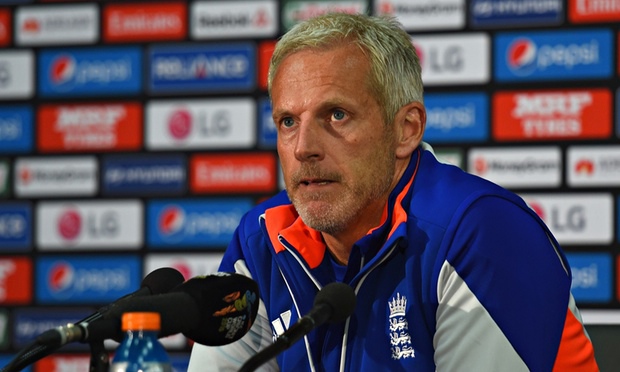
England head coach Peter Moores

At this point I think we knew that Moores was not going to last.The ECB were in a period of flux as Clarke was being shunted upstairs, Collier had a replacement in professional Tim Westwood body-double Tom Harrison, and reviews threatened. Graves said what he said (yes, a throwaway line according to Alec Swann), and there was a febrile atmosphere. Harrison had Downton on his way, but Moores was left to win a test series in the West Indies with the medicore tag ringing in his ears.

A drawn test series against the mediocre West Indies sealed his fate it seemed, but I have a feeling Strauss’s antipathy to his coaching techniques would have done it anyway. When the ECB were cleaning house, and brushing out the Downton from the cupboard below the stairs, it was easy to claim a clean break and relieve the coach of his duties. Except the new man couldn’t keep his trap shut, the information got out there (was it Moores’ agent, was it Nick Knight – I was in the US at the time) and Peter Moores had to endure a day I’d wish on no-one. Saying sorry never really felt like it was enough, because he’d had to run an England team while others were almost laughing at him. The ECB probably reached its nadir that weekend, because HIM made a big score soon after and leaked that out too.

When Downton got his marching orders (after a frankly bizarre reaction to the World Cup exit which actually sounded like a “please sack me because I’m out of my depth” plea) and Strauss replaced him (albeit with a comma) Moores was out. Strauss had made no secret in his autobiography, carefully worded as it was, that he didn’t think much of Moores as a coach (the only time he was dropped as a player was under Moores – any coincidence?) and sure enough he pulled the trigger. I am accused, constantly, of being obsessed by HIM, but it spoke volumes that Strauss did to Moores exactly what HIM did, yet…..

Moores went back to county cricket, assisted Nottinghamshire and got hugely favourable reviews, and he will probably go on to do what he does best. Raise young county cricketers and gel them as a team with technical skills. When you get to international level coaching, that doesn’t appear to be enough these days.

I’m convinced that an English coach will never succeed in major international sport, because, by their nature, they’ve not gone overseas, and they don’t have that charisma or gravitas. Peter Moores was the victim of the HIM putsch, not the beneficiary. His record first time around replicated. His reputation the same as before – good county coach, found wanting at the top level. The collective brains of the outfit thought they could reinvent the wheel. Sell us the same goods, but with experience. Peter Moores was chewed up and spat out. He was Downton’s folly. Bayliss has proved how lacking he was, especially at limited overs cricket. It wasn’t all his fault, as the selectors for the World Cup ballsed it up, but he didn’t exactly provide the data to keep him on.

More Dmitris to follow…..

Guest Post – Free To Air – The Silver Bullet?

While your friendly blog administator has been lording it up in the bars of Central London, having a whale of a time, Sean B has been working on a guest post for us…..

Fire away Sean…. and many thanks!

FTA – The Silver Bullet?

Much as been made recently of the BBC’s decision to omit any of the Ashes winning England cricket team from Sport Personality of the Year this year, and whilst most are in agreement that SPOTY is but a relic, designed to carry favour with the few sports that the BBC still has left, there has also been general consent that this is a worry for the future of the game. There have been a number of excellent articles written about this, George Dobbell’s piece being the best in my opinion – http://www.espncricinfo.com/england/content/story/947713.html, and hence I don’t want to cover old ground by focusing too much on this. However I do feel there is more of a piece that needs to be covered around what and if we can possibly do to try and breathe live back into a sport, which for all intensive purposes is struggling to win both the hearts and minds of the British public.


A sensible and much heralded opinion is that the sport has declined in popularity since the end of FTA coverage and the move to Sky, where only those with deep pockets have been able to watch both domestic and international cricket for the past decade. Don’t get me wrong, as much as I think Sky’s coverage of cricket on the whole is excellent (if you take out Nick Knight and Dominic Cork it would be so much better); however their viewing figures compared to the last major series on FTA speak for themselves – In 2005 an average of 2.5m watched the Ashes series on a daily basis with FTA access on Channel 4, with 8.4m people transfixed by the climax of the fourth Test compared to just over 460,000 who watched the final day of the first (and only vaguely competitive) Test of the 2015 series. That is not just a big drop off, that is a complete haemorrhage of cricket viewers.


This has cascaded down further, there are plenty of figures that show the popularity of the sport has also been in sharp decline for the past few years now, with The ECB participation survey highlighting that 844,000 participated in the game in 2014 compared to the 908,000 in 2013 and by Sport England’s own figures that show a decline of just over a third from 2006-2014. I, like most others would welcome the return of some cricket to FTA, even if I think the possibility of this ever happening is incredibly remote (Rupert Murdoch is not renowned for his corporate social responsibility and Sky’s model has always been around locking in big sporting events); however I’m not overly convinced by those arguments that make this the one silver bullet, that will return cricket to it’s heyday of 2005, it seems to be a far too simplistic argument to me. I believe there are a number of factors in place here, some fairly obvious, some far more nuanced, that need to take place before we can see both viewing and participation figures start to head in the opposite direction.


I will happily concede the FTA coverage of the England cricket team, was probably the main reason why I came in contact and started to love the sport. I had no real reason to come into contact with cricket whilst I was growing up, my family are Irish (before cricket got popular over there) and had no interest in the sport. My old man loved football and hence I was taken to football to play in a team at an early age. I also went to a primary school with a small concrete playground and no playing fields, so really the signs weren’t promising that I would ever come in contact with cricket as a sport. This is where FTA coverage was great for me. The summer used to be a barren time with no football, wet summer holidays spent in the UK (certainly in my younger years) and an inordinate amount of boredom if I was stuck inside. I would literally watch any sport – cricket, tennis and sometimes even golf (though that was pushing it a bit) to keep me pre-occupied until the football season started again. As with anything, the more I watched cricket, the more I got to understand it and the more I got to enjoy it, even if watching the England team throughout the 90’s was viewed by many as sheer masochism. This was how I got into the sport and I was absolutely delighted when my old man caved in and bought Sky in 1993 as he missed the Premiership too much (we had spent a couple of years pretending Italian football on Channel 4 was the best league in the world), which meant that I could also start to watch some of the Away tests that Sky was showing as well as feeding my own love of English football.


However, one of my main complaints about the FTA argument is that we’re basing the argument on our own experiences of coming into contact with the game, which in my case is around 25 years ago and certainly not how today’s generation Y or Z (or whatever generation the children of today are, I’ve lost count) would consume content. If I use an example of my Niece and Nephew, who don’t even watch the TV anymore unless there is a film on or they have been told to leave their iPad’s at home. The generation of today can pretty much download any content at any time they want to and hence as a result, attention spans I would guess are shorter than they once were. If they start watching something or playing a game and get bored, then they can switch to watching something else whereas I had 4 channels and snoopy tennis to keep me amused as a child, so you generally stuck with things more, even the slightly more tedious passages of play when Australia were thumping our bowlers to all parts.


The major challenge with all sport, but cricket even more so, is that the cricket players and fans of the future don’t consume information the same way we did at their age, nor looking at Sport England’s figures, do they participate in as much sporting activity as we did 10-20 years ago. I strongly believe you could have shown all of the Ashes tests on BBC One throughout the summer and the demographics of those watching wouldn’t have particularly changed (yes you would get greater numbers with an influx of non-Sky subscribers, but I doubt you would have got too many new fans). I totally agree that we need to open up the sport so more can actively watch games and hopefully look to emulate those at the top of the game (and I believe Sky could help by potentially selling 5 day tickets for £20 on their On Demand Access service) but feel that FTA is but a part of the solution and there needs more focus to stream both live games and comprehensive highlights, especially of T20 games, through the web as it will likely to garner more interest with those who have yet to come in contact with the game. Access is king here and FTA, whilst something I would very much welcome, is only part of the solution.


Another major aspect (and in my opinion of far greater consideration) is how do we get people playing the game again. Football has the monopoly here. It is a sport that is supported across the world and on the whole easier and cheaper to get kids playing it, even with sport participation dwindling massively over the past few years. I started playing football when I was 6, partly because my parents enjoyed the sport and partly because it was a lot cheaper to buy me a football and some football boots and to let me run off some of my youthful energy. You can also play football pretty much anywhere and me and my friends did as kids.


Cricket is more difficult, it is more expensive to buy equipment, less prominent in the majority of schools and has less of a fan base to operate with than say football, as most children will take up the sport of their parent preference. Again, If I go back to my own experiences as a child, I had never really had that much urge to play the game despite enjoying watching it on FTA. We never had a cricket games at primary and secondary school and my only real experience was playing it in the large garden of mutual friend, whose father was passionate about the game. In the end, I was lucky enough to befriend the captain of the town’s under 12 cricket team, who were always on the look out for more players and was invited down to see if I could play (thankfully I had pretty good hand-eye co-ordination and was lively in the field, which meant I got in the team fairly quickly, although my dream of being the next Shane Warne never really made it past first base). I played cricket all the way through my teens and then in various 2nd XI’s into my late twenties, as although, I wasn’t actually that good but could bowl and bat a bit, I still really enjoyed playing the game and was happy to give up parts of my weekend to play.


My point here is that I wouldn’t have had the exposure or chance to play if I hadn’t made friends with the captain of the local team as the access to the sport, especially at state school level where most don’t have a chance to play cricket, is incredibly poor. The crux of the matter is that we will continue to see participation drop, if we do not give more opportunities to those not from the previous hotbeds of cricket (i.e. those that might not have been traditionally viewed as prime cricket material) and this in turn will result in fewer people taking up the game, more cricket clubs closing because they can’t field an XI and eventually a mighty old headache for the ECB, when people stop paying top dollar to attend England test matches as people lose interest.


As much as I find the ECB an insipid and quite frankly an out of touch organization, even they are beginning to wake up to this fact. David Hopps’ article on the appointment of Matt Dwyer, the ECB’s director of participation and growth is an interesting piece –http://www.espncricinfo.com/england/content/story/950475.html, and highlights some of the real challenges that the sport is currently facing. Cricket more than ever, is the preserve of the wealthy and those that can afford to send their children to Private School. Without doing any particular research, I would guess that most of those currently playing in the England cricket team went to Private School and thereby had access to the facilities that those of us who didn’t, would only dream about (I remember as a kid, my team managed to negotiate 2 winter net sessions a season at the local private school and we felt lucky that we were able to do so.) The Chance to Shine programme, though laudable, has yet to really take off and has only really scratched the surface in engaging children to start playing the sport and needs to be ramped up significantly. We need somehow to get this on the national curriculum otherwise cricket will continue to be a sport of the elitist and local facilities and clubs will continue to be ripped up and shut as many local authorities and schools look to cut their cloth in a world of continued financial hardships. This is both the biggest challenge and opportunity for the ECB, although whether Matt Dwyer and the ECB are up to the challenge is a question in itself, I do wish them good luck though.


The final piece of the puzzle in getting more people engaged in the sport is also by having the opportunity to watch it live. I went to my first test match in 1999, when I was studying at University (or supposed to have been and was lucky my next door neighbor suddenly found himself with a spare ticket) and have attended at least 2 games per year for the last 16 years since. I’ve also been out to watch England tour a couple of times, which I’m sure the ECB are grateful to me in help swelling their coiffures during this time, even if there gratitude normally extends to raising the price of tickets for the following summer. My main observation though is that now it is pretty much impossible to take a family to a Test Match these days unless you have a lot of money to burn (circa £250 for a family of four is mind wateringly expensive). It is getting rarer and rarer to see a parent and their children at one of the test games these days and unfortunately I really can’t see this changing in the short term. The ECB, like myself, understands the metrics of supply and demand and in the majority, though perhaps not this year, the demand has outstripped the supply, hence the ability to charge obscene prices for both tickets and refreshments in the ground. This is where I feel county cricket can come in and help fill the void. As my article earlier in the year suggested, I don’t feel that county cricket is in the rudest of health and I certainly don’t think it helps itself in many cases. That said, I do think that this is the easiest, cheapest and most accessible place to get more people involved with the game (and not just those that turn up on a Friday night at the T20’s to try and shove as much beer down their throats as humanly possible) with a few changes to the schedule and structuring.


Now I hadn’t planned when I was first thinking about writing this article about wading into the T20 debate, but the more I think about it, the more essential I feel that this is to the health of the game. As I mentioned in my last paragraph, the T20 blast, which should be the easiest way of getting kids into watching the game, is now largely a no go because of the scheduling of all games on a Friday night. I went to 5 T20 Blast games last year and many of them (especially those at the Oval) would be the last place where I would want to take young children as half of the crowd have decided that it’s a prelude for heavy drinking and as a result, increasingly we are starting to seeing more drink induced episodes of violence, which has no place at the cricket, or anywhere else in my mind. Now don’t get me wrong, there are a number of games that I attended in my twenties where some of the action after tea was a bit of a blur, but it was all pretty good humored and very different to the atmosphere at some T20 games (interestingly, I found the out-grounds to be far more welcoming with a nice mix of young and old, make of that what you will). Nor do I blame the Counties in driving through their desire to have all of the T20 blast games on a Friday, as it’s a great money spinner and indeed essential to some for their continued survival; however the current format of the tournament is a logistical nightmare for Players and Broadcasters alike and in my opinion is of a lower quality to those T20 leagues player around the world (and judging from the comments of the England ODI captain, it looks like the players are in agreement). The more I think about it, the more I feel that we need to embrace a franchise league played in 5/6 weeks over the Summer holidays. Now I understand that this might be seen as heresy in some quarters, but my the two main reasons underpinning my thoughts on this are that:


  • Firstly every game can be aired on TV including some kind of FTA/streaming capacity to be able to better reach the masses so that we don’t get the farcical situation of only a couple of thousand people being able to see Chris Gayle smash the ball around at Taunton or watch Glen Maxwell, Brendon McCullum and other world class T20 players that could inspire a generation.
  • Secondly, by basing this tournament around the Summer holidays and with games scheduled at different times of the day with a sensible pricing policy, then there will be opportunities for all types of cricket fans to attend the games, not just those who see it as a chance to drink a lot of beer on a Friday night.


This I believe would help open up the sport to a whole different range of supporters especially with the carrot of being able to watch and hopefully then try to emulate more world class superstars who I feel, would be far more attracted to come over and play in a shortened tournament as well as likely increasingly the skill level of the competition – a win-win for both fans and players alike.


I also believe the four day game has a part to play in this too, although the scheduling and cost doesn’t help at all at the moment. There has to be a movement by the counties for getting the majority of the games back to starting on a Saturday, when they are most accessible for both those that work and those that have families. The move to Sunday or even Monday starts has meant that it is increasingly difficult to view county cricket, whether you are sold on it’s merits or not, and seems to me to be completely at odds with trying to attract a new audience to the game (as well as increasing attendances for the most difficult format “to sell” to the public.) It’s all very well pointing to increased attendances in cricket http://www.skysports.com/cricket/news/12123/10076035/cricket-attracts-record-crowds-for-domestic-and-international-games, although I think there are many factors here with these statistics (and some that aren’t as perhaps as wholesome as we would like), I’d be very surprised if the demographics of those attending those games, especially the county games, have changed at all. I also believe that the pricing for the games is wrong, with it being relatively expensive for a family to come down and watch a day of county fair (£20 for adults and £12 for children, I believe at Lords). Why not introduce a family ticket for £30 whereby 2 adults and up to 2 children can come and watch the cricket for a day? This would surely make more sense as it will firstly mean a fairly inexpensive day out for a family, build more atmosphere inside the ground and most importantly, provide access to live cricket of a decent quality for a broader audience.


In summary, there are a few fundamental changes that need to be made in my opinion, some of which can be done in the short term and some that will take longer, mainly due to contractual obligations:


  • A franchise T20 competition to take place over 5/6 weeks during the Summer holidays with fair ticket pricing and ability to watch free of charge over YouTube or another similar site
  • Most county games to start on a Saturday with a fairer pricing policy including family tickets
  • The ECB to commit to double it’s spend on grass routes cricket inclusive of investing in pitches and equipment to both cricket clubs and also to show a commitment to invest in cricket at state school level
  • FTA access to at least 1 ODI and 1 T20 International per series – this can be done via one of Sky’s intermediary channels such as Pick TV
  • £20 Sky Access TV tickets to watch a test match in its’ entirety, £10-£15 tickets for ODI’s and T20 Internationals


Now these are simply my opinions and many may will disagree with them, but one thing is for certain is that we can’t simply sit back and hope the current status quo magically produces a new wave of cricket fans, it simply isn’t going to happen, even in Colin Grave’s wildest dreams. The foundations of the ivory towers in which the ECB currently presides are starting to look as unstable as they have ever been and one only needs to look at the current state of West Indies cricket as a reminder that blind faith counts for very little when you ignore the most pressing of problems. Now I do hasten to add, that I’m not trying to directly compare the current situation of West Indies cricket with that of English cricket, the WICB has the unenviable position of making the ECB look like a bastion of a sensibility and a well run cricket board in the extreme, an unenviable achievement in itself; however both have had the same problem, albeit the West Indies on a far quicker scale than in England, in that they are governing a sport that has experienced a serious decline in popularity. The ECB aren’t staring at the precipice just yet, but the cliff is beginning to crumble beneath their feet.


Giles Clarke may have blustered “that Test cricket was in rude health” in the film Death of a Gentleman, but it was just that, desperate bluster. I believe that his decision to sell most of the other cricket nations down the river in his support of creating the big three is almost a “King Canute” situation, desperate to repel the tied, but who’s only answer is play against Australia and India more and in the hope that it might buy him a few more years and boost the coiffures. It indeed might, but I’m not sure it will, it seems like a desperate attempt by a desperate board to make as much money as they can whilst the sun shines; Very soon, the cricketing public will become blasé about another Ashes series or another series against an uncompetitive Indian team (I think it’s closer than anyone at the ECB actually thinks) and will vote with their feet. As I mentioned earlier on in the piece, the ECB has a rudimentary grasp on supply and demand and this may well spring them into some much needed action, after all, no punters, no queue of companies offering to sponsor “Hydration breaks” and a big hit in the ECB’s pocket. The strong ivory tower that the ECB thought they constructed might well have foundations made out of sand after all.


Cricket in England is in decline unfortunately and whilst not in a death spiral just yet, there are plenty of reasons to be very concerned. Unless there is radical and fundamental change in the way cricket is administered in England and in the way that new fans are brought into the game, then cricket risks becoming a relic, mourned by the traditionalists, but largely irrelevant to the rest of modern society. Over to you Colin and Tom, no pressure chaps…


@thegreatbucko


My thanks to Sean – I’ve not edited the piece as I want to encourage people to take these things on themselves. I’m sure he’d be happy to hear comments from you, so fire away!


Just a couple more parties for me. Will be back soon.

Dmitri

I Think We Understand

Peter Hayter has an interesting piece up on ESPN Cricinfo.

His finale sums up the issues. Those out there think we don’t understand. We do. But only you are in a position to do anything about it….

The finale…..

The standard of reporting remains excellent, but the desire of the cricket authorities in general, and the ECB in particular, to manage the news, manipulate the media and, on occasions, be downright obstructive, is unhealthy and unhelpful. So is the complicity of those journalists who have allowed the daily news briefing to form the basis of their coverage. Aiding individual requests for access is almost impossible. But if anyone has bothered to buy all the newspapers after non-match days in recent summers, they would quickly have realised they were reading the same story, featuring the same quotes, in the same order. The reader will also be told at the end of such a piece, and sometimes halfway through it, that so-and-so was speaking as a “brand ambassador” for whichever sponsor’s turn it was to have the use of an England player – information that will mean nothing to readers. Those who work in public relations call it churnalism. Journalism, it is not. We have all dined at the same trough. But it did come as a shock to be told by an ECB media officer, soon after I had secured an interview for the first issue of The Cricket Paper with England captain Andrew Strauss (by ringing him up and asking him nicely), that in future I would not be allowed access to any England cricketer unless the piece was arranged in conjunction with a sponsor. I admit I have not always stuck rigidly to the rules.

Players are now well versed in the art and science of media training, to which they are subjected as soon as they show the slightest sign of being good enough to represent England one day. This is conducted by professionals from newspapers, radio and other media, and is intended to teach the poor wee lambs how to talk to journalists – by opening and shutting their mouths without actually saying anything.

In my experience of talking to younger cricketers, media training is the last thing they need. Some may think their time could be better spent being trained to bat, bowl and field. It is interesting to note how much more fun than the English the Australians are to interview, and how much better they come across in public, even while they were losing the 2013 Ashes 3-0. Could this be because, in the main, they said what they actually thought, and not what they thought their media relations department told them to say? If you are looking for answers, don’t bother: I haven’t really posed any questions. But, as well as feeling a profound gratitude for having had such a ball while doing this for a living, I am a little saddened that the next generation of journalists will spend more time glued to the internet than having a beer or two with friends who happen to be cricketers.

And one thing I do know. A bored player talking to a bored reporter in controlled laboratory conditions, sometimes with a sponsor or ECB blazer on their shoulder ready to intervene, usually equals a boring interview for all concerned. The real victims are those who have to read it.

This is why blogs can thrive. We do our best to fill the gap. We don’t need quotes from players, but we look at what happens and do our best to fill in the blanks. It makes us wonder why journalists churn out the line fed to them with little analysis, and in some cases, blind support. They can change it by refusing to comply. The sponsored interview is an abomination, an absolute indication of the utter contempt the powers that be hold us in. You are enablers. You can make it stop. Don’t turn up.

This leads me on to the next Dmitri……..The one journalist to make it in this year for reasons of contempt. You know who it is. I’ve already done 1000 words and feel like I’ve barely scratched the surface.

UPDATE: I was watching Sky last night and they had this teeth-itchingly awful piece with Hussain (RIP his integrity) picking some commentary XI with awful inserts including Eoin Morgan, Joe Root and Jonny Bairstow. It was everything wrong with the modern media relationship in a nutshell. It was neither too close (but interesting how Sky managed to get England players to indulge in a puff piece for their station) nor distant enough. It may seem like a little harmless fun, but to me it just spoke volumes. It’s a business relationship. Pure and simple. There’s no soul, no passion, no vivacity. It’s strictly effing business.

Certainty In Reflection

Hello all. This is a personal blog post, so please forgive me.

It has been a week of huge change for me. This time last week I was preparing to represent my employers in Hong Kong for a major event, and yes, it was an exciting but also daunting prospect. I appreciate the opportunities, and welcome the challenges it proposed. You’ll forgive me if blogging took a decided second place! I met people I hadn’t seen in a decade, I met a great mate who emigrated and is a massive success (and I’m proud of what she has become) and I travelled with a top bloke too. I even ticked one off the bucket list with a flight on an A380! I came back on Thursday, had a wonderful night out with my longest work friends last night, which got quite emotional (and I do emotions) because 2016 looks a year of immense change.

So it was a time for reflection and decision. I will be honest with you, I’ve had thoughts of phasing the blog out. I find I lack the sheer energy I had a few months ago. You’ve heard this refrain a bit, I know. But what keeps me going is the energy in the comments, the sheer love of the game from you lot, the sheer despair in your voices as you see the game waning inexorably in front fo your eyes. TLG’s brilliant last piece should be read by the cognoscenti. It captures a school of thought that may not be universal, but is the preserve of a lot of us. We’re sick and tired of being told that cricket is in rude health when in England it patently isn’t. We’re sick of the international game being vandalised before our eyes. And we notice what is going wrong beneath the surface, beneath the England cricket team. It’s more, much more than a KP Fanboy rant-a-thon, but a cry for help. A wail of hopeless despair. While the ECB release their fan figures and congratulate themselves on record numbers, the game disappears further from the public eye. It’s going to turn what was our second or third largest sport to a minority one in a decade.

But this isn’t to replicate TLG’s piece. It’s to get to the heart of what I feel this week.

I’ve not been a happy person for a while now. It’s not in my nature to be particularly happy at the best of times. The blog isn’t a place to cheer me up. But on landing in Hong Kong, and after meeting a great old friend who has done so well for herself since she left the organisation I’m with, I thought that it must be more important to do what you want, as much as you want. Great friendships are precious, and through this blog I’ve already met some top people. So in the hope I’ll meet some more, I’m going to continue to do what I can. But also, I am going to write what I want, not what might play to some mythical gallery.

TLG and I went for a beer a couple of weeks ago. What came out of that discussion is that we remain committed to this project, that we would do our best to be at our best, and yes, we’ve some long-term projects that we’re not sure how to play at this time. I will also not be meeting any journalists, not that they give a shit anyway.

In an interview I read a few months ago, a prominent player said that he knew that a large percentage of people hated him, and that a lot of people liked him. He’d spend his time on the latter and not give a shit about the former. This blog seeks to be a forum for the disaffected. A place where international cricket is debated and pulled apart. It is a place to put our views on those that run the game, or report the game. Want to be a fanboy, an apologist, then good luck. Bring your A game.

This is not a post to invoke “please carry on” because you lot wouldn’t do that. It’s for some understanding if gaps between posts are a bit longer than they used to be.

Dmitri Award #2 will be with you shortly. And I lied……


Well, It’s Like This

As Christmas beckons, I have to say writing for the blog gets to be more of a labour of love as parties and what not get in the way. So in a normal year this would be an issue.

However, this isn’t a normal year, and having met up with TLG on Tuesday (and it got messy quickly), I know how busy he is, and I’m going to be out of commission for most of next week too due to work (I’m going a long way from here – Angus, if you’re still reading this blog, I’ll be quite close to you!). We ‘ve got some ideas for posts, including the Dmitris and the long-awaited TLG media post (and the journalist list), but it’s taking the time to do them.

In the meantime, any comments on cricket and such like should be posted here. I hope you are all well, enjoying the festivities if they apply to you (and even if they don’t) and I’ll be along soon enough.

Cheers,

Dmitri

The First 2015 Dmitri – Joe Root

P1060695-01
Joe Root – Lord’s 2015 – A Dmitri Pic

It needs to be stressed up front. These “awards” are not to be confused with “Player of the Year” awards because there’s an additional unquantifiable criteria that I want to bring in. That said, you’d need to put a pretty good case against Joe being our player of the year. He’s vital across all formats, he has a joy about him when he’s playing the game, he’s a right royal pain in the arse for the opposition, and no person can deny that he has a rock-like temperament. The main problem, if it is one, is that Joe Root is taken for granted.

The Joe Root story goes back (for me) to his county season before he broke into the team. The ageing World #1 outfit were going to need fresh blood to put pressure on the middle order. But the most urgent need, as Andrew Strauss was struggling for form, was for an opener. Yorkshire appeared to have one. A young kid banging out big scores at the top of the order for his county, playing on the mythically difficult Headingley wicket. It was second division cricket, which wasn’t used against him, but 700+ runs at an average comfortably over 40 indicated a real talent. A 222 not out at Southampton, out of a score of 350 for 9, indicated an appetite for big runs, and especially when the pressure was on him. He was on the radar.

His debut for England came under intense pressure. Brought in for the 4th test, with England 2-1 up, it was not an easy position for him to enter the fray. It might have been a good wicket to start you career – a road that tested the batsman’s patience rather than technique – but it was 119 for 4, and he was to lose KP very soon after. No worries – 130-odd for 5 on a dead deck, trying to keep the series in our hands. The temperament shown was exemplary. He dug in, he put on 103 with Matt Prior, and made a hugely impressive 73 in 289 minutes. In his first game, he’d played a massive part in saving a series. After the match Vic Marks wrote of his selection:

Root knew that he was going to play 24 hours before the match began. The day before that the England think-tank had watched him carefully in the nets, noting that he played an assortment of respectable Indian spinners exclusively with the middle of his bat. That net may have convinced them to take the plunge and to select Root for this vital Test – ahead of Samit Patel, Jonny Bairstow and Eoin Morgan. Having come to their decision against the expectation of all those on the outside, what did they say to him? “They just said I was playing,” explained Root. “They didn’t say why.

He has had travails since then (all players d0), over the 10 tests against Australia he was moved up to open, then dropped to three, before being dropped entirely, and a 180 apart (which is the anchor point for Root Maths because he was let off very early by Haddin) at Lord’s, questions were asked. But a return to the side in 2014 brought a double hundred at Lord’s, more big scores against India (all three of his hundreds that summer were unbeaten) and suddenly the man we were questioning was now the anchor of the middle order, batting at 5. Given another go at Australia overseas, I think most people believe he’ll be a much finer player than the one on the 2013-14 disaster.

This summer his contributions in the middle order were vital. In fact, I’m not sure “vital” does it justice. His 98 and 84 at Lord’s kept England afloat in that tumultuous first test at Lord’s, with the 98 impressive because of the enormous pressure England were under (and why I rate Stokes’s innings in the first better than the second -although I realise that’s a personal choice) in the match. Without that Root and Stokes fightback, the summer may have turned out totally differently. His 134 in the first innings at Cardiff played a part in laying the Johnson bogeyman to rest (allied with the wicket) and allowed England to post an extremely competitive score, and his 60 in the second innings allowed us to post a large target. His 63 in the first innings at Edgbaston was important to allow England to post a sizeable lead when his cheap early dismissal may have put us in strife. His 38 not out to take us home against a small target was also not to be underestimated. As Joe went so did we. His innings of the year candidate at Trent Bridge, on a wicket Australia had been dismissed on for 60, when he made 124 by the close in quick-fire style had pretty much sealed the Ashes. It was fitting that it should be him to do so.

Joe is also a fine part of an attractive ODI team, playing the role of the relentless accumulator with the big shot, in amongst the pyrotechnics of Roy, Hales, Morgan and Buttler. You almost take him for granted now, yet we would not want to be without him. He’s a T20 player of some class too and will be a part of our World Cup line-up. As I’ve said, he’s easily taken for granted. His 182 not out was largely forgotten in Grenada due to Jimmy’s last day heroics, but was immense, class, ruthless and brilliant. 8 test hundreds before he is 25, 6 ODI tons in the same period, a 90 not out in a T20 showing he can take to international attacks in that format. Even his UAE experience wasn’t too shabby. No hundreds but two good matches in Abu Dhabi and Dubai where he wasn’t dismissed below 70, was followed up by a poor one in Sharjah. That his standards are so high meant we were disappointed.

I like to start off with a positive Dmitri and I have nothing but praise for the way Root keeps that England middle order afloat. In the ODI team he is a part of the puzzle, in the test team, he’d be the missing piece if he wasn’t there. We’ve put a lot of weight on his shoulders, look to put more on him by making him test vice-captain and FEC, and ascending to the top post has had bad long-term effects for all who take it on. His off spin is not to be taken lightly, but his back may restrict how many times he is able to turn his arm over. He looks the popular leader on the field, the leader of the foot soldiers rather than pure officer class. He’s had off-field run ins with oppo players. He’s a pest on the field. Without him, certainly in tests, we’re bang in trouble.Look at five of our six losses this calendar year – 33&1 in Bridgetown, 0&1 at Leeds, 1&17 at Lord’s, 6&11 at The Oval, 4&6 at Sharjah (only Dubai, with twin 50s saw him succeed in a losing cause) – where his failure has played a key part in losses. In tests England did not lose this calendar year, the lowest score he was dismissed for was….59!!!!!

But he’s our man. And he is the first of this year’s Dmitris.