It’s now three days since England came so close to winning a second World T20 title, and the press have had their say and moved on. Ben Stokes has received a lot of scrutiny over that final over, most of it sympathetic, some of it much less so, particularly in the immediate aftermatch, to the point where the concerns about him being the latest journalistic punchbag post Pietersen have resurfaced, specifically a Daily Express headline writer who decided to go with “Choker” as the headline, doubtless to the fury of the journalistic staff.
Over the last couple of years the Daily Telegraph has largely supplanted the Guardian as the broadsheet newspaper which delivers some of the most thoughtful comment. That’s not to say the old Telegraph of blazers and public schoolboys (although to be fair, there’s a lot of that in the Guardian too, they just tend not to revel in it) has disappeared, for Simon Heffer wrote in the aftermath of the tournament a protest against the way it is supplanting both championship and Test cricket. His article actually makes a number of very good points, though the opening line of “Along with thousands of other MCC members” is always going to raise a smile. Still, it’s rare enough that someone in the media references Death of a Gentleman to be worth checking out, and while some of the issues, such as the question of T20 franchise cricket are not open and shut, Heffer argues his case with passion, which is welcome.
Almost all the Telegraph coverage focuses on the players and the match itself. Paul Hayward is one who retains sympathy for Stokes in print. Hayward doesn’t tend to get universal praise for his writing, but his opening line is a potent one:
“If you think Ben Stokes’s bowling was to blame, try hitting four consecutive sixes in front of a global television audience, in the final over, to win a world title when all seems lost.”
By focusing on the brilliance of Brathwaite instead of the pain of Stokes, he followed the line that the Telegraph has maintained since the game finished. Jonathan Liew’s initial match report had remained sympathetic throughout, merely hoping that Stokes would be able to forgive himself, while Michael Vaughan follows pretty much the same line. Vaughan does go on to say that it was the best tournament he had seen, and gave it 10 out of 10, which is a curiously shallow view of it. For certain, many of the matches were exciting, and one semi-final and the final itself were thrilling, but 10 out of 10 when the ticketing was a shambles? When the Associates were more or less ignored at the start? From the perspective of looking only at the TV spectacle, yes you could see why that might be a view, but surely there are wider issues to look at.
In contrast, the Guardian decided to go big on Andrew Strauss, Vic Marks in the build up writing an homage to Strauss’s achievements. It is always curious how the players themselves seem to be secondary in some eyes to those above, for while Strauss does deserve some note for his decisions, retaining Eoin Morgan as captain was unquestionably slightly surprising, to then focus only on all good things as being the work of the Director, Cricket is nonsensical. As for the media being “hoodwinked” over the choice of Bayliss as coach, when all expected it to go to Jason Gillespie, well maybe they were, but this blog queried the likelihood of him getting it at the time, specifically because of how much the media were going on about it, and the ECB’s talent for not telling them the truth. Choosing Bayliss was a good call, but praising Strauss for everything, while quietly ignoring some of the less glorious episodes, and indeed the players is bizarre. Even when Nasser Hussain invoked Strauss, he did make the point of saying the players deserve it most of all. It’s a very English thing though, the suits are the ones who get the praise, but so rarely the criticism as we’ve been all too aware of over the last couple of years.
Marks did focus on the players, or more specifically Stokes himself, when writing after the final, following suit with most others about how he will deal with what happened, but Mike Selvey manages to go through all sorts of hoops when writing about the dysfunctional relationship with Caribbean cricket to avoid even referring to the wider issues about the world game. It’s quite impressive in a way, for while the relations between the players and the board in the West Indies are indeed shambolic, at least part of the problem is down to the West Indies very much being in the bracket of the have-nots of the international game, something that Selvey has studiously avoided ever considering. If he’d ever bothered to watch Death of a Gentleman, he might grasp some of the problems that afflict countries outside the Big Three, but presumably even daring to do so would bring down the wrath of his friends in high places amongst English cricket’s hierarchy.
Over in the Mail, Paul Newman got a bit carried away, writing a tear stained love letter to Stokes of the kind that he used to do for his one time ghost-writing subject Kevin Pietersen. It’s all rather lovely, but we have seen how he can turn. He also decided to take the opportunity to talk about Strauss, going so far as to describe the Champions Trophy as one that Strauss “will be desperate to win” which is just odd.
When reading through the various articles about this, it’s quite striking how little comment there is. The Times might well have plenty, but since it’s hidden behind a paywall it’s going to get ignored. The press did give coverage to the match reports, which is useful given most of the public didn’t see the final, but subsequently? Not so much. It’s a bit thin, and although there are the specialist sites such as Cricinfo, which are so frequently excellent with Jarrod Kimber excelling himself, and Ed Smith being, well Ed Smith. But for general newspapers, the days of in depth analysis seem to be largely behind us. A shame.
Spare a thought this evening for Ben Stokes, a player for whom most things have gone right the last 18 months or so. With England needing to restrict the West Indies to fewer than 18 runs off the final over, and with Marlon Samuels marooned at the non-strikers end, confidence must have been high. Four consecutive sixes to win the match with two balls to spare probably wasn’t figuring in many worst nightmares for the England team, and yet that’s exactly what happened.
And you’ve got to laugh. Not because the England players remotely deserve the pain they are going through in any way whatsoever – but because sport can be magnificent sometimes, no matter how much administrators try to ruin it. And make no mistake, that was magnificent. West Indies were if not quite dead and buried then certainly on life support, England on the verge of victory. And yet, there’s always the slight possibility in any sporting encounter for the extraordinary to happen. It doesn’t very often, for if it did the exceptional would become the mundane, but when it does it is enough to make any viewer apart from the most partisan and one eyed stand and applaud. The essence of joy in sport is to chuckle delightedly at special achievements.
The incredible finish doesn’t alter the truth that England could and should have posted a much better score than they did; some dismissals were unfortunate, some a little careless, albeit within the confines of a format where a high risk approach is a necessity and often highly rewarded. It is difficult and unreasonable to criticise players for doing the same thing that gains them success when on occasion it leads to failure, unless that failure is evidence of failing to learn. Equally, safety first is never a profitable means of playing 20 over cricket, but a fair few England players will look on their final with regret. England’s disastrous start in reaching 23-3 was one they never entirely recovered from, although Joe Root once again did his best, and David Willey in the closing overs got England up to some kind of score.
One of the key arts of captaincy is for decisions and gambles to come off, and in attempting to defend a moderate total, opening the bowling from one end with Joe Root was definitely a gamble, but one that did indeed come off, removing both Gayle and Charles in his opening over. From there the West Indies were struggling to catch up, and the required rate began to rise. Marlon Samuels received a life when initially given out caught behind only to be reprieved by the TV umpire. This is as unsatisfactory as it always is. It’s been demonstrated on so many occasions that foreshortening makes the ball look like it touched the ground when it didn’t, to the point where the late Tony Greig showed a ball several inches off the ground appearing to be grassed. Did it carry? Who knows. Television is a poor means of examination precisely because it is fundamentally misleading. Those saying it touched the ground are doing so on the same flawed evidence in the first place – it is simply impossible to know. The umpires need to take control here and make decisions, and onlookers need to accept their judgement as being based on better evidence than the television can provide, that of seeing the action in three dimensions.
Willey was the pick of the bowlers, alongside Adil Rashid, as their ability to restrict the batsmen first tilted the game towards England, and then seemingly had it won.
The fall out from the tournament will undoubtedly continue over the next few days. Darren Sammy had plenty to say at the presentation, not holding back in his criticism of the WICB and stating his uncertainty about whether the team would play together again. There’s no doubt at all that cricket in the Caribbean is in serious trouble; where the primary responsibility lies is open to debate, but if this victory concentrates minds in a region where cricket remains a passion, then perhaps it will be worthwhile. The problem is that we’ve been here before, and it made little difference. There are no signs it will this time either, for a disconnect between administrators and players and supporters are hardly the sole prerogative of the English.
If there’s one thing to act as a saving grace in England’s defeat, it’s that it has stopped some of the more predictable sources from gloating about how the ECB have handled things perfectly over the last couple of years and how a win would have justified it all. It clearly doesn’t, in the same way that defeat doesn’t make those criticisms correct either. But the desire from some to cheerlead the actions of a board that’s demonstrably untrustworthy remains as downright peculiar as it ever was. With 19 required off the final over, the suspicion that “Who needs Kevin Pietersen?” tweets and articles were about to be sent out is a strong one. And here’s the point, that argument is valid win or lose, it’s just that it tends not to appear when England lose. For those it will not present a problem, for they will doubtless pop up again next time the players on the pitch perform well, the obsession is peculiar from those who profess not to care.
And the England team? They’ve performed well in this tournament, probably significantly above expectations. Eoin Morgan has not had the best time with the bat, but has led the team well. The bowlers improved by the game, while the batsmen were explosive, and reasonably consistent, notably the outstanding Root. Those players will be crushed by the loss, and particularly the way it happened, and exhortations to be proud of themselves will fall on deaf ears. That’s the nature of elite sportsmen and women – second is nowhere. But England do have a collection of highly talented cricketers, and despite the ructions above have been a credit to themselves and the shirt they wear.
The tournament itself is a testament to the belief that less is more, for by going straight to semi-finals rather than quarters, each group match became critical. The main competition was short and sharp, entertaining and often nail biting. The continuing disdain for the Associate nations and the way they were kept out of sight before the entry of the Test playing countries remains as contemptible as it appeared a month ago. In 50 over cricket, the ICC have gone for the ultimate – making the tournament long and boring and excluding the outsiders to peering through the gates at the party within. There isn’t so much wrong with cricket that it couldn’t be improved by exiling the sport’s bureaucrats and power hungry businessmen to a remote island somewhere.
As for the media, there will doubtless be much wailing about the outcome here, but the reality of T20 is being wise after the event to explain wins or losses only makes sense where a team is clearly off the pace. England could have won today, but didn’t. It’s just sport – trying to find explanations in a very tight match is merely speculative. There was a huge amount wrong with how England played the game for about a decade, the way they are playing it now is exactly how they should play, and the antithesis of how many in the ECB establishment allowed them to play for a long time. And when that basic concept has been corrected, to the credit of players, captain and coach, it is a bit much for those who stood in the way all that time to try to claim the credit. Some you win, some you lose – but play the right way and the opportunities to win are much greater.
Well done the West Indies, both men and women. The party tonight will be good.
As the saying goes, one out of two ain’t bad. Equally, both sexes should be preparing for a final, for this morning the problems in the middle order finally caught up with the women’s team and cost them the match. Throughout the group stages the top order had done most of the job, only for the jitters to kick in, the wickets to begin tumbling and a frantic scramble ensued to win matches that already looked safe. Against Australia the same thing happened, only this time the quality of opposition was superior. A fascinating thing about cricket is the collective panic that can set in to a side, and then happen repeatedly. Everyone in the team is aware of it, everyone about to go in to bat feels they are the ones to arrest the slide – and yet it proves impossible to do. The psychology of team sports is endlessly fascinating. T20 cricket more than perhaps any other form of the game can be about an individual raising their team to higher levels than perhaps they are at as a unit. Edwards, Taylor and Beaumont have been excellent and carried the side to this stage. The inability of those following to capitalise means they will go no further.
From the men however, it was dominant, as they cruised home against New Zealand with nearly three overs to spare – a result that is to all intents and purposes a thrashing. It was also the most complete performance from them in the tournament to date, for every side is more than aware that the firepower of England’s batting is their strong point. Moreover the victory over South Africa in the group stages means that every side will be thoroughly aware that they have the ability to chase down pretty much any target set, but on this occasion they didn’t have to because the bowlers did their bit, and more.
New Zealand will be deeply disappointed to have only made 153, especially after passing 100 after just 12.2 overs. At that point the generally useless score predictor beloved of the TV coverage was suggesting 197, which just goes to show that complex algorithms supplied after hundreds of hours of work are no better than equal to someone with a modicum of common sense and cricket watching experience thinking that they could get 200 here unless England start taking wickets to slow them down. Moeen Ali was the first to apply the brakes to the scoring, despite only bowling the two overs. Stokes and Jordan then increased the pressure to the point wickets began to fall under the strain of trying to raise the run rate. The latter in particular has improved by the game in this competition, while in Stokes England have a genuine death bowler for the late stages. Whoever England play in the final, this is going to be critical, for both potential opponents have explosive players who can ruin any carefully laid plans.
Alex Hales and Jason Roy made a sub-standard total look positively inadequate within 5 overs, rattling along at ten an over and removing any sense of pressure from the equation. Roy in particular was outstanding, demolishing a good attack while never slogging, while Hales, who has plenty of form for doing the same thing showed an excellent sense of game management in playing the supporting role to his partner. By the time Hales was dismissed for 20 runs that were far more valuable than in the numbers, England were over half way to their target with the better part of 12 overs to get the remainder.
It wouldn’t be England without a small wobble, and two wickets in two balls supplied that – Eoin Morgan’s penchant for first ball dismissals coming to the fore once again – but England had this under control and pretty much in the bag even then, despite Scott Styris’ entirely understandable pleas for a couple more wickets. Any prospect of the game going to the wire was removed by Jos Buttler brutally finishing the game off with an unbeaten 32 off 17 balls, yet ironically it was the present of Root, quietly going about his business that lent the sense of certainty to the outcome some time before.
And so a nation rejoices, right? Well not really. As has been observed before, this whole competition has barely registered with the wider public. In some ways that’s down to the perception (in the UK) that T20 is the least important format of cricket, and when England won the thing back in 2010, it can’t be said that open top bus parades were the result. Yet if the muted response to England’s first global tournament victory back then was the benchmark, this time it’s even more low key. Sky’s coverage has been as thorough as it usually is – at least for the men (the protestations that the failure to cover the England women was out of their hands is nonsensical, Sky are a very high value partner for the ICC, one who can and do push their case with them) but the newspaper coverage has been a little scanty and relegated to the inside pages, and while the BBC have certainly promoted the event in their TV reminders (not adverts. Oh no) it is without any sense that it has captured the zeitgeist.
The reality here is that cricket’s media footprint has declined to the point it’s a special interest sport, not a general interest one as it used to be. Here’s a little test for you: when was the last time you heard someone say they hated cricket? It’s so invisible they don’t have to any more, it doesn’t even exist as something to loathe. That’s no reflection on this current team, who are playing T20 how it should be played – indeed how only a couple of England players in the past demanded it be – which means that they are doubly unfortunate to be doing all the right things at a time where people don’t really care any more.
This isn’t carping at the England team, and it’s certainly not berating the print media, who respond to what their readers wish to see. But it is a dreadful missed opportunity that England can reach a world final, and rather than it be a catalyst for increased participation and interest, it merely serves to reinforce the sense of decline in importance for the wider public. The vast majority of people will see this result only in a 60 second round up on the main evening news. The showing of in game highlights has been a welcome development, so it isn’t that things aren’t being tried, with the proviso of refusing to recognise the bigger issue – the fear is that in England at least, it may be too late; not for the game, which will survive, but for cricket as a mainstream sport.
Reaching the final is a credit to this team, and they have every chance of winning the whole thing. What a pity so few will notice. What a shame Jason Roy’s innings today won’t be the thing everyone is talking about work tomorrow.
One of the fundamental problems with working for a living, is that it thoroughly gets in the way of other things – like watching cricket. This is even more the case when that work involves travelling. So it was that the first week of the tournament was spent in Berlin, which didn’t really matter that much given how the ICC were trying to keep those awful associates out of the way as much as possible. The second week was spent back here in the UK, except with a ludicrous schedule whereby the defeat to the West Indies was spent either on the tube or eventually in a car heading to Bristol – which would have been fine but for the presence of a German colleague for whom the delights of a cricket match on the radio probably wouldn’t have been the centre-piece of his trip.
The win over South Africa was spent in Cambridge, a five hour meeting which was productive, but not really the time to be checking Cricinfo to see what was happening.
Afghanistan was missed by dint of what in truth was a fairly pleasant lunch in Mayfair, although my lack of familiarity with such places was evidenced by my (silent) reaction to the presentation of the bill. Free advice to you all: Do not ask someone who works in Mayfair where they fancy going to lunch. They will tell you, and then you’re stuffed.
Sri Lanka – ah yes I watched the Sri Lanka match. I’m pretty sure I was back home by then, and after four overs of their innings texted a friend to say that surely even England couldn’t screw this one up, only to watch them try awfully hard to do just that. Still, they won, and the nature of T20 is that it often gets close simply because of the shortness of the format.
And so England are in a semi-final of a tournament that has largely passed me by. And here’s where Dmitri’s preview hits the nail on the head, because I’m a cricket fan, I watch it routinely and yet by not getting to see it, it’s barely registered as a competition. Worse than that, the women are also in the semi-final and haven’t even had all their matches broadcast on Sky. There have been mealy-mouthed justifications that it’s out of their hands, but that’s a nonsense – if they wanted to show them they would have made a point of ensuring there was coverage. They didn’t.
Captain this ship is sinking Captain these seas are rough, oh yes We gas tank almost empty No electricity, we oil pressure reading low Shall we abandon ship Or shall we stay on it and perish slow We doh know, we doh know Captain you tell we what to do
Gypsy – Sinking Ship
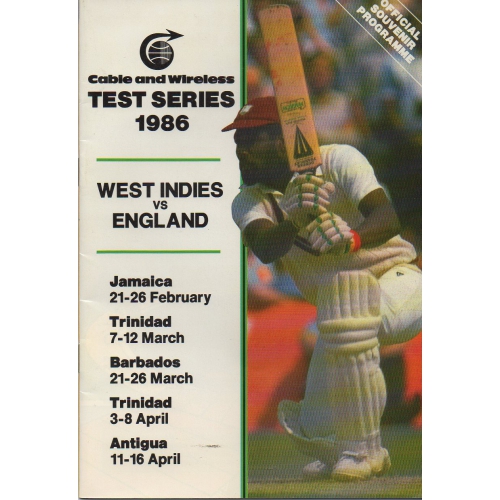
We left the England team a quivering mess. Having been dismissed in Barbados, the series score was 3-0. England faced the fourth test in Trinidad, having lost the second there, and then the finale at St. John’s. The Blackwash was on for a second time. The England team were falling apart at the seams, and morale was at a terrible low. Most of this was centred around the off field relations between Ian Botham and the press. The infamy of this clash is still recalled, because if you play word association with Botham and Barbados, the somewhat less than pristine state of a piece of bedroom furniture generally pops into my mind.
“Optional Nets”?
David Gower, in his column in the May 1986 Wisden Cricket Monthly, commented on the allegations..
“To catalogue the list of allegations against Ian Botham would take too long, and the man certainly has had enough strife on the field out here without having to worry about some of the stuff that has filtered back from home or been thrust under his nose by inquisitive hacks phoning through at five in the morning local time.
This is not the place to try to solve these individual bugbears, nor must I give the impression that all this happens every day as a matter of course. In discussion with colleagues and the gentlemen of the Fourth Estate, the concept is emerging of cricketers now becoming more like pop stars in terms of media treatment. John Jackson of the Daily Mirror, when questioned by BBC Sporstnight, quite happily and honestly admitted that extraneous Press interest was going too far, but. equally honestly suggested it will have to be accepted more and more as time goes on. If this pop-star status is to be officially conferred on us, perhaps the TCCB should be warned that we shall need £1m up front plus a share of all album sales before our next “gig ” at Lord’s.”
This was typical Gower and why he lost the press. He didn’t play their game, but also didn’t appear to take the game that seriously. In trying to laugh off what was a bloody awful time between press and players – and yes, today’s players ought to recognise that (and in the context of Pringle’s piece in TCP too) – he didn’t take umbrage in an overt way as he might have to “protect his players”, nor antagonise those “gentlemen of the Fourth Estate”. His rallying cry at the end of the piece is pure Lubo.
“Lest I be accused of ending on too flippant a note, let me just say that as ever we still have work to do out here, and intend to carry on trying.”
Stephen Thorpe, in the same issue of TCM, starts a piece rather over-dramatically but captures the moment:
“He’s gone on record as saying he doesn’t read newspapers any more. If he’d read them over March he’d be close to suicide now. Those who know hims best say he is affected, but rarely ever shows it.
Botham had been accused of taking hard drugs, bedding local “beauty” queens and hardly tasting sobriety throughout. You had to be there at the time to know how vociferous these attacks were, and how big a personality Botham was in the game. It seems scarcely credible now the game is hidden behind a paywall and there is instant news everywhere.
We can study this a bit more at length in due course, but I think we must sum up the final cricket action of the tour.
England may have still been in the ODI competition, but the fourth game of the series was the end of that hope. Played on a wicket described in the B&H Year Book as a “slow wicket”, Tim Robinson took 40 overs over a score of 55, and in the end racked up a score of 165 for 9 in 47 overs. Haynes made 77, Richards made 50, both unbeaten, and the hosts completed a series win in 38.2 overs.
The fourth test started four days after that, and the wicket I recall John Emburey said he was looking forward to bowling on in the hopes a second go around at Queen’s Park Oval might take spin, was not quite what was expected:
“No blame could be attached to the England side for their batting display in the first innings. They asked to bat first on a coarse, green wicket where survival was precarious and life dangerous. It was disgracefully under-prepared for a Test match although, obviously, highly suited to the West Indian pace attack.”
The Almanack was hardly less vociferous…
The pitch, a hotch-potch of thick grass and bare brown patches, was described as the greenest ever seen in Port-of-Spain. It was two-paced, uneven in bounce throughout, and after two days criss-crossed by cracks. On the third morning when, under the supervision of the umpires, groundstaff shaved off an eighth of an inch of grass, the resultant clippings weighed about two pounds. England’s cricket lacked distinction, and not only with the bat, as Thomas’s analysis makes clear. But what remained of their fighting spirit had undoubtedly been diminished by the seemingly calculated nature of the pitch’s preparation.
I do recall the commentators on the radio mentioning how green the wicket was. But England would hardly have wanted a great batting surface, because there had been a few of them in 1984 and it hadn’t made a difference. Perhaps if we bowled well, it might be a leveller? Ha. Wishful thinking.
England made 200, with Joel Garner the pick of the host bowlers, taking 4-43. Robinson was out early for 0, Gooch out for a stodgy 14 an hour and a quarter later, and Gower had preceded him, caught behind. At 31/3, with Big Bird rampaging through the line-up. disaster awaited. A recovery was put in place, as Lamb and David Smith put on 92 for the 4th wicket, with Smith falling for 47, Lamb for 36. Botham added 38, but the tail provided little value added, with our own Rupe making just 7, and England scraped up to 200.
The West Indies, playing on the same coarse wicket, made their innings count. In their score of 312 there was one half-century, made by VIv (87). England looked to have got a foot back in the game after the WIndies passed 200 with just three wickets down, as they took three wickets for 5 runs and the hosts were 249 for 7. A 50 partnership between Harper and Holding took the game away from England, and the deficit of 112 looked too much. One good response though came from Ian Botham who took 5 for 71. This contrasted to his new ball partner, Greg Thomas, who had 101 runs taken off his 15 overs. Viv’s 87 off 11 balls transcended all other efforts, and it would prove to be too much.
England may have had some hope entering Day 3 – a mere 71 behind at the time – but this was extinguished. The Yearbook spares nothing in their view of our performance:
“England now proceeded to give one of their most miserable batting performances in many years as they showed neither technique nor willingness to cope with high class fast bowling. The misery began third ball when Gooch mis-hooked. Robinson, the gap between bat and pad growing each innings, was bowled. Patterson left Gower stranded with quick movement and Lamb fell to a ball which pitched on middle stump and hit the off.
Holding bowled beautifully and had Smith LBW to an inswinger, the batsman offering no stroke. Willey had looked increasingly vulnerable as the tour progressed and, not surprisingly, fell to Marshall. Botham was taken at cover, and Emburey lost his off stump. Garner accounted for Foster and Thomas.
England were all out in 38 overs….”
Here’s the Almanack summary…
Once Gooch, hooking, top-edged the third ball of the innings straight up in the air, England never looked like overcoming their deficit of 112. Robinson, bat crooked and far away from body, was bowled off the inside edge for his fifth single-figure score in six innings in the series; Gower was adjudged lbw when he turned his back on a short ball, bowled over the wicket, which kept low; Lamb was beaten by a great delivery from Patterson which pitched on middle stump and struck the top of off. Hard enough to play in conditions favouring the bat, as in 1984 in England, the quality of West Indies’ pace quartet made for something less than gripping contests on pitches such as this.
England were bowled out for 150, and the West Indies polished off the 39 required in 5.5 overs to go 4-0 up. Desolation. Beaten inside three days, it just meant we had longer to wait in between times for the final coup de grace. Off to Antigua and to another Blackwash. Surely.
Gower had received a nasty blow in the second innings of the 4th Test and only made himself available on the day of the 5th Test. David Smith, who had top scored in both innings for England in Trinidad, was ruled out with a back injury, and Gatting, back from both injuries, returned.
B&H showed our mindset:
“The England management had rightly complained to the West Indian authorities about the pitches on which they had been asked to play the Test Series for they were invariably wickets on which the bounce was uneven.”
We were a bunch of bloody moaners then too.
Gower won the toss on a belting wicket at St. John’s (plus ca change) and then decided to put the hosts in, believing the only opening you might get would be early moisture. That proved optimistic and our bowling and fielding did not back up that insertion. Botham dropped Haynes off Foster when he was on 2, and dropped again off Emburey when on 38. Dessie went on to make “a sober hundred”. Haynes made 131, but again the West Indies top order didn’t fire fully, with Greenidge (14), Richardson (24), Gomes (24), Richards (26) and Dujon (21) all getting starts and all getting out. West Indies were 281 for 6 when the top order had gone, but this was the start of the malaise in this match.
The lower order launched “a violent attack”, and took the game away. Malcolm Marshall made 76, Roger Harper 60 and Michael Holding made 73. 474 all out after a barrage of shots and a dispirited England looked set to lose by an innings again. After all, who gave us an earthly of making it to 275 to avoid the follow on?
But England did. They started really well, with a century opening stand. Wilf Slack and Graham Gooch both made half centuries as we reached 127 for 0. Both fell in the space of five runs, and it was then left to the Captain of the Sinking Ship to try to avoid the rocks as he made England’s highest individual score of the test series. His 90 took us past the follow-on early on Day 4, and there was, at least, a sigh of relief. Maybe a draw could be established. They passed 275 with seven down, and then eked out another 20 after Gower left the scene to finish on 310, and a deficit of 164. The Yearbook made another point…
“Marshall then subjected Foster to some unwarranted, unnecessary, uncensured and vicious short pitched bowling accompanied by the fast bowler’s glare, as England added 20 for the last week.”
We didn’t half moan.
Obviously not in Antigua. But It’s him…
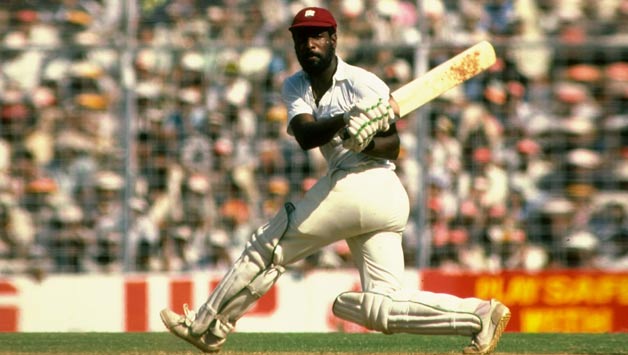
What followed was the stuff of legends. England had one aim in mind, to contain and delay the declaration. The West Indies had one aim in mind, to score, and to score quickly. Greenidge had been injured and so Richardson opened with Haynes. They put on a brisk century partnership, before Richardson fell to Emburey for the sixth time in succession. In hindsight getting out the son of Viv probably wasn’t our wisest idea. For in strolled the Masterblaster. 56 balls faced later, and one of the longest standing records in test cricket had fallen. Jack Gregory had made the previous fastest test century in 67 balls in 1921-22 against South Africa. Viv raised the bar.
“From the second ball he received Richards hit a six.”
“From 35 deliveries he made 50.”
“From the next 21 deliveries he made another 50.”
“The massacre of the England bowlers ended when he declared after reaching 110 from only 41 scoring strokes.”
“…did not play a false stroke in an innings which intoxicated his home crowd and stunned his opponents who could only pay homage in awe at the man’s brilliance.”
Wisden was equally as fulsome:
“Richards’s display, making him the obvious candidate for the match award, would have been staggering at any level of cricket. What made it unforgettable for the 5,000 or so lucky enough to see it was that he scored it without blemish at a time when England’s sole aim was to make run-scoring as difficult as possible to delay a declaration. Botham and Emburey never had fewer than six men on the boundary and sometimes nine, yet whatever length or line they bowled, Richards had a stroke for it. His control and touch were as much features of the innings as the tremendous power of his driving. As can be calculated from the following table, he was within range of his hundred six balls before completing it (with a leg-side 4 off Botham), while from the time he reached 83 off 46 balls there had been no doubt, assuming he stayed in, that he would trim several deliveries off J. M. Gregory’s previous record of 67 for Australia against South Africa at Johannesburg in 1921-22. The full innings went: 36126141 (24 off 10) 211 412 1 (36 off 20) 112 2111 (45 off 30) 1 1624441 (68 off 40) 12 664612 (96 off 50) 21 461 (110 off 58).
Plundered in 83 minutes out of 146 while he was at the wicket, it had to be, by any yardstick, among the most wonderful innings ever played.”
England showed real signs of distress, and in the short period of play that remained that day Wilf Slack was bowled and Robinson run out (ending a wretched tour for one of my favourite players of the day) to leave England 33 for 2.
I remember little of the hundred other than its sheer inevitability. I was at school, it was a Tuesday, and coming home the carnage was starting. I didn’t listen to it. I couldn’t. Richards was a majestic player, and watching him was something else, but listening to him tearing us apart was not something I wanted to subject myself to. Viv was Viv. Nothing else to say.
England commenced Day 5, almost an achievement to savour, with defeat not a total inevitability. Likely, but not inevitable. Gooch was there, our only international centurion of the tour. Richard Ellison was nightwatchman, and he’d shown stickability in the first of the two tests in Trinidad. Gower had made 90 in the first innings. Gatting might be able to get some form back in time to salvage a horrific experience.
And it started really well. Ellison stuck with Gooch until nearly lunch. Ellison fell, having been out there for two hours and faced 76 balls. The pitch had a little bit of low bounce, but no real demons. England might do it. Then Gooch fell shortly after lunch, and the house of cards collapsed thereafter. Gower made 21, but Lamb and Gatting went for one run each. Botham reined himself in, but the game was slipping away. Wickets fell. 84 for 2 subsided to 124 for 6 and the game was up. When Downton, who according to the Yearbook “had been lucky to hold his place throughout the series” (truly a difficult winter), was dismissed, LBW to Marshall (there’s a difference between the Yearbook and Wisden as to who the last man out is – Yearbook seems to suggest it’s Emburey, Wisden says Rupe. Rupe fits the story the best), the second Blackwash was complete.
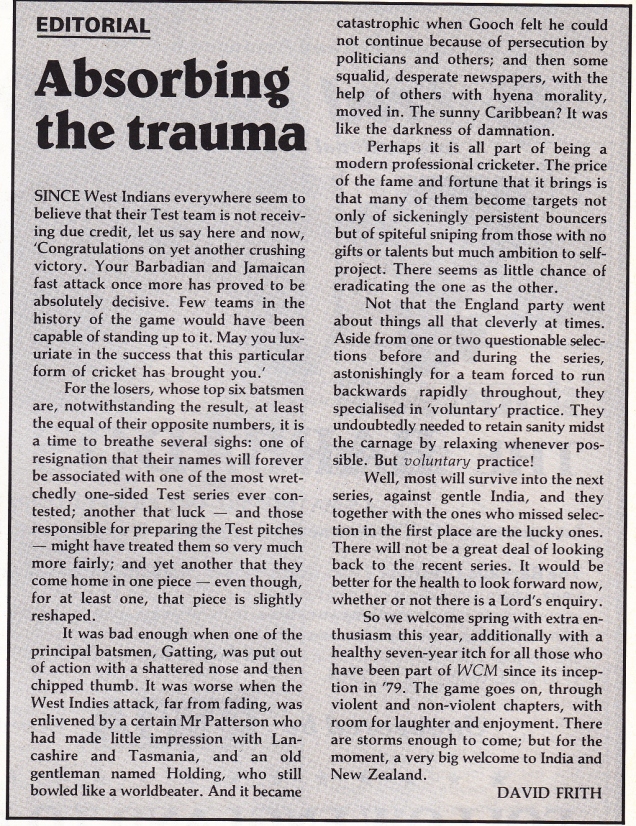
We will finish the story in a wash-up, but let me give you a taste of what is to come. David Frith in WCM wrote this, I think, mid-series. It sums up the age very well.
Note – Sean has a post below, and I’ve stuck a new one up as well. But I need to set up tomorrow’s game…
An early start for this one, as England seek to solidify their position going into the final round of games. Despite the fantastic win against South Africa, the chasing down of a mammoth total did not do a huge amount for the net run rate, and so it probably means that to qualify we will need to beat Sri Lanka and hope South Africa lose to West Indies or give them a huge beating (assuming South Africa beat Sri Lanka, of course).
There’s the danger. Afghanistan are not to be treated lightly. England can be vulnerable to non test playing nations in these competitions. We can’t assume a team that puts up a spectacular performance like they did with the bat on Friday, can just repeat it. England should win, but it doesn’t mean they will win. The unspoken words are that we don’t need to just win, but win very very well.
Comments below, as per usual. After this game we’ll see where the land lies. We have Sri Lanka to play on Saturday, and then we have to wait for three other games in the group to play out. We’re by no means certain of qualifying even if we win the last two games.
And I’m noticing that I’m still using “we” for England. It’s still there. Somehow. Lord knows the authorities that run our game don’t deserve it.
I know I frequently say this blog (in my posts) is written to represent my views only. I don’t wish it to be representative of anyone or anything. But I have to recognise there is a loyal band of readers, and that I need to keep interesting stuff coming to maintain this blog. So I had a number of questions.
Who, or what are we? Why does this blog continue on its path? What is there for people to discuss now the KP reinstatement debate is closed for good.
We’ve lost, haven’t we? As evidenced by….
There’s a major international competition going on, and yet the key theme here is that people cannot be bothered with it due to ECB/ICC stuff.
There’s an England team that has just performed the remarkable, chasing down 11 ½ an over to win a World competition match, and people are still talking about a batsman who isn’t there.
There’s a world competition going on, but people on here are talking about the teams not there, the organisation, the scheduling and the weather.
There is now a relative calm around the England team and the media feel it, but there’s still anger about key reporters, their “agenda” and their actions.
It’s March 2016 and not January 2014. These issues are still there, even if they are wished away.
This blog has discussed to the extreme what has happened in the past 26 months, in both its guises (HDWLIA and BOC), and seen an ignored writer (I’d been blogging for years) pick up “followers”. It has responded to every setback with an anger that can make those outside believe that its fanaticism, for want of a better word, is dangerous, pathetic, sick even. I’ve picked up critics, of course I have, but their vehemence against “us” did surprise.
I don’t see this as a cricket blog. Not in the sense those outside want a cricket blog to be. They want it to be about nice things, positive things, lovely things, places where you aren’t challenged, places where you find “writers” not bloggers. I find much of that writing tedious, but fully recognise that there is a wide audience out there who lap up those sort of articles, playing on their nostalgia and glorious memories of the past game, and reflecting it in the more brutal crash, bang and wallop of much of today’s cricket. Some are truly magnificent at this genre. It’s not for me. I wouldn’t go on their blogs to tell them. I recognise that there are all sorts out there. There is lots for all tastes.
I see this as a blog about someone who watches cricket, loves the sport, but who can see not much good in it at the moment, and in that I share some of the looking back to the past that others focus on. I see this is a blog that widened its scope from one decision in January 2014, to a look at those making the decisions, those reporting the decisions, and those authorising the decisions. We do match reports, we do match previews, but we’ve not the time, or the inclination, to try to emulate other blogs who go the extra mile, or the dedicated sites that do this better than us. I work five days a week. I spend four waking hours at home each night. I have other interests. Cricket is competing for space. In not just my life, but other people’s. Weekends are to do the jobs we can’t do in the week, or to go out. Running a full time blog requires dedication and motivation.
It seems to me that we need to think about the direction the blog should take. Chris and I had a discussion about this a month or so ago, and came to few conclusions. We react to events and give our take on them. I was much more pushing the KP line over the past two years, but Chris and I both agree that’s pretty much over. His treatment will always be raised, but what happened with our media must not be forgotten. That line, though, doesn’t lend itself to a continuous blog writing experience! There needs to be something more.
I have watched, and read, the numerous comments on this blog recently over the BTL comments in The Guardian. At the start of my ever so humble rise, I did go BTL, especially as Clive and NonOx were linking me on there. I stopped pretty much after Bertie Wooster described my posts as having poor grammar (you know my rule, draft, post, polish), which is fair enough. My writing style has always been Marmite, back to my school days. It isn’t going to change now, and my former English teacher is an occasional reader and hasn’t told me off for it yet! But Bertie also said he couldn’t read the posts for the bile on the screen. And that’s been a really convenient hat to hang on me. I’m bilious. It’s all about the bile. From that moment on, I thought it wasn’t worth it. I may have the occasional sortie on there, but I honestly can’t remember them. Bilious ain’t my style. Persistence is.
Since that date the schism, a word I love, has been stark. Those that still believe not a single thing has changed in the decision-making process that is the ECB, are given the KP Fanboy tag as a reason to explain away the miscreants in their midst. As if wondering how an England cricket legend, and he is, could be sacked and no-one told why, is something for blind rage and anger management patients only. By challenging the status quo, and the unforgiveable lack of inquisitiveness in our normally nosey keyboard clankers of the press, we’ve been labelled all sorts. Just the mention of a review of the media in these here parts has some outside wailing, insulting, denigrating the work. Even before it’s written, in some cases.
When I set out on the KP path, it was very much press focused. I reacted to piece after piece. I don’t really do that any more. I was thinking of starting it up, but in a much more thorough way, but then decided not to after the incident earlier this year when the groundwork was too much to continue without having to deal with extraneous matters. It was also very boring for me.
I have, though, been following a lot of the BTL stuff with amusement and amazement in equal measures. It is clear in the eyes of some that they have “won” and that the “KP Fanboys” can now just shut up and form whatever odd little tribe they like. Because the ECB and their compliant press have managed to weather this out (and I’ll bet when they started they didn’t think it would take two years) they are now “in the right”. It’s unedifying, and it’s also wrong. It is a Pyrrhic Victory, just as getting KP back into the side would have been. The damage to English cricket support may not be great in terms of numbers, although I think the people this has alienated are passionate fans who no sport can do without, but it’s a deep wound inflicted and there’s little sign of peace. Now a number of our gazes are at Mike Selvey, his words and deeds, his defenders and his critics. There are many on here who probably cast Selvey above Clarke as our Number 1 “enemy”. There are a number who are saying this pro-Establishment line is typical of the “new Guardian” (in the words of Chris Morris, who said this of Mark Thomas, I think the Guardian are more the harassers of the office secretary than true authority). I’m not sure. I don’t know why this has happened, but it has.
Mike Selvey utterly bemuses me. It’s not anger I feel, at all. It’s contempt, and that’s apt because that’s what he shows to anyone who goes up against him. I’ve taken the advice of those who said that I should stop reading Paul Newman if it upset me that much, and applied this to Selvey. He has nothing to offer me. I know he has let down many of you, who thought he was “more than this”, and that’s reflected in his dominance in our “Worst Journalist” poll. I don’t tweet him, I don’t read him, and only react to the comments on here when I need to. I did, for example, read his piece on T20, which was, frankly, something we could have all done with the access. And that’s it. He has the access. Not many of us are mates with a former England bowling coach. When it’s raised to me that I don’t know how journalism works, I do smile.
But Selvey and the Guardian’s frankly moronic comments policy (and the ludicrous reactions of the journos when criticised) aren’t enough to sustain us going forward, are they? And this is where I begin to get concerned. I’m nowhere near as enthusiastic as I was. About the game, about what surrounds it, and about writing about it. At this stage, the critics will be more than pleased, because they’ve done little to put a case to us, let alone persuade us to change views. It hasn’t been a dialogue of mutual respect, that’s for sure. But at some point, as I said when I gave up a voluntary role a few years ago, if you keep banging your head against a brick wall it does start to hurt.
I don’t want this blog to ever be boring to its client base. I don’t want to mail in posts more frequently than the current rate (20 questions being a case in point – a whim, a post, and lots of response). I respect the core readership much more than that.
I’ve rambled on and on as usual. I think you get the picture that the future isn’t clear. It rarely is. I don’t want this to be just a rant at the press, anti-Cook blog. We need to be more constructive. I’ve said it countless times over the past two years, if you want to write, and it fits what we want to do, then fire away. We don’t do satirical stuff, we don’t do poetry… I’ll leave those to SgtCook and the Bogfather! But how you feel, yes. We do that. What you think. We do that. Challenge us, we’re more than fair about it. I had a discussion a few weeks ago with someone very close to Andy Flower – we never came to blows, never even rowed. I’m not some obsessive, and I’m also going to stand my ground if I feel fit. I had a drink with him. We got on! I think some people need to realise that.
The blog won’t be going away. It just lacks a focus at the moment. One thing that the last two years has taught me is that something to concentrate on is never ever far away. We’ll be here to comment.
Been having laptop issues, and writing posts on the tablet is a real pain. Plus, it’s a weekend and I have other things to do!
England’s victory, which came as a great surprise to some, but as evidenced by my tweet midway through the South African’s innings, was fantastic. The theory I have is that by scoring 230 to win it does rather unclutter the mind. It’s put the pedal to the metal and have a real old go. So in the same way South Africa chased down that 430 odd those years ago, by going for it from ball one, so did we. And that’s the flip side of this new attitude. Plenty of column inches were devoted to the lack of sense this team showed towards the end of the South African series, and yes, that might be fair when setting a total. But when chasing, you have a less cluttered mind. It’s focus 100% on giving it a lash from the start. Jason Roy did that, Joe Root played the superstar innings we like to see from him, and the others (with perhaps the curious exception of our captain) maintained the pace. It was a top win. I’m not going to pretend any otherwise because to do so would be having an agenda, and that’s not me. I’m so fed up with explaining the wilful misrepresentation of my position, but I’ll say this – the performance on Friday does not neutralise the argument any more than Wednesday’s supported it. I will always say this country puts character above talent.
We have a bit of a break before the next game, so add your comments on the current matches on here. I saw AB’s 29 off an over this morning, and felt for Rashid who was getting all the plaudits on Twitter! I’ve just seen Cloete’s LBW decision on Dilshan and laughed. I defend umpires, but good grief.
Have a good week. I have a guest post from Sean B on the stocks which will be up later, as he discusses the T20 and other world cricket perspectives. It’s a good one.
As I said, the laptop is giving me some grief, so do bear with me.
I haven’t been on here much in the past week. Basically I’ve had to take a very important decision in my personal life, and now it’s finalised, I can sort of concentrate on the blog again.
Providing that I give a stuff.
Sure, we’ve had the smoke blowing up the England team’s arses from the lot out there, and back at base, and while some of the big beasts are sitting this tournament out, there is still enough Farby to go round. A human energiser bunny, a man who could find the bright side out of a foggy day, Farby is doing the old ra-ra, and we’re supposed to be going loco with excitement. Straussy gets his props too, as the visionary who told England to stop being shit at limited overs cricket, and bob’s your father’s brother. Simples.
Tomorrow is a decent test, but as was shown today, anything can happen in T20. I won’t be watching as I’m still gainfully employed, but feel free to comment below – as you lot do!.
Thrilled at the reaction to the county cricket piece! Won’t be bothering with that again for a while!!!!!
In all seriousness, it has been a hell of a week. Blogging was the last thing on my mind. There were so many thoughts going through my head that I really paid no attention to much of anything outside of family and decision-making. I put those two posts up last Friday and it is interesting to see what gets the attention and what doesn’t. I hope people understand that I can’t do this as regularly as I maybe was one or two years ago, partly because the material is harder to come by, and because the enthusiasm for the main team I write about is at an all time low.
But we’ll struggle on. Have a good evening, and for those watching the cricket, enjoy!
I’m a reasonably contented admirer of Lord Palmerston when it comes to my Victorian history. So much more interesting than Peel, Gladstone and the others around that time. A bit of the old Gunboat Diplomacy…. Without going all FICJAM on you, I commend his response to the Schleswig-Holstein question to you…
“Only three people have ever really understood the Schleswig-Holstein business—the Prince Consort, who is dead—a German professor, who has gone mad—and I, who have forgotten all about it.”
I feel much the same way about the English cricket summer. For Schleswig Holstein read what to do about Leicestershire? It is a question that, simply, cannot be answered. We have inherited a long, historic structure of 18 counties we would not replicate now if starting a competition. There are variances in size. A solution cannot be found that will satisfy all parties.
“We want less cricket” say many of the players, but like their peers in other sports that won’t be matched by “we’ll take smaller salaries” which is the logical consequence of a reduction in productivity in these modern times. “We want a T20 series with all the stars, in a block, with franchises” say the progressive looking so and sos who see and smell a quick buck. But the counties see their golden goose being taken away after building up the audiences the past couple of years, each time those calls for T20 to be “sexed up” reaching a crescendo after the Big Bash concludes and our retinue of shiny toy merchants, probably including me, want to see us imitate it. The ECB have elongated the season so that the county championship starts in the first rather than the latter weeks of April, and that it finishes a lot closer to October than I might recall it doing so in the past. Then there’s the tricky old issue of the other competition. The not 20, not timed, format. 40, 45 or 50 overs. Played in a block or throughout the season? Played when? Where? How? Who cares? Why?
From 1905 the County Championship had 16 clubs. Number 17 came in 1921, number 18 in 1992. In 2000 we went to two divisions with three-up, three-down. This was too much sporting meritocracy from those who wanted “long-term planning” and was reduced to two-up, two-down. We’ve had the Sunday League, the B&H Cup (55 overs for a long time, 50 when it finished and with a mid-season final) and the 60 over cup which had that first Saturday in September final. There were play-offs in the 40 over comp, some other odd formats based on where you finished in the county championship for the 50 over comp. We’ve had short season T20s, 16 game pre-qualifying T20, and 14 games (where it doesn’t seem to matter that this is disjointed, but the sanctified County Championship does). The County Championship has been three days, three and four days, and now all four day cricket. It was never everyone home and away in the 18/17/16 team days (Can’t vouch for the latter back until 1921). There were fixtures a week in the CC for the entire Summer, until recently when they were bookended by and large at the ends of our season. We’ve had two universities, then six, then lord knows what. We had a pure knockout cup, and one with group phases. We’ve had leagues in limited overs. We’ve had absolutely bloody everything.
I am the first to rail against the “sport as a business” mantra. The sport needs to sustain itself as a whole. It needs to provide an outlet for talent to grow and develop before it reaches international standard, and it needs to do that in as cost-effective, but long-term way that it can. Those two ideals rarely coalesce. I’m reading “Barbarians At The Gate”, a book about the leveraged buy out of RJR Nabisco in the late 80s, and it’s plenty of making lots of money, but absolutely eff all to do with long-term growth. It’s short-term wealth and share-prices, and long-term well…… we’ll deal with that when we get there. That’s the times we live in now, kicking the can down the road, and hoping to get through another season. I said in a Tweet a few days ago that you can’t solve the glorious beast that is county cricket. Once we get that through our heads, then we can deal with what we have.
The one part of the equation that never seems to get called into question is the players side. We see many a survey complaining about their workload, that county cricket loses its meaning, that it’s a treadmill, flitting between format. OK. So they’ve said they want to work the system into blocks. They have their wish, supported by Director Comma, another of those brought up on the system of county cricket, but not so keen to laud its qualities once he got to the international limelight – see also Atherton, Mike. It does have considerable qualities. The standard, by and large, isn’t all bad. Overseas superstars didn’t come over here to experience our cold Aprils, our magnificent May ambience, or the leaf-fall of early Autumn. Mr Rabada isn’t coming to Canterbury for early season high jinks. It is a great school of learning, even now, when the top stars don’t come along. The T20 competition, much maligned, although not the unmitigated success some of its key plaudits would have us believe, isn’t a bloody disaster either. It seems we’re more interested in dressing up a competition to flog overseas (a la Big Bash), than one that works. And the Blast has posted increased attendances. Friday nights worked. There were good games, with good players, and crowds seemed to like it. It’s not for me, but then that’s not who it is aimed at. Matt Dwyer, the ECB’s recruit from Australia to get participation levels back up, said this in an article for All Out Cricket:
Here we get into the debate of TV coverage, which is a very separate topic and one with a life of its own. T20 in a block is for the players, it is not for the fans. As many point out, if a team has 7 home games in two blocks spread over, what, three weeks, at £20 a pop per ticket, how are families, who they want to attract, going to be able to watch all of them without a significant reduction in ticket prices. Those same ticket prices that counties depend on, and can be spread out more easily over fortnightly periods by and large, for their core revenue? I could make the flippant point that it isn’t about the international team, as we don’t choose our international T20 team on merit, but it’s about a route by which counties can better self-fund. They still need the revenues from the test and other international arenas, but it’s a way for them to contribute better. It’s damn easy for Yorkshire or Lancashire or the KPs to bang on about “franchise cricket”, but they have no plan for how those below that amazing height are going to keep the international cricketers, test cricketers of the future gainfully occupied.
I’ve seen mention of a pooling of resources, but that over-arching care for all attitude left these shores in all sporting formats long ago. Football fucked over its have-nots by making the Premier League for the benefit for the 8 or so clubs who would only get relegated if they left Tim Sherwood in charge too long, and pooling the perpetual vast revenues among themselves. Those smaller clubs who tried and dared became like Icarus. They got to the sun, paid out mightily, got relegated, went bust. Rugby union has its big club teams, and I’ve no idea of the strength beneath that level. Rugby leagues big prizes seem to reside in the big four clubs at the top of the game (Leeds, Wigan, St Helens and Warrington, I’m thinking). It’s business, not altruism. There will be a point where a Yorkshire franchise, perhaps run by similar people who run Yorkshire might say “hang about. Why should a Derbyshire be getting a cut of my hard work?”. The fact the county championship has 8 test venue counties and Somerset says a lot. It’s probably already happening. I’ve heard it said about my county side, that it isn’t really even a cricket club. It’s a successful conference facility running a cricket team.
Which leads me on to the Championship. Many of us profess to love it. That it’s just a wonderful thing. And it is, and I do. My fellow author isn’t so enamoured. Or so he’s told me. But do I support it? Do I hell. Why not? Because I have a full-time job, and a wife and dog to spend time with when I’m not there, and my wife isn’t a cricket fan. Any days I do go are on my annual leave, and I’m not taking too many of them in the summer for that. When I have gone, I’ve been the benefactor of free tickets. I’ve bought my own food and beverages. Great, at last season’s Middlesex v Yorkshire Day 3, I saw the newly crowned champions, a magnificent fightback by that North London mob, a Toby Rowland-Jones hundred AND I got to meet Mr Declaration Game and Mr Wigmore. A tremendous day out. I hardly contributed to the coffers though. I have stumped up some entrance money in the past, of course, but it’s not going to cover the hourly rate of a jobbing county pro, let alone the top boys. It is not economic. It will never be economic. I’m inclined to say leave it the hell alone. A messing about of the format is going to achieve nothing except annoy some bloody loyal followers of the sport. The sort this lot can’t get shot of in the chase for the Big Bash Street Kids.
I’ve done 1600 words, and I’m no nearer the answer. And nor are the people on the ECB committees and such like. Nor are any of us out there. There is no answer. Like the Scottish football league trying to do all it can to make it interesting, when it’s really only about two teams once the blue lot get back to the top of the pile, there’s no real point. It is what it is. A Big Bash type league isn’t going to do for cricket that the Premier League and all its bombast has supposedly done for football (our recent European club form is lamentable, our national team is pure Championship level in world terms), and deep down, people, you really all know it. You really do.
Me? Leave the County Championship as it is, even moving to three-up, three-down, but not fussed. A pure knockout 50 over comp. Even invite Netherlands, Ireland, Scotland, Denmark whoever to play in it. If it’s 18 teams, then one preliminary round, drawn at random, then a straight knockout with the Final played in June. T20 – well the Blast worked for audiences so I wouldn’t mess with it. This one I’d invite the national teams as well, have 21 teams, 3 pools of 7, each pool winner and second going through and the four best remaining records go into a Wild Card round, a la NFL. The four best records get home draws for the QFs, then there are home semis for the best record, and a Final. But it’s just a pipe dream. They want an 8 team tournament to get the mythical “best players”.
Of course, the national team lays over the top of that, like the hippo on the silentnight bed. Writing about that will be another 1000 words, and it’s late, it’s Friday, and Lord Palmerston is probably right. I’d forgotten about them.


 Being Outside Cricket