In The Year 2028

It is 2028. English cricket is in turmoil. There’s a new report out that says after the 2029 Ashes, England will play any test cricket in May and June, including future Ashes series, and all other test series will cease. India has decided to extend the IPL into a six month competition, with 20 teams, playing each other home and away ending during the Northern Hemisphere summer, and at the risk of the test matches being played by effective 2nd XIs (or 3rd XIs in the case of the West Indies) it has been decided to cease playing test matches. The unspoken word is that key international players like Morgan Owen and Peter Kevinson are about to announce they will playing for the Ranchi Rubber Factory and Ahmedabad Reliance respectively instead of the 2029 Ashes, despite averaging well over 40 in the tests they’ve played.

Meanwhile the eight owners of the “franchises” (the teams were sold by the ECB to raise money after the disastrous 2026 summer, when England held home tests against Sri Lanka and South Africa without the visitors’ top players and crowds and TV audiences tanked) have joined together to announce, a la Premier League 1992, that they were breaking away from the ECB and forming their own English T20 Premier League company to run and administer their competition. Their first announcement after this would be to announce that two new teams would be added to the competition. Liverpool would get a new team, to create a rivalry with Manchester, and a third team would be put into London as the Olympic Stadium had been made available after West Ham had moved out to move back into a proper football ground. Given Lord’s and the Oval had sold out regularly, once the pesky Blast had been dispensed with in the 2022 Harrison Review, it made commercial sense to stick a team there, rather than the competing bids of Newcastle, Glasgow, Edinburgh and Dublin.

As a result of the breakaway, the eight current franchise owners announced that players would not be released for international or county cricket, and that given they were paying these players vast sums of money to pay T20, they would devote their careers to that format. Emboldened by the competition filling stadia throughout the land, the owners knew they held the whip hand. The ECB banned all T20 players from playing international cricket. The players shrugged. Kevinson’s contract with the Southampton Stars, the Ahmedabad Reliance and Melbourne Stars more than covered his needs without playing exhausting test cricket.

The franchise owners negotiated their own TV contract, with Sky taking 90% of the fixtures, and ITV4 having the rest. They also set to capture the internet interest by setting up their own ET20 website where cricket fans could pay £100 for the year to watch every game on streaming video. With all TVs getting their signal via the web, this was seen as more important than selling to a media company. The owners realised that not only could they contract out the technical side to one of the burgeoning private production companies, but it also got to keep all the subscription and advertising revenue for itself. Some people pointed out that MLB had been doing that for 15 or so years prior to the formation of the new T20 league in 2020, but now someone with a clue was in charge, the sport might get into the 2010s in terms of media coverage.

The sport had never had a more visible product, but traditionalists were left in the cold. Having seen the county championship abandoned in 2025 through lack of interest and quality, as many of the better players got minor IPL contracts in the expanded 20 team league, the only route into test matches was to shine in one of the T20 competitions. While Morgan Owen and Peter Kevinson had made sparkling returns, Roy Jason, a perennial scorer for the Kerala Kangaroos in the IPL, and for the South of the River Lagers in the ET20, had flopped in the last tour of South Africa. Graeme Cygnet, a promising young spinner for the Sherwood Foresters in the ET20 and the Canberra Crybabies in the 10 team Big Bash, found that bowling flat darts wasn’t a way to get top players out in tests, and we bemoaned the dearth of English spinners as Rashi Adil had retired the year before.

One problem loomed on the horizon for the ET20, and that was India’s announcement to have another league in the winter months now Test cricket had been shelved. In doing so they would insist that all players contracted to their teams would be to them only. World superstar Kooli Tendravid, a magician in all forms of the game, announced he would be the exclusive preserve of the Mumbai Billionaires, and immediately the ET20 team that had benefited from the relaxing of the Indian restrictions in 2024, the Birmingham Bears, went to the wall. Head of the ICC, Tom Harrison, said from the rented offices in the IPL HQ, that change was necessary to futureproof the game in India, and that the obsessive fanbase created in England needed to adjust to the new world. The following day Morgan Owen announced that he would be signing an all year contract for Ranchi and his putative ET20 team (he rarely played for them), the Marylebone Cricket Club Fancy Dress Party, would no longer be able to play him.

The ICC were left to fill the one event allowed per year in the timeslot assigned. The World T20 would be shoehorned in to the programme in September and October and would be played only in India. It is an annual tournament, with 6 teams representing England, India, Australia, Sri Lanka, South Africa and the winners of a qualification tournament between everyone else, played during the IPL and ET20. Each team played each other twice, before a Semi-Final and Final. Three time winners West Indies had dissolved as an international federation, but Barbados did squeak in as the 8th best qualifier for the straight knock-out qualifying tournament. Their top players, Brathwaite Carlos, Brathwaite Craig and bowler Tino Mediocre, were all playing in the IPL and ET20, earning £500k and more each. When Barbados demanded they play for them for a match fee of $50, they were branded mercenaries for turning it down and banned for life by Cameron David, the head of the Barbados Cricket Association.

Wisden, henceforth known as the Bible of T20 cricket, has shortened to 100 pages and is an online resource only. The real bible has become CricViz, with the stats obsessed franchises utilising the data for the annual draft for new international players. Cricket blogs either looked back in joy at the exploits of Alastair Cook, laughed at the inefficiency of Brian Lara’s backlift, or went to town on Morgan Owen’s Fielder Utilisation Coverage ratio. Paul Newman still maintained Kevin Pietersen should have been sacked, George Dobell had been made patron of the Chris Woakes Charitable Foundation and Derek Pringle and Dmitri Old had a bar fight with their zimmer frames after a chance meeting at the ET20 exhibition at the Olympic Stadium. Mike Selvey and Giles Clarke, seeing what had become of the game, had driven off like Thelma and Louise, pursued by angry obsessives, bilious inadequates and the quaint social media zealots who still used Twitter.

In a sad reflection of the state of the modern game, Alastair Cook, aged 43, scored 205 not out for Essex against Sussex in the successor to the County Championship, the Southern League. He took the attack to the assortment of 30+ and under 20s left playing second tier cricket. When asked why he was still playing, Cook said “you know why? Because I love playing cricket, and batting for more than an hour”. The audience laughed at him. “I once got a century in T20, you know” he added. “That didn’t count” said one media pundit. “It happened before the year 2020. Cricket didn’t exist before then”. That media pundit had ascended to #17 in the cricket hotlist. Below the ten franchise owners, the head of the ET20, a couple of player agents, the MCC (who owned a franchise, a ground and still had a 200000 waiting list), media personality Ben Stokes and head of the IPL, Ravi Jadeja. Simon Hughes had come a long way.

OK. It is a bit hit and miss, and I did it in one take. Some of it might be nonsense. But you’ll be fooling yourself if you don’t think some of it will come true. Like if the competition is a success it will be flogged to owners for cash. That’s how we do things here. Add your own ridiculous thoughts to the comments.


Gambling the Family Jewels

Well everything is bright and rosy in the Garden of Eden that is England Cricket or that is what we have been told to believe by one of our beloved leaders, the vacuous ECB mouthpiece which is Tom Harrison. Dmitri did a brilliant job of deconstructing the various rubbish that the empty suit spewed in his various interviews over the past week, so I’m going to try and not go over old ground, instead I’m trying to fathom what this actually means for English cricket going forward.

Amongst all the corporate language and boring platitudes that were trotted out by Harrison, the most revealing comment was that “There’s a moment when we need to have a leap of faith, and I think we’re very close to that”. So in other words, it’s a case of sticking your finger in the air and hoping for the best, not exactly a ringing endorsement of the ECB’s strategic capabilities by any means. This is the equivalent of going all in on red at the casino table, hey you may be lucky and win the prize or it may come down on black and hence you lose everything – 130 years of county cricket down the drain because you went on a stupid hunch.

As for the competition itself, it more and more seems to be a bodge job with every day that passes. Surely if franchise cricket (or city based cricket, it’s the same thing to me) is what you believe in as the savior of English cricket then go the whole hog, replace the Blast with the new competition and start aggressively marketing it now – county opposition or not. The fact we will still have the T20 Blast in some form or another in an already busy calendar, which will now be viewed as an inferior competition and the fact that the new ‘Super T20 competition’ will take players away from the County Championship in the most important part of the season, thus making that an inferior product too doesn’t seem to make an awful amount of sense to me bearing in mind the investment needed.

The irony of all this is that the attendances at the Blast have been rising exponentially over the past years, certainly in the South of England, with a growth of 63% over the past four years. This might well be down to the fact that the majority of games are held on a Friday night and from experiences attending them myself, it does seem that a large make up of the audience tends to be younger males looking to throw down a number of beers in the sun before heading out for the evening (though quite why you would choose to consume Foster’s at £5.50 a pint in large quantities is beyond me); however the numbers don’t lie, the Blast has continued to see growth. Now I’m not saying the Blast is an ideal format, there are too many pointless games when qualification has all been assured or not, it is impossible to screen more than one game on TV, so broadcasters have to play lucky dip, hence we all got to miss out on Chris Gayle smashing a hundred at Taunton a couple of years ago and the competition lasts too long to get the top draw T20 players to attend. However, I think it would be fair to say that the cricketing world needs another T20 competition like a shark needs a bowler hat, quite simply it doesn’t. This is the crux of the matter, we have simply missed the boat as every Test playing nation has a T20 competition. What was new and innovative when the IPL came into place has become a dull, yearlong parade of mediocrity in the most part. If the ECB had been deadly serious about a new franchise competition as the only way to save English cricket, then it should have done it 5 years ago before all the other leagues started to pop up, not in 2020, when potentially everyone is sick of seeing Dwaine Bravo or Thisara Perera on their screens for 12 months solid and the format is already stale.

One of the most worrying things for me is the lack of market testing that the ECB has carried out. It is estimated that people will travel between 3-5 miles to attend a Blast game, how do they know that more people will travel to a South London Stags or a Manchester Moose’s game? That is obviously a rhetorical question, as quite obviously they don’t, no matter how much money is thrown at marketing the new competition. Then there is the case of actually alienating current fans. English cricket is fairly unique in it’s structure with so many first class teams and many fans are very tribal about the counties they support and rightly so (perhaps the exception is India, who have a large first class competition, but they struck while the iron was hot with the IPL), so how many of these fans are going to pay extra on top of what they already spend to go and see a team that they have absolutely no allegiance to? I couldn’t see myself getting particularly passionate about supporting a South London side and I guess many are in my boat too. Perhaps we’re not the ones that the ECB wants to get through the door, as the ECB is desperate to get kids involved as shown by the “Chance to Shine” programme, which in my opinion is simply a sticky plaster across an open wound. If the ECB is banking on attracting loads of families to attend the new competition as their main source of revenue, then it is a completely reckless gamble. Cricket has been out of the public eye since 2005, with only a select few that can either afford Sky or have family with a keen interest in the sport that have continued to follow the sport. Throwing a few plastic bats and kit at kids, when club cricket and interest in the game has continued to decline rapidly, is a bit like pissing into the wind. Sure the empty suit might think that Jonny Bairstow or Ben Stokes are the recognisable face of English cricket, but if I went to the average state primary school, with pictures of them, then I would bet 80% of the kids have no idea who they are. Cricket has been forgotten, it has become more elitist than ever and more importantly it no longer resonates with todays generation of kids. The ECB sold the future of English cricket down the river for a shed load of Sky’s cash, end of. It is welcoming to hear that the new competition will have some FTA access, but it is 12 years too late. Sure, you might well get some new younger converts, but how many will shrug there shoulders wondering what this weird game is?

Then of course, we come to the money aspect and that is where Mr. Empty Suit, feels he is best qualified, after all he was heavily involved in the sale of rights to Sky in the first place. Harrison is banking on the fact that they can get enough spin going around the new competition to get £35 million from either Sky or BT and he may well be right, after all, there is history of bidding wars between the two organisations; however even if they bank the TV money, they are still projected to lose £15million in the first year. Now I might not be an economist, but if went to my boss with an idea that was going to lose £15million in the first year, then I’d get laughed out of the room, yet this is the flagship competition that is going to save English cricket? I simply can’t reconcile both the figures and the risk here to make it a going concern.

Perhaps a more sensible suggestion would be to take that £15million and properly market the Blast, reduce some of the ticket prices to make them family attractive and use some of that money to take some of the games off Sky and onto an FTA platform. Sure the Blast could do with a bit of a revamp, as with any product that is 15 years old (2 or 3 divisions perhaps as a starter for 10), but it simply shouldn’t be ignored that it is only part of English cricket that isn’t in decline.

Surely it’s better that than recklessly gambling the future of county cricket on a hunch? Unfortunately logic has famously never been something that influences the corridors of power at the ECB. All in on red please.

Just Who Is This Clown?

Tom Harrison
Comical Empty Suit

You know me. I’m calm. I’m placid. Nothing much riles me. This blog has always been about keeping an even keel, being steady as she goes. But sometimes, just occasionally, someone pushes me too damn hard.

And in the past couple of days that person has been Tom Harrison, aka The Empty Suit. Here’s this no-mark’s latest missive from his saintly pulpit:

Speaking as the ECB launched All-Stars Cricket, which aims to get 50,000 five to eight-year-olds excited by the game this year, Harrison said: “The England teams are very clear that part of their responsibility in playing this bold and brave cricket – this commitment to playing an exciting formula of cricket every time they go on the park – is linked to this.

I don’t like unique, Simon H doesn’t like statements, I don’t have a lot of time for either formula or brands, and Mark doesn’t have a lot of time for any of them 🙂 . But this is arrant nonsense, and if I were Trevor Bayliss, or Andrew Strauss, I’d tell this effing bean counter to do one, or I’m resigning my post. If he wants to set the direction of travel for English cricket, then win the job as the absentee landlord coach, his laugh-a-minute deputy, or the man who put the comma into Director, Cricket. Until then, the way they play is up to them whether you like it or not.

One has to think what Alastair Cook must be thinking now. His job in the new England team, and my, we have a new England team every couple of months these days, is to be our anchor man. He has a promising young partner who appears to come to test cricket with an oven ready defensive technique and temperament, and we’ve got an Empty suit spouting off like a screaming child at a Bieber concert!

“Joe Root and [one-day and Twenty20 captain] Eoin Morgan understand their responsibility to be playing exciting cricket for future generations to connect with and for fans of the game to get behind us. It’s a very deliberate strategy. It doesn’t work every time you go out on the park. But we understand that it’s more likely you’re going to be forgiven for having a bad day if you’re doing everything to try to win a game, as opposed to not trying to lose it, which is a very key difference in positioning.”

I want to bang my head against a wall. Look at Australia on the same day as Harrison is uttering this wibble. They’ve played magnificently to draw a test and stay in the series when they could have blown it. Like another team failed to do and did blow it not so long ago. Someone pointed out in the comments that isn’t this opening up players to play so-called “reckless” shots and being able to quote “that’s the way I play”. I seem to recall that not going down too well not so long ago. Not just with the powers that be, but with the media as well. Harrison is not some wet-behind-the-ears media newbie like Downton.

Harrison said it was “100 per cent correct” that growing the game mattered more to the ECB than England winning a one-off Test playing boring cricket.

Then you are wrong. If we win an Ashes test playing boring cricket, then good on us. You won’t be finding me ever criticising the 2013 Ashes team.

We’re in a competitive world now. The reason why T20 blows other ratings out of the park on television and attendances – and this is not just in the UK, this is around the world – is because people want to watch. They know they’re going to go there and see some dramatic cricket, they’re going to see some amazing skill.”

Oh fuck me. In one paragraph he’s given the whole game away. He’s not concerned about cricket over and above everything else. He cares about revenue. T20 revenue. Competitive world it may be, but you are saying you are giving up on tests, and that T20 has to make money to fund it.

“We know that we’ve got a relevance issue with five to eight year-olds at the moment, as many sports do. We know that we’ve got a sport which can appeal to these audiences if we position it correctly and we deliver experiences that makes sense to parents and makes sense to kids.”

So in doing so, we’ll pay no heed to the preachers of the game – the parents, the people who play and run the clubs the ECB seemingly have just discovered since Matt Dwyer came into the fold – who seem to quite like test cricket, enjoy watching it, and would like to actually, you know, get to watch it without selling a kidney for a ticket, or their kids for a TV subscription. He’s still not mentioning the elephant in the room, is he? He can’t be this empty, can he?

Harrison said that the ECB’s controversial creation of an eight-team city-based Twenty20 competition was driven by similar motives.

“We’re trying to connect everything we do with this new audience that we’re trying to attract to the game,” he said, adding that it was about “making sure it’s relevant for mum and the family to go and spend some time at the county ground watching, taking their children along, watching a fantastic, phenomenal, exciting game of cricket”.

And throw the baby out with the bathwater. Make those mums and families travel further, to see teams made up of players thrown together at random, and who will all fly off to play in another league where they are all thrown together at random and rinse…repeat. It’s not putting a lot faith in the competition, it cares more about “individual skill” and “phenomenal, exciting” games of cricket. Watch Day 5 at The Oval in 2005. Watch Day 5 at Adelaide in 2006. Watch tension and pressure ratcheted up to the hilt. It’s what makes the Ryder Cup great. You know it means so much. Playing for England rather than some corporate whoredom like the Premier League, and its fans, have become.

Harrison revealed that whoever won the rights to the competition would have a say on which eight cities ended up with teams. He also disclosed that the ECB’s various rights would be split into packages, with at least one made affordable for terrestrial broadcasters, who have been starved of live coverage since 2005.

“The last time we went to market, we did not have international T20 as a product which was really packaged in a way that excited broadcasters,” he added. “We’ve got the new T20 tournament, which is designed to grow the sport in this country. And that will excite broadcasters. It is exciting broadcasters.”

Notice how the supporters have only been invoked as meaningless children carrying fodder, there to get the mums and kids (patronising as it is that mums don’t already like cricket – my mum, for example, loved it. Breaks my heart she died just before the 2005 Ashes) to come along. But no, the rights winners “would have a say on which eight cities ended up with teams”. This is like someone has put the worst ingredients of every single focus group inspired marketing consultant into a sports authority and then added steroids for an enhanced performance.

Harrison denied that English cricket had become less visible since live coverage vanished from free-to-air, insisting players such as Ben Stokes had “huge profiles”.

Well then he’s a liar as well as a clown.

This article was based on the reportage from the Telegraph article – http://www.telegraph.co.uk/cricket/2017/03/20/joe-root-told-england-must-play-exciting-cricket-even-leads/

Nightmare In Dubai – Guest Post by SimonH

We would all have seen the sudden news from the ICC today about the sudden resignation for “personal reasons” of Shashank Manohar. As if he was reading my mind, our regular scrutineer of all things ICC has put pen to paper, or keyboard to screen, to give his quick take on what has happened today. So, take it away Simon H….

Clarke Book

“The Presidential limousine is turning into Elm Street…. President Manohar is waving…. There seems to be some sort of disturbance in the motorcade…. “

A bright new leader, not without his flaws certainly but committed to taking on entrenched interests and elites with vast power and money, is removed from office before completing his term? His proposed reforms look certain to die along with him? His shady deputy leader is positioned to take over? It may not quite be Dealey Plaza, and nobody yet has been identified firing the fatal shot from the grassy knoll, but it looks very much like March 15th 2017 has seen an undeclared coup (bloodless, fortunately) in global cricket governance.

The first thing to say is that this seems to have come out of nowhere. There had been no hints, no nods-and-winks, that this was imminent. The global cricket press corps, those Woodward and Bernsteins of investigative “proper” journalism, seem to have been completely blindsided. But then it isn’t so difficult to be blindsided if you’re looking in the opposite direction…..

Shashank Manohar, eight months into his two year term as ICC chairman, has emailed CEO Dave Richardson that he is standing down for undisclosed “personal reasons”. Indian media sources are reporting that it was a pre-emptive move in anticipation of losing the crucial vote on ICC reforms next month. Those proposals involved a new revenue-sharing deal that would cut India’s 22% of ICC revenue, the creation of a Test championship that would slash the number of games teams played, the creation of two divisions of 9 and 3 teams with no promotion/relegation, qualification for all teams for ICC tournaments and various other measures. The BCCI needed four FMs to block the moves and have reportedly secured the support of SL, Zimbabwe and Bangladesh. Those boards are apparently against more money for themselves. Some indication of the economics are here: http://www.hindustantimes.com/cricket/bcci-could-lose-180-190-million-in-new-icc-revenue-model-still-biggest-earner/story-YhtzoiMgonO7OJnriqJ7ZL.html

It appears that Zimbabwe have voted themselves out of $5m and the figures for SL and Bangladesh would be several times more that. This, obviously, is not

something you see every day. They are, more understandably, against permanent demotion to D2 (in Zimbabwe’s case) and playing a lot less Test cricket (in SL’s case).

The ICC will appoint an interim chairman until new elections can be held for a permanent replacement. Candidates need to be past or present ICC directors and to be nominated by at least two FM directors. The process seems most likely to carry on into the summer although it could technically be resolved next month. Unsurprisingly, the speculation from UK media sources is that Giles Clarke, known to be ambitious for the job but unable even to secure two nominations last time, is positioning himself for the job. The normally media-shy Clarke gave a rare interview recently: http://www.standard.co.uk/business/giles-clarke-the-cricket-nut-who-swapped-retail-for-oil-on-his-latest-innings-at-amerisur-a3463606.html

Clarke’s ambitions had been thwarted previously by non-Big Three FMs still furious over the 2014 Power Grab. Clarke has recently become a great supporter of returning international cricket to Pakistan: https://www.theguardian.com/sport/2017/mar/06/pakistan-host-international-cricket-t20-series-world-xi-icc

Relentless churls might point out that Pakistan is not safe so Clarke set up his very own Warren Commission to come up with the result that had already been determined: http://www.espncricinfo.com/magazine/content/story/1086672.html

Therefore, we find ourselves today with what was yesterday’s distant possibility having become today’s imminent probability. The LBJ of cricket governance – with all the original’s probity, charm and intestinal fortitude for taking on those with money and power – is closing in on that crown he so coverts. If there’s one thing we should learn about the running of cricket, it’s never to say “it can’t get much worse”.

Back to the West Indies

When you have low key series like this one, there’s a temptation to re-use an old post title, asking whether a tree does fall in a forest if no one is there to witness it, but there is an unquestionable appeal to cricket in the West Indies in its own right, not least to the thousands of British tourists who use the opportunity of a cricket tour to get some much needed sunshine at the end of winter.  For the journalists too, it’s still a plum posting to get following the England team about, irrespective of the cricket on offer.  That’s not to criticise them for that, we all have elements of our employment that are rather better than others, and it’s understandable enough to want to go.

Although England are talking a good game about this tour being an integral part of the warm up for the Champions Trophy (which is something of a stretch) there is some importance for the West Indies given the psychological – but not cricketing – shock of failing to qualify for the tournament.  Moreover, there’s no certainty whether they’ll make the next World Cup given the determination to restrict it to as few teams as possible.  As an aside, it would thoroughly serve the ICC right to lose the West Indies if they didn’t make it just to highlight the stupidity of making the premier one day tournament such a restricted affair.  That being said, it would diminish the tournament if they were not there.

Therefore there is something riding on the series, at least for the home team who have only a further five matches to cement their place in the competition before the September cutoff.  Cricket fans around the world have watched in distress as the administrators and players collided repeatedly and often idiotically over the years.  The former powerhouse of world cricket had enough structural problems to deal with without constantly making things even worse.  The blame game got to the point that for many outsiders, they know longer understood what each spat was about, and more damningly they no longer cared.  Across the Caribbean positions were naturally more entrenched, but at the end of it the despair over the collapse of the international team never seemed to concentrated minds sufficiently to the point where all involved actually felt they needed to do something about it.

Given the conduct of the ECB over the last couple of years it’s easy to be cynical about all attempts of governing bodies – who tend to be anything but – to profess a new dawn in how they will run the game, but at some point the civil war in West Indies cricket will have to end.  It might be too much to hope that they will go from their current mess to back challenging all and sundry in the foreseeable future, but any signs of progress have to be welcomed.  If the ICC’s Big Three takeover is properly reversed, there might even  be an opportunity to make the most of doing so, but it will require an alignment of the all the planets to happen.  In England, Andrew Strauss’s title of “Director, Cricket” has been much mocked, yet his role unquestionably has value if done properly.  For the West Indies, the slightly less marketing department inspired Director of Cricket position has been taken up by Jimmy Adams, who is at least a figure who ought to generate widespread respect for his achievements.

George Dobell interviewed him for Cricinfo, and while words in themselves mean little, his desire to have the best players available – no qualification, no hedging – as a straightforward statement of intent, and that all sides need to give ground is perhaps one of the more promising signs for some time.  Whether it ultimately means anything at all, or whether he becomes another in a long line of people to leave in frustration at the Kafkaesque machinations of all sides is still to be seen, but any and all cricket fans around the world will hoping against hope that perhaps he is the one to really push the vested interests into looking after the wider game in the region.

In terms of the on field action most attention has been directed at the reunion of Ben Stokes and Carlos Brathwaite, following the spectacular end to the last World T20 final.  Brathwaite has spoken about his struggles to live up to that day, and it’s perhaps unfair to have expected him to.  There’s every chance it will be the highlight of his career when he comes to look back on it.  If so, there are worse memories to have.

Stokes himself might be worth keeping an eye on, if for no other reason than it’s either in the Caribbean or with Caribbean players that seems to define so many of his actions, from punching a locker to the repeated clashes with Marlon Samuels – which Samuels, it must be said, won.

As far as conditions in Antigua for the first match are concerned, the pitch appears grassy in places and bare in others, but with a 57 metre boundary at one end, the bowlers are going to have their work cut out to stop it being carnage.  As is so often the case with one day or T20 cricket, much discussion is had about bats, fielding restrictions and so on, whereas actually giving the bowlers a chance in the first place tends to be ignored.

England were pretty well beaten in India – in all formats – and perhaps their desire to put right some of those frustrations will make for a watchable series.  But let’s not pretend it’s essential, because it isn’t.

A Letter From New Jersey

Dear Fellow Outside Cricketers,

I am so sorry you have not heard from me, via a post, for quite a while. As some of you may know my mother-in-law was taken seriously ill in early January which meant my wife had to fly out to be with her, and I’ve come over to lend support etc. for a couple of weeks. This has meant that there won’t be a holiday this year, which means I won’t be disappearing off the site for a whole month or so when the cricket season is in full swing in the UK, but it has meant not a lot from me, save for the odd comment here and there on here. As always Chris and Sean have kept the pot boiling, and, of course, the brilliant guest posts we get too!

It also means that the only ball I have seen of any cricket was a catch by Saha on one of ESPN’s top 10 plays of the day segments. This was, sadly, characterised by the usual lack of knowledge from the hosts who said that India lost anyway, which was incorrect at the time because this was on Day 2 of that test match. Or maybe they had a premonition that a team unbeatable at home were going to stuff it up completely second time around, as they had the first. But a little more of that later on.

On the personal front, the mother-in-law is recuperating in a very decent care facility. The main problem with this is it is 90 miles away from her house, where we are staying, so we are seeing a lot of New Jersey’s road network and I’ve not had a ton of time to devote to cricket. I could write many a post on the plusses and minuses of US healthcare, but that’s for another time. We hope the mother-in-law comes home shortly after I return to the UK (next week), but that’s not entirely clear at this point. I’ve had some down time, and this has coincided with record high February temperatures last week (mid 70s fahrenheit), so I can let you all know that on the same day as Storm Doris, here is a picture of where I was in 75 degree heat..

20170223_123308-01
East Point Lighthouse – New Jersey

So what has happened in the cricket world since I left? Well, of course, most notably, Australia handed India a hell of a thrashing in Pune. I’ve seen none of it, but it is not hard to draw one conclusion – we were handed a pup by all the know it alls who said that India were unbeatable on their home turf, and that 4-0 was a result we really all should have expected. I’m not saying this now, I was saying it then. You talk down a “potentially great” England team like that, you are going to look stupid when another team gives them a game. A proper game. Rajkot should not have been an outlier, but the standard. The ultimate stain on that team, and that leadership, is that a bloke scored 303 for India against them and was dropped the next match. Karun Nair sits there as a total outlier when it comes to test triple centurions. I’m sure history will frame things differently, but the Tendulkars, Dravids and Gavaskars of this world have not made 300. I’m sure they found M25 surfaces somewhere, somehow, in their time in test cricket (and of course, lets not forget England collapsed in a heap on that Chennai surface the following day).

Australia, of course, were a dead team walking after they’d lost the first two tests against South Africa, and the pundits were on BT Sport having a good old laugh, giving the impression that all England had to do next year is show up and the Ashes would safely remain in out hands. I have my own nickname for Australia, and it is the cockroaches. Not because they are vermin, but because when you think you’ve killed them off, that they won’t return, that you are on top of the “problem”, they pop back up again, and return with a vengeance (this is based on my childhood in a tower block in Deptford – we could not shift those bastards. Cockroaches, not Australians). I will never write that country’s cricketers off. They may go on to lose the series, but Australia showed that they would stand up to India. It wasn’t just getting the best of the wicket, because Australia made 200+ after India were dismissed for 105. No-one is seriously claiming that Nathan Lyon is better in India than Ravi Ashwin, or that Steve O’Keefe is better than Jadeja? Are they? It may be, as I’ve not seen the game, that the pitch suited the Aussies better than expected, but it also show some bloody character in the Aussie make-up that we just excused in the English press prior to Christmas. Of course, let us see how the rest of the series pans out. I’m also keen on not jumping the gun and anointing a team a champion on one result, but you have to admit that this doesn’t cast our media’s supine attitude to the Cook Farewell Tour in a wonderful light thus far, does it?

I’ve not really followed the ODI series in New Zealand at all, if truth be told. I also note England are out in the West Indies, in my time zone (sort of) but there will be little chance of seeing anything until I get home. In the following six days I will have at least three, possibly four visits to the care home, which takes out the entire day, and when I do get home there will be some really good NBA games to watch live at a sociable hour, including the Warriors at the Bulls on Thursday. US sports TV is an interesting behemoth to study, with the amount of talk programming, and “embrace debate” stuff that can lurch from totally perceptive to utterly idiotic within a five minute span. It’s also interesting how much football from England we can get on main sports channels. I was in the care home last week with the Watford v West Ham match on.  I couldn’t see the League Cup Final as that was on a less mainstream cable channel (BeIN). Cricket, of course, doesn’t get a sniff anywhere as far as I can see. I sort of know the horror I will face if I ever emigrate.

New Jersey is my second home now, and yet cricket has a part to play in keeping me from it. I would miss not being able to see matches that I want to pay for via some all embracing website that would allow me to do so in one central location – like the US do on NBA, MLB and to a lesser extent NFL – but as I’ve said before, that would require foresight, prescience, vision, altruism and a price set fairly for all. I’ve as much chance of becoming Donald Trump’s Press Secretary than that happening.

Finally, I packed the edition of the Cricketer with the Paul Downton interview in it. I really must finish that piece. I just need to get angry again. Any suggestions.

All the best from South Jersey. Missing England…

20170223_173629-01

Wish you were here,

Dmitri

The Curious Case of Moeen Ali

Sometimes when contributing to a blog, you need to write an article that you would really prefer not to. It is safe to say that this is one such occasion, as I’m going to call for the unthinkable, put my head on the line and say that Moeen Ali should be dropped from the Test side this summer.

I know, I feel like I’m clubbing a baby seal here, but please do hear me out on this one. Moeen is without doubt one of the most likeable and selfless players in the English set up. He has been pushed up and down the order by the England selectors more than I’ve had hot dinners (I believe he has batted every position from opener to number 9). He put his head on the line back in 2014, when England asked him to be their main spinner, when he was at best a part time bowler for his county. Not once has Moeen ever complained about the constant shifting of his role within the England team and that clearly shows that he is a selfless individual, one who is exceptionally proud to play for his country and hence why it is difficult for me to demand for him to be dropped.

Moeen currently averages 35 with the bat and 42 with the ball at this time of writing and averaged 45 with the bat and 46 with the ball over the last 12 months (before our resident stats expert Simon picks me up on this one). So some may question why I would like such a valuable team player as Moeen to be dropped, especially when he scored a hundred in the last Test in India. However, I’m sure we all remember Shane Warne’s observation about Monty Panesar some years ago “that Panesar, rather than having played 33 Tests, had merely played his first one 33 times.” Some felt it was overly harsh, I actually happened to agree on this point at the time. I also feel this quip should also apply to Moeen with both his batting and bowling. Moeen, whilst it’s wonderful to watch his batting in full flow, is just as likely to hole out to cover with a slightly uppish cover drive or to advance down the wicket a whack one down mid-on’s throat. He has been doing this since his Test Debut back in 2014, some 37 Test matches ago. There hasn’t seemed to be any deep thought about his batting and why he consistently gets out playing loose, wafty shots. Perhaps he is of the mindset that ‘that’s the way he plays, so why change when it’s bought him success in the past’ and that could be a fair point. I mean I remember another English batsman who came onto the scene in 2005 and played exciting, attacking and sometimes fairly brainless cricket; however this individual averaged a whole lot more than 35 in his career playing ‘his way’. Unfortunately the said individual liked to whistle when he got out, so that was that for him then.

I could however, live with the fact that Moeen is as likely to nick a wide one to third slip when looking to save the game as he is as likely to launch a sumptuous cover drive to the boundary that should have an R rating to it. I could live with this, if the rest of his game was in order; however it simply isn’t due to one glaring weakness that sorts out the county pro from the Test pro, the short ball. It’s not that Moeen can’t play the short ball, it’s the fact that Moeen really really can’t play the short ball. One only needs to look at the recent series in India, when he bounced out on slow low wickets both in the Test series and then latterly in the 3rd ODI against a 40 over old, soft white ball. The tangle that Moeen gets himself into when facing the bouncer is two fold. He doesn’t seem to have the ability to duck and weave against the short ball, something that Atherton in his prime had a fantastic ability to do, nor does he have the natural shot appreciation to deposit it into the stand such as Ricky Ponting did. This leaves Moeen in some halfway house, where he still has to play the hook but it is likely that he’ll either top edge it or place it down deep square legs throat. It sort of reminds me of Yuvraj Singh’s inability to make it in international cricket, he had all the shots in the book, but as soon as word went round that he didn’t like it by his nose, then every fast bowler worth his salt tried to put it there. We only have to see the results of the 2011 series in England, which pretty much ended his career as a Test batsman. This upcoming year, we have a strong and quick South African fast bowling attack coming to England, followed by the Ashes on quick and bouncy Australian wickets. I dread to think what the Hazlewood and Starc will do to him at the Gabba and WACA, but what I do know for sure, there aren’t going to be that many pitched up deliveries for him to cover drive.

Now this could be glossed over somewhat, if Moeen was a premier spin bowler, but sadly most people now agree that he is what we thought he was in 2014, a part time bowler trying his best to cover England’s empty cupboard of spin bowling options. It is often true that when a new bowler comes into Test cricket, he has a bit of a bounce effect, in that the batsmen haven’t seen them bowl too much and quite often there are a few early wickets on offer as batsmen have yet to work them out. As with anything though in international cricket, coaches soon go through hours of video footage analyzing their technique, their weaknesses and where to target them and hence only high quality bowlers will flourish on this stage. This was true in 2014 when the Indian batsmen kept getting out to Moeen, by whacking him into the stands. However Moeen has now played 37 Test matches as England’s main spin weapon, and it would be fair to assume that he would be able to improve in that time; however sadly, I believe he has actually regressed as a bowler. He has all too often been easy pickings for opposition batsmen, milked around for singles at every opportunity and then waiting for the bad ball (which is often just around the corner) to put away to the boundary, thus making it impossible to build any pressure on the opposing side. Sure Moeen might bowl the odd Jaffa, but that doesn’t help too much when you’re constantly going at 4.5 runs an over. I might be being a tad unfair on Moeen’s bowling, as Graeme Swann aside, we have never been blessed with great spin bowlers since I’ve been following the cricket in depth. We won the 2005 with Ashley Giles as our main bowler, who wasn’t blessed with the most talent of an international Test spinner; however the one thing Giles could do was tie up an end and let our battery of quick’s steam in from the other end with an attacking field, because their main spinner wasn’t leaking 80 runs a day. This is something that unfortunately Moeen is simply unable to do.

It seems folly to me, to head to Australia where pitches aren’t exactly conducive to spin bowling with a part time bowler who can’t keep the runs down. I doubt Dave Warner or Steve Smith are losing any sleep about facing him in the middle. Even with England’s stocks of spin bowling being so diminished, surely it would make more sense to take a specialist spin bowler rather than a part time spinner that has regressed? The likes of Leach, Rayner, Rashid or even Mason Crane might not have that much better results in the short term, but I would hope that they would learn a lot from the experience and hence improve as their experience of International cricket grows. After 37 Test’s, I just don’t see how Moeen will improve his bowling sufficiently enough to be of an international standard.

In my own humble opinion, Moeen needs to focus on improving his batting, certainly against the short ball to lock down the number 5 position on his batting alone or somehow for his bowling to dramatically click for him to start the summer in the Test side. England had a preference for bits and pieces cricketers in the 90’s and we all know how that worked out for them then, I simply don’t see a place for them in a current Test side.

Right, I’ve got my tin hat on..

Viewing Figures – A Ramble Through Facts

We’ve another guest post from Andy Oliver, this time about the viewing figures for cricket over the last few years.  It’s a subject that isn’t easy to find hard facts on given the reticence of Sky to tell anyone how many people watch of course.  As ever with a guest post, our sincere thanks to Andy for writing it, and he’ll be around to answer any questions – or of course you can track him down on Twitter – @oshodisa

Don’t forget we’ve also got Man In a Barrel’s piece about county finances – that you can find here: https://beingoutsidecricket.com/2017/02/17/guest-post-a-look-at-county-finances/


A topic of discussion that comes around occasionally is that due to Sky’s lockout of coverage, there is nowhere near as many viewers of cricket as there was 10 years ago.

How true is this?  Has anyone seen any facts, figures or discussion?  I bow to any MSM who have covered this but I cannot recall coming across that many actual facts or discussion (queue the first reply being a list of 4 articles covering the same ground!).  We often hear that 8m people watched at one point of 2005 Ashes, but no one ever says how many people watched ‘Cooks Redemption’ (TM Nasser 2015) Ashes victory.

A Census Taker Once Tried To Test Me…

I’ve gathered this information from barb.co.uk, so cannot vouch for its accuracy, but they appear to be an industry body and say all the right things.  It’s been interesting seeing what info can be found on their website.  To generate their stats they have something like 5000 homes who provide a representative selection of the population.  These homes have automatic program trackers fitted to keep a log of what is watched.  They are then multiplied up to give a number of viewers and Bob’s your uncle.

The data publically available is not particularly user friendly for this type of research (There is a lot of data that I’ve had to plough through one weekly graph at a time).  I think that each individual result is an average for the duration of the program, rather than peak viewers at any given moment.  For example, the 4th(?) Ashes test in 2005 peaked at 8 million viewers but the program averaged 4 million viewers.  Please bear this in mind as I write below – I may play a little loose with terminology, but unless I explicitly state anything different, I mean the average number of viewers in any given broadcast as reported by BARB (so the 4 million, not the 8 million).  I’ve had to make a few educated guesses where info is not available or a particular programme is off the bottom of the week’s viewing figures.


Only the Facts Ma’am…

Since 2012 we have the following showing the maximum number of viewers any single day of a Test match play received.

2016 2015 2014 2013 2012
Most viewers 497,000 647,000 429,000 805,000 427,000


So it’s a bit up and down, but arguably viewing figures are sitting at an even level with intermittent peaks, but what do they represent?  Well, 2015 and 2013 were Ashes years.  It appears that Australia have a large impact on how many people watch cricket on Sky.

Non-Ashes years appear ‘stable’ between 400,000 – 500,000, but our Australian friends give us a significant boost.

So a bit of judicious reviewing of Australia’s last four visits (including you know when) gives us;


Test vs Australia
2015 2013 2009 2005
Most viewers 647,000 805,000 1,109,000 4,630,000

So, the most viewed single day’s play attracted over 4.6 million viewers (average remember, not peak) in 2005, and this has declined to less than 650,000 viewers in 2015.  Sky have lost up to 4 million people who showed an interest in cricket back when it was free to air on Channel 4.

Where have all these fans gone?

And remember that these are the most watched days of play.  The average viewers for the series shows us;


2015 2013 2009 2005
Average viewers across series 360,444 470,434 668,190 2,760,000


Again, this is a significant decline from on average 2.7 million people watching a series to just over 360,000 people.

So, talking broadly, about half the peak viewers for any given broadcast stay on to watch more of a series than just one day.  This number will be swung by rain days / early finishes – but I would not have thought it would be that significant to massively affect the above.

Why are people not watching as much cricket?  Is it the time it takes (this is an assessment of Test matches remember), or is it the quality of the matches?  Obviously the opposition matters, but why has the number of viewers even for Australia decreased?

Are the ECB aware of these numbers?  Do they even care given that Sky are currently happy to fill their schedules with easy to produce programming and pay the ECB handsomely for it?  Do Sky care given that cricket costs peanuts compared to how much they pay for football?  I wonder how much Sky makes on subscriptions and advertising for their £65 million yearly investment with the ECB.

Let’s take a quick look at the top three viewed broadcasts for the last 4 Ashes.

2015 2013 2009 2005
Top three viewed broadcasts 647,000 805,000 1,109,000 4,630,000
476,000 701,000 1,033,000 4,030,000
471,000 668,000 951,000 3,370,000


This gives an idea of how sustainable the top viewing figures are.  As we can see, 2005 quickly loses over a million viewers, but equally it is just one day’s play that kept the peak of 2015 above the half million mark (no prizes if you guessed that was Broads 8-fer-peanuts at Trent Bridge (I think)).  Both have lost about a quarter of their viewers between the peak and the third place broadcasts.

I presume that this is a normal pattern as there will be peaks and troughs – especially over the course of a test summer, but the raw reach of cricket appears to be significantly diminishing.

 You can’t handle the Truth!

No matter how it is spun, Test cricket attracts fewer TV viewers year on year.  Is this because test cricket it boring (dominated by home series advantage), or because it does not have the visibility of (until recently) the IPL.  At least the IPL was available on ITV 4.  That may be another one to look at – viewers between IPL on ITV and Sky.

In fact;

2016 2015 2014 2013 2012
IPL finals 116,000* 100,000* 536,000 398,000 469,000
77,000 59,000


The IPL changed from ITV to Sky from 2015… hmmm, there is a pattern here!

A note about the Sky numbers – The final match was not on the ten most watched list on BARB (Or I could not find it), so I put the highest match actually watched in that week.  Not perfect, but it’s something to go on.  The 2nd numbers in Sky’s stewardship are the 10th most watch programme in the week the final took place (on the channel they were showing the IPL on).  Suggesting that the IPL final got fewer viewers than 59,000 and 77,000 for 2015 and 2016 respectively.

If that is correct… Wow…   Wow…

For all the good that Sky have brought to cricket; the technology, the quality, the analysis (back when they did that well – but I remember first encountering Hughes as the Analyst on Channel 4, when he did actual analysis properly), etc, they seem to have form for slashing the viewing numbers a sport used to get on Free to Air, and for reducing its availability and visibility.

But, a quick look at the last World T20: when England got Brathwaited in the final.  This tournament was in India so time zones come into play for a start, but Sky got over a million viewers for the final.  In fact England’s lowest number of viewers was 323,000 against Afghanistan on a Wednesday, which is basically as much as the peak number of viewers Sri Lanka got in the May tests which followed soon after.

So maybe there is hope there, that there are people who are interested.

If you build it, they will come…

Maybe we have seen in all the above that the broadcasters/ECB should be using T20 and ODIs as a gateway into Test cricket, not as an alternative.  Not everyone will make the transition, especially when Test cricket is sometimes dry, boring and predictable.

Thinking about that – any guesses for how many people watch the Blast Final (or whatever it was called before that).  I might have come across these at the same time as looking for the above.

2016 2015 2014 2013 2012
Blast 262,000 229,000 384,000 245,000 433,000
Leic 0 v Ars 0 Tot 0 v Eve 0 Eve 2 v Ars 2 SWA 1 v ManU 4 not on tv
BT sports Sky Sky Sky
608,000 691,000 946,000 1,833,000


At least the Blast appears to get more viewers than the IPL!

The Blast final is on a Saturday afternoon/evening so I’ve found the equivalent Premier League game on TV at approximately the same time.

As you can see there is a big decrease from the Premier league viewers to those watching the Blast final, but maybe not as much as I might have expected.  I would have thought more games on a Saturday evening would have got over 1 million viewers, but evidently not.

The football is just a diversion from the above table though.  In reality the Blast figures should be compared with other cricket.  Now making a comparison against Test matches is like comparing apples and oranges, but at least they are still fruit.

As we can see from the above information in 2016 more than twice as many watched Tests as they did  the Blast. That must be a scary stat for the ECB, and it’s no wonder they want to re-tool the Blast into a different competition.

Houston, We Have A Problem…

On a personal note (and one that may be echoed by those who read this), I have seen club cricket slowly wither as people participate less and less.  There are a number of reasons for this (my own personal reason is that I have a toddler now who takes up a lot of my time so I cannot justify spending 15 Saturdays over summer out and about like I used to).

But the number of teams that struggle to get a side out, or fold half way through the season seems to be increasing (purely anecdotal, but it does feel that way).

My village pushed forward on the back of 2005.  That was a watershed ‘rebirth’ of the aging side.  We (the royal we, I wasn’t around then!) had a massive influx of juniors who saw the Ashes and wanted some of it.  They are still playing now and are vital young 20 somethings.  We don’t see that now though.  Most of the Sunday juniors are there because it’s free child-minding for the parents (again anecdotal, but from a senior member of the club who does the training).  Often the kids don’t seem that interested.

Why are fewer people playing cricket?  Why are fewer people watching cricket?  Does it take too much time, do people not like the characters associated with the game (either watching it, playing it or dare I say reporting it)?  Are there no heroes to worship (Mine was Atherton growing up…. No, I don’t know why….).  Nowadays people want to bat like Pietersen, Gayle, Kohli, Butler etc.  This is great – but these talents need to be put on display so that more people see them and want to emulate them.

I’m serious… and don’t call me Shirley

What’s the solution for getting cricket back into the public consciousness?  I’m sure greater people than me are actively working on the problem (or at least I hope to God they are).  I know it’s been discussed on and off here on BOC.

I’m not sure getting Test cricket on FTA TV would work.  Not in the short term at least, however there must be a way to get the Blast or some international ODIs/T20s on there.

I don’t watch Premiership rugby, but usually enjoy sitting down to the World Cup or Six Nations.  I’m probably the definition of a fair weather fan where rugby is concerned.

I would watch rugby because it is available.  If it had been available for me to play when I was younger/fitter I might have gone in that direction.  I don’t hunt down rugby on Sky/BT now.  I don’t have the time nor the inclination, but I do watch rugby free to air; I know about the sport and in the future I might start going to matches & watching more.

Where is the draw for the fans in cricket?

It may not be the answer, but it surely must be the starting point.  Everyone agrees that there are more ‘distractions’ available for kids growing up.  They may not sit down in front of TV and be glued for a day (like I was way back when).  But they are certainly not going to sit down in front of Sky and watch it.

It’s all well and good catering to the hardcore fans (is that us?), who go to games, despite the cost, who pay for Sky, despite the cost.  Just to actually see some action.  But where is the next generation going to come from?  Launching a Twitter channel is not engaging new fans.  They won’t go looking for it without hearing/seeing some cricket.

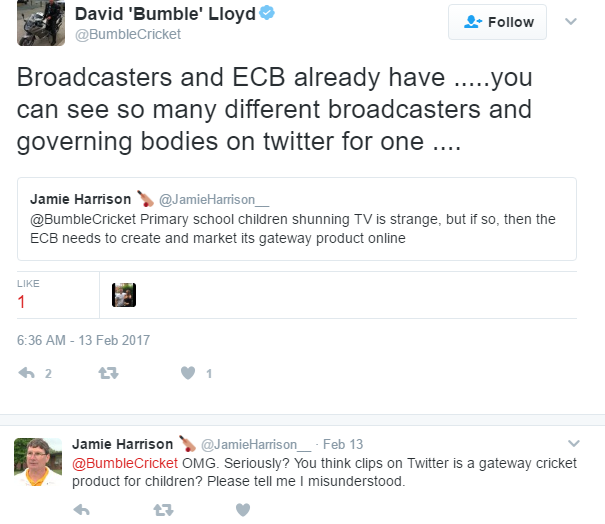
This is a Twitter exchange I happened to see from dear old Bumble.  Don’t know what started it, or the exact details, but it highlights the mindset.  If you put it there, people will come, which isn’t true, you need to make people come.  The only people who check Sky/ECB Twitter are people who are already fans.  This is not enough;

tweet


The ECB need to decide what they want from their cricket.  Do they want Sky’s (or BT Sport’s which is another topic) pounds, or do they want to get more people watching it (live and on TV), more people talking about it and ultimately more people playing it.

You be the jury…

This has been a WWAAAYYYYY longer article than I ever intended, so well done if you have stayed with me to the end.  Please tell me what you think?  I could have gone into early summer versus prime summer, what happened on those ‘most watched’ days, what day of the week got the most viewers, ODIs & T20Is, World Cups (more than I did) and who knows what else.   It’s probably a good job I stopped here!

And my topic headers will be no challenge to anyone who has done the Crossword!

Never a Cross Word

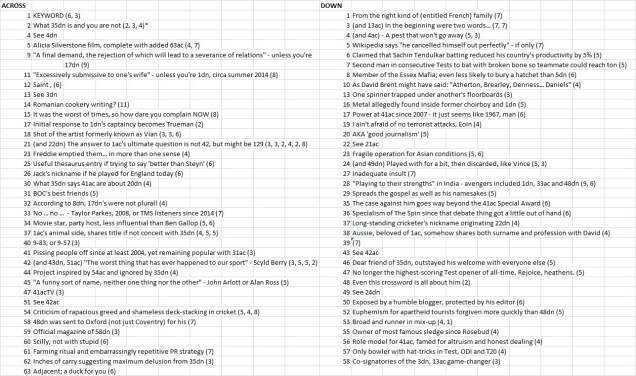
Now don’t tell me you get THIS in any normal blog. Anyone who knows the Editorial Team here at BOC will tell you that we really want Arron to write some blog pieces for us (Nonoxcol as he’s known round these parts). Well, he has, but this is completely different. He’s put together a crossword. Yes. Seriously.

I apologise that in my New Year horror-zone I had completely forgotten this (and a Man in a Barrel piece I also want to put up) and so this should have been up weeks ago. I hope you’ll be able to click on the picture and get the full size version of the grid.

arrons-crossword

And to the clues….

arrons-crossword-clues

It is very BOC-centric so hopefully you will get the references! My thanks to nonoxcol for all the effort put into this. 

This is no ordinary blog, eh?

If you wish to comment on the appointment of Joe Root, please read TLG’s post below. Judging by the current reaction it’s all a bit of a shrug of the shoulders. 

Meet the New Boss

One of the more striking features of the ECB in recent years has been their ability to leak when it suits them, remain tight lipped when it doesn’t, and insist that they don’t leak at all at all times.  So while Cook’s resignation was kept under wraps right up to the point it was announced, there can be little surprise at the heavily trailed news over the weekend – confirmed today –  that Joe Root will be appointed England captain.  By all accounts this was agreed on Saturday or Sunday in a phone call with Andrew Strauss, who presumably was using the bugged phone the ECB provide when they want news to get out.  A day is a little slower than normal for it to reach the media – few will forget the way the supposedly private meeting between Strauss, Harrison and Pietersen ended up being reported in detail on Radio Five Live mere minutes after finishing for example.  Sharpen up fellers.

Still, while the ECB deserve all the cynicism that comes their way for their repeatedly duplicitous behaviour (OK, this one is hardly a crime – but they shouldn’t have it go past without comment), it didn’t take a cricketing sage to work out that Root was more or less the only name in the frame once Cook had finally decided to go.  Indeed, it is remarkable how the simple matter of the on-field captain has now been built up to become A Very Important Thing in a way that it never used to be.  Sure, resignations and appointments to the role have always been big news, that’s no different – what is, is how long is taken over the process, as though the Nobel Committee were ruminating on a choice between Einstein and Newton.  It’s natural to want to get it right of course, but it’s hard to get away from the feeling that pomposity and procedure is felt to directly correlate to importance – perhaps it is a direct response to the declining news footprint cricket now has in the British media.  It is a disease afflicting a lot of sports these days – but news management has now eaten itself by becoming more important than the news itself.

Appointing Root was the blindingly obvious decision, and the possibility it wouldn’t be him only arose because the ECB, Strauss and Cook have taken so damn long over the matter in the first place.  When Cook resigned the papers dutifully followed the line that he’d been thinking about it since the start – the start note – of the India leg of the winter tour.  When the handover of the England captaincy takes longer than that of the US Presidency, something is a little peculiar.  To be fair to Cook, if they’re going to allow him to take an age, then why should he rush, but it still reaches levels of absurdity to place the role on that kind of pedestal, with the fundamental difference that the England cricket captain, who hasn’t been especially successful in the role by any measure, was allowed to do all that for himself seemingly with no outside reference on whether he should be permitted that freedom.

What will prove interesting in future years will be whether Root himself is elevated to that level of God-like status, or whether Cook is an exception.  For there are some similarities to Cook in the way that he has been groomed as most favoured son for some time now. It almost felt as though the only reason for a reluctance to move on more quickly was some lingering feeling that being a damn nice chap prevents any action in favour of the next damn nice chap.

Much has been made of Root’s inexperience in captaincy – a situation that is entirely inevitable in the modern game where playing county cricket is the exception rather than the rule for those who reach international level.  It isn’t remotely relevant for the simple reason that unless things change radically in future, this is likely to be the case with every England captain forever more.  Whether he succeeds or fails, it won’t be because of a lack of experience, it will be whether he is any good at it.  For the fundamental point is this:  There is no reason from the outside to assume any one player is a more natural captain than any other.  Root might well be the ideal choice for captain, but then so might Ben Stokes, or so might Mark Wood.  There is simply no reason to think one way or the other amongst those of us outside cricket beyond a certain kind of prejudice that we all carry within us.  Root being a clean cut generally good egg from the right background certainly makes him suitable for the ECB marketing department, but it doesn’t mean for a moment he is the best on-field captain.

Lest this be thought to be making a case for Stokes or anyone else, it isn’t, but it is to highlight that the choice of captain always tends to be from a rather narrow set of parameters.  As the years go on, the choice of Michael Vaughan stands out as being highly unusual from the usual mix of those whose nice background marked them out as being of the right stuff for the ECB. Again, it isn’t anything against Root himself, but it has been long made clear he was the heir apparent and no other candidates were ever put forward.  To put it another way, Moeen Ali has some captaincy experience at both England U-19 level and for Worcestershire as a stand in – not much, but no less than Root, yet there was never any prospect of him being the one, and given he isn’t certain of his place in the side, that could easily be argued as to why not.  This is where it gets into difficult territory, because there is no accusation whatever of discrimination on race grounds (Nasser Hussain belies that anyway), but more that it is simply rather hard to imagine the current ECB going with someone with such a normal personal history.  Not impossible, for it does happen (Vaughan), and nor is it advocating that someone like Moeen should – it’s merely the case that the ECB is constituted by a certain type of person from a certain type of background, and they by default look for a similar kind of person in their captain.  It’s probably unconscious, and echoed by a cricket media that is largely from the same kind of environment who have a tendency to approve of that line of thinking.  They’ll hate that and deny it, but we all do the same thing in our lives, we instinctively support those similar.  Let’s put it this way: how likely is it that the ECB would be keen to appoint a working class kid from the wrong side of the tracks as captain?  It’s a little hard to credit.

For Root himself, there is the fear that his being chosen as captain will automatically impact on his batting, yet there is no reason to believe so.  Cook himself didn’t suffer notably from being captain, his record before and during is fairly comparable; his batting problems when they occur are more a matter of him being a player at constant war with his technique than anything else.  Likewise, to take England’s Australian counterparts, the three most recent incumbents have all performed superbly with the bat as captain. The fear that he will lose form is nothing but seeing the glass as being half empty – why shouldn’t he do a Graham Gooch for example?

Then there’s the question of what kind of captain Root will be.  With so little experience it’s hard to know for sure, but the glimpses of him substituting for Cook tend to imply he’ll be rather more creative and attacking than was Cook, at least initially.  The truth is that we don’t know for sure and won’t find out until later this summer.  Having Cook to lean on should be an advantage, for whatever the merits or otherwise of his tenure, he will know what Root is going through better than anyone else.  Nasser Hussain managed the transition back to player better than most; if Cook can do the same it will be unquestionably an asset to the side and to Root personally.  It’s not an easy thing for Cook to do, and it’ll be hugely to his credit if he does it well.  Likewise, Cook the batsman should – all things being equal – be of far more importance to the England Test side than Cook the captain.  Being able to focus on that rather than the whole team may well liberate him to contribute heavily in the area that he is most valuable.  This too is a matter of uncertainty, precisely for the same reasons that his batting didn’t unduly suffer by being the skipper, but if those who believe Root will lose form from being captain are right, then it follows that Cook should significantly increase his contributions too – it can’t be had both ways.

Perhaps one of the more notable parts of the announcement is by omission – that Root has been appointed the Test captain.  As has been pointed out before, the England schedule over the next 2 years is bordering on the vicious, so it is at least good to see that he hasn’t been burdened with all the captaincy roles.  There are enough fears for the longevity of those players who play all formats already, without making one of them captain and thus unable to easily miss some of the tours – or at least parts of some of the tours.

The instinctive reaction is that Root is a good choice for the job.  There are never any guarantees, but he appears to possess the right blend of brains and mischievousness to make a go of it.  Cook wasn’t a great captain, and to that end he does have a relatively low bar to get over; whether he will get quite the hagiographical coverage that Cook did in the cricket press is a different question.  And in many ways, a deeply interesting one.  If he’s only ever “hung out to dry” to the same extent, he’ll do well enough.