England vs Pakistan: 3rd Test Day Two

Predicting sporting contests is a fool’s game much of the time, though it remains fun to do.  The very essence of sport is that the unexpected happens, otherwise there’d be no point watching or participating.  Nevertheless, the degree of certainty so many had that England would prevail in this match before the start was rather peculiar, apparently based on the undoubted hiding that England dished out at Old Trafford.  When Pakistan put England into bat, it was called defensive, when England were bowled out on day one, it meant that England would do the same to the tourists on day two.  It is as though Pakistan’s victory at Lords never happened, as though they were merely cannon fodder for an all conquering home side to swat aside.  Some even predicted a 7-0 Test summer, as though Pakistan were no more of a threat than Sri Lanka.

England are not out of this game by any means, the late wicket of the excellent Azhar Ali made the day slightly less dreadful than it would have otherwise been, and with Pakistan still 40 runs behind the possibility of early wickets in the morning with a still fairly new ball remains.  But England desperately need those early wickets for if they don’t get them they are in serious trouble, even if Pakistan are the ones having to bat last.  All things being equal, by the time England are batting again, there should be a little more help for the spinners, and one of the notable things about Moeen Ali’s bowling today was that while it wasn’t hugely effective, he was getting bounce occasionally, and bounce is a considerable danger when utilised by an outstanding spin bowler.

It had all started so well, Mohammed Hafeez slapping a wide long hop straight to Gary Ballance at point, but after that it was all Pakistan.  Sami Aslam impressed mightily in only his third Test match – and startlingly, he hasn’t played a first class match since December.  He looked every inch the Test opener; compact, technically sound and perhaps as important as anything else, he left the ball superbly.  England didn’t look like getting him out, so his partner did it for them, running him out with a dreadful call, albeit Sami could have backed up a little more.

Should Pakistan bat well tomorrow, England have another potential problem, for Anderson has received two warnings for running on the pitch and another will see him banned for the rest of the innings.  Anderson himself didn’t behave terribly well, and subsequently said that he’d apologised to both umpires.  Whether that is enough to distract the match referee remains to be seen.

The not out batsman overnight is Younis Khan, and it is hard to decide whether it is amusing or painful to watch his batting travails at present.  He looks hideously out of form and is fighting with himself every ball he faces.  His batting technique is all over the place, jumping in the air constantly, weight distribution somewhere around the inverse of what it should be – yet he is still there.  To see such an elegant player battling this way is both impressive and worrying given his age.  As ever, when a player gets older he is given little time to simply be out of form.

One other small point:  the 90 overs were completed today.  That it is worthy of comment should in itself highlight the problem.

By the close of play tomorrow England could be in serious trouble, if they aren’t batting soon after lunch it will be a difficult match to win; if they aren’t batting by tea they are in dire straits.  Tomorrow is a big day for both teams, but Test cricket can and does turn on a session.  England will need the morning to be one of those.

Day Three Comments Below


Guest Post “40 Years On – England v West Indies, 3rd Test 1976″…by Simon H.

gordon-greenidge-02.jpeg.jpg
Gordon Greenidge – 1984. Although the post deals with 1976, Gordon needs to be in colour!

One of our loyal commenters has offered up his first main cricketing memory for a piece. SimonH, international governance monitor, statistics maestro, memory man for the game has put together this piece on his first test match memory.

I’ve decided to cut it into two pieces, with the first part the build up to the game and the events of Day 1. The second will finish off the game report, and the aftermath of the match.

As always, I’d love to get pieces from you out there on your cricketing memories, or on anything that catches your eye or you want to talk about. We don’t take anything, as it has to be within the blog’s remit (don’t ask me to define it), but we do certainly like pieces like this.

So, SimonH…. this is your test!

FORTY YEARS ON – ENGLAND V WEST INDIES, 3rd TEST 1976

We all have matches that are particularly dear to us. Some of these are dear to most fans because the game is such an obvious classic – Headingley ’81 or Edgbaston 2005 spring to mind. But others are more personal. Often it’s a first that sticks in the memory. My first ‘live Test was bloody awful. England lost to India at Lord’s under leaden skies.

However the first Test I can remember specific moments from watching on TV has stayed with me and it’s a shock to find it was forty years ago this month that it took place……

SOME CONTEXT

Cricket and me – I had been hooked on cricket the previous year by the first World Cup and my father’s love of the game. It was a love  that dare not speak its name at school though (a West Sussex rural comprehensive) where football was king and cricket was seen as dull and posh (if it was noticed at all). This eleven year old was desperate for the game to show it was pretty cool. I’d watched some of the 1975 Ashes but can’t really remember any of it if I’m honest. I don’t remember the first two Tests of this series either (although I do remember watching the ‘Grovel’ interview on ‘South Today’). The Third Test at Old Trafford is the first Test I remember watching – and it turned out to be a game with everything the sport has to offer, except a close finish. It was also one of the most significant games of the modern era, marking the formation of a dynasty that would rule the cricketing world for two decades.

England – England had been the dominant side of the early 70s in world cricket, at times holding all the trophies (TM). What had seemed a settled side inherited by Mike Denness from Ray Illingworth had capitulated in the original ‘difficult winter’ of 74/75 and I got a clear impression from my father that English manhood had somehow been found wanting. Tony Grieg had taken over the captaincy in 1975 and the side recovered some pride as David Steele stood up to Lillee and Thomson. Although Boycott was in self-imposed exile, the team had Edrich’s reassuring presence at the top, SPOTY Steele at No.3, Bob Woolmer fresh off 149 against the Aussies and the new Cowdrey we were told in the middle order, Greig and Knott to halt any collapses at six and seven and plenty of bowling options that seemed to cover all eventualities (pace from Snow and some bloke called Willis if only he’d stay fit, plenty of English type seamers, spin was in the capable hands of Underwood). There was no winter tour 1975/76 so the team was somewhat unproven but there was little sense that this was a team heading for the slaughter.

West Indies – West Indies had been through a rocky patch after 1967 when the great 60s side started to age. From 1967-74 their only great series’ win was in England in 1973 but around that were some poor results. The middle order batting (with Kanhai, Sobers, Lloyd and new bloods Kallicharran and Rowe) and the spin department with Gibbs still looked strong but (ironically, given what was to follow) they had no reliable opener to partner Roy Fredericks and the pace bowling had lacked any real speedster. It all started to come together for West Indies on the 1974 tour of India as new batsmen Greenidge and Richards established themselves and the attack found a new spearhead in Andy Roberts. However that appeared a false dawn as the team went to Australia in 75/76 and were mauled, both on the pitch by Lillee and Thomson (Kallicharran vomited on the pitch after being hit on the head by one bouncer, Bernard Julian had his hand broken by another) and off it by some crowd behaviour that shocked some of the younger players who’d never encountered such blatant racial taunting. West Indies tried to fight fire with fire on that tour and kept losing wickets to hook shots that reinforced the stereotype of ‘calypso cricketers’ who couldn’t knuckle down under pressure. New captain Clive Lloyd, one of the few to sustain his personal performance on that tour and now able to put his stamp on the team with the Sobers-Kanhai-Gibbs generation departing, was determined to change all that.

Cricinfo recently interviewed some of the participants here:

http://www.espncricinfo.com/magazine/content/story/998589.html

GROVEL – had there been any previous series more famous for what was said to the media more than any of the actual play? And has there been a more infamous line by a Test captain than Greig’s:

https://www.youtube.com/watch?v=_TPQbPszfUI

Greig’s choice of words, and his delivery in that unmistakable accent, hung over that tour. The fact that there was some reasonable thinking behind it was obliterated by his crassness. West Indies had just lost 5-1 in Australia. England had beaten them on the 73/74 tour by hanging on in a series of draws until West Indies collapsed, apparently under pressure and to Greig’s own bowling, in the final Test. Greig himself had been involved in the controversial run out of Kallicharran and seemed to thrive on confrontation. My memory of it at the time is that it was controversial but more for Greig’s brashness and impoliteness than for its racial sensitivity. That only became clearer (at least to a white schoolboy in rural Sussex) as the summer unfolded.

What few had noticed was that in their last series before coming to England, West Indies had taken on India at home. Some fellow called Richards (mainly up until then famous for his fielding in the 1975 WC Final) had scored a stack of runs at No.3. The last Test seemed to have some odd goings on with half the Indian team marked down as ‘absent hurt’. There were accounts of fearsome pace from new bowlers Holding and Daniel – but then hadn’t India been bowled by England for 42 only a couple of years earlier by Old and Hendrick? Perhaps Holding and Daniel were as quick as those two? India had also chased a then-world record score to win the Test before Kingston – so it looked at worst as if the West Indies were still crazily inconsistent. Nothing too much to worry about……

The West Indies played warm-up matches against all bar one of the counties on that tour. Win after win didn’t set many alarm bells ringing. The few who saw them thrash a strong MCC side at Lord’s (including a century for Richards and seven wickets for Holding plus putting Denis Amiss in hospital) warned this was a formidable team. Still, Yorkshire had come within 19 runs of beating them and Chris Balderstone had nearly scored two centuries off them for Leicestershire.

THE IMMEDIATE CONTEXT

Given what was about to happen, it’s still slightly surprising to realise that the teams went into the Third Test after two draws. Not only that – the matches had been quite even. West Indies had the best of the first game after Viv Richards made 232 (I think I remember him saying that was the best innings of his career) but England held on for the draw relatively easily. Steele and Woolmer made runs which seemed to show their performances against Australia were no one-off. England had the better of Lord’s with Underwood skittling the tourists in the first innings and West Indies had been only four wickets from defeat at the end. The match had ended with Greig resisting Lloyd’s call to call things off early and with England fielders clustered around the bat.

However….. West Indies had not been at full strength for either game. Holding and Daniel had missed the First Test and Richards the Second Test. At Old Trafford, they had everyone fit. England, on the other hand, had problems, especially with the bowling. Snow and Old were injured (possibly others too) so England’s pace attack lacked a cutting edge. However, West Indies had collapsed against spin at Lord’s, had collapsed against spin in 73/74 and OT had a reputation for turning compounded by rumours that, as the hot summer of ’76 took hold, the pitch was dried and cracked. England went in with two English-style seamers in Hendrick and, on debut, Mike Selvey, two support seamers in Woolmer and Greig and two spinners in Underwood and Pocock. There was an issue in the batting too – the openers at Lord’s hadn’t convinced (Mike Brearley had looked out of his depth, Barry Wood had been injured by Roberts) so 45 year old Brian Close (who had top scored at Lord’s) was pushed up to open and local hero Frank Hayes (who had made a debut century against 1973 West Indies) was called up. There were promising young batsmen emerging on the county scene like Gooch, Graham Barlow and Randall but the selectors held off picking them (perhaps remembering Gooch’s tough baptism against Lillee and Thomson the year before). Randall was made 12th man which was one of the few times in his career the selectors did him a big favour.

THE MATCH

DAY ONE – Clive Lloyd won the toss and batted. That was what you did in those days. It was the right decision – and made precious little difference. The start of that day is etched on memory. In his first over, Selvey bounced Roy Fredericks who hooked it straight down Underwood’s throat at long leg. Fredericks falling on his wicket in the WC Final hooking was my first cricket memory and now Fredericks getting out hooking was my first Test memory. I’ve never seen Selvey explain why he bowled that bouncer. In his next over, Viv Richards played his trademark walking on-drive to a big in-swinger, for the only time in his career that I can remember missed it and was bowled. Almost immediately , Kallicharran (who like Lloyd and Rowe was never in any great form on that tour) played on. Lloyd was soon caught at slip off Hendrick and West Indies were 26-4.

What followed was one of those times when you know you’re watching something special. When it’s one of your heroes doing it, it’s something even more. As a young Hampshire fan (although I lived about 800 yards over the border in Sussex I was born in Hampshire, all my family were from Hampshire and there was only one team I was ever going to care about), Richards and Greenidge were my heroes. Greenidge in particular was one of ours. With Greenidge and Roberts playing for West Indies and considerable resentment that Hampshire players (despite the team winning the CC in ’73 and coming second in ’74) were ignored by England, I could feel nothing but enjoyment at what Greenidge was doing. A lifetime of not seeing England as ‘us’ and the opposition as ‘them’ was born. West Indies were more ‘us’ than England to me. I liked him because he hit the ball hard. Very hard. And he had the coolest of cream pads. Later the pleasure would be deepened by discovering Gerenidge had not had an easy upbringing and was a complex and at times difficult man. But mostly he hit the ball hard. When the bowler pitched up, Greenidge waiting on the back foot, would throw his whole weight into the drive in a way that wasn’t textbook, and would get him out sometimes, but was mighty thrilling when it came off. Even better when bowlers pitched short, he took it on. If it was wide, he’d cut – and what a cut! If it was straight, he’d hook – and it very seldom seemed to get him out. No ‘high to low’, no rolling the wrists – he’d try to hook it out of the ground and he usually did. He was everything I wanted to be, but wasn’t. If I couldn’t be it, I could damn well appreciate it in others.

https://www.youtube.com/watch?v=3UEo2VDnakw

In bald stats, what Greenidge did that day was score 134 out of 211 (193 while he was at the crease). He gave no chances – the nearest he came to dismissal was a top-edged hook that landed between Knott and Underwood. Only Charles Bannerman in the very first Test had scored a higher percentage of his team’s runs at the time (three more have since):

http://stats.espncricinfo.com/ci/content/records/283999.html

Not only was it a lone-hand but he scored his runs at a phenomenal rate by the standards up to that time:

http://stats.espncricinfo.com/ci/engine/stats/index.html?batting_positionmax1=2;batting_positionval1=batting_position;class=1;filter=advanced;orderby=batting_strike_rate;qualmin1=100;qualval1=batted_score;spanmax1=10+jul+1976;spanval1=span;template=results;type=batting;view=innings

It wasn’t quite Roy Fredericks in Perth – but it would do. Greenidge’s main support came from one of the great unrealised talents in West Indies’ cricket, Collis King, who on debut reined himself in to make a handy 32. King would only play nine Tests but would have his moment in the 1979 WC Final when he eclipsed even Viv Richards for a time. He never seemed forgiven after Packer and ended up a banned SA tour rebel. These days he’d have made a fortune in franchises.

England ended the day on 37-2 with Close and Steele out. Batting had looked tough but the match seemed evenly poised. The next day saw a power-shift in world cricket that would last two decades…..

—————————————————

The second part will be put up in the next day or so. My thanks to Simon for all the effort put into this. I don’t remember this test myself, but do recall Viv’s 232 at Trent Bridge and 291 at The Oval.

1986 – Nightmare At Nottingham – Part 1 of 2

You know I love a good anniversary, and you also know I love my nostalgia. So while Sky make a very decent and informative programme about England in the 90s, which, of course, coincided with Sky covering cricket, some of us have some more than poignant memories of the 1980s, when, at times, England were, truly, awful. You might remember I did a series of pieces on the Blackwash in West Indies in 1986, and yes, I never did quite wrap it up but it does stand another view if you’ve not seen it. August signifies a less heralded low point, but a low point nonetheless. In the early part of that month England took on New Zealand at Trent Bridge in the second test of a three match series. The first, at Lord’s had been a bit of a dull bore, livened up only by Bruce French being sconed, and replaced, for a short while, as keeper by Bob Taylor. The test hardly got going.

The second, though, was a different beast entirely. England had been without Ian Botham all summer after his admission to smoking some Moroccan Woodbines (that’s from Only Fools and Horses) and incurring the wrath of Denis Compton who wanted him banned for life. While Botham was a diminishing force anyway, the England team had not recovered from the annihilation in the Caribbean and had been easily defeated at home by India. David Gower was removed from the captaincy in favour of Mike Gatting, but the first test of the Middlesex man’s leadership regime was an annihilation at Leeds. Gatting made a massive ton at Edgbaston, but it looked like it wasn’t going to be enough until the weather ruined the final day of the third test when it looked more likely that India would win than the home team. Rain may have saved us from another clean sweep.

Bob Taylor

England were in disarray, and yet there was just a blithe assumption that we would beat New Zealand. These were not your pushover Kiwis any more. Richard Hadlee was a brilliant, utterly brilliant bowler – the Jimmy Anderson of his era only, and you might disagree here, much better. Martin Crowe was coming to the fore, not quite the great he would become, but a decent old presence in the middle order. At opener was the sturdy John Wright, doughty, a fighter but bloody good on his day. Ian Smith was the keeper, decent with the gloves, a nuisance with the bat. They had beaten Australia in Australia the previous winter and were simply not to be underestimated, but it felt like we did.

In that first test we gave a debut to Martyn Moxon, a consistent run-scorer at the top of the order for Yorkshire, and a man with a classical technique to match. Moxon had made a decent impression in the Lord’s test, making 74 in his first test innings. One run more than Joe Root made in his first innings in tests! Moxon was opening with Graham Gooch who had made the game safe in the second innings of the test with a score of 183. At three for England was Bill Athey, who at this point had not made an impression in tests, and seemed to be betwixt and between. It wasn’t until the following winter that he got a firm place in the team, and not until the next year he made his only test ton. He seemed made for test cricket, but seemed to be in the team due to a 142 not out he made in the second ODI (which I remember he avoided what looked a plumb LBW when he was near his hundred). At four was David Gower, not in great form, still getting over the captaincy, but still a class player on his day. Shame for England was he wasn’t having many of them.

At five was captain Mike Gatting, He’d made that 180-odd at Edgbaston, but he’d not shown signs of turning the ship around, and with an Ashes winter coming up, panic was beginning to set in. Panic may have been induced by the presence of Derek Pringle at number 6. Now, we’re not fans of Degsy here, but he wasn’t a bad player. I think even Pringle might admit that number six was probably one, and more likely two places too high for him in a batting order. A man who made one test half century shouldn’t be that elevated, and that indicated issues. Number 7 for England was John Emburey, who was a more than useful spinner and handy lower order batsman, and at 8 was his Middlesex spin partner, Phil Edmonds. Both had survived from the previous year’s Ashes series, in their own ways. Note that England had no hesitation in playing two spinners at home in those days. Batting at nine was Glamorgan quickie Greg Thomas, who had an in and out career, which didn’t last too long at the international level. Number 10 was Bruce French, the keeper – and yes kiddywinks, we thought nothing of having a keeper batting at 10! Number 11 was Gladstone Small, the Warwickshire seam bowler, who whenever I saw him play at county level, looked a handy old bowler. But it took him some years to get in the team. He made his debut in this match, joining Thomas, who had made his debut in the Blackwash series, and the military medium of Pringle. Yikes. We had to hope it turned!

The New Zealand team lined up as follows. John Wright opened with Bruce Edgar. That partnership had seemed to be in place for years! Both were doughty players, using that word again, but Wright just had that something extra. In at three was Jeff Crowe, who never seemed to make the scores required of him, but following him at four was his younger brother, the late, great Martin. In the foothills of his career, he’d shown his promise and played some crucial innings. He would become one of their greatest players in the fullness of time. Once the Crowes were out of the way there was Jeremy Coney, the skipper. A redoubtable player, a total annoyance, and a dibbly dobbly bowler of some awkwardness. Coney had a legendary relationship (or lack of) with his gun all rounder, Richard Hadlee, who batted at 7 (compare Hadlee, who made test tons batting 7, and Pringle batting 6 for England). In between Coney and Hadlee was Evan Gray, a spinner/batsman bits and pieces all rounder. Number 8 was John Bracewell, a spin bowler and handy lower order player (not giving much away to the uninitiated here!) and following him at 9 was Ian Smith (let it not be forgotten that in 1984, Smith had made a century against England, and here he was at 9!!!!). The number 10 was Derek Stirling and 11 was Willie Watson, two seam bowlers of honest toil, but limited repute.

Game on.

The B&H Yearbook, for those of you who don’t remember it, was a more pictorial, more acerbic, record of world cricket, than the Almanack of the time, and their introduction to the review of the second test is a belter…

“In the fortnightly search for a fast bowler, England brought in Gladstone Small for his first Test Match and Greg Thomas for his first Test match in England.”

Jeremy Coney won the toss on a wicket that looked a little greener than the previous years strip. The Trent Bridge test in the 1985 Ashes was a festival of runs, as Gower made a huge hundred for England (166?) and Australia replied with a big total of their own thanks to tons by Wood and Ritchie. This strip, according to Wisden, was not that different, but whereas the previous year’s match had been played in glorious weather for much of the contest, the day, according to B&H was mainly cloudy and very windy.

A sub-plot to this test was whether Graham Gooch would make himself available for the upcoming Ashes tour. Botham had missed the 1984/5 India tour, and while many came home from the West Indies the previous winter, missing tours was seen as a pretty drastic thing. Now, I must confess, although I know Gooch wasn’t there for the Ashes, I never really recalled why. Sidesplittin’ in the comments to a previous post said it was because he had had twins (he thought). B&H describes the decision as “hanging over English cricket like the Sword of Damocles”. Anyhow, Gooch began the test with an assault on Hadlee (18 off 18 balls) before the Kiwi, playing on his home county ground, trapped him LBW. Moxon, after his promising debut, was bowled shortly thereafter for 9 and England were 43 for 2. Bill Athey and David Gower took England to lunch, where the total had reached 102 – a really decent clip in any test, but bloody good in that era. It was described as one of England’s “rare shafts of light of the summer” according to B&H.

Athey was dismissed for 55, with the score on 123, LBW to Watson, having played with “pleasing assurance if not total confidence”. Gower marched serenely on, showing the “effortless grace which makes him the most attractive of batsmen” until offering no shot to a ball from Evan Gray that turned sharply from outside off and been given LBW. 170 for 4 became 174 for 5 when Gatting was bowled through the gate by Hadlee, a dismissal B&H thought had “some sense of inevitability”. “The England captain had played an embarrassing shot” it moaned. Arron might have applauded. Did you write it, sir?

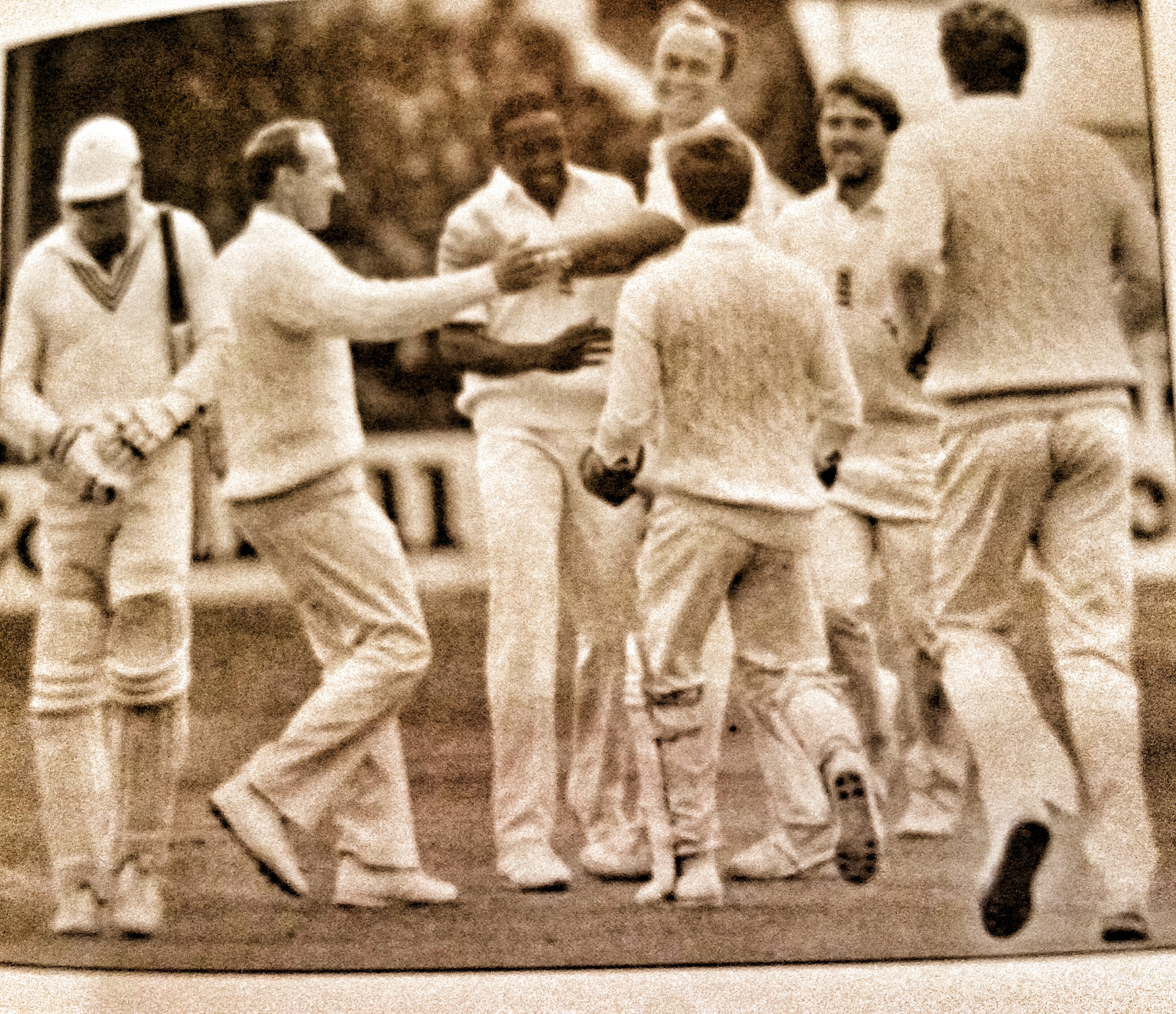
20160727_234209-01.jpeg
Picture by Adrian Murrell – “enhanced using Snapseed”. I think this is a wonderful snap, just for Richard Hadlee. Evan is giving it the two hands. Smiffy is directing traffic. Wright Jeff Crowe is Saturday Night Fever. Coney looks like he’s in need of the facilities. And then there is Hadlee… Fabulous picture.

After a brief rain delay, Hadlee packed off the Middlesex spinners in one over, both falling to catches that rose sharply and moved away late, and these wickets moved Hadlee into third place in the wicket-takers list behind Lillee and Botham, and completed a 27th five wicket haul, then a record. Pringle, batting at a nose bleeding six, survived a drop before falling to a hook shot. B&H said

“….the failure was more one of confidence than technique. The Essex all-rounder seemed frightened to hit the ball in his old manner.”

As he’s never read the blog, nor is likely to, he won’t comment on that.

England’s innings meandered to the close, finishing 240 for 9. Thomas had played some “spirited shots” before falling to Hadlee. England added another 16 the following morning, with the aid of some dropped catches (B&H lamenting the slip fielding). The previous year 400 played 500, so this instinctively felt short of a decent total.

Thomas opened the bowling and was “fast, but wild” which could have been the summary of his brief career, but he succeeded in making the opening breakthrough, having Bruce Edgar LBW via a fast yorker for 8. Jeff Crowe joined John Wright and solidity was enforced. The pace was dilatory, but it took until the afternoon session to remove John Wiright, who “seemed in total command” and Jeff Crowe, caught behind, both off Gladstone Small to provide the Warwickshire man with the first two of his 55 test victims. Small became a bit of a fan favourite, and I’ll break off this test review to just share a piece of Matthew Engel’s pen picture on Cricinfo…

he was always a whole-hearted tryer, a committed team man and a delightful guy. Australia’s discomfiture was increased by Small’s strange build: seemingly without a neck, he walked around as though he still had a coathanger inside his jacket. He came to England from Barbados just after his 14th birthday, the cut-off date for automatic qualification. However, the combination of his looks and his then-pair of nerdish specs made the Lord’s registration committee think he had no chance of ever playing Test cricket anyway, so they let him through.

Anyway, we interrupt this message to ask, what did he have in common with Derek Randall, Les Taylor, Alastair Cook and Mike Gatting?

20160727_234220-02.jpeg
Another pic from Adrian Murrell. Small captures his first test wicket, it says being Jeff Crowe, but the piece reckons Wright was his first victim. Quite hard to tell from here. Perhaps one of our New Zealand friends can make the definitive ID?

Back to the test and at 92 for 3 England had got themselves back into the contest. Martin Crowe was joined at the crease by Jeremy Coney, and they set about rebuilding again. Having put on 50 for the 4th wicket, and with both looking untroubled (although Coney had been dropped at slip) “disaster struck in the last over before tea”. Martin Crowe called for what was in the view of B&H an “unwise short single” and Coney hesitated, before perishing. The wicket before tea looked worse when straight after the break Crowe turned Emburey into the hands of Phil Edmonds at backward square leg and New Zealand were 144 for 5, still 112 in arrears. However, the New Zealanders had a more formidable lower order, and it was now their time to shine….

England vs Pakistan: 1st Test, Day Four

Given the troubled and fractious relationship over many years between England’s and Pakistan’s cricket teams, perhaps the most startling outcome from this Test has been the realisation that they have become a likeable side.  The celebration at the end of a match they have thoroughly deserved to win made most onlookers smile, for it signified a team seemingly united and also enjoying their cricket.  Although that might have been the most obvious example, there were plenty of others, from Misbah’s century celebration to the adorable reaction of Mohammed Hafeez to the sight of a young Pakistan fan in the stands celebrating his catch to dismiss Alex Hales.  Rather obviously, over recent years Pakistan have had something of a PR problem, but under Misbah’s exceptional leadership and example, they have demonstrated themselves to be very welcome tourists.

It does of course help player demeanour when matches are won, and although England swiftly wrapped up the Pakistan second innings in a few minutes this morning, 283 was a big ask in the fourth innings of a match that had already showed declining batting returns.  Reaching such a target is quite possible, but it does require a fine batting performance, with few mistakes and bowling opposition that isn’t on top of its game – none of that was the case today.  Some were got out, but all too many of them were self-inflicted.  Cook certainly got a good ball, but his technique is looking ever so slightly awry again, his head moving over to off and ending up squared up by the bowler much too often.  In contrast, Hales and Vince were loose, Root and Ali downright careless, as England went helter-skelter at the target.  It wasn’t until Bairstow was joined by Woakes that a calmer mindset was brought to proceedings, and although the two of them battled hard against some exceptional bowling from Wahad Riaz in particular, much of the damage was already done – unless they were to pull off something magical, an end was always going to be open the moment the partnership was broken.  So it proved, from the moment Bairstow to his utter horror managed to miss a long hop to the end of the match was a mere five overs.  The final nail in the coffin came with the loss of Chris Woakes, who batted longer in the game than any other England player, for 58 runs and once out to go with his eleven wickets.  Seldom has an England player in recent times been more unlucky to finish on the losing side.

Yasir Shah’s ten wickets in the match will receive the plaudits, but the seam bowling today should give England pause that they are going to be up against an attack with no weak links.  As was suspected before the start of the series, the strength of the two sides is in the bowling, albeit Pakistan have a spinner on a different level, and both batting line ups look brittle.  For England the return of Anderson and Stokes will improve the side, with Finn and presumably Ball the likely ones to make way.  That would certainly improve the batting in the middle order, but that’s not the area where England look vulnerable. Vince doesn’t at this stage look likely to contribute more than a few breezy runs,  while Hales at the top still doesn’t exude reliability.

From a series perspective, Pakistan’s win is probably the best thing that could have happened; England now have to show they are capable of more than beating up weakened opposition.  But if nothing else, three more Tests as enjoyable as this one certainly won’t harm interest in the game.  These are two fairly well matched sides, both flawed, both capable of brilliance.  Pakistan won this Test rather than England losing it, because when it came down to it, their key players stepped up and delivered to a greater extent than England’s did.  That may not be the same next time, but for now they can reflect on a fine performance, that had the added side effect of winning over some hearts and minds.  Not a bad day’s work.


England vs Pakistan: 1st Test, Day Three

Lords tends to be one of the quieter grounds in world cricket; even when full it is more a murmur than a roar, yet in the last hour of play today the crowd were vocal and supportive, particularly towards the outstanding Chris Woakes and the desperately unlucky Stephen Finn.  The reason why is straightforward enough, for this is a Test that has been a scrap from the first ball, with both sides harbouring legitimate hopes of victory.  With all the suggestions and plans for ensuring the relevance of Test cricket, the involvement of those at the ground was due not to gimmicks, or innovations, but to two sides battling to gain the upper hand in a Test that has been excellent throughout.

Perhaps some would then think it churlish to begin with a complaint, but it’s the same one as on the first two days – that the over rate was sufficiently poor that the full 90 weren’t completed in the day.  That it was only two overs short is not the point, they have an extra half hour to complete them.  It’s very simple – stop cheating the spectators and talk about them being cheated will also stop.

With the most obvious difference between the sides being in the lower order, it was natural cricketing perversity that ensured that while England’s fell away in the morning to be bowled out 67 adrift of Pakistan’s first innings score, the tourists decided that today was the day when theirs would perform.  Yasir Shah for one is engaged in a personal contest with Chris Woakes for all rounder of the game, merrily dispatching England bowlers with disdain just when England might have thought they had the upper hand at last.  It capped a fine day for him – in removing Finn this morning, Yasir had become the leading wicket taker in Test history after 13 Tests (an arbitrary number for sure, but evidence of the impact he has made on the game).

Indeed, for most of the day England looked to have clawed back much of the first innings deficit, especially when Pakistan were reduced to 60-4 following an impressively dreadful shot from the captain.  The best matches are those that swing one way and then the other, and a hideously out of form Younis Khan may at the end of matters consider that his crabby, laboured 25 was vastly more important than the number suggests.  Asad Rafiq and Sarfraz Ahmed carried on that work in much more fluent fashion, along with the aforementioned Yasir.  They had a little help, Cook and Bairstow dropping very catchable chances, both off the luckless Finn but with a lead of 281 with a couple of wickets still in hand, Pakistan are in a very strong position.

That they are is despite the best efforts of Chris Woakes, who once again was the star of the show with the ball, although rather surprisingly he was held back early on.  How impressive his match has been is perhaps best illustrated by how he’s reduced his Test bowling average from 41.25 on Thursday morning to 28.18 now.  Yet he doesn’t appear to be doing anything greatly different – a fairly consistent bowling action, line and length, and a little bit of movement off the seam.  In the last few Tests he had mastered the art of being parsimonious, and perhaps the wickets he is now taking are to an extent created by the impression of being hard to get away he has begun to foster.

Around 300 never seems that big a total to win, but history is against it, not just at Lords but in Test matches generally.  It’s rare to chase down that many, indeed over 300 has only been done 28 times in the history of the game, which given the number of Tests played is a miniscule number.  There is a constant underestimation of the difficulty in reaching targets of that size, amongst players and commentators as much as anyone else.  So it was that Nasser Hussain talked about England being comfortable up to 280, when they should be anything but.  It’s not a criticism of him, as it’s something heard widely from all quarters on each occasion it comes up in a match, but make no mistake, England are in a spot of bother.

What it does mean is that there will be a result in this match, possibly tomorrow, possibly early on Monday.  Mickey Arthur at the close of play stated that Pakistan had hoped for a lead of 275, and allowing for the usual kidology that is always present in interviews, there was little doubt that he was delighted with their position.  That’s certainly not to say that England cannot win this, but the bookmakers are being a little generous (patriotic money presumably) in cricketing terms in making them the favourites.  While Yasir Shah may be felt to be the biggest challenge based on the first innings, the seam attack underperformed a touch first time around, and with the warm weather and bone dry pitch, both conventional and reverse swing should add to the level of difficulty.

This has the makings of an excellent series, and praise be it’s been enjoyable to watch.

Day four comments below 


England vs Pakistan: 1st Test Day two

It is perhaps perversely illustrative of the issues Test cricket faces that after two days play there is considerable intrigue at where this match is going, and rather more pleasure at the way that it is developing into a proper scrap.  Despite all ECB attempts to portray the last Ashes as a classic, each Test was more or less over by the end of day two, the direction of travel beyond retrieval.  Thus, the prospect of an even fight is in itself an attraction, and as far as Lords is concerned at least, reflected in strong ticket sales.  Give the public something to watch, and they’ll turn out.  This is of course helped by Pakistan not having come here for six years, precisely the importance of not killing the golden goose by playing the same teams constantly.  Whether it’s a lesson the ECB will learn seems unlikely – the four year Ashes cycle that was promised to return is already being compromised as administrators look after their immediate financial interests rather than the game itself.

This isn’t anything new, nor is it remotely something of which critics are unaware, yet it bears repeating at every opportunity, for the matter of the game’s integrity is more important than anything else in cricket.  Pakistan are a talented team, and one who are good to watch.  There are wider reasons for their long absence from this country, but it doesn’t mean there is any excuse should it be a similar gap before their next visit.

For the second day running, the scheduled 90 overs were not bowled in the day.  The bulk of the bowling was from Pakistan, after England bowled them out in fairly short order, meaning that both sides have been guilty of not providing ticket holders with what they had paid for.  A ticket in the Compton stand was £90, making the mathematics rather straightforward.  Yesterday we were three overs short, today it was four.  This is after the additional half an hour was played in order to complete the allocation.  The television coverage gently mentions it from time to time, but suffers from the fundamental problem that all the media does, written or broadcast, which is that they aren’t paying for their entrance – the very opposite.  Ultimately, they don’t care any more than the players do about what is, without a shadow of a doubt, theft.  That might be a strong word, but it’s a disgraceful, entirely unacceptable state of affairs.  Players get fined occasionally (note that the money is not returned to the spectators, as it should be) but almost the entire series in South Africa suffered from shortened days in terms of overs, and nothing whatever was done.  Fundamentally, as if we did not know already, the players and the ICC do not care about the spectators except as a revenue stream.

Doubtless if put to them they would protest that, but the fact is that nothing is done about it, and nothing is ever said to those unhappy about it.  Both yesterday and today the crowds thinned out around 6pm, the scheduled close of play, as the crowd caught trains or buses home.  This is meant to be when it finishes, so there is a contempt already present by not meeting the timings imposed; to then fail to get the overs in within the additional time allowed is nothing short of scandalous.  The match referee then looks at it over the course of the Test, which is ridiculous in itself given that most people go for a single day’s play – it doesn’t help them if the over rate speeds up later on.

There are various ideas about how to prevent this happening, but the given the current sanctions aren’t used a great deal anyway, there’s little point even talking about them, as it seems unlikely they’d be used either.  Both captains should be banned for the next match.  But they won’t be.  No one suffers – except the poor bloody spectator who pays for the game to be put on in the first place.

Chris Woakes is one of those figures whose first class record suggests an all rounder of rare ability, genuinely worthy of a place with both bat and ball, yet to date in his international career he has been more likely to be in receipt of comment that neither discipline is good enough, that he is, as the parlance goes, a bits and pieces cricketer.  There has been defence of him on these pages, but his presence in the team has been anything but universally welcomed.  In the same way that early struggles shouldn’t be a reason to his dismiss him, nor should his current success mean that he is a fixture for years to come, yet there are signs he is coming to terms with the standard, not just today, but in recent games where he has been one of the better performers.  His 6-70 was outstanding, his halting of the Pakistani charge through the England line up in the last session highly meritorious.  The one area where England have a notable advantage over the visitors is in the lower middle order.  Woakes has hinted at batting ability often enough without going on to make a significant score – partly due to his lowly position at 8 or 9 – but in a tight game, a contribution from him could make all the difference.

Alastair Cook was the prime contributor to the England score, and in so doing became the highest Test run scorer of any opening batsman, overtaking Sunil Gavaskar.  Longevity may not be the most important attribute in analysing a player’s worth, but nor is it to be ignored either.  Opening the batting remains a uniquely challenging occupation in cricket, and the landmark is worthy of praise.  Yet today he seemed somewhat out of sorts, playing and missing outside off stump frequently (and being turned square far too often) as well as having two escapes when straightforward edges were dropped.  Most batsmen will worry little about that, factoring in the occasions where brilliant catches are taken or dubious decisions are given as evening up the ledger.  But the slightly out of sync technique brought his downfall, dragging the ball on to the stumps as he failed to get across to it outside off stump.  He’s not quite in top form.

Joe Root was clearly upset with himself for his dismissal; a poor shot undoubtedly, not for the first time recently.  Perhaps he will receive genuine criticism for the first time in a while, but it seems few will be as hard on him as he will himself.  Jonny Bairstow too was guilty of a poor shot, one borne perhaps of overconfidence as much as anything.  Many a batsman will say that you don’t make hundreds when you are in the very best of form, because you take chances you wouldn’t do if the fear of dismissal was in the back of the mind.

But if those were somewhat self-inflicted – most dismissals are batsman error – it doesn’t detract from the performance of Yasir Shah.  To take five wickets on day two of a Test at Lords, where pitches are usually flat and slow, is some achievement.  England consistently have problems with legspin, despite their protests that they have learned lessons, and so it proved here.  Given that the seam attack was a little off colour (not helped by the drops) it was ominous that England struggled so.

Late in the day the tale of two lbw decisions pointed the way to the future.  Firstly Moeen Ali was given out despite two elements on umpire’s call in the decision.  It was of course out by the rules pertaining to Hawkeye, but the question is whether it should be.  If there are two points of doubt, surely there is doubt all round?  The second example was the appeal against Stuart Broad, it was not out according to the current playing regulations, but when the new ones come in later this year, it would be.  There have to be concerns that the number of lbw decisions will increase quite substantially, and matches shortened accordingly.

England are 86 runs behind with three wickets left.  They could get close, they could be rolled over in short order. Not having a good idea where the match is going is when Test cricket is at its best.  Day three may be pivotal, it may not.  But the point is that there will be interest in finding out.

Day three comments below


England vs Pakistan: 1st Test Preview (of sorts)

A fundamental difference between the world of the blogger and the world of the journalist is that real life intrudes on our witterings. There are other differences of course, not least that some of the latter have little but contempt for those who dare to write on the game (and it needs to be said that others still find the blogs of interest), but that is probably the principal one.  What it means is that we have jobs and cricket is a side interest.  That side interest both waxes and wanes depending on circumstance, but even when at its zenith it doesn’t mean that cricket – or any other interest – is in the position to take priority.

So it is that in my own case I have been unable to watch more than a few overs in the last month.  It might have been a little bit more were it not for the truly impressive incompetence Southern Rail bring to proceedings, but even if they were capable of such unusual abilities as running a train service, it wouldn’t have been much.  As some know, I was a month in Asia, travelling around Laos, Thailand and Indonesia (minor plug for the blogging results of that – go to http://www.thoughtsonatrip.com), which as work goes is hardly being condemned to working down a pit, but it was work nonetheless.  Returning from there it was a week away working, and after that an actual real life holiday for a week in Turkey.  This week is the first time I’ve had more than two days at home since early May, all of which is a roundabout way of saying two things; first an apology for silence and second to note that I don’t have a clue what’s being going on.

The Sri Lanka series was comfortably won, even the wider points based version that precisely no one gives a stuff about, but my own experience of it consisted of reading the odd newspaper report and Sean’s excellent precis of the action on here.  That means that for this series the pretence to hold is that the approach is one of a fresh mind, open to all possibilities, and the editor’s decision is final on that one.

Having said that, I am also at Lords tomorrow, so anyone who wants to say hello get in touch.  It makes for a curious feeling, one of trying to re-engage – not with the England team, that still seems some distance away which is a saddening truth, but with the game of cricket itself.  For everyone here and beyond does hold that in common, a love for the game and its vagaries and sub-plots.  The presence of Pakistan adds to that, for it has been six years since they were last here, on a tour that will go down in cricketing infamy.  The relationship between England and Pakistan has been anything but smooth over the years but that particular tour was the one that caused considerable damage to the game itself rather than to assorted egos.

Such discord seems rather less likely this time around, barring the odd bout of booing for Mohammad Amir.  As an aside, I will not be joining in any of that, my own view is that once punishment has been served, that is the end of it.  Whether that punishment was appropriate is another matter, and I am as unlikely to cheer him as I would have been to cheer Dwayne Chambers, but that isn’t the same thing as actively expressing displeasure at his presence.  Either way, and assuming nothing untoward happens, it will dissipate both across the day and the series.  The history does not require constant reminders to always be there.

Pakistan cricket has recovered its reputation in the intervening years in large part, and much of the credit for that must go to the captain, Misbah ul Haq a man who receives very little of the credit due to him in his own country, and rather more outside it.  Misbah’s career as a batsman has been impressive enough given his late blooming as a cricketer – one which gives entirely unmerited hope to all forty somethings everywhere – but his leadership of his nation has been a thing of wonder.  Above all else, he has given Pakistan cricket its dignity back, no small achievement considering their continued exile from home internationals.

Misbah himself hasn’t played Tests in England before, something of an irony given a batting line up that is anything but youthful, and despite strong Test records there has to be a question over how it will perform in English conditions.  It is perhaps to the advantage of Pakistan that the first Test is at Lords, where chairman’s pitches have been more frequent than not over recent years.  In any event, while there may be question marks over the batting, the visitors do possess a potent pace attack, and one that will cause England far more difficulty than that of the of the Sri Lankans.

England’s batting is anything but settled, the departure of Nick Compton, the promotion of a Joe Root who hasn’t had the best of summers to date, return of Gary Ballance who hasn’t looked fully at home against pace in his Test career to date, Vince is just starting out and with that Pakistani attack, it is a Test that for the first time this year has a degree of uncertainty about the outcome.  Pakistan are a dangerous side with the ball, and despite potential fallibility in English conditions do at least have a top and middle order of known competence.

This is an intriguing match up, neither side have all options covered, both have significant and obvious weaknesses, both have equally obvious strengths.  As with many sports, the period before it begins is in some ways the best time, with all possibilities open.  May the cricket be the focus, and may it be a proper tussle.  And after tomorrow, I may even know what’s going on.


The Post With No Game

Newman Markings
Newman – 12 May 2015

Well, it has been an interesting old week. Today is the 12th May and it marks the one year anniversary of the “Trust” press conference / media event which many now congratulate Strauss on for providing clarity and a clear message going forward.

Relive the joy through the threads on the day. Chris live blogged a press conference:

https://beingoutsidecricket.com/2015/05/12/strauss-press-conference-live-blog/

“Strauss has effectively acted as judge in his own divorce case, awarded himself the house, then asked his ex to advise on the redecorating.”

https://beingoutsidecricket.com/2015/05/12/trust-1/

Standing O for Andrew Miller….

But no matter how passionately they expressed their platitudes, or how multi-layered they made their appeals for a reassessment of the team’s priorities, the white noise of corporate bullshit was precisely the last thing that we, the working media, and by extension, them, the disenfranchised masses so odiously dismissed by the previous regime as being “outside cricket”, needed to hear.

There’s a lot of this sort of management mumbo jumbo coming out in the ending of the career of Charlotte Edwards, where it is clear the individual wanted to carry on, but also clear that the management did not. Now if this is down purely to playing matters – i.e. whether a player is the best taking into account all facets of the game – is less clear. Indeed, there is some indication that this might have been done with that hoary old chestnut of “developing for the future” coming to the fore. While media gurus sniped at women’s cricket lacking “athletes”, the drop off in performance of our world beating team of a few years ago is disappointing. Mark Robinson is out of the ECB School of Coaching, and this looked like a typical move. It seems a nice contrast to see Pakistan’s men team coming over with a 40+ captain this summer. Age is quite often used against players – see the drip drip drip about Ian Bell’s “eyes going”. I thought it was an interesting day watching the dancing around the issues. Robinson has made his bed and will now have to lay in it. Edwards has made it known that this wasn’t a decision of her choosing, but the inevitable decision she had to make once she saw the writing on the wall. All quintessentially English.

I’m not a keen follower of the female game as some on here – simply not enough time – but it has to be said I am judging this through the “ECB of the last couple of years” prism. I’m also more than wary of the men judging the women’s game through men’s standards – sub-consciously or not. I don’t often hear anyone on the T20 circuit, for instance, complain about Chris Gayle’s lack of athleticism. An extreme example (and when he’s not scoring runs in the IPL, like he is now, a cogent one) maybe, but Edwards is that taliswomanic (I love making words up) figure for the English team. Robinson may be trying to show he’s made of the stuff in making tough decisions. I hope the decision hasn’t been made to appear tough.

I can’t help but reflect on the death of Tony Cozier. For me he was the voice of West Indian cricket. I’ll never forget the first time I saw him on TV. It was on Newsnight, in 1984, with a dazzling white suit jacket on, explaining in the wake of the 340-odd run chase at Lord’s how the West Indies were so great. And of course, without knowing, the response was “he’s white?”. However, the main reasons we cared so much about his passing have been gone into in great detail on here in the comments, in articles, on Twitter etc. He was part of our cricket education. In an era when educative commentary is buried behind “well how many caps did you get” drivel, Cozier educated you on the rise, and fall, of West Indian cricket. He’s one part of the reason that the West Indies have a special place in my heart. His love of the game, and his determination to speak what he believed, shone through. I’m sure he had his faults, we all do, but to finish his life virtually ostracised by the WICB, casting aspersions on his fitness to commentate on the game when he’s surrounded often by braying morons, saddens me. I had the chance to pay a visit to The Wanderers Club in Barbados in October 2005. Before I went I did not know it was his club. Instead I went on a pilgrimage, at first, to Kensington (then being demolished) and then to Holders Hill. But when we visited Wanderers his presence as club behemoth lent it an aura I’ll never quite forget. RIP Tony. You gave much to me, and I know many others.

I won’t comment much on the England selection, which saw the outlandish predictions of a few weeks ago row back into yesterday’s limited changes. Congratulations to Jake Ball for his rapid rise, no doubt helped by being on TV a couple of weeks ago, and also to James Vince who will make his debut, I would imagine, as a straight replacement for the sadly retired James Taylor. Now Vince has undoubtedly benefited from being a client of a prominent management group and a vocal ex-England player, and his initial international performances can be filed under “encouraging” rather than “devastating”, so he has a lot to prove. I hope the hype is matched by performance. The selection of Compton also was interesting. I would have had no problem if he’d been dropped. Provided this dropping was based on his performance on the field and the notion that there is someone more suited for his number 3 slot. Instead what I’ve been reading and hearing is a whispering campaign about being “fidgety” “overwrought” “nervous” “too intense” “bad body language”. Barely a piece goes by that does not allude to Compton’s mental state. In one sense the media individuals spouting this amateur psycho-babble claptrap must be pleased he’s been picked because they can go on about it again. I’ve never seen a player briefed about in this way since, perhaps, Mark Ramprakash. Good luck Nick, I hope you prove the doubters wrong.

Some House News. Both TLG and myself will be off premises for a few weeks at end of May, beginning of June. For me that doesn’t mean I won’t be able to post, but it might not be that regular (depends on how the holiday is going). That said, I won’t be able to watch any of the second or third tests. I can set up posts, and perhaps read some from others, but commenting on the action will be difficult. We’d love one or two of you to write up reports on the day’s play if you have the time (I know you’ll do lots of it in the comments) and if you wish to volunteer, please let me or Chris know. Otherwise, I’ll make do and mend.

Finally, I was journeying home from another leaving do last night when I came across the frankly astounding interaction between Tregaskis and Paul Newman. I want, believe it or not, to be fair to the Mail journo, but good grief he makes it hard for you. There is no doubting that getting an interview with Andy Flower was a “scoop”. Well done. To then allow that interview to appear to be a job application form, and a puff piece with little delving into things he clearly doesn’t want to talk about (like the Difficult Winter), Newman, in my view, let us down again. There’s clearly a desire to hear Flower’s side of the story from the horse’s mouth (and not unattributable “Sportsmail understands” nonsense), but instead there’s a dance around it. The result was an interview so lacking in substance that it’s little surprise that there has not been a lot of re-reporting of it that I’ve seen. Then to get prissy with Tregaskis, who clearly has got under his skin before if that was anything to go by, and start doing that “let me explain journalism to you” claptrap that I have had in spades from others, seemed out of character. Newman blocked me 2 years ago. I can still read his stuff. I don’t think I’ve ever directly tweeted him so blocking me is absolutely spurious, but he blocked Tregaskis who is rather confused by it all.

A message to you good folk of the dead tree press. Speaking for myself. I don’t want to be a journalist. I have never wanted to be a journalist. I just like to write on things that I care about, and cricket is my niche at the moment. I don’t want to know the horrors of your job, or understand access and such like. I’m sure you work very hard doing something you love. But your responsibilities are now to hits and churn and not to getting to the bottom of the story. Flower may have said no questions on KP, but you then go out of your way to praise his dignity rather belies any sort of meaningful approach. We are now all aware that if we are ever going to get the definitive counter-view on that Difficult Winter, it’s going to be through Alastair Cook or Andy Flower’s autobiographies. We’ve long since given up on the dead tree press getting it. So while I received a comment last night, one of a few in the past year, to let these things lie because I can’t change them, it still means a lot to me that these issues, in their own way, aren’t out of the visibility. In our own small way, Flower’s reticence still resonates. Because we, and others, won’t let it go. That’s the issue, not a KP comeback.

That should get you through the next day or so. Chris has promised at least one piece, so we look forward to that.

And from this month’s Cricketer it is a battle of good versus evil!!!!

20160512_200927-1.jpg

The Anatomy Of Plants

So here I was, watching the golf from Quail Hollow and reminding myself that I was in the States this time last year, when Innocent Bystander, a Tweeter you should follow if you don’t already, alerted me to the Andy Flower article in the Mail. Now we are semi-joking, well I am, when I talk about an Essex Mafia in the media, but coming on top of Derek Pringle singing the praises of Tom Westley, and Newman bringing Nick Browne into the debate too, an interview with Flower that would disgrace Hello! Magazine is too much.

Both on HDWLIA and here we’ve had our fill with our cricket journalists. There is a major story to be told, yet it isn’t being told in anything other than small pieces, and with key parts deliberately excluded. When Pietersen told his side of it, the ECB leaked a dossier, a not totally irrelevant point when reading yesterday’s puff piece, which actually painted their own management staff as being a bunch of paranoid oddballs. When the scapegoat was being lined up and measured for assassination, the dignity shown by the management team (and judging in hindsight and at the time, there were a few of them at it) was to leak. Remember the harrumphing of the media at KP breaching the sanctity of the dressing room, while all and sundry were “good journalisming” aided and abetted by people clearly with an axe to grind.

Just to refresh your memories…

http://www.dailymail.co.uk/sport/cricket/article-2535242/Its-KP-England-coach-Flower-resign-Pietersen-isnt-dropped-team.html

Yeah! He kept silent all right.

It is a gamble by the hugely principled Flower, particularly as England are likely to be a weaker team in the short-term without Pietersen, but it is one he is fully prepared to take and he will walk away with his head held high if the ECB decide their loyal support for him cannot be extended now.

I wrote this on HDWLIA:

Someone all over that story, as an apparent vehicle for Leak City was the Daily Mail’s cricket correspondent Paul Newman. Just as he was the useful vehicle at that time, so, back in the immediate aftermath of the 5-0 whitewash did he become the main focal point for the public release of the official England anti-KP sentiment.

To wit:

Jamuary 7 – 15:08 – Its-KP-England-coach-Flower-resign-Pietersen-isnt-dropped-team

January 7 – 22:06 – Flower Driven To The Edge

January 8 – 12:00 – Time For KP To Go

The case is set up. The quotes are leaked. Paul Newman makes the cry for the parting of the ways.

No, what. The ECB, Andy Flower or players had nothing to do with this co-ordinated attack? They wouldn’t desecrate the inner sanctum, would they:

Such has been the deterioration in the relationship between the two that Flower has suggested to England’s new managing director Paul Downton that Pietersen must go before the rebuilding programme can begin after the abject low of their 5-0 thrashing by Australia.

How did he know that?

but now the team director is adamant that there should be no place for their most talented batsman in this ‘new era.’

Who told him that?

Sportsmail revealed on Tuesday that Pietersen’s international future was in jeopardy but now it has emerged that the situation has already reached breaking point, with Flower deciding that he cannot carry on if Pietersen is reprieved

Oh yes, it came out of the ether. It emerged like Excalibur….

Flower has been fully backed by the ECB in the aftermath of the Ashes horror show. And while the coach denied he had delivered a direct ultimatum, but for Flower to effectively say ‘it’s him or me’ makes it clear his relationship with Pietersen is at breaking point.

Shane Warne wasn’t the only spinner in attendance at the SCG that day.

Sportsmail understands Flower believes Pietersen to be a divisive influence in a dressing room that will need to be united behind captain Alastair Cook in what the coach admitted will be a ‘painful’ transitional period. So bad has it become that Flower is risking his own position to bring the matter to a head.

“Sportsmail UNDERSTANDS” = Someone told them. All that understanding, and how remarkable that the United Behind Cook meme was floated back in January! I understand when someone is being briefed…

There has been anger at Pietersen’s attitude to warm-up games, which neared contempt here in Sydney ahead of the first Test, the manner of many of his dismissals in the Test series and what Flower sees as the undermining of Cook.

Sounds like someone breaching the inner sanctum to me.

The problem has been so serious, in Flower’s mind, that disciplinary action has been considered by England but they held back until after the final Test so as to try to seek damage limitation in the series before fully assessing the situation

This is making Piers Morgan look like a mute. Who is telling Newman this stuff? Given what has happened, this clearly wasn’t a figment of his imagination.

If the relationship between Flower and Pietersen has never really recovered from that point there had been a truce between the pair for the good of the side until the text scandal of 2012, revealed by Sportsmail, when the South African-born player sent ‘provocative’ phone messages to South African players about England captain Andrew Strauss during the Test series between the two.

Someone leaked that out of the inner sanctum as well….

Pietersen, who is very publicity conscious, attempted to get his retaliation in first after Sportsmail reported that his international career was in jeopardy by tweeting that he remains committed to England and wants to help them win back the Ashes in 2015. Clearly, if Flower wants him out then he is going to make it as difficult as possible for him and England

The publicity conscious KP. That one again. Yes he is. He also knows a bloody stitch up when he sees it. What should he do? Keep letting Newman talk to the flower in his garden without responding? He hardly got his retaliation in first when the paper leaked he was on the way out. Newman having it the Daily Mail way, that is both ways.

England want all their players to earn their Test places again with performances in county cricket, and will want Pietersen to play for Surrey under his old mentor Ford rather than cash in on India. If a deal is already in place for Pietersen to play for Delhi, as he was due to last year before injury forced him out, then clearly the situation is untenable. It is that piece of ammunition which Flower, who this week called the IPL ‘a tricky situation’ will want to use most keenly in what has become a hostile battle with Pietersen.

Which is not acceptable when it is KP, but it is for Ian Bell and Stuart Broad (my apologies, Stuart Broad wasn’t put forward for the auction. Other potential international cricketers were, though, including, amazingly, Jade Dernbach)…. Again, Newman seems to know a lot about what Flower is thinking.

There will be outrage from his high profile supporters like Shane Warne and Piers Morgan and he will make sure he acts the victim but it would be both a huge surprise and mistake if the ECB did not fully back Flower now.

Newman rather underestimated the outrage, underestimated Flower being backed to stay on when he clearly intended to, and the game is/was given away by how much of this came from sources within the inner sanctum.

It’s just hilarious. Because in his own views, Newman just about gives the game away…

Yes, for the record, there were times during this Ashes when Flower considered disciplining Pietersen for poor behaviour and, yes, patience is wearing thin about his attitude towards practice matches and his general attitude in the dressing room, where he can set a bad example.

For the record. Then some pretty assertive statements for the record. Leaving you no doubt someone wanted it on the record. Someone who would never defile the sanctity of the inner sanctum.

I give Paul Newman his due. He never sat on the fence. He did some reporting. He may have an agenda, but he didn’t hide behind nonsense. It’s pretty clear he had sources in the dressing room telling him stuff. He did what a journalist is supposed to do. Fine. Just don’t throw that accusation back at Pietersen when he does it. That’s rank hypocrisy and everyone with a brain can see through it. Newman tries to re-write history regarding his role in the Moores nonsense – with friends like him, who needed enemies – but is putting a view out there and not hiding. The rest seem to just want to hide.

Yesterday’s article was just another of those pieces.

Andy Flower is taking his place among the sprinkling of supporters at an early season county match happy to remain anonymous as he sizes up one of the next generation of England cricketers.

‘We’re sitting here at the Oval watching Somerset and Tom Abell is batting with Marcus Trescothick,’ said England’s most successful coach. ‘The biggest compliment you can pay Tom is that both look like international batsmen.

‘There are some very good young batters around and Tom is one of them. We just have to keep pushing the boundaries and find out how good they can be.’

Just to remind you that when Flower left the England job he moved into one he was actively lobbying for. Remember how there were unattributed comments on his workload, the Radio 5 special on his modus operandi, the almost unanimous praise for his coaching. Still Flower got the job he wanted and in the eyes of the press and, if I recall, Swann, good on him. This is to remind you….

Two and a bit years on from the Ashes disaster that brought his distinguished reign at the head of the England team to a crashing halt and Flower is reveling in his role as coach to the England Performance Programme and the Lions.

A job he wanted. I thought I’d remind you. The point made to me last night was compare the last days of Fletcher with those of Flower. People were actually calling out Fletcher’s mental health after that dismissal. There was no love lost between the press and him. The way Flower managed his press relationships paid off. He walked out with no rancour from them, and into an important job, and gets to be called distinguished. Flower was a very good England coach. But he lost 5-0 to an Aussie side that doesn’t compare with the greats of the past. He can revel in a new role. Nice.

‘This is an excellent match to be at,’ says Flower as we watch one of the four county games he took in within four days last week assessing young talent.

‘Tom Curran and Mark Footitt opening the bowling for Surrey is great competition for Tom. He may not have scored many here but you can see his potential. 

Hello! magazine stuff.

‘We’ve got some very exciting young players and I think English cricket should feel very optimistic about the resources we have.’

Players as resources. Teeth itch.

Flower is finally optimistic himself now after emerging with his dignity intact from the fall-out of the 5-0 Ashes thrashing that saw one of the best of all England teams unexpectedly disintegrate spectacularly and then bitterly.

Now this is where the Looking Glass stuff starts. Dignity? Issuing a him or me ultimatum? Saying he wanted to stay before resigning/being asked to leave? Presiding over a team imploding on itself, losing 5-0, putting up a shocking display at Sydney, players falling by the wayside, debutants having disasters? That’s dignity intact? Words can’t express what I feel about that nonsense. Newman himself can’t quite buy it. How can one of the “best of all England teams” lose 5-0 AND have their coach remain with dignity intact?

The man who coached England to three Ashes victories, the No 1 Test ranking and a World Twenty20 triumph disappeared into the background to lick his wounds while the mud-slinging and recriminations swirled around him.

As you can see with the post I reproduced above, he didn’t go silently, and threw a fair bit of mud. That it wasn’t reported as coming directly from him fooled nobody. Please don’t insult our intelligence.

Even now he will not respond to the assassination of his character by Kevin Pietersen in the saga’s aftermath and instead is content to still be playing his part in the betterment of English cricket away from the spotlight he never relished.

Kevin Pietersen’s character was assassinated by unattributed leaks, journalistic innuendo, and the maintenance of flat out lies (the texting how to dismiss Strauss is still regularly spotted). That went on from mid-December 2013 until KP released THAT book in October 2014. That doesn’t seem to matter. No. KP said what he thought and suddenly we need to be concerned about an ex-coach’s reputation. Flower doesn’t have to say anything in public. You lot, and especially Newman and Selvey, did it for him.

‘It fell apart very quickly and much quicker than I hoped,’ reflected Flower on those tumultuous times in Australia. 

‘Regardless of whether I moved on I would like to have seen a healthier transition where some senior players stayed and there was a drip-feed of younger ones rather than a complete makeover.

Don’t worry Andy. Mission accomplished. The journos kept reminding us of the good times and laying all the blame on KP and the dastardly Mitchell Johnson. No-one could have done any more. SimonH in his comment buries the transition myth as well.

‘Sometimes life doesn’t work out perfectly and that’s an example of that but England have made a great recovery.

‘Peter Moores put some really good foundations in place and had some tough situations to deal with and I think Trevor Bayliss and Paul Farbrace have reaped some rewards for the work he did during that transitional period for English cricket.

We live in a world where we praise Peter Moores contribution as coach over KP’s contribution to a world-beating XI. Peter Moores was done badly by the ECB, but lets not pretend that his reign was anything other than a failure. Let’s also not take away the credit from the current management team, who, of course, are not linked to Flower in any way. Moores brought Flower into the England set-up, lest we forget.

‘It’s such a shame it didn’t work out twice for Peter because he’s an outstanding coach, and man, and Trevor has acknowledged that which is good because he didn’t need to do that,’ says Flower in his first major interview since the Ashes meltdown that cost him his job.

Newman’s odd, quaint reminder, in case you’ve forgotten that Flower has been a mute in the last two years is out of place. As is an homage to Peter Moores.Likeable, dignified man, but not an international coach. All this praising of Moores comes across as some sort of defence mechanism for a decision made in Spring 2014 that was a mistake. They want to say it is an honest mistake. There was a large school of thought that the key man pumping Moores tyres was Flower.

‘Trevor is a very experienced coach and he’s bringing a lot of knowledge to English cricket. He may give the impression he’s a simple guy from the bush in New South Wales but he has a cricketing wisdom about him and about people and teams. 

‘He’s making that count for English cricket. I still don’t know Trevor that well but I’m looking forward to knowing him better.’

Hang about! The England Lions coach and Trevor Bayliss don’t know each other that well. Do they talk at all? What’s going on here? Are there two fiefdoms in operation?

It is an enormous shame that it all ended so badly for Flower after he did so much, along with his captain Andrew Strauss, to lift England to unprecedented levels after taking over in the wake of another Pietersen fall-out in 2009.

He deserves the praise when we win and none of the blame when we lose. This is Essex Mafia in full effect. See also A.Cook. I don’t remember the enormous shame articles after Fletcher left. And he inherited a far greater mess than Andy Flower, who did a very good job for most of his tenure I must say, did. If you want me to feel sorry for Flower, you aren’t going about this the right way.

He deserves to be remembered for the highs of that rare away Ashes success in 2010-11, climaxing with innings victories in Melbourne and Sydney, and another win against Australia in the final of the 2010 World Twenty20, rather than when the world of English cricket came tumbling down around him.

And airbrush out the bad bits. Remember the great bits, forget the humiliation. Wow. Journalism in full cry. Should we remember how he jacked in the limited overs stuff?

‘There were hard times during that tour of Australia and some testing times for me and a few others afterwards,’ he reflects now. ‘So I don’t have good memories of it but having said that it was still fascinating to be part of.

Very fascinating. How to get out of that with “dignity intact” seemed to be the important aspect. Nothing like some nice press and managing upwards to enhance future job prospects. But to sum up the tour as “some hard times during” it and “some testing times for me and others afterwards” is a whitewash. You might not have good memories Andy, but stick around and Newman et al will airbrush them out. “You will always be our #1 Andy”.

‘It was interesting to try to find a way of halting the slide even though we weren’t able to do it. It was fascinating to watch how people were dealing with what we went through and how I dealt with it myself. 

‘Coming out the other side and evaluating why things happened. Hopefully I’m stronger and wiser for it.

‘If we’d won that Ashes I would have wanted to carry on, no question. There was talk of me going even if we’d won but I would have wanted to stay because I was really enjoying the job and it’s one of the best you can have. Why wouldn’t you carry on when you’re winning?’

It was interesting to try to find a way of halting the slide. Hilarious. I had a ton of respect for Flower – read my blog properly if you don’t think I do – but what is he trying to do here? We know his attempts were laughable. It was team in a death spiral. You also didn’t want the whole job – you’d packed in the limited over stuff and had more than one journo telling us you hated the constant travelling as you had a young family. Now you want to change that. I’m confused

Alastair Cook did, of course, carry on while England moved on without the likes of highly successful players like Graeme Swann, Jonathan Trott, Matt Prior and, controversially, Pietersen. 

And the way his second captain has emerged from the dark times himself gives Flower enormous satisfaction.

‘Cooky has done amazingly well,’ says Flower. ‘He’s got genuine resilience and strength. He was under a lot of pressure in that post-Ashes period. He took a lot of the brunt of the Pietersen fall-out and has always been a stubborn b****r which is one of his great qualities.

‘He was stubborn enough not to back down personally from the challenge in front of him as England captain and I’ll always respect him for that. 

‘He came through it like a champion and hopefully he’s got a few years of heavy scoring in front of him. And not just heavy scoring but also contributing as a leader.

‘One of the things I’ve most enjoyed over the last 18 months or so is watching him change as a captain. I think he’s evolved as a leader.

Not going down the Saint Alastair of Bedford route. But “the brunt of the Pietersen fall-out” was a creation of his own device. He was reported to be in agreement with the sacking, he was reported to be opposed to any rapprochement. He went two years without a hundred. Stubbornness backed by a board who needed him.

As for the last point. A skilled observer might note that Cook developed as a leader once free of the shackles of the Flower/Moores management axis. But that wouldn’t fit the narrative, would it Paul?

‘He’s become stronger, more certain of his views and he’s learnt from watching. The example set by Brendon McCullum and New Zealand, I think, was very important to him.

‘Some of that stubbornness sometimes meant he didn’t learn as quickly as some but I think because he was going through such a hard time he watched and looked and listened during that period and he’s come out with much clearer views on his leadership and the tactics he’s going to employ in Test cricket.

‘It’s a really tough job at any stage and we tend to think as soon as we give someone the captaincy they become all knowing on tactics, leadership and selection and how people develop.

‘It’s a crazy thing to expect young guys to become great leaders straightaway but part of my job is to create environments in which we can give opportunities to these players to lead in different ways. 

‘And through that they can make mistakes, learn about themselves and learn what leadership means in their context. That’s quite a chunky responsibility we’ve got at our level.’

Again, a studious avoidance of the influence of Bayliss and Farbrace and an exoneration of his own methods. The attribution to this of Cook’s youth is staggering and we can’t let them get away with it. He was 29 when Flower was sacked/resigned. He had brought up his 100th test on that tour hadn’t he (at Perth)? He’d been an international cricketer for 8 years. Good grief. He wasn’t a young guy. Is Joe Root going to get that? Michael Vaughan was 28 when he assumed the captaincy, with a lot less international experience. I don’t recall anyone ever calling him young.

All the indications I hear is that Bayliss is letting Cook be the leader. Maybe Flower should worry less about his chunky responsibilities and look and see how he has reacted once out of the control of Moores and Flower.

It is a responsibility Flower is relishing in a far more significant role than his initial job as director of elite coaching that the ECB gave him after he finally decided he could not possibly survive that 5-0 humiliation and resigned.

‘It’s very different to being England coach but I’ve really enjoyed doing it for the last two winters,’ says Flower.

We never will know what went on after that tour. The truth never will out. The thing is, when he was appointed technical director of elite coaching his role was described as..

His new role will be based at the national cricket performance centre in Loughborough.

“Not only will Andy work with both players and coaches but he will also look to enhance the relationship between the county coaches and the England set-up,” added Downton.

“He will also work with Level 3 and 4 coaches in the ECB coaching structures.

“Andy will also build on the highly-successful ECB coach and talent development programmes which have seen players such as Joe Root, Ben Stokes and Jos Buttler, to name a few, graduate to England senior teams as well as work with a number of coaches from first-class counties who have been involved with the England Lions.”

Flower said: “I am particularly excited about the chance to build and mould a leadership course which is not simply about captaincy but much more.

“This role offers me a chance to make a real contribution to the ability and character of England players and coaches in the years to come.”

So now he just works in the winter, or am I reading this wrong – indeed the article seems to indicate he’s acting as some sort of talent mentor at home. His role has never quite been defined in public and I’m finding this reporting strange.

‘You’re still working with very talented players, ones who are hungry to play international cricket and have this dream of fulfilling their talent.

‘You are away from media scrutiny and it’s quite nice to take a break from that after seven years with England. It’s a lovely role to have, I’m still trying to make a positive influence for English cricket and that’s really nice.

‘I was very committed as England coach to the cause and I’m lucky to have this job, still be involved and still doing my best for the English game.’

He talks with real enthusiasm about his charges among the second string, for example a batsman who appears set for his Test debut against Sri Lanka in the first international of the summer at Headingley on May 19.

‘James Vince has captained the Lions the last two winters and he’s been outstanding,’ says Flower.

Great. I hope he does a brilliant job with them. He’s not had a huge hit rate thus far, but it is early days. James Vince is carrying a lot of hopes. Also, James Vince seems to be an assured pick as well, which is interesting. Has he links to Essex as Pringle has been bigging him up too.

I’ve skipped the bit on the Currans…so on to the finale…

Flower himself is thoroughly enjoying the way the new vibrant young England team are playing now, a team that have emerged from the ashes of those troubled times to reach the brink of greatness now themselves.

‘It’s a really exciting England team and they’ve selected exciting players,’ says Flower. ‘Players with plenty of power and it’s a young, developing group too.

‘One thing I like is that they obviously like playing with each other. It’s nice to watch players having fun together and in a fun environment you learn quickly.

‘You don’t quite have the emotional involvement and commitment as when you’re coach but I’ve loved what I’ve seen over the last year. We were huge underdogs in that Ashes last year and for the England side to come through as they did was magnificent.

‘Then to go to South Africa and win was a great achievement. We went there a few years ago and drew 1-1 so we know how tough it is.

No comparisons with the dour functionality of the 2013 Ashes win, something which, in my eyes, no-one has anything to apologise for. Plenty of hints that that team didn’t enjoy playing with each other. PLenty of tips to youth that Flower didn’t have a great record of developing while in the job. Also Flower is doing himself down over South Africa. That team we put out in 2009-10 faced a vastly superior opposition then. Three factors. Smith. Kallis. A fit Dale Steyn. We had Swann as well (so that’s four). IN blowing smoke up our teams arse this is almost too self-effacing.

The article tails off with things about future international jobs.

Flower is done little credit by this. Two years silence to talk about a current job and hinting about things that went on, while interviewed by a friendly face who is hardly going to pose the tough questions because he nailed his colours to Flower’s mast many years ago, and has been at times an out of control anti-Pietersen reporter. Flower was not a failure as a coach. I’m not saying that. I’m saying Flower got a man scapegoated for the tour, and in the process secured a job he was campaigning for at the time because he knew that team’s run might be coming to an end. There is still the unanswered questions on his role in the dodgy dossier, the leaking, the role in getting KP sacked. He chooses not to answer. I think that silence speaks volumes.

I still want answers, and I want him to answer them. He doesn’t have to, of course, but what we don’t need is for friendly journos to put his case for him. That’s why those of us who huddle under the “outside cricket” umbrella, rained upon at many turns, get so frustrated. There’s no attempt to be even-handed. They’ve decided that KP was the man doing the character assassinating and that anything said about him was fair game, even though it came through all sorts of leaks and sources. Until the likes of Newman actually get this, we’ll still be doing what we are doing.

The final question about this is timing. Why now? Flower has been, so the story goes, an example of a man keeping his counsel. The dignified coach who let the mess go on around him. We never bought it, but we understood the right to silence. Now, 28 months after the end of the series, he speaks, albeit tangentially about the thought processes and his new job. Why now? What does he want to get out of it? This looks like an ECB sanctioned piece – only Newman can tell us that – so there has to be some thought going into why you’d open up this can of worms now (I fully expected it to come out in either his or Cook’s autobiography)? Is he after another job? Is he worried that not enough credit his coming his way? Is this some sort of attempt to get him back in the public eye now KP has gone for good? I really don’t understand. These media managers manage for a reason.

It’s a long time since I fisked an article and this one deserved it. Andy Flower was a very good England coach. I have not gone to town on Flower ever. I think he had things he should have said, I think he had a role in what went down, and I think he leaked (has anyone ever asked him whether he leaked the discussion over Taylor with KP). I know some will sigh and say “it’s just Dmitri being Dmitri” and if that’s the way you feel, you’ve done well to reach the 5000th word of this piece to read that. But I don’t trust the ECB and their motives and I sure as hell don’t trust this journalist to tell it straight. So what is going on here and don’t you think the supporters of England should know?

Feel free to take me to task. This was bad.

Read more: http://www.dailymail.co.uk/sport/cricket/article-3577853/Andy-Flower-admits-reign-fell-apart-Ashes-whitewash-believes-England-bright-future-Trevor-Bayliss.html#ixzz47y5iopQb

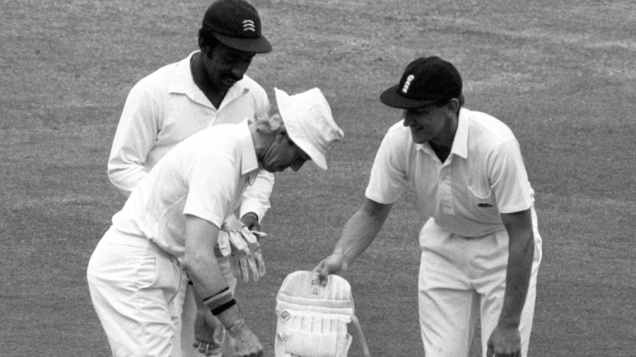
The World T20 Final – England v West Indies

Who you got?

The winner of the toss – D’Arthez? 🙂

England have played pretty well since that opening game against their final opponents. I’ll bet if you asked the experts which group might produce both finalists, you’d have said it might have been the one with India and Australia in, but it didn’t. Now the question might be are England over the mental scars they might have picked up from the first meeting in Mumbai?

Both teams had shockers in one form or other against Afghanistan. England won their match while the WIndies had little to play for and got caught out. The WIndies saw off the remainder of their opposition in better style than we managed, so on form, it has to be the West Indies, doesn’t it?

England, though, put it all together against our almost perennial ICC tournament nemesis New Zealand, in a complete display. The form of Roy, the clinical bowling, the coolness under pressure all augur well.

You cannot argue. England have taken many strides forward in the limited overs formats, and bat all the way down, with the bowling improving game by game. To argue against that isn’t going to have evidence on your side. This really appears to be Bayliss’s strength, and made the selection of him as coach quite a prescient one (oh dear, another knock on Downton). I think bringing in Strauss as some guru is stretching it a bit – after all, I don’t remember the hosannahs for Hugh Morris when we won the same competition on 2010 – but the philosophy appears the right one. If it is still within your heart to forgive the ECB and all that surrounds it, and cheer on this England team with all your might and heart, things look really rosy. Enjoy the game.

Me? You know where I stand. I wish Jason and Jos, Alex and Joe, Chris and Moeen, good finals. I like these guys. They embody the new England. They seem decent guys. I don’t wish them ill. I just can’t stand their employer. Not quite Teddy playing for Manchester United but not far off it!

Personally, I think England will win. I think they are on a roll, qualifying comfortably through their semi, rather than the fraught, but awesome run chase the WIndies had to pull off. Bit like 2010 – we (relatively) cruised through the knock-out games, the other finalist pulled off an escapology act in the semi – we pulled things together.

Enjoy the game.