India vs England: 1st Test day three

This particular Test has caused a mild outbreak of panic at BOC Towers, falling as it does during a period when all three of us are snowed under with work during what tends to be our busiest time of the year in our respective jobs.  Add into that 4am start times, lots of travelling and full days and trying to keep abreast of goings on in Rajkot appear to be a little distant.  In my own case, this week has been spent at World Travel Market at Excel, where international goings on allowed me to play a small joke on various colleagues on Wednesday morning:  “Have you seen the news overnight?  Isn’t it extraordinary?”, “Yes it is, I wonder how all the people on the American stands are feeling this morning”, “Oh I doubt they care too much, but 311-4 is a really impressive start”.

England’s 537 all out undoubtedly created scoreboard pressure, on a pitch that was felt likely to deteriorate, but India’s response has been one of outstanding batting and perhaps slightly disappointing bowling.  The seamers have been tidy enough, without being especially threatening while the spinners have been short too often, and badly used in at least one instance.  The stand between Vijay and Pujara was both essential and deeply impressive, slowly getting India back into the match, taking few risks and batting time.  Having reached 277-1, what followed was something of a surprise, for England had shown few signs of being likely to take wickets, only to snare three in little more than an hour.  If nothing else it was a reward for plugging away, and for keeping the scoring rate under control.

High scoring matches often appear to drift for large parts of a given day, as one side slowly claws their way towards parity and the other fruitlessly tries to stop them.  It’s why low scoring matches tend to be consistently exciting throughout, whereas with ones like this the viewer can disappear for an hour or two and come back to see how little has changed in terms of the balance.  The three late ones don’t exactly amount to a clatter, more of a gentle rattle, but they will have caused a frisson of anxiety in Indian ranks and raised the hopes of the English ones.  The pitch so far hasn’t been a dead one by any means, and there is both spin available and some movement off the surface for the seamers and rather more in the air.  It may be simply that both sides have batted well, it wouldn’t be the first time.

While Stokes removed the fluent Pujara, it was Adil Rashid who got the obdurate, yet intermittently attacking Murali Vijay with a delicious googly in his first over back just before the close.  And here is where even Sky felt it reasonable to offer up some criticism of Cook (before Rashid took the wicket, note) for not making more use of him and going to him as the last possible option.  It’s a criticism this blog has made repeatedly, and it’s not a matter of being wise after the event, it’s because there’s absolutely no point in having a leg-spinner if he’s not to be used as an offensive weapon.  England’s plethora of all rounders frees up spaces for luxury players who can bring something different, and a leg spinner is about as different as it gets for an English team.  Yes, he will go for runs, yes, he will be sometimes inconsistent.  But he’ll also get you wickets, that’s the whole damn point.  England have six frontline bowlers in this side, there are plenty of fall back positions should the leggie have a bad day – for him to bowl the fewest of any of the spinners on a pitch that is offering purchase is a waste of resource.

As for the wider question of where this game is going, as things stand the draw appears the favourite, but that is based on how the bat has dominated to date.  The behaviour of the surface is going to dictate much, yet with few signs of radical change to date it’s perhaps wishful thinking to expect it to drive a result on its own over the next two days.  India have plenty of batting still to come but are also a sizeable 218 runs still in arrears.  Should they get remotely close then the pressure will transfer to England as they will be doing nothing other than playing for the draw with the time remaining, while even if they only add another hundred it’s hard to conclude that England would feel safe enough to declare until some time into day five assuming things went well.  But perhaps given the kneejerk response to defeat in the last Test in Bangladesh, that’s still a position England should be pleased with.  The old mantra that they are never quite as good or quite as bad as the press portray them is as true now as it ever was.  All things considered, so far it’s quite even.

Day Four Comments Below


Bangladesh vs England: Series Review

England’s defeat yesterday was the most disgraceful thing ever to befall the national team.  Losing to a side who had only previously beaten a much weakened West Indies and Zimbabwe is a new nadir in the national fortunes, for which there is no excuse.

Actually, Bangladesh are an improving side and will trouble most teams at home these days.

It was the spinners’ fault – especially that batting collapse.

Gary Ballance was at fault throughout.

It’s fair to say that there’s been no universal response to the result yesterday, and an awful lot of tiptoeing around the wider issues for the England team as they move on to face India in a five match series where they are very definitely the underdogs. Some of it goes beyond legitimate criticism about particular performances and moves on to existing prejudices in some instances, and what can only be seen as blatant attempts at deflection in others.

There are some things that can be safely said – that England do deserve credit for going in the first place, for a second tour after Australia’s aborted one cancelled for security reasons (even if justified) would have crippled Bangladeshi cricket possibly beyond repair.  Amid the joy of victory, it was notable that a significant number of home supporters made a point of thanking England for coming in the first place.  That it passed off without incident doesn’t in itself justify the decision to go, but it does mean we are able to talk about the cricket itself, and able to revel in the pleasure given to a country that doesn’t exactly get its fair share of good news stories.

It can also be safely said that Bangladesh are a much improved side.  Whatever the shortcomings of England, they will give many teams a hard time in their own conditions – particularly the non-Asian sides.  Cook deserves credit for rejecting an invitation to wallow in the excuse that the surfaces were difficult by brusquely saying “Why wouldn’t you?” in response to a question about the wickets suiting the spinners.  As it turned out, rather than being low and boring in an attempt to scrape a draw, the groundsmen produced result pitches.  And well done them, we had two exceptionally entertaining matches.  Rather obviously, Bangladesh’s bowling strength is in their spin attack, and while Mehedi Hasan’s glorious start in Test cricket is no more a guide to his longevity than Bob Massie’s early matches, it showed that they have the attack to put sides under serious pressure when conditions allow.  That means little when they go away from home, for not a single fast bowler took a wicket for them in this short series, and the prospect of the hard tracks of Australia or South Africa, or the green seamers of England or New Zealand would likely mean they were overwhelmed, but all sides have to begin somewhere, and winning at home is that somewhere.

It’s not just the bowling either; Tamim Iqbal may well love batting against England in particular, but he is a very good player full stop, as is Imrul Kayes, while Shakib Al Hasan is a potent all rounder.  The lower order was too often blown away, but there is plenty to work with here.  They are improving, and all they need is the opportunity to improve further.  If there were to be one good thing to come out of this England tour, then it would be that teams play them more often – for this was their first Test series in over a year.  Too long and simply not fair.

Perhaps in advance of the series there was a degree of underestimation about where they were as a side, although given the lack of cricket, and Test cricket in particular, it’s not too surprising that most observers were short of detailed knowledge.  That they had better players than in the past was known, but it didn’t mean that there was any kind of expectation they would draw the series.  It doesn’t alter the truth that having watched them play this time, there is a recognition that they aren’t a bad side at all now, and that they thoroughly, completely deserved what they got, indeed they perhaps should have won 2-0.  Having lost the first game it would have surprised no one if they’d been badly beaten in the second, a narrow defeat is always hard to take.  That they went after England with a vengeance instead was wonderful to watch.

That doesn’t necessarily let England off the hook for the result, and while it is true that England were beaten by the better side in Dhaka, it’s reasonable to ask whether Bangladesh should have been the better team, even with all their improvements.  It therefore comes down to a question of what England did wrong, how much was forced by Bangladesh, how much was their own shortcomings as players, and how much was underperformance.

What can certainly be said is that by agreeing to play 7 Tests in 8 weeks, and skipping a warm up fixture in India to boot, they brought some of their problems on themselves.  This is the ECB’s responsibility rather than the captain or the coach, for they do their masters’ bidding in terms of the itineraries.  But with no match between this second Test and the opener in India, they were certainly forced to treat this one at least to some extent as a warm up match for India.  That meant resting Broad and bringing in Finn for one of his periodical appearances on surfaces for which he couldn’t be more unsuited.  Whether that made all the difference is neither here nor there; Broad didn’t have an exceptional first Test, but he is an exceptional bowler, and dropping him did weaken the side, no matter how necessary that decision might have been, and how wise it might turn out to have been over the next month and a bit.

The other change was dropping Gareth Batty for Zafar Ansari, and it is here we get to the thorny question of the England spin bowling.  England played Moeen Ali, Batty, Ansari and Adil Rashid across the two matches.  Ansari was on debut, and allowances have to be made for that, while the others have been the recipients of exceptionally strong criticism for their performances.  This is grotesquely unfair for a number of reasons.  Their returns were not bad at all overall, Moeen averaged 22 with the ball, while Batty and Rashid were a touch under 30.  They’re not fantastic figures of course, and certainly nothing like the wicket-taking levels of Hasan or Shakib, but it has to be asked what is expected here.  Bangladesh should be expected to have better spinners than England, in the same way that England can expect to have much better fast bowlers than Bangladesh (which they do).  Likewise, when they get to India, they’ll be facing better spin bowlers than they possess themselves – this is normal and to be expected.  Complaining about it is akin to wishing for golden elephants.  The last time England toured India they had the best spinner England have had in 40 years bowling from one end, and another who in another era would have been a fixture in the team for being the best we had by a distance.  Indeed, a fit and healthy Panesar right now would be a major upgrade on all of the alternatives.  England does not often produce quality spin bowling, and while that is a criticism of the coaching and structure that can and should be made, whining about the positioning of the deckchairs on the Titanic is what it always has been – pointless.

Therefore the only option is to work with what is there.  Rashid is a leg spinner; they have always been prone to bowling a bad ball an over, it tends to be in the nature of them with the rare exception of the very best like Shane Warne.  Even one as good as Stuart MacGill was relatively expensive.  That isn’t to defend his performances, but it is to make the point that if a legspinner is going to be selected in the first place, then some understanding of how to manage that legspinner is needed, plus a decent and realistic level of expectation about what they can and can’t do.  You simply don’t pick a leg spinner if the aim is to dry up the runs, it’s not going to happen.  Cook has shown little sign of understanding how to captain Rashid, who should be considered a wicket taking weapon, who will go for some runs (rather like Finn come to that).  Betraying a complete lack of confidence by having as at one stage six players on the boundary hardly helps the bowler or the team and removes the whole point of having a leggie in the side in the first place.

This is a common attitude problem in the English game, one that goes all the way down to Sunday village cricket, where a seam bowler who gets smashed around the park comes back for another spell later – a spinner suffering the same is lucky to get another bowl three weeks afterwards.  It takes an astute and clever captain, sympathetic to his bowlers to manage it and to make the best use of their assets.  Cook, unfortunately, is not the man to do that.

Moeen overall bowled passably well – he is what he is, a batsman and part time off spinner converted into being the senior slow bowler.  He does let the odd bad ball go down, but the truth of the matter is that people need to deal with that, he’s quite probably the best England have, and is someone who is doing relatively well given where he’s come from bowling wise.  Batty’s recall was frowned upon or approved of depending on perspective, and while he didn’t bowl as well as he might have hoped, even at his best he simply isn’t going to run through an Asian side in Asian conditions.  These players are very used to facing spin – something else that hasn’t been taken into account when berating the bowlers for not being better than they are, while imagining that left at home is a miracle worker who would have repeated Laker’s feat.

If that reads like an extended defence of the spinners, it’s only partially meant that way. They could certainly have bowled better, they unquestionably could have been captained better, but they are players limited by their English upbringing and learning.  The truth is that those who don’t play find their reputations enhanced by virtue of missing a defeat; whoever England select would not change things dramatically, and complaining that they aren’t Graeme Swann is as futile as the years Australia spent discarding spinner after spinner for the crime of not being Shane Warne.

More to the point, if the spinners were average but not appalling – in other words pretty much what could be expected of them, then the attempt to blame them for the match loss and the drawn series is downright peculiar.  It certainly wasn’t the cause of collapsing from 100-0 to 164 all out in little more than 20 overs.  The pundits have a real habit of demanding the heads of the bowlers for batting problems, and it’s much more realistic to point to the batting failures as being key to England not winning this series.  Not one of the top 5 averaged even 30 and they managed just four fifties between them in the series from a combined 20 attempts, with a top score of 68 from Moeen Ali as he and Bairstow attempted to rescue the team from the wreckage of the first morning of the first Test.  Only Woakes, Bairstow and Stokes managed to even score 100 runs over the four innings,while just behind those three in the averages was Adil Rashid, who with Woakes performed another recovery act from the shambles of the upper order.

Put simply, blaming the bowling is simply an attempt to project from the reality of where England went badly wrong – the top order batting.  Cook was poor, Duckett was brand new, Ballance was lucky to be in the team and was extremely poor, Root was poor.  Not many sides can handle the core of their batting malfunctioning repeatedly and go on to win.  And here is the problem for India, for it is hardly a shock to anyone to know that they have superior spinners, but for England to have a chance they need in particular for Cook and Root to step up and score runs – and lots and lots of them.  They are more than capable of course, Root is a fine player and Cook is an exceptionally good player of spin, and for an opener a phenomenal one.  But they could and should be feeling particularly uncomfortable with the way the spinners are getting the blame for not winning a series that was fundamentally about the inability of the England batting to reach 300 in any innings – and only once getting close because the middle and lower order got them there.

Furthermore, of the England players Ben Stokes is the one who can really hold his head up, his bowling was outstanding and his batting was good enough to score more runs than anyone else.  Yet the comment about him largely concerns his behaviour in getting into a spat with opponents.  Stokes is a fiery character alright, but it is peculiar to say the least that this gets attention and criticism ahead of the failures of those above him.  This blog has expressed concern on a number of occasions that a few media types are waiting for him to fail so they can properly put the boot in – nothing has happened which changes that worry, for we know all too well that it has happened before.

Bangladesh can bask in the glow of a successful short series, while England go to India with a lot of questions to answer.  It is to be hoped that some spend time on the questions that matter rather than wishing things were different than they are.  That is nothing but carping.  Whinging.  And if it’s unfair on some of the England players, it’s more than just unfair when it comes to the Bangladesh ones – it’s disrespectful.  This was an enjoyable and hard fought series, and one where a deciding Test would be just perfect.  Bangladesh would be quite strongly fancied to win it.

Bangladesh vs England: 2nd Test Preview

What might have been.  England could easily have been preparing for this Test on the back of defeat, with a side displaying manifest weaknesses, and with a tour of India around the corner having failed to arrange any practice matches before the first Test.  Resting players, rotating the seamers and giving debuts to the next bright young things would have been the last thing on the minds of captain and coach, as they sought desperately to avoid an embarrassing series defeat against one of the weakest (but improving) sides in world cricket.

But they won.  And that’s ultimately the point, for hard luck stories and what might have beens are always the refuge of the desperate.  Bangladesh will – or at least should – feel they missed a real opportunity to beat England.  Whether they can raise themselves to put in a similar display will perhaps be the biggest question of this match, and it would not be a surprise if England were to win comfortably given the narrow escape at Chittagong, even though there’s no reason to suppose so based on the performances.

It seems likely that the hosts will look to prepare a result pitch, not least because the weather forecast for Dhaka is iffy with a cyclone heading towards the city. It would be an immense shame if weather denied Bangladesh at least the opportunity of putting England under the same kind of pressure as they did first time round.

The ECB will deny it of course (don’t they always?) but this second Test was clearly intended to be a warm up fixture for the India series.  The lack of any intervening practice matches between tours made that clear, and the rumours verging on fact from the press that changes will be made to the side make it abundantly clear where the priorities lie.  Given the schedule, it’s understandable to do that, but Bangladesh can be forgiven if they feel a little slighted.

Zafar Ansari seems likely to be given a debut, probably at the expense of Gareth Batty, while the word is that Stuart Broad will make way for Steven Finn.  The batting appears likely to remain unchanged, despite the status of Gary Ballance as the whipping boy of the media these days.  England won despite the lack of contributions from Cook and Root, and however unfair it might be that Ballance copped the bulk of the stick, those two are the ones who will need to perform in India for England to have a chance.  Jos Buttler it appears will have to wait for his chance.

Bangladesh are likely to be unchanged, with the requirement that they perform better all round than in the first match.  Their batting line up is a decent one these days and plenty of them got starts in both innings.  Converting that into substantial scores remains their biggest challenge, for they have the bowling to trouble anyone at home.

Chittagong was a terrific Test match, if we can have something similar this time, then it’ll be required viewing.

Day One Comments Below

England in Bangladesh: Preview

Friday sees the England team back in action after a break that scarcely warrants the term.  To put it into context, they begin the ODI series in Bangladesh on October 7th.  In 2017, they will finish their home international season on 29th September.  It’s been pointed out before that England’s schedule is beyond ridiculous, and irrespective of all the other matters around whether England were to tour at all, it would be unsurprising if some within the England camp were hoping for it to be cancelled for no other reason than to provide a more meaningful break.

Some players are missing anyway of course, Alex Hales and Eoin Morgan deciding not to tour, while James Anderson is injured, and in so being thoroughly justifying the medical team once again who advised so firmly against his selection during the English summer.  If this series feels like a warm up for the India tour, it’s not helped by the lack of any scheduled preparatory matches before the first Test in Rajkot; the implication that Bangladesh will provide what is needed is hard to avoid.  Nevertheless, despite the debates over the security issues, Bangladesh as a cricket nation desperately needed it to go ahead.  If England had not agreed to go, the likelihood of other countries visiting would take a big hit.  There may be lots of criticism about how deserving Bangladesh have been over their Test status in the last decade, but losing home matches would be a body blow to the prospects of the game there.  Cricket is not in the healthiest state it could be, and while Pakistan reaching the number one ranking (since overtaken by India) while playing in exile might be a notable achievement, it doesn’t mean it’s a template for others to follow.

This series comprises three one day internationals and two Tests, but few in England will be excited about it.  That isn’t the point though, and while it is easy to play a game of whataboutery, whether it be concerning Ireland’s treatment or the actions of the ICC, for the game to have any chance, the weaker and poorer members of the international firmament need to play against the rest, and play at home.  On my recent travels I had the opportunity to talk to a number of people from Bangladesh, hoteliers, ground handlers and so forth, and while this cricket tour is not something from which they expect to see any business, the very fact that it is happening at all was clearly uppermost in their thoughts.  In difficult times even the most peripheral action can have an impact on the future and on the degree of confidence in the future.  They need this, and they need it badly.

England will expect to win, and although Bangladesh’s progress is uneven, they are even more hampered by having not played international cricket since March’s World T20.  In a time when the ECB are heavily criticised for grinding their players into the dust in an attempt to extract the maximum financial return, it is easy to forget that other countries might regard that as a nice problem to have.

This tour will be low key on the field, and all hopes are that it will be equally low key off it.  Yet for England fans the selections of Zafar Ansari and Ben Duckett will be of interest, as will the performance of some of the bowlers given the challenges ahead.  Chris Woakes has had the kind of summer he would have dreamed about, but rising to the challenge of sub-continental pitches will be something new to deal with.  How he does that, particularly in the absence of Anderson, will provide an indication as to how competitive England will be in India.  The same can be said of the spin attack – the recall of Gareth Batty doesn’t inspire great confidence in the potential amongst the younger players, but dealing with the here and now rather than chasing a future that never arrives is perhaps something England haven’t done enough of in recent times.

However it turns out on the field, this tour says more than just about cricket, and perhaps that is the most important thing.  The debate about the rights and wrongs of players going, not going, how the ECB handled that, how the cricketing press responded to that has been done and not too many came out of it with a great deal of credit.  The matches themselves can at least provide a respite from that.


Guest Post “40 Years On – England v West Indies, 3rd Test 1976″…by Simon H.

Part Two…Simon H kindly wrote out his memories of this important, but often overlooked but for the battering the old guard got, test match in 1976. In part one we had the build up and the first day’s play. Now let Simon take you through the rest of this match.

You can access part one here.

DAY TWO

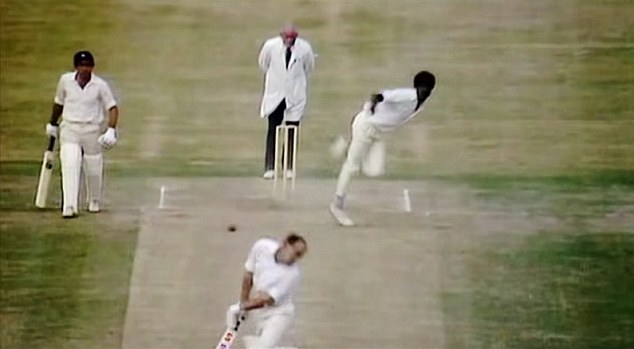
The memory has every day of the summer of ’76 sunny and hot but in fact Friday at OT was cloudy. However overhead conditions had little to do with England losing 8 wickets for 34. A pitch that had something for medium pacers and spinners turned out to have a whole lot more for bowlers who delivered the ball at searing pace. Roberts bowled impressively from one end probing Edrich on off-stump until he finally knicked one and then getting one to rear off a length to have Hayes caught at fourth slip. But it was Holding at the other end who was electric. Running in from near the sightscreen it was athletic and thrilling as only great fast bowling can be.

If I may digress for a moment, it is one of the beliefs of the moderns that fast bowlers of the past weren’t really fast. After all, haven’t all objectively measured sporting performances got better over the years? Fast bowlers of the past seemed fast at the time but they’d be medium pacers now, some say. I have to say that , from the little footage I’ve seen of Frank Tyson, he doesn’t look that quick. But look at the film of Holding in this match and he looks quick, very quick indeed. The 1970s speedmen were also tested in early speed-guns and Thomson was found at 99 mph with Holding (who wasn’t then at his peak) not far behind. It isn’t rheumy-eyed nostalgia that imagines this was ‘pace like fire’. It was.

Nightwatchman Pocock soon edged Holding to first slip. However it was an unplayable lifter to Woolmer that knocked the stuffing out of England. Greig tried to counterattack but it had a hint of desperation about it. Daniel replaced Roberts and with his wading-through-water run-up and muscular action produced an in-ducker that bowled the England captain. For all the talk about bumper wars that was about to erupt, West Indies realised Greig’s weakness was to the full ball and didn’t make the mistake of Lillee and Thomo in 74/75 when Greig goaded them into losing their length. Knott couldn’t salvage this England innings and edged to second slip. Underwood got an alarming bouncer and then was bowled as was Hendrick. The bouncer at Underwood was genuinely scary but he had made 31 in the previous Test (without which West Indies might well have won the game) and English bowlers inflicted some nasty injuries  on tailenders in the 1970s (Snow to Jenner in 70/71, Willis to Iqbal Qasim in ’78 and, most famously, Peter Lever to Chatfield in ‘74/75). Holding had 5-17 and West Indies a lead of 140.

England needed quick wickets to keep a toe-hold in the match but like all great sides West Indies sensed the moment to attack. Greenidge launched a second furious attack on the England seamers who looked tame in comparison and although never at his best Fredericks chipped in with fifty before treading on his wicket. When the opposition are effectively 256-1, seeing Viv Richards striding to the crease was just what England needed! Richards survived a few early alarms and at the close West Indies were 163-1.

https://www.youtube.com/watch?v=KtWKfhGKw9w

DAY THREE

So far the match had had great batting, great fast bowling, some decent spin bowling and good catches. What it hadn’t had was major controversy. The last hour on Saturday changed all that.

Most of Saturday’s play was actually the dullest part of the match. That one can say that when it featured Viv Richards making a century says something about the rest of the game! Richards had been a little scratchy late on Friday but here he was at his masterful best and some of his late cutting of Underwood was a delight. It was only slightly dull in the sense that a century was so inevitable. Greenidge hit some more thunderous drives on the way to his second century but then Selvey knocked his middle peg out – a moment captured in a photo that Selvey doesn’t like to show every chance he can. Clive Lloyd tried to bat himself into some form and was looking more like his old self before he holed to mid-on to give Selvey his sixth wicket of the match (and the last of his Test career). Otherwise Kallicharran, King and Murray scratched around to no great effect and started to remind everyone that this wasn’t an easy pitch to bat on. A bored eleven year old drifted off into the garden to play some cricket with his brother (cooking apple tree trunk for wicket, Gunn & Moore bat, don’t loft it on the on-side as it would go in Mr Fry’s garden and he was a bit scary) and he missed what was about to kick off……

Lloyd declared leaving England 80 minutes that night to survive and then a further two days to hold on or 552 to make. What happened next Martin Williamson recounts here:

http://www.espncricinfo.com/magazine/content/story/921731.html

As has been a fault of mine too often, I could see both sides. England were to blame for preparing such an unfit pitch and selecting such an unsuitable opening partnership. As I said earlier, English fast bowlers dished it out in the ‘70s and West Indies’ batsmen took it without (as far as I can recall) any complaint. Complaints about nasty fast bowlers usually boil down to “why haven’t we got any?” There was a nasty tinge to some of the complaints that denied the skill of the West Indies and tapped into some unpleasant stereotypes. But….. Holding did go too far that evening and Lloyd was too laissez-faire about it. That bouncer that just misses Close’s head is a genuinely frightening moment.

Close Holding

I should perhaps say here that I was always immune from the cult of Brian Close. Perhaps I was just too much of a confirmed Southerner? Mostly, I wanted an England batsman to hook like Greenidge. John Edrich was something of a hero though – I liked a dashing opener like Greenidge but a nuggety opener was okay too and anyone with eyes could see that Edrich was having to face some tough bowling. At the time, Surrey weren’t too good and didn’t keep beating Hampshire which also helped.

https://www.youtube.com/watch?v=_8kvK-rylWw


DAYS FOUR AND FIVE

I don’t have any recollection of watching day four on the Monday. Was I still at school? The match started on July 8th and I remember watching the first day live – did we break up that early in those days or had I pulled a sickie?

Anyway, the records show that West Indies reduced England to 125-9. After all the focus the day before on Holding (and Daniel) it was Andy Roberts who stole the show. Roberts was also one of Hampshire’s and, if he wasn’t as high in my affections as Greenidge, he was still one of ours. Later in his career Roberts cut his pace and became a more English style bowler relying on accuracy and seam movement. In 1976 he was still genuinely rapid, if not quite in the Holding league.

He was twice on a hat-trick and the second time he was denied when Greenidge at second slip dropped Selvey. I can remember watching that but it was late in the day so I’d obviously come back in from whatever I’d be doing. At the time it didn’t seem such a big deal – didn’t hat-trick chances come around quite often? Poor Frank Hayes who’d been picked as a bit of a dasher (he hit 34 off an over once) who might take the fight to the West Indies hung on the longest. His reward was to be promoted to No.3 for the next game where he made 7 & 0 and was dropped never to play again. He played all his nine Tests against the West Indies and ended with an average of 15 despite hitting an unbeaten century.

Rain ended play early on day four so the teams had to come back for ten minutes on day five. Selvey edged Roberts to Greenidge again who didn’t drop this one. West Indies had won by 425 runs. It was the fourth worst defeat in Test history at the time (there have been two worse since) and England’s second worst:

http://stats.espncricinfo.com/ci/content/records/283901.html

http://www.espncricinfo.com/ci/engine/current/match/63165.html

AFTERMATH

The next Test at Headingley was in some ways even better. Unfortunately, the family holiday got in the way of watching most of it and I spent several days in the Cotswolds trying to find a TV or radio so I could find what the score was. We got back in time for the climax and I remember being incredibly upset when Knott was caught behind and any realistic chance of an England win went. Fortunately, the decks were cleared for the Fifth Test and a game of three monumental performances (Richards 291, Holding’s 14 wickets, Amiss’s 203) could be enjoyed in its entirety. The moaning about bouncers became moaning about over rates and about crowd noise and I wanted to become a cricket writer/commentator who would write/talk about his love of the game and not just moan all the time (!).

It would be 14 years and over 20 Tests before England would beat the West Indies:

http://stats.espncricinfo.com/ci/engine/stats/index.html?class=1;opposition=4;spanmax1=01+mar+1990;spanmin1=01+jan+1978;spanval1=span;team=1;template=results;type=team;view=results

West Indies’ global domination perhaps wasn’t confirmed until they beat Australia in Australia in the first post-Packer series in ‘79/80 – but in retrospect the domination had started at OT. A cricketing dynasty was founded.

England recovered some pride by winning the winter tour in India. West Indies hosted Pakistan in an epic five Test series at home and, with Holding and Daniel injured, discovered two new bowlers in Colin Croft and Joel Garner. (Ironically it was David Holford’s leg-spin that won them the final test and the series 2-1). The West Indies’ reservoir seemed bottomless and the game became increasingly dominated by pace (or at least seam). Mike Brearley wore a skullcap under his England cap to protect the temples in 1977 and on the tour of the West Indies in 1977/78 Graham Yallop became the first batsman to wear a helmet.

This youngster joined one of those cut-price book clubs so he could buy cricket books cheaply. CMJ’s ‘MCC in India 76/77’ was I think the first. Tony Cozier’s ‘Fifty Years of West Indies cricket’ soon followed (with its cover picture of Clive Lloyd driving while Greig stood helpless at slip). I replayed the matches endlessly in garden cricket or on the indoor cricket games I had. I don’t remember listening to the India tour on the radio so either it wasn’t covered or I wasn’t doing that yet. I only listened to TMS when there wasn’t TV coverage and there was no Richie. Richie was impossibly exotic and didn’t keep telling us it was better in his day. I loved listening to him and felt transported to a different, more exciting place. The Centenary Test was shown on TV in a highlights’ package and in the epic Lillee-Randall duel, England at last a batsman who could take on a great fast bowler and win. Australia arrived in 1977 – the Ashes were supposed to be this great thing but it soon became clear this Australia weren’t very good. Lillee had stayed at home and the fearsome Thomo of legend wasn’t so fearsome. And they weren’t the West indies.


My thanks to Simon, for a brilliant account of a very interesting test match. Feel free to comment, and to share any memories if you are old enough!

Dedication’s What’s You Need

Since the first one day match nearly 50 years ago England have had a rather troubled relationship with the format.  Despite protestations to the contrary over that time, it has taken a clear second place to Test cricket in both the affections of English fans and the ECB itself. Where the horse and the cart are located is an open question, but despite reaching three World Cup finals it’s a poor record compared to any of the other major nations. The World T20 win in 2010, propelled by He Who Must Not Be Mentioned remains the only global title England have ever won, a shockingly poor return.

England have had periods of some success of course, but always with the feeling that they were carrying an extra load on their backs.  The innovation came from from others, England last showing signs of thinking differently when they pushed Ian Botham up to open the batting in Australia in 1987.  The 1992 tournament turned out to be something of a high water mark meaning that for a substantial proportion of followers England have been dreadful their entire lives.  Of course that’s a slight exaggeration, there have been times where they’ve put in good performances, won series and reached finals ; likewise there have been players who have been good performers in both 20 and 50 overs, and yet although individual players were considered dangerous – Pietersen most notably recently – it never amounted to a side who would ever truly scare the opposition.

With the invention of T20 at professional level, it moved to a different plane, as all the major sides upped the ante.  Where scores of 300 were regarded as exceptional, they now became the norm, with 400+ now not even proving a safe score as Australia found in South Africa.  But not for England.  Stories abounded of them being hidebound by computer modelling, of aiming for “competitive” scores that the data told them they would win with, only to be battered.  Graeme Swann has rarely proved to be a reliable witness but his stories of England’s tactical thinking seemed all too plausible.

The nadir came at the 2015 World Cup, where England failed to get out of their group, something that takes a considerable degree of effort considering the determination of the ICC to try to render the group stages to be as meaningless as possible, except financially.  They left to derision from the cricket world, and contempt at home, a path their football and rugby equivalents would follow soon enough.

And yet.  With hindsight perhaps the first glimmers of a new approach came at around that time.  The removal of Alastair Cook from the side, to his clear and very public disgust, was long overdue – not because he isn’t a good player, but because his style of batting is simply obsolete in short form cricket. His replacement Eoin Morgan’s clearly stated dissatisfaction with the method England were employing became ever more obvious during the disastrous performances in Australia, while the omission of Ben Stokes from the squad and refusal to pick Alex Hales seemed symptomatic of a setup that simply didn’t appear to understand one day cricket, thinking it a contraction of Tests not an expansion of T20.  For the first time though, the players were showing the smallest hints of rebellion, and the appointment of Paul Farbrace to the England coaching staff seemed entirely at odds with a side approaching the game in such a conservative fashion.

The removal of Peter Moores as coach appeared to be the catalyst for finally attempting to play the game as the rest of the world had been doing for some years, and the bonus of New Zealand being the first visitors post World Cup forced the change in concept, both in one day cricket and Test cricket.  England have a lot to be thankful to their teachers for.  Andrew Strauss’s decision to retain Morgan as captain was, if not a brave one as such, certainly not what was expected.  Farbrace’s determination that England play with freedom wasn’t remotely the first time it had been said, but it was the first time anyone had ever meant it.  The old line about scoring at ten an over but don’t take any risks which was unquestionably the way England thought gave way to a more forgiving environment where taking risks was encouraged, and failure in that pursuit forgiven.  This is perhaps the biggest, most important change England ever made.  Freeing up players to express themselves is only truly possible if those players do not feel a presence looking over their shoulders in the event that they fail.  There are endless buzz terms to describe that, but it still amounts to accepting that failure is the price of success.

The impact was immediate, England going over 400 for the first time in a series where they scored at least 300 every time except in a rain affected D/L win.  Whereas before 300 was the upper limit of England’s aspirations, they were suddenly viewing it as the bare minimum.  The second match, a defeat, perhaps best expressed the remarkable change in thinking.  New Zealand had scored an impressive 398-5, the kind of total England couldn’t ever have hoped to try to chase down.  They fell short alright, but only by 13 runs.  For the first time, there was a feeling that England might actually be developing the kind of side to seriously challenge large totals.

New players were being brought in, not because they were being analysed for a Test place, but because they were outstanding one day prospects.  Jason Roy had a slowish start but was kept faith with; Ben Stokes was brought back; Alex Hales was no longer kicking his heels and carrying drinks but opening the batting and being told to play the way he can.  From an era where England relied on the middle order to try to raise the tempo from a solid start, they were suddenly going at it from the off, with those below tasked with maintaining the momentum, not rescuing a lost cause and aiming for respectability.

A series defeat to Australia followed, and the flip side of the determination to attack showed itself in the decider, where England collapsed to 138 all out and were thrashed.  This perhaps proved to be the most important test, for rather than retreating into their shells they instead, under new coach Trevor Bayliss, reaffirmed their determination to play in the same way and to consider such failures as nothing other than an occupational hazard.  There’s an irony here – for so long asserting that high risk approach as being the way a player or a team does things has been used as a stick with which to beat them.  Grasping that risk is part of the equation has always seemed beyond a certain, very English kind of mindset.

A comfortable series win in the UAE against Pakistan showed that England could play more than one way under different conditions, for that kind of away series offered different challenges and different upper limits in terms of scoring.  It also marked a change in bowling approach to stop simply using the Test bowlers – not for the sake of it, but because there were better one day options available.  Jason Roy too finally showed what he is capable of, and with Jos Buttler rapidly becoming a player to genuinely fear, for the first time in living memory England had a top five or six where every single one of them could seriously damage opponents.  One player not mentioned so far is Joe Root, and it could be said that he is performing the kind of role given in previous years to Cook or Trott – the conventional player around whom the others would bat.  The difference being that Root is a true modern cricketer, multi-dimensional and capable of all formats.  A run a ball as the base minimum is not at all bad when others are scoring even faster.

England lost the subsequent series in South Africa, but not before once again approaching the 400 mark and not before once again overreaching and falling short in two matches to cost the series. That caused the first criticism from the press of how England were playing, that they needed to learn to lower their sights.  Although never being explicit about it, the message that came back when reading between the lines was to reject that kind of thinking completely, that bad days given the nature of the format were inevitable and that if England were truly to become the best, then this was the only way they would achieve it.

It is of course impossible to assess a wider view on how that response was received, but at least anecdotally, English supporters appeared to be fully behind it, and much more willing to accept the bad days than the media were.  In most sports, supporters tend to be more forgiving of failure if they have faith in the approach.  And this one was exciting – reaching for the stars is more thrilling than simply aiming to get off the ground, even when it doesn’t quite work out.

Which brings us to yesterday.

Given the history of England in one day cricket, the very idea that England would break the world record total was perhaps one of the most laughable that could be conceived.  Perhaps only Bangladesh or Zimbabwe of the full members would ever be thought less likely to do such a thing, and undoubtedly eyebrows will be raised around the world that it was England (“What, England?”) who set the new target.  But it’s been coming.  While results have been a little up and down, the likelihood that England would give a bowling attack a right royal pasting has been increasing all the time.  Pakistan may not be at the level they have been, but their bowling is their strong suit, and yesterday they were simply destroyed.

Perhaps symptomatic of England’s troubled history is that their national record for the highest individual score had stood for over 20 years, and while Robin Smith’s 167 is a fine score in any era, that it barely crept into the top 40 of highest individual scores – with the best ever nearly a hundred more – was as good an example of how badly England had been left behind as you could find.  Smith’s record may have stood for 23 years, but there are no guarantees at all that Hales’ new mark will stand for as long as 23 days.  Jason Roy came close only recently, and Jos Buttler, Joe Root or Ben Stokes look capable of beating it every time they come out to bat, while Eoin Morgan is hardly ruled out.

Further down the order hitters are prevalent too, indeed only Mark Wood resembles a tail ender in any way – Liam Plunkett at ten has shown himself capable of striking the first ball he receives for six in the past.  If that is the batting, then the bowling attracts less attention, but as much as anything this is merely how one day cricket now works.  It is all about the batting, and bowlers, to their chagrin and the delight of batsmen the world over, are reduced to nothing more than feeding the batters and trying to keep the run rate under control.  Perversely or not, this makes bowlers who do take wickets even more valuable, and it is in that discipline that there is a little less certainty with regard to England.

While Hales rightly got the man of the match, it was Buttler who caught the eye even more.  He simply terrorises the opposition – while he is in, anything is possible.  Even so, while he reached his 50 off 22 balls, Eoin Morgan was only two balls slower to his, yet passed almost unnoticed such was the headiness of the striking.

England are now at the point where they strike fear into the heart of opponents.  By making such a statement they are ensuring that no team will ever be sure they have enough runs, that no total is ever impregnable.  It may not be that England are the best team in the world, but they are not far from it and they are still developing.  Next year sees the Champions Trophy held in England, and perhaps for the very first time England will go in to a tournament not just with hopes of winning, but realistic aspirations that they should.  Quite simply, there is no team, not India, not Australia, not New Zealand, who can compete with England’s batting power and depth.  That in itself does not make them the best, for different conditions will bring different problems and highlight specific weaknesses, while other teams will play far better than Pakistan have.  But what it does do is cause every other nation to cast nervous glances towards a side who are beginning to demonstrate that they are something a little bit special.

For any England fan, this is truly remarkable.  The country that showed little interest except during World Cups where they stank the place out has set down a new standard.  For the first time, perhaps ever, it is England who are causing the rest of the world to consider how to catch up.

Remarkable.


England vs Pakistan: 2nd ODI

No form of cricket can guarantee close matches or excitement, and the first game somewhat petered out in a drizzly mess.  But even though England’s win was ultimately confirmed by Messieurs Duckworth Lewis and Stern, there was little doubt which way the match was going anyway.  It was a curiously old fashioned game, at least as far as Palistan were concerned, as their innings brought back memories of England under Flower and Moores as much as anything.  260 may even be a “winning score” as far as the statisticians are concerned (probably not) but England were in complete cruise control throughout.

The second match therefore will be interesting to see how the visitors look to approach it, for England look a real force in the one day format, one who seem quite capable of reaching another hundred on top of that.  That’s not to say they can’t fall in a heap, for the shorter the game, the higher the level of risk, and the greater the opportunity for collapse.  One of the more pleasing things about this England side is that when that does happen, they regard it as an occupational hazard, shrug it off and continue in the same vein.

Yet if the batting is doing well, it was the bowling, or more specifically, one element of the bowling, that caught the eye.  Mark Wood has shown he has ability and pace before, but his entire England career to date has been while labouring with the presence of an ankle problem.  Having been away for quite some time getting it sorted, he is now back – and my, how he is back.  His pace is right up there with anyone, and it was startling to read that he feels he’s not fully there yet and could get quicker.  It may yet be the best news of the summer providing he suffers no reaction.

In the days between these matches England confirmed that they will tour Bangladesh this autumn.  The ECB rarely earn praise from anyone – well, apart from one or two for whom they can do no wrong no matter what – but while it is impossible to judge the rights and wrongs of this particular decision, they do deserve praise for at least trying wherever possible to ensure these tours go ahead.  It’s not the first time, back in 2008 after the Mumbai terror attacks, England returned to the country, ensuring that normality was restored in sporting terms.

Again, we must trust the Foreign Office and the ECB’s own advisors that this particular decision is the correct one, but assuming it is so, it would still have been easy to use the security situation to cancel it.  Indeed, there must be a suspicion that other countries may well have done so, and thus with the proviso that we do not know the reality of the decision, the ECB do deserve credit for not using it as an excuse to avoid going.  Notwithstanding Pakistan’s wonderful rise to the top of the Test rankings, it would have been crippling to Bangladesh had it got the go ahead.

The ECB have told England’s players that they can drop out of the tour with no effect on their careers, but whilst this is a good thing to say, the truth of the matter is that for all but those absolutely certain of their place, it means nothing.  Players who do well are always going to be in pole position, the man in possession has the advantage.  It means that for some, there will be some soul searching about whether to make themselves available or not.  It is hard to think how else the ECB could have done things, they may be many things, but they are not fools, and they will be as aware of this as anyone.

Finally in other news Somerset have announced the prices for the T20 international between England and South Africa next year.  It is the first time they will host an international in 30 years, and they seem determined to make the most of it, by announcing ticket prices of between £60 and £80.  It’s not the biggest ground, it is a big event for them.  But it is still an outrageous price.  There seems little doubt they will sell out, and therefore in commercial terms it’s justifiable.  Yet once more it is those who support the game being used as a cash cow and nothing else.  Commercially sensible yes.  Grasping and greedy, also yes.  I trust they’ll use the financial bonanza wisely.

2nd ODI comments below

Hand me Down a Solution – Series Review

In the early 1980s when growing up, summer holidays meant tuning in to BBC1 at 10:55 to watch the Test matches.  Come the end of summer, the feeling of melancholy at the conclusion of a series was always strong, with the only subsequent cricket being the end of season Lords one day final, which was akin to pretending to enjoy the sloe gin from the drinks cabinet when everything else has been consumed.  Times change, and cricket now is unending, where the finish to the Tests is merely a pause before the one day internationals begin, and then England go on tour somewhere.  In the same way that the end of the football season is a mere pause in hostilities, the end of the Test match cricket summer no longer normally carries so much power to create sadness.

And yet with this one, perhaps there is a little more in the way of regret at the passing of the season.  This is probably as much as anything due to Pakistan, who have been exceptional tourists, and thoroughly merited their victory at the Oval to draw the series.  Four Tests also offered up the reminder as to why a five Test series remains the best possible format, provided the series is a competitive one.  Few cricket fans would object to a decider for this one, yet it is a lament that so often is heard and never acted upon.  It was at least better than the ridiculous two Test “series” against New Zealand last year.

What the drawn series did do was silence those who were quoting the article of faith about England holding all the bilateral trophies.  It isn’t that doing such a thing isn’t a meritorious achievement, it’s just that something that no one had ever noticed or paid attention to before somehow became the highest possible achievement in the game in their eyes.  As with so many things, the context is all, noting success is a good thing, going overboard about it is not.  Doubtless, the bilateral series record will now return to being what it always was – a minor matter.

Given their troubled previous tour to England, Pakistan clearly intended to win hearts and minds this time around, and in that they succeeded.  It is a remarkable turn around for a side who it is probably fair to say were one of the least popular touring sides in England; they played with a joie de vivre that reminds everyone that cricket – even in its modern, money is all important guide – is a game, a pastime, and above all fun; the reason all of these players first picked up a bat or a ball in the first place.  The repeated press ups may have irritated the England players, but it amused the spectators every time.  Quite simply, the Pakistan team looked like they were enjoying themselves.  One particular moment comes to mind, a catch by Hafeez (who didn’t exactly have many high points) caused a young boy in the crowd to wildly celebrate, being picked up by the TV cameras and leading the player to end almost doubled over laughing, and applauding his young supporter.  It was a delightful moment, and one that re-inforced the image of a team comfortable with where and who they are at last.

Misbah ul-Haq remains under-appreciated in his homeland, but elsewhere he is approaching hero status for cricket fans.  The achievements are verging on the extraordinary, with Pakistan now having the most successful period in Test cricket in their history under his leadership.  It is quite exceptional in itself, and given his age, truly remarkable.  Misbah has made Pakistan competitive, and above all given his team their self-respect.  If it has to be that it is something more recognised for what it is abroad, then that is a pity, but it is still worth recognising.

So what of England?  The first part of the summer was routine enough, a Sri Lankan side shorn of its great players was despatched with little difficulty, but Pakistan proved to be something of a harder nut to crack.  This in itself came as something of a surprise to some, with many predictions of a comfortable England win before the series began.  Yet Pakistan were always going to be a threat, and in advance of the series the assessment of it being between two sides with good seam attacks, and patchy batting proved to be ultimately more or less right.  England had the advantage in the middle and lower order, while Pakistan had a (much) better spinner at their disposal.

Statistics can be gleefully misleading at the end of a series though: take the comparison between Moeen Ali and Yasir Shah, both of whom averaged over 40 in the series with the ball.  Yet Yasir was instrumental in both Pakistan wins, while Moeen – with the ball at least – certainly was not.  This isn’t a particular surprise of course, for Yasir is an outstanding bowler, and even the most adoring fan of Moeen would never make that claim.  But it does highlight the point that players can have an impact in a game disproportionate to their overall figures, perhaps we could call it the Ben Stokes effect.

England did have some real successes in the series, Moeen himself batted absolutely beautifully, that dreadful slog at Lords proving to be very much the exception.  It’s notable in his case that that particular dismissal didn’t stop him from using his feet to the spinners, most gloriously on that final morning at Edgbaston where in the first over of the day he served notice that England were going all out for the win.  That Moeen can bat is not especially surprising news, that his batting improves out of all recognition when given one of the batting spots rather than being in the tail perhaps is.  Either way, and given that England have limited spin bowling options – presumably Adil Rashid will come in for the India tour – his series will count as a success, albeit with a couple of major caveats.  One item of note with Moeen’s bowling is that although his average is certainly not the best, his strike rate is quite decent, comparable with Nathan Lyon for example.  Batsmen do try to attack him, and do get out to him.  In the absence of a truly top class spinner of the calibre of a Graeme Swann, replacing Moeen with another off spinner is unlikely to deliver markedly improved results.  It doesn’t mean defending Moeen irrespective, but it does mean cutting England’s cloth according to what they have.  A decade ago Ashley Giles received no end of criticism for not being Shane Warne, but he did a job, and did it well.  Chasing rainbows is not the means to a successful side.

Joe Root finished top of the batting averages, largely due to that astounding 254.  Aside from that it will represent a mildly frustrating series for him, getting in and getting out with annoying frequency.  An illustration of just how good Root has become is shown by the feeling that the series was a slightly unsatisfying one despite over 500 runs at more than 73.  Such is the penalty for excellence, for brilliance is expected every time.  But Root himself alluded to the irritation of getting out when set, so it is less a criticism, and more a matter of the player being so good now that he can deliver even more than he currently is.  He has a decent shout of being England’s best batsman in many, many years.

Cook too had a mixed time of it, despite a strong set of figures over the series.  He looked somewhat rusty in the first Test, but thereafter his biggest problem appeared to be that his form was too good if anything.  He rattled along, having the highest strike rate of anyone bar Moeen, a most un-Cooklike state of affairs.  He was fluent and even playing cover drives, which tends to be one of the best indicators of an in form Cook.  That would then bring about his downfall – seeing him caught at point off a skewed drive, or dragging pull shots onto the stumps is not something that is expected.  Most batsmen will tell you that they score the most runs when they are just shy of their very best, where there is a degree of caution in the strokeplay.  When feeling on top of the world, more chances are taken, and getting out is more likely.  It is impossible to measure, but the suspicion has to be that this was the case with Cook this time.  Still, a good series for him.

Jonny Bairstow was the other major plus point in the batting order.  He’s the leading run scorer in Tests in the world this calendar year (by dint of having played far more than anyone else, it has to be an Englishman) and scored heavily without ever going on to a truly match defining innings at any point.  Four fifties and no hundreds represents a decent return from a player in excellent form, but perhaps his most notable achievement was muting the comment about his wicketkeeping.  He hasn’t turned into a great ‘keeper overnight, and probably never will, but it is tidier, and with fewer errors than in previous series.  He pulled off a couple of decent catches too.  His wicketkeeping remains a work in progress, but the reality is that his runs balance that out; the age old debate about a specialist keeper versus an auxiliary batsman who keeps has long been settled, in favour of the batting.  Bairstow will make mistakes, but the more he keeps – and it does need to be remembered that much of his career he has been essentially part-time – the better he will get.  There have been some suggestions that he move up the order, effectively to compensate for the flaws in England’s batting, but it would be a big ask to expect him to do that, especially in the heat of India or Bangladesh.  Weakening another player to make up for the failures of others has never been a solution.

England have become something of a team of all rounders in the last eighteen months, and the player who was widely felt to be more of a bits and pieces player than a true example of the breed is Chris Woakes, who probably had the best series of anyone.  He batted well enough, making a maiden half century, but his bowling was a revelation to many.  Yet Woakes has an excellent first class record with both bat and ball, and he was hardly the first player to find the transition to Test cricket a challenge.  The demand for instant success clouds the reality that an immediate impact guarantees nothing, and other players can take time to adjust.  One fine series doesn’t mean that he’s a fixture for the next few years, but he’s started to look the part with the ball for a while; in South Africa he bowled with very well yet was spectacularly unlucky.  This time he got the rewards.  By all accounts he has worked exceptionally hard on his bowling, putting on an extra few mph and improving his control.  Players can and do learn – it is not unlikely that James Anderson is a rather useful resource – and Woakes’ success is a reward for being patient with him.

Stuart Broad is a bowler who attracts considerable ire and much comment, despite a record over the last couple of years that compares with anyone.  This series certainly wasn’t his best, and mutterings about his apparent habit of coasting resurfaced.  Yet 13 wickets at 28.61 is hardly a catastrophic return, and if that now counts as coasting, then it merely demonstrates what a fine bowler he has become.  It was a relatively quiet series for him because he didn’t have one of those spells where he becomes completely unplayable, rather than because he struggled at any point.  Broad is the focal point of the England bowling attack these days, despite Woakes having a better time of it this time.  Criticism of Broad is absurd, he is a fine bowler who had a series that was quiet by his standards.  The “by his standards” is the key.  Where there can be severe disappointment with him is with his batting.  It has completely fallen apart, and the pity of that is that for so long he looked like someone who, if never destined to be a true all rounder, looked a player capable of meaningful contributions on a regular basis.

Anderson too had a reasonably quiet but still moderately effective series.  He didn’t take a whole lot of wickets, but maintained excellent control throughout.  He made more headlines for having a preposterous strop at being rightly sanctioned for running on the track than anything else.  What can be said about him is that at 34 he remains an outstanding athlete, with few obvious signs of diminishing powers.  Assuming he carries on for another few years he will doubtless get slower, but he is a clever bowler, and one who will use the skill developed over a career to take wickets.  At the veteran stage of his cricketing life, he is still a valuable asset.

As for Steven Finn, his raw figures look horrible, but at times he bowled well and with pace.  He’s a difficult one to assess, forever making progress and then regressing.  At 27 he should be coming into his peak, but the nagging worry that he is not going to fulfil the potential he first showed is very much there.  Two away series (assuming Bangladesh goes ahead) in Asia are unlikely to show him at his very best, given that the rampaging, lightning fast Finn of the past now appears to be something we won’t see again.  He is once more at the crossroads, and which way his career goes is open to question.

The bowling overall looks in reasonable shape, the nucleus is there as it has been for some years, and if the spin side of it looks a bit thin, it’s an issue that applies to the English game as a whole more than anything.  Unfortunately the same can’t be said of the batting, for despite the good performances of those mentioned, that they were required to do almost all of it as the rest of the top order had poor series.

Ballance was the best of them, and he at least has a strong record to fall back on.  His return to Test cricket doesn’t appear to have shown any major changes in his technique, beyond batting a little more out of the crease than he used to.  He didn’t appear out of his depth, did get a few good deliveries and made one score of note.  Of all the players who had weak series, he still appears to be best equipped for Test cricket.  Yet the jury remains out on him, as to whether that slightly idiosyncratic style is going to allow him to make a true success of the longest form of the game.  He probably did enough to retain his place in the side, if only because others did worse, but he needs significant runs soon if he is not to be another to shine brightly but briefly.

Hales and Vince are the two who are most at risk, yet for differing reasons.  Hales doesn’t have the purest technique, but was brought into the side to provide a contrast with Alastair Cook’s accumulative style of batting.  Yet it was Cook who was by far the more fluent, while Hales appears to be attempting to bat like a traditional opener.  It’s hard to understand the thinking behind this, for Hales is never going to be as competent at that as others are, his strengths are in playing his shots, taking the attack to the bowling and giving England a fast start.  Once in, he is one of the most destructive players around, but whether it is his own decision, or it is pushed from above, it seems to be the worst of all worlds, a pedestrian style and a technique that doesn’t stand up to the rigours of Test cricket.  It would be easier to comprehend if he was trying to be England’s answer to David Warner, and whether that succeeded or failed, it would at least be an experiment worth trying.  As things stand, it’s hard to grasp what the intention is.

Vince in contrast looks lovely, full of gorgeous and stylish shots, only to fall repeatedly to a fundamental weakness outside off stump.  The health enforced retirement of James Taylor created a vacancy in the middle order, but it wasn’t a position that had carried much strength anyway.  Vince looks every inch the Test cricketer right up to the point he gets out, then rinse and repeat next time around.  Michael Vaughan for one has insisted that Vince be given more time but the ISM factor there lowers the credibility of someone whose views ought to be credible.

What that means is that there are three players in the top five not pulling their weight, an impossible situation for any team.  The only reason it hasn’t proved catastrophic is because of the strength of the middle and lower order.  When England’s top five (with two obvious exceptions) are collectively referred to as the “first tail” it’s clear there is a problem.  Of course, not for the first time the selectors have made a rod for their own backs.  As with the Pietersen situation it requires replacements to be notably better than those that have been dropped, and the discarding of Ian Bell can hardly be said to have been an unqualified success.  The problem here is not the dropping of a player, it so rarely is.  Bell had struggled for a while and not selecting him for the South Africa tour was a decision that could be justified.  Where England go wrong is in at the very least implying that at no point could they ever have made a mistake, and ignoring any and all criticism that they may have done so.  All teams have to create a space for new players to develop, the issue England have is that 60% of the top five are in that position, something completely unsustainable.  The rather transparent attempt to undermine the selectors in the media by the coincidence of several articles at once proposing the creation of a supremo (like we haven’t been here before) don’t alter the truth that the selectors themselves have a fairly patchy record.

Looked at that way, it is something of a miracle England managed to draw the series at all.  With the five matches in India to come, it is difficult to see how they could get away with these flaws.  The one bright spot is that Ben Stokes will return, and while his batting is not entirely reliable it is at least more so than some currently in the side.  It may well be that by bringing in Rashid and dropping one of the seamers (presumably Finn at this stage) they have a ridiculously strong middle order with Stokes, Bairstow, Moeen, Woakes and Rashid comprimising numbers 5 to 9.  Whether that then compensates for the top is another matter.  There are whispers that Adam Lyth may be recalled to top of the order, or it could be that another young player is thrown in.  Eventually no doubt they will find the right player, but repeated discarding of batsmen doesn’t give too much confidence in the method.

A few last items: It has been a regular topic of complaint on here, but this was surely the summer in which poor over rates finally caused the ICC to take action and stop the theft of spectators’ money.  It would take an extraordinarily insular governing body who didn’t have an issue with it, one that considered paying spectators as nothing other than a resource to be exploited.  Perish the thought.

According to the press, should the Bangladesh series go ahead it will be left to the players to decide whether to go, with no adverse reaction should they decide not to do so.  Nice words, but the reality is always different; it may not be deliberate, but a player has a chance to get into the side by making himself available – equally few but the most comfortable will want to take the chance that someone else comes in and takes their spot.  It’s not meant to be critical, the ECB’s position on this is a reasonable enough one.  But reality intrudes on this – there will be some reluctant tourists.

After that comes India, and a huge challenge for the team.  While it is entirely for monetary reasons, it is still welcome to have a five Test series over there, but 2012 is a long time ago and England will do will to escape with a drawn series, let alone anything better.  Cook will need to be at his very best for one thing, but the batting will need to do far better than it has shown itself capable of in recent times in order to compete.

England are not a bad side at all.  The Test rankings show nothing more than that several teams are capable of beating each other on their day and (especially) in their own conditions.  But for all the talk about whether England could get to number one by beating Pakistan, it’s of no importance if they might drop down the series following.  There is no outstanding side in world cricket quite simply, and the focus on being the best is quite some way away.  Although there is necessarily going to be an England-centric focus on that, it’s no bad thing to have a number of competitive sides.  A bigger issue is the difficulty of winning away for anyone – which is why Pakistan drawing this series is such a creditable result.  They have been delightful visitors.

Oh yes one last thing.  It’s 8-8 in Director, Cricket’s  Big Plan To Make Cricket Relevant Idea.  You hadn’t forgotten had you?
England vs Pakistan: 3rd Test Day Five

Pakistan must be wondering how they contrived to lose this game. Having been 257-2 one ball before the close of play on day two, a mere 40 runs behind England, they would surely have expected to go on to win the match. Even though their first innings wasn’t as big as it could have been, it still left them with a lead in excess of 100.

Indeed, although England wiped off the deficit without loss, they were soon back in some kind of trouble at effectively 23-2 and again though less so at effectively 179-5. That turned out to be the final chance to win the game, from there Moeen and Bairstow took the match away from Pakistan and by the start of play today a draw was about the best they could hope for.

Cook has not been especially brave with his declarations during his captaincy but there could be few complaints (whatever the eventual result) with today. The plan was clearly to throw the bat and declare as soon as possible and Moeen rather helped by taking the first over from Yasir for 20. He might be a flawed player (albeit one who has had a great year to date with the bat) but he is exceptionally unselfish. He could have a better batting average than he does by quietly ensuring the red ink, but many a time he has got out desperately seeking runs when batting with the tail. Today his immediate assault ensured that it was quite clear England were going for the win.

344 was the nominal target, but despite a pitch that was still flat, and despite the usual panic about Pakistan making it, the history of the game makes it clear that such targets are unlikely in the extreme. But there was no reason at all the tourists couldn’t bat out the day, the surface showed no signs of breaking up – if anything the only concession to four days of play was for it to have got slower and lower.

When batting out time a key requirement is to have a good start, but Hafeez once again decided to give England a boost. Having slapped a long hop to point in the first innings, this time he decided to hook Broad straight to Woakes at fine leg. Batsmen make mistakes, it’s part of the game, but this was poor batting and given the circumstances, somewhat irresponsible.

Still, there was a recovery from there, Azhar Ali joining the hugely impressive youngster Sami Aslam. For a time, all seemed serene and England were, if not flat, somewhat subdued.

It was not long before tea that all hell broke loose, four wickets falling for a single run as Anderson, Finn and Woakes ripped through the middle order. Edgbaston is the most raucous, noisy ground on the English circuit, and when the home team gets on top – especially with the ball, it creates an air of expectancy and certainty that another wicket is round the corner. Enough sportmen are quick to say that the crowd can be the twelfth player for it to be obvious that this does make a difference, and it takes a strong team to resist that kind of atmosphere.

When Finn (who bowled at times with something approaching his old hostility) persuaded Sami to leave a ball that darted back in to the crash into his off stump, it was all over bar the shouting. An entertaining last wicket partnership merely delayed the inevitable slightly.

Make no mistake about it, this was a fine England victory. The lower order strength in batting rescued them from an unpromising position, and when the seamers get some shape through the air, they look lethally dangerous. England’s bowlers are superb exponents of making the most of favourable conditions, where they look toothless is when there’s nothing to help them, for they don’t have the raw pace or hostility to trouble opponents on flat and unhelpful surfaces/conditions. No matter, for all bowling sides can be criticised for the times they don’t succeed, but England do have a useful unit, one that might be completed by a truly Test class spinner. Ah yes, the Moeen question – he has a poor average but it’s worth noting that he also has a very similar strike rate to Nathan Lyon. It’s hard to see anyone else being a radical improvement, which isn’t to say that they shouldn’t be tried of course.

Today they forced a win they had little right to expect. It was great to watch, and a perfect example of why those who talk about four day Tests are quite simply wrong. 

England can go to the top of the ICC Test rankings if they win the final Test. That is perhaps more reflective of a number of flawed sides in world cricket than anything else, for there is no outstanding team in the game, only ones who look good sometimes, dreadful others. A degree of uncertainty is not something to be unhappy about, though winning away in the modern era looks increasingly difficult to achieve.

This was a second good Test from three this series. If the final one of the summer approaches it then it will have been one of the better ones in recent years. It was therefore slightly disappointing that Edgbaston was barely half full for what was likely to be a good final day. This time it wasn’t about the pricing, as £16 for adults was well judged and good value.

It was a weekend, England had a good chance of winning and it was cheap. But not full or close to it. Perhaps this is having unreasonable expectations, misremembering a time when there were queues to get in; certainly the 80,000 spectators over five days seems a number the authorities are pleased with. It just doesn’t feel like cricket can ever again truly capture the public, and that’s a deep concern.

England 2-1 up, and no one has even thought about the score across the whole tour. I suspect most have forgotten about it. Which probably says it all.

One final point. The over rate today was excellent. Indeed had they needed to really push they might have been able to squeeze another in. Funny that. 

England vs Pakistan: 3rd Test, Day Three

This blog has been on something of a mission to talk about over rates over the last year or so, but even by the woeful and unpunished standards of that time today was something special.  Only 81 overs were bowled in the day, and that was thanks to the innings change being at tea, otherwise it would have been in the seventies.  That is 10% of the day’s play not completed, and rightfully there has been much comment about it.

Yet it is merely an extreme example of something that is considered acceptable.  In no other sport would this go on – can you imagine a football match finishing after 81 minutes for example?  People have paid good money to go to these matches, and they are being shortchanged repeatedly.  What normally happens is that the match referees take into account delays such as reviews, repairing the bowlers footholes and so on – but this is nonsense.  The additional half hour is there precisely to cater for such things, it is not part of the playing time.

No excuses, no justification.  Today is merely an extreme example of the game not giving a stuff about those who pay to watch.

During what play there was, England actually had an exceptionally good day, perhaps even more so considering it wasn’t one of those magic days where nothing can go wrong.  Instead, on a pitch that has shown no signs whatever of breaking up – indeed it appears to have got flatter – they worked hard and stayed in touch through the dint of those efforts rather than anything extraordinary.  The wickets were shared around with the exception of the luckless Finn who cannot buy one at the present and suffered yet another dropped catch towards the end.

Woakes again was excellent, Anderson was miserly, and Broad showed what he has added to his game in the last few years – namely the ability to keep things tight and pick up wickets even when not at his very best.  Broad in particular is one of those divisive characters who gets criticism despite having a truly outstanding record in recent years.  He has a bowling average of 22.69 in the last two years.  This isn’t just good, it is truly world class.  Yet he still gets stick when he has a less than perfect day.  It’s hard to know what more he could possibly do to win the detractors over.

For Pakistan, a lead of 103 might have been less than they had hoped for, but it would have still been an immensely satisfying outcome from the first innings.  Stats can be manipulated to express a desired outcome, but the one that only 3% of matches have been lost by a side taking a lead of 100 or more does emphasise the strong position in which they found themselves.

It could have been better still – Misbah continued his one man mission to give hope to all those over the age of 40 with another good innings, cut short rather unluckily from an inside edge that deflected off pad and heel back on to the stumps.  After his departure the innings began to fall away, despite the best efforts of the increasingly impressive Sarfraz Ahmed, ultimately left stranded on 46 as the tail fell away.

Flat as the surface was, England were in some difficulty with the match position, and Cook and Hales deserve immense credit for batting to the end of the day without either being dismissed.  Pakistan’s bowling could have been better certainly, but there’s always the temptation to lay the blame on the opposition rather than praising England.  Confining Cook by not bowling anything wide of the stumps for him to cut is extremely easy to say, and not terribly easy to do.  The way Australia managed it in 2010/11 was exceptional – but that is not normal, or cricket would be a far easier game than it ever has been.  Likewise, Hales may have a weakness outside off stump, but he batted with good discipline and reined his instincts in.  In some ways this was his most impressive innings to date in the Test side.

So with England now in the lead with all 10 wickets in hand, it could be argued that the match is now level, and numerically this is so.  But psychology plays a funny role in cricket, and an effective 17-0 it may be, but the effort in getting to parity cannot be overlooked.  England have made a very good start, but 120-0 can all too easily become 150-3; still not a bad innings but in the match context 50-3 is back in trouble.  Therefore for England to get into a good position they will need to bat exceptionally well tomorrow too, they are the vulnerable team in this match still.

The draw is now a good possibility though, with two days remaining it’s hard to see circumstances where England are sufficiently comfortable to be in a position to declare, so at worst Pakistan will likely have less than a day to bat should things go perfectly for England.  Pakistan remain the most likely winners, and perhaps England’s best chance of victory is to be bowled out, sometime towards the end of play tomorrow.  Another 300 would represent a perfect fourth day and be a stiff target.  But another 300 would also require England to bat out of their skins.

This could yet become an exceptionally good Test match.

Day Four Comments Below