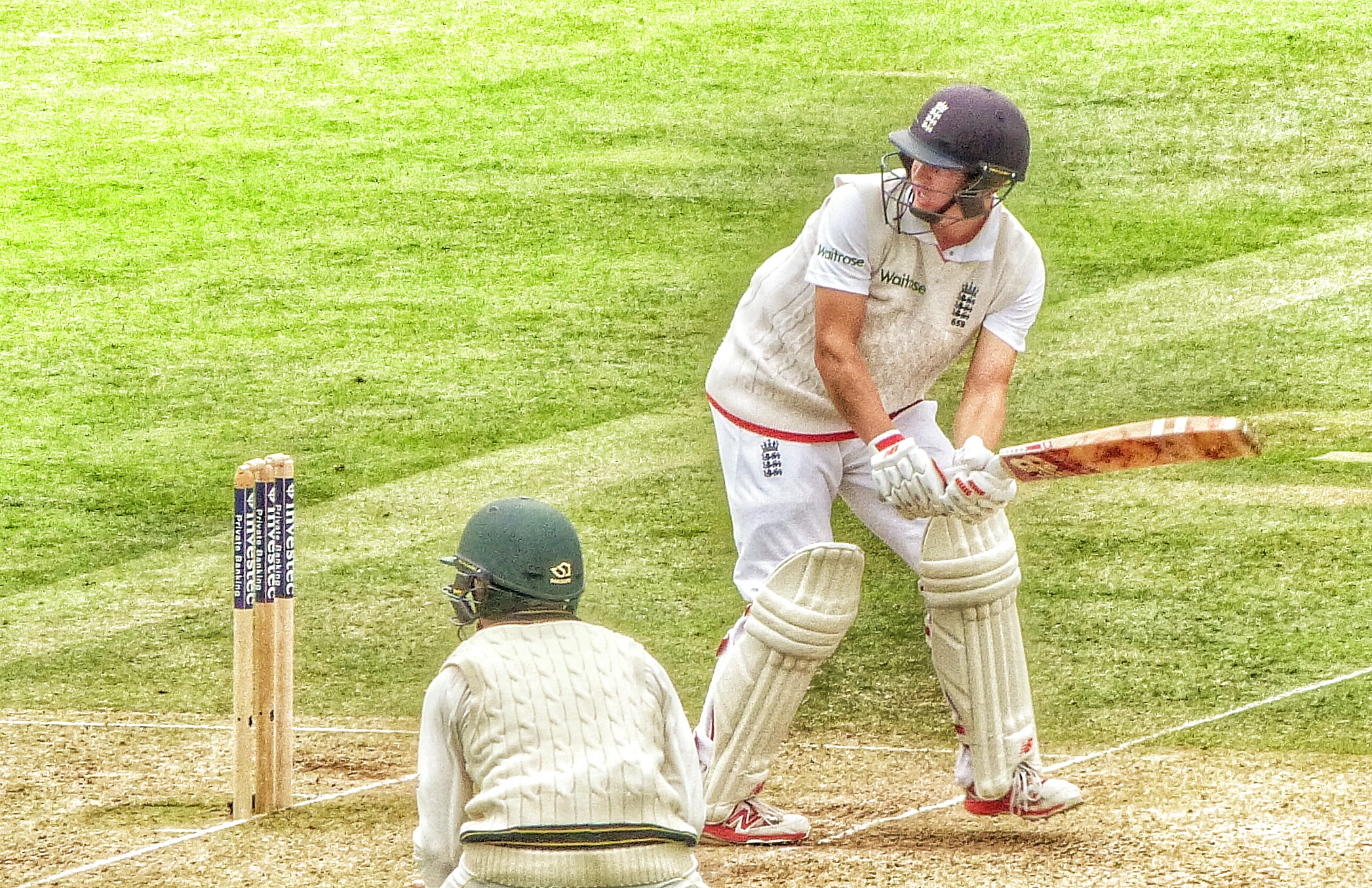
4th Ashes Test, Day 3 Review

I’ve missed virtually all of the cricket up until now in this game, having been staying with family over Christmas, so it’s been with great surprise that I’ve been following England’s progress every morning. Keeping Australia contained to 327 runs on a batting track and then posting 192/2 on the second day with Root and Cook still in, this game seemed to be fulfilling the Christmas wishes of quite a few England fans.

The day began how the last one ended, with Cook and Root making slow but steady progress against the Australian bowlers. That partnership ended just before the drinks break, with Pat Cummins making the breakthrough. To quote Dmitri from the live blog (I hadn’t woken up yet), “A pretty ordinary shot. Skies a pull shot and doesn’t convert again. Not really sure what you can say about that. Lyon takes a comfortable catch well in from the boundary.”

This brought in Dawid Malan, who should have been in confident form after his 194 runs in Perth. As it was, both Malan and Cook played somewhat nervously against Lyon and Mitchell Marsh. Why was Marsh bowling, I hear you ask. Because the new ball was due in a few over, and in only his second ball with the shiny Kookaburra Hazlewood dismissed Malan LBW.

Except, and this is almost unbelievable, he edged the ball onto his pad and yet failed to review it. If the replays and Hotspot are to believed, it was a huge edge. Colossal. Basically off the middle of the bat. For the second time in a single innings, England had failed to review a clearly false LBW call. If we were the kind of Cook-hating blog we are sometimes characterized as, I might take this moment to also point out that Cook was at the bowler’s end for both dismissals and could have told both batsmen to review it. Malan might even have been hit outside the line of off-stump. I’m not saying that both wickets were Cook’s fault, but…

Bairstow looked to play aggressively, with both boundaries and missed shots in equal measure. Eventually he top-edged a delivery from Nathan Lyon to the Australian wicketkeeper, and he had to go. Remarkably, this was only the third time Lyon has dismissed a right-hander in the whole series, having taken 17 wickets in total.

The loss of the fifth wicket has typically heralded the beginning of an EnglandTestCollapse, and Moeen Ali didn’t disappoint in that regard. Perhaps taking the view that his T20 batting form was better than his Test batting form, Moeen took the attack to the Australian bowlers. He scored 20 runs off his first three overs, but drove on the up from Nathan Lyon and Shaun Marsh caught it at short cover.

And from there, the promised collapse failed to appear. Chris Woakes mainly blocked the ball whenever possible whilst Cook progressed at his usual pace. Cook had a lifeline just before the midway point of the day, as he pulled a short ball from Cummins to the right of Steve Smith at square leg. The Aussie skipper got his hand to it but couldn’t keep it in his grasp, and for the second time in the innings he had dropped England’s opener. A few overs later England passed Australia’s score of 327, and the partnership progressed fairly smoothly though to Tea. Woakes was probably a little lucky to still be in though, after edging a ball between keeper and slip.

Cummins managed to get Woakes out shortly after the break, with the England allrounder gloving a bouncer from Pat Cummins to Tim Paine. This brought debutant Tom Curran to the pitch, but not for long as he got a fine edge. It was given not out by the umpire, but the Aussies reviewed and Hotspot showed a clear mark and he had to go. On a sidenote, Hotspot in this game has been much better than in the past few games. I seem to remember several instances where the thermal images showed nothing and the umpires had to rely on Snicko instead. Maybe they messed up the calibrations or something up until now?

This brought Broad to the crease, where he received his traditional welcome of bouncers. Lots of them. He looked nervous, wearing one on his shoulder and edging a few over the slips. He somehow survived though, and Cook’s steady accumulation carried on as he passed the double century with a drive down the ground for four. Broad was clearly waiting for his partner to pass the milestone, as he suddenly started swing at everything with at least some success including hitting Lyon for a six.

A few overs before the end of play, Broad got a top edge on a wild slash outside stump which just about reached Usman Khawaja running in from third man. The umpires gave it out, despite the Australian fielder indicating that he had bobbled it and that it should be reviewed. The soft signal appeared crucial, as the replays suggested that the ball had probably hit the ground at some point but there was no conclusive shot of it doing so. As with most reviews, the decision favoured the umpires’ original decision and Broad had to go.

Cook and Anderson both held on until close of play, with England’s opener hitting another milestone in the last over for a second day in a row. This time he overtook Brian Lara on the all-time Test runs leaderboard, taking him to 6th overall. England finished on 491/9, a first innings lead of 164 over the Aussies.

This is, remarkably, Cook’s second double century this year. It’s dragged his series average up to 54.50 (although that may fall if he loses his wicket tomorrow) and he’s now England’s top scorer. Looking at England’s batting statistics over the past year, you can see a marked difference between Root and Cook. In his 19 innings, Root has reached 50 ten times including 2 centuries, making a contribution in virtually every game he plays in. Conversely, Cook has only managed to pass 50 four times but on two of those occasions he went on to pass 200. The debate is like the one comparing Anderson and Broad. Anderson is reliably good in most games, whilst Broad is great in a few games but often innocuous.

On a personal note, whilst great for the England team and of course as fans we’re happy, Cook’s innings has meant that both Sean and I have lost our bets with cricket trader James Fenn. I bet that no England player would pass 160 in an innings, whilst Sean bet that Cook would average less than 25 in the series. Let this be a lesson to you all, never bet with a cricket trader!

As always, feel free to comment on the game or almost anything else below.

Blame, Babies, Bathwater

The lesser spotted Escape Goat, believed discovered by the Warner family, is only fleetingly seen.  Examples of this rare beast abound, hidden away in museums as examples for the public to view.  New sightings have been rumoured in Australia, where it seems they have their home.  It is a strange animal, whose only evolutionary purpose has been to serve as a diversion for other creatures, generally to be found in St Johns Wood, London.  Usually secretive and ignored by the wider world, they pop up whenever anyone starts asking awkward questions about disasters in Australia in particular.

The shambles of four years ago had an obvious culprit.  Everyone knew it, everyone could write about it.  All other incidentals could be safely ignored, all other factors dismissed.  Just one person could be held responsible for everything, and if only that person was removed, all would be wonderful.  If nothing else, that would buy four years for everyone else to forget, and by the time another trip to Australia came round, everyone could get behind “the boys”, and cheer them to victory, putting the damned colonials back in their place.

That it wasn’t going to happen that way should have been obvious to everyone, yet collective fingers went in collective ears, and a refusal to listen was more than a metaphor, it was literal.  It’s not that a potential whitewash this time around was a racing certainty, for Australia are good but not exceptional, and England modest but not awful, but the distinct likelihood that it will now happen is not overly surprising either.  The ECB deserve credit for one thing, they have managed to make those who have become indifferent rather angry.  This must not be permitted.

Still, the players are always the ones who get the focus, not least because wider issues can be safely ignored.  It’s so predictable.  In the run up to the series it was correctly stated that for England to compete, their experienced players would need to perform exceptionally, and it’s true they haven’t done so.  But it was equally stated that the new players would prove the weak link, and generally speaking they’ve done better than their peers.  That England had managed to get themselves in a position like that was, naturally enough, ignored – the discarding of players who didn’t fit the character parameters is a particular joy of the ECB structure, but let’s not talk about those, after all no one in the media ever does.  And of course the way first class cricket in England has been marginalised in the pursuit of T20 cash must never ever be mentioned, except by those few extremists who have been banging on about it and boring everyone by actually caring about the game itself.

No, those responsible cannot possibly be any of the administrators, who have created the environment in which English cricket exists, and cannot be the selectors who happily built a merry-go-round where cricketing ability is only one factor to be considered.  Unfortunately, this time it can’t be Kevin Pietersen either, that useful idiot who was single handedly responsible for everything bad from the dawn of time, and the only reason for any 5-0 defeat.

Ben Stokes has to be one of course.  Forgive me – that should be “New Zealand-born Ben Stokes”.  His absence is undoubtedly a cricketing blow, and one that can be maximised and extended to be blamed for the poor shots or poor line and length of his colleagues.  Those absent tend to perform incredibly compared to those who are present, and in that, nothing changes.  Had Stokes been there, England would be romping to victory by now.  It’s been a limited line of attack so far, but expect more as time goes on, especially if it gets worse on the field.

Who else can be targeted?  Ah yes, the senior players.  How perfect.  Cook, Root, Anderson, Broad, Moeen – they will do.  Now, it’s clear that of those only Anderson has done well enough to be generally excluded from the firing line, even though any kind of detailed analysis might raise questions over the detail of his performances.  But since the figures look decent enough, probably best not to mention him, that would take proper analysis.

Cook is by far the most interesting name to come up as being culpable.  It’s not that he has played poorly, for that is very obvious. It’s not even that he look technically adrift, for that looked to be the case from the first ball of the series.  It is instead that the editorial line has gone from Greatest Ever to Time To Go with nothing intervening.   Just three Tests.  This blog has highlighted the declining returns from Cook over the last few years repeatedly, to the point it’s accused of being anti-Cook.  Yet it was the reality, and the frustration wasn’t so much with him, it was with the way this was repeatedly denied by those who would write hagiographies at every opportunity and deny what they were so keen to say of others going through the same process in their careers.  Hypocrisy is rarely admitted.

Now, apparently, it is time for him to go.  Yet the point about Cook is the same one that should be about every player.  Is he the best we have in his position?  If so, then pick him.  It really shouldn’t be a difficult concept to grasp, yet apparently is.  Unless England can do better than him, then the calls for him to go are nothing other than jumping on a bandwagon and, somewhat deliciously given the history, meting out the same treatment to him that was given to others.

Then we come to the way Stoneman and Vince have apparently done reasonably well, but Root hasn’t.  To some extent it’s a matter of expectation, but scoring a half century and getting out is not confined solely to Root, yet it is Root that all the focus is upon.  It’s something of which he is acutely aware of course, but once more, differing judgements on the same outcome are as absurd as they always has been.  Root’s conversion rate is similar to that of Cook over the last few years, something never mentioned then, and only mentioned in passing now as an excuse to give Cook an extra kicking.  This is either a problem for everyone or no one – pretending otherwise is preposterous.  Dawid Malan has done well this tour so far, and Jonny Bairstow has done reasonably.  No one else has.

As for Moeen, his batting has been the issue.  Without question.  But his bowling is pretty much what should have been expected in Australia.  English finger spinners don’t do well in Australia – even the exceptional Graeme Swann averaged over 40 there, and Moeen is no Swann.  It’s not been great, and a finger injury hasn’t helped, but the apparent surprise at this is laughable.  England even have a couple of leg spinners, but the one who is there wasn’t picked even when Moeen was supposedly injured, and the one who isn’t – who can even bat as well – has long been thrown on the scrapheap, less for his cricketing skills and more, it seems, because he isn’t the right character.

And finally Stuart Broad.  A bowler who has been exceptional for England over a number of years, one known to be carrying injuries, one who even amongst the wreckage four years ago could hold his head up high.  He had a quietish summer, certainly, and hasn’t been great on this tour.  But now, at 31, he’s done.  Past it.  Finished.  Broad is a spiky character, and not one who has generated much love among supporters, but this is his first genuinely poor trot in a while, and now the knives are out. No mention of playing him injured, no mention of his workload, no mention that there might be reasons of any kind, it’s time to move on, while of course keeping his bowling partner four years his senior.

Questions can be asked and questions should be asked.  But we’re here in the same place again.  Only a few should carry the can, and others can be excused.  And above all else, it stops those difficult, awkward objections to the way cricket has been run in England.  The likes of Graves, Harrison, Strauss and the entirely invisible Whitaker cannot, must be questioned.  Ever.  Nothing changes, not on the field, nor off.  If Trevor Bayliss is to be in the firing line, who appointed him?  Who appointed his predecessor?  Who created the English cricket structure?  Is it possible that those people could be responsible, in the smallest, tiniest way?

Gins all round chaps.  It’s only Test cricket after all.


3rd Ashes Test, Day 5

The day began with England 127 runs behind, with 6 wickets remaining. Perhaps more importantly for their chances of saving the game, the day started with rain. Lots of rain. It fell overnight and for most of the first two hours, and some of it had managed to make it through the WACA’s rudimentary rain covers, leaving wet patches on several points of the pitch.

This led to scenes of the Aussie groundsmen firing six leaf-blowers at the affected areas of the pitch prior to play beginning, and the England camp were clearly unimpressed with the state of the pitch. An early Lunch was taken, and play eventually resumed for the day at 5am, 3 hours after the scheduled start of play, with England needing to survive 70 overs in the day.

Things didn’t start well for the tourists when Bairstow fell in the second over of the day. He was bowled by a Hazlewood delivery which appeared to stay low off the pitch, a fact that certainly annoyed Jonny and left several England fans reminding their Australian counterparts of the “pitch doctoring” allegations two years ago. Certainly it never seemed like the Australian bowlers needed any help in this series, but they gratefully welcomed the surface they faced today.

In the same over, the new batsman Moeen Ali edged one towards Steve Smith at second slip which the umpires judged not to have carried. The umpires sent the decision upstairs, where the footage wasn’t able to conclusively overturn the ruling on the field. Smith was not pleased.

The next few overs were full of incident and excitement. LBW appeals, bouncers, swinging deliveries and run out opportunities. Malan and Moeen appeared to have weathered the storm of the first hour when Ali played outside the line to a straight ball from Lyon and was given out LBW.

Chris Woakes and Dawid Malan steadied the ship for a few overs, until Malan gloved a ball from wide outside leg to the Aussie wicketkeeper. This wicket effectively ended England’s chances of eking out a draw, barring a surprise rain shower. Overton was peppered with short balls aimed at his injured ribs before he hit a leading edge to Khawaja at gully. In the next over, Broad gloved a short ball from Cummins right into Paine’s gloves.

The next delivery from Cummins struck Jimmy Anderson on the side of the helmet, but fortunately the England bowler was just shaken up by the impact. Chris Woakes did his best to shield Anderson from the strike but the allrounder eventually top-edged a short ball from Cummins, ending the game and the series.

There’s no doubt going to be several posts over the following days and weeks about England’s performances over this series. The simple fact is that they have been outclassed in every facet of the game. Batting, bowling, fielding, and even off the field, Australia are indisputably the better team. England won all three tosses, the weather has been relatively cool, the pitches slower than expected. England have had almost every advantage possible in this series, and not come remotely close to winning or even drawing a game.

With the series beyond reach, several people seem to be suggesting that England try new players in the remaining two games. Certainly on their current form in this series, there’s a case for Cook and Broad to be ‘rested’. It seems bizarre to me the amount of flak Joe Root is receiving from the English media whilst Cook seems to get a free pass. Root literally has more than twice the batting average of England’s all-time top scorer in this series. Despite being England’s most effective bowler this series (which has to be damning with faint praise), I’d also rest Anderson for the last two games. He’s 35 years old, and forcing him to play two dead rubbers on what are likely to be batting-friendly pitches doesn’t do him or England any good.

In Stokes’ absence, neither of England’s allrounders has really stepped up and performed well so far in this series. Moeen Ali averages 19.33 with the bat and 105.33 with the ball, whilst Woakes averages 14.66 with the bat and 51.77 with the ball. Because both of them are not really justifying their places as a batsman or bowler, there has to be a case for replacing them.

All of which really only leaves Bairstow, Root and the newcomers to the side. I genuinely did not rate any of them going into the series but Stoneman, Vince, Malan and Overton have all exceeded my expectations and deserve an opportunity to secure their places long-term. Of course the level of my expectations for these new players were so low that in some ways the worst the players could do is meet them, but fair play to them taking their chances.

Or maybe they won’t change anything at all. After all, it’s not the fault of the coaches, or players, or selectors. As our 100% scientific poll suggests, this series loss is all KP’s fault.

As always, feel free to comment below. Or rant. I’m sure there will be a lot of ranting.

Paradise Lost – By Maxie Allen

Would you like to know my dirty little secret?

It might shock you. It could well annoy you. It may make you think less of me.

The thing is, I’m English, we’re in the middle of the Ashes, and I have an inconvenient cricketing truth, gnawing away at me.

Shall I just go ahead and spit it out? Well…here goes. I couldn’t care less whether England win or lose the Ashes. In fact, given a choice, and hand on heart, I’d rather Australia won.

Perhaps I’m not being completely honest with you. I want Australia to win.

So now you know.

I am a heretic. An apostate. A traitor.

I used to support England. Oh yes, I followed England with great passion and loyalty. And I did so for more than three decades, dating back to 1983, when I was eight years old.

For all those years, I hung on England’s every move. Every run, every wicket, every result. I cared. I mean, I really cared. If England were hurting, I was hurting. If England triumphed, so did I.  I was a part of the England team, and the team was a part of me. We were indivisible.

In the days before Sky and the internet, I’d watch entire sessions via Ceefax. I flew to Australia to watch the 2002/3 Ashes. I attended test matches as often as I could. And when this happened, I hugged a series of total strangers. But I also supported England unquestioningly and uncomplainingly through all the bad times, and there were plenty of those in the 1980s and 1990s. No one could have accused me of being a fairweather-fan or a Johnny-Come-Lately. I was the real deal.

So what changed? Some of you may already know, or can guess, as you might remember me from another blog, which I used to jointly run, or indeed saw this piece which I wrote in early 2016. In essence, it boils down to a series of events between February 2014 and May 2015 which left me alienated from, and disgusted by, English cricket.

Now, don’t worry – I’m not going to rehash all of that again. I won’t exhume the details.  The point is, nearly four years later, I’m still unable to move on.

But why? Am I being completely ridiculous? Aren’t I taking nose-cutting to spite-facing to an absurd level of masochism? Haven’t I taken these old events so monstrously out of proportion that I now regard one player and one press release as more important than my country winning the Ashes? I fistpump when Cook gets out: am I mad/twisted/deliberately obtuse? Or just too stubborn to let bygones be bygones? Have I thrown out a huge baby with a drop of bathwater?

The answer to all of these questions is – maybe. Perhaps. Arguably. But I can’t help it. It’s just the way I feel.

I’ve been thinking recently about how this looks to my friends. Or to any third party, especially casual cricket followers. They would see my position thus: I have abandoned my national team, the one I passionately followed, as man and boy, and now want their oldest enemy to beat them, and beat them in the Ashes, of all things. And the reason? A few backstage shenanigans which the majority of cricketer followers were barely aware of and have now entirely forgotten. By any rational analysis, my position is absurd. To any England supporter, it must seem insane. But as I say – I can’t help it. And to me at least, it makes sense.

It all began with the very first Test England played after February 2014. As the match reached a dramatic denouement, I found myself – despite being at work – in front of a TV showing the coverage on Sky.

With the first ball of the final over, Stuart Broad took Sri Lanka’s ninth wicket, and a strange thing happened: instead of punching the air in delight and excitement, my heart sank.”Oh God, England are going to bloody win”, I found myself thinking. With the fifth ball, Nuwan Pradeep was given out LBW, and as Broad and Cook celebrated wildly, I felt forlorn and bitter, as if ‘we’ had lost, not won. There was a twist in the tale, however, because Pradeep then called for a DRS review which revealed a inside edge. Reprieved, he narrowly survived the final ball and Sri Lanka saved the game. I was delighted.

This was my epiphany: the moment I realised my cricketing life was transformed. Unconsciously, and instinctively, I now wanted England to lose, not win. A total reversal of the position I’d held so ardently for the previous three decades. And as the months passed and Test matches came and went, my feelings only hardened in that direction. I supported the opposition, because my enemy’s enemy was now my friend.

It wasn’t that I’d calmly formulated my new position by deductive reasoning on grounds of principle. I hadn’t sat down with a pen and paper and sketched it out. I didn’t say to myself “well, as I think x and y about such-and-such, this regrettably but logically means I must oppose England”. No, it was an instinctive emotional response. But the more I reflected on it, the more it made sense, and the more I saw that it was underpinned by a solid rationale.

In a nutshell – and I’m trying desperately not to reheat old material – my view was the people who ran English cricket had made something very clear: the England team belonged to them, and to them only. The team existed purely as a cricketing representation of their corporate entity. Added to that was my sense of betrayal, and also of outrage at a great injustice. This all combined to corrode and nullify any pleasure I could draw from the actual cricket on the field of play. By extension several of the key individuals became opponents. In sport, opponents become enemies, and you want your enemies to lose. Boy, did I want my enemies to lose.

This might not seem very rational to you. Chiefly, my position appears obtuse because of my apparent sense of priorities. I’ve taken a one-off personnel issue, and a few comments by officials, and made them more important than the team itself – and more important even than England beating Australia in, all of things, the Ashes, with all its history and significance. I’ve abandoned thirty years of passionate support to start cheering on the opposition.

That sounds irrational, to put it mildly, but in sport all support or opposition is fundamentally irrational. Is it rational for Arsenal and Spurs to hate each other? Is is rational to cheer on Mo Farah at the Olympics? Is it rational to want to beat Australia at cricket?

The thing is, I didn’t want any of this to happen in the first place. None of what happened was my doing. I mainly feel sad and regretful about it. I wish things were different. And I had hoped for resolution, as I wrote in April 2015 when it looked like the tide might turn, only for those hopes to be dashed.

It would have helped enormously if England had been hammered in the 2015 Ashes, which I know is an odd thing to say. I longed for the defeat of the Cook/Strauss regime, and what it stood for, but despite Australia’s emphatic victories in the second and fifth tests, it wasn’t to be. Australia’s collapse at Trent Bridge cost me dear, because an England defeat would have lanced the boil and cleared the way for a new start.

I now find myself in very strange and lonely place. I am probably the only person in the world who holds my position, and I certainly don’t know anyone else in everyday life who thinks as I do. My friends don’t understand it, and they definitely don’t like it. They think I’m mad, or being a self-martyr, or being deliberately provocative. But I just can’t help feeling the way I do.

When I talk along these lines on Twitter or Facebook I might come across as a troll, trying to wind people up. I’m not really, I’m just saying what I think. And face-to-face, especially when I meet new people, I’m rather coy about not supporting England – embarrassed to admit it. I’ll be talking to a new acquaintance and the subject of the Ashes comes up, and they assume I’m gutted that England are two-nil down. What do I say? How can I explain where I’m coming from, in the space of a normal conversation? How do I make sense of this to someone with a casual, patriotic attachment to the England cricket team, someone who watches just for fun, who has little idea what I’m talking about, who’s never heard of Giles Clarke, and who believes, quite understandably, that England beating Australia is more fun than obsessing about a four-year-old press release?

Speaking of fun…I don’t find cricket much fun any more, and I derive little enjoyment from watching it save the hollow satisfaction of an England setback. I sorely miss what I used to have – not just a team to support, but a community, a family, of fellow supporters. I miss that camaraderie and fellowship, the sharing of mutual experience. I used to be a part of those conversations, but now I inhabit an alien land.

Nor do I even get much enjoyment from memories of supporting England pre-2014. I can’t dig out the 2005 DVDs and relive that series with joy and pride, because I know what happened later, and that has tarnished everything. With the exception of my village team, my whole life in cricket has been a waste. Every England success I rejoiced in now means nothing.

Now, to you this must sound incredibly self-important and self-pitying. You’ll feel that I am whinging about wounds which are entirely self-inflicted. I don’t believe that’s the case, but I’ll understand why you might think that. People tell me to snap out of it. I can’t. People tell me to move on. I can’t. How can you move on when nothing has changed, and nothing been resolved?

One argument in particular is often put to me. Most sports have bad administrators, and most clubs have bad owners. But everyone else puts that aside and supports the players – and so should I. Regrettably, that analysis doesn’t hold true when it comes to English cricket. The ECB aren’t like the Glazers – they’re not outsiders who barge their way in but eventually sell up and move on. It’s the other way around.

Why? Because the only permanent and irreducible thing about the England team is the ECB. Players come and go but the board and its ethos remain, and the ECB configure the team as a representation of its values and philosophy. The England team is a show they’re putting on. Supporting England means supporting the ECB, and I don’t think you can separate them. I’m open to persuasion, but I’ll need a lot of convincing.

What’s interesting, though, is I now watch cricket in a very different way from how I did in the past. England are a much better team when you’re not supporting them. Seriously. Before, if England were batting, I’d fear a wicket every ball. The batsmen looked like sitting ducks. Now I don’t want them do well, England’s batsmen look composed and authoritative, hard to remove. I used to think Australia’s bowlers were unplayable and their batsmen invincible. Now, to my eye, they often look flawed and unconvincing. From my unusual perspective, beating England looks much more difficult than it used to do.

Will I ever have a change of heart? One of my best friends said to me: “when we’re in our seventies, and we go to the cricket together, will you still be supporting the opposition because of something which happened thirty years ago?”. Maybe. Maybe not. I’m not quite sure what could realistically happen which would change the way I feel. Nor do I know what approach to take should my daughter, currently aged two, develop an interest in international cricket. Pretend to support England, for her sake? Is that actually a beneficial thing to do anyway?

Now and again I get the odd England twinge, the occasional conflicted moment, when I forget myself briefly, and feel a brief pang of connection or empathy with the England players and what they’re trying to achieve. For a beat or two I feel English again. It’s usually to do with players. I’m fond of Jonny Bairstow and when he’s batting there’s a part of me that’s pleased to see him do well. Dawid Malan, too.

Every now and again I slip and refer to England as ‘we’, but by using the word ‘slip’ I don’t mean to say there’s a pretence, or that I’m deliberately trying to subvert my instincts through stubborness. It’s just the old rhythms and cadences of my past life breaking through.

These little ‘twinges’, though – they pass quite quickly and leave me back where I started. What do I do? Do I try to force myself to support England again? Or do I convince myself that I’m just being pointlessly bloody-minded and that if I could only eat humble pie, move on, and support England again, life would be much more rewarding? Again, I don’t know.

I can imagine my hostility fading with the passing of time. But not opposing something isn’t the same as supporting it. Can I ever feel excited about England again? What would it take for my heart to leap with joy, as for so many years it did, at the sight of an England bowler taking a wicket? What might inspire me to cheer when Alastair Cook reaches a century?

I’ll finish by making an important point. Whatever my own position. I’m not trying to convert others. I’m not telling you or anyone else what to do. I’m not scolding England supporters for their adherence to the regime. If you support England, good luck to you, and I hope you enjoy the team’s successes. A part of me wishes I could join you. But for now, at least, I cannot.

Maxie Allen co-founded The Full Toss and has written on cricket ever since, family permitting.
How To Make A Crisis In Four Easy Steps

In the past few weeks, all of the cricket media in England and Australia have been talking about England’s behaviour off the field. Two incredibly minor events, coincidentally in the same Perth nightclub, have overshadowed coverage of the actual Ashes.

I would argue that this whole situation has been caused by the ECB’s chronic failures in PR and management. Time and time again, they act in a way which actively hurts the team’s perception with fans and the media. It’s incredibly predictable, unfortunately, and here’s how they do it:

Step 1: Wait until the reporting hits fever pitch before releasing the full story

This allows the journalists to build up speculation through the day, ideally whilst England are playing cricket. Some people might suggest that this would distract the English players from performing at their best, but the management still want to perform a thorough investigation of any incident before they release it to the press.

So if we look at how the Bairstow incident was revealed, the Aussies were sledging England over the incident through the game and after hearing about it through the stump mics the Aussie media published the story on their back pages on Sunday. Speculation continued running through Monday, the fifth day of the Test, with a vague statement from Strauss confusing matters even more. Apparently it was “playfulness, no malice, blown out of all proportion.”

It wasn’t until after the game had finished that the full story came out, and then only because the Australian opener Cameron Bancroft explained it in great and amusing detail whilst Steve Smith was laughing his ass off beside him.

With Ben Duckett, the news came just before the toss in England’s two-day warmup game in Perth that he had been replaced by Joe Clarke. There was nothing else released, which led the assembled journalists to investigate the matter and about halfway through the day’s play the ECB finally released a statement. Even then, it only described the situation as an “alcohol related incident” with no details included. It was only through “good journalism” that the full facts of the matter came out later.

Step 2: After “investigating” the matter, declare the players involved as both simultaneously innocent and guilty

As we know on this blog, the ECB are not unfamiliar with the concept of confusing statements. The name “Being Outside Cricket” comes from a joint ECB/PCA press release (still available on the PCA’s website) surrounding KP’s expulsion from the England team in 2014, where they appeared to suggest that no one outside of the ECB had any right to question their decisions.

So in Brisbane, Trevor Bayliss described the Bairstow ‘headbutt’ as “blown out of all proportion” but also said that the players have “got to be smarter” away from the pitch. The Director Comma England Cricket also came out of hiding to talk about it, declaring that “It’s a minor issue but it highlights the fact that minor issues can become major issues.” I think that certainly is the case when the ECB are in charge.

Trevor Bayliss’s statement on Ben Duckett is a thing of beauty, if you find contradiction and incompetence beautiful that is.

“To be quite honest it’s fairly trivial but in the current climate it’s not acceptable. Everyone’s been warned about [how] even small things can be blown out of all proportion. The ECB has also been quite strict to the boys with their message, and it’s quite simply unacceptable.”

So let’s break that down. Duckett’s actions were simultaneously both “trivial” and “not acceptable”, to the point where his possible England future is being written off. Again, this seems fairly familiar to fans of the blog, with its regular references to staring out of windows and whistling being sacking offences. How would this affect a team’s morale, when they know that their team’s management will actively attack them over incredibly minor issues.

Step 3: Severely punish the innocent players

What would be the absolute worst thing to do after a team’s management categorically denied their players had issues related to drinking after the Brisbane Test? How could they utterly undermine themselves and put all of the team under huge pressure? If there was one surefire way to suggest that England are a team of violent drunken thugs who can’t be trusted, it was forcing a curfew and other restrictions on the players. So that’s what their management did.

Certainly I enjoyed the irony when Bayliss said that “even small things can be blown out of all proportion” about Ben Duckett, since the whole media circus was created by the ECB overreacting to a “trivial” incident and dropping the batsmen for the tour match and possibly the rest of the Lions series. As far as I’m aware no journalists had heard about Jimmy Anderson’s unscheduled shower before the warmup game, and so there’s no reason to suspect that it would have come out. Even if it did, without the ECB promising a full investigation from Andy Flower it would be a fairly minor and amusing story rather than another alcohol-fuelled crisis.

Step 4: Repeat

If there’s one thing you might admire about the ECB, they certainly have the courage of their convictions. Despite screwing up in the same ways over and over again, they never change. They never admit they were wrong. They never apologise. So it keeps happening, as regular as an England batting collapse and just as much fun for the fans.

No doubt this won’t be the last of this sorry saga. At this point, anything could become a full-blown international incident and many England players should contemplate not leaving their hotel rooms for the rest of the tour lest they risk their careers in some way. There are already reports that Bayliss wants to get rid of the people he considers troublemakers from the squad to face New Zealand, which certainly offers some interesting parallels to Andy Flower’s actions four years ago.

And… that’s it. Hopefully England can make it through to Wednesday night without another self-inflicted wound, but I wouldn’t bet on it. As always, feel free to share your views below.

Enjoy It, It’s Your Last Chance Anyhow

With England already down 2-0 with only 3 games left to play, it’s fair to say that they’re currently drinking at the last chance saloon. Metaphorically speaking, of course. After the Stokes and Bairstow incidents, they’re probably all teetotal and in bed well before their curfews. But they need to win at least 2 games, and probably 3 since a drawn game seems somewhat unlikely. Looking at the team’s performances so far doesn’t instil us with confidence that they can achieve this, but perhaps they can bring some new blood from outside the current team to turn things around

On a related note, an England XI led by Moeen Ali will play a 2 day game against a Cricket Australia XI in Perth starting tonight. Apart from the England spinner, the 12-man squad for the match contains the 4 players who didn’t play in Adelaide from the senior squad plus 7 from the Lions squad which is also touring Australia. It could be England’s last opportunity to make changes to the squad while it can still make a difference, so the performances in this nonsense game could still make a massive impact.

It’s fair to say that I know almost nothing about county cricket. This could be a problem, because 6 of these players haven’t played for England’s Test team. But seeing as I’m on the internet, I figure I can just bluff it out with 5 minutes of research and, so long as I act confidently enough, I’ll get away with it. So here’s my profile of England’s hopefuls:

Mark Wood – Probably the one player mentioned most from the Lions squad, Wood can reach speeds of 90+mph when he puts his back into it. Never seems to be fully fit, as he’s either injured or returning from injury at any given point. His current Test bowling average of 40.65 doesn’t really suggest that he’s going to blow Australia away, and I’d doubt he’s up to full speed yet.

Mason Crane – Being managed by ISM, there seems a fairly realistic chance that Crane might be selected. A First Class bowling average of 43.98 doesn’t exactly inspire confidence, but he’s only 20 so does have youth on his side. He does have the advantage of having played Shield cricket in Australia last year though.

Jake Ball – A current Test bowling average of 114.33. Match figures of 1/115 against Australia. If Finn was considered “unselectable” in the previous Ashes series, Ball has to be somewhere beyond that now. “Banished from cricket”, perhaps?

Gary Ballance – I’m a big fan of Ballance, I thought it was massively unfair when England dropped him for the first time. But in the 8 Tests he’s played since then, he averages 20.26. On top of that he’s a left-handed batsman, so is presumably vulnerable to Lyon’s off spin.

Ben Duckett – Another left-handed batsman, he averaged 15.71 in his 4 Test innings in India and Bangladesh. Obviously there’s a very different playing surface in Australia, but he lost his wicket all 7 times against spin bowling and was clean bowled 3 times.

Keaton Jennings – Left-handed batsman? Check. Test average under 25 in the last 2 years? Check. Shouldn’t be within a million miles of the England team when they have to face Lyon? Check.

Tom Curran – The only “pace” bowler in the senior squad not to get a game so far, his time will probably come after England are beyond saving the series.

Ben Foakes – His First Class batting average is 41.84, which is higher than 3 of England’s current top 5 batsmen. He’s right-handed. His being in the side would allow Bairstow to bat higher in the order and probably cause a net increase in both England’s batting and fielding. On paper, I cannot fathom why he isn’t in the side.

Dan Lawrence – Also with a career First Class batting average over 40, and right-handed, surely he could replace Malan or Vince in the middle order?

Jack Leach – Just looking at his figures, I wonder why he’s not in the team already. And then I remember that he’s bowled most of his games in the Somerset fortress of spin, Ciderabad. I think I’d need to see what his figures are like away from home before I jumped on this particular bandwagon.

Liam Livingstone – I’ve maybe left the best for last here. His First Class batting average is the second highest in this squad to Ballance, he’s right-handed, and he presumably can’t be any worse than Vince or Malan. Get him in the team already!

So, who would you bring in from this game into the Ashes? Or would you go for someone else who isn’t in this squad? As always, comments welcome below.

Ashes 2nd Test: Day 5 Review

“Let me tell you something, my friend. Hope is a dangerous thing. Hope can drive a man insane.”

Not my words, but those of Morgan Freeman’s character in The Shawshank Redemption. Day 4 ended in perhaps the cruelest manner possible for English fans, with some ‘expert’ analysts estimating that England had a 20% chance of winning the game. Not anywhere near high enough to expect a win, but more than enough to raise the hopes of any but the most hard-bitten cynic.

It may not surprise you to learn that the writers at Being Outside Cricket are all very much in the cynical camp. We’ve seen England through the past four years, and indeed through the 90s, and it takes a lot more than someone saying England have a 1-in-5 chance for us to start believing. If anything, we were too harsh on the tourists. Dmitri said 220. Sean said 225. England proved them both wrong and amassed a grand total of 233 runs, just 120 short of their target.

The collapse began on just the second ball of the day. Chris Woakes played inside the line to a ball from Hazlewood and was given out caught behind. Woakes reviewed the decision and there was a tiny noise shown on the snickometer, which was all the evidence the TV umpire needed to show the English allrounder the door.

And there begun the familiar procession. Root followed 2 overs later with another edge from Hazlewood’s bowling to the Aussie keeper. That was surely the end of any optimism the England fans had when they woke up at 3.30am hoping to watch or listen to a potential sporting miracle.

Moeen Ali was next to go, 6 overs later to an LBW decision when facing Nathan Lyon. He reviewed it and it was shown to be umpire’s call for both pitching in line and hitting the wickets. Moeen could consider himself unlucky, and England fans left to wonder whether the fact Australia had no reviews remaining might have led the umpire into giving a marginal decision in the host’s favour.

Bairstow and Overton both soldiered on another 10 overs, but when Australia took the new ball it was all over for England. Starc struck on the very first ball with the new Kookaburra, pinning Overton in front of the wickets with a fast, swinging delivery. Starc also dismissed Broad and then Bairstow in his next two overs, and the game was over.

This loss leaves England 2-0 down with three to play. It would be a monumental feat for them to turn the series around and actually win or even just retain the Ashes with a draw. The more realistic members of England’s fanbase are now talking about avoiding a second consecutive whitewash in Australia. The most pessimistic supporters are looking beyond what they consider the inevitable humiliation of not winning a single game and trying to consider how the team and management will respond. As I said before, we at Being Outside Cricket are very much in the latter group. Already the writers are planning their post-whitewash posts.

Adelaide was considered by many to be England’s best opportunity to win a game down under. A pink ball which might be more inclined to swing, more grass left on the pitch and twilight being an equalising factor which could come to favour England. This loss will hurt the team and their fans, perhaps even more than the 10-wicket drubbing in Brisbane. It’s hard to see how England can change their fortunes for the next Test in Perth, with no real alternatives sitting on the bench. Ballance, being left-handed, is likely too vulnerable to Nathan Lyon’s off spin for England to risk. Tom Curran and Mason Crane seem like they have been taken to assess in the dressing room rather than as realistic picks. Wood and Stokes (if made available) are short of match fitness and practice, which makes either having an immediate impact at best a huge gamble.

And speaking of gambling, Sean and I have each placed a bet on this series with a cricket trader via Twitter. Sean’s bet is that Cook will average below 25 in the Ashes and, with the former golden boy of English cricket residing on an average of 15.50 after two games, it’s looking good for us at BOC receiving a round of drinks from the lucky chap with his winnings.  Whilst Sean wagered with the rather more impressive stake of money you can fold, I took the more cautious approach and bet 10p that no England player would manage a score of 160 in the whole series. This was in reference to Bayliss saying after an England warmup game that they needed to score 160s and not just 60s. My money is also looking pretty safe right now, with 40% of the series gone and James Vince is the closest so far with his high score of 83 in Brisbane. It’s fair to say I’m not worried that I might lose this one.

As always, feel free to comment below!

Australia vs England: 2nd Test, Day Four

Let’s be clear here, Australia should still win this match, and comfortably so.  But England played with skill, tenacity and demonstrated considerable bottle for the first time this series, and gave cause for some small degree of hope that they could pull of the remarkable.  As has been said on so many occasions, it’s never the despair, it’s the hope that gets you.

England needed everything to go right with the ball, and it more or less did.  Anderson post play admitted that England had bowled too short in the first innings – which more than anything else is the reason why England have been in trouble in this match – and both he and Woakes in particular probed away, swung the ball and got their rewards.  Praise for their efforts will of course be tempered with frustration that they didn’t do it first time around, as the position of this game could have been entirely different.  C’est la vie.

So 354 was the target, which would be the tenth highest run chase in Test history.  It was indicative of England’s position that the 85 added by Australia for their last six wickets from their overnight position was both an outstanding performance from England, and still about 50 more runs than they realistically could afford in order to have a decent shot at winning the game.  Still, given where they were, this represented a huge improvement from having no chance at all, to a slim one.

That slim chance improved fractionally further with a decent opening stand between Cook and Stoneman, passing 50 with relatively few alarms and doing the vital work of seeing off the new Kookaburra ball.  Cook got away with an lbw that wasn’t referred by Steve Smith – the beginning of his tribulations with the system today – before falling to Lyon again, playing round one and once more getting too far across to the offside and falling over somewhat.

The dismissal on review did cause a fair few people to query the predictive ball tracking.  The most important point is that if the system is being used, then you go with it.  DRS showed Cook to be out, and that’s the end of that.  However, it doesn’t mean a specific instance can’t raise eyebrows.

Before the ball tracking overlay, the ball looked to be heading far more to the legside than was then shown.  Probably showing it hitting, but on the inside of the leg stump looked like a far greater degree of turn than appeared the case.  Now, the eye can be fooled very easily, and it is certainly possible, even likely, that it was an optical illusion, and some didn’t see it that way at all anyway.  However, acknowledging that doesn’t mean DRS was unquestionably right either, and it certainly doesn’t mean it can’t be queried – not on the basis of some kind of objection to the wicket, but more the reliance on the technology as being somehow infallible.

The problems here aren’t necessarily with the technology, but it should to be noted that “odd” ball tracking decisions are much more prevalent in Australia and New Zealand than in England.  In England Hawkeye is used; it’s a purpose built ball tracking technology designed specifically for this purpose, and a lot more expensive.  In Australia, Virtual Eye is used instead.  That has its origins in a graphical representation software suite, and the designer has said it wasn’t designed for predictive tracking, while the creator of Hawkeye (who would say this wouldn’t he?) has called it up to nine times less accurate.  Now, this was a few years ago, and technology must be expected to have moved on and be better, but it is important to note that all systems are not created equal.

Of course, whenever something questionable arises, the responses tend to be along the lines of pointing out that umpires are more fallible, and that is probably true, but headscratching over one particular decision isn’t to decry the entire system, or wish it scrapped, but it always invites things like this:

https://twitter.com/benpobjie/status/937985387749715968

Except that it wasn’t designed for this specific purpose at all.  Hawkeye was though, perhaps why there are far fewer occasions when there is cause for a debate using that system.

Ball tracking is right because it says so, and because it says so, it’s right.  There’s no reason to doubt its general accuracy, albeit with the proviso that some systems will inevitably be more accurate than others, but it’s also absolutely the case that as far as cricket goes and the predictive element of DRS, there’s little information available.  There has been a formal test of its accuracy done, by the ICC, but unfortunately they’ve never seen fit to release the results and we simply do not know the outcome.  It’s entirely reasonable to assume that they wouldn’t have gone with it had it been unsatisfactory, but not knowing the detail is always going to leave scope for doubt.

The most vital points of all are that it’s not for a second suggesting the system is wrong, and not suggesting human umpires are better; but assuming all systems are right all the time given the enormous variables in both outcome and in sampling size is as dogmatic as assuming it gets it wrong on a frequent basis, for which there’s no reason to make such a case.  Being puzzled over a single piece of ball tracking doesn’t for a second mean either that the questioner is right, nor that there’s anything inherently wrong with DRS but responses on that basis are simply an exercise in trying to shut down discussion.  Maybe it was entirely correct in its prediction, and it’s most definitely not about Cook’s dismissal per se, not least because anyone objecting to it on partisan grounds would have to note Root being rescued by the same system.  It just looked slightly peculiar.

In terms of Cook himself, he had battled away, but still looks out of sorts, to the point where some of the journalists are now querying whether this might be his last tour.  It is somewhat ironic that he appears to have gone from genius to liability in the eyes of some within two Tests – it surely has to be more nuanced than that.

Shortly after Cook, Stoneman followed, having made another bright start.  For England to be confident of victory, two wickets down was probably about the limit of what they could afford to lose but Vince soon followed, again caught behind as he has been in 10 of his last 12 innings.  It was a poor shot, and not for the first time.

Joe Root at least was batting well, if not without lbw related alarms.  He padded up to one far too close to leave and was given out on the field, only to be reprieved by the ball tracking showing it going over the top.  Thereafter, Australia’s determination to get him out led them to burn both their reviews on highly speculative appeals, much to the delight of the Barmy Army who gestured for a review each time subsequent lbws were turned down.  He received valuable support from Dawid Malan, who batted maturely for a 29 that in other circumstances would have been perceived as infinitely more valuable than it will probably be.  His late dismissal to a superb ball from Cummins was a blow England could not afford.

Four days down, and a superb fifth day in prospect.  As ever in these circumstances, it’s worth highlighting that there are some who would wish to make Tests a four day game.

Only one captain in history has lost a Test after failing to enforce a follow on, South Africa’s Dudley Nourse in this game and it remains highly unlikely England will add to that very short list.  But they have at least properly competed at last, and if it requires Joe Root to make a big century, and for everyone else to support him, then that’s still a situation England would have taken before play started today.   Unlikely is not impossible, a slight chance is vastly better than no chance.

It is most likely that waking tomorrow will see the last rites of the Test being performed.  England need to get through the first session without loss, and then, well just maybe.  And sometimes that’s enough.

Ashes 2nd Test: Day Three

When it’s all going hideously wrong, the temptation to cling grimly to any floating wreckage nearby is a strong one, and four wickets for England’s bowlers in the evening session has given rise to curious assertions that England are back in the game, a triumph of hope over experience.  In reality they are, taking the kindest, most sympathetic view possible, not totally out of it.  Since Australia’s lead already far exceeds England’s miserable first innings total, this is taking blind hope to unprecedented levels.

England weren’t in the worst position at the start of play, and a good batting day would have begun to transfer some pressure back onto Australia, with the usual third innings jitters a possibility.  Instead, England collapsed hideously to 142-7, and only got even close to saving the follow on thanks to Craig Overton making an unbeaten 41.  Irony of ironies – the England tail wagged this time around.

The batting order’s insistence on doing the same things and hoping for a different outcome is magnificently stubborn (perhaps the only way that adjective could be used about them) and once again it was poorly executed shots that did for them rather than brilliant bowling.  The pitch didn’t do much, and in the daylight there was little swing.  Only Malan could be said to have been got out, and whatever the merits of Australia’s bowling attack, the same level of carelessness that’s been present in England’s batting for a long time was once again to the fore.  When they come off, it’s certainly thrilling, but an inability to play the situation is becoming a real hallmark of this team and there’s so little evidence they are learning.

It is perhaps this, more than anything else, that justified the pessimism before the start of play, and highlights the increasing fear that this tour could get truly ugly.  Again.

Smith’s decision not to enforce the follow on was perhaps understandable given the time left in the game, but the principle of doing what the opposition would like least must surely apply – England would not have wanted to bat again, under lights, under the pump, and under pressure.  In defence of the decision, it’s unlikely to make that much difference to the outcome either way, for by the close of play a lead of 268 with six wickets remaining is the kind of marvellous position teams dream about, but it did at least offer England the chance to give Australia a bloody nose.  And yet even with the wickets taken, the same old flaws were there:  England still bowled too short, still bowled too wide.  At 53-4 it might seem a peculiar criticism, but both Anderson and Broad were consistently shorter in length than their Australian counterparts, and while it hardly went too badly on the field, it doesn’t suggest that the plans are either thought through, or alternatively that the bowlers want to apply them if they are.  There is no doubt at all that when Broad, Anderson and Woakes kept the length full, they looked extremely dangerous.  They usually do – which is why so much hair is pulled out at their continuing refusal to do it on a consistent basis.

Apparently, tomorrow morning is another “vital” first session.  It really isn’t.  It would need to go catastrophically wrong for Australia to allow England to have any kind of realistic sniff of a win.  It is of course just about possible that England will skittle the hosts and then bat out of their skins to chase down a total almost certain to be in excess of 300, but that’s barely enough to encourage even wildly unreasonable optimism, let alone genuine confidence.

The worst part about England’s predicament is that so much of it this series to date has been self-inflicted.  Australia are some way from being a really good side, but they have, to use the appropriate cliche, executed their skills well so far.  England haven’t.  Assuming they do, and in spades, it means that Australia will be bowled out for around 100 in a magnificent display of attacking bowling, while the English top order compile a couple of centuries to take them home in one of the top 20 run chases of all time in Test cricket.

That’s the miracle scenario.  And that says it all.


Australia vs. England: 2nd Test Day 2 Live Blog

Well we’ve just woke up here at BOC, and it appears that England have just had a nightmare. Having been put in to bat, Australia have declared on 442/8 and leaving England with a tricky 28 overs to face tonight. And without further ado, here’s the live blog:

0906 Starc bowls the first over, getting over 93mph. Bowling very full, but no swing and England play it safely with two singles.

0910 Hazlewood from the other end. Again fast and full from Australia, England score 5 runs and no real drama for England.

0916 Starc’s second over, and it looks like he’s warmed up. Stoneman gets a leading edge on the first ball and it goes in the air past backward point for four. Stoneman also plays and misses on the third ball before getting off strike with a single. Cook blocks out a yorker to finish the over.

0921 Hazlewood’s second over, and there’s an LBW shout first ball despite it pitching outside leg. Stoneman’s bat splinters whilst blocking out another yorker. Another LBW appeal whilst pitching outside leg on the last ball, which will always happen until the ball swings or Hazlewood bowls from the other side of the wicket.

0927 Starc’s second ball of the over and Cook plays and misses at a swinging ball well outside off stump. Some light relief at the end of the over as an Aussie fielder is wrongfooted by a ball hitting the edge of the square and gifting Stoneman a couple of runs.

0931 Cook gets a four off his legs on the first ball of Hazlewood’s over, then Stoneman flashes hard at a wide delivery which goes over the fielders at point all the way to the boundary. 11 runs from the over.

0936 I’m surprised Australia haven’t tried any bouncers so far. Whilst obviously bowling full is a good tactic, I’m curious how well  players can pick up the short ball under lights. That said, Cook comfortably guides a waist-high delivery with a controlled pull.

WICKET Starc bowls a full delivery at Stoneman’s leg stump, and the batsman is trapped deep in the crease playing across the ball. He goes for a DRS appeal, but unfortunately for England it shows 3 reds so they lose a review. England 29/1.

0940 Quiet over from Hazlewood at the other end. A shout for caught behind from the keeper after a glance from Cook’s pads. Vince to face his first ball from Starc at the other end…

0944 Vince blocks out the first ball, a full yorker on the stumps. Starc draws him into a play and miss outside off stump, but Vince survives with six dot balls.

0946 Cummins replaces Hazlewood, and it’s a huge appeal from Australia first ball as Cook is squared up and the ball glances off his back thigh guard to the keeper. Before another delivery can be bowled, RAIN STOPS PLAY!

0957 Bad news for England, the covers are coming off.

1003 And they’re back on again.

1018 And back off again…

BT Sport had a feature on Ben Stokes in New Zealand, which seems like a moot point. Also a mute point, as Graeme Swann was talking in the studio during the rain break so I had turned off the sound. It seemed like they were seriously talking about his return and hyping him, but with his lacklustre performance in his first game and the legal process dragging on I doubt he’ll be ready in time for an Ashes return.

1027 Umpires have just inspected the field. Apparently play has to resume by 1040 am in order to play again today. Fingers crossed!

STUMPS England are 29/1 and 413 runs behind. Presumably play will begin 30 minutes earlier tomorrow, personally I think I’ll just have another lie-in.