Five Days in January

Given the news that England are pushing for four day Tests, the worst outcome at Newlands for the ECB would doubtless be a match that went into the fifth day.  Or that would be the case if anyone truly thought that cricketing requirements made the slightest difference in their quest for short term cash.  Still, it would have the advantage of being mildly embarrassing to have them reminded yet again that at least half of Tests do go to the fifth day, and the groundstaff at Newlands are rumoured to be playing their part by preparing a batting friendly pitch.  That being said, unless it’s slow and low, England have shown plenty of aptitude in terms of backing up their board on the pitch by flopping badly with the bat whenever the opportunity arises, so guarantees are in short supply.

England’s biggest doubt (at least until Rory Burns injured himself playing football) seems to be Jofra Archer, struggling with an elbow injury in the build up.  Should he not make it, then a one paced seam attack will be the outcome, and the Archer-meter will veer back to the “essential” side of the display, highlighting yet again that a player is never more valuable than when he’s not in the team.  If Archer is missing it will also postpone any decision about who to leave out from Centurion.  England made protestations about being happy to make the tough decisions over Broad and Anderson, which more than anything suggested they weren’t happy at all about it, though given the difference in performance between the two in the first Test, it’s curious that anyone would think it that hard a decision in the first place.

The main difference is potentially (though apparently not certainly) the selection of a spinner this time around, with the speculation being that Dom Bess is likely to get the nod in the continued absence of Jack Leach.  Not for the first time, selection policy is where eyes roll and heads shake, and in terms of how England handle their spinners, it’s more a permanent fixture over the last half decade or so, as they forever undermine their own processes and their own players.

Will MacPherson wrote a piece highlighting how the mismanagement of Moeen Ali has left England without the option of recalling him this series, and while Moeen’s dropping from the England team last summer was more a mercy than a blow, it is symptomatic of the inability of the management structure to treat players like valued staff instead of commodities that they managed to turn a necessary decision into a mess.  Moeen had and has severe limitations, but in that he is little different to any of the other options who don’t have even his level of Test success to fall back on.  This is forever the conundrum – awareness that the alternatives are unlikely to be any better shouldn’t be a reason to never make a change, but when making that change, to burn bridges with those who have had at least some success is the kind of ineptitude that England appear to specialise in.

That Leach has been poorly for a while is just unfortunate, though it should be noted that his main contributions in his Test career to date have been more with the bat than the ball – a particular irony given Moeen’s status as a batsman and part-time spinner converted into the main slow bowler – re-inforcing the central issue that the dearth of spin in the English game has no obvious resolution in current circumstances.  That those circumstances are self-inflicted by a board who prefer white ball cricket to the challenge of the longer game is a wider point that should never be overlooked.

The more immediate sour taste would be at the treatment of Matt Parkinson, the second spinner in the Test party until illness spread through the squad prior to the first Test resulting in Bess’s call up.  While it’s true that selection shouldn’t be automatic, to select a player in the original squad and then overlook them in favour of someone not even in it originally will hardly motivate Parkinson to feel he’s part of the set up.  That he’s a leg spinner is part of the problem, for England haven’t shown a great deal of faith or management skill in any of the options they’ve had for the hardest of bowling arts over many years, with Adil Rashid being the latest whipping boy all too often, in the press as much as elsewhere.  The revolving door of England spin selection for players not called Swann and over-expectation of what they might achieve has been a constant for a number of years now, with no sign that it will change any time soon.

The batting options were initially confined to a question of whether Ollie Pope comes in for Jonny Bairstow or not.  England have defended the latter with the age old “playing well in the nets” rationale, but Bairstow only played in the first Test due to Pope being ill, so it seems likely he will return to the middle order.  However, the news today that Burns had hurt his ankle playing football set off another round of comment about whether the team should be playing such a sport in advance of matches.  My own view on this is pretty simple – injuries happen in practice, warm ups are necessary in themselves, and  young athletes want to play games.  Wrapping them in cotton wool is neither possible nor desirable.  Players forced to sit around or do gentle sit ups for fear of breaking would go stir crazy anyway, and that’s before the likely increase in muscular injuries without regular and fairly intense exercise.  Shit happens.

For South Africa, the one probable change is the injury enforced omission of Aiden Markram, with Pieter Malan the man tipped to replace him at the top of the order.  Temba Bavuma has been released from the squad and told to go and make domestic runs, so the superbly named Rassie van der Dussen keeps his place.  Having progressively demolished England in the first Test, all is pretty well with the hosts’ camp, an illustration of how rapidly things can change in short order.  The fundamentals of this series haven’t particularly changed, South Africa’s batting is still brittle, and their back up bowling is as much a concern as it was before the series got under way.  But it is indicative of the way one side seized their opportunities and the other wilted under pressure.

Momentum is as irrelevant in a Test series as it’s ever been, but England will have to perform dramatically better in all facets of the game to get back into this, and while it’s possible that they may do so, another defeat will only increase the clamour from the stands and the press box for a plan to improve.  If only the problems afflicting English cricket had been in any way predictable.

South Africa vs England, 1st Test: Omnishambles (Slight Return)

This Test might have lacked one of England’s now iconic 50 all outs, but taken as a whole this match has highlighted once again the deep structural problems in the England team.  Yes, there has been illness, and as a result even those players who were fully healthy by the start of the game were likely undercooked, but as excuses go, this only offers up a plausible response if the team generally performs at a higher level than this.  England don’t, this is more of the same, more of the usual failings.

Putting the opposition in might have been a gamble, but this game wasn’t won or lost at the toss, but in the manner of the performances thereafter.  England had South Africa in trouble at 111-5 and let them get away to a workable total.  This happens all the time, to the point that England in recent times have the highest bowling average of any Test side for the last three wickets.  They followed that up with the normal abject collapse in the first innings losing their last 7 wickets for 39 runs.  Again, so customary, so repetitive.

Having conceded a sizeable first innings lead, England again bowled pretty well initially, only to utterly fall apart as the deficit grew, whether by accident (which lacks discipline) or design (which lacks brains).  And then when given a virtually impossible target, they batted pretty well, but were still needing to rely on a miracle of Headingley proportions to pull off the win.  Those events just don’t happen very often, which is why they’re considered miracles.

And here’s the rub.  We’ve written all this before.  You’ve read it all before.  You’ve screamed at the television watching another middle order player with their feet in treacle throwing their hands at a wide one and getting caught.  We’ve seen Jos Buttler end up holing out because he has no choice but to go into T20 mode when batting with the tail.  That doesn’t for a moment exempt him from the longer term problems of which he is part, but it is another repeat of the same old afflictions and the entirely predictable way this game ultimately panned out.

For South Africa came into this Test match in disarray, and England not only didn’t take advantage, but they were pretty heavily beaten.  Again.  Sickness throughout the squad can be pointed to as a factor, but patience has been exhausted with this team – there’s always a damn excuse for yet another capitulation.

It’s not so many years since England smugly discarded players with Test records the current lot could only dream of on the grounds of preparing for the future.  That future is now, and it really doesn’t look very good at all.  Individual players are still scapegoated, – Jofra Archer before his five wickets in the second innings was getting plenty of stick, a new, raw fast bowler ground into the dirt with a workload more suited to a stock bowler than a strike one; he was mishandled in New Zealand, and then berated for failing to put right all the myriad flaws in English cricket.

Broad and Anderson have been superb servants of English cricket, but they are coming to the end, and they aren’t, can’t be, at the same kind of level they were in years past, and the cupboard is pretty bare. For all their peculiar flaws upstairs for players with so much experience, it’s hard to believe things are going to get better once they’re gone. On the batting front, Rory Burns has shown there is something there to work with, but while the top scoring player should never be singled out, it’s still true that when that top score is 84, the team won’t be winning many matches.  Joe Root and Ben Stokes are the big names in the middle order, but the most solid player in the line up is a 33 year old who responds to a deficit in ability at Test level with sheer bloody-mindedness.  Joe Denly deserves immense respect for extracting every ounce of talent he has, but when he is the one most likely to dig in for the long haul, and a feeling of impending doom with his dismissal is present, it says everything about the level England are operating at.

Even those players who do have the ability have compromised their Test games in pursuit of white ball riches.  Joe Root, however frustrated a figure he cuts when he gets out, is a shadow of the Test batsman he looked prior to attempting to move into T20 leagues, Jonny Bairstow’s technique (never his strongest feature) has disintegrated to the point where the tactics against him have been simplified to either bowling straight or bowling wide and waiting for him to get out.  Jos Buttler shows little sign of becoming a fully fledged Test batsman after nearly 40 Tests.

If the players just aren’t that good, the thinking and the planning at every level of English cricket is worse.  The mentality of the approach is invariably wanting, epitomised by the tactics of bowling bouncers on a surface crying out for the ball to be pitched up.  England do this time and again, misreading conditions, making the wrong call in selection and at the toss.  They are less than the sum of their parts on every occasion, and the antithesis of a team like New Zealand who still manage to compete overall with a fraction of the resources despite their recent hammerings in Australia.  The difference between a side that has a strategy and one wildly thrashing about in the dark is apparent.

It isn’t just about the Test team either.  This is an endemic, systemic issue afflicting the whole of English cricket.  The Hundred in itself is just another form of cricket, the mentality and approach that resulted in its formation though, is another instance of failing to see the wood for the trees.  This is institutional incompetence from top to bottom, and while they can legitimately point to a World Cup victory as proof of a strategy, the response to that of effectively scrapping the domestic 50 over competition was most representative of the utter confusion throughout the administration.

England just don’t learn, English cricket just doesn’t learn.  In this Test match the spirited attempt at a preposterously unlikely target is considered mitigation for the circumstances that led them to need such a low probability outcome in the first place.  Whether it be Stokes or Kusal Perera, the fact that every team is going to be nervous while they’re at the crease doesn’t make it any more likely they’ll turn once a career performances into once a series ones, and hoping for them to do so is a triumph of hope over reality.

Test cricket fundamentals haven’t changed, not even in an era of T20 dominance.  A big first innings score means a team will win a lot more matches than they lose, and for England a big first innings is now 300, not 500.  There are three tours scheduled this winter, as things stand, and even playing teams that aren’t all that great, the distinct possibility of losing the lot is a live issue.  South Africa are a long way from the powerful unit that they have been in the past, but in comparison (and in comparison is the important point here) they look cohesive, well drilled and simply superior.  They didn’t even have to play that well to hand out a drubbing this match.

If the performance of the team itself is a kick to the nether regions of increasingly annoyed supporters, the awarding of an honour to Colin Graves in the New Year list was more of a laughable joke.  The honours system is one that people either approve or disapprove of, and it’s always going to cause ructions when it comes to the individuals chosen.  Yet as usual, it’s a faceless suit that picks up the best gong going in English cricket (a knighthood for Clive Lloyd, a pleasure, isn’t a reflection on cricket in this country), and once again for no apparent reason apart from climbing the greasy pole of the establishment.  It’s not that it is reprehensible as such, it’s that it leaves a sour taste for all those up and down the land doing their level best to ensure the survival of their local club despite the official indifference towards their efforts and in a sport where they are fighting a losing battle, such has been the mismanagement from the top.

Over Christmas news leaked out that England were open to an Indian idea of an annual four way white ball competition, including Australia and one invited country.  There had been suggestions of an additional ICC tournament, nixed by the Big Three on the grounds of insufficient gaps in the calendar, yet suddenly the dollar signs appeared before the eyes of the administrators and at least two of those Big Three seemed to find a space in the diary for it to happen.  That this would be disastrous for the world game is fairly obvious.  That the mendacious, avaricious, self-interested cockalorums in charge of the world game would think it a magnificent wheeze equally unsurprising.

England head to Cape Town for the second Test.  Pope will presumably come in for Bairstow, and if England want to play a spinner it leaves an interesting decision as to which seam bowler to drop.  But it’s still likely to be more of the same – the personnel might change, the coaching staff might change, but the confusion and modest performances continue, along with the excuses.  If there’s one thing that’s improving in English cricket beyond all measure, it is the excuses.  Good work everyone.


South Africa vs England: 1st Test, Day One

A fair to middling opening day to the series all round. South Africa won’t be terribly happy with their total, England won’t be terribly happy with their bowling performance.

If nothing else, it’s set up the rest of the match for anything to happen, for the host’s total is one to get them into the game without being in any way imposing. Equally, England’s ability to fall in a heap with the bat remains undiminished, despite a more patient approach in New Zealand that still resulted in series defeat.

England’s sickness throughout the team dictated at least some of the selection, and Ben Stokes was off the field requiring re-hydration for at least part of the day suggesting he has been suffering the same affliction, adding to what’s been a hard few days for him to say the least.

Two players can be particularly satisfied with their efforts: Quinton de Kock’s counterattack in the middle of the day got South Africa back into the game from a position where they could have disintegrated, while for England Sam Curran was the clear pick of the bowlers. He remains someone upon whom the focus is all too often what he can’t do rather than what he can – he might not be the quickest around, but he does swing it both ways, and does provide control as well. Vernon Philander, for whom this is the last Test series, has never remotely been quick, but he has been an unqualified success at Test level. If Curran were to have a similar impact over his career, he’ll have done alright.

That England had South Africa 111-5 represented their high point of the day. That they failed to take advantage of that position is all too familiar to watchers of England. Sure, illness and the consequent lack of good preparation may be factors in that, but it’s hardly an unusual state of affairs for them to let teams off the hook and today was no different. If there’s one thing that has been abundantly clear over recent years, it’s that a score of around 300 against England is not one that is often shown up to be sub par, and often is enough for a decent lead.

That said, the pitch offered some movement, but it was no minefield either. There’s no reason why England shouldn’t bat decently, except the constant doubt that they are able to put together a big total in any but the most benign circumstances. They have insisted that there is a different batting approach under Chris Silverwood – less helter skelter, more graft – and tomorrow is no bad time to make that obvious.

One constant does remain – despite the extra half hour to compensate for delays, 90 overs still weren’t bowled in the day, with only 82.4 being managed before the close. It is boring to keep highlighting the lack of care or interest from the authorities in enforcing this most basic of requirements, but they could do something about it if they wished, or they could just say what we all think is the reality and that they couldn’t give a stuff. It’s this pretence that 90 is the minimum when it plainly isn’t that grates most of all.

England have one wicket to take in the morning before it’s their turn to bat, and as ever, day two provides a better indication of the direction this match might be taking. After day one, it’s fairly even, albeit England could have had a much better one than they eventually did. Their brittleness with the bat as much as their profligacy with the ball may yet be the decisive factor.

Curating a Better Egg

Barring a collapse from New Zealand of the kind that England have so often managed to conjure up in these circumstances, this match will probably end in a draw, not least because the weather forecast isn’t overly promising.  The hard facts will then be that England have lost a second successive series in New Zealand, albeit with only two Test in each instance the term “series” is barely justified.

The surface in Hamilton is slow to the point of being turgid, and England have demonstrated they can definitely bat on such pitches, so assuming this game to be a benchmark for the future would be unwise to the point of recklessness.  But it is also the case that in both matches England have at least tried to play more like a Test team with the bat, and if that went rather badly wrong in the first match, it was at least an attempt.  As Dr Johnson once said about a dog walking on his hind legs, it’s not that it is done well, but you are surprised to see it done at all.  Perhaps this is a new approach, perhaps it is indicative that England are taking Test match batting more seriously and without the carefree approach that has seen them fall in a heap all too often.  Or perhaps it’s just a very slow pitch with minimal movement that has allowed them to plod to big total.  Whether the glass is half full or half empty probably depends on how many times someone has cursed at the television over recent years when England are playing away from home.

The upside is that Joe Root will unquestionably be better for a long innings and a big hundred.  Sure, conditions for batting were benign, even if upping the tempo was difficult, but Root’s relatively poor run in recent times appeared less down to a technique that couldn’t cope with faster tracks than someone who appeared to have lost his patience to play long form cricket.  To what degree this was down to his pursuit of T20 contracts is a matter for debate, but it certainly can’t have hurt to be reminded of what it felt like to play a long Test innings and make the kind of personal score almost forgotten by English batsmen.

In the same spirit, Ollie Pope’s 75 is also highly welcome, especially so given his additional role this match as emergency wicketkeeper.  He is a player of promise, and at such a young age there is no reason to assume he won’t learn and develop, meaning his occasional extravagant shots can be forgiven at the present time.

The new coaching set up had insisted that England were going to bat properly in Tests and these two matches have at least shown a willingness to try.  That doesn’t mean the first Test collapses aren’t indicative of pre-existing faults, but at such an early stage, perhaps a willingness to give the benefit of the doubt towards the intention is worthwhile.

What it doesn’t fix is England’s ongoing problems using the Kookaburra ball overseas, but then there are many reasons behind it that are unlikely to be fixed in a couple of Tests in New Zealand, even if there was a firm intention to fix them at all, which remains doubtful.

Slow, low pitches provide the least entertaining conditions for watching cricket, and if the setting is stunning, the cricket has not been.  The game can ever surprise, but anything other than a draw after tonight will be a major one.  Test series should never really be just about learning for the future, but neither should it just be a case of looking at outcome and ignoring at least the possibility of progress, however limited that might be.

The problem is invariably a complete lack of faith in the ECB to truly mean any of what is needed to provide a genuine pathway, but if the ECB’s duplicity in talking up Test cricket while acting at every stage to undermine it, at least they’re not alone in that.  Cricket South Africa have provided an object lesson in Dennis Healey’s first law of holes – having removed the accreditation of cricket journalists for the crime of daring to criticise a highly dysfunctional governing body, they have subsequently tried to justify it, apologised for it while justifying it, mentioned that cricket journalists should only be talking about events on the field, and even got in the ECB favourite of thanking the stakeholders.  They haven’t so much backtracked as crabbed sideways before flipping over and waving their legs in the air in a vain attempt to get back upright.  It remains endlessly fascinating how cricket administration is so appallingly inept that it even fails to reach the limbo level low bar of sports administration generally.

With England due to arrive in South Africa in a fortnight, it offers up the enticing prospect of playing against a team whose governing body is even more crassly incompetent than their own, although in their favour they haven’t yet come up with an entirely new but unnecessary playing format.

Still, first things first – England do have a match to win this evening, and unlikely as it may be, the old favourite of a couple of quick wickets making it interesting will certainly apply.

Road to nowhere – NZ v England, 1st Test, day three

Days like these are the ones where the very occasional pang of sympathy extends in the direction of the cricket journalist. After all, what is there to say about three sessions where the bowling lacks penetration, but the batting plods on at a modest pace?

The lack of excitement is grist to the mill of those who laud short form cricket, or indeed go on about the “exciting brand” of Test cricket played by England at various times. And they have something of a point in that being skittled out to a succession of hopeful thrashes outside off stump certainly lends a frisson to the day.

But Test cricket remains the highest form of the game because of the variety it offers, and New Zealand slowly turning the screw on the England team has its own particular beauty – particularly in the way the pressure begins to transfer from one side to the other. There’s plenty of comment about the nature of the pitch, certainly, but we’re barely half way through this match, there’s plenty of time for one side or the other to fold on it, and England are going to be the ones facing the likelihood that they’re going to have to bat long to save the game.

There’s a wider issue here about the ball used, certainly, but it’s far from the first time England have looked toothless away from home when using it, and the tactics of containment adopted early suggests their limited potency is something they are only too well aware about. But irrespective of that, endless praise should be showered on a New Zealand middle order that played with discipline and plenty of skill. BJ Watling has long been one of those players to quietly go about his business without too many mentions of him whenever lists of the best keeper/batsmen around are compiled.

So it was a holding day – one side toiling, the other quietly placing themselves in a position of strength. It’s far too soon to start complaining about the surface, but England now have a job on their hands to get out of this in one piece. An uneventful day in Test is infinitely more important than the quiet middle overs of an ODI, for it directs the pattern for the remainder in a greater way.

Jofra Archer continues to attract comment, partly because his pace is so often believed to be the answer when the rest of the seam attack fails to penetrate. He’s only in his fifth Test, and learning his trade. It is an odd thing where people can be so quick to jump on a young player for failing (in this match) to be the answer to many prayers. Singling him out seems peculiar.

The fourth day should define where this match is going, but while New Zealand are favourites, there’s no reason whatever England should be feeling in particular trouble. But the game is played in the mind, and seeing how they approach things will be indicative of whether any major changes are in process or not.

If that’s not a definitive post, it’s fair comment to point that out. But the wonder of Test cricket is that a match can be a slow burner and explode into life, or it can remain a turgid bore. Either way, we’re yet to find out, and after three days of play, that in itself is to be appreciated.

Stuck Between a Rock and a Hard Place

It’s been a bit of a strange time over the last month or so – the conclusion of the domestic cricket season caused a fair bit of retrospective comment about how successful the summer had been – the World Cup victory being the clear stand out, with the scraped draw in the Ashes being recast as something of a success by too many people who ought to know better.

Much of the recent cricketing action in this country has been off the field – the ongoing Hundred debacle most central to that, including the hearing at the DCMS committee. It’s particularly notable the way the ECB have pushed their entire tournament to the media has shifted slightly, almost a tacit admission of the horrendous balls up they’ve made of it to date, while at the same time continuing to block any direct questioning, even by MPs. Yesterday Ashley Giles talked about the Hundred being played alongside the County Championship, raising a fair few issues in the process.  Giles has tended to be rather more thoughtful and honest than most in the ECB, and while that’s not saying a lot, if ever anyone was going to acknowledge, even obliquely, the problems raised, it was always likely to be him.  The ECB have decided that the domestic professional game will go in a certain direction, and the consequences of that are more or less impossible to avoid – as such this is perhaps the first time anyone has even publicly considered how to mitigate them.

The main problem with the Hundred has never been the format itself – it might have attracted scorn and derision, and deservedly so, but it remains a short game of cricket, even if the added funkiness does little to further it.  The impact on the rest of the season however is far more pertinent and permanent – even were the Hundred itself to fail and be turned back into T20, as some hope, it wouldn’t alter the general balance of the season the ECB have determined.

The initial response to Ashley Giles’ comments about running the Championship concurrently is interesting, partly because it’s been almost universally negative. So perhaps it’s time to challenge that somewhat, albeit a rather lukewarm challenge and a thought experiment as much as anything. But it could be argued that given where we are now it’s as good an idea as is practicable. The impact on Test techniques of short form cricket has been a concern for a while but there has also been some divergence, especially in batting and spin bowling, between those players who prioritise white ball cricket and those who aim to be long form players.

There is always the balance to be struck between insisting on purity in the response (“Hundred bad, sack them all”), and thinking about what might be feasible as mitigation, given stopping it at all appears out of the question.  The call to get behind the new competition may be nonsensical, but equally opposing the Hundred to the point that any and all suggestions made around it are automatically dismissed isn’t hugely helpful either.  If there were a genuine prospect of changing the direction of travel, that might be a different thing, but this seems desperately unlikely.  This is how it is going to be for a number of years at minimum, whether people like it or not.  Since that is the case, it bears examination whether Giles’ idea might then represent a better outcome than a normal county championship pushed ever more to the margins of the season? It’s an open question, but one worthy of consideration. There are serious downsides to Giles’ idea, but whether the upsides improve the overall position compared to doing nothing should be considered properly, without a knee jerk “no” as a response to everything.

The suggestion that only half points should be awarded for the championship games played during the Hundred window is particularly controversial, but it does also offer up the intriguing prospect that even with half points, counties might need to balance their squads rather better than they do under next year’s regime where it makes no difference. Essex and Somerset for example might be especially weak if 2020 was repeated, but under Giles’ thinking then rather than necessarily being a bad thing, it might encourage them to ensure they have sufficient red ball specialists in the leftovers to prevent them being repeatedly crushed.

Such a proposal would also have the knock on effect of requiring some of the matches to be played at the outgrounds rather than the eight stadia where the Hundred matches will take place. This too is a mixed blessing – certainly such venues tend to be popular with spectators, but there is a considerable cost involved in making them ready for Championship cricket, and the quality of pitches can be variable. There is also the matter of the value for money involved in county membership, given some matches would be rather distant from the main ground, yet a proposal that offers an unclear picture as to whether something is good or ill rather represents progress – such is the reality of ECB planning.

Along with one or two political matters that Will Not Be Talked About Under Any Circumstances, the polarisation caused by the advent of the Hundred makes a nuanced response difficult to maintain. Without question, the ECB are culpable for this – it’s not just the principle behind the Hundred that can be criticised, but also that the ability of the ECB to make the worst of things is genuinely impressive. Purely from a business perspective, they are an extraordinarily incompetent organisation. The continual omnishambolic leaking, the genuinely dreadful marketing (as an aside, it’s endlessly amusing reading former cricketers who know nothing at all about such things defending the ECB to the great unwashed, many of whom might actually know a bit about the subject) all points to an organisation that is amazingly amateurish. This is then always the problem with those who say that the fact that it is coming is sufficient reason to get behind it – they don’t deserve anyone getting behind them and haven’t done for many years. An acceptance of the reality that it’s going to happen is not approval, and certainly not support, and pointing out the inherent flaws and idiocies remains perfectly appropriate.  Andrew Strauss once talked about the Kevin Pietersen issue being a matter of trust, but the ECB have long since burned any residual trust they had with those who love the game of cricket, which is why their pleas forever fall on deaf ears. Sporting governing bodies might not be popular, but only the ECB is at war with its own supporters.  It is therefore particularly irritating to be told to pipe down by those who stand to benefit directly, and speaks to the consistent failing in all circles of professional cricket in conflating what is in their own interests with the general interests of the sport itself.

It’s long been my contention that “the game” doesn’t mean the wider game, only their small part of it, but it is equally beholden on those of us on the outside not to oppose just for the sake of opposition. The Hundred might well drive a coach and horses through traditional cricket, and provide little to no benefit further down. But there is little merit in screaming into the void at every single suggestion ever made and assuming it can only make things worse, even if scepticism about the rationale behind their latest wheeze is perfectly reasonable. Giles’ suggestion would also return the 50 over competition to being a first team one rather than a development tournament, albeit early in the season, and to that end would undo some of the crass stupidity of the ECB abandoning the format domestically in which England have become World Champions – often at the expense of the Test side.

The County Championship would certainly be diminished by playing it at the same time as the Hundred. But the problem is that it’s diminished anyway, and if next year’s schedule was repeated, that diminution is only going to continue and get worse. Rugby provides some interesting comparisons with cricket in many ways – far more so than football. And rugby does cope with players disappearing from their club sides to play internationals at the same time as the domestic championship takes place. Perhaps it can be said that is no different to how cricket has always been, but this Rugby World Cup is a good case in point of radically weakened sides still competing in the main domestic tournament, and making use of that by bringing in younger players and developing them. Perhaps the lesson there is that it is possible for such things to be a net positive. In this case that is a highly contentious proposition, but it does at the very least deserve a fair hearing.

Of course, rugby has also been notably different to cricket in terms of the exposure it seeks. This morning’s World Cup final will doubtless have been watched by many millions of people (albeit a lot might have turned off with 10 minutes to go), but the contrast in that is not just with the ECB. World Rugby specifically have a policy that the World Cup should be free to air wherever possible – it’s written into their mission statement for the entire tournament. Japanese TV coverage was an interesting example, where they had to negotiate to ensure some matches were free to air. This is antithetical to the ICC, who sell off the rights to the highest bidder and have no interest in who they are sold on to, and whether people then have to pay to watch. It’s a stunning, startlingly huge difference in approach by the two sports, and it’s hard to dispute that rugby has done a better job of promoting itself. Even the presence of rugby sevens in the Olympics while cricket continues to show ambivalence about T20’s involvement demonstrates that, while if ever a difference could be identified in profile, it could be seen in the way on the eve of the Rugby World Cup final, it was the number one item on the BBC Six O’Clock News. The number one item.

For us as a group, the post summer period tends to be our quiet time of the year, partly because we take a bit of a break, and partly because those people who pay us to work do expect us to turn up and do it. We’re fortunate that our really chaotic periods tend not to often coincide with each other, if ever there’s a gap when cricket is on, that’s what’s happened. So it’s a pleasure to note when we make our return that we still have plenty to talk about. The winter tours (three of them) have begun, with a T20 against New Zealand that rather passed everyone by,  but we are back, and we are as annoyed as ever.

Paradise (Not Quite) Regained – By Maxie Allen

I’ll get straight to it. Full disclosure. I’ve stopped hating England. I no longer support their opponents. Over the course of this summer, I even found myself wanting them to win, and was glad when they did.

At the grave risk of sounding self-regarding, I’ll quickly remind you of the backstory. I wrote a piece for this site a couple of years ago explaining my contempt for the England cricket team and why I both exulted in their defeats and cheered on their opposition. That was the position I’d found myself in after three decades of loyal support. It was because of Things That Happened in 2014 – which left me angry, alienated, and betrayed.

And then all of a sudden, early this summer, and after five years of that alienation, I began to feel differently. It wasn’t a conscious decision. Nor was it because of a specific performance, or player, or passage of play. It was before any of 2019’s standout stories unfolded. There was no fairy-tale epiphany after watching Stokes or Archer. It crept up on me. It was something I noticed and then realised must have been there for a while, like hair-loss or a suspicious lump.

What I do know is it began with the World Cup, even though I’ve never been wildly interested in white-ball cricket. But it wasn’t because of England winning the world cup. Success, in itself, didn’t win me round and never has done. No, it was because of England trying to win the World Cup. The distinction is important. England had lost three times in the final but never won the tournament. They were at home. They were favourites. Would they fulfil their elusive destiny? It was a good story. And that story slowly but inexorably reeled me in.

The thing I’ve always loved most about cricket is its narrative arcs. The twists and turns. The sub-plots. The drama with an unwritten script. And England’s World Cup campaign crafted itself into a narrative I found too seductive to quite resist. They started brightly, messed up, bounced back, and, well, you know the rest, but the point is, I began to sense I had personal equity in the outcome.

I found myself going out of my way to watch the final group games against India and New Zealand. I was on a family holiday abroad, but managed to get an iPad to hook up to Sky Go by the pool. I couldn’t face missing the games. What startled me – maybe even disappointed me – was that I realised I wanted England to win. I feared them losing. A feeling I hadn’t experienced for five years.

It was an unsavoury sensation, and hard to come to terms with. I didn’t want to want England to win, because I’d hated them so much, and for good reason. But there it was. And then came the final, with one of the greatest narratives of all, and when Buttler broke the stumps from Roy’s throw and I could see Guptill hadn’t made his ground, I yelled and screamed and leapt around the room. Which I almost felt ashamed of doing.

I suppose I’d never felt quite as much contempt for England’s white-ball side as their Test counterparts. They felt vaguely like a separate entity and less tarnished by what happened five years ago. So the ODI team were the soft underbelly of my enmity, a gateway drug which led me into the hard stuff. Because when the Ashes began a fortnight or so later, I still found myself not hating England. Found myself sucked into the narratives of the Edgbaston test. Found myself at the mercy of their fluctuating fortunes and having to admit to myself that I wanted them, not Australia, to prevail.

This persisted and consolidated itself through the course of the series. I was disappointed by their setbacks, pleased at their comebacks. Again, it was unconscious, and again, it wasn’t because of individual flashpoints. I didn’t warm to England because of good things the team did, because it wasn’t bad things the team itself had ever done which had put me off them in the first place. I had spent thirty years watching England lose and that had never made any difference then.

I categorically did not return to England because of Stokes and Headingley. But that match did have a significance. I spent the Saturday afternoon on parental duties at a splash park, but found myself compulsively checking my phone to monitor the Root-Denly partnership. I slipped back into my superstitious habits of old, such as deliberately not watching or checking for fear of triggering an England wicket.

When Stokes got England within fifty, I stopped looking at the score, for that specific reason, and just hoped my phone wouldn’t buzz with the dreaded wicket notification. When I caved in, checked, and saw just eight were needed, only then did I actually start watching again. Those reawakened neuroses, once more. A year ago I would have been enraged by England stealing an outrageous victory. But there I was, feeling the exact opposite. And at that moment, I knew that this was the way things were going to be. I had to give up the fight and accept that I wanted England to win again.

All of which is a bit like a Celtic fan waking up and thinking “You know what, I’ve got a bit of a soft spot for Rangers”. It was the reluctant acceptance of something I didn’t want and felt uncomfortable with. But the only alternative would be to force myself to hate England and pretend I still wanted them to lose, which even for me seemed a bit silly.

So what happened? I’ve already mentioned the stories, and the power of those. When the Tests began, the fact it was an Ashes series played a part. The history and heritage – the unique magic of the urn – proved seductive. More broadly, the sheer heft of my previous life as an England supporter exerted its gravitational pull. Perhaps it was inevitable that in the fullness of time that thirty years of good things would outweigh one year of very bad things.

The biggest factor, though, is that Alastair Cook has gone. That may sound petty and vindictive and bitter, but I don’t care. I would always hate England when he was in the side, captain or not. With Strauss also departed – for tragic reasons of course, but the fact remains that he left – virtually none of the culprits survive apart from Graves. The absence of Anderson also helped. Here was a new and relatively blameless generation.

Some things will never be as they once were. I can’t imagine supporting England in a patriotic way, if that makes sense. Supporting England purely because they’re England and I’m English and the other side happen to be from abroad. I still think of England as ‘they’ or ‘them’, not ‘we’ and ‘us’, and I doubt that will change.

I’ll never be remotely jingoistic about England, as I was before, or take pleasure in mocking and taunting their opponents, as I once did. Neither will I revel in an opponent’s failure or humiliation, or begrudge them success when deserved. I won’t hope that an opposition player will fail or embarrass themselves just for the sake of it. The last few years have taught me how ridiculous those attitudes really are. This summer, I enjoyed watching Josh Hazlewood bowl and admired Steve Smith for his achievements. In the past I would have loathed both those things.

I will never forget or accept what happened in 2014, because nothing has changed, or forgive those responsible, because they have no desire to be forgiven. That includes not just the administrators but also the large number of England supporters who displayed such ingratitude, ignorance and bigotry – and it was those “fans” who alienated me almost as much as anything else.

What I have done is something all my friends have told me to do for years, which is to suspend disbelief and separate, by a few degrees at least, the cricketers on the field from the governing body in whose name they play. Many splendid cricketing things have happened in England this year, and not one of them happened because of the ECB and how they operate. Whatever is good about English cricket is good despite them, not because of them.

And this is how I reconcile myself with a softening attitude to England. For five years I thought supporting England meant supporting the ECB. I saw it as an act of capitulation. I was wrong. It’s an act of defiance. I hated England because they’re the ECB’s team. I was wrong again. The ECB only claim it’s their team and to play along is to give them what they most want: ownership. And validation of their proprietorial sense of entitlement. They can degrade professional cricket, trash the fixture list, bully supporters, and lock cricket behind a paywall, but one thing they cannot do, however much the ECB crave it, is to steal the team or steal the game. They belong to everyone.

Pushing Boundaries: Pavel Florin Interview

By Annie Chave

If you want an easy example of how free to air television can make a difference to the visibility of cricket then you don’t have to look much further than the incredible rise to fame of Romanian cricketer, Pavel Florin. He became an overnight internet sensation in July, when the European Cricket League was broadcast by the Sports Channel Network.  Florin’s Cluj Cricket Club were playing French side Drexel, and his unusual bowling action caught the eye of viewers around the world, provoking a deluge of mockery, which modulated into patronisation, and stayed there. That in itself isn’t surprising – in the social media world every keyboard warrior is a critic and an expert – but what was unusual was Florin’s reaction to this barrage. He showed a defiance that sprang from his genuine passion to improve his own game, and that passion has become so infectious that it has spread across the internet like a virus. He has been quoted as saying, “Maybe someone says my bowling is not beautiful or not effective, but I don’t care because I love cricket”, and he means it. Having spoken to him, I know he does.

pavel2

When I contacted Pavel, on the offchance that he would be willing to talk to me, his response was “anything is possible”. This, I was soon to discover, is his mantra, and appropriate as a sentiment if he is to achieve what he has set out to do; to teach his country “what cricket is”.

Speaking from his apartment in Romania, Pavel said that he’s become quite used to being asked both questions and his views on the game.  He remains both relaxed about and dismissive of his newly found fame. The non-stop messaging on his phone is ignored with a sang froid that comes from a genuine sense of detachment; he’s not bothered with his fame because the attention is largely irrelevant to the job he has to do. His much-publicised trip to England, where he was invited into the President’s Box at Lord’s and interviewed on Test Match Special, was “a great experience”, he told me, “but it doesn’t help cricket in Romania”. “Here, I’m alone, I need to show what cricket is.” He isn’t a celebrity in Romania – he’s a night-club bouncer and a sport junkie – but he’s taken on a mission, and luckily for the game worldwide, it’s all about cricket, and only cricket.

Pavel came late to the game, beginning at thirty-two when most careers are winding down. An obsessive sportsman, he had played American Football and – in a national league team – Futsal. Now, though, his interest in cricket is “a story that everyone knows”. “I saw it being played in the park, and asked to join in. I am big and they [the group of Indian cricketers] were small … I could hit it hard and they flattered me, telling me that I could go far and be captain of Romania. I liked the lie”.  He laughs, and admits that they chose the right person to engage and flatter because, like Hans Christian Anderson’s little match girl, he took the spark they offered him and lit all of his matches to make his dream come true.

Pavel joined his local team, and, for six years spent most of the time fielding because “they wouldn’t let me bowl”. It was his determination to improve that won his teammates over, and he became not only a bowler but President of his club. Now, at the positively veteran age of forty, he plays for the Romanian national team. “There are six cricket teams in Romania”, he tells me, but his club is composed of thirteen Indians, one Pakistani, one Englishman and him. Cricket remains very much a minority pursuit and hasn’t filtered down to his fellow countrymen and women yet. It’s similar in many European countries, where expats from more traditional cricketing countries make up a large proportion of most teams, but Romania is a somewhat extreme case. Pavel tells me that he knows of only ten Romanians who do play in the whole country. No wonder: “ it’s not easy”, he explains, “I have nowhere close to train, my ground is 500km away.” He takes this journey with his team three times a week just to practise. It is time consuming and financially draining too. “There is no sponsor”, Pavel says, “I have to pay for my kit, my equipment and all my travel. My team play twenty matches and there are around five international games”. It is easy to see that, to survive let alone to succeed, there must be a real commitment to the sport and an unparalleled drive.

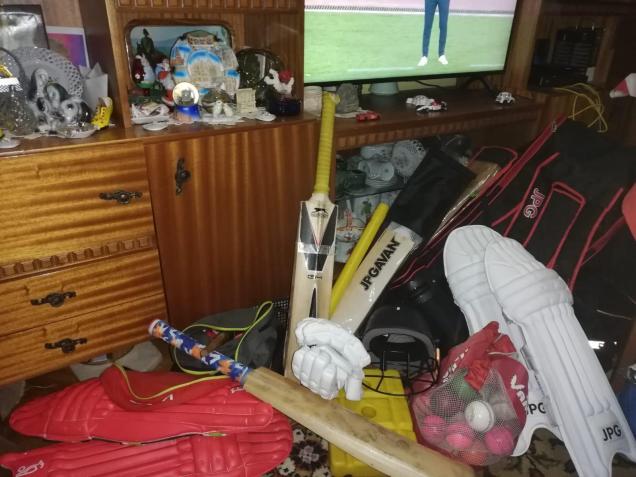
It is when he pans his phone around his room that the huge gulf in the status of an ‘international cricketer’ in Romania and one in England is at its most evident. Piled around Pavel’s small apartment is a choice array of cricket equipment that he’s been sent by well-wishers. For him there’s no clubhouse containing the bats, pads and various items of kit, they fill his room. He has no one to care for them or to transport them for him. The gifts are precious to him though; there’s the promise of a future with every item he’s sent, and he is determined to make good use of them all.

Pavel1

Pavel’s stardom saw him initially inundated with offers from those eager to capitalise on his fame, with “agents offering me advice on making money”, but “they weren’t interested in cricket”, he laments, “it’s the little people that make me famous, not the ones that want to make money and not the ones that make fun of my bowling and then don’t have time to help.  I’m not stupid; why do you think I bowl this way?” It’s a question I can’t answer, but his explanation is fascinating and shows a sophistication that he’s not been credited with. “I do it because people don’t hit sixes off me.”

I ask him why cricket, and he quickly responds “I love all sport”, but when I ask him why cricket his answer is considered and to the point, “Because sport is adrenaline-based, and in something like football there is no time to think, but in cricket you pause and make decisions.” This, he says, “is adrenaline-pumping”.

The Pavel Florin story is best read in a global context. He doesn’t care about either the accolades or the criticisms that have come his way. He’s not playing for the connoisseur, he’s playing for the love of cricket and it is that and that alone which drives him. “One day I want to be the President of the Cricket Federation”, he says, and it has to be said that he’s made a start towards achieving the unachievable. “I have plans to talk to the council about finding a ground to play cricket on”, he says. “I will make my country see cricket”. As a cricket-loving nation, we should surely be encouraging him because, if cricket is to grow, it needs to move beyond its existing boundaries, and encouraging interest in a nation like Romania thanks to Pavel Florin’s new found fame is an opportunity that should not be missed.

You can follow Annie on Twitter:  @AnnieChave

England vs Australia: 5th Test, Day Three

This is rather a strange Test match.  England are now hot favourites to square the series, barring a ridiculous Smith innings, which given his performances this summer only a fool would rule out entirely.  With the Ashes gone, the question of this Test being a dead rubber or otherwise is a fair one, but it is somewhat surprising to see how shoddy Australia’s performance has been at the Oval, given the series wasn’t won.  Catches dropped in the first innings, some poor bowling in the second, and while England’s problems haven’t gone away, they’ve played with by far the greater intensity of the two teams in this one.

Joe Denly was the star of the day, falling 6 runs short of a maiden Test century – his disappointment at getting out plain for all to see.  He has been perhaps the most interesting of the players tried in the England top order; he certainly hasn’t been a runaway success, but he has delivered more and more as the series has gone on. His technical flaws outside off stump were beautifully highlighted by Ricky Ponting, but he has been flashing at the wider ball on fewer occasions and seen his run returns improve as a result.  At 33 years old, he has set an example to some of the other – more experienced – players about how to learn and improve, rather than just repeating the same errors innings after innings.  He had some luck – being dropped last evening and getting away with an lbw not reviewed by Australia – their dire DRS performance continuing – but he earned it.  In the latter part of his career, he may not be considered a long term enough player for winter selection, but short term selections to fulfill a role – perhaps at 3 allowing Root to drop a place – aren’t necessarily bad in themselves.  Either way, his innings at Headingley gave England an outside chance of a win, his innings here has put England in a position where they should win.  It’s more than most in the top order have done.

Stokes and Buttler provided the most support.  The former looks to be the best batsman in the England side at present, given Root’s technical struggles.  Stokes has an uncomplicated technique, allied with ferocious power, and a concentration level that perhaps might not be expected of such a destructive player.  But while the sixes were still hit, this was a disciplined, focused innings in partnership with Denly that took England from a position of mild peril to one of strength.

Buttler capitalised on the foundation with a breezy knock taking England’s lead past 300.  He’s a funny one, he’s not had a good series overall, but has batted relatively well in the last couple of innings.  His defenders advance the case that to see him at his best the side need to lay a platform for him so he can play his shots, and while that’s probably true, if he’s in the side as a batsman then his job is to bat in all circumstances, not just to press an advantage home, or he’s simply a luxury player in a team that doesn’t have that freedom to select one.

Cummins and Hazlewood were again the pick of the Australian attack, without getting the rewards due, but Mitchell Marsh, given his first innings efforts, was curiously underbowled, and got more movement through the air than most others when he did.  Siddle picked up a couple of wickets, but was highly expensive, while Lyon was targeted early on by Denly and proved unable to fully contain the England batsmen thereafter.

As for tomorrow, England have a couple of wickets in hand, but are unlikely to add too many more runs, meaning Australia are likely to be chasing around 400 on a surface that’s still good, but offering a little more turn for Leach to exploit.  It is a measure of the fear Smith has instilled that England aren’t considered nailed on to win this.  Should they do so – and they really ought to, a 2-2 draw would represent something of a success in many ways – not in pure terms, but given how they’ve played.  Failing to regain the Ashes, certainly, but for much of this series the England batting order has been a mess, to the point that dropping a batsman for a bowling all rounder represented a strengthening of the order.  It would also be something of a failure for Australia not to win the series.  They’ve been the better team in three of the matches, denied by a freak performance from Ben Stokes.  Retaining the Ashes might have been the primary aim, but not winning a series that they really should do is falling rather short.

Lastly, the mandated number of overs to be bowled yet again weren’t.  Only two short today, but the running total for this Test now stands at 17 unbowled due to tardiness.  It remains unacceptable.

England vs Australia: 4th Test, Day Three: Snakes and Ladders

It was all going so well.  Surprisingly well, albeit if two batsmen in the top order were going to get set, settled and score runs, Burns and Root were by far the most likely.

Overton was an early loss, but while having him hang around would have been a bonus, he’d done his job last night.  The bulk of the day was all about the partnership of 141 which, if not comfortable, certainly looked in relative control.  It wasn’t easy, Cummins in particular bowled with pace, aggression and plenty of skill, while having very little luck.  But the two batsmen took England to the point where wild fantasies dreamed of a total decent enough to take England to some kind of position of safety.  Should have known better.

If nothing else, it demonstrated for the second innings in a row a greater level of batting responsibility from the England batsmen since the shambles of Headingley first time around.  To that extent, credit is due to them, for if 200-5 at the early close forced by bad light is some way of being a triumph -it did at least offer a relatively responsible example of batting at Test match pace, against challenging bowling.  It is to praise without context, for the times when England might be expected to respond to a big total by posting one of their own are receding rapidly into the past.

The late flurry of wickets, with both set batsmen departing and Roy joining them back in the pavilion wrecked a lot of the hard work that had been done, and with just 6 overs to go until the new ball, the possibility of a full blown collapse in the morning is distinct, but England’s first target of avoiding the follow on, which will take some time out of the game at least, is less than 100 away, and failing to get at least that far would represent a failure and a let down of the batting work done today.

Having been utterly dire yesterday, the problem England have is that they can’t afford a bad half hour for the rest of the Test, and that’s exactly what they suffered late after tea.  No one threw their wicket away, Burns and Root were both got out by excellent bowling, while Jason Roy had looked vastly more at home in the middle order than opening, before being undone by his technical looseness against a high quality Test match bowler. Perhaps if he’d been asked to bat in the middle order from the beginning, he’d have had a chance of getting into Test cricket, but his defence looks far too loose to allow him to stay in long enough to capitalise on his undoubted stroke making skill.  Even so, that he might never have been good enough to hold down a place is one thing, it is another altogether to select him as an opener which undermined fatally any chance he might have ever had.  There’s no disgrace in getting out to the ball that did for him, but how he got out, utterly beaten with stumps splayed everywhere wasn’t a good look.

Root will be picked up again for failing to convert a fifty into a hundred, but both he and Burns probably deserve credit for how they batted today more than criticism for not going on.  Losing them together was a huge blow for England’s chances of an escape, but the pressure had been increasing for some time, with Hazlewood, Cummins and Lyon turning the screw ever tighter.  For once, England’s predicament is less about the batsmen, though the flaws inherent in the order make handling facing a big total more daunting than it was and than it should be.

It makes tomorrow a designated Big Day for the destination of the Ashes – England are going to have to bat out of their skins to get remotely close to Australia’s total, and bat long enough to take sufficient time out of the game to put pressure on Australia to try to force the win.  But it’s hard to see England having to bat less than a day second time around at minimum in order to get a draw, and by the time day five rolls around, on a surface that’s taking ever increasing amounts of spin.  Rain and bad light might yet intervene, and provide England with a salvation that they will scarcely deserve, for although they are battling hard, and doing about as much as might be expected of them with the bat, they are looking a doomed team.  The performance of Smith has been the difference between the sides, and England are wilting in the face of the repeated pummeling.  Bairstow and Stokes are still at the crease, and given the latter’s preposterous predilection for pulling off the impossible, all hope is not lost, but it’s not just uphill from here, it’s getting steeper by the minute.

Late on today came the announcement of the sad death of Abdul Qadir, swiftly followed in the rugby world by that of Chester Williams.  Two sportsmen who were iconic in different ways, the latter an icon of the rainbow nation that won the 1995 Rugby World Cup, the former for carrying the banner of leg spin bowling at a time in the 1980s when it appeared virtually extinct, especially in England.  Shane Warne a decade later would gain the plaudits for being truly extraordinary, but for a certain age group, Abdul Qadir was leg spin bowling – a man who would demonstrate something that was sufficiently rare and exotic as to send a thrill through the observer in an age where pace bowling dominated.   His record is a fine one, but his impact around the cricketing world can scarcely be underestimated.