West Indies vs England: 2nd Test, Day One Blog

As most of you know, I’m at the Test this week, so will do a live blog for at least today and then see how it goes. Much depends on the quality of the mobile signal and if I can steal a WiFi password if it’s poor. Oh and it’s not the BBC. You’ll need to hit refresh.

First up, the weather this morning. On my side of the island at least it’s cloudy and showery but nothing to worry about. Everyone in this hotel is going to the cricket, so breakfast is done and heading over to the ground now.

Joe Denly is due to make his debut today, and here I have to confess I have a real problem with him playing. It’s not that he’s done a thing wrong, it’s not that I don’t like him as a player. It’s that I remember playing against his Dad Nick and seeing Joe playing cricket on the boundary as a kid. Dear God.

0821: Pissing down at present.

0926: Finally got into the ground. I knew it was a bit isolated, but it really is in the middle of nowhere. It’s like holding a Test match in the middle of Dartmoor or something. You’ll never complain about the Rosebowl again. The contrast with the ARG – basically at the end of the High Street in St John’s is stark.

Still, it’s an attractive ground alright, it’s just that it robs any chance of casual local spectators and that’s a real shame.

The weather has improved somewhat though.

0930: second bit of good news. By getting the cheapest tickets around, we appear to be by all the bars. Result!
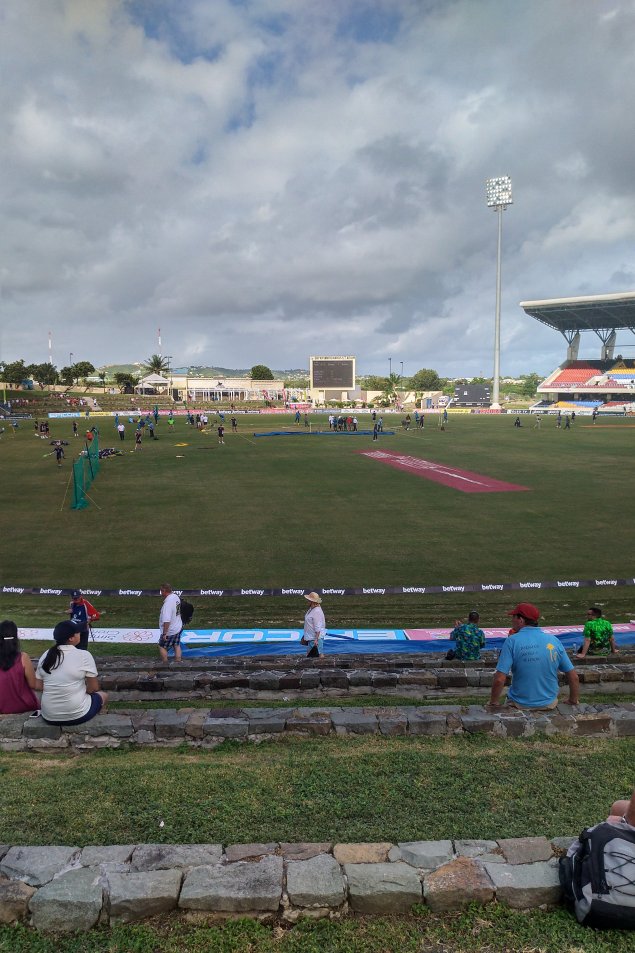
0938: oh England are batting. Right you are. On the plus side, this could be exciting. Brief, but exciting. Nah, my bet is they’ll do ok this time around.

0954: Delighted to announce that some Brits stood for the national anthem and the rest resolutely stayed seated. Fantastically, contrarily British. I’ll leave you to guess which was me.

1010: Unsurprising, I know, but the crowd is almost entirely English. It’s a work day of course, and anecdotally quite a few Antiguans say they’re planning on coming in the afternoon. Hopefully they do.

Panoramic view of the ground:
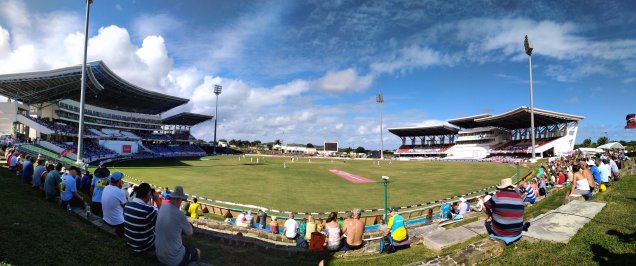
1027: Be nice if they would actually show the review for those of us at the ground.

1049: This is going well. Again.

1102: Was told to post at drinks, so I will.

1112: This chap is providing plenty of entertainment taking the piss out of the England team. How good his local tours are, I’ve no idea – but I do admire clever marketing.

1121: Aside from that one going through the top and exploding off a length (best of luck out there, batsmen), the most entertaining thing so far is meeting an American chap called Dan. He’s here on his honeymoon having fallen in love with cricket. He told his new wife there was a Test match on this morning. Apparently she’s ok now she’s had some beer and rum.

1140: Dan’s new wife must think these things called wickets happen every few minutes.

1156: Ben Stokes has the best technique of any England batsman. Discuss.

1203: Lunch the lobster smells amazing.

1215: The lunchtime PA blasting out Earth, Wind and Fire is a lot more fun than Lords. And it’s not even September.

1255: No luck on the Dan front yet by the way. Stokes and Moeen at the crease could be fun. And saying that, you just know what’s going to happen next…

1304: Told ya.

1344: Drinks, and a pretty low key last 40 minutes or so. Probably not such a bad thing for England, but that was very nearly like Test cricket. Remember that?

1423: Pretty decent recovery stand between Foakes and (especially) Moeen. Hard to know what a decent total here is, though England are some way short at present of what you’d think was.

1427: In any potential list of things unlikely to garner too much sympathy, having to move in order to get out of the sun and into the shade is probably fairly high. But it is extremely hot, and one rather nice thing about this ground is a complete absence of anyone greatly caring where you wander to.

Which means I can give a nice new view of the ground:

1439: Just for Trevor

1441: And that’s tea. Something of a recovery, though given there are 39 over yet to be bowled in the final session, we’re going to be very, very short.

Moeen though. Enigmatic doesn’t begin to cover it with him, he fails repeatedly, but when he’s good there are very few better players to watch.

1520: not sure if that stopped on him or if it was just a poor shot. Either way, the end is probably nigh. So here’s some video, which won’t turn up the right way. Sigh.

1539: Is it bad to be really, really looking forward to watching Stuart Broad bat on this?

1553: this could be a very interesting last couple of hours or so, just to see if England get anything out of the pitch or not. If not, this could get very painful.

1623: Concerning the above, there are definite twinges.

1643: This has not been the most threatening of opening spells from these two. And it’s mostly being played on the back foot.

1703: Innocuous stuff really.

1741: The West Indies batted really well in that final session, and while England might claim that they didn’t have much luck, nor did they really create much in the way of chances. Unless they have a great morning tomorrow they’ll again be in serious trouble. But that is for then.

From a spectator perspective, the isolation of the ground is a problem, but the experience when there is simply delightful. No one particularly cares where you wander, meaning the ground is there to explore and get different perspectives. The food stalls are individual, cheap and put the horrific money pits at English grounds to shame.

It’s now back to the hotel, relax, have dinner and do it all again in the morning. See you then.

West Indies vs England: 2nd Test Preview

Playing catchup in a series, especially a short one, does tend to rather focus minds somewhat, and while it is not in the make up of anyone even remotely associated with the ECB to admit to an error, the 12 announced for tomorrow’s match at the Sir Vivian Richards Stadium (let’s be honest, we all miss the Antigua Recreation Ground) by England are as much a tacit recognition of a first Test balls up as is ever likely to be the case. Broad is back in and seems certain to play, Jennings is out in favour of Joe Denly as the revolving door of England openers shows no sign of slowing down. More notable is the dropping of Adil Rashid, a player who might not be the Shane Warne standard that he appears he has to be in order to get any credit, but isn’t the clueless ingenue he gets all to often painted as either. More strikingly with him is the clear lack of any clue as to how to use him, either from the captain or the coaching team. If he’s not going to bowl more than a handful of overs, there’s little point playing him.

As ever, there are cases to be made both for and against any individual instance, but the inability of English sport across the board to be able to handle flair and individuality, whether on or off the field is a constant. It isn’t that Rashid in this instance deserves defending for his performance in the last Test, it’s that it’s impossible to ever know with such players how good they might be, so determined is the sporting culture to force them down narrow channels. This happens at elite youth level all too frequently to begin with, discipline too often coming to mean an insistence on conformity.

There is a consistent focus on what players can’t do rather than what they can. The idea that Rashid can be a stock bowler in Tests is absurd, yet so much of the criticism aimed at him consists of complaints about his accuracy and economy – it’s such a very English thing to do. None of this means that he is the answer to all our prayers, nor that his on field performances shouldn’t be criticised, but the pre-disposition in so many quarters to hold him to a standard he could never possibly achieve is simply bizarre, while the lack of scrutiny over how he is used is a failure of analysis.

Still, Denly can bowl a few leggies if asked, while Rashid can focus on more important personal matters.

For Jennings, there must now be serious questions over his future. He probably does have the aptitude for it, but his technical problems have become a major barrier for him. He has time to go and put that right, but it could be a long haul.

For Stuart Broad, with his new, more economical run up and work on his action, much will be expected. Not because of anything much more than that his omission was deemed in some quarters more culpable for defeat than the abysmal batting display in the first innings and the in some ways worse in the second. Being out of a losing side is one of the best ways to improve a reputation after all.

In the West Indies camp all is serene, the victory in Kensington most obviously allowing the clear anger at a perceived lack of respect to be vented from a position of strength. And why not either.

The weather for tomorrow seems similar to today, cloudy with showers. The dash from the beach to the room in a downpour will have earned me all the sympathy I’m expecting.

Tomorrow morning I daresay I might liveblog it and see how that goes down.

West Indies vs England: Send the Word, Send the Word Over There

It’s hardly surprising that the Caribbean is a popular place to come and watch England play: what isn’t there to like, warm weather during the depths of winter while watching cricket has a certain allure to begin with. Then there is the romance of the West Indies in cricketing terms to add to that.

Spending the day on a tube at 35,000 feet for 8 hours is a small price to pay, though with my travel industry head on, it remains endlessly amazing that places reliant on tourism often don’t seem to grasp that condemning arrivals to a wait of well over an hour to get through immigration is rarely the best first impression. These are the kinds of things that people comment on to friends and acquaintances.

No matter. The welcome is exceptionally friendly as might be expected, and the volume of people coming for the cricket comprised the majority of the flight, meaning if nothing else there is clear demand to come and mix a holiday with seeing the game.

From a ridiculously small sample of two people, there also appears to be a good level of interest locally, on the back of the West Indies’ dominant display in Barbados, which is surely a healthy state of affairs if it comes to pass in terms of the crowd.

A brief post this evening then, a more detailed one tomorrow, as the blog attempts not to become too much of a travel related one, and with a proper preview tomorrow.

West Indies vs England: First Test, Day Four

What is there really to say? England lost this Test in the first (abject) innings and the last two days has largely been about how long the West Indies cat intended to torture the English mouse, and then see if the England batsmen could make a better fist of things second time around.

To that extent, today was a modest success, at least in the first half. Certainly Rory Burns put a tick against his name with a fluent innings that ended when he someone missed a fairly innocuous straight ball. Perhaps it was a question of concentration more than anything, just before a break, which would be unfortunate to say the least. Still, beating up on the top scorer is an English pastime that is indulged far too often. His idiosyncratic bat lift distracts from what appears very good weight distribution in his shots. Whether there are too many shots is another matter, and we shall see how he develops.

Certainly he is in a better place than Jennings, who fought hard but again played a horrible waft outside off stump to a ball that he didn’t need to play, and hadn’t got close to. As a result, he played entirely with his hands, with the obvious result. He’s clearly trying his hardest, but it is his judgement rather than his technique that is letting him down most often.

Thereafter there were pretty twenties and thirties, as England fell apart to the newly fearsome spin bowling of Roston Chase, who managed to lure English batsmen into some remarkably careless shots. Teams that find ways to get themselves out like this betray scrambled brains, lack of confidence in their method and uncertainty at how to play. It’s all there, and in spades.

To a degree, the fact the game had long gone made the second innings irrelevant, but both for their own confidence and to make a statement that they really can play, losing with dignity and forcing the opposition to strain for the win can be valuable in a series context. Collapsing to defeat as England ultimately did has the opposite effect.

The problem is that by and large this collection of players is the best England have. Whether it is down to the progressive sidelining of the first class game or the rise of short form cricket, or a combination of both, English batsmen have no sense of permanence. Even if they score runs, they do so quickly – batting out a day seems mentally beyond most of them. Perhaps ironically, the one who looks most capable of doing that is Ben Stokes.

As for the West Indies, they have thoroughly outplayed England, and perhaps it was the ultimate salt in the wound that having expressed surprise at England playing two spinners, their own part-time version demolished England’s batting comprehensively, to record the best figures of his career.

England will doubtless make changes for the second Test – Broad will presumably return, at least Rashid and possibly Moeen too will be dropped, while the question of how long Jennings will be persevered with will come up again.

There’s no reason to assume England will be as poor next time around, but these abject defeats aren’t occasional events, they are fairly regular. Two figure totals are also becoming regular. They can play better, and they probably will. But it doesn’t change much, the brittle nature of England’s game is inherent and endemic. And after Anderson and Broad call it a day, the bowling future looks equally uncertain.

There will be the usual over-reaction to defeat and the gnashing of teeth about what happened. There shouldn’t be. Not because it’s not a terrible defeat, but because the structural issues around English cricket have been there for ages. Bad defeats don’t make that more obvious, good wins like in Sri Lanka don’t make it less. But pretending it’s about one performance is to condemn everyone to the same next time around.

To put it another way, is anyone actually surprised? The ability of the team to play rash shots and collapse is a known feature of the team, muddled selection is another. Granting a part time spinner eight wickets on a pitch not helpful to spin merely another indicator of the position they are in.

In times past, a recognition of the problems in the game and a concerted effort to put them right would be the response. Not any more. Now we have a Chief Executive who channels his inner Iraqi spokesman to insist all is well, and the future is exciting. Many may beg to differ.

West Indies vs England: First Test, Day One

Ah, the start of a series in the Caribbean. If it isn’t quite the highly anticipated series of years past, it does at least have the advantage for an English audience of good scheduling, both in terms of post-work cricket to watch, and in reminding everyone of the sunshine in the depths of January – this is, after all, the prime justification for the broadcast of Death in Paradise.

Given the West Indies side, talented but still recovering from the schisms of the last decade, the pitches that would give them the best chance are those with a bit of life, a bit of pace and plenty of bounce. Certainly their quartet taken as a whole are quicker than England’s, particularly after the decision to drop Stuart Broad. But there is a contradiction between the best interests of the West Indies team, and the related needs of the cricket board and tourist boards, both of whom see dollars of various descriptions dancing in front of them, and have no intention of wasting the opportunity.

Thus it is that to the surprise of precisely no-one, the pitch turned out to be on the slow side, prompting England to select two spinners, while the hosts stuck with four seamers and the locals insisted the pitch was unlikely to turn. That meant for the third time in four Tests Broad was omitted, this time for Sam Curran, and naturally prompting whispers about the senior man’s future.

It is perhaps a little premature to do that, but there seems no doubt at all it is Anderson who is the first choice of the two at this stage of their careers, and probably rightly so. The one thing that has really returned to bite Broad was illustrated by Root’s observation that Curran offered the team more batting depth. Broad’s decline from almost being considered an all rounder to virtual ferret may well now be the factor that goes against him. A reminder that cricketers now have to be multi-faceted if they’re not right on top of their discipline.

As for the day’s play, it is forever the case that unless one side has a genuine shocker of Melbourne 2010 standards, at the end of play it can only be said that England finished well, but the West Indies are in the game.

Anderson remains an exceptional performer, and three late wickets from him and one from Stokes tilted the balance significantly. Yet a total of 300 would be at least adequate enough to provoke sighs of relief from the authorities, and it can’t be said that England are sufficiently reliable with the bat to be sure of matching them. But there must be a sense of a missed opportunity in the home dressing room -five batsmen passed 40, none reached 60, albeit Shimron Hetmyer is still at the crease on 56, and has looked very good getting there.

Second new ball apart, the England seamers looked unthreatening much of the time, Stokes probably being the pick until Anderson’s late burst. But it didn’t tell us anything that we didn’t already know, England lack the express pace to overcome a sluggish pitch, they don’t have mystery spin and they are heavily reliant on the exceptional skills of their veteran spearhead, even on a pitch that doesn’t suit him.

In the morning, Hetmyer may well need to try to score rapidly, but the real meat of this game will be seeing what the home team can get out of this pitch in response.

Standing in the Middle of it

Referees.  Umpires.  Judges.  Whatever the sport, the one appointed to arbitrate on the rules of the game is destined to be alone in their role.  Viewed with tolerance at best, contempt at worst, their errors are highlighted repeatedly, their characters called into question, their motivations considered suspect.

Who on earth would be an official?

Naturally, it’s never as simple as that, and the experience of those passing judgement on the play at the highest level is vastly different from further down the chain, while the experience varies widely between different sports and the conduct of the players within them.  Football referees are routinely abused by players and spectators at professional level, and there are sufficient tales of even worse behaviour at the grass roots to wonder why anyone would wish to put themself through the experience, but cricket, at least, remains a relative beacon of enlightenment compared to many other pastimes with regard to the treatment of the officials.

That’s not to pretend there are no problems, for at Test level incidences of open or masked dissent are legion, while there have been instances in club cricket of serious argument and, lamentably, even violence.  That they remain very much the exception is something to cherish and appreciate, and worthy of exploration as to why that might be,while also paying tribute to those who give up their time to perform a function as vital as opening the batting or bowling.

The most obvious statement to make is that without an umpire in some form, there isn’t a game.  Players can self-umpire, certainly, but it still requires someone to make the decisions and at the very least count accurately to six – albeit the ECB seem hellbent on adding extra complexity for the officials here with the Hundred.  This perhaps is something that sets cricket apart from other sports, for while in all of them an individual can choose to become an umpire, cricket is almost unique in that virtually everyone who has ever played an organised game of cricket will have stood as an umpire as well.  Friendly cricket may be in trouble, but it remains the usual path into more competitive fixtures for young players growing into the game, and few clubs have a permanent umpire prepared to stand all day on a regular basis for all teams.  Thus, the players have to do it themselves, and most players can remember the dawning horror of giving a team-mate out incorrectly, or the sense of pressure from a bowler, usually in a friendly manner, enquiring which of the three stumps that ball might have been missing.  Personally, the one particular incidence of humiliation came from a highly amused bowler gently asking how long one particular over was going to go on for, as I accidentally recycled the coins around my pocket for a second time.

Everyone can tell their own particular tale of woe here, but if nothing else, it taught a sense of understanding and respect for the role of the umpire, and the difficulties therein.  Without ever publicly admitting it, it was years before I learned to get the call of “no ball” out of my mouth in anything remotely approaching a timely manner, so bowlers more or less had a free pass to overstep whenever they were lucky enough to have me in the middle. I simply didn’t dare mention that the one that had just up rooted off stump should have been called by the idiot stood at the bowler’s end, though being by trade a batsman, I probably rejected more than my fair share of reasonable appeals.  Swings and roundabouts.

There were other side effects too, and perhaps it can be argued that the widely held view that batsmen ought to walk can be ascribed to the self-umpiring model – a reluctance to put a team mate in an invidious position; the memory of a tongue lashing from a senior player who was put in that position on the one hand, being that umpiring player put in that position on the other.  Certainly it’s quite common for batsmen to walk in a friendly game while refusing to countenance doing so in a league match.  It’s an approach that might make little sense when viewed from the outside, a certain level of hypocrisy being involved, yet via the peculiar internal logic that applies in every sport, it seems an entirely reasonable way to go about things, and one I always applied personally.  To those who objected to the idea of not walking in a league match, I always countered that not once did a fielding side ever call me back to the middle when they’d benefitted from an incorrect decision.  Equally however, for that to stick, it really does mean accepting the decision of the umpire, right or wrong.

There are other benefits from being forced to go out and officiate for ten overs (we all remember team-mates leaving us out there for far longer) on a Sunday such as the opportunity when standing at square leg every other over for a pleasant chat with a member of the opposition, particularly as the years rolled by and regular opponents became acquaintances and sometimes even friends.  The social dimension of cricket has always been its greatest strength and its glue, but few sports offer the opportunity for a casual conversation over half an hour in the middle of the game the way cricket does in these circumstances; a particular delight rudely broken only by the panicked alarm of a run out appeal. Indeed, even in the high pressure environment of a Test match, it is common to see square leg fielder and square leg umpire engaged in conversation, let alone further down the pyramid.  Rose tinted spectacles shouldn’t be applied to considering the nature of this self-policed umpiring system, but while it is easy to remember occasional disagreements between teams, the reality is that for the most part, it’s a system that works well with little friction, mostly because only pride is at stake.

The rise of league cricket has changed the dynamic somewhat.  Some leagues still allow this method of player-umpires, particularly at the more junior levels where finding sufficient numbers of people to do the job can be challenging, but it is now more customary to either require a club to provide an umpire or, particularly at County League level, for panel umpires to be neutral decision-makers.  In the former case, it is probably the biggest potential cause for dissatisfaction – there is always an opponent renowned for having an umpire with selective eyesight depending on which side is batting.  Players of course are as one eyed as they always are in any sport in perceiving bias and slights against them while perfecting the cognitive dissonance of being absolutely certain the umpire was spot on when it favoured them.

Panel umpires on the other hand remove this perception, yet they also take something away from a club whose umpire never gets to stand at his own ground in a competitive match.  Players would consider this a price well worth paying, yet it remains a sadness that it is considered necessary, even though it almost certainly is.  Cricket does have an advantage here though, in that while socialising with opponents in the bar after a game has declined substantially in the last 30 years (drink-drive laws have played a major, and entirely justifiable, part in that), there remains the opportunity to chew the cud with the umpires after the game.  It is something that is far rarer in other team sports, and indeed even discouraged in some, the referee disappearing at the end of a game and never getting to know the players, and more importantly, never allowing the players to interact at a normal, human level.  This depends on the club, but the opportunity to see things from the umpires’ perspective is one that perceptive cricketers tend to seize upon, even if only to try to ensure the club in question gets a positive umpires’ report.  But equally umpires are often quick enough to apologise for any error, and batsmen quick enough to accept a decision honestly made even if incorrect.  Or as one umpire less than sympathetically reminded me, if I hadn’t missed the ball in the first place, he wouldn’t have had a decision to make. It is not utopian to note that the facility to talk to each other remains a significant strength in the game, and the aforementioned experience almost all cricketers will have with umpiring allows a degree of empathy not always present in every sport.

Leagues also now tend to require a scorer, a decision that makes sense on every level, not least to the frustrated webmaster of a club trying to make sense of a scorebook requiring entry into Play Cricket that doesn’t remotely add up.  Players common loathing of having to do the scoring meaning that scorers get more appreciation for their efforts than perhaps umpires do.  They also tend to privately regard those who love scoring as being slightly odd, while publicly expressing appreciation and delight for those doing it, a magnificently hypocritical position that’s going to cause the blood pressure of at least one of the authors on this site to rise significantly.

Every bit as much as the unsung heroes within a club who ensure cricket can be played, the umpires (and scorers) are essential to the running of the game.  Those who volunteer may be under-appreciated, but at least cricket appreciates them more than the adherents of many other sports do.  It isn’t that no one ever snaps or mutters at an umpire, but it is that most involved object when it happens, and it really doesn’t happen all that often.  Player behaviour towards each other may have deteriorated in recent times, but the sacrosanct nature of the umpire’s position remains largely in place – and needs to continue in the same vein.

Umpires down the years have been every bit as integral to my cricketing experience as the rest of the game, whether they be right or wrong, or whether they be the Sunday umpire Mike who took enormous delight in signalling byes rather than wides when I’d dived full length down the legside to try to reach an outstandingly wayward delivery from the bowler.  He bloody loved it.

Some of those I played with and against became umpires as their playing careers wound down, and the gentle teasing that as a former bowler they weren’t trusted by any batsman in the entire league was and is an essential part of the cycle of the game and the handing on of the baton.  Umpires at the very highest level might get paid, those below may in some circumstances get expenses, but more often they do so because they wish to give something back to the game they love.

Raise a glass to the umpire.  Without them we don’t have a game.  Raise a glass to the scorer.  Without them we don’t know who has won.

Boxing Clever

Christmas Day for a cricket fan is one where the festivities of the season take place with a note in the back of the mind that there is Test cricket to watch later. This year we were rather spoiled, with three Boxing Day Tests scheduled, rather than the one (plus random ODIs or T20s) that has been more common in recent years.

Hagley Oval was the gorgeous sight it always is, perhaps the most welcome addition to the Test roster anywhere in the world. New Zealand appear to have got their venues spot on in recent times, a focus on smaller dedicated cricket grounds that fill, rather than the vast multi-purpose arenas that looked deserted even if there is a vaguely healthy attendance. Of course, in Christchurch there are specific circumstances rooted in natural disaster, but New Zealand cricket deserves praise for turning this into a positive, and in this instance building a ground that every lover of the game wishes to visit.

Perhaps surprisingly after a first day where 14 wickets fell on a very green surface, it made it to the fifth day, albeit the outcome was in little doubt by the third, but Sri Lanka showed some fight in the final innings, despite being doomed long in advance.

In all three matches, the quality of the pitches was an issue, certainly at Centurion which remained bowler friendly throughout, to the advantage of the hosts whose pace attack took full advantage.

At the MCG, another turgid surface led to two days of grind, and rapid deterioration thereafter. Winning the toss was the key to winning that one, and the self-inflicted wound under which Australian cricket currently operates was highlighted in their batting in both innings, but perhaps also in their bowling, which has become oddly ineffective with the old ball in recent times. People can draw their own conclusions on that one, and probably will.

Australia were well beaten in the end, and can at best draw the series. They are a team with problems in batting depth, as any side where a 35 year old is still an unproven performer would be.

Smith and Warner are due to return for the Ashes, and there seems little doubt that whatever the problems of re-integration, they will be selected simply because of the fragility of Australia’s batting. This makes the continued blame game intriguing, as Warner continues to be portrayed as the evil genius taking advantage of naive young players with no one else involved. Cameron Bancroft’s recent interview claiming he did it to fit in is an abrogation of the responsibilities of any player, who is, and should be, more than aware of the difference between right and wrong. If he hoped to garner sympathy, it appears to have backfired.

Equally, the idea that the rest of the team and staff were oblivious remains as preposterous now as it was at the time. The crime itself wasn’t the issue, players have always sought an advantage. The brazenness with which it was carried out was remarkably stupid, the claims of innocence elsewhere, especially among the bowlers, implausible. The idea they neither noticed the condition of the ball nor cared what the batsmen were up to with it ridiculous. It shouldn’t matter, except to say that the discussions post-Bancroft remarks about team culture have all failed to consider this element – faux innocence, back-stabbing and finger pointing are at least as damaging to unity as anything else.

How Warner responds to being portrayed as the arch plotter will be fascinating, for England fans in the crowd will be unforgiving in the summer, creating what could prove to be an entertaining sub-plot to proceedings.

The New Year’s Honours List appointed Alastair Cook a knight of the realm, perhaps the ultimate vindication of being part of the establishment. The response to this has been interesting, the delight in some quarters that their man has got his dues, the bewilderment in others that a 34 year old gets such an award so quickly perhaps being the biggest response. It doesn’t really matter overly, whether for or against it, but it does seem remarkably early given it took Ian Botham until his fifties and a lot of charity fundraising to get the same. Presumably James Anderson will get the same upon his retirement, for if he doesn’t, it will smack of double standards, not for the first time.

Perhaps more than anything it demonstrates grade inflation in sporting honours, Andy Murray receiving his while still playing at the highest level. Anyone can point to oversights in the past, but one favourite for me has always been the lack of one for John Surtees, the holder of a truly unique record in being the only man to win world titles on both two and four wheels.

I can’t get that cross about the whole thing, it’s more amusement at the sense of vindication and the sheer tribalism of it all.

And so we move into 2019. First on the agenda for England is a trip to the West Indies, and yours truly will be heading over to Antigua for the second Test. I’m sure the England team can’t wait. After that, a busy summer awaits, with a home World Cup and (another) Ashes series.

A final word. The Christmas period brought the terrible news that Ruth Strauss had passed away. Nothing brings home the pettiness of cricketing squabbles so clearly as human tragedy. Expressing condolences feels so empty and meaningless, yet it’s all we can ever do.

The Lord’s Mayor – A Pantomime for every Tom, Dick and Harri(son).

Tom Whittington sat at home, gazing around at the room, contemplating his existence.  His faithful cat, Mary Le Bone washed herself in the corner, content with the world, and oblivious to Tom’s plotting.  A poor orphan boy, believed to be Harri’s son, he was sure there was more to life than this.  He had heard tales of untold riches to be found in that there London, where the pitches were paved with gold, and where a bright boy could make his fortune.  He was determined that if the chance came along, he would go to London, where he could dig up the pitches and take enough gold to be forever wealthy.

One day, a county trundler passed by.  Tom called out to him, asking where he was going.  “To London”, came the answer.  “I’ve been doing this for years, following the same line and length each time”.  Tom hopped aboard, with Mary Le Bone following him and as they passed the fields and greens of England, Tom was sure he could make a difference, looking with disdain at all around him and thinking about real estate opportunities.  When they reached London, Tom was amazed – he could see wealth and affluence, but even as he went through St John’s Wood, nowhere could he see pitches lined with gold, although he could see concession stalls with astonishingly high prices.  “Whatever am I to do?” he cried, seeing no way he could make his fortune, for he could not even see how he could make enough money to eat – especially at those prices.

After a few days, exhausted and hungry, he collapsed on the doorstep of a rich merchant’s house, at number 100 on the street.  Despite his condition, the germ of an idea came into his head, unbidden, not obvious even to him, but a possibility, a chance…

“Be off with you, you ragamuffin” cried The Cook upon spying him, with a failed attempt at a sweep to move him off the step.  At that moment the merchant, Liveon Skye, returned.  Taking pity on poor Tom he ordered his buttler to carry him into his house, Mary sneaking in behind him.  Given a job in the kitchens, he realised Skye was incredibly wealthy, even though hardly anyone saw what he did.  The house was plagued by rats and mice, but Tom, in his small room had Mary for company.  Mary Le Bone was a very special cat, she kept his room free of rodents, she was loved by all who saw her, and she protected Tom, nurtured him and provided him with a safe place to sleep.  But instead of appreciating her, Tom felt she was in the way, and that all those who loved her weren’t important, and nor were their views.  He thought only in terms of what the cat might be able to do for him in future: the cat was a barrier to riches, not a gift to be cherished.

Not long after, the merchant announced he would be embarking on a long voyage, and asked all the staff if they had anything that they would like to send on board for him to sell.  “Please sir, will you take my cat?”.  Everyone was horrified, for the cat had been nothing but a servant to Tom, but the merchant smiled, sure he could somehow make something out of Mary, even if no one else could see it, even if it meant sacrificing all they held dear.

With Mary Le Bone gone, Tom’s life was plagued by the rats and mice, plus endless football in the street, but he didn’t feel sad, he blamed the cat for abandoning him for failing to live up to what was needed in the modern world.  Tom wasn’t a thoughtful or grateful man.  Clearly Mary had done nothing for him, and he had no use for her in future.  Tom decided to run away, for even the Cook had turned against him, and was now demanding to be called “sir”.

As he left the house, he heard the church bells ring, and they seemed to be speaking to him. “Turn again, Tom Whittington, turn again and again with more ideas, no matter how daft they sound.  Lords Mayor of London is your destiny and not even a leg before can stop you”.

“Goodness me”, Tom thought – if I am to be Lord’s Mayor then surely I can put up with a few rats, even if Mary has abandoned me”.  Back he went inside, determined to show the Cook that there was more to be done than just the traditional way of things.

Across the other side of the world, in India where the pitches truly were paved with gold, the merchant had arrived.  He sent gifts of food to King Kohli, but as soon as the food was presented, a plague of rats descended and gobbled it all up.  Seeing an opportunity, Skye told the king that he had a very special cat, a very traditional cat, who could help.  Sure enough, Mary cleansed the pavilion of rats, as she always had.  The king cried out with gratitude, asking the merchant what would he desire for such a gift.  The merchant thought about it, deciding that a Hundred balls of gold would be the price, certain he could make use of that back home.

Upon his return, greeted by thousands of mums and kids who had appeared from nowhere, Tom was overjoyed to see the sale of his cat had produced such riches.  He bought a fine new house, never once thinking of the cat who had helped him or what became of her, but instead buying a golden goose with some of the proceeds.  Killed it, naturally.  And Tom lived happily ever after, even if everyone else lamented the loss of Mary.  But as Tom said to himself, really, who cares about the cat?

The End.  Because it probably is.

Merry Christmas from Chris, Peter, Sean and Danny at Being Outside Cricket, and my thanks to the World Stories website for providing unwitting help with the story.  You can read their real version here

Because I’m not Ed Smith.


Circular Firing Squad

Sometimes it’s hard to escape the nagging feeling that the ECB  appears to actively dislike its own sport.  It’s also easy to think they are deliberately and specifically trying to kill county cricket, particularly in its four day format.  It’s one of those thoughts that passes through a mind, dismissed as ludicrous, but re-appearing with every new announcement that appears intended to do exactly that.  The Hundred, the marginalisation of the county championship to the edges of the season (and a rather odd celebration in some quarters when a couple of fixtures are not at those margins), the apparently deliberate disdain for its existing audience.  The notion seems preposterous, but if it were to happen, it’s hard to believe the attempt would be done much differently to the way it is now.

There needs to be some full disclosure here:  I am not and never have been a passionate adherent of county cricket – it’s been a matter of relative indifference to me except as a pathway to the international sides, while club cricket was always my focus, with a healthy (or unhealthy depending on who you speak to) disdain for the conduct of the counties over the years.  To that extent, I don’t have an emotional bond to that strata of the game, more a recognition of how vital it is as a cog in the larger wheel, albeit one that could have been managed rather differently over the last fifty years.

And yet, at the same time, I also recognise how much it matters to many others, not least the other writers on this site, who have been spectators at many more games than I have, and who care about the tables and outcomes far more than I do.  That’s just me, I don’t defend it, and I don’t propound it, it’s just how it is.  And yet the finalisation of the format of the Hundred, to start the year after next, remains a subject to stoke my ire, due to the sheer arrogance of its creation and the dismissal of any opposition to it as somehow irrelevant.  Few businesses can survive with such a lofty view of those who might attend, and since the ECB have gone down the route of being a pseudo-business in the first place, it’s a fair stick with which to beat them.  New audiences are all very well, but existing ones are much easier to keep than winning brand new ones – indeed creating an entirely new market would be considered as nigh on impossible in equivalent circles.

Here, a reminder of why the Hundred is deemed necessary is worthwhile.  There is already a T20 tournament in place, but the deal with Sky for exclusive rights to it meant that there was no chance of any of it being free to air.  And the ECB have belatedly realised that their decision to remove any visibility for the sport has had catastrophic effects – the plummeting participation levels being one obvious result.  Therefore a second competition was necessary, one that could be sold to free to air television, at least in part, while also flogging it off to pay TV for more money.  I say sold, but the rumours are that the BBC are picking it up for peanuts, so desperate are the ECB to at least have some degree of public awareness it’s going on.

Having decided that a second short form competition is essential, the ECB were faced with a couple of problems – firstly to shorten it somewhat (although it should be noted that in all the early announcements it was stated to be a T20 competition, and presumably the BBC knew it), and second to give it at least some differentation from the Blast.  Hence the mad scramble for something shorter and with different playing conditions.  Likewise, the franchise idea came about by noting how other countries had fewer teams to make it work, and as a rather useful way of bypassing the counties themselves, given the feeling that 18 sides is too many.  An irony here is that in football, the very strength of the game in England is that there are so many teams – something other countries view with envy.  For cricket here it is deemed a problem, and not an opportunity.

Naturally, a smaller competition means that brand new teams need to be created, and thus the desire for city based franchises came along, preferably with a ready made audience who might affiliate with the urban centres in which they were based.  The trouble was, it was still going to be just another T20 tournament, and one that might even make sense as a financial centrepiece, were it not for there already being a competition in place that provided that.  So why not fiddle around with all the rules and make it “simpler” through various initiatives to render it vastly more complex?  And here we are with the Hundred, a format no one really wants, and no one asked for, all to fit around a succession of requirements forced on the ECB by their own actions and their own long term goal.

The confirmation of five or ten ball “overs” to fit the decimal headline number smacks entirely of trying to force a game into a title, and while it is hardly sacrilegeous to change the number of balls (8 ball overs were a thing for many years – indeed in order to shorten what became T20 many clubs have for years played 15 x 8 ball overs in evening leagues), it is the attempt to present a solution to a mathematical problem of their own making as somehow revolutionary that generates sarcastic responses.

Still, it’s going to happen, and despite the self-imposed strait-jacket, it will doubtless cause some initial interest, simply as something new, and as an event.  It may even catch on, given that the pressure from gambling broadcasters and governing bodies for ever shorter and more numerous forms of cricket is certainly there – as evidenced with T10 tournaments.  If it does, then the question of what happens to the T20 Blast will come up, for that competition can be seen as something of an barrier to what the ECB wish to achieve here – sidelining the annoying self-interested counties and producing a competition that can attract international attention for the benefit of the self-interested ECB.  It’s easy to be sceptical about the ECB’s motives (usually because being sceptical about their motives proves the correct attitude), but the current season structure is not going to be sustainable in the long term, and the creation of franchises moves the professional game in the direction that the avaricious will far prefer.

The other fly in the ointment is the county championship itself.  Although it ought to be a proving ground for Test cricket, the changing nature of Test cricket itself (and the selection of short form specialists to the team) has rendered it less vital in the eyes of those who must be obeyed.  It’s a nuisance – it takes too long, the crowds are small, and the counties need to be subsidised to play in it.  Why would anyone want such a competition when there’s so much money to be made elsewhere?  Thus, the heart of the season has been given over almost entirely to limited overs matches of one form or another, whether domestic or international, with the annoying red ball cricket kept out of the way, like an embarrassing uncle.  Some might argue that it could be nurtured and helped, a format of cricket that needs assistance rather than contempt, but this is not the way the ECB do things.

Having in 2018 created a fixture list that managed to avoid any cricket on a bank holiday (people might go along and watch – can’t have that), for 2019 they have gone the extra mile, avoiding any matches at the weekend where possible, and ensuring that those who work for a living won’t have a chance of getting along to see any play.  The sarcasm is justified, because there are only two possibilities here – firstly that the ECB are so completely incompetent that arranging fixtures at a time people might be able to go is something they’ve never considered, or that it is deliberate.  Despite the feeling that ineptitude is written into the ECB’s mission statement, they can’t possibly be that lacking in basic ability, so it can only be on purpose.  A deliberate decision to make the county championship even less accessible to spectators.  A deliberate decision to make membership of a county even less attractive.  A deliberate decision to turn away people who love the game.

Those who go and watch county cricket might be relatively few in number compared to other sports, but they are also very often the people involved in grass roots cricket, administrators and volunteers – those whose passion for the game exceeds the casual spectator by orders of magnitude.  They get laughed at and belittled, including by some members of the press, let alone the ECB who are supposed to be on the same damn side, but these people have a disproportionate value to the game that goes far beyond them sitting isolated under a blanket at New Road.  All ignored.  All treated with contempt.

This scornful attitude is why those who insist the Hundred is given a chance are missing the point.  It’s not that it can’t succeed, it’s not even that it won’t succeed, for even some free to air live coverage has a chance of generating interest far beyond the niche sport cricket currently is.  It is that the ECB really do not care about taking those who love the game with them.  They have no interest in trying to manage the 21st century commercial realities with the responsibilities that their supposed husbandry of the game of cricket in England and Wales ought to instil.  The dash for cash is the primary aim, the actual game of cricket a cipher, not the end in itself.

Those who play up and down the country are irrelevant.  Those who love cricket for the sake of the game they grew up with are irrelevant, unless they can be switch-sold and monetised.  The game of cricket itself is irrelevant, it is merely a means.  And that is the reason for the anger, not messing around with the rules, not trying to square a circle that wouldn’t be easy in any circumstances.  It’s that they don’t care about you, they don’t care about me.  That you played the game all your life is no more than a footnote, that you watch the game only of value in so far as you can be added up in revenue stream.

The ECB.  The only sports governing body that regards the game for which they are responsible as a hindrance to their aims.

Sri Lanka vs England, 2nd Test: Victory

That England took the last three wickets to fall relatively quickly is not so surprising, that England have taken the series reasonably comfortably perhaps is. Sri Lanka certainly aren’t the side they were, and have a better justification for the usual excuse for defeat (“rebuilding”) than most do, but it remains a difficult place to go, as South Africa found to their cost only a few months ago.

England haven’t won an away series of any description for three years, and haven’t won in Asia/UAE for six, so there should be a recognition that this is a meritorious achievement. Perhaps most strikingly, they did so through their spinners, Leach, Rashid and Moeen all performing well, and perhaps surprising a few people. Nasser Hussain won a series as captain there, and observed afterwards that by creating pitches exceptionally conducive to turn, the hosts brought England’s more limited slow bowlers into the game – it may be that the same error has been made here again.

Certainly Leach has come out of the series to date with credit, but Moeen Ali for one has also to some degree answered those who maintained his away record was too poor for consideration. It’s just two Tests of course, and doesn’t alter what went before, but nor can it be ignored when he does do well. As for Adil Rashid, he remains a potent weapon, and if perhaps a luxury at times, that’s what wicket takers often are.

Perhaps the difference most of all was to be found in Joe Root’s century, as is often the case when a standout player raises himself to levels others cannot match. Pietersen did that in Colombo on a previous tour, appearing to be playing a different level to everyone else, and if not quite so startling this time, Root certainly showed he is a player of rare ability. There has been too much focus on his failure to convert fifties into hundreds and too little on his ability in the first place in recent times, a batsman being held responsible for the failures of others.

As for the openers, they have performed creditably enough. In neither case can they be said to have permanently cemented themselves, but equally neither has the Cook of the last few years been missed. In a match where it has been so spin friendly that England’s seamers failed to take a single wicket, to come out on top having made contributions counts as a win on more than one level.

England have endless problems off the field, but at times on it they simply deserve credit. This is one of those. A fine win, and a better series win.