Guest Post – “Suits, Not Boots” by Simon H

Simon H is the man I look to for updates on the governance of the game. Here is his take on the events of this week….as always, many thanks to Simon for his time and effort in putting this together…. He e-mailed me this last night and there’s an update at the bottom to reflect further events.

SUITS, NOT BOOTS

It’s been a stellar few days for those of us (and we number literally in our half dozens) who find cricket governance fascinating. The administrator-media complex that runs the game have produced three stories at more or less the same time, so here’s some attempt to sort out what’s been going on:

  1. The ICC.

As LCL has already written, there has been an ICC board meeting in Dubai. I’m very much a newcomer to trying to understand the ICC and don’t claim any great expertise here. Firstly, those who remember the world pre-1990 may remember something called Kremlinology. This was how outside observers tried to understand the goings-on in the USSR without virtually any official sources – no minutes, no press releases, no interviews, no diaries, no leaks, no non-attributable briefings, no former members pontificating in TV studios. The ICC offices in Dubai feel very much like the Kremlin, except they’re uglier and less drafty.

So, from a handful of statements that have appeared, and from the sterling work of the handful of journalists who are interested, what can we glean? This was an ICC board meeting, featuring the heads of domestic boards but not, as far as I can gather, Shashank Manohar. The formal ICC meeting is next month (I thought it was going to be in Singapore but it now seems to be in Cape Town). ICC board meetings don’t appear to generate any minutes (not that they are ever anything less than next-to-useless) and I don’t think they have any formal power. However, informally, they seem to matter a great deal in preparing issues for the ICC meeting proper.

The big story emerged, of course, on the first day in the lack of a majority for the draft two-division plan for Test cricket. The plan needs seven FMs in support and only had six. India, Sri Lanka, Bangladesh and Zimbabwe were the four against. This was apparently ‘understood’ without a formal vote and was used to prevent the plan even being discussed. Therefore, a measure backed by 60% of the FMs, presumably most of the associates if anyone bothered to ask them and 72% of players according to a FICA survey (although that may be deserving of some scepticism) has been quashed. The most that seems possible is a play-off between the top two in the rankings (hands up who’d like that to Pakistan – and India). Money talks and democracy walks in cricket governance.

That headline story may mask that other measures won approval at the board meeting. ODI and T20 leagues were supported. This will necessitate ODI series being standardised at three matches of each – and every team will have to play the other top thirteen at least once in a three year cycle (hmm, I’ll believe that when it happens). The leagues will be used for qualification to ICC tournaments. It was also agreed members retain control of Test fixtures and the ICC continues to have no power here. Most importantly, there appears to be some move towards revenue-sharing with England, Australia and South Africa keen to pool their TV revenues and other boards welcome to join. This has the potential to be massively important and needs more discussion among cricket-followers. Cricinfo report that changes in the Indian TV market are the driving force behind this and a sharp decline in those revenues is expected. There has been an assumption that sharing means it would be equal – but that remains an assumption.

The background to much of this appears to be a rapidly souring relationship between Manohar and the BCCI. The head of the BCCI has been visiting Srini and playing the card straight from the Srini handbook – threatening boycotts of ICC events, starting with the 2019 CT. Resentment at funding for the CT compared to the T20 WC has been cited – Manohar disputes their figures and the chances of any of us knowing who’s right are as great as a recall for Nick Compton. The internal politics of Indian cricket are something we’d all better learn to start taking an interest in:

http://www.firstpost.com/sports/bcci-vs-icc-battle-gets-murkier-india-may-pull-out-of-champions-trophy-2017-2993924.html?utm_medium=twitter&utm_source=twitterfeed

And although it’s hardly been mentioned, all this would seem to leave Manohar’s plan of handing back 6% of India’s 22% ICC revenue-share as dead in the water….. which I rather suspect was, ultimately, the point.

  1. City-franchises

Not to be outdone in farcical cricket governance, the ECB have been building up to their very own D-Day. The interminable debate about city-franchises has led many to tune out of the issue – but the crunch meeting is soon upon us as September 14th looms. The proposal needs a two-thirds majority and Nick Hoult, who’s reporting on this has been in a league of its own, reports the ECB are close to achieving the numbers they need.

This isn’t the place to debate again the merits of city-franchises. Whatever one thinks of the idea, the methods of the ECB are the issue here. They’ve presented county chairmen with five options – but to discover these “options”, the chairmen have had to sign ten year gagging clauses. We may discover what these options are later next week once this meeting is done. The ECB’s conception of options might turn out to look rather like that expressed here (starting at 14:55):

https://www.youtube.com/watch?v=jllMX_bQx7U

Then there is the role of our media chums. Curiously, a number of writers who have taken a not exactly critical line of the ECB in recent years have suddenly discovered a rampant enthusiasm for city-franchises. One got an extended holiday with his mate out of it. Others have been convinced more easily. They get to know confidential ECB survey evidence that has not been published. They don’t know how that survey was conducted, and whether the results are worth the paper they’re written on, but they’ll repeat them anyway:

https://twitter.com/theanalyst/status/773787861342650368

https://twitter.com/theanalyst/status/773834112750723072

They’ll use their Twitter accounts and magazines they’ve somehow come to edit as platforms for not debating an issue but prosleytizsng a cause. Maybe they are genuinely convinced? Maybe after the nonsense of the last two years, they don’t deserve any benefit of the doubt……

Finally, Nick Hoult captures in a nutshell what lies behind all this:

https://twitter.com/NHoultCricket/status/773990826120736769

  1. Eoin Morgan

While ECB chairmen are gagged for ten years, certain journalists discover that Eoin Morgan has told Strauss he isn’t going to Bangladesh:

https://twitter.com/JohnSunCricket/status/773991330221522944

Certain other journalists then have pieces out that proclaim that signifies the end of Morgan’s England career forever:

https://twitter.com/Anarey_NLP/status/773974634609905664

There will be widespread rejoicing among certain BTL communities where who can hate Morgan the most seems their main amusement.

It turns out Morgan has some good reasons, based on past experiences in Bangladesh. Lawrence Booth has produced the best account of these:

http://www.dailymail.co.uk/sport/cricket/article-3780211/England-one-day-captain-Eoin-Morgan-gives-strongest-possible-hint-not-tour-Bangladesh.html

Some have already decided it’s because Morgan isn’t English enough. That’s all they needed to know, they’ve known it in their bones all along when he wouldn’t sing the national anthem or miss the IPL to watch it rain in Ireland.

Some are reading Strauss’s comments about not going giving opportunities to others as trying to pressurise Morgan and as a veiled threat. I’m not exactly Strauss’s greatest fan, but I think these were more anodyne statements of the patently obvious. The captaincy will now presumably be between Root and Buttler. We’ve seen there are some doubts about the former as captain before and there has been some talk of resting him in the Bangladesh ODIs. Some may also suspect he would raise more issues about the Test captaincy. Smart money may be on Buttler.

Will others follow Morgan and opt out? If they do, Morgan is damned for influencing them. If they don’t, Morgan is damned for thinking he’s something special. Maybe KP’s intervention might produce some desire among the ECB to show that he was wrong and they will forgive Morgan. Maybe…

SATURDAY UPDATE FROM SIMON…

I should say this was written late yesterday afternoon and quite a bit happened just afterwards. Newman’s article for one. the discovery of Dobell’s podcast for another:


Reading Sharda Ugra on Cricinfo has also opened up a new interpretation of the two-division plan – that the ECB and CA were trying to drive the less attractive parts of their schedule off the roster just before negotiating new TV rights’ deals. It’s a new argument – but if trying to judge whether they are more motivated by short-term greed or a sudden conversion to the principles of meritocracy, which one – based on their recent track record – seems more likely?
Eoin, T20, ECB, ICC, Tired….

As Chris is off around the other side of the world, and my job has gone absolutely hyper, the time to consider and even react to games, news, events is so totally limited. Coming home has been like wandering into a gently soothing cool shower, draining away the aches and pains, but leaving you still tired and needing rest. Such feelings don’t correlate with writing passionate blog materials. Twitter is easier, but also lazier.

Carrying out the duties of a blog like this means a lot of spare time is taken in reading and listening to what is going on. Today is a good example. I bought the Cricket Paper this morning. The only time I’ve even thought about reading it was when Tregaskis asked me if he could see a copy of the front page. I get home and the first time I actually catch up with the Surrey and Middlesex scores is on the bus to my house. I’ve listened to George’s podcast while having one eye on the unbelievable opportunity I have in 9 days time to fulfill one of my dreams.

I sit and read the stuff on Eoin Morgan. My job entails me going around the world, infrequently, and seeing some extraordinary places – I’ve been to Almaty in Kazakhstan, a brilliant experience, and down a coal mine in Illinois. I’ve been to Istanbul a number of times, and even the amazing city of Moscow. I’ve been nervous about many of them. But I went, because I believe I can look after myself, have a huge sense of danger, and feel as though my wits are about me. I don’t guarantee safety, but then again life is too short to worry about everything. I’m sure something will happen some day, but it is as likely to be in Paris as it is in Istanbul, for example.

But I have turned down visits that don’t suit my personal circumstances, or where being a chunky could get me into trouble (i.e. being able to run decent distances). Or, importantly, where they make me nervous. You see, I may have to make the choice of going to Bangladesh soon, and I’m not that keen, but would probably, on balance go. But I am not a high profile international cricket team. I have every sympathy for Eoin Morgan, who has damn good reasons for not going. His own. You don’t walk a mile in his shoes, so don’t you dare judge him for making that decision. It is all perfectly well people saying “he’s the leader, he should show some courage”. Bollocks. There’s too much of this judgmental crap these days, and I’ve had enough of it. I’m sure many of you have too.

Those who like that sort of thing are pointing out Eoin Morgan’s “lack of form”. The irony of that smacks me in the face. Two years ago lack of form was nothing when the other England captain was playing test cricket, and his lack of form at ODI level took more than a few months bad trot to get him out of the team. Morgan will know how much he lost if he is not selected for India. If he isn’t selected in the squad, then I know that this is personal. Morgan is a very good white ball captain. Jos Buttler will not surprise us that much in three games to persuade us that Morgan still isn’t the best white ball captain.

Then there is the T20 stuff. Look, sorry people, but I really haven’t been following it as much as I know you might like me to. Part of me is past caring. The ECB know what they want. They want an 8 team tournament, in prime summer, with international superstars, and it live and exclusive on Sky TV. Yes, you read the last bit. If it ain’t them, it will be BT Sport. That the counties want little to do with it, is not a surprise, but they’ll be told “no nice payouts to keep you going if there isn’t what we want” and we’ll melt down into civil war over cucumber sandwiches. Unlike Australia, on which we are basing our T20 envy, the game has lost its grip on the social fabric of the country because it banned itself from free TV. Australia still reveres it cricket and there is still an audience for it. It also, as I read from someone today, the perfect set up with large urban centres limited in number. What would we do?  Graves seems to have all the negotiating skills of a Sandstone cliff, and Tom Harrison couldn’t persuade me to put the heat on in winter, so what chance do we have? I don’t think the other side of the debate has been all that crash hot either. Why do we need to save the counties? If they didn’t “need” saving we wouldn’t have to help them out. The game is not viable even in the current “massively successful” T20 Blast era. You know my view – players are getting paid above their market value, and unless there’s some damn realism in this sphere, we are going to be in real trouble ad infinitum. There is not a single current non-international cricketer who should be on more than £2k a week in county cricket. There used to be a few at Surrey. I’ll bet they weren’t the only ones.

And as for the ICC. May god have mercy on the souls of the cricket boards of this world. We truly are in the hands of men with little imagination, other than how to try to make money. I’m done with it. What is there left for us to say? What more could Death of a Gentleman do to say, sort this mess out? I’m not sure two divisions would have saved test cricket, nor do I believe it is in as dire a state as some say it is. It most certainly is in certain countries, but that isn’t new. We have the wonderful success story of Pakistan, the world #1 that never plays at home. England are up and down. Australia too. India look to be getting some consistency. Sri Lanka can pull magic out of a hat. South Africa may still have it. The ICC don’t give a shit. Not really. The BCCI run the game and we all know it. It may have sounded like they were moving towards consensus, but that was always transient in my eyes.

So tiredness and weariness, despair and demoralised, we move on to the end of a season where the premier long-form competition is coming down to a thrilling conclusion with the top two meeting in the last fixture and our host broadcaster, with five or six sports channels to fill in midweek, cannot be arsed to cover it. And that’s the broadcaster who #39 put their head chap at #6 in his power list. He should be #1 because if the exclusive broadcaster can’t be bothered to do this and that company is very likely to keep all cricket in the future, then this sport has the wrong priorities. But we knew that.

UPDATE – Paul Newman has written a truly appalling piece on Morgan’s decision. I’m not linking it. If you want to read it, then go ahead. But there is no room in his ivory tower for a shade of grey. The sort of article that plays the man, and not the issue. An issue so serious that the ECB Head of Security went out there for a week and still the ECB said there would be nothing held against anyone who did not travel. I ribbed an Aussie about their non-tour last year, I know. But there’s been some naughtiness since (I’ve learned a hell of a lot about Bangladesh since then) and it’s a judgment call. No more no less. But there isn’t empathy in Newman. Certainly not in his writing. I don’t know if I could be more angry with him.

Cash, Money, Lucre, Power, Influence…

I think Jarrod Kimber’s Twitter feed spoke volumes last night….

You can read the rest. Jarrod lets the BCCI and Anurag Thakur have it with both barrels.

Here at Being Outside Cricket, well especially me, I bow to Simon H when it comes to matters of ICC and world administration. It’s tough to keep up with the machinations of our press and ECB goings on without keeping an eye on what is happening in the international game. But what we all know is that India control the game – and Indian fans save your admonishment because this is realpolitik not some cosy fancy “good for the game” nonsense that I’m fed by people who want more of my cash to be able to watch the sport we all love. For that’s what this is all about. As Gideon Haigh says, what are fans other than something to be monetised? Sport has always been about money and entrenching power. The “product” on the field is a definite second.

But hey, you say, if the product is rubbish then no-one will watch? Well, yes, to a degree. I happen to think that “modern football” of the last 20 or so years, while technically much better, is far less exciting. It’s why I don’t go to my team any more – I was bored watching defensive, fearful football, with losing more feared than winning enjoyed – and yet the Premier League is doing better (supposedly) than ever in the money stakes. India have the IPL – I really couldn’t tell you who won it, was it Bangalore? – and it rakes in a fortune. The Indian national team is a money printing machine, and while they have the cash they do not have one vote on the table. They have THE vote.

We can sit here and moan all we like. This is the real world. We have ONE jewel in the crown – our team plays a massively lucrative series against Australia – but non-India years in the accounts are not good. We’ll see how down they are when we get the next season’s accounts, but revenue was well down in 2015 from 2014, and that was from India to Australia, and they are bound to be a lot worse compared to 2015. Money men, and it’s usually men, who run cricket, don’t tend to do altruism, and in many cases don’t take a long-term view.

One thing with the Giles Clarke interview in The Cricketer is that where there is lots of plaudits on himself for securing a lucrative TV contract without which the professional game in this country could not have survived – his words – he has seen a growth in international player’s wages in the UK which has not been matched by a growth in the game itself. You only have to look at clubs in my area merging or folding (our team did because we had no younger players, and the constant strife the counties put themselves in while paying players money they can’t afford. It’s come to the point where the game in England depends on whether a TV company is going to pony up the money to pay for it. At some point the sports rights market is going to be saturated and people won’t pay any more. Take the fact the US Open tennis has been dropped by Sky, for the cost, I read, of ONE Premier League fixture. Cricket better not be still standing when the music stops and the chairs are all taken.

It’s OK for us diehards to say “that Pakistan series was great and we should have more of them” because Sky don’t want that stiff. They’d have Australia and India alternating if they had their way. They’d have an IPL in England if they had their way. And that’s the issue for us, and increasingly on a global scale. TV calls the tune, and more importantly, Indian TV money (not influence, as the way they are advised to broadcast shows the power the BCCI holds) does, and that’s a lot of money.

There were a lot of rumblings when Shashank Manohar swept on the scene, stopped Giles becoming the head of the ICC, made some very nice international noises which were in contrast to Srinavasan, that all wasn’t all it seemed. A number of the constituent parts of the BCCI weren’t so keen on hearing about THEIR revenue being nicely shared around the world for the “good of the game”. I could just imagine out constituent Premier League clubs doing just the same – a bit like how the top boys react when the Champions League is being reformed, The top boys want the riches for themselves. The assured cash flow. To hell with fairness and competition.

Now, it appears, at the ICC council that the Indian board aren’t going to be as fulsome in their altruism as we first thought. Part of me says why the hell should we. If we were in their shoes, we wouldn’t be. If any part of this impinged on counties, we’d have no chance of changing the rules. So don’t be slagging India off for doing what we would do.

Two division test cricket would only have worked if we truly believe England, India or Australia would have been allowed to be relegated. If you believe that, then you should check the bottom of the garden for fairies. Cricket is bankrolled by India, so what they say will pretty much go. The IPL has pretty much destroyed, if it needed much help, test cricket in the West Indies as it always clashes with their season. The best West Indian players get to “choose” whether to earn a reasonably small sums in an uncompetitive team on dreary wickets in the Caribbean, or pocket a small fortune in playing in a competitive if ultimately relatively meaningless “league” in India. That’s tough. Don’t spend too long thinking about it.

The game is run for naked self-interest. We got angry, rightfully so, and we should never not get angry, at this. Of course we do. We’re bloody diehards. But we aren’t who boards care about. We’re the ones taken for granted that we’ll still be there when it all falls apart. We’ll still cough up our Sky Subs, our match tickets, even our memberships just to watch the game.

I hope Simon will write a piece on the meeting – if not, I’m sure he’ll comment – but the ICC haven’t surprised me in the slightest, and I’ll bet deep down they’ve not surprised Jarrod, Sam, Gideon, and all those others out there who railed against the machine. What they have done is make things a little less comfortable, but when there’s money to be made, and cash and power to be invested in themselves, personally, now, I’m afraid mere diehards can go do one…..

Just listened to the Ugra clip on Cricinfo headlined “BCCI standing with the “small guys”. Really? REALLY? Because they are voting against a two-tier system when they themselves virtually operate one themselves (no tests against Bangladesh at home until the FIRST one in Spring next year). I’m sorry, you’ll have to come up with a better rationale than that.

Guest Post “40 Years On – England v West Indies, 3rd Test 1976″…by Simon H.

Part Two…Simon H kindly wrote out his memories of this important, but often overlooked but for the battering the old guard got, test match in 1976. In part one we had the build up and the first day’s play. Now let Simon take you through the rest of this match.

You can access part one here.

DAY TWO

The memory has every day of the summer of ’76 sunny and hot but in fact Friday at OT was cloudy. However overhead conditions had little to do with England losing 8 wickets for 34. A pitch that had something for medium pacers and spinners turned out to have a whole lot more for bowlers who delivered the ball at searing pace. Roberts bowled impressively from one end probing Edrich on off-stump until he finally knicked one and then getting one to rear off a length to have Hayes caught at fourth slip. But it was Holding at the other end who was electric. Running in from near the sightscreen it was athletic and thrilling as only great fast bowling can be.

If I may digress for a moment, it is one of the beliefs of the moderns that fast bowlers of the past weren’t really fast. After all, haven’t all objectively measured sporting performances got better over the years? Fast bowlers of the past seemed fast at the time but they’d be medium pacers now, some say. I have to say that , from the little footage I’ve seen of Frank Tyson, he doesn’t look that quick. But look at the film of Holding in this match and he looks quick, very quick indeed. The 1970s speedmen were also tested in early speed-guns and Thomson was found at 99 mph with Holding (who wasn’t then at his peak) not far behind. It isn’t rheumy-eyed nostalgia that imagines this was ‘pace like fire’. It was.

Nightwatchman Pocock soon edged Holding to first slip. However it was an unplayable lifter to Woolmer that knocked the stuffing out of England. Greig tried to counterattack but it had a hint of desperation about it. Daniel replaced Roberts and with his wading-through-water run-up and muscular action produced an in-ducker that bowled the England captain. For all the talk about bumper wars that was about to erupt, West Indies realised Greig’s weakness was to the full ball and didn’t make the mistake of Lillee and Thomo in 74/75 when Greig goaded them into losing their length. Knott couldn’t salvage this England innings and edged to second slip. Underwood got an alarming bouncer and then was bowled as was Hendrick. The bouncer at Underwood was genuinely scary but he had made 31 in the previous Test (without which West Indies might well have won the game) and English bowlers inflicted some nasty injuries  on tailenders in the 1970s (Snow to Jenner in 70/71, Willis to Iqbal Qasim in ’78 and, most famously, Peter Lever to Chatfield in ‘74/75). Holding had 5-17 and West Indies a lead of 140.

England needed quick wickets to keep a toe-hold in the match but like all great sides West Indies sensed the moment to attack. Greenidge launched a second furious attack on the England seamers who looked tame in comparison and although never at his best Fredericks chipped in with fifty before treading on his wicket. When the opposition are effectively 256-1, seeing Viv Richards striding to the crease was just what England needed! Richards survived a few early alarms and at the close West Indies were 163-1.

https://www.youtube.com/watch?v=KtWKfhGKw9w

DAY THREE

So far the match had had great batting, great fast bowling, some decent spin bowling and good catches. What it hadn’t had was major controversy. The last hour on Saturday changed all that.

Most of Saturday’s play was actually the dullest part of the match. That one can say that when it featured Viv Richards making a century says something about the rest of the game! Richards had been a little scratchy late on Friday but here he was at his masterful best and some of his late cutting of Underwood was a delight. It was only slightly dull in the sense that a century was so inevitable. Greenidge hit some more thunderous drives on the way to his second century but then Selvey knocked his middle peg out – a moment captured in a photo that Selvey doesn’t like to show every chance he can. Clive Lloyd tried to bat himself into some form and was looking more like his old self before he holed to mid-on to give Selvey his sixth wicket of the match (and the last of his Test career). Otherwise Kallicharran, King and Murray scratched around to no great effect and started to remind everyone that this wasn’t an easy pitch to bat on. A bored eleven year old drifted off into the garden to play some cricket with his brother (cooking apple tree trunk for wicket, Gunn & Moore bat, don’t loft it on the on-side as it would go in Mr Fry’s garden and he was a bit scary) and he missed what was about to kick off……

Lloyd declared leaving England 80 minutes that night to survive and then a further two days to hold on or 552 to make. What happened next Martin Williamson recounts here:

http://www.espncricinfo.com/magazine/content/story/921731.html

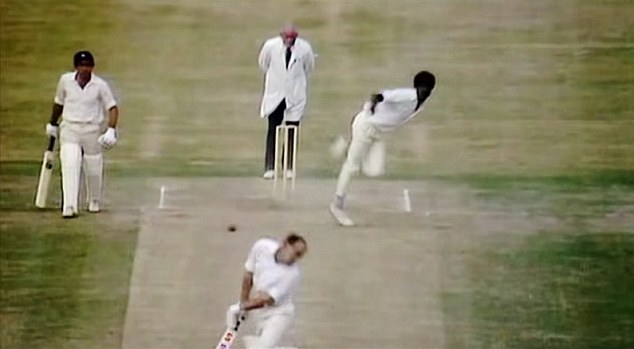
As has been a fault of mine too often, I could see both sides. England were to blame for preparing such an unfit pitch and selecting such an unsuitable opening partnership. As I said earlier, English fast bowlers dished it out in the ‘70s and West Indies’ batsmen took it without (as far as I can recall) any complaint. Complaints about nasty fast bowlers usually boil down to “why haven’t we got any?” There was a nasty tinge to some of the complaints that denied the skill of the West Indies and tapped into some unpleasant stereotypes. But….. Holding did go too far that evening and Lloyd was too laissez-faire about it. That bouncer that just misses Close’s head is a genuinely frightening moment.

Close Holding

I should perhaps say here that I was always immune from the cult of Brian Close. Perhaps I was just too much of a confirmed Southerner? Mostly, I wanted an England batsman to hook like Greenidge. John Edrich was something of a hero though – I liked a dashing opener like Greenidge but a nuggety opener was okay too and anyone with eyes could see that Edrich was having to face some tough bowling. At the time, Surrey weren’t too good and didn’t keep beating Hampshire which also helped.

https://www.youtube.com/watch?v=_8kvK-rylWw


DAYS FOUR AND FIVE

I don’t have any recollection of watching day four on the Monday. Was I still at school? The match started on July 8th and I remember watching the first day live – did we break up that early in those days or had I pulled a sickie?

Anyway, the records show that West Indies reduced England to 125-9. After all the focus the day before on Holding (and Daniel) it was Andy Roberts who stole the show. Roberts was also one of Hampshire’s and, if he wasn’t as high in my affections as Greenidge, he was still one of ours. Later in his career Roberts cut his pace and became a more English style bowler relying on accuracy and seam movement. In 1976 he was still genuinely rapid, if not quite in the Holding league.

He was twice on a hat-trick and the second time he was denied when Greenidge at second slip dropped Selvey. I can remember watching that but it was late in the day so I’d obviously come back in from whatever I’d be doing. At the time it didn’t seem such a big deal – didn’t hat-trick chances come around quite often? Poor Frank Hayes who’d been picked as a bit of a dasher (he hit 34 off an over once) who might take the fight to the West Indies hung on the longest. His reward was to be promoted to No.3 for the next game where he made 7 & 0 and was dropped never to play again. He played all his nine Tests against the West Indies and ended with an average of 15 despite hitting an unbeaten century.

Rain ended play early on day four so the teams had to come back for ten minutes on day five. Selvey edged Roberts to Greenidge again who didn’t drop this one. West Indies had won by 425 runs. It was the fourth worst defeat in Test history at the time (there have been two worse since) and England’s second worst:

http://stats.espncricinfo.com/ci/content/records/283901.html

http://www.espncricinfo.com/ci/engine/current/match/63165.html

AFTERMATH

The next Test at Headingley was in some ways even better. Unfortunately, the family holiday got in the way of watching most of it and I spent several days in the Cotswolds trying to find a TV or radio so I could find what the score was. We got back in time for the climax and I remember being incredibly upset when Knott was caught behind and any realistic chance of an England win went. Fortunately, the decks were cleared for the Fifth Test and a game of three monumental performances (Richards 291, Holding’s 14 wickets, Amiss’s 203) could be enjoyed in its entirety. The moaning about bouncers became moaning about over rates and about crowd noise and I wanted to become a cricket writer/commentator who would write/talk about his love of the game and not just moan all the time (!).

It would be 14 years and over 20 Tests before England would beat the West Indies:

http://stats.espncricinfo.com/ci/engine/stats/index.html?class=1;opposition=4;spanmax1=01+mar+1990;spanmin1=01+jan+1978;spanval1=span;team=1;template=results;type=team;view=results

West Indies’ global domination perhaps wasn’t confirmed until they beat Australia in Australia in the first post-Packer series in ‘79/80 – but in retrospect the domination had started at OT. A cricketing dynasty was founded.

England recovered some pride by winning the winter tour in India. West Indies hosted Pakistan in an epic five Test series at home and, with Holding and Daniel injured, discovered two new bowlers in Colin Croft and Joel Garner. (Ironically it was David Holford’s leg-spin that won them the final test and the series 2-1). The West Indies’ reservoir seemed bottomless and the game became increasingly dominated by pace (or at least seam). Mike Brearley wore a skullcap under his England cap to protect the temples in 1977 and on the tour of the West Indies in 1977/78 Graham Yallop became the first batsman to wear a helmet.

This youngster joined one of those cut-price book clubs so he could buy cricket books cheaply. CMJ’s ‘MCC in India 76/77’ was I think the first. Tony Cozier’s ‘Fifty Years of West Indies cricket’ soon followed (with its cover picture of Clive Lloyd driving while Greig stood helpless at slip). I replayed the matches endlessly in garden cricket or on the indoor cricket games I had. I don’t remember listening to the India tour on the radio so either it wasn’t covered or I wasn’t doing that yet. I only listened to TMS when there wasn’t TV coverage and there was no Richie. Richie was impossibly exotic and didn’t keep telling us it was better in his day. I loved listening to him and felt transported to a different, more exciting place. The Centenary Test was shown on TV in a highlights’ package and in the epic Lillee-Randall duel, England at last a batsman who could take on a great fast bowler and win. Australia arrived in 1977 – the Ashes were supposed to be this great thing but it soon became clear this Australia weren’t very good. Lillee had stayed at home and the fearsome Thomo of legend wasn’t so fearsome. And they weren’t the West indies.


My thanks to Simon, for a brilliant account of a very interesting test match. Feel free to comment, and to share any memories if you are old enough!

The End of Summer

p1050776-04.jpeg
Eoin in rare Middlesex pose… Last game as Skipper tomorrow?

We were discussing, on the way home, whether to bother with a preliminary for the T20 international being played tomorrow between England and Pakistan. This is it. If you want to comment, now the Super Series is over I wouldn’t blame you if you didn’t, then please do so here.

In the meantime a couple of house notes. First of all the List, which has seen more unique visitors hit this site than has been achieved in a long, long time, now takes it permanent place above in the Pages section, next to The Glossary (which I must really update). We’ve had some very interesting reaction and comments, and the post will remain on the blog itself as well (so you can read the comments), but it’s time to unpin it and get on with our lives.

This means we move from the ridiculous to the sublime, and I will be putting up Simon’s conclusion to the 1976 test piece that, in my opinion, was absolutely fantastic and would love to see more of. This blog is more than just criticism, debate and reaction. It’s nostalgia, it’s a world view, it’s the memories that make cricket the game it is. It’s also getting YOU to tell us your memories and personal thoughts. They may not get the attention that a List like Saturday did, but they are what I most like about doing this. So my thanks to SimonH once again for all the effort he put in. It will be up within the hour (all being well).

Lots more to come – and if you want to comment on the T20, do so here. I may be at The Oval tomorrow as well, so be prepared for pics etc.

All the best, and thanks for the support.


#39 Mis-steps

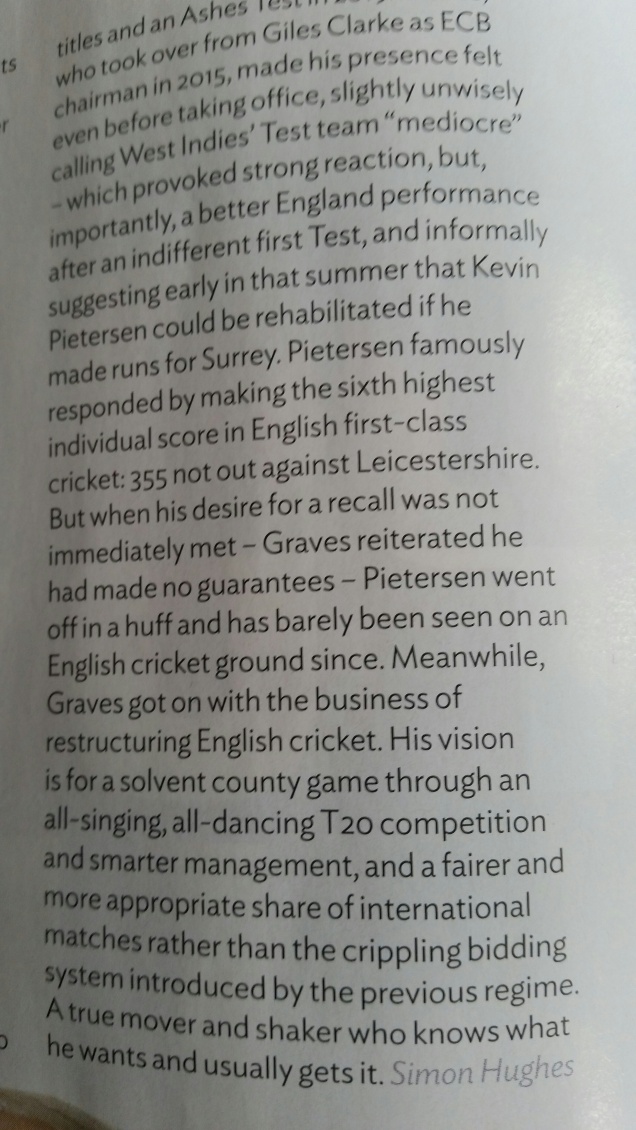
I’m really sorry to do this. But let me just put this excerpt from The Cricketer out there. It’s not a great copy, but it is readable. A piece by Simon Hughes (aka #39).

wp-1472900261863.jpg

News Hughes. We were there. We documented it. We commented it. Don’t lie to us. Don’t omit Strauss. Don’t pretend that this was informal – he gave up money to have a go, and Graves spoke out on the radio – and don’t pretend Pietersen was the author of that sordid episode as the comment “went off in a huff” implies.

This is why I do what I do. I can’t abide this distortion. It treats the public like idiots. This excerpt is from the Power List piece on COLIN GRAVES. This incident made Graves look like an imbecile. Not the most powerful man in cricket. Strauss finished KP’s career, probably in alliance with about three other people. Graves was made to look a clown.

#39 getting high on his own power trip. This is nonsense.

Around The World – Part 2

In part 1 of the World View I looked at the fortunes of the three teams up there with England at the top of the World Rankings. In this part I’ll be looking at those in the mid-division and having a peek at their future series and where they might be going in the next year. This, I must stress, relates to test matches, not other international cricket. It was also written earlier this week, before the conclusion of the South Africa v New Zealand test. Hope you enjoy it.

South Africa

The Proteas were the top dogs of test cricket for quite a while (since 2012?) without ever seeming to have that aura of a dominant team. That was amusing because whichever way you looked at it, the 2-0 win in England to take the top slot was mightily impressive. It is hard to fathom that England have ever been more soundly beaten in a test match at home as they were at The Oval in 2012. South Africa’s reign at the top was assisted by the fact they rarely lost away from home, so that when they did lose at home, as they did to Australia in 2014, the away wins kept them top (along with the inconsistency of all the other nations).

P1000684-01

The South Africans fortunes have waned recently, culminating in a horror winter of 2015/16 when they lost at home to England and were thrashed in India on what one might call some interesting surfaces. As they did so their cracks became clear. The first is at the top of the order. Walking into an England series with Elgar and Van Zyl looked like it was asking for trouble. Elgar is a solid citizen, and played well for a century in Durban, but he’s no Smith or Gibbs. Van Zyl was a middle order test player stuck up the order and did not produce. The middle order solidity of Amla, Du PLessis and DeVilliers let them down in the two series, and when that was breached, problems in other areas got exposes. DeVilliers in particular is sending out warning signals about his workload that some Saffer fans are not too happy about. DuPlessis did not score as heavily and his average dropped down to the low 40s. Amla cannot go on forever. Cook coming into the top order (some saying long after he should have been) added some strength and Bavuma has a lot of promise, but this doesn’t strike you as World Number One batting. What they seriously must hope is that Quentin de Kock is going to work as an opener. He’s great to watch in the one day matches and the South Africans would love to see him do that for them. He’s opened in this recent match, made an 80, but you suspect this is a Hales like experiment. Probably doomed to fail.

Where the cracks are really showing is in the Proteas’ main strength; their seam bowling attack. They simply can’t get their top four pacemen fit at the same time. Imagine an attack of Steyn, Morkel, Rabada and Philander in England next Summer? That is all we will do because Steyn is breaking down more than a 40 year old Trabant, Morkel is rickety, Philander has been out for quite a while and only just back, and Rabada is shouldering a large workload. South Africa have little spin threat, although Dane Piedt isn’t bad, but that’s something they are used to. The bowling just below test level is unproven – as it is most everywhere – but this doesn’t seem to be at the depth of England’s for example.

South Africa’s winter is a bitty one. They play this series against New Zealand, and look like they might win the test at Centurion, then play a five game ODI series against Australia at home. They then travel to Australia for a three test series in Perth, Hobart and then a day-nighter at Adelaide. Given Australia’s recent travails in Sri Lanka, that looks a potentially exciting series. Sri Lanka visit South Africa for three tests starting at Port Elizabeth on Boxing Day (followed by Cape Town and Johannesburg).and then a whole host of limited overs bilge. Then South Africa jet off for a series in New Zealand, playing copious amounts of ODIs before settling in to a three test series starting in early March in Dunedin – the other two matches are at Wellington and Hamilton.

With that workload their chances to get to England with the four pace bowlers intact looks limited. 11 test matches I make it, and bundles of hit and giggle. Those people sniping at AB for the workload comments (and yes, that is rich when you make the IPL your be all and end all) may need to revisit it. South Africa are at the crossroads, like so many, with younger players not really establishing themselves in blocks, but with enough green shoots to be tantalising for the future. They need to eke out as much as they can from AB and Amla before they ride off into the sunset. That may not be far away.

Sri Lanka

The legends are bowing out, one by one. Holes in the test team need to be filled. By common consent, from what you read, the authorities running the game in Sri Lanka are beyond the ECB in ridiculousness. There are perennial financial crises. The nation that brought  us Murali, Vaas, Kumar, Mahela, Sanath, Aravinda et al looked firmly on the downslope of their test match fortunes. They seemed the poster children for the travails of the test game worldwide. They played a frankly miserable series in early summer England (and I use the word summer with due poetic licence) where they lost 2-0, may well have lost the final one but for rain, and all seemed doom and gloom.

Then Australia visited Sri Lanka and all hell broke loose. Suddenly, a month later, they had whitewashed the supposed World Numbe One team (and when have we ever seen a number one team thrashed like that in Asia. That never happens) despite batting weaknessess that have been opened up wherever they go.

The reasons for the Sri Lankan demise, if that is what it is, is that maybe in this modern era of test cricket, having oven ready longform players is not going to be the norm. These players are going to take time to adjust, to gel, to form decent careers. In many ways this means selectors and senior pros are going to need to take time and not a little skill to identify who the top prospects are. Sometimes they will thrill you, play the innings of their life and give you a glimpse of their ceiling, but that is just what it is, a glimpse. We’re not talking about a James Vince cover drive in a dashing 30, but a matchwinning, Mark Butcher 173-esque zone of a lifetime knock. A Chandimal. A Kusal Mendis. A Dananjaya De Silva.

For Chandimal, who also keeps wicket, that’s not such an issue, but Kusal and Dananjaya have given us a tempting look at the future. All around there is uncertainy, save for the trojan captain Angelo Mathews, who can’t go on forever. The fleeting sights of a Karunaratne ton are outweighed by maddening inconsistency. Kaushal Silva shows flashes of brilliance. There seems no shortage of those flashing lights, but they aren’t as world savvy as their predecessors, and aren’t coming into a team protected by the genius bowling of Murali. And while Herath is a lovely bowler, a joy to watch, and of full of width as your author (actually, I wish), he isn’t Murali and we can never hope to see another.

That 3-0 win was a shot in the arm for test cricket. In each test they won the scraps. When it got tight, they got out of it. In each match they exposed the visitors’ weaknesses and held sway. In doing so they threw Australia into crisis. The spin bowling was brilliant, and although the seam bowling, despite Sanath’s cries, is not the best in the world, it has enough going for it. Will it be worldly wise enough to carry them through the next few years? Only time will tell. But watching Sri Lanka will be fascinating going forward. I think they are the bellwether for tests (along with the West Indies). When Sri Lanka’s production line is strong, then there’s warmth in my heart for tests.

This winter Sri Lanka seem to have no test cricket until December when they travel to South Africa for the three tests mentioned above. They outstrip England for a stupid tour (our’s to the West Indies for 3 ODIs) with one to Australia for three T20 internationals in February. And that is it. There is nothing on Cricinfo suggesting they will be going anywhere else. Are they going to Zimbabwe? Their future tour programme shows a massive blank up until five tests at home after the Champions Trophy (2 v Zimbabwe, yeah right, and 3 v India).

So how can you develop with a patchy program like this? So those that shout from the rooftops that Sri Lanka’s win against Australia vindicates test cricket, should look at the bigger picture and wonder why they are spread so thin this winter? Sri Lanka are one of those teams to nurture, not shun. We won’t be any further forward in knowing what we have in 9 months. Staying strong in South Africa would be an achievement, and then…. we may have quite a wait.

New Zealand

With those two series defeats, home and away, against Australia, together with the retirement of their talisman, Brendon McCullum, it really looks like an end of an era for New Zealand. Such as it was. The most patronised of international cricket teams might still be ultra competitive in the shorter forms with their explosive, brutal batting, but in tests the flaws are too great for them to march forward, and you don’t sense a production line of Kane Williamsons are there to keep them afloat.

The upcoming winter, if you include this series, sees New Zealand play 12 test matches, which is a considerable number compared to recent years and probably going to test them well. Two in South Africa, (well one given what happened in Durban) is followed by a series in India with three tests (see India section in previous post for venues). Then New Zealand host Pakistan in a two test series, have South Africa at home in three, and according to the FTP, Bangladesh visit as well with two tests in Wellington and Christchurch in January.

Of course, as English-centric as we are, we can only refer back to the last series between our two teams as a marker. Some have claimed it to be the most important series of test cricket played in recent years, which is lachrymose nonsense. It was a two test series contested between two evenly matched teams, and the cricket reached very good quality at times. It produced excellent performances, and it also contained some absolute nonsense (Day 4 at Headingley again…). The key message should have been that a two test abomination at the start of a summer treated a good team with contempt. Instead it was Stokes and Cook.

So what do we have with New Zealand now? In common with pretty much all test teams (India aside?) there are problems with openers. Latham and Guptill don’t seem to be that secure but they don’t appear as though they are going to be left out. The replacement is Rutherford, I presume. The next two batsmen are plenty solid enough – Kane Williamson is in the top echelon of players, and as I write he’s the only one not falling apart against South Africa. Ross Taylor has had some top innings in the past year, and is a major player. After that we have promising players, unproven players and insecurity. That is except BJ Watling, who is one of the most unsung cricketers I’ve ever seen. I’m a huge fan, and it is always a sense of consternation to me that his innings at Headingley is hardly ever mentioned. He’s a total pest to shake off when he is in.

Then there is the bowling. Trent Boult and Tim Southee are a good opening pair, and there is back up in the seam department with Wagner, Bracewell, Henry and Milne. The spin bowling is taken care of by Santner at the moment, but like many others, the lack of mystery spin, or even a Swann-type hinders many teams these days. New Zealand are no exception. Will we have any more idea where New Zealand will be in the next 12 months? There is a feeling of a slightly managed decline, with the odd top performance being countered by continued problems against foes they struggle against. Pakistan at home for two games, and South Africa for three look to set the tone for the next couple of years.

————————————————————

The Final Part will be around in a week or so, dealing with West Indies, Bangladesh and England. Zimbabwe? Why bother? Who knows when they play?

England v Pakistan – ODI #3 – Preview and Comments

Now. I’d be lying if I said I was looking forward to tomorrow’s game with the excitement of a child on Christmas morning. I’d be lying if I said this was the number one thing on my agenda tomorrow. I’d be lying if I said this series had gripped me by my lapels, shaking my pent up excitement like a pair of maracas. The first two games have been unutterably dull.

This may be the case of after the Lord Mayor’s Show, given the excitement and verve of the recent test series. It might be that Pakistan are outmatched with a dodgy batting line-up, while England have a murderers row all the way down to Adil Rashid at number 10. The bowling is more even, but England haven’t had massive chases to test how much the visitors might bend. It’s been routine so far, and that’s not what we like to see. ODIs need the touch of the extraordinary or they become extra ordinary. A bad ODI, an uncompetitive one where the first score is low is no recipe for future enjoyment. I sat through Saturday’s game and I was phenomenally bored. I fell asleep for 45 minutes during our chase – part older age, part not caring as much, part the dullness of the game.

This much is true. (cue Spandau Ballet) 18 months ago we were garbage at ODI cricket. Absolute unmitigated rubbish. Now we (I) get bored when we win routine matches. Yes, I sound like an entitled Manchester United fan fed up that we aren’t winning in style. I get this. Except there’s not a lot of fandom, other than dearly hoping Jason Roy or Jos Buttler go off. I don’t mind Hales or Root play very well either. Less enamoured of Morgan, ever since the “that’s from me” macho bullshit, and Stokes really needs to justify his white ball place with performances rather than “I want to bowl because I’m bored” stuff, even if that was tongue in cheek. This isn’t unconditional fandom at all. But you knew that!

Tomorrow the match takes place at Trent Bridge. A couple of months ago there was a thrilling game where England got out of jail with a tie when Liam Plunkett hit the last ball for six. It was the sort of ODI that gets your attention. England, through Buttler and most notably Woakes, gave us a thin chance, and then got the rewards. Last year New Zealand made 349 and England chased them down with six overs, yes six, remaining. Eoin Morgan made 113, and yet not much more than a year later there are whispers that he should not be in the team, He made a half century on Saturday, so maybe that clamour has receded. Just mentioning those two matches show how the landscape has changed, and probably why the last two matches have been dull in comparison.

In my opinion, and I said it on Saturday, Joe Root should be given a couple of weeks off. He plays all three formats, has hardly had a break, and got a knock on Saturday. We do push our players to extremes at times, and I think he’s earned a break. No doubt Joe won’t want one, and no doubt the medical and management staff know better. But it looks to me as if there is no harm in doing so. Maybe, if we clinch the ODI series tomorrow, we can take a more pragmatic line, whether we are placing equal weight on ODIs and tests or not. It’s not as if there isn’t some exciting young talent behind the scenes. Duckett, Billings, Bell-Drummond et al. I know we are building a solid team for the Champions Trophy next year, but health has to come into it.

Comments on the game below. Come on now, you WILL enjoy it.

As a reminder, it’s 12-8 in the Super Series.

DID YOU KNOW? Kevin Pietersen played 5 ODIs at Trent Bridge, but batted just twice? 41* and 0. Why now? Just trailing the upcoming look at his test hundreds

Kevin Pietersen – The Test Hundreds

australia-2006-sim-1-305-02.jpeg.jpeg

A while ago, a good year or so probably, in one of our editorial meetings Chris and I were pontificating – because we pontificate well – as to what we could do for future pieces. I mentioned that although a massive fan of all that KP did for England (well, nearly all), it’s got to the point where the very mention of him has some of our supposed cricket lovers rolling their eyes, but that there were things that I would like to do around his career and put up as posts.

Chris, in his sage like way – because he sages well, a Yoda figure – said something along the lines of “you should write a series of articles on his great innings for England” but advised I should leave it “for a bit”. We discussed about how his innings impacted on English cricket, the important moments, the approach, and that I should do something in the vein of the piece I did on Thorpe’s centuries.

The thing is, I have nearly all of KP’s centuries on DVD. In either highlight form or in the case of two of his Ashes tons, in full. A number of them are also on youtube. So there’s plenty to look at and review in terms of material. Then there are the books written around the time of some of them, including KP’s tomes, varying as they are in usefulness for the purposes of this set of pieces (Glenn McGrath, on a speed read of his book, barely mentions the 2005 Ashes!). But throughout the review of the hundreds there’s nearly always that sense of utter brilliance that was, by pretty much common consent of all his peers in the team, beyond their comprehension.

Good friends of mine, who’ve known me decades, cannot understand why I am such a fan of Pietersen’s. He seems, in their eyes, to embody all I hate in sport. The flashness, the assuredness, the flamboyance, the appearance of I above Us. But I’m not sure that’s necessarily true. It can’t be abrasive characters because I’ve always sort of liked Nick Faldo. It can’t be talented geniuses who rub team mates up the wrong way because I love Brian Lara. I think they reference across to my “hatred” of Manchester United and especially David Beckham, but that was because I hated (and still do) United and he was the epitome of why. Pietersen was playing for my team, and in fact Beckham, post United was nowhere near as loathed when he played away from United and was a key player for England.

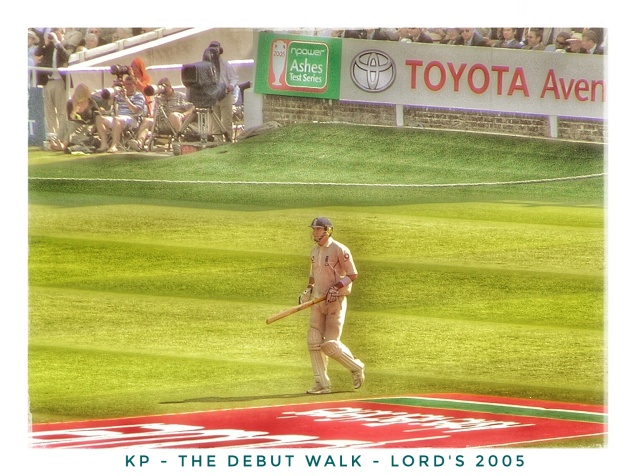
So for this series of pieces, which will take some time, and I may never finish, I’m going to look at all KP’s test hundreds. I may take one in one piece, may couple some together (going to struggle with that one to set up a declaration in the West Indies), but I’ll do it looking at the footage I have and discussing each one. Of course, that means the first is the 158 at The Oval in 2005, and books could be written on that one alone. As always, I’ll intersperse these pieces with personal recollections, photos if I have them (I saw three in the flesh, and the start of a fourth) and anything else that comes to mind. Pietersen is a divisive figure, putting it mildly, but it is because of what we saw, and how he did it, that makes those of us who were furious at the end of his England career how we are. How can you not want to see him do “this” again?

So…Part 1 – Century #1 v Australia at The Oval – September 2005… Coming Soon. But in the meantime, let’s get the introductory part to prepare for it.

cropped-australia-2006-sim-3-384-02.jpeg

To go into the story of the 158, you probably have to go back a long way to the way Pietersen’s career unfolded. But I’ll spare you the county details which you can read in Paul Newman’s ghost-written autobiography of Kevin Pietersen which came out soon after the Ashes victory. Instead the true beginnings were in Zimbabwe, at the tail end of 2004. All through that summer I recalled that Kevin Pietersen’s name was in contention for the A team, unconstrained by full country qualification requirements, and he’s played his part in a massive England A innings in India that also ended in a massive run chase by the home team to win the game. I’d seen Pietersen play at Whitgift School for Nottinghamshire against Surrey, and although remembered some clumps to leg, and a couple of big shots, I also recall falling asleep on the grass bank! That game pre-dated my Olympus Ultra-Zoom camera so no shots of the man from them.

Pietersen was picked for the Zimbabwe ODI tour which attracted, shall we say, a fair bit of controversy. I think, and I could be corrected here, that it was the last international tour not covered at all on live television in this country. So what came back were news reports and scorecards. In his debut he made 27 not out to steer England home to a relatively small total with a couple of overs to spare. Ian Bell had made his ODI debut too, and done very well, making 75, whereas the only report I could find on KP’s debut was:

Pietersen eventually hit the winning runs, but not before running out Collingwood and twice almost doing the same to Jones.

Some might say there was a warning right there. The second ODI, also in Harare, saw KP deliver a more substantial return. He made 77 not out in 76 balls, including three sixes, to get England to a very competitive 263 – he and Geraint Jones put on 120 in 13 overs and put the game out of the hosts reach.

Pietersen and Jones hit maiden one-day international half-centuries in a rollicking stand of 120 off 80 balls, which stood for four days as an England record for the sixth wicket against any opposition. Pietersen’s innings had the air of an announcement. Arriving in the 26th over with England stuttering on 94 for three, he was initially studious, taking 40 balls over his first 16 runs, before opening up to finish with 77 from 76, including four fours and three sixes.

As the Almanack expressed this as an “announcement”, the thought that KP might actually play for England in the next Ashes probably seemed fanciful. But Vaughan was beginning to be convinced, and maybe this is in hindsight, he thought KP had that “something” that was different. In the Third ODI, Pietersen wasn’t needed as a century from Solanki and 50s from Bell and Vaughan meant England chased down a total for the loss of two wickets. Game 4, also in Bulawayo (where the 3rd was played) saw KP get a first ball duck. But he’d done enough to convince the selectors he was worth a go for the ODI series in South Africa, and we pretty much all know what happened then.

That series, where Pietersen made three centuries (although none in a winning cause) ranging from the bravado of Bloemfontein, where one might say he went a little over the top in celebrating, to the rapid but ultimately fruitless explosion at East London, and the worthy but let down by his team mates 116 at Centurion. Pietersen had proved a point, and none more so than his international TV debut at Johannesburg where he confronted the hostility of a crowd and an opponent he had riled, stared them down, and held firm to assist a D/L win.

Nobody seemed happier than Pietersen, who was there at the end after being loudly booed while walking out for his first innings against South Africa, the country he abandoned in frustration at a perceived lack of opportunities. His initial exchanges with the always theatrical Nel provided the most dramatic moments of the game, with Pietersen struggling nervously for 11 balls before getting off the mark.

Pietersen weathered a hostile reception from the crowd, and the odd word from the fielders. After a nervous start – he played and missed at his first ball, at Nel – he proved a worthy replacement for Strauss, as he and Vaughan moved seamlessly through the gears. Vaughan brought up their fifty partnership from 73 balls with a forceful cover-driven four, while Pietersen’s thumping on-drive took England past 100.

The centuries and the attitude that was reported to come with it seemed to indicate a coming force, and conjecture already surrounded how he could be fitted in to the test team. Michael Vaughan claims that his mind was made up that in some way he had to be selected for the Ashes. A lot of weight was being put on whether you had “mental scars” from too many Ashes beatings. Here was a man, unburdened by history, it seemed, fearless and relentless. It seemed too good to be true. It probably was.

Seasoned cricket fans on this blog need few reminders about the events of early 2005. England’s test team had won in South Africa, without Ian Bell who had made his debut at The Oval against the West Indies the previous year. The England team that finally won in South Africa contained a line-up of Trescothick, Strauss, Key, Vaughan, Thorpe, Flintoff, Jones at the top of the order, and with Freddie being a clear choice at six, the main vacancy appeared to be Key’s. This was despite an impressive innings at The Wanderers, and a double ton in the home series before. Bell was clearly earmarked for three, judging by the press statements (Butcher had been injured in South Africa and never played another test) in advance of the home series against Bangladesh. There seemed little threat to Thorpe, who although creeping on in years, had been a vital cog in the previous series (his century in Durban making the game totally safe in a famous fightback, and also vital in the West Indies the winter before). Whispers started to surround Thorpe. He was too old, too many scars, going to retire soon etc. etc.

Those whispers weren’t made any louder by his form in the Bangladesh series, where I don’t believe he was dismissed, but also got little chance to make an eye-catching hundred, while Bell did at Chester-le-Street. The batting line-up seemed settled then, and in truth there was not a lot of noise for Pietersen. Then came that Sunday afternoon in Bristol.

I was out watching my club side that afternoon (my Mum was in the last throes of her cancer, and I took the chance to meet some friends as a brief release), and so have only seen the very repeated highlights on Sky. The innings that won the game had all the same bravura of South Africa. He dismantled Jason Gillespie in particular, and gave off that self-assured, confident demeanour that would delight and enrage in equal measure. He also had narrow escapes on run outs. But this was totally un-English in its approach. It reminded you of a more developed, more accomplished Ben Hollioake at Lord’s. It wasn’t really true until he did it here. Sure, he had played well in the T20, but this was nearer “proper cricket”. The crescendo grew.

OLYMPUS DIGITAL CAMERA
In action v Australia at The Oval – 12 July 2005

I was at The Oval to see his 70-odd pull England to semi-respectability and it was the second time I’d seen him in the flesh. I really can’t remember a lot. My mum had passed away 11 days before it, and her funeral was the next day. As a release it was great, but as a day’s cricket, Australia’s win passed me by. My mind was more on what would happen the following day, putting the ill-fated eulogy into my head, worrying about my Dad and all that. Compared to the events of the following day, the effects of which persist to this day, seeing a KP 70-odd hardly resonates. But where it did, it mattered. Now the calls for Pietersen to be in the test team were unstoppable. And in the firing line was Graham Thorpe.

Now, as you may know, if you’ve read the blog long enough, Thorpe was/is one of my favourite ever players. His hundred in Barbados in 2004 is still one of the greatest innings I have ever watched for England. When he got to the hundred, that shot of adrenaline, the thing that makes your hair stand up on the back of the neck, was amazing. The ovation at Kensington was incredible. He had fought so hard, and you’d think that fighting that hard would be what was needed against Australia. We thought wrong.

When Pietersen was up for selection there was absolutely no doubt that Ian Bell would play. None. In hindsight we all say “well, he shouldn’t have played instead of Thorpe, it should have been Bell” but that was not on the cards. Thorpe was in danger. Pietersen batted in his position in the side – number 5. Thorpe was the oldest. Thorpe wasn’t mobile in the field. Thorpe had back problems. He looked vulnerable, and when the axe fell, it was on him. He’d just had his 100th test match, and it seemed a neat end. But there still are the pangs of “what if”?

ashes-day-1-21-july-2005-187-02.jpeg.jpeg

I was fortunate enough to be at Days 1 and 3 of the first test match. Again, anyone with a passing interest in cricket does not need a reminder. KP came into bat at 20 for 3, saw two more wickets fall quickly, rebuilt the innings to a degree with Geraint Jones, and make a fifty, including smashing McGrath into the Lord’s Pavilion for 6. In the second innings he made another 50 in a totally hopeless cause, and despite a soul-crushing defeat, loads of dropped catches (although he did effect a run out) and all round feelings of “here we go again”, the man with the mad hairstyle had announced his arrival.

ashes-day-3-23-july-2005-387-02.jpeg.jpeg

The Edgbaston test saw KP play his part in the rollocking 400 in 80 overs first day, with a quickfire 70-odd in concert with Freddie, and then a 20-odd in the second dig. Diminishing returns at Old Trafford, including his first test duck were lost in the tenseness of the test, and he did not pull up any trees at Trent Bridge.

So to the Oval. Here is where we pick up the story of Kevin Pietersen’s test centuries. The next instalment will be along when it is written. Keep your eye out…..

Four Sessions, 30 Degrees, Two Currans, One Sanga

20160823_162609-02.jpeg

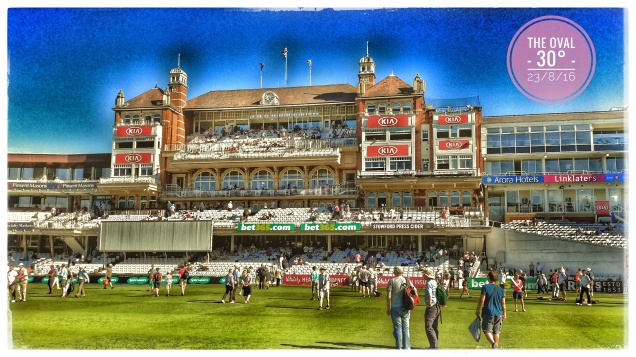
I used to be a Surrey member. I’ve been a supporter since the 1970s, when I followed my deceased grandfather’s teams rather than my Dad’s (Dad was Kent), and thus can’t be accused of the old “bandwagon” tag. But I did become a member for about six years from 2001 onwards, and spent some great days at The Oval, as well as going to Guildford and Whitgift over the years.

I had some leave to take and thought the Lancashire fixture looked like one to be at. For me Surrey v Lancashire will always bring me back to a magnificent tense Day 4 back in 2002, when Ramps took us home against a pretty decent Lancashire attack (Chapple, Flintoff and Hogg). This year’s match saw two teams looking up and down, as the table is very congested in the middle, with only Middlesex, Yorkshire and Nottinghamshire really sure of their fate (safety/relegation). All eyes look at Hampshire and what one win might do to the competition, so although Surrey lay in third place, they had played more and could not afford a slip-up. A win would guarantee survival, more or less.

Continue reading