At the start of the series, a player called Cook scoring a century could have been expected to result in endless articles paying glorious tribute, so it’s an undoubted irony that Stephen, on debut, would be the first Cook to reach three figures. In the way of cricket, there will be celebration at the achievement, and an accusing finger pointed at the selectors for waiting until he was 33 before picking him. In the wider scheme of things, it may yet matter little, but the achievement of a Test century cannot be taken away from him, and perhaps he’ll have that late career opportunity that Chris Rogers took so gleefully with both hands.
That South Africa don’t have another Test for six months may cause a problem with that hope, but in becoming the hundredth player to score a hundred on debut, he has made his mark.
It was a curious sort of day, and the kind that Test cricket is so good at, in that one side was utterly dominant for the first two thirds of the day, only for it to move slightly more back in the balance after tea.
England consistently bowled too short, something they are prone to do to immense frustration all round given how dangerous they look when they bowl a fuller length. Broad was once again the pick of the attack but even he failed to make the most of what movement there was, though he did more with the ball than anyone else by a distance.
In the case of Anderson, he was unthreatening and innocuous. It’s not been a great tour for him, and he’s at the age where the whispers start about a player in decline. Given his record that’s unquestionably premature, for he’s far from the only player to have had a quiet time, notably the captain has too.
Woakes looked tidy and decent, but sooner or later he’s going to have to start taking wickets to justify his place. His batting is certainly decent, and so is his bowling. Test quality? Well perhaps, perhaps not, but in his fifth Test he’s on his fourth spell in the side, which is hardly going to help him settle in.
Moeen just has the knack of taking wickets, and that cannot be overstated, while Stokes keeps threatening to break through with his bowling without yet showing consistency. Patience is a key to all watchers.
At 237-1, South Africa were in total command, so finishing on 329-5 will represent something of a disappointment, and so it should. On a flat surface 400 is a minimum, and while they should do that, England will feel they’ve got away with it today.
They were at least honest enough to admit it wasn’t a great day for them, which in itself is welcome given the days in the past where the approach was not dissimilar to Channel 9 commentators when assessing the chances.
Hashim Amla was again dropped early, and again punished England for it. Amla remains one of the most watchable batsmen in world cricket. Yet the malaise of the captains this series has seamlessly transferred to AB De Villiers who collected another duck.
Day one is always a wait and see day, unless one side or the other has a total catastrophe, and so it is here. But both sides have cause to be relieved and both have cause to be dissatisfied.
Bad news for all you “The Leg Glance” fans out there, as the reins for the 4th Test preview have been handed to me. Yes, one of my alter egos that gets the people to moan, is back. The Twitter Idiot Dmitri Old. If you’ve not seen my poem on trains tonight, well, go and look. The Bogfather liked it. That’s enough for me. TLG is unavailable until much later in the week, so I’m writing the preview. Loads of words, a bit of scorecard nonsense, a plea for realism and I think just the one mention of Kevin Pietersen. That’s progress.
We’ve seen the media in full cry this week. I do believe we were world ranked #6 going into this series so inevitably knocking off the world #1 in their own backyard is sound enough evidence that this is the World’s Best on the brink of something special. Now, as you know, I’m not overly swayed by world rankings, and tend to think of who might come out best on neutral grounds in test matches. So, if England were to play Australia in India for example, who would win? India played Australia in the UAE who would win (or maybe the West Indies)? I think it is fair to say that South Africa got to number 1 because they were the most adaptable side in all conditions. They got stuck into pretty much anyone and didn’t lose. Then that tour of India saw them disintegrate and provided England with an opportunity to hit a side very low on confidence.
That they did, and kept the hammer down speaks volumes for this team, and we can all see the promise. But think of the dominant teams and you think of excellent bowling attacks – and England could provide rivals to the vaunted 2005 attack if only they could all bowl together. It’s as if Stuart needs Jimmy to be absent or off his game to be the king. Stokes has a lot more wickets at this stage of his test career than Freddie for instance. It has immense promise. The batting line-up is deep, allowing numbers 6,7 and 8 to flog tired attacks if the top order does its job. But the achilles heel is the batting. Think of world number 1 teams at their ascendancy. Greenidge, Haynes, Richards, Lloyd; Hayden, Langer, Ponting, Martyn, S. Waugh/Hussey/M.Waugh, Gilchrist; Sehwag, Dravid, Tendulkar, Laxman, Dhoni; Smith, Kallis, Amla, DeVilliers. We have Cook and Root. England’s team that got to world #1 had a fading Strauss, but Cook going well, Bell, Trott, KP. When you look at this team, it’s short there.
This needs to be remembered as we see press people get carried away. I’ve not read BTL, or much of the papers (that site needs updating when I have a few hours) as real life has interjected. But some of the hints on Twitter, the over-burdening of praise, over hyping individuals has been noted on social media. This is an exciting team, I really don’t want people to get the idea that I’m arguing the contrary, but act like we’ve not got ADHD? They’ve won three of their last 8 test series, drawn 1 and lost 4. Perspective is not losing sight of the bigger picture. There are many looking at the upcoming home schedule and thinking that it’s there for us. It could be, but let’s win those matches.
I was also amused at the piece today citing that Stuart Broad is in the top five English bowlers ever. All I’d say about that piece is that no-one would have written it before this test. And that’s not to besmirch Stuart Broad, who can point to the wickets and say, “it’s true.” I hate everything about this rush to hyperbole, and contextualising modern day cricket only. It’s the way the Premier League denies anything before 1992, why any young kid who scores for Man Utd is lauded out of scale etc. I’ll bark at the moon all I want on this one. I do get excited, just not carried away. That’s not the modern way.
So on to the 4th Test in Centurion. We have not lost there, if my memory serves me well. The first tour was the first test ever played on the ground, and Hick made a ton before the rains. The infamous leather jacket test was next, so less said the better. 2005 saw us clinch the series having given us mild palpitations after tea on Day 5, and the last time we visited, we drew with nine down. So the positives are that we go to a venue with a decent record. The flip side is that we don’t seem to finish test series well. Losses in Sharjah, at The Oval, Headingley and Bridgetown this past 10 months are fresh in the memory. Only one of those can be put down to being a “dead rubber” like this.
The hosts appear to be a team in disarray. A captain who seems to be giving out all the signs of jacking it in before he even started, flux at the top, Amla seeming to be not as sure as himself as he used to be, bowling raw or not good enough (or a bit of both) and the fielding surprisingly off. But there’s a palpable sense, from here, of a team lacking belief. Belief in itself, in the future, and with the sport itself. I’m used to South Africans being up for it, playing up their strengths, not approaching a game in fear. They looked a beaten side in Joburg long before the coup de grace was executed by Broad.
This is a big test match for Hales, Compton and Taylor. None have stamped their authority on their place, while all have given great hints as to why they are there. I’m not going to have the obligatory dig at Cook because there’s no point. His stats only matter when he scores runs. Bairstow nailing down the batsman/keeper spot is a bonus, Stokes’s game changing abilities are a rare commodity and we should be keen to accentuate the positive – I’m not sure we’ve really come to terms with the 258. I suppose Woakes will be in for the injured Finn to cement his status as “next taxi on the rank”.
OK, I’ve meandered enough. Comments for Day 1 will be in a separate thread, but until then, have a great rest of the week.
The series win was clinched yesterday and it’s one to savour. Since readmission we’ve won one series at home and two away against South Africa, and while we can get the feeling that we are beating a side on the way down, it’s also a salient point to remember that in 2005 we were thinking much the same thing. A number of us on this blog remember that 2004/5 series win as probably one of the greatest away wins England had, and we aren’t wrong. But there were also some similarities as well.
Any victory, in fact any tour result, has an obvious series to compare it to. 2005 Ashes had 1981, the whitewash of 2013-14 had the whitewash of 2006-7, every dominant Aussie side will be compared to the number 1 team of the late 90s, early 2000s. England’s series win here will be compared to 2004/5, so let’s do some of that now. I’m going purely on memory of 2004/5, so any errors, please let me know.
Going into that tour England had had an amazing 2004 – they’d won all but one test match they played, and that was due to playing against Brian Lara on the Antiguan equivalent of Heathrow Airport’s main runway. Some of these wins came from blowing the oppo away, but many came from gritty batting displays chasing down some very itchy totals – I’m thinking New Zealand at Lord’s (the Nasser farewell), New Zealand at Trent Bridge (all hail Thorpe) and West Indies at a very gloomy Old Trafford (a grossly unfairly forgotten knock by Rob Key). During that spell we’d drafted a new opener (Strauss) who had settled in well, and a new keeper (Jones) who made a ton in his third test. The bowling was gelling as a unit, without Simon Jones, but with Hoggard, Harmison, Flintoff and Giles. The batting was solid, Strauss, Tres, Butcher/Key, Vaughan, Thorpe, with Ian Bell waiting in the wings. The focus was on 2005, and the Ashes. This was our chance. But in the way, and as it turned out, how great it was that it was, was a tour to South Africa.
Readers will know that I went to the Cape Town test, and also two days of the Jo’burg match on that tour. You may also know that by pure chance we booked into the Guest House run by the former manager of the South African cricket team who had just recently been reassigned when the Board sacked coach Eric Symons and installed Ray Jennings. This was also the time when the South Africans had a right downer on Mark Boucher. On our first full day in the country the hosts arranged for a friend to take us round the Cape Coast, and it turned out he was a retired sports journalist. We’ll always remember (I went with Sir Peter) his rationale for the exclusion of Boucher (“the board hate him. I hate him. He suffers from “little man syndrome”).
At this stage the home side were 1-0 down and had just narrowly avoided it being 2-0. The first test at Port Elizabeth was a triumph for Andrew Strauss, who made a ton in the first innings and an unbeaten 90-odd to see us home in the second innings. It was a top test match, as the game ebbed and flowed, and it also saw two reasonably decent players make their debuts, AB de Villiers and Dale Steyn. I think it fair to say we were far more impressed by the latter at the time. That team looked unbalanced, with Tsolokile keeping wicket, new players, and confused selection. The coach had come over as some sort of boot camp sergeant (infamously pinging a ball of Smith’s head in catching practice in Joburg) lacking any degree of sophistication.
The second test in Durban was one of those “stake in the ground” matches for England which made you utterly proud of them. The first two days could hardly have gone worse. Put in on a helpful wicket, England were skittled in the first innings for 139 and then felt the brilliance of Kallis who made a brilliant 162 and put the hosts nearly 200 in front. Three days left and the situation looked bleak. England did not wilt. They erased the deficit for no loss, piled on 570 for 7 declared and gave themselves time to bowl South Africa out. The hosts were clinging on (just as Sir Peter and I were venturing out for a beer in Cape Town – we were successful in our pursuit) and arguably were saved by the bad light.
The third test, in Cape Town, was a wake up call. England conceded 400+ in the first innings, fell foul of Charl Langeveldt on debut by collapsing in the reply, with the hosts putting on the required runs in enough time to give them to bowl us out for a second time. The game was sealed mid-way through Day 5, giving us enough time to belt up Table Mountain before our flight out the following day.
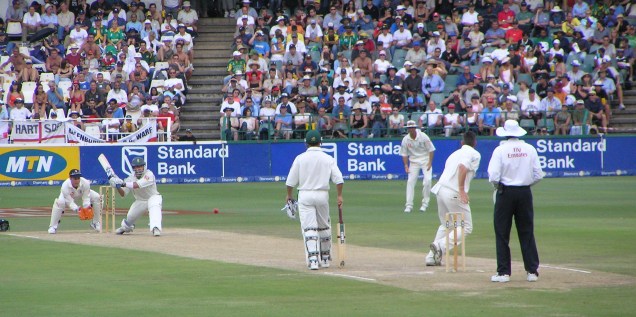
Herschelle Gibbs about to sweep and bring up his century – Joburg 2005 (c) DmitriPics
The Joburg test was one of those seminal moments for that team. A great first day (when we were driving down from Hluhluwe to catch our flight from Durban for Day 2) by England was eagerly taken in on the radio and the airport TV, but as we were in the air Strauss got out for his third hundred of the tour, Key was dismissed for 80 odd, and Thorpe a duck. It wasn’t so great. Nor was the weather in Joburg on Day 2, but there was enough play to see Vaughan regain some nick and he and Harmison put the hosts through the wringer before Bucknor took everyone off for bad light. England had over 400, declared overnight, and a lovely sunny Day 3, spent sitting next to Kevin Whateley while not uttering a word to him, saw Herschelle Gibbs make a century, and South Africa claw their way back into the game. We flew home that night. What followed was possibly Tres’s greatest knock for England, and then possibly Hoggy’s greatest spell of bowling. With time running out England knocked over the hosts and took a 2-1 lead.
Centurion was blighted by weather, saw AB make his first test hundred (having got out in the 90s in the first innings), Kallis make his third of the series in mystifyingly slow circumstances, and England wobbling in a nervy last session. There wasn’t really a doubt, but we’d suffered enough in the past to have it in our minds that it was. But even in that test there was confused thinking from the hosts. DeVilliers opened with Gibbs with Smith batting at 5! Seems odd to think that now, doesn’t it?
So, using this as a tenuous reference point, what are the similarities. Well, there was a feeling that England were on the up, with a team coming together. The batting had largely held up, but we knew Thorpe was nearing the end and the assumption was that Bell would come in. Butcher had played his last test, although we didn’t know that at the time, and I’m not sure Key ever played again, either. We know who came in for that slot, and we were a matter of days from hearing the name that partially dominated the newsline for the next decade. Our bowling was solid as a rock, even allowing for Jones not quite nailing it and Anderson having a bad time at Joburg.Harmison didn’t have a great tour, but then we won without our main bowler having an impact. Broad went into this series as Anderson’s oppo. Now he’s on top of the pile.
Jones was a concern at keeper as he had developed a habit of going for pretty much all that was heading for first slip and not nailing it. Bairstow finds himself a bit more advanced on the batting front but with still major keeping concerns.
We encountered a South Africa unsure of themselves and it permeated the team. Van Jaarsveld had a decent second test, playing a big role in saving the game, and was bunted out straight away and turned into the Surrey-killing Kolpak. Tsolokile was keeper for one test, then it was AB, then Boucher. Openers were changed. Pollock wasn’t long from the end of his career. South Africa had a Nathan Lyon complex over Nicky Boje. But they also had two gun young players in their midst – Steyn and AB and that meant hope sprung eternal. Also in that series we saw Amla. This Hashim Amla was a walking wicket, a man no-one feared. Stick with someone and you never know what you might have might be the mantra.
For AB and Steyn the hosts must be hoping Bavuma and Rabada are somewhere in the same zipcode. Can you rely on that and also, there are othere ageing players in that line-up too. But all the comments I’m seeing on the future for the South Africans are grim. When your not quite made it test players can go back to first class cricket and immediately dominate, it does not look great. A number subscribe to the “cyclical nature” of cricket but that’s not happened for the West Indies, is not looking likely for Sri Lanka, and who is to say Pakistan will continue to churn out talent? The noises around AB, that has inspired huge discomfort from the Saffers I come across on Twitter, have not eased anyone’s soul. There’s a lot of discontent that AB took his first captaincy press conference to pour cold water on the future spoke volumes. It may not be the cause, but the effect is that if you feel your leader’s heart isn’t 100% in it, then nor should your’s – even sub-consciously. South Africa have been under the leadership of two players who don’t really exude commitment to being the main man. The fish rots from the head.
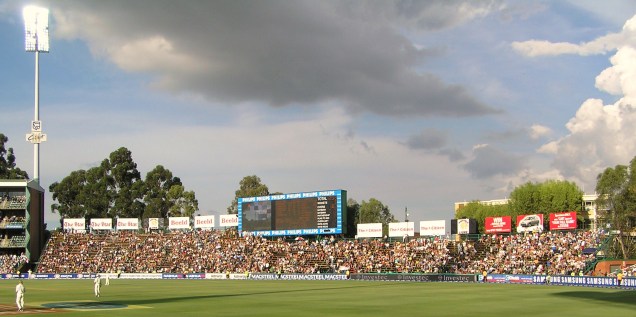
Leaving The Wanderers – 2005
For England this is a great win. Let’s not get churlish about this from the team’s standpoint. Durban was won due to important batting contributions from Compton and Taylor, not our usual old faithfuls. It was won without Anderson. Then there was Stokes and Bairstow at CT, and then two of our old reliables, Broad and Root in Joburg. The batting isn’t world number 1 class, it just isn’t making the runs across the board, the opening slot is a mess, the number 3 in flux, Taylor hasn’t nailed down five (nor is he letting us down) and it’s because the batting has depth down, arguably, to nine, that this is not as crucial. While 2-0 in South Africa is a tremendous result, it doesn’t, for example mean 2-0 in UAE should be ignored, not with the challenges of India this winter on the horizon. This is the World #1 opposition in name only, and a #1 in flux and down in the mouth. We did what we should do. Beat a team in that shape, and make it worse.
Just for laughs, I thought I’d pick a composite team of the two from those winning squads. I bet this will go down well.
Whatever was expected for day three, it wasn’t this. England grabbed the moment, and with it the match and the series. The headlines will be all about Stuart Broad, and so they should be. For he has now taken 5 wickets in a bowling spell seven times in his career, which is remarkable. I was fortunate enough to see the first “Stuart Broad Day” back in 2009 when he ripped through the Australian batting order to effectively win the Ashes back for England, and there’s something about him when he gets going that makes him irresistible, he goes through batsmen like a knife through butter.
Broad is one of those players who seems to attract as much criticism as praise, and he’s not even close to being one of the best loved of England cricketers. His demeanour over the years has sometimes irked people, and his tendency to blow hot and cold has often frustrated – as tends to be the case with explosive players, some remember the bad times rather more than the good. The same applied to Kevin Pietersen of course, where some would choose to deny the match winning performances and point to the failures, as if that meant anything. Those who make the game look easy at times are cursed to be berated for not producing excellence on every occasion. Yet Broad’s overall record as a bowler is now a genuinely fine one. He didn’t have a great start, and his bowling average didn’t dip permanently below 40 until his 21st Test, and only went below 30 after 76 matches. And yet that average continues to fall and is now at 28.54, which is more than respectable.
Nor is this just a golden spell for him, for his bowling average over the last five years is 25.67, and over the last two it is 23.97. This suggests not only a player who is of Test class which has been apparent for years, but one who is now world class. He should now be at his peak, and James Anderson may well be nervously looking over his shoulder as the England record wicket taker, for over the last year or so Broad is just beginning to reel him in.
England have been on the receiving end of games like this often enough, where the team becomes crippled by uncertainty, unable to score, and reduced to resembling startled rabbits, transfixed in the headlights of a rampaging bowler. And yet few of his wickets were batting errors, they were instead outstanding bowling. He won the man of the match award for it, and although some felt Joe Root’s hundred the greater contribution, it was Broad who created the result, and perhaps given the name of the award, that is the right approach to it.
South Africa are unquestionably a team in transition, the loss of their great players to retirement and the absence of Steyn and Philander through injury have reduced them to a shadow of the outfit that reached number one status in Tests, but both age and injury are facts of sporting life, and it’s never been an excuse when England have lost, so nor should it be now. However, there is a strong sense that these are two sides heading in opposite directions. If this is purely a cricketing circumstance, then for the English it would be a reason for celebration; this England side is one that is full of verve and vigour, playing an attacking and incisive style, and responding to adversity by going after the opposition. There is much to like about them.
The trouble is that with Test cricket in the state it is, any pleasure from it has to be tempered with real concern about the future. The ICC stitch up with the resulting loss in relative income means that the potential for South Africa to lose their best players to T20 wealth is high, and if that is so, then building another fine side could prove beyond them. For the point about Test cricket is that to take the maximum pleasure from your own side winning so handsomely, it must be in the knowledge that in future the tables will be turned. That is after all why the English and Australians gleefully tease the other, because they know next time they’ll get it back to the same extent. Success is only special when failure is an option.
England’s win means that South Africa are dethroned as the side at the top of the ICC rankings. India for now take over, with Australia in second place. England may well be currently fifth, but with home series against Sri Lanka and Pakistan to come, are more than likely to move up the table quite quickly. In short order the top three Test sides will almost certainly be India, Australia and England. Quite the coincidence.
With that proviso, it remains an outstanding feat to win the series, for since being accepted back into international cricket, Australia and England are the only sides to have won series there. That is perhaps not so surprising as it might seem, for South African conditions are entirely alien to all other sides bar perhaps New Zealand, who you wouldn’t expect to win there often if at all. Yet those predicting a healthy England win before the series were considered outliers, and understandably so. England have unquestionably exceeded expectations, the younger players have brought verve and joie de vivre, and the side appears a very different one to the nervous, hidebound and risk-averse outfit under late era Flower and Moores.
Which means praise for Trevor Bayliss and Paul Farbrace in particular – and indeed Andrew Strauss for appointing the former and backing the latter. Good decisions should always be acknowledged, in the same way that bad ones should never be brushed under the carpet. The style of Bayliss and Farbrace appears to be to remain in the background, encourage the players to express themselves, ensure the captain runs the side rather than being a cipher for the backroom staff, and to play attacking cricket wherever possible. What sets them apart is that so far they’ve actually done it, for every coach says these things, but they have managed the ultimate coaching trick of getting out of the way. Cricket is not football, and prescriptive management isn’t going to work. Being a support and an adviser is, and early stages though it might be, the signs are excellent.
England aren’t a very good side just yet. But they might become one. From the depths of disaster, largely self-inflicted, that’s considerable progress.
In the world of Formula One racing it’s been said that in order to make the sport exciting, just add water. And so it is with cricket, though adding water isn’t a great idea. Instead, add a pitch that has some pace and bounce to it, where bowlers feel they are in with a chance, and good batsmen can play shots and score centuries if they play well. Quite simply, it makes for better, more exciting cricket. The trouble is, a surface like this tends to be exception rather than the norm, with a tendency towards slow, turgid pitches that can be nigh on guaranteed to last into a fifth day and thus make more money for grounds and boards.
It’s a quite astoundingly short sighted view, for endless slow pitches just make for boring cricket, as fast bowlers end up on their knees from the exertion of trying to extract something, while batsmen find playing shots difficult and merely accumulate. The result is slow scoring, few wickets and a crowd who have either drifted off to sleep or haven’t bothered to turn up in the first place.
Of course, cricket needs to be played in all conditions, and home advantage should be just that. And the domestic cricket played on the pitches the domestic structure creates informs the strengths of the home side. Yet when Test cricket is in dire need of support from its boards – and the suspicion is they couldn’t care less about Test cricket because it doesn’t make them money – the refusal to comprehend what is right in front of them is part of the damage being done. Of course, the disparity in incomes, both for players not from the Big Three countries, and their respective boards is the biggest factor in the current swathe of articles about the danger the game is in, but it’s not just that – or rather there’s a corollary point that’s related to it.
It all comes back to money and to power. The crisis in Test cricket due to the land-grab by India, England and Australia has finally got the attention of at least some of the newspapers. These are the papers who generally ignored the whole matter with the odd honourable exception who pointed out what the likely impact was. Those terrible bloggers added their voices to the writers retaining their integrity and lambasted the others for their ignorance or lack of interest (or both in at least one case). Perhaps we should be grateful they’ve noticed at all, certainly the British newspapers managed to pretend Death of a Gentleman didn’t exist. And given the wider issue and the importance of it to a game we love, it is better late than never. Just. But if they have noticed the trouble Tests are in, they still haven’t joined up all the dots. Chairman’s Pitches are part of the same equation; the players certainly don’t love them, on the few occasions they can be persuaded to venture a real opinion (the deliciously outspoken Moeen Ali apart ) the one thing they will loudly criticise are pitches that have nothing in them.
The ball is also part of that. It really doesn’t matter whether the ball is a Duke, a Kookaburra or an SG, it just needs to last long enough to keep the bowlers in the game and not become a rag after 15 overs. The pitch and the ball are clearly critical, and get those right and we at least have a sport that is worth watching.
The best, most exciting Test matches tend to be the ones that don’t go the distance. In fact in some instances they are done and dusted in three days or even less, which is a disaster if that’s due to one-sidedness, thrilling if it’s a proper fight. Nor is it about rapid scoring or wicket-taking per se, for a slow but tense passage of play can be the most exciting of all. Test cricket might be considered the purist’s version of the sport, but the attractiveness of T20 stems partly from the fact there is plenty of action. In Tests, cricket with uncertainty, whether with bat or ball, is very watchable cricket. And very sellable cricket. And very broadcastable cricket. It’s not bloody complicated.
And so the groundsman at the Wanderers deserves immense credit; it’s not an exact science, and wickets can sometimes perform in a manner that leaves the ground staff tearing out their hair. That’s a given, it can happen. But the intent has to be there, as it is in Johannesburg and as it all too often isn’t in England. And this is still trying to make use of home advantage, for a bouncy, pacy track is one where South Africa unquestionably fancy their chances of a win. Not a thing wrong with that either, no matter how much certain hypocritical Australians might bleat about it.
And so this game has see-sawed, from South Africa throwing away a decent position on day one only to roar back with late runs, positively made, and then to leave England in trouble before Stokes and especially Root dragged England back into a position of parity. We’re at the end of day two and we don’t know where this Test is going, except to say there will probably be a result. This is perfect, this is Test cricket as it should be, where a cricket lover can’t take his or her eyes off the screen because something is going to happen. You don’t know what, and you don’t know who – but something is.
The South African total of 313 is in that sweet spot where there is uncertainty as to whether it is a good one or not. It’s one the home team will probably be fairly satisfied with, and has the notable record of being the highest Test total where no one has made a half century. And when England were 22-2 and 91-4 they would have been ecstatic with it, and confident of a first innings lead of some size. That this is now in question – and England really should reach parity at the least – is largely to do with one partnership that bounced along at seven an over. Stokes of course was Stokes, a player who is lethally dangerous with the bat, and able to take a match away from the opposition in a session. But Joe Root was the central figure, making his ninth Test century in a career that is rapidly flowering to be very special indeed.
Root has looked in form all series, making good contributions before getting out when set, to his clear frustration. He’s now far enough into his career that we can start making proper judgements about him. He’s had the poor run of form and come out the other side grinning – as he does a lot. We may have someone truly special on our hands. If he stays in any length of time on day three, South Africa are in trouble. It’s quite striking how he seems to get to 30 without anyone noticing; he scores his runs at a fair lick without ever seeming to really attack; it’s his ability to find gaps for singles and twos that marks him out, for he doesn’t have an obviously rock solid technique defensively. He can be caught on the crease, he can be lured into playing away from his body, and early on the slip cordon will be licking their lips. But when he gets in, and when he gets going, he’s a joy to watch.
Alastair Cook was again caught down the legside cheaply. It’s clearly an opposition tactic and a technical problem for him, where he is too far over to the offside and playing the ball outside the line of his body. He has had a poor series with the bat to date. Let’s be clear about this, batsmen can have poor series, they can be slightly out of sync with their movements and they can struggle somewhat. You take the rough with the smooth and accept it happens. With Cook it is what it always is, less about him having peaks and troughs, and more about his cheerleaders in the press refusing to ever acknowledge the chosen one has been anything other than magnificent. Instead they will openly criticise other players who have done better across the series. Some sympathy for Cook in this area is due, for this sacred cow approach is doing him a major disservice. Acknowledging that a good player is having a rotten series doesn’t mean he’s not a good player. It means he’s having a rotten series. Try being honest and straightforward – it might be liberating.
A case in point resides with Compton, a player for whom there appears to be a queue formed in order to criticise him. He made a slow start to his innings, and of course it suddenly because a topic for the usual suspects to mention it. What is this? Is playing yourself in suddenly unusual? Isn’t this Test cricket, not a T20? He got in, he got going, he scored runs – and then he got out. He won’t be happy with the shot that led to his dismissal sure, but then the number of times a batsman is truly got out rather than bringing about his own downfall is rather few. He’s done a mostly good job this series, and isn’t deserving of the scrutiny he’s receiving.
The hosts’ pace attack impressed too. The absence of Steyn is giving the chance to some new, younger players. Rabada looks a bowler of immense talent, and is a pleasure to watch, while Viljoen showed pace and hostility throughout, hurrying the England batsmen repeatedly.
Tomorrow is moving day. It’s going to be fascinating. Test cricket – it really can be good.
Not sure if TLG has a day’s play review coming up, but we’ll get something later. (UPDATE – He is. Don’t worry TLG, post as soon as it is ready…)
There’s been a bit of a break from me (again) this week or so. I have a rule with this blog that if I am off sick from work I do not write posts on here. It’s not right, and I am not about to take the mickey out of an employer, no matter how much the provocation. The odd comment here and there, but no posts. But I am back fit and well, so there are opportunities for me to get back into it. I do know I still owe the patrons the rest of the review of 2015, including the May entry which, as many of you might know, was the record month for hits. All in the future, when I get around to it.
I thought I’d pick up on some of TLG’s observations in his excellent piece on Day 1 of the test. The thought is that we (I) might have over-reacted to the witterings of an idiot or two on Twitter, but TLG was right to say, yet again (and if you can sense the frustration in my “writing voice” as I put this down for the umpteenth time) that neither he nor I have any desire whatsoever to be journalists. Before some smart arse thinks they can do it for me, I need to get something off my chest.
Not be a journalist? What does that mean? If it means getting paid then TLG’s assertion is about 95% true in my case, as I’ve long held a dream of being the English bloke who brought American sports to the UK in terms of writing as one day I might live out there, and perhaps be recompensed for it. I dipped my toe in the water just over a year ago. For a few weeks in 2014 I wrote a couple of pieces for a website, they never got published, and I never claimed for the work – basically, after tax on the earnings from it, it was not a great use of my time. I never bothered with it afterwards. So it’s not strictly true that I didn’t want to get paid for what I do, it’s just I never wanted to get paid for doing this blog. We don’t have donate buttons, we’ll never take on paid advertising, and speaking for myself, I’ll keep this going for as long as I can.
I have made absolutely no pretence throughout the life of this blog that it reflects my views in my posts. You can choose to agree or disagree. I don’t speak for anyone other than myself, or if the blog is challenged, the people who come on here and contribute in the way that they should. I do get annoyed at people who wilfully misrepresent what we say, act as some sort of gatekeepers for the media, or worse still, act like they give a shit on here, and then run off elsewhere and slag us off. I don’t expect everyone to like us, good grief no. I’m not that naive.
But if they want to accuse us of being journalists, then let’s have the evidence. Because it’s not new. My first ever blog was derided as being tragic. I thought it was nonsense then. We write on cricket here, but don’t want it as a profession, and don’t get paid, nor have access to players, administrators or, in many cases, those who do get paid to report. I don’t consider this journalism.
But what is journalism? The online definition when “journalism” is input to Google is…
the activity or profession of writing for newspapers or magazines or of broadcasting news on radio or television.
We write, but not for newspapers or magazines and we don’t have broadcasting capabilities (although one day we might try to do a podcast – already have a name if we do it “The KCC”). The difference between blogging and journalism can be defined by the medium of transmission, but I don’t think that’s what the likes of Agnew and Etheridge, to name two, are on about. They are on about the years of “hard yards”, the slog to get where they are, the contacts, the ability to access information, the way they go about their writing, the time it has taken to develop these skills. I’m not denying that at all. But I don’t pretend to be that, and I don’t want to be that.
However, I also think they subscribe to the journalist Saleem Khan’s description (Saleem being a full-time journalist at the time this was published)
The blogger vs. journalist debate is (in my view) primarily an old-guard one promoted by traditionalists who regard bloggers as unreliable, non-authoritative sources of information vs. journalists who are viewed as reliable and authoritative under this model. (I believe it’s an argument that stems from journalists’ self-preservation instinct, meant to warn people away from bloggers and convince them to go to journalists to stay informed as traditional news outlets’ fortunes wane.)
The reality is not so black and white. Bloggers have diligently investigated and reported news stories that had been ignored and eventually made it to mainstream news outlets, and professional journalists have reported unverified, unreliable and ultimately false stories as fact.
Bloggers may be subject-area experts with deep professional training, experience and knowledge of a topic that is often greater than a journalist (or they may not be).
Journalists may also be domain experts with extensive training and experience, but are more likely to come by their specialized knowledge of a topic over time through sources they interview.
We write, by and large, opinion pieces. We delve into “facts” when it comes to some of the stats, and we try to piece together what is going on from the shreds of evidence we come across, but after all that, most of our pieces are our opinion of what we have gleaned. We don’t think we are right all the time, but judging by some of the reactions we get, we don’t think we are miles off the mark on much of our stuff either. If this poses a “threat” then I suggest those that feel that way get used to it.
Those from the journalistic side who now snort at us were more than willing, when times were very tough and a lot of shot and shell was fired around them, to come and talk on here, or DM me, or engage on Twitter. How odd it is, post-Ashes, that any of our interactions now tend to be short, have diminished in number, or are now totally ignored. No, I’m not begging them to come back, and no, I don’t get the hump if someone else talks to them. I just get amused by their transparency of motive then and opacity of approach now. As I said, The Ashes win saved more than just the England team, it kept the media corps in clover too. There’s the offers to explain what they do, as if it’s a huge secret, sure. But where there was regular contact and dialogue, there’s not a lot.
A blogger has to be more personal. Has to develop relationships with their respondents, take on board their views, have an inkling what people might want to read if they are to come back to read more. But it is also about being your own boss, your own editor (yeah, I’m bad at that) and having your own style. If it works, it works. Hey, this works.
Personally, I’m just a fan of the sport writing about it, and writing about how it is reported. I choose to have just one title, if I was forced. Blogger. That is all.
One of the issues with a blog such as this, is that it’s written by people who have jobs, and jobs that aren’t in (and definitely not Inside) cricket. That means that any post when a match is ongoing is dependent on being able to have the television or at worst the radio on during play. In my own case I am fortunate enough to be self-employed with an office at home, and doubly fortunate that having it on in the background doesn’t distract me in the slightest when I’m concentrating on work. Cricket is like that, it exists but it isn’t necessarily something where full on focus is possible or even desirable all the time. The same applies when going to a match of course, where much of the time can be spent chatting to others; queuing for the bar (which at Lords can take up to a session of play, so inept are they at looking after their customers); queuing for food (because you don’t want to do that during that portion of the day usually referred to as lunchtime, unless you want to miss even more of the play); or nipping off to the usually vile loo. Sometimes it’s as simple as wanting to stretch the legs that have indentations from the seat in front and where you try to recover some kind of blood flow in a backside numb from a plastic seat presumably bought in a sale at B & Q.
It’s a routine that cricket fans tend to be familiar with, and regular supporters take account of it. As an aside, a picnic at the cricket is often viewed by the media as being somehow charming, as opposed to the reality of it as being a necessity when faced with outrageously priced, virtually inedible tat you’ve waited an hour to receive – at which point imminent starvation tends to win out over revulsion.
All of which is the background to explaining that with meetings all day, I haven’t seen a ball of the match, and haven’t heard a ball either. But then you see, as I work for a living, I don’t get paid to watch cricket. On the contrary, cricket costs me, and costs me a lot of money. It’s not just tickets of course – for some on here go to far more matches than I do – or indeed for some like Dmitri, flights, hotels and tickets. It is also television subscriptions and the TV Licence fee.
This could be viewed as something of a disadvantage on a cricket blog, and indeed in terms of providing brilliant insights on a day’s play, it unquestionably is. I mean, I could start talking about how late the fonts moved off the seam on Cricinfo’s ball by ball text, but it’s probably not going to make anyone sit up and ponder. But here’s the thing, this isn’t a newspaper, and it isn’t written by journalists. We don’t get paid for this, and more to the point we don’t want to be paid for it. In fact, let’s go further than that on the point about us not getting paid. We don’t monetise this site through advertising either. The odd advert does come up, but that’s a WordPress thing, it’s nothing to do with us. The option to get banner advertising here is in the settings, it hasn’t been done, and it won’t be done either – neither of us are remotely interested in ever doing that.
And yet the idea that we are frustrated or failed journalists because we pen our thoughts here doesn’t seem to go away. Let’s be clear about this, neither Dmitri nor myself have the slightest aspiration to join the ranks of the paid hack, to have to pay attention to the possibility of upsetting someone at the ECB, to worry about “access” to players or officials or to have to write “Sponsored by Waitrose” at the bottom of a puff piece about Stuart Broad’s latest hairstyle (receding by the way, poor lad). Why would we? We have our careers and we’re both pretty happy with them. More to the point, if journalists as a body were doing their jobs properly, then blogs like this would barely exist, for few if any would read them, let alone take the time to make comments which repeatedly teach me new things and find out contradictions and hypocrisies of which I’d otherwise be unaware. Why unaware? Well, you see it tends not to be in the papers. Written by…oh yes.
What is puzzling is quite why some journalists find the blogs to be such a threat. If they are so irrelevant, inane or downright mad, what’s the problem? Clearly no one will pay them any attention and readers will instead genuflect to the great correspondents who nobly dispense wisdom on a daily basis. So why even mention them, why make a pointed comment about the difference between a journalist and a blogger as if one is somehow inherently superior? Because they get paid for it? Some people get paid for having sex, we don’t tend to consider it a plus point.
We do get the occasional journalist talking to us directly on here or on Twitter. It’s quite striking the difference in approach. The ones utterly unconcerned about blogs tend to be friendly, inquisitive and (he’ll hate me for saying this) full of praise for my partner in crime’s writing. The ones who are tend to make public comments at odds with what they say directly. There’s a word for that kind of behaviour, although “insecure” fits, it’s not the one I was thinking of.
The first paragraph of this post detailed some of the joys of going to cricket when you’ve actually paid for a ticket. How many journalists are in any way aware of any of it? How many have paid to get in to a Test match and sat in the normal seats? There’s a TMS commentator who played the game at the highest level and thought tickets were about £20; there is a total disconnect between those who report on the game and those who pay to watch. It’s a delightful little club, where they really are Inside Cricket, and the rest of us are Outside. Obvious it may be, and it’s all too often regarded as a trite point by those on the receiving end, but without people going to matches, they truly wouldn’t have a job. In my line of business I’m acutely aware that without customers I don’t have a job, not least because it’s happened. And yet there is very little evidence whatever that the media appreciate that most fundamental of points. The various ECB disasters over the last couple of years were dissected repeatedly from the perspective of those on the inside of the special club. The wider question of why people should pay a fortune to be treated like dirt at the ground while at the same time being dismissed as irrelevancies never occurred to many of them, because they don’t even realise that’s how it is.
It isn’t all of them of course, no one would claim that. And yet those this isn’t directed at would know that perfectly well from reading it. They know who they are, and they do good work.
Here’s the rub, great journalism does what a place like this could never do, and wouldn’t even try to do. It can be majestic, and it can change the world (FIFA, IAAF). You want to know the difference between a journalist and a blogger? It’s that you can. You want to know why there isn’t one? It’s because you don’t.
Oh yes, the Test match. Looks pretty even to me. Here’s a match report:
After a break in the series which England seem to have largely spent on the toilet, hostilities resume tomorrow at the Wanderers in Johannesburg. And yet within that break, and in the context of a series finely balanced, the nature of Test cricket itself has come under scrutiny.
AB De Villiers, fresh from his appointment as South Africa’s captain, spoke candidly about the stresses of cricket, and his future within the game. There is no question that he is one of the shining lights of world cricket, a batsman as brutal in the short form of the game as he is stylish in the longer form. For him to openly question his place in Test cricket in the way he has should be ringing alarm bells.
For this is no single player whining about a workload, it is a direct consequence of the way the world game has been mistreated and viewed as an impediment to the making of money.
“I’m still very committed, to the job I’m not sure – obviously the two Test matches for now are all I’m focusing on and then there’s a nice big break of six months before we play Test cricket again” [my emphasis].
This is the Test captain of the number one ranked side in the world expressing relief that the next series is half a year away, during which time he will play ODI and T20 cricket for the national team, before the World T20 and then the IPL. Ah yes, the IPL, the source of all problems, some would say. And yet the reality is that his IPL contract is worth ten times that with South Africa. There is no point in lamenting that players show interest in this, nor that with other tournaments such as the ongoing Big Bash there are other opportunities for earning that attract the attention of the leading players. When the difference is so stark, players cannot be expected to put that aside, any more than anyone else would in their own chosen career. It is not greed to wish to be paid commensurate to your earning ability; while De Villiers may be at the top of the game, the same considerations will apply at the levels below, and for those people cricket is a short career with limited opportunities for making a living.
Of course, the remedy for that requires for players to receive an income for what De Villiers recognises as the pinnacle of the game that reflects the wider reality of their position as leading performers. And this is the problem, for the power grab by India, England and Australia has directly reduced the potential income available to the cricket boards of the other Test playing nations with those three enriching themselves at their expense. Handwringing about the trouble Test cricket is in while ignoring the elephant in the room about the structure of the ICC and the divisions of the spoils ensures that only the symptoms are looked at and not the cause. For this is not an arcane possibility, the one sided hammering of the West Indies team by Australia is indicative of the problem, where players who would make the Caribbean side a competitive one, even with all their internal problems, weren’t playing and weren’t available.
Although the problems the West Indies are facing are at least partially down to longstanding structural problems and failures in administration, it remains a fact that one of the great names in world cricket cannot pick their best side because their players are off playing in T20 tournaments instead, and more importantly, the Test team is seen as a step towards achieving that T20 status rather than being the pinnacle in its own right.
Therefore, paying players properly to play Test cricket is the only way this can be prevented, and under the new structure, this is simply not going to be possible for the boards who must now make do with a smaller share of the overall pot. A striking contrast would be with James Anderson, who on the same day as De Villiers was mulling over his future made it clear his priority was Test cricket and not the IPL or anything else. Anderson is quite plainly a Test bowler first and foremost, but he is also a big name who would be an asset to the marketing of any tournament. The principal and overriding difference in his case is that as an England Test player, he is well paid for his efforts.
That means that Anderson has a definite choice, the differential is not especially large for him, and he’s never been especially effective in the shorter form of the game anyway. For younger players, brought up within the T20 era, this is not so true, and the presence of so many English players in the Big Bash is noticeable.
The ICC are doing their usual thing of sticking their heads in the sand and pretending it will all go away – and so it will, just not in the way they mean – with Dave Richardson performing his usual routine of blandly ignoring reality by saying nothing will change before 2019 when the current Future Tours Programme comes to an end. The Federation of International Cricketers’ Associations pointed to a survey of their playing members considering the route of being free agents in order to play in the tournaments springing up on a regular basis. This is the death knell of Test cricket if it happens and nothing changes, for it will be impossible to schedule tours at a time when none of them are going on. Test cricket needs to find an accommodation with these leagues and money is part of that, but so is giving Test cricket a context, as FICA insisted is needed.
“If we wait until 2019 then bilateral cricket around the world is going to be in real trouble. The engagement and insight provided by players is vital to this process. We surveyed players recently on structuring in the context of cricket. We are using some of our outcomes of that with ICC.
“The worrying thing is that the players are telling us that if things don’t change they will be turning more to T20 leagues. It varies from country to country. Countries where players are well paid and Test cricket is stronger have a big affinity to Test cricket. But in many countries that is not the case. You have to think big picture. You want to keep Test cricket strong in a number of countries so players want to play the format and there is investment in the format.” – Tony Irish, Chief Executive of FICA
The concept of having divisional Test cricket has been around for a while, for it would give context to the format, and meaning to victory and defeat. The public objections to it tend to revolve around the practicality of arranging series, which is an exceptionally weak argument. The reality of the opposition is that England, Australia and India are petrified of relegation removing major series from the equation, while the other teams only make money from series against India – or at a push, England – and cannot survive on their meagre ICC percentage without them. This is of course not that difficult to overcome, for a redistribution of income from all sources would support the countries involved, as well as creating the opportunity for the likes of Ireland to become a full member – the reluctance of the chosen ten to countenance this being yet another illustration of the self-centred nature of avaricious cricketing governance.
This isn’t going to happen.
When writers are talking about the ways of giving Test cricket a viable future, they are talking about the sport. The ICC and its constituent management are not thinking about the sport itself and haven’t done for years if ever. It is about power, and it is about money. At no time have they shown the slightest inclination towards the purity of sport, which ought to be their raison d’etre. The boards themselves think the same way – the possibility that the Ashes might not happen fills the ECB and CA with horror, rather than considering the best way to ensure that never happens is to develop players and teams to provide success.
This is why at the halfway point of what has all the prospects of being a great Test series there is no celebration of how wonderful Test cricket can be, it’s more of a concern about how long this will carry on in its current form.
As for the Test itself, expectations are that the wicket will be seam friendly, to the point that South Africa will be going in without a frontline spinner. With Dale Steyn ruled out, England have a real opportunity to take a winning lead. The Wanderers usually produces a result, and a straight shoot out between the pace attacks is likely.
A big welcome, and Happy New Year, to The Great Bucko (aka Sean B) for another one of his think-pieces. As usual, food for thought, and interesting to read. Fire away with the comments…
Take it away Sean….
9th May 2015. The date which most of the mainstream media credit as the day when English cricket finally pulled itself out of the doldrums. To be fair it’s an easy narrative for them to create, the “messiah” Andrew Strauss had ridden his chariot into the offices of the ECB to join forces with our “brave young captain” Alastair Cook to pick English cricket up by it’s shoelaces and turn them into the young warriors who would sweep away the invading Australian hordes from the hallowed gates of the Home of Cricket. The disastrous world cup would be a distant memory, the inability to beat the worst West Indian team in living memory now forgotten and oh yes, Paul who?
Of course, I’m being slightly glib here and it would be wrong of me to let me my own personal feelings about Andrew Strauss cloud my judgment of the fact that he has done a pretty decent job since being made Director, English Cricket (see Andrew, it’s actually beneficial not to let one’s personal agenda get in the way of sound decision making – I present Mr. Kevin Pietersen as my first offering to the jury). The decision to sack Peter Moores and appoint Trevor Bayliss was a shrewd move and although the way it was carried out was just horrendous (another fine PR show from the ECB), it was the right decision and one that should have been made 18 months earlier. Dmitri has covered the Peter Moores era in his review of the year, so I don’t want to go over old ground, but it is safe to say that I’m in agreement that Moores, whilst an honourable man and certainly someone who didn’t deserve the shabby treatment he was afforded when being removed of his post, was never cut out for coaching at an international level (my argument was that he should have been made the Lions coach, as he did have a skill for unearthing good young talent). I also applaud Strauss’ thoughts around affording more focus for the one-day and T20 teams, with players like Willey and Rashid encouraged to play in some of the worldwide T20 tournaments to hone their skills and gain experience (perhaps he has read KP’s first book after all). Of course, there was the Ashes victory too, which allows Strauss to justify all his decisions in the lead up to the series and to proclaim England are on the up, even if it was against an average Australian side on doctored green seamers.
However, in my opinion, the 2 biggest reasons why there has been progress from the England side, both on the pitch and just as importantly off the pitch (in the eyes of the paying public), were 2 decisions made before Strauss’ tenure had actually begun. Paul Farbrace, though whisper it, who was appointed under Paul Downton’s reign of calamity, has been a vital cog in the new England set up (though I refuse to give Downton any credit, as I believe it was Moores’ who pushed for his appointment). Bayliss and Farbrace dovetail extremely well, and from all the reports coming out of the dressing room, Farbrace is an extremely well liked and respected individual who has played a major part in uniting the dressing room, allowing players to play their own game and promoting a positive brand of cricket (totally alien to that in which we were playing under Flower and Moores). He has sometimes been referred to as the “silent man” but every cricket fan can understand the skills and expertise he has bought to the England set up. Farbrace has undoubtedly been a big cog in England’s success; however the most important decision that the English Cricket team has made in my opinion, came with relatively little fanfare. The date I will remember as being the most important for English cricket in 2015, was 26th March 2015. The date when a certain Ottis Gibson was bought back into the England fold as bowling coach for a 2nd time, although a lot of credit also has to go to the Melbourne Renegades, who somehow saw fit to hire David Saker as head coach (that’s worked out well hasn’t it??)
This decision, again in the final death throes of Peter Moore’s reign (they had worked together previously in Moores’ first stint as England coach) was arguably the most important decision made by the ECB last year (although some credit has to go to Strauss for extending his contract). Gibson is the exact antithesis of Saker, an individual who isn’t desperate to be in the limelight (I can’t remember seeing an interview with Gibson since his appointment), an individual who is happy to do his work behind the scenes and let the bowlers take the credit when things go well (it always seemed more than a mere coincidence that Saker would appear at the end of a day when England had actually bowled well) and an individual who has more than one tactical plan when Plan A isn’t working. These character traits dovetail excellently with Bayliss’ and Farbrace’s style of management. I must admit that I almost jumped for joy when I heard the news that Saker was leaving England. This was a man who had made a career living off the glories of one great Ashes series in 2009/10 against an Australian side in complete disarray with an English team who were close to their pinnacle. David Saker generally had one plan and one plan only, let the opposition “have it up them” whatever the conditions – bowl short, bowl hard and show them how aggressive you are (no wonder there were divisions in the English dressing room between the batsmen and the bowlers, Saker probably actively encouraged it). For series after series, England bowled too short at opposing teams with the nadir being reached against the Sri Lankans at Headingley in 2014, where England’s bowling tactics were some of the most brainless I’ve ever witnessed on a cricket field; the macho “let’s show these Lankans who’s boss by letting them have it up them” ensured that we lost the game from a position of strength and without doubt showed David Saker’s limitations for the whole world to see. It wasn’t just that Saker was tactically poor, that was his probably his best quality, it was also the fact that he made all of our bowlers consistently worse and nearly destroyed one of them. Jimmy seemed to lose the ability to swing the ball, Broad was told that he had to be the destroyer alongside Plunkett and then we get to the case of a certain Steven Finn. At the end of the 2013/2014 Ashes series, Ashley Giles commented that Finn “was simply unselectable” – not that I attach any blame to Giles, the real perpetrator without doubt was David Saker, who had tinkered and toyed with Finn’s action so much that he simply didn’t know what to do anymore. I remember when Finn burst onto the scene in 2010 against Bangladesh and Pakistan, there was genuine excitement that we had a bowler who could bowl at 90MPH with the height to trouble even the most adept of batsmen, so to then hear that he had been reduced to bowling throw downs at a single stump at the end of the 2013/14 Ashes series should have prompted some thorough soul searching amongst the ECB hierarchy. This was all on David Saker’s watch, how could one of our most promising bowlers been left in such a situation? Why wasn’t Saker’s part in this heavily scrutinized unlike the batting failures that cost Gooch his job? Oh yes they were too busy throwing our best batsmen under a bus to worry about little things like this. The fact that Finn is somewhere back to his best (I thought he was the pick of the bowlers in the first two tests against South Africa) is testament to both Finn and to Richard Johnson (as well as Raph Brandon for helping him with his run up) and highlights what a simply terrible coach David Saker is.
Ottis Gibson, on the other hand, seems to do the all of the basics well and without doubt has the full respect of the English bowlers, many of whom he would have worked with at the start of their career. Aside from the West Indies series where we bowled like drains and to be fair to Gibson, he had only just taken up his post a couple of weeks before, England have consistently bowled better than they had done for the four years previous. Anderson (who many including myself, thought might be coming to the end of his career last summer) is consistently swinging the ball again and bowling better lines both at home and away. Broad has suddenly realised that you’re likely to pick up more wickets by pitching the ball up (gone are the macho “enforcer” passages of play thankfully) and as a result is also bowling far more wicket taking deliveries and also with a far better economy than ever before. Stokes and Finn have been allowed to play their natural games and hunt for wickets and not worry about being dropped for not “bowling dry” as they would have done in the past. Moeen also seems to have improved over the past couple of months and he again was very complimentary about working with Gibson – http://www.espncricinfo.com/south-africa-v-england-2015-16/content/story/956105.html. The bowling of the white ball side (Woakes, Willey, Topley and to some extent Jordan) has also improved dramatically.
And how have we needed our bowling attack to perform as well, most of England’s victories over the past year have revolved around an excellent bowling performance that has allowed our batsmen to play without pressure (and we have seen what our batting performances can be when suddenly the pressure gauge is switched, the 2nd innings at Cape Town was a perfect example). England’s batting line up still has many holes in it, with only one world class batsman (Root), one other proven international class batsman (Cook) with the rest being talented cricketers (Taylor, Compton, Bairstow, Stokes etc.) either trying to find their way in international cricket or are striving to become more consistent (if Stokes can regularly bat anywhere near to the ability he showed at Cape Town, then we will have a superstar). As a result, for England to be successful in the short term, we need to find an opener (still), get the batting unit to fire more often and pray that the English bowling attack can continue to carry our somewhat stuttering batting line up.
This for me is why Gibson’s appointment was the singularly most important news of 2015. We have always had a good bowling attack on paper for the past few years, but 90% of the time we were never sure which version would turn up, the one that bowled out Australia for 60 at Trent Bridge or the one that allowed Sri Lanka to score 457 in the 2nd innings at Headingley? It was a conundrum that neither Moores nor Saker could solve. It is still early days in Gibson’s tenure as bowling coach, and there will be some bad days as well as good, but the omens appear good. We appear to now have a bowling attack where each individual knows the role in which they have to play in it and as a result of this, it has become far more consistent and threatening in a variety of conditions.
Strauss and Cook may well get all of the credit in the mainstream media (wrongly in my opinion) and naturally there must be a hefty dollop of praise to both Bayliss and the “silent man” Paul Farbrace who have been instrumental in England’s improvement, but for me the most credit has to go to the individual that has received the least credit publicly since his appointment, one Ottis Delroy Gibson – the silent man’s silent man.

 Being Outside Cricket