2015 Test Century Watch #22 – Asad Shafiq

Asad-Shafiq

Asad Shafiq – 107 v Bangladesh at Mirpur

The third century of the innings was made by Asad Shafiq, which was his 6th in tests in 35 matches, his second in Bangladesh (the other was made in Chittagong in 2011) and his 4th highest in tests (his career best is 137 v New Zealand in Sharjah last year). He has two tons against South Africa as well, and one other against Sri Lanka.

We’ve done Mirpur now in the Younis Khan hundred yesterday, so sort of running out of things to say at the stadium or Pakistani level now! So was thinking, had we had a 107 this year, so far? The answer is no, so we can go to town on that then!

Have you seen a test 107, Dmitri? The answer is “not really”. I was there on Day 2 of the England v Sri Lanka test in 1998, when Graeme Hick was dismissed on 107 early on that day, but he’d scored all the runs the day before. So it doesn’t really count.

Asad’s 107 was the 68th score of 107 in test cricket. The last one before him was by Jimmy Neesham against the West Indies last year at Sabina Park, Kingston. The last by a Pakistani was by Younis Khan (not out) against India at Eden Gardens, Kolkata in November 2007. David Boon, Allan Lamb, Denesh Ramdin, Alec Stewart, Doug Walters and Younis Khan have all made two scores of 107 in test matches.

The first 107 was made back in July 1893 at Lord’s. Arthur Shrewsbury, who we featured in an earlier piece, had made 106 in the first innings of the game, and when Harry Graham came in for the Australians at 75/5 on the dismissal of Trott(y) things looked bleak. But Graham kept the visitors honest with his 107 which he made on his test debut. I love the old Almanack entries on Cricinfo…. here cometh a mention of a “5”:

Half the wickets were down for 75, but then came the partnership between Gregory and Graham, which completely altered the aspect of the match. These two young cricketers began by making a series of short runs, and obviously upset the fieldsmen by the fearless and rapid manner in which they travelled between the wickets. Very soon, too, the bowlers became anxious, and almost before the spectators could realise it runs were coming at a great pace. So admirably did the two Australians bat that at lunch time 120 runs had been added without further loss, and in all the total had reached 217, or 142 for the wicket, before Gregory was dismissed. With Bruce in, Graham completed his hundred, and soon afterwards the follow-on was saved with four wickets in hand, but at 264 Graham’s splendid, though by no means faultless innings, was closed by a catch at the wicket. Out of 189 added during his stay, the young Victorian had made 107, batting for two hours and twenty minutes, and hitting a 5, twelve 4’s, two 3’s, and nine 2’s.

The obituary makes you want to find out more:

Harry Graham did many brilliant things as a batsman but scarcely gave himself a fair chance. Had he ordered his life more carefully he might have had a much longer and more successful career in first-class cricket. His natural powers were great. He did not play with quite a straight bat but he was a splendid hitter with any amount of dash and vigour. When he came to England for the first time in 1893 he was at his best, playing the innings of his life against England at Lord’s. No one who saw the match will forget the way in which he and Gregory knocked off the England bowling after Australia had lost five wickets for 75.

Count me in as intrigued. On a bit of subsequent research I found this – http://www.cemeteries.org.nz/stories/grahamharrysthn90608.pdf

Other 107s to note, maybe, even if it isn’t a wonderful big ton, are Alec Stewart’s only hundred against the old enemy, made in Melbourne in 1998, when he gave up the gloves to Warren Hegg, in a game England won. In 2004, Marcus Trescothick completed two centuries in a match when he made 107 in the 2nd innings against the West Indies at Edgbaston. But all in all, 107 isn’t earth shattering, is it?

Especially when you have a 226 and a 148 coming in before you.

Asad Shafiq’s 100 came up in 149 balls and contained 9×4 and 1×6.

2015 Test Century Watch #21 – Azhar Ali

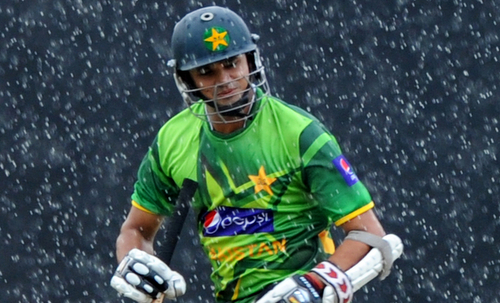
Pakistan batsman Azhar Ali runs as rain falls during the third one-day international (ODI) match between Sri Lanka and Pakistan at the R. Premadasa Stadium in Colombo on June 13, 2012. AFP PHOTO/Ishara S. KODIKARA        (Photo credit should read Ishara S.KODIKARA/AFP/GettyImages)
 AFP PHOTO/Ishara S. KODIKARA (Photo credit should read Ishara S.KODIKARA/AFP/GettyImages)

Azhar Ali – 226 v Bangladesh at Mirpur

Mohammad Hafeez’s Pakistani record against Bangladesh lasted a week. I had a hunch this man might get close when he rested overnight on 120-odd and so it proved. An old fashioned test batsman making a really high score to set his team on the right path. It’s time for some stats.

This is the 15th highest score in tests by a Pakistani batsman and the 39th test double century. It is Azhar’s first test double, as he passed his previous best score of 157 made against England and Sri Lanka in 2012. This is his 8th test ton, half of which have come against Sri Lanka. He took his average from 41 to over 44 in this innings, and also passed 3000 runs in test matches. His previous best against Bangladesh was the 83 he made in Khulna in the previous test.

I have done the Pakistan and Bangladesh stats to death already, so let’s look at the number 226. Have you seen one, Dmitri? Given there have been just 8 scores of 226 in test history, the answer is likely to be no, and so it is. There have been recent 226s in this country – Kevin Pietersen made one against the West Indies at Headingley back in 2007, while Jonathan Trott also made this score against Bangladesh at Lord’s in 2010. Azhar’s is the second in Bangladesh – Neil McKenzie made 226 at Chittagong in his record stand with Graeme Smith back in 2008. Bridgetown has seen two scores of 226, and both by Barbadians – Sir Garfield Sobers made one in 1960 v England, while Gordon Greenidge made his score against Australia in 1991 (when, if memory serves, they were thinking of dropping him for poor form). Brian Lara is the third West Indian to make 226, completing his effort in Adelaide against Australia (of course), while our history slot looks at the first 226, made in 1931 by someone who specialised in large innings.

The first score of 226 was made by Don Bradman, and it wasn’t his usual foe (England) he made it against. This was made at Brisbane against South Africa, and his individual score was higher than both South African innings in this game (170 and 117). Bradman made 200 on the first day, and Australia made 450 in the first innings, but this test still managed to go SIX days (yeah, yeah, two of them were rained off) in a timeless match. Interesting that South Africa had a Morkel in their team….

226 is the 136th= highest score in test cricket. Still the holy grail of 229 has not been scored in the history of tests (it must go soon, surely….). 228 still has been scored just the once (Herschelle Gibbs), while 227 has three instances, 225 has three, 224 has six, 223 has nine, 222 has five, 221 has five and 220 has three. Must be something about 223 and 226!

Azhar Ali’s 100 came up in 212 balls with 10×4, and his 200 came up in 406 balls with 19×4 and 1×6. His total innings lasted 428 balls with 20×4 and 2×6.

Lament

Well, good morning/afternoon all. It has been an interesting one to wake up to, I have to tell you. I’ll leave “proper” politics because there’s a ton more places to look for it than on here, and it divides rather than unites which is never good in my book. So let’s talk about the sort of politics we all love to indulge in and that’s from the good old ECB.

I think you all remember the aftermath of the Ashes debacle when in the infamous February press release, the most heinous crime anyone could perpetrate in the English cricket firmament was to breach the sanctity of the dressing room. There were certain journalists who were said to be “anal about leaks” but that didn’t stop them talking out of that orifice on a daily basis. The people on this board, out there in the world aren’t stupid, and they know these stories don’t just appear out of thin air. These journalists have contacts, have their way to read the runes, because if they didn’t, they wouldn’t be doing their jobs. I’m not sure it is, as John Etheridge I believe once said “more good journalism than leaks”, but it’s something that annoys us all.

So we can’t be all up in arms because the news leaked regularly about Kevin Pietersen and not be when it affected Cook (in December when his sacking from the ODI captaincy got out) and now seems to be for Moores. I know the journalistic corps will accuse me of naivety and all that, and that this is how the world works, but it doesn’t make it right. I’m going out on a limb here and say that although I didn’t support the appointment of Peter Moores (reeked of a pre-ordained Flower-inspired stitch up) and don’t particularly rate him as an international coach (this progress we are making seems rather ephemeral to me – as Grenada / Barbados seems to indicate) he comes across as a very decent man trying his best, and the one thing that those people deserve above all else is to be treated with the same decency. If this is proved, and I note Lawrence Booth for one is saying this didn’t necessarily come from the ECB, to be from high-placed official sources then more shame on them. This is not the way a new and improved organisation does business, and if it is one of the exiting old guard doing it, well….. you know what you should do about that.

The responsibility for a leak goes to the source of the information. So if the ECB told someone in confidence that the decision had been made, and then this gets out, it’s the ECB’s fault for trusting that confidence. The fact is that if this is the case here, and that’s the message coming out here, there’s always the convenient “plausible deniability” on behalf of this organisation which seems to make key decisions ahead of appointees taking up their roles. Indeed, Strauss hasn’t even been officially announced yet, and he’s supposed to be the one either doing the sacking or rubber-stamping it.

I see one of the commenters BTL on the Guardian is going on about us conspiracy theorists again. I’m glad these people are so trusting of those in authority to think that way and just let those running the game to do as they please, no questions asked. Trust those inside the game. But from the outside there seems to be a bit of a power struggle within the ECB and I have no idea how it is going to pan out. The deserved sacking of Downton, a man who should never have been appointed, seems more and more like a piece of meat thrown to us “slobbering hordes”.  We then replace his role with something not yet defined, and when they found out that not many people were interested in a Downton-lite role, the new revolution stumbled across an old pillar to effect whatever it is Harrison and Graves think is needed, which at this stage, we don’t have a clue about. Memo to all here, I’m not buying what Harrison is selling, not at all. Now to appease the hordes again, we are going to fire a coach AFTER a series where we could have looked at new players, but the coach and captain were too keen to bolster positions and didn’t try much. This isn’t a new bold strategy, but something else too familiar. Clueless, aimless and now heartless. The absence of a decent media strategy, treating people in their employment with dignity and class, and allowing things to just get out there, however they get there, isn’t great. It really isn’t.

Lawrence Booth, Jonathan Agnew and Ali Martin can all put their side of the story any time they like – they are more than welcome to here, but I would not expect that. How this news got out there matters to people. It speaks of an organisation seeking to regain our trust, to re-engage with us, to make us proud of the England cricket team again and to bridge the divide. This is not what is happening. The divisions aren’t now a simple chasm down the middle framed by a decision to sack Pietersen. They are becoming fractures, along familiar fault lines, but fractures nonetheless. Those that were original members of the outside cricket club see more of the same. Those who were more attuned to the ECB way of thinking see appeasement of the great unwashed. Those of a more sceptical bent than the ECB line to takers see increasing incompetence and doubt creeps in, like rot in a wooden building. The Cook fans see devilment in every utterance on the doubts in his form. The KP fans see an ECB talking out of both sides of its mouth. The ECB are further away than ever from gaining public trust. Their ultimate test was to keep their traps shut and do this the right way. They haven’t. It’s a bloody PR disaster.

Just one thought, that could negate much of this, but not all. The only explanation that gets the ECB partially off the hook is that the leak came from Peter Moores himself, or someone close to him. In which case we can make our own judgements on him. That said, it would seem a little out of character, wouldn’t it?

Ireland v England – ONLY One Day International

A forlorn, over-tired Dmitri will not be up in time for the start of this game, as at 6:30 UK time, I’ve not gone to bed yet. It’s 1:30 in New Jersey, and I’m not a happy camper, but this isn’t a politics blog and I am friends with people of many political persuasions, not many of my own!

So to this game between an insulting scratch England squad and a keen and enthused Irish team. If anyone feels inclined to comment on this game, please do so. I’ll probably be asleep for half of it.

Thanks for the comments on the press people. You know, if they read it, people like Ed Smith, they may see why some get a barrage of comments on their posts. It might be of benefit to think about how they come across. I tried to call a truce a while back, a bit silly of me, open to discuss with some people, but now they don’t even seem to try, and I guess they feel the need to interact with the great unwashed is less.

That’s fine by me. I’m at least happy in this pursuit. Good night.

Election

Well, I’m over here, and most of you are over there, so let me just set down a quick message. In the next few days, please try to avoid political talk on here. We all have our own views, and once the votes are cast tomorrow, that’s that for us as the electorate. I like you all on here without us getting into tedious political debates that divide more than unite. Yes, it’s the “can’t we all get along” speech. I’m out for most of tomorrow, to visit the home of the Lakewood Blue Claws for their crunch Single A clash against the Augusta Greenjackets. Before that, I might be going to a location of an (in)famous TV show. So on your best behaviour and all that….

Right, with that over with, I’ve got some work to do. I’ve begun the (in)famous Journalist rankings piece, and thought I’d seek your input. You get to nominate one of the following for the top prize – Selfey, Newman, Pringle, Brenkley for the top prize – but also I’d like two or three others that you think merit consideration for the top 10. The focus should be on this calendar year, and on something or other that really got to you. We are talking quality over quantity. You can nominate anyone, as long as they write regularly and the main reason for putting them forward is their written work (spoken words can be taken into consideration). Less weight should be given for those employed as recently retired internationals.

At the end of the day I have my own views, but your’s will be taken into account, and the votes actually count when we repeat the exercise for the awards at the end of the season. Particular articles that really riled should be put forward. You also know that if last year is anything to go by, some of the nominees read the piece. I know, because Jarrod Kimber told me. So fill up those comments and help me write the piece.

2015 Test Century Watch #20 – Younis Khan

Younus-Khan_1500837cYounis Khan – 148 v Bangladesh at Mirpur

Ah, the old warrior, fresh from missing out in the runfest at Khulna, has cashed in today with a 148 in the second test. This was his 29th test hundred, made in his 98th test match, and he continues an exemplary conversion rate which means when he reaches 50, he makes it to 100 every other time. This is his 12th highest test century, not even half way to his career best of 313 against Sri Lanka in 2009 in Karachi.

This is Younis’s third test ton against Bangladesh, with the other two both coming in Chittagong, where he made 200* in 2011, and 119 as long ago as 2002. His previous best at Mirpur was 49. This was the 18th test century made by Pakistan against Bangladesh (number 19 followed three overs later) and Younus joins Mohammad Hafeez as the only Pakistanis to make three test hundreds against them.

Let’s do 148, and ask the question. Have you ever seen a test 148, Dmitri? Ah, funny you should say that but…no. I thought that might have been the score of one of Ponting’s tons in Adelaide, but it isn’t. This was the 31st test 148, and some that my readers may remember include:

  • Rahul Dravid at Headingley in his 2002 “we don’t seem to be able to get this chap out” tour.
  • Alastair Cook’s 148 at Adelaide in his tour for the ages in 2010/11, where he followed up his 235* with this knock. Those were the days.
  • One for Arron, Robin Smith’s 148* at Lord’s in 1991 when he marshalled the tail superbly and made a magnificent hundred.
  • Tim Robinson’s 148 in 1985, allied with David Gower’s 215, was a joy to watch one glorious Saturday afternoon. Have that on video somewhere…

However, as I always try to do, I want to pick out the old or the obscure, and the first 148 was made back in 1884. It’s almost astonishing that another man was not dismissed on this score for 87 years after that (MAK Pataudi), but back in the day Allan Steel made 148 at Lord’s in 1884 to help England to an innings victory over the Australians. I liked this description of him from Cricinfo:

Though not a regular captain of county or country, he had an improbable run of success as skipper: Marlborough over Rugby, Cambridge over Oxford, Gentlemen over Players, Lancashire over Yorkshire and England over Australia.

Bet he’s on Metatone’s Mafia hitlist (well, he’d been dead over a century, so that’s probably pointless). Anyway, the almanack entry gives you the facts of the first test 148.

Les Ames made an unbeaten 148 against South Africa at The Oval in 1930, and Kenny Barrington an unbeaten 148 against the same opposition at Kingsmead, Durban in the period intervening Steel and Pataudi. Tony Greig made two scores of 148 in 13 months – once in India at the Brabourne, Mumbai, and once in Bridgetown. Greig and Dravid have been dismissed twice for 148, while Barrington and Tendulkar have a dismissal and a not out to their name of that score.

This is the second 148 of the year. The first being made by AB DeVilliers against the West Indies in Cape Town. That century watch can be found here

This was the 26th test hundred made at Mirpur. At time of writing, given Azhar Ali is not out overnight, Younis ranks in 6th place, has the highest score for Pakistan (beating Taufeeq Umar’s 130) and was the second Pakistani to make a hundred at this venue (again, obviously, Taufeeq being the first). The ground record is held by Shivnarine Chanderpaul and Mahela Jayawardena who both made unbeaten 203s.

Younis Khan’s century came up in 142 balls and contained 9 x 4 and a six.

Coronation

So it’s Strauss.

There seems little doubt that the man who appeared nailed on to be a blazer at the ECB post retirement is indeed going to be a blazer at the ECB.  That people are sceptical about this is hardly a surprise, if you were to pick an Inside Cricket candidate, it could only be Strauss whose name would come up.  The line from the media is that he should be given a chance to address the doubts, and that’s a fair line as far as it goes, but it doesn’t acknowledge a fundamental point – that the ECB have broken any level of trust with the supporters that they once had, and don’t deserve it either.   It is possible Strauss will surprise us, and to that extent a degree of patience is warranted but only a degree.

The ECB have never addressed the relationship with those who provide the money for them.  The “Outside Cricket” jibe festers for good reason.  It’s never been apologised for and fundamentally there are only two options – that the ECB don’t realise the damage it caused, or that they don’t care.  Neither is exactly to their credit.

It’s always a matter of conjecture how representative those who Tweet or comment in the newspapers or on blogs are of cricket supporters, but Ed Smith’s preposterous argument that because those who do are only a small minority, that is evidence that it’s an unrepresentative minority is nothing but an example of confirmation bias at its worst.  For a man who basks in a reputation of high intelligence, it’s a remarkably stupid argument to attempt to make.  The truth is that all the indications are the dissatisfaction and indeed contempt for the ECB is widespread.  Proof is impossible to come by, but evidence is still evidence.  If Smith wants to try and reject that, he needs to demonstrate that there is support for how the ECB conduct themselves.  Claiming the support of the silent majority on the grounds that they are silent is desperate.

Of course, what the usual line of dismissal focuses on is Kevin Pietersen.  It is a classic example of a straw man argument, as I’ve said on so many occasions, Pietersen is a symptom not a cause.  And this is where the question of how Strauss will handle the matter becomes critical.  It will without doubt be the first or second question that is put to him, meaning that within seconds of his getting the job, the disaster of the ECB’s own making will once again be front and centre.  Strauss is hardly in a good position already, having notoriously been abusive on air about him.  His response to that question is going to be what creates the headlines, however he addresses it, that much is in no doubt.  Some of the press reports are suggesting that the line will be that a return will cause too much disruption, and this remains ludicrous.  Of course it would cause disruption to the cosy little world the ECB live in – whose fault is that?  It is because of the incompetent, ham-fisted, unprecedented decision to sack a player that it is still an open sore.  The continuing refusal to acknowledge that it is the bed they made for themselves is precisely the problem – and precisely the reason for the scepticism about Strauss himself.

Should England have a bad summer, as seems distinctly possible, this will become even more acute an issue, so long as Pietersen scores runs.  The only way of responding that will give Strauss credibility is a simple statement that all players who merit a place will be considered for selection.  Stick to that line, and don’t move off it, for that is the only one that won’t involve the potential for having to make a U turn.  And here’s the rub, how on earth can it be controversial to consider selecting your best players?  If he’s not one of them it doesn’t matter – the only reason they tangle themselves is knots about it is because of a fear deep down that he might be.

Let us cast this forward – if indeed England play badly, and Pietersen scores runs, then a failure to state all players are available for selection is simply going to be unsustainable.  Players who aren’t in the team always improve in status anyway, for such a famous one to be ignored is going to be constantly questioned.  Do they really believe that will be less disruptive than the alternative?

Yet again it ends up coming back to Pietersen.  The irony is that this is frustrating whatever side of the debate one is on.  The previous regime are actually correct in that it shouldn’t be.  Everyone would like to move on.  Including those awful people who buy tickets.  Strauss’s hardest problem is finding a means to do it, and for his own benefit that means being open to his selection, should it be merited.  Any other decision will quite simply undermine his credibility from the outset.

And what of captain and coach?  It’s been noted that Straussy and Cooky are close, and that’s another problem.  Not in itself, there’s clearly nothing wrong at all with people being friends, but the captain is himself in considerable trouble.  Will Strauss be clear sighted enough to see that and take action when needed?  There have to be doubts.  It is not the job of a Director of Cricket to prop up his mate, nor to refuse to see reality.  Strauss’s commentary has hardly been overcritical of his captaincy to date.  Does he really believe Cook is the best captain England could have?  For it really is as simple as that.

For all the debate about Peter Moores as coach, there is doubt he would go as far as to sack him.  Moores may well be out of his depth, but Strauss’s own likely appointment is because of the conservative nature of the ECB, that conservatism is no different when it comes to the choice of coach.  Whatever Moores’ failings, he’s exactly the kind of man the ECB will want to see at the helm.  That limits things to Peter Moores type coaches in the first place, and Moores is probably a good example of that kind of coach.

Fifteen years ago England chose Nasser Hussain as their captain.  Hussain was abrasive, incredibly unpopular on the county circuit, difficult, opinionated and hard to handle.  It is impossible to imagine the current ECB ever appointing such a person.  It is equally impossible to imagine the ECB appointing someone like Darren Lehmann.  That doesn’t mean that Lehmann would be the correct choice, it means that the ECB limit their choices from the outset.  Which is why we end up with an Andrew Strauss.  Safe, comfortable and quite probably the right kind of chap with the right kind of family.  So much of the dismay about his likely engagement is less about Strauss himself and more about what it represents.  A refusal to admit that they might have got things wrong before, and a refusal to admit that they might need to change.  It is unsurprising in any way.

Assembly

The aftermath of the tour continues and eyes turn towards the futures of the top table. Those eyes are cast more in the direction of the coach, Peter Moores, and when you read some of the stuff coming out, it’s no surprise.

Moores has to carry a number of burdens, partly of his own making, and partly a little unfair. I have not been inside a dressing room at professional level, but even at club level, you know when people don’t think you are credible, don’t listen to what you do, don’t care about your future. It’s not fair that Moores never played international cricket, and that will always count against him when it comes to motivating and coaching great international players. However, he has been on the county treadmill and knows it inside out, and will be a great county coach again when this ends. He commands respect of the county pros, but maybe lacks a little at the top level with the senior pros. Maybe. It’s guess work, but I’ve seen enough football managers lose that respect, and I can recognise some of the problems. At this stage, with a young core of players, Moores can bring them along, as long as he retains the support of the key senior pros. These being Cook, Bell, Broad and Anderson, and to a lesser degree, the next in line, Joe Root. All have played every game under Moores, and there is no hint of this changing any time soon.

The second cross he has to bear is that he lacks credibility among much of the watching public. James Morgan on TFT makes the analogy perfectly – would the England national team go back to Steve McClaren, or would the rugby team go back to Andy Robinson. Both were assistants under more successful coaches who never bridged the credibility gap with the public, probably unfairly. Moores, like it or not, comes across as a nice guy out of his depth at this level. I’m not, like some, going to assign some malevolent motive to his tenure on his behalf. He’s been thrown a hell of a challenge after the Ashes 2013-14, made even harder by the idiotic jettisoning of Kevin Pietersen (not for his absence from the team, but because of the messages it sent) and he has developed some of the younger players (although not greatly, not really). The sense remains though, as the World Cup campaign showed, that Moores is not up to key elements of the job. He will present a case, but the evidence is not backing it up. Combine an abject disaster in the World Cup with a home loss to Sri Lanka in all formats, and coughing up a 1-0 lead in the Caribbean, and there is not a lot to say “keep me on” other than some sort of hope for a change of fortune. My football team did that this season, and by the time we sacked our manager it was too late to save them, despite the best efforts of a new manager who did really well.

Which brings us to the third problem, and this one was partly of his own making, but more of that champion of champions Paul Downton. Peter Moores applied for a job and got it and accepted terms no manager/coach should ever do. That is, be told who he could not have in his team under any circumstances. You anti-KP fans keep making it about him if you want, but the message this sends to any player is profound. Be independently minded, have a strong opinion about your game, and how you want your career to pan out, and that could happen to you. It wasn’t a good start. Then, to have your appointment accompanied by the “greatest coach of his generation” comment by Downton was just amazing. Moores would have been completely at liberty to tell the MD to shut his hole, because that was going to stick. If he could not put before the public a set of results to live up to that billing, he was going to be ridiculed. So it has proved.

The final problem for Moores is his inability to speak, or appear to speak, in anything other than management tones. He sounds like a first year MBA student more than a cricket coach. Sport is about maximising the analytical tools to hand (I’m reading a fascinating book on baseball analysis at the moment) but it is also about unquantifiable exploits. You don’t find Jimmy Anderson’s fifth day morning session in any text book. You have that seize the day approach, the raising of the game to higher planes which can’t be factored in. If they were, sport would be bloody dull and we’d all not bother to watch it. But it’s too much process this, learning lessons that.

I’ll tell you another thing that doesn’t help, and it’s a warm welcome to a Paul Newman quote on here after at least a couple of weeks absence, is nonsense like this:

To watch England here has been to see a highly promising group who respect their coach and want to succeed for him and I believe Moores should be given that crack at the Ashes denied him in 2009 by another Kevin Pietersen-inspired controversy.

Just read that and weep. No player is going to come out in the open and say Moores shouldn’t be coach. KP did that and got fired as captain. KP said that about Flower and was booted out for it. There’s not a lot of longevity in showing you aren’t playing for the coach. I’d say we need to win more games to show how well we are playing for Moores, instead of going overboard over one win in Grenada. But Newman doesn’t let it go with his bete noire, who he is now getting all tin foil hat over. KP has the square root of eff all to do with Moores staying on as coach. Pietersen has not scored the runs required of him by Graves et al for starters. Second, KP is not responsible for Moores performance in the job thus far, so is a total utter irrelevance about whether Moores should stay in the job. Third, we’ve been down this long service award drivel before (he deserves a crack at the Ashes – if he deserved it in 2009, he’d have made an unanswerable case instead of losing home series in 2007 and 2008) and that worked in the World Cup. Also, Newman’s changed his tune. He was really down on Moores after the World Cup. Maybe Cook’s told him to lay off or something.

I feel a bit for Moores, to be honest. I actually think he’s a really decent man giving it his all, but he doesn’t really stand a chance. It may be, like before, he’s laying down the foundations for someone else, but also there’s the suspicion that this is as far as he can go. While it is hard to ignore the fact he took the job on compromised terms, he has not been the hate figure some portray him to be. He’s more a figure of sympathy, and in international sport, that is often much, much worse. If this best case you can make to keep him on is he deserves his go at the Ashes because he got sacked before, then you are not making a convincing case.

I thought I’d concentrate more on Moores in this piece, but do a brief bit on Cook and Strauss before longer thought pieces.

Cook has been the subject of a vicious attack by Boycott in the Telegraph. I wonder how Cook will approach Jonathan Agnew about that. Cook doesn’t take kindly to being spoken about like that and the consequences could be interesting. Boycott is a loudmouth, paid to express loud opinions, and you take them as they come. But I’ve never seen him this aggravated by a captain / player ever. This was going for the throat. I would say that it’s not as easy to dismiss Boycott’s views that align with a lot of us outside cricket, than it is for them to slate me, but they try (he’s a wife beater, he quit on England, blah blah – he also faced top quicks at 90 mph without a helmet on). A lot of us believe Cook isn’t the nice guy that his image is portrayed as, but I want to get away from that part. I want to look at the evidence – it’s all I try to do, and try to interpret. He’s protected, for now, and could jettison Moores to keep his career in check. It will be interesting to see how this plays out.

As for Strauss…. appointing him the new Director of Cricket would be Downtonian in its brilliance. He talks the language of all charlatans – promising to build for a non-specific future, while using this to move on from something else that he doesn’t like (in this case a player who might return to form and demand selection). He also has the cult of Cook in his playbook, and would be an establishment, company candidate when root and branch change to a more exciting, attractive style of play is going to be needed. This current England team still has dedicated fans and lovers of the game actively wanting them, or key members of them, to fail to get the changes needed in structure, attitude and approach. Bringing back Mr Bowling Dry, with his foster son as captain and his foster dad wheeling away behind the scenes, is spitting in the face of those who actively want to love this side again. Strauss is typical ECB. Unexciting, not credible and the wrong man. More of this later.

2015 Test Century Watch #19 – Alastair Cook

o-ALASTAIR-COOK-facebook

Alastair Cook – 105 v West Indies at Bridgetown, Barbados

And so it came to pass on the first day of the fifth month of the year two thousand and three fives since the birth of our lord, that Saint Alastair of Cook made his 26th test century. And there was great rejoicing among the corps de press, and amongst former disciples and pharisees, who announced from the highest heights that the lord and saviour was “back to his best” and doth bellowed from their pulpits that the Saint had “rammed the critics’ words back down your throats” and “be quiet muppets”.

Alastair Cook’s 26th test hundred came nearly two years after his previous one. In that time he immortalised the number 95, and went the number of innings not making a century from the opener slot that was inhabited by people like Mike Brearley. I could make this a whole piece on the nonsense between hundreds, but let’s try to keep this true to form.

Only one of Cook’s tons has been less than 105 – his unbeaten first century on debut v India at Nagpur where he made 104 not out. This was his second century at Kensington Oval, where he made 139 not out in the first innings back in 2009, and it remains his only venue in the Caribbean where he has made a test hundred. This is his fourth century against West Indies, and as we’ll see later, he’s not exactly gone on from the three figure score in those innings. This is his first test century in the first innings of a test match (first overall, not England’s first innings) since his 115 in 2012 v South Africa.

Have you seen a 105 Dmitri? Well, funny you should ask, but I saw a large part of a 105 made by Alastair Cook, when he made that score v Pakistan at Lord’s in 2006. I have seen two others at The Oval – the first by Chris Gayle in 2004, in an innings that drove Michael Holding mad I seem to recall, and the other by Justin Langer in 2005, when the Aussies started getting us all worried with that opening partnership. There have been 92 scores of 105 in test cricket. Alastair Cook and Jacques Kallis are the only two players to have been dismissed three times on that score. Ricky Ponting and Kumar Sangakkara have also made the score three times, but both have a not out to their name.

In our vintage slot, we go back to the first 105 made in tests, and that took place a mere 130 years ago (any jokes about it seeming like that between Cook’s last two hundreds is your gag, not mine). His name was Arthur Shrewsbury Sr, and he made his unbeaten 105 at the MCG. The home team had been dismissed for 163, and it reached that due to the Demon Spofforth making 50 from number 11. In England’s reply of 386, made over a very sedate 221 overs, Shrewsbury came in at 97 for 3 and batted for over 5 hours in making his score. Must have got a wiggle on with that over rate. England went on to seal an innings victory, bowling out Australia for 125 in a mere 102 overs. Paul Collingwood….beat that. The match report is worth reading.

The first 105 in the West Indies was by Les Ames in 1930 at Port of Spain. Doug McGlew’s 105 against Australia in 1958 held the record for the slowest ever test hundred until Mudassar Nazar beat him twenty or so years later. Just the nine hours and five minutes in getting to three figures. Fifty of these 105s have been scored since 1992, although it has been over a year since the last one – Virat Kohli made 105 against New Zealand at Wellington last year (after McCullum’s triple). Sherwin Campbell made the last 105 at Bridgetown, in the famous 1999 test against Australia (think Brian Lara).

This was England’s 17th test century in Bridgetown. Alastair Cook nestles in at #15. The record score for an England player is, surprisingly, 154 by Mark Ramprakash in 1998. Only one other player has passed 150 there for England, and it’s that man Andrew Sandham again, who made 152 in 1930. Alastair Cook joins Alec Stewart (two in one match) and Graham Thorpe as the only England players to make two centuries in Barbados.

Going back to Sandham, that 152 was made in the first innings of the first test. After a lean run in tests 2 and 3, Sandham made 325 and 50 in a timeless 4th test and never played for England again.

Imagine that, Alastair.

Alastair Cook’s 100 came up in 259 balls and contained 10 x 4.

Washing up

And so the dust begins to settle.

Let’s get something clear here, before the start of the Test series, an England win was expected by everyone.  No one in the media said that the West Indies were an improving side, no one in the press said that there were grounds for concern.  England might be a “developing” (a delightful euphemism for “not very good”) team, but the result of the series would be that England would win it. And they haven’t.

And here come the excuses.  Colin Graves was at fault for motivating the West Indies by calling them mediocre apparently.  Let’s just look at that for a moment.  Say that what he said did motivate them, did do their team talk for them.  Are we really saying that a few words from the chairman of the ECB, a man most of the West Indies team have probably never heard of, made the difference?  Firstly, that’s incredibly insulting to the West Indies team, it implies that without such words they would have rolled over to defeat.  It also says that England could only win if they were scrupulously polite about the opposition.  How fragile must this England team be?  How shallow must the West Indies be?

It’s a nonsensical line of argument, particularly so when Alastair Cook talked only a few days ago of how the West Indies would crack under pressure.  If anything were to motivate the opposition, those words would have done it – but to suggest they did is still silly, for all the reasons above.  The series was drawn because of what happened on the field, not what was said off it, especially when both instances are pretty mild.

As it happens, Graves shouldn’t have said what he did – but not because of what happened in the series, simply because it was impolite.  But people who are outspoken sometimes say things, weirdly enough.  That four paragraphs have been written about something so supremely irrelevant is a reflection of how some have grasped at straws.  Let’s move on.

It is genuinely pleasing to see some signs of life in West Indies cricket.  The wider picture is important, and they do seem to have found some young players who have a bit about them.  Jermaine Blackwood had a terrific series, averaging a shade under 80.  There’s little question that his innings first time around in  Bridgetown  went a long way towards the eventual result; his team were dead and buried without him, and he kept them in the game.  Jason Holder equally looks a good prospect, while Darren Bravo played with a discipline yesterday that’s been lacking in much of his career.  In all cases it’s up to them to ensure it’s not just a one off, but something to build on.  It’s hard to see this side seriously troubling Australia in a month, but nor should they be expected to.  It’s at the bottom of a very long and winding hill – there’s a heartbeat, that’s enough for now.

As an aside, what a sad cricketing irony it was to see Shiv Chanderpaul look like he’s reached the end.  A player who almost single handedly kept them alive over a grim decade, but whose age catches up just as there seems to be some hope.  No one ever said life was fair.

England lost this game in their batting.  First innings wasn’t good enough; the pitch was at its best, and scoring under 300 was abject.  Cook held the innings together, with an innings that was obdurate and stubborn, and he certainly deserves credit for that.  His dismissal at the close of day one was likely a loss of concentration.  It’s not that surprising shortly after a hundred he so desperately wanted and needed, and blaming the bloke who got the hundred for getting out misses the point as much as it always did.

Yet Cook’s hundred was not evidence of him being back and it’s wishful thinking on the part of those who worship at the altar of the blessed Alastair to assume it is.  His technique remains flawed and there are serious concerns about how he will shape up against a better attack this summer and next winter.  He deserves immense credit for getting it, because even the longest journey begins with a single step, but that’s as far as it goes.

Bell had a poor Test, and not a great series.  Indeed, he’s struggled since his Ashes mirabilis in 2013.  He clearly deserves the patience his record warrants, but it is concerning as we go into the summer that he seems so adrift from where he could be, especially so given that he doesn’t appear out of form.

We are probably saying goodbye to Jonathan Trott.  There’s an extensive piece elsewhere, so there’s no point going over that again. His near tearful reaction at the end of the match suggested he knows it too.  There’s no shame in attempting to come back, and no shame in not succeeding. He’s been a fine servant for England.

England’s second innings of 123 showcased all the problems that have been evident for some years, especially the way that they freeze when put under pressure.  The irony of Cook’s comments about the West Indies cracking under such pressure is evident, and this is nothing new.  The tour to New Zealand two years ago had a few instances of England becoming strokeless and terrified of defeat.  For all the talk about England playing fearless cricket, they do the opposite.  Only Stokes and Buttler tried to reverse the position, and Stokes then received criticism for the way he got out.  That’s just not good enough.  When a player tries to change the momentum they are taking risks to do so – sometimes it doesn’t come off.  The reality is that it still has to be attempted.  That England got as many as 123 is down to him, and then Buttler.

Buttler was again left high and dry.  At number eight in the order that’s clearly going to be a risk, but given the side England selected, should he be any higher in the order?  Probably not.  The issue is that England’s lower order fold even when there is a batsman to play for.  Jordan was a bit unlucky, and Anderson fought.  Broad’s batting is simply not good enough for someone of his ability.  There were signs in the first innings of the smallest smidgen of progress – he stayed in line at the point of delivery (he stayed legside of the ball, true) which is more than he’s being doing recently.  But he’s in pieces still.

Root and Ballance both had good tours, one of the most striking features of the second innings shambles was how England fell apart when those two failed with the bat.  Like always, we cannot rely on players having unsustainable runs of form to bail us out of a hole.  At some point, they won’t manage it.  Still, in the wider context, those two have been a success.

Moeen Ali had a curious time of it.  His bowling wasn’t great, but compared to what?  His first class record hardly suggests he is a world class spinner, but he is a hard worker and improving.  Bringing him in after an injury and with little bowling behind him was a gamble, and one that didn’t work.  He batted well in the first innings before Cook ran him out, but he needs to deliver more than he is.  He’s flattering to deceive and becoming a bit of a frustration.  He clearly has talent and desire, even if the blame game is trying to highlight him.

Buttler himself did well throughout the series.  His keeping was good, and he’s still inexperienced in that discipline.  His missed stumping yesterday cannot and should not be used as an excuse (another one).  Keepers do make mistakes.  The specific missed stumping is one of those that commentators and journalists who have never done it talk about as being easy.  It is an abiding frustration that those who know nothing about keeping are so keen to dispense their lack of knowledge.  When the ball goes between bat and pad, there is a tendency not to follow the line of the ball, but the expected path of the shot.  It’s a bad miss because every keeper who has ever done it (and every keeper has) berates themselves for the error.  But it happens, and happens a fair bit.  A perfect example of the complete lack of understanding about wicketkeeping comes when a catch standing up to the stumps is described as good reactions.  It’s nonsense.  When standing up, the keeper isn’t even aware that there has been an edge until AFTER the ball is in the gloves or on the ground; the brain simply cannot process information that quickly.

None of which means that Buttler won’t be bitterly disappointed not to have taken the stumping, but some understanding is required here. He made very few mistakes behind the stumps this series, and for a young player making his way in Test cricket, that’s a good effort.  Wicketkeepers drop catches and they miss stumpings.  It was ever thus.

Chris Jordan is another who showed promise without ever fully justifying his inclusion.  His catching in the slips was genuinely astonishing, and he bowled some fine spells without seeing quite the rewards.  Like Ben Stokes, his wicket taking was below what would have been hoped for.

Broad with the ball seemed to be getting his mojo back.  He needs overs under his belt more than anything.

And then there’s Anderson.  The best compliment he can be paid is the frightening thought of him getting injured this summer.  Like with Root and Ballance, England cannot be so reliant on him going forward and hope to succeed.  He was overbowled in the last home Ashes due to desperation, and largely ineffective thereafter.  He’s a fine bowler, but he’s not invincible.

Peter Moores spoke after the game talking about how players had developed over the series.  Presumably he meant that Lyth, Wood and Rashid have become particularly expert on which bats to carry out to those playing, and what combination of drink they prefer.  In any tour, players are left out, and often become little more than a spare part, yet this was a missed opportunity.  If Rashid is not to be selected for pitches like Bridgetown or St Georges, when is he going to be selected?  Is it remotely likely that he will play in the Ashes or in May/June Tests against New Zealand?  England were on a tour against one of the weaker sides in world cricket, and chose not to introduce new players, but to stick with the tried and presumably trusted.  Perhaps the worst part of that is the fear about what a player can’t do, not what they can.  This is symptomatic of the problems in the England team, the negative considerations always outweighing the positive.

James Whitaker looks likely to pay the price for this tour, having been described (as was Moores) as a “dead man walking” at the outset.  Yet it wasn’t the selectors who ignored the fringe players on this tour, that was down to the captain and coach.  Whitaker has been something of a PR disaster in his role, but it would be somewhat cruel for him to ultimately be blamed for the reluctance of Team England to trust the selections he and his colleagues made.

Moores himself is now extremely vulnerable.  Both he and Cook specifically contradicted the words of the chairman, in the captain’s case by his effectively partially blaming Graves for the outcome, and in Moores’ by saying there was no need for an enquiry.  Repeatedly saying how it had been a “good tour” in defiance of the results simply adds to the impression of being removed from reality.  And yet there should be some sympathy for Moores.  A better and stronger captain would have made a significant difference, but he has helped in his own downfall by being front and centre in terms of what he wants.  England are the only team in the world where the coach has such a significant role in how the team actually plays, it is impossible to imagine Duncan Fletcher being interested in such a structure – which is perhaps exactly why Fletcher wanted captains like Hussain and Vaughan who knew their own minds.

And then there’s the captain himself.  It is curious how so many queue up to damn him with faint praise.  He did indeed do alright as captain this series.  Alright.  For Moores to talk about him learning in the role is preposterous, he’s now one of the longest serving captains England have ever had.  When will he learn to be England captain?  2019?  When he breaks Graeme Smith’s Test record perhaps?  Maybe then he’ll actually be “not bad”.  Highlighting that he’s done alright merely emphasises that he so often has been awful.

The least surprising, but most troubling news came in the shape of various articles indicating Strauss would get the DoC role.  Above all else, such an appointment would be a circling of the wagons and a reinforcement of the status quo.  As Vaughan said last night, sometimes you just have to accept it isn’t working.  Unless you’re the ECB.

England drew with the eighth ranked side in Test cricket, who in the last four years have beaten only New Zealand, Bangladesh and Zimbabwe.  Stop the excuses.